Your ShelfYour Projects

The Youth’s Instructor, Vol. 43, No. 10.

FRANCE DURING THE LAST HUNDRED YEARS

The Youth’s Instructor

Mar 7, 1895

S. D. A. Publishing Association · Battle Creek, Mich. · Mar 7, 1895

FRANCE DURING THE LAST HUNDRED YEARS.

THE FIRST REPUBLIC.
For more than a century there has not been a stable, permanent government in France, and really there does not seem to be one up to this day. With the outbreak of the French Revolution—June 20, 1789—that most bloody period of cruelty and inhumanity which ever stained a professedly civilized country, France gradually took on such freaks of development that regal rule was abolished Sept. 22, 1792, by a decree of the National Convention, a raw body of lawmakers, composed of seven hundred and forty-nine members, who declared the country a republic. Jan. 21, 1793, the head of King Louis XVI fell by the knife of the guillotine. Ever since that time—not to go back to the treacherous and satanic slaughter of the Huguenots, on St. Bartholomew’s night, Aug. 24, 1572, when in Paris two thousand and in the country twenty thousand, together at the very lowest calculation twenty-two thousand souls, composing the very best blood of France, were butchered like hogs—the people seemed to have lost all stability, and have evidently been unable for any length of time to settle upon any one form of government or dynasty, and to abide by that. After destroying all the representatives of royalty they could get into their clutches,—the queen, Marie Antoinette; Princess Elizabeth, the sister of the king; the crown prince; and many others of the nobility and the citizens, irrespective of age or sex, causing human blood to flow in streams under the very eyes of the people, for a series of months; namely, from January 1793 to July, 1794, not only from the guillotine but at the insatiable mouths of cannon and musketry, and drowning countless numbers more,—it would seem as if such atrocities could not be left unpunished by Heaven much longer.
As a matter of fact, the new republic thus created lasted till the year 1800, when General Bonaparte was made first consul, and ruled alone as such until he had himself proclaimed and crowned as emperor, Dec. 2, 1804. In the years from 1792 to 1815 the French, with little interruption, carried on a steady, aggressive warfare with all Europe, so that after the last signal defeat of Napoleon I on that memorable eighteenth of June, 1815, at Waterloo, the aged General Lafayette exclaimed mournfully: “For more than ten years three million Frenchmen had to die for one man [Napoleon I] who to-day still proposes to hold out against the whole of Europe!”
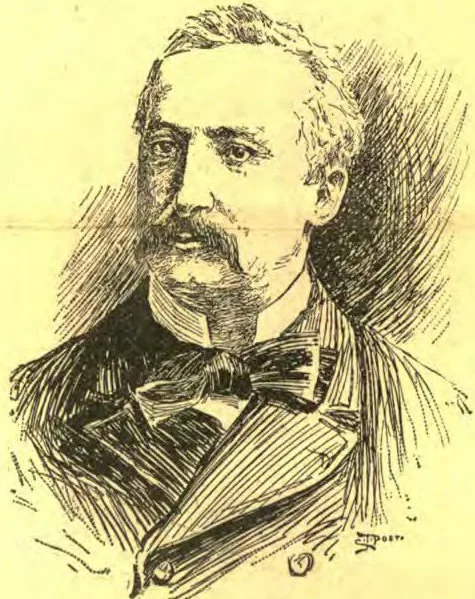
M. FELIX FAURE.
M. FELIX FAURE.

THE SECOND REPUBLIC.

After the downfall of Napoleon I, the Bourbons came to the throne of France again, and maintained themselves in power as “the kings of France and Navarre,” as the old Bourbon kings used to call themselves. But the July revolution of the year 1830 put an end to their rule, and brought the Orleans line to the front. August 7 of the same year Louis Philippe, Duke of Orleans, was proclaimed king of the French. But Feb. 24, 1848, he found himself compelled to abdicate and flee to England, for this was the beginning of the Second French Republic. Dec. 2, 1848, Louis Napoleon, son of Louis Bonaparte, the brother of Napoleon I, was chosen president of the government thus inaugurated; but he, by a stroke of state, before his term of office—four years—had yet expired, made himself sole ruler, Dec. 2, 1851. Exactly one year from this date he was proclaimed emperor of France, as Napoleon III. But he, too, was not to reach the end of his years as occupant of the throne he had thus created for himself.

THE THIRD REPUBLIC.

In 1870 he had so completely entangled himself that his only way out was a successful war against the Prussians and their confederates, who, since their victory over Austria in 1866, had become exceedingly formidable. His defeat in that disastrous undertaking, at the battle of Sedan, Sept. 2, 1870, is still fresh in the memory of even the most youthful student of the history of the last quarter of a century. The Napoleonic empire was crushed, never to rise again. After this came a provisional government of a few months—presided over by General Trochu, with Jules Favre as vice-president, Jules Ferry as secretary, and Gambetta as minister of the interior and later minister of war,—the last-named really exercising at times dictatorial powers in the government. It was he who, Sept. 4, 1870, proclaimed the Third Republic of France. Thiers, the historian, a former minister of Louis Philippe, was chosen president of this French republic on Feb. 17, 1871. But it was not till the bloody Commune of Paris, which began March 18 of the same year to repeat some of the atrocities of 1792, was put down (May 28), that Thiers could really enter upon his office, May 29, 1871. Only two years later, however, he found himself compelled to abdicate, in consequence of the shameful intrigues of the monarchists. Marshal Mc Mahon was then chosen president, May 25, 1873. Although he was voted presidential powers for a period of seven years, he could nevertheless not conform to the more and more unreasonable demands of the Republican leaders, and found himself gradually surrounded by such difficulties that he voluntarily withdrew from office, Jan. 30, 1879.
His successor, Francois Grevy, hitherto president of the Chamber of Deputies, saw himself disgraced by the criminal conduct of his brother-in-law, Wilson, who had committed forgeries and embezzlements on a grand scale. This compelled Grevy to resign in December, 1887. Hereupon Sadi Carnot, a grandson of the great minister of war of the First French Republic, who had so skilfully organized the National Assembly of those days, took the reins of government. He fell by the dagger of an Italian assassin, June 24, 1894. And the new president, Casimir-Perier, chosen but three days later, tendered his resignation Jan. 15, 1895. His reasons for so doing, as given in a manifesto, were that in his efforts to fill his office nobly, regardless of party preferences, as president of the entire French people, rather than of a mere party for party ends, he met nothing but ingratitude and base desertion from every party, thus showing that they were all corrupt. With astonishing rapidity the French National Assembly had already on the second day after, January 17, settled on the person of Felix Faure, up to that time minister of marine, as the new president of the republic.

THE PRESENT CHIEF EXECUTIVE OF FRANCE.

Felix Faure was born Jan. 30, 1841, in Paris, and had established a flourishing shipping trade at Havre, where he was chosen as president of the Chamber of Commerce. During the war of 1870–71 he was commander of a battalion of the “Garde Nationale Mobile,” of which troops he sent a party of volunteers to Paris to put down the Commune. In 1881 he was elected for the first time to the Chamber of Deputies, and November 14 of the same year, Gambetta appointed him under-secretary of state, in his newly created ministry of commerce and colonization. In January, 1882, he retired with the entire cabinet of Gambetta, but was called to the same post again by Jules Ferry, Sept. 24, 1885. The elections of Oct. 4, 1885, brought Faure into the Chamber of Deputies for the Department of Seine Inferieure, and in the first Cabinet Tirard he was once more made sub-secretary of state. From the second electoral district of Havre he was returned as deputy, Sept. 22, 1889, which office he filled up to the day of his promotion to the head of the nation. In the last legislative period he was vice-president of the Chamber of Deputies, and in the last Ministry Dupuy he held the marine budget. In this cabinet he was still active because of the presidential crisis, even though it had tendered its demise before the resignation of Casimir-Perier.
Time alone can tell how long this state of things will last, though judging from the past we need not wait very long for another change to take place. A. K.

THE SEVEN WONDERS OF THE WORLD.

NO. 4.—STATUE OF THE OLYMPIAN ZEUS.

There is an innate tendency in man, even when enshrouded in the darkness of heathenism, to worship and pay homage to a being higher than himself. After he has drifted away from God, and lost all definite knowledge of his Creator, he has not ceased to reverence a higher power, an imaginary being, an “unknown god.” To mythological deities have been reared costly temples, colossal statues, and imposing shrines.
Thus did the Grecian world while wrapt in the mantle of idolatry. As a nation, the Greeks had numerous deities, each of which was entitled to some degree of reverence. There were twelve chief gods and goddesses, and it was supposed that upon the lofty summit of Mt. Olympus, nine thousand seven hundred and fifty-four feet above the level of the sea, where snow was visible about nine months in the year, these guardians of earth and sky had their mysterious abode. As Homer expresses it,—
“The gods in peace their golden mansions fill, Ranged in bright order on Olympian hill.”
Zeus and his wife Hera, of the Greeks, were the same as Jupiter and Juno of the Romans. Zeus was the great king of the gods, and Hera was considered as the queen of heaven. Zeus gathered the clouds and held the thunderbolts. He was the father of gods and men, and it was he who punished wickedness and rewarded virtue. The Grecians believed that Zeus was all-powerful. It was not too much to ascribe to him the sentiment,—
“If I but stretch this hand, I heave the gods, the ocean, and the land; I fix the chain to great Olympus’ height, And the vast world hangs trembling in my sight.”
At Olympia a festival was held in honor of Zeus every fifth year. “As a national sanctuary of the Greeks, Olympia contained within a small space many of the choicest treasures of Grecian art, belonging to all periods and states; such as temples, monuments, theaters, and multitudes of images, statues, and votive offerings of brass and marble. In the time of the elder Pliny, there stood here about three thousand statues.” Here was a magnificent temple dedicated to the king of the gods. It was two hundred and thirty feet long, and ninety-five feet broad, and was of Doric architecture. It was designed in the sixth century before the Christian era, but more than one hundred years elapsed before its completion. It contained many fine statues and exquisite paintings.
The renowned Phidias, an Athenian by birth, and perhaps the greatest sculptor the world has ever known, gave to the temple of Zeus, about 433 B. C., its master touch of art. It was he who made the colossal brazen statue of Minerva, which adorned the citadel of Athens. He, too, made the famous statue of Athene, which was clothed in a golden robe worth forty-four talents of gold. But it was also his to execute even a more marvelous piece of workmanship, the colossal statue of the Olympian Zeus, which was destined to be known through the ages as one of the seven wonders of the ancient world.
“The idea which he essayed to embody in this work was that of the supreme deity of the Hellenic [Grecian] nation, enthroned as a conqueror, in perfect majesty and repose, and ruling with a nod the subject world. The statue was about forty feet high, on a pedestal of twelve feet. The throne was of cedar wood, adorned with gold, ivory, ebony, precious stones, and colors. The god held in his right hand an ivory and gold statue of Victory, and in his left a scepter ornamented with all sorts of metals, and surmounted by an eagle. The robe which covered the lower part of the figure, as well as the sandals, was of gold. After the completion of the statue, Zeus is related to have struck the pavement in front of it with lightning, in token of approbation.”
This was the great sculptor’s masterpiece. But the artist himself was doomed to an untimely death in prison, the victim of a trivial accusation during political dissensions, about 432 B. C.
Man shapes the statue, gilds the dome, Which multitudes, admiring, praise. Time rudely steals the work of art, And takes the artist from our gaze. He who wins merely earthly fame Must vanish from our raptured view. He who wins heaven will still remain When earth itself shall bid adieu.
MRS. M. A. LOPER.

Little-Known Woods of Central and South America

MANY of the finest woods in existence are yet unknown, or only slightly known, to the manufacturers of wood in the civilized world. The woods of Central and South America are, perhaps, the most remarkable as well as the least known. In the yet untouched forests of this continent are many woods far finer than any of those now in use. These woods range from pure white to jet black in color, and many of them are most beautifully marked and veined. Some of them are so hard that they turn the edges of axes, chisels, and other tools, while the band saw cuts them only slowly. In the Columbian Exposition there were many displays of little-known woods, and the finest of them were those from Argentine Republic, Brazil, and other South American countries. Some of these southern woods yielded to the teeth of the band saw, not the ordinary sawdust, but fine powder,—fine as the finest flour,—so hard were the woods. Some of them burnt but slowly. Others possess qualities that keep them free from insects. Some of them seem to be practically indestructible by air and water. All along the eastern slopes of the Andes, up to the snow line on those great elevations, throughout all the great river valleys, and in some of the wide areas of level country in South America, are great forests of fine woods that are specially fit for the finest cabinet and furniture work, and also for shipbuilding, carpentry, and other industrial arts in which wood is the “raw material.” These great forests are now an unknown quantity in the commercial world, but they will come rapidly into the knowledge of men and into industrial use when once the railway has reached them.— Scientific American.

The Blessing of Useful Toil and Industry

MIND must have occupation, or be miserable. Toil is the price of sleep and appetite, of health and enjoyment. The very necessity which overcomes our natural sloth is a blessing. The whole world does not contain even a briar or thorn which nature could have spared. We are happier with the sterility which we can overcome by industry than we could have been with spontaneous plenty and unbounded profusion. The body and the mind are improved by the toil that fatigues them. The toil is a thousand times rewarded by the pleasures which it bestows. Its enjoyments are peculiar. No wealth can purchase them; no indolence can taste them. They flow only from exertions which can repay the laborer.—The Myrtle.

Baltimore American on New French President Felix Faure

REFERRING to the new president of the French republic, the Baltimore American says: “All the reports of M. Felix Faure since his accession to the highest office in France indicate that he will make one of the very strongest presidents in the history of that remarkable country. He is a solid, sensible man.”

Plans for a Pan-American Congress of Religion and Education

PLANS are developing for the holding of a Pan-American Congress of Religion and Education in this country the coming summer.

The Honest Man Who Judges Himself

THE man who claims that it is impossible to find an honest man, tells others what he thinks of himself.

HISTORICAL AND TRADITIONAL ACCOUNTS OF THE FALL OF AEROLITES.

EVERY country and every age has its historical, semi-historical, or traditional stories concerning immense stones falling from the sky, or more properly, from space. Levi tells of a whole shower of aerolites which fell on the mountains near Rome in the year 654 B. C.
The Arundel marbles (marble tables giving the events of the Grecian history from 1582 B. C. to 624 B. C. in chronological order) give an account of a great stone which “fell down from heaven” at Æogostami about the year 467 B. C. Pliny, who died in the year 79 A. D., says that in his time the “great air stone” mentioned in the foregoing was still to be seen on the Hellespont, “and,” he quaintly adds, “it is even now of the bigness of a wagon.”
Since the opening of the present century there have been several well-attested instances of falls of stone from the regions of space. In the year 1803 a perfect shower of litho-missiles fell in the farming country adjacent to L’Aigle, France, upward of three thousand separate stones falling upon a wedge-shaped section of country eight miles long by about four miles wide.
Aerolites, or “meteorites” as they are sometimes called, usually fall singly, sometimes in pairs, and less frequently in showers, as was the case at New Concordia, Ohio, in 1860, when nearly two hundred red-hot stones fell in a field in broad daylight.
Up to Jan. 1, 1894, there had been between three hundred and three hundred and fifty instances recorded of stones falling from the unknown regions outside of our atmosphere, and in eight of these the fall was in the shape of “showers,” three individual falls numbering from ten to five thousand of all sizes, from that of an orange to immense blocks of strange combinations of minerals weighing hundreds of tons.—Baltimore Herald.

Oxygen Supplies as Protection Against Mine Dangers

ONE of the dangers of mining seems to be in a fair way toward removal, or at least a degree of modification that will rob accidents of most of their terror. Since it has been proven that death from suffocation is not due, as has been supposed, to the presence of carbonic acid gas, but to the absence of oxygen, it stands to reason that if a supply of oxygen can be furnished, the immediate danger is averted. Oxygen, compressed into almost inconceivably small space, is stored in strong bottles fitted with inhalers, tubes, and regulating valves. Each miner may carry one of these bottles slung at his belt, ready to use in case of accident. It has been suggested that large casks or other suitable vessels with compressed oxygen be stored along the ways and on various levels of the mine, ready to open in time of need. On the same principle oxygen might be forced into wells, vaults, or other places where bad air is a menace to health or life.— St. Louis Globe-Democrat.

Avery Bequest to the Smithsonian for Ether Research

THE bequest of one hundred and fifteen thousand dollars which the late Robert Stanton Avery has left in his will to the Smithsonian Institution for “lectures and treatises upon and concerning those mechanical laws which govern ethereal mediums,” might appear at first blush to be the testamentary whim of a very ethereal personage. The value of this scientific legacy, however, may prove incalculable from the standpoint of America’s position in the world of science. The mystery of ether—that unknown, hypothetical medium for all the waves of heat, light, sound, magnetism, and electricity—lies at the bottom of the secret of nature, and the Avery endowment may yet be the incentive to original research which shall take mankind a step nearer to the sources of world-energy and force-transmission.— Philadelphia Record.

Emperor Donates Plesiosaurus Skeleton to Berlin Museum

The German emperor has lately presented to the Berlin Natural History Museum a very fine specimen of a Plesiosaurus skeleton (the first ever found in Germany), in which part of the outline of the creature is preserved on the rock, chiefly about the tail. It has been named after the emperor by Prof. W. G. Dames, of Berlin, who will in February lecture on it to the Academie.— Knowledge.

Magnetic Fatigue in Iron Used for Electrical Purposes

IRON, through its use for electrical purposes, seems to have developed a new quality, magnetic fatigue. In tests made of transformers lately in London to ascertain the open circuit loss, it has been found that the loss increased steadily for the first two hundred days until it reached a fairly constant value of forty per cent more than at starting.

English Chemist Armstrong on Electricity and Chemical Action

AN English chemist named Armstrong asserts it as his belief that no chemical action ever takes place except in the presence of some substance capable of being decomposed by electricity, and that therefore all chemical phenomena are electrical.

FINDS IN JERUSALEM.

Dr. Bliss, who is conducting excavations for the Palestine exploration fund in Jerusalem, sends home a report of recent work, in which he states that he has found, at a depth of a few feet, the foundations of a wall which may be those of the actual first wall of the city, and are certainly on the site of that wall. In the course of the work he had uncovered three large square towers. He had also found a gateway, the doorsill of which was still in situ, with the holes of the door posts and the holes for the bolts. This was still four feet above the ancient paved road which passed through the wall at this point, but on digging deeper he found, four feet below, and therefore on a level with the ancient road, the sill of an older gate. Herr Schick reports that he has found a postern in the north wall on the exact spot where the Leper’s Gate is placed by writers in the twelfth century.
Reviewing the future of exploration at Jerusalem, Major Conder, in an interesting article in the Scottish Review, reminds us that within the temple inclosure it is hopeless to expect that leave to excavate can be obtained from the sultan. If it were possible to remove the flagging of the platform on which the Dome of the Rock now stands, or to open the archway in its eastern retaining wall, over which a mound of earth was heaped in 1881, when Major Conder attempted to get leave for exploration, it is thought very probable that we should find the foundations of the temple courts and steps beneath. The “Well of Souls” under the Sakhrah is a cave which has never been seen by any one now living, and which is described by no ancient writer. Within the city, excavation is pronounced only possible immediately west of Antonia, where there is an unoccupied area, or in the western part of the Hospital of St. John, which still lies beneath an accumulation of rubbish twenty feet deep. In all other parts houses and monasteries cover the ground. Outside, on the north, further examination of the ground west of the Damascus Gate is considered desirable; but on the south there is greater possibility of work. The slopes of Zion are covered with terraced orchards, which are known to overlie the remains of the ancient city. On Ophel a mighty rampart seventy feet high lies completely buried; and here, in the opinion of this authority, inscriptions of the early times of Solomon and Hezekiah might very probably be recovered, with perhaps archives of the palace and the “Field of Burial of the Kings”—finds which, as this writer observes, would be more valuable than any settlement of such questions as the exact place at which the words “Lower City” or “City of David” should be written on the map.

Behring's Antitoxin Remedy for Diphtheria Gains Confidence

Dr. Behring, the discoverer of the antitoxin remedy, is to be decorated with the Cross of the Legion of Honor in the New Year's list, and Paris discloses increasing confidence that the pest of diphtheria has been definitely robbed of its terrors. Drs. Behring and Roux declare that of one hundred thousand cases now on record, there is not a single instance of the vaccine doing the slightest injury.—New York Medical Record.

Temperature of the Ocean Floor Measured by Cables

THE temperature of the bottom of the Atlantic Ocean, as determined by the resistance of the Atlantic cables, is said to be thirty-eight degrees Fahrenheit, which is a mean for the whole year. That at the bottom of the Mediterranean, measured in the same way, is said to be fifty-seven degrees Fahrenheit.

HYGIENE OF THE MOUTH.

THERE are many people who will do all in their power to remove all sources of contamination from their surroundings in order that they may not be so liable to contract disease. This certainly is right, and should be thoroughly done in every instance. It is difficult for such, however, to understand that they may yet have failed to do their full duty. There may be in the mouth sources of contamination which may be equally as dangerous to the health of the individual as is the neglected sewer in the back yard. No one stays continually in contact with that which is unhygienic in his surroundings; but if one has a diseased tonsil or a decayed tooth, he is constantly subjected to whatsoever is detrimental to health in that condition.
A cavity in a tooth will furnish a place of refuge to numberless disease germs where they can flourish luxuriantly; and as they outgrow their present commodious quarters, they will transplant themselves to the lungs and stomach, and watch for a favorable opportunity to begin their work of destruction. They secure this chance when the person catches a “cold,” or has an attack of indigestion, or when from any other cause the vitality of the body is lowered in any way.
It is often the case that the teeth are not given the least attention until they begin to ache so violently that they do not give their possessor any comfort. It is then frequently found that the work of destruction has been so extensive that the tooth cannot be saved. If it were not to be filled, it would have been much wiser to have it extracted earlier in its history of disease.
At a time when diphtheria is as prevalent as it is now, it is of the utmost importance that the throat should be properly cared for. It is a well-known fact that a perfectly healthy individual with a sound mucous membrane in his throat cannot contract diphtheria. In the recent diphtheria epidemic in New York City it was found that out of a large number of healthy persons examined, three per cent had diphtheria germs in their throats. This meant that they were there ready to set up the dread disease the moment they could obtain a foothold. There are many medicinal solutions which may be used as gargles, and would act as disinfectants when thus used. An excellent substitute for these is simply hot water with a little salt added. Not only may this be used for a gargle, but a liberal amount should be snuffed up into the nasal cavity to cleanse it thoroughly, as it is often as dangerous a source of disease as the throat or teeth.
It is true that these are but simple matters; but the effects that are the outgrowth of their neglect are in no sense so simple, whether they are traced to the original causes or not. It is our sacred duty to preserve our bodies in the best possible health, and in order to do this it is absolutely necessary that we should not overlook those avenues of disease that may appear to us insignificant.
DAVID PAULSON, M. D.

Natural Sleep Versus Artificial Sleep
Two hours of natural sleep are worth more for real recuperation than a whole night passed under the influence of some drug. Artificial sleep is no substitute, in a physiological sense, for “nature’s sweet restorer.”
DAILY SERVICE IN THE HOLY PLACE.

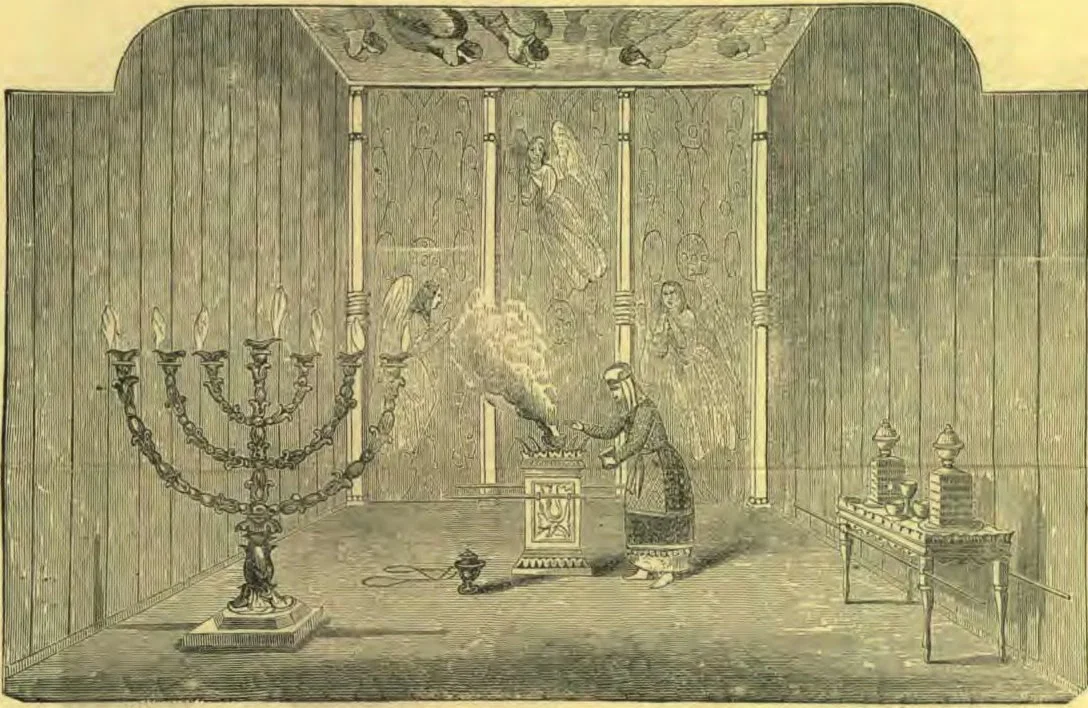
THE DAILY SERVICE OF THE TABERNACLE.

In the patriarchal age the husband and father was the priest of his own household. He erected his altar, and brought offerings for himself and his family, and prayer and praise ascended to God every morning and evening. This form of service and worship was customary with God’s true people until the erection of the tabernacle in the wilderness in the days of Moses. Then the Lord chose the tribe of Levi as his own, in place of all the firstborn of the children of Israel for the work of the sanctuary. The priesthood, however, was restricted to the family of Aaron. Aaron and his sons alone were permitted to minister before the Lord; the rest of the tribe were intrusted with the charge of the tabernacle and its furniture, and they were to attend upon the priests in their ministration, but they were not to sacrifice, to burn incense, or to see the holy things till they were covered. In Ex. 2:1–10 and 4:14 we learn that Moses and Aaron were of the house of Levi, and hence their descendants were Levites. Aaron and Moses were chosen as priests to minister in the sanctuary. Ex. 28:1.
In Exodus 28 we have a description of the garments prepared for the priests, and in the next chapter we have an account of the services connected with their consecration. These should be carefully studied.
When the tabernacle was finished and erected, it was anointed with oil preparatory to the priestly service which had been appointed. (See Ex. 30:22–33; 39:32–43; 40:1–17.) This service was carried forward from day to day by the priests throughout the year. One year was allotted to this ministration, and it always closed on the tenth day of the seventh month, with a special service. The ministration up to that time was performed in the court and in the first apartment of the sanctuary.
A lamb of a year old was burned upon the altar of burnt offering each morning and evening (Num. 28:3, 4), and on the Sabbath two lambs of the first year (verse 9), so that on the Sabbath days the burnt offerings were double what they were on other days. All the animals brought for sacrifice were carefully examined by the priests; for God had given explicit instructions that every offering should be “without blemish” (Lev. 22:18–22), that they might typify Christ, the “Lamb without blemish and without spot.” 1 Peter 1:19.
Incense was burned on the golden altar morning and evening. Ex. 30:1–8. The symbolism of this service is forcibly set forth in the following quotation:—
“The incense, ascending with the prayers of Israel, represents the merits and intercession of Christ, his perfect righteousness, which through faith is imputed to his people, and which can alone make the worship of sinful beings acceptable to God. Before the vail of the most holy place was an altar of perpetual intercession; before the holy, an altar of continual atonement. By blood and by incense God was to be approached,—symbols pointing to the great Mediator, through whom sinners may approach Jehovah, and through whom alone mercy and salvation can be granted to the repentant, believing soul.
“As the priests morning and evening entered the holy place at the time of incense, the daily sacrifice was ready to be offered upon the altar in the court without. This was a time of intense interest to the worshipers who assembled at the tabernacle. Before entering into the presence of God through the ministration of the priest, they were to engage in earnest searching of heart and confession of sin. They united in silent prayer, with their faces toward the holy place. Thus their petitions ascended with the cloud of incense, while faith laid hold upon the merits of the promised Saviour prefigured by the atoning sacrifice. The hours appointed for the morning and evening sacrifice were regarded as sacred, and they came to be observed as the set time for worship throughout the Jewish nation. And when in later times the Jews were scattered as captives in distant lands, they still at the appointed hour turned their faces toward Jerusalem, and offered up their petitions to the God of Israel. In this custom Christians have an example for morning and evening prayer. While God condemns a mere round of ceremonies, without the spirit of worship, he looks with great pleasure upon those who love him, bowing morning and evening to seek pardon for sins committed, and to present their requests for needed blessings.”
Sin offerings were made throughout the year. Instructions are given in regard to these in Leviticus 4. When the priest or the whole congregation sinned, the blood of the sin offering was sprinkled before the vail, and put upon the horns of the golden altar in the holy place. In such cases the sin offering was not to be eaten by the priests, but was to be burned with fire. Lev. 6:30. When a ruler or one of the common people sinned, none of the blood of the sin offering was brought into the sanctuary. In such cases the sin offering was eaten by the priests in the court of the tabernacle of the congregation, and this was the general law of the sin offering. Verses 25, 26. From these facts it will be seen that sin was transferred to the sanctuary by the priest not only through the blood, but through the flesh of the sin offering.
Thus day by day sin was transferred to the sanctuary, and it was defiled. Hence a special service was performed each year, on the tenth day of the seventh month, for the removal of sin. This work was called the cleansing of the sanctuary, and the day was called the great day of atonement, as set forth in Leviticus 16 and 23.— Christ our Advocate.

REMEMBER THY CREATOR.

REMEMBER thy Creator In the early morn of youth; Guard well the hidden entrance To that precious virtue, truth; Press on thy way with fervor; Seek the noble, do the right, By brave and firm endeavor, Patient working with thy might.
If you wish to gain a fortune, Study well God's holy word; There are mines of deepest knowledge, Best instruction ever heard; Tells of wealth and gems most costly, Rubies, pearls, and diamonds fair: Everlasting joys and pleasures, Which the seeking ones may share.
But in order to obtain them, Earnest work we all must do— Ceaseless, firm, untiring effort Every day, life's journey through. Take the Saviour for our pattern; Study well his life of love; Then may all our youthful readers Hope to meet in realms above.
There with minds made all immortal, Learn of knowledge grand and true From the blessed Educator All the ceaseless ages through.
Day of triumph, day of gladness, Hasten on thy gleaming light; Patient let us work together, Till our faith is lost in sight.
PAULINA M. ALWAY-ANDERSON.

A SMALL SWEET WAY.

THERE'S never a rose in all the world But makes some green spray sweeter; There's never a wind in all the sky But makes some bird wing fleeter.
There's never a star but brings to heaven Some silver radiance tender; And never a rosy cloud but helps To crown the sunset splendor;
No robin but may thrill some heart, His dawnlight gladness voicing. God gives to all some small sweet way To set the world rejoicing.
— Our Young Folks.

Receiving Christ as the Ruler of the Heart

If you receive Christ as the ruler of your heart, you will learn to know him as the Saviour of your soul.

Caution Against Drifting Into Error

WE can never be sure of going right if we are not careful lest we go wrong.
Continue reading: LESSON 12.—THE JUDGMENT MESSAGE (CONTINUED)