Pacific Press Publishing Company · New York · Nov 5, 1896
MEANING OF THE “CHRISTIAN CITIZENSHIP” MOVEMENT.
At the late international Christian Endeavor convention held in Washington, D. C., Rev. William Rader, of San Francisco, voicing the sentiment of the convention, said:—
Taking an interest in politics does not mean that the minister of the gospel should bring politics into the pulpit, but it does mean that he should take his pulpit into politics. It does not mean that he should bring politics into church, but it does mean most emphatically that the Church should be translated into political power.
Unfortunately, this language did not express merely the private opinion of the speaker. It did not announce a doctrine which he felt called upon to apologize for or to sustain by argument. It was but a statement before the convention of the “Christian Citizenship” idea, to which the “Christian Endeavor” movement stood already committed.
This doctrine of the church in politics has been heard before, in the councils of the “National Reform” movement, and has already borne fruit in State and national legislation. The significance of the situation to-day lies in the fact that the banner of “National Reform” is now borne aloft at the head of a vast army which represents the working strength of nearly all the churches combined. The “little leaven” has leavened the whole lump. The “Christian Citizenship” movement is not confined by denominational limits. All the leading Protestant bodies have contributed to its ranks, and are represented there by the very flower of their membership. Fired by the enthusiasm of youth, but guided by the counsels of mature years, this vast organized expression of outward Christian union stands girt for the conflict with the “enemies of Christ,” and the cry of its leaders is, On to Washington.
That Congress will be besieged the coming winter by this “Christian Citizenship” host in the interests of religious legislation, there is not the slightest room to doubt. And worst of all, there is grave reason to doubt whether the outcome will be other than capitulation. The World’s Fair Sunday legislation of 1892 furnishes a precedent for conclusions upon this point.
The advocates and exponents of the “Christian Citizenship” movement seek to quiet any possible public apprehension concerning its character and aims, by the statement that it seeks no union of Church and State, and does not mean the introduction of politics into the church. But upon these points they are able to draw distinctions where there is no practical difference.
We are plainly told, however, that the “Christian Citizenship” movement does emphatically mean that “the Church is to be translated into political power.” There is, it is true, some difference between this result and the introduction of politics into the Church, but it is rather technical than practical. The Church, as represented by this organization, does not mean to become the ally of any political party; but it is her intention to become a political party herself. Were the Church to become merely a political ally it would be bad enough, but nothing could be worse than political domination by the Church in the interests of no party but herself.
What the Church seeks to-day is religious legislation. To secure this she will fill political offices with candidates of her own choosing. Those whom she does not elect she will intimidate with threats of political opposition. She will dictate the vote of her adherents. And thus will she stand “translated into political power.” That is what the phrase means, and that is the meaning of political organization within the Church.
When the Church shall express her will through a political platform, control the vote of her adherents, and cast that vote for men of her own selection, she will be in every practical sense a political party. Politics will have become one branch of her Christianity.
It is denied, of course, that the Church will engage in politics as a Church. But whether as a church or not, it will be as a religious body, politically organized for religious purposes. It matters not that no distinctively denominational vote is contemplated, or that there is no intention to array one religious body against another by any denominational alliance with a secular power. The essence of Church and State union consists in the exercise of civil power for religious purposes, without reference to differences of religious belief. The evil of such union lies not in a discrimination in favor of one denomination against others, but in the damage which results to all parties from the administration of religion through civil force. The union of religion with the civil power must be through the Church, and must mean a union of Church and State if it means anything at all.
Human power cannot become an ally of Christianity. The power must be of God. The gospel is “the power of God unto salvation to every one that believeth.” Rom. 1: 16. Apostate “Christianity” has always allied the power of man with tradition, which is the word of man. The power of God, on the other hand, is inseparable from God’s word. The power of man will not unite with the Word of God, or the power of God with the word of man. Tradition seeks an alliance with human (the civil) power, because it would otherwise be entirely powerless.
A religion which seeks alliance with human power cannot be Christianity, however high its claims, or however numerous its adherents. It may retain the forms of Christianity, but it is shorn of the divine power, which alone can give spiritual life. This counterfeit, which possesses no life-giving and soul-satisfying power, is palmed off upon the people, and the result is spiritual darkness and death. This is the real and gigantic evil in a union of Church and State.
We are now told that “the Church is to be translated into political power,” and we are surrounded by the most convincing evidences that the statement is true. The translation is in full progress before our eyes. The Church is stretching forth her hand to grasp the power which she sees almost within her reach. And for what purpose does she want this political power? It is for the purpose, as she tells us, of ushering in the kingdom of God. Political power is wielded for the purpose of shaping legislation. The Church, therefore, through the “Christian Citizenship” movement, seeks for translation into political power in order that she may control346civil legislation in what she deems the interests of the kingdom of God. She desires to enforce upon all men “the laws of Christian morality.” One of her chief aims is to “preserve the sabbath.” To do this she means to secure both national and State legislation to enforce the observance of Sunday. And whatever else among religious observances or moral practice may be deemed necessary to the establishment of Christ’s kingdom, will likewise become the subject of legislation.
All men ought to be good. They ought to be followers of Jesus Christ. But the majority are not Christians, even by profession. Very many are open violators of moral precepts. This is a sad state of things, but it cannot be remedied by human law. Why? Because the root of the evil is in the heart. The testimony of God’s Word is that the heart of man is by nature at enmity with God’s law. It is selfish, and there is no power in man to change its nature. Human legislation cannot touch the heart. It can only regulate the outward conduct. One power alone can change the heart, and that is the power of God, operating through faith in Jesus Christ.
It may be asked, Will it not be an advantage to regulate the outward conduct of ungodly men by human law? Certainly it will, in those matters which involve the maintenance of human rights, but not in the matter of religious observances. And why not? Because a religious observance is only hypocrisy and a mockery of God without faith; and human law cannot supply the faith. Open disregard of the Sabbath is very bad, but it is not so bad as a hypocritical, forced observance of the Sabbath; and the same principle applies to any other of God’s moral requirements.
These considerations make clear the gigantic evil which is involved in this attempt to usher in the kingdom of God through the exercise of political power by the Church. The result will be the ushering in of a state of things exactly opposite to the reign of righteousness and peace. And this ushering in is now at hand. The situation is one which calls for active, earnest, prayerful and immediate effort on the part of all those who know the meaning of gospel liberty.
“CHRISTIAN CITIZENSHIP” SUBVERSIVE OF THE CONSTITUTION.
THE purpose of the founders of this Government was to place all men on an equality before the law. We are warranted in believing this both from the language of the Constitution and from the Declaration of Independence. The latter expressly declares that “all men are created equal, and are endowed by their Creator with certain unalienable rights;” while the former provides that “all persons born or naturalized in the United States, and subject to the jurisdiction thereof, are citizens of the United States, and the State wherein they reside.” A further provision of the Constitution is that “No religious test shall ever be required as a qualification to any office or public trust under the United States.”
But the “Christian Citizenship” movement, so-called, purposes to change all this; not indeed by changing the wording of the Constitution, but by overriding it, practically, and establishing not only a religious test as a qualification for office, but a religious test of citizenship itself.
In a “Christian Citizenship” meeting, held in Washington, July 8, 1896, Rev. Wm. Rader, of San Francisco, Cal., said, as quoted in the “Official Report”:—
The possession of rights does not constitute true citizenship, which properly assumes that a right is only efficient when rightly used, and that a man is no more a citizen because of the constitutional authority afforded him by the Constitution than he is an artist because he owns the brush of Rubens or the chisel of Angelo. What are known as American rights, such as free speech and political suffrage, are the political instruments of Christian men: they are not ends, but means to an end; they are the instruments of political righteousness, the legal opportunity of a Christian man to practically apply this Christianity to the State. Citizenship, then, is more than the political authority to cast a ballot; it is the moral ability to cast it right in the interests of the kingdom of God, and according to the Christianity of Jesus Christ. Voting is a Christian function.
We are not disposed to deny that every man who casts a ballot is under moral obligation to act conscientiously in so doing, just as much so as in any other business matter. The man who acts politically acts for the public, and he is just as much bound to act for the best interests of the public, according to his judgment, as he is to act for what he believes to be the best interests of a mercantile or other business firm of which he may be a member.
But we cannot grant that voting is a Christian function in any other sense than that which we have explained. The rule of the Christian life is, “Whether ye eat or drink, or whatsoever ye do, do all to the glory of God.” It is clear, therefore, that a man who votes, equally with the man who eats or drinks, or who engages in any business, must do so to the glory of God. That, however, does not make voting a Christian function any more than it makes tilling the soil, or conducting commercial enterprises a Christian function. These things may all be done by Christians,—may be done to the glory of God,—but they are not Christian functions. For if they were, only Christians would have a right to engage in them. For instance: Baptism is a Christian function; but only a Christian has the right to administer baptism, or even to receive it. Partaking of the Lord’s supper is a Christian function, but only a Christian has the right to partake of it. But under American law all men are equally entitled to participate in the affairs of government.
But “Christian Citizenship” seeks to change all this, and to establish for the citizen, as we said before, a religious qualification; therefore, in spirit and intent so-called “Christian Citizenship” is opposed to the Constitution of the United States, and would subvert it.
The purpose of the founders of this Government, as before remarked, was to prevent class distinctions, to put all men on an equality before the law, so that there might not be classes as there were and are in European and other countries. But “Christian Citizenship” would undo the work of the fathers of the Republic, and would establish a special class, enjoying special privileges. It is true that this class might not be created by law, and their special privileges might not be guaranteed to them by constitutional provision; but these privileges might be none the less real, and the Constitution be none the less surely subverted.
True Christianity asks for nothing of this kind. The fundamental law of the Christianity of Christ touching social relations is: “All things whatsoever ye would that men should do to you, do ye even so to them.” Christianity seeks no special privileges for its adherents. It asks no monopoly for itself; and the pseudo-Christianity which assumes arbitrary control in matters of Church and State is not Christianity but is only an exhibition of human selfishness.
God is glorified in the proper use of all his gifts to men. He is glorified by the farmer who tills the soil, sows the seed, guards his growing crop from injury, and who finally with thankful heart reaps the harvest which God has given him through the operation of natural laws. The Creator would not, however, be glorified by the man who would misuse the soil, the seed, the rain, and the sunshine, by endeavoring to produce results contrary to the ordinance of God.
In like manner the citizen, who is likewise a Christian, glorifies God by using civil government for the purpose for which it was ordained, namely, for the conservation of human rights.
The gospel is the power of God unto salvation, and he who, leaving the gospel, the power of God, seeks to save men by the power of the State, dishonors God, no matter how much or how fervently he may say, Lord, Lord.
Let the Christian vote, if he can do so, conscientiously; but let him remember that he is no better before the law than any other citizen; that he is entitled to no more consideration at the hands of the public; and that he has no more right to use the civil power to compel others to believe or to practice as he does, than unbelievers have to use civil power to compel him to believe and to act as they do.
THE CHRISTIAN CITIZENSHIP LEAGUE.
By S.
From the Christian Citizen, the organ of the National Christian Citizenship League, published in Chicago, Ill., we gather the following information relative to the character and aims of this organization:—
Christian citizenship is more than reform; it is regeneration.
It is more than the ethics of politics; it is the science of righteousness.
It maintains that the State is as truly sacred as the Church, should be governed by as high principles and should recognize God as the source of all authority.
It demands as high character in the ministers of God (Rom. 13:3, 4) who occupy our legislative and executive chairs as in the ministers of God who occupy our church pulpits.
It regards all public evils primarily as enemies of Jesus Christ and calls for a union of the friends of Jesus against them.
It believes that but two ways lie before our country, one leading to anarchy, the other to the application of gospel principles to public affairs.
It is the voice of one crying in the wilderness of public sins, “Prepare ye the way of the Lord,” measure all things by the rule of absolute righteousness rather than that of “policy” or “expediency;” cast out everything contrary to the will of Christ.
About three years ago, the National Christian Citizenship League was organized to promulgate the above principles. It knows no party, creed, nationality or sex, but seeks to unite all the friends of Jesus against his enemies. From its headquarters at 153 La Salle St., Chicago, it sends out large quantities of literature and many able speakers. Through its agencies many local victories have been won over the saloon and other public evils. It is organizing local leagues wherever called for and State departments in various States. Its mission is to serve and to preach the “old Gospel” as applied to public affairs.
It is evident that Christian citizenship, as here set forth, contemplates a condition of things above and beyond that which can be realized through human wisdom or power. For it must be admitted that “regeneration” and “righteousness” cannot be a product of human effort. The possession of civil power cannot contribute in any way to their realization. Yet the Christian Citizenship League347seeks to accomplish its purposes through the direct instrumentality of the ballot.
“It maintains that the State is as truly sacred as the Church, . . . and should recognize God as the source of all authority.” But the only recognition of God which can be pleasing to him is that which comes through faith in Jesus Christ. “Without faith it is impossible to please him,” writes Paul, “for he that cometh to God must believe that he is, and that he is a rewarder of them that diligently seek him.” Heb. 11:6. A recognition of God which possesses any saving virtue must be something more than that acknowledgment of him given by the devils, who “believe and tremble.” James 2:19.
But the State cannot exercise faith, and hence cannot make any proper or acceptable acknowledgment of God. Faith is for the individual only. Through faith we become acquainted with God so that we can recognize him as he is. Any other recognition of him could not meet with his approval.
The State speaks through its laws. Its recognition of God must therefore be by law. And if by law, it cannot be of faith. The character of State legislation is determined by the composition of its legislature, which in turn depends upon the vote of the people. But voting is not a religious act; it is the exercise of a civil right, which Christians and non-Christians possess and exercise alike. Hence there can be no true recognition of God through the ballot.
Faith is given to secure salvation. If the State can exercise faith, it can be saved. But if it cannot exercise faith, it has no business to concern itself with religion. Salvation, however, in the Christian sense, is a meaningless word considered apart from the individual; for Christian salvation means always salvation from sin. But all sin lies at the door of the individual. Sin never will demand other than an individual accounting. The Church of God cannot save the individual member of it who is a sinner; much less can he hope for salvation through his connection with the State.
The scheme of State recognition of God, therefore, is altogether Utopian so far as any Christian purpose is concerned. Its significance is wholly of an antichristian character. For State recognition of God, by law, means enforced religious observances on the part of those subject to the State, if it means anything at all. But enforced observances are not of faith, and “whatsoever is not of faith is sin.”
S.
RELIGIOUS INSTRUCTION IN STATE SCHOOLS.
[From the New Zealand Baptist, August, 1896.]
The position and attitude of Nonconformists in England when Forster introduced his Education bill in 1870 are being repeated by us to-day, for the question of “religious instruction in schools” finds us confused, divided, and blind to the great issues at stake. Unless we promptly close our ranks and present a solid front to the clericalism and intolerance involved in the present agitation, the probability is that in a few years we shall find ourselves in the weak position Nonconformists occupy in the present crisis in England. The question concerns us as Baptists, more than any other denomination, for we have ever been foremost in the fight for liberty of conscience and toleration in matters of religion. Now, I think I shall be able to prove that the proposed innovation,—the teaching of religion by agents of the State,—violates some of our most sacred principles, sapping the foundations of some of the fundamental truths which lie at the basis of the Nonconformist position.
There are two main principles accepted universally by Baptist churches, viz:—
Liberty of conscience.
The noninterference of the State in matters of religion.
In the course of the article we shall see how the proposal affects these principles.
The question at issue is not the merit of any proposed text-book, but the acceptance or rejection of broad, generally-accepted principles. The question is not “Will it benefit us?” but “Is it right?”
I shall state my case by a series of propositions, to which no Baptists can rightly object.
1. The State has no right to interfere in matters of religion.—It is because we recognize this principle that we oppose the establishment of any sect or church by the State. We demand that religion shall be free and unfettered by any connection with a secular State. It was because of this principle that Baptists in England preferred to go to prison rather than to pay rates in aid of the Established Church. Whatever may have been obscure to our Baptist “fathers,” this principle has never been lost. They realized, and we realize, that religion is a spiritual thing, and therefore beyond the reach of any secular power; so when the State stoops to patronize or strives to coerce, we reply, “Hands off. This is God’s affair, for religion is free, voluntary, and sacred.” Why, our very position as Nonconformists is a protest against State interference.
Are we not agreed so far? Well, do you not see that the teaching of religion by the State in the “day schools” is a direct interference in religious matters? By so doing, the State presumes to enter into a region forbidden by the spirit of religion and by our own belief. Logically, if we allow the State to-day to further the interests of religion, we have no right to complain if the State to-morrow does its utmost to hinder the interests of religion. Once admit the State’s right of interference, and we give ourselves away, placing ourselves at the mercy of the State.
2. We have no right to give religious instruction by enforced taxation.—In the spiritual realm there must be no coercion, all must be done of free choice, willingly, gladly. This is one of our reasons against a Church establishment by act of parliament. No church dreams of taxing its members for the advancement of religion by act of parliament. We recognize that whatever we do or give is not a matter of law but of conscience. Now, our schools are maintained by enforced taxation; all having to contribute alike, irrespective of their belief, whether Christian, Atheist, Oriental, etc.; so, consistent with our principle, we maintain that you have no right to apply this money to religious instruction, which you must do if you allow religion to be taught in the schools. Further, is it not clear if we allow religion to enter the schools that we give this principle away; for if the State is to establish the school for religious purposes, why not establish the Church for the same end? If we allow it to establish the one, we have no reason to object if it establish the other. If a religion cannot be maintained without the secular arm, then it is unworthy of maintenance, and the sooner it die an ignominious death the better.
3. Religious instruction can only be given by competent teachers.—Competency here implies conversion; so religious teaching can only be given by the religious. For the irreligious to undertake this work would be sacrilege and unholy presumption. We recognize this principle in all our churches. We would not dream of letting a non-Christian occupy one of our pulpits; and yet, by this agitation, we purpose handing over to our school teachers (about 60 or 70 per cent. of whom are not Christians) the religious instruction of our young. Could inconsistency go further? I deny the right of any section—large or small—of the community to make a “conscience” clause. It is an unwarranted and invidious interference with the teacher’s religious belief. No State has the right to ask me what I believe. My belief is too sacred to be at the mercy of the State.
4. We have no right to compel anyone to receive religious instruction.—What applies to the teachers applies with equal force to the scholars. Why should an invidious distinction be made between child and child in State schools maintained by every section of the community?
5. There must be uniformity of belief before there can be uniformity of religious instruction in the schools.—A little consideration will soon make the fairness and honesty of this proposition evident.
The State is made up of many bodies—religious and non-religious,—some of which are widely divergent in belief and practice. There are Protestants (including Unitarians), Roman Catholics, Theosophists, the Chinamen, with their Buddhism or Confucianism, etc., etc. All these bodies contribute equally to our State schools. Then what right have we to use this money to enforce the religious belief of a particular body? Where is the fairness and justice of the proposal? The comparative worth of the religious belief does not enter into the question at all.
Could a Buddhist honestly subscribe to any religious text-book we might frame? This dishonest compromise of outward uniformity has broken down in England, and the attitude of the Roman Catholics proves that it will break down here. So keenly sensitive are the Catholics to the impossibility of any compromise, that, rather than be a party to it, they maintain their own schools out of their own pockets. And every other nonconforming body has equal ground for protest. The only other possible supposition is, that the creed of each religious sect be taught in turn; but the absurdity of this prevents serious consideration.
6. Is it just to compel non-Christians to pay for the extension of our religious belief, just because we happen to be in the majority?—Do you not see that we are forcing them into an immoral position—to support what348they do not believe? Is it a right use of the freedom and tolerance so many of our fathers purchased with their life’s blood? We lay great stress upon our liberty of conscience, but have not they equal right to equal liberty? Whether their belief be right or wrong in no way affects the issue. Neither is it a question of majority or minority, but of justice and tolerance. If ninety-nine per cent. vote in favor of religious instruction in State schools, its enforcement is quite as immoral as if but one per cent. were in favor of it. Once you admit the right of the majority to rule in religious matters, whatever religion happens to be in the ascendant will have the right to enforce its tenets on the community by State aid.
After all, it is the old heresy, that you can make a nation religious by act of parliament. It has been tried down the centuries in various forms, but always with the same result—ignominious failure.
Now, consider these six propositions, which are based on some of our most sacred principles, and you will see what your duty is in the present crisis—to maintain in all its integrity and purity the heritage of freedom handed down to us by the fidelity and sacrifice of our fathers. The fact that Baptists have contributed more, perhaps, to the cause of religious freedom than any other denomination, except the Quakers, ought to be a sufficient inspiration to resist to the utmost the attempt now made to undermine our principles by the plausible pretext of an “Irish Text Book.” Admit the “Irish Text Book,” and sectarianism, with all its intolerance and bigotry, is made possible. How firmly then should we resist the intended encroachments on the freedom of our State schools.
If those who so persistently inform us that the colony is doomed unless a system of religious instruction be introduced into our schools, would utilize a little of the energy now wasted in declamation in making the most of the present facilities for religious instruction, they might be able to postpone the day of doom.
ONE of the wildest notions that was ever conceived by man is the idea of reforming the nation without reforming the people composing it. And yet many apparently wise and intelligent men to day seem to entertain this idea. They talk and act as though by some magic stroke of policy, by some act of Parliament or the like, the people may all be made Christians. To deal with the people individually they think too slow a process, and virtually a hopeless task. The work must be done by wholesale. The inconsistency of such a theory is thus grotesquely expressed in a modern publication, under the heading, “Took a Smaller Job:—
“He drank, chewed, an’ smoked, an’ was likewise
profane;
He got angry on small provocation;
So he gave up the job of reformin’ hisself,
And went in for reformin’ the nation.”
HOW SUNDAY LAWS OPPRESS THE POOR.
[New York World, Oct. 18, 1896.]
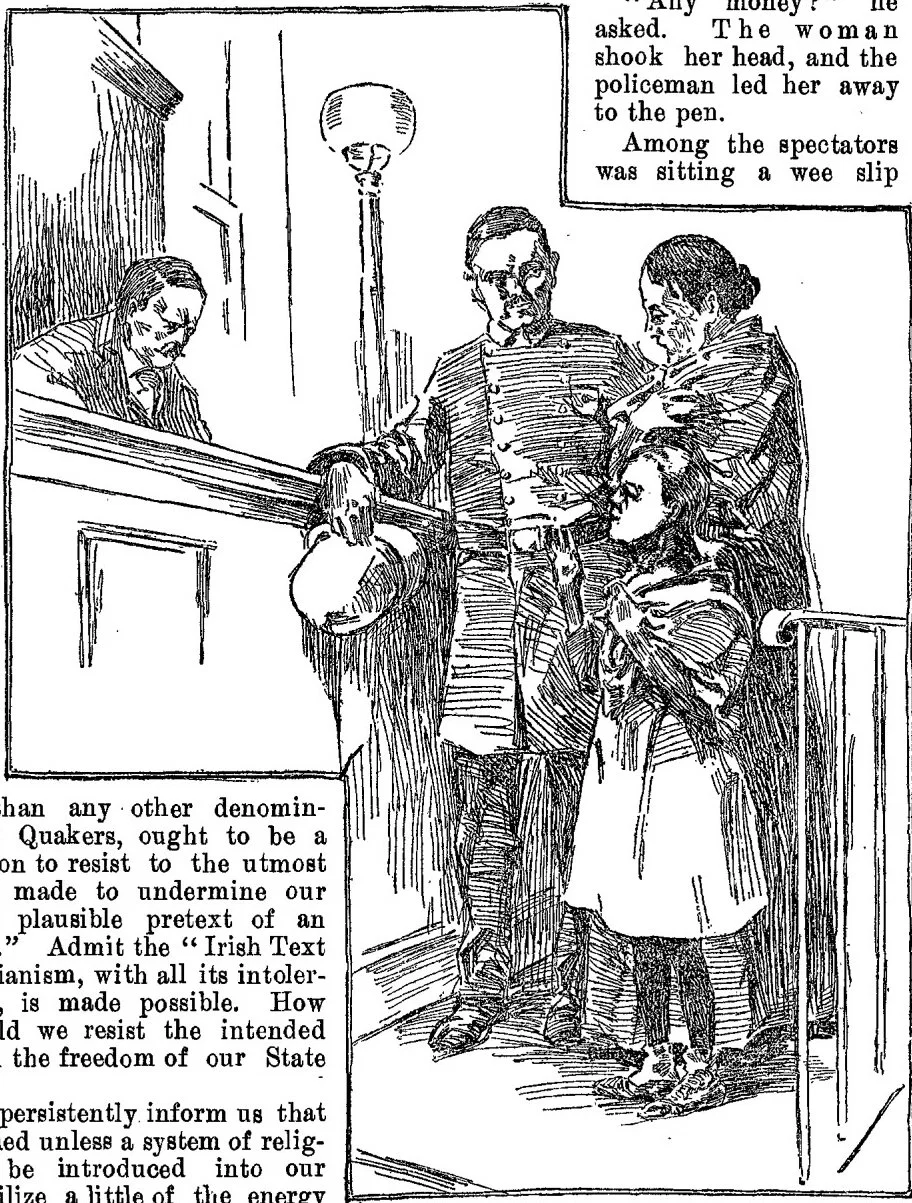
A WOMAN with her face drawn in deep dejection stood in the Essex Market Police Court yesterday, gazing with pleading eyes at Magistrate Crane. She was Mrs. Eva Kooperschmidt, of No. 77 Eldridge Street, who had been arrested for selling a piece of cloth in Hester Street on Sunday.
“Oh, sir, Your Honor,” said the woman, so faintly that the clerk bade her speak up, “oh, sir, it is true.”
The woman was crying into her apron as she said this, and the magistrate looked up.
“Well,” he said, and then he paused.
“It is very hard. Oh, Your Honor, there are the children to take care of, and there is the father, he cannot work: so I take the push-cart and peddle. It was Sunday—yes, but I did not know, and the piece of cloth was very small.”
“She was peddling there, Your Honor,” spoke up the policeman, “in direct violation of the law.”
“Well,” said the magistrate, “since you have confessed to having sold the cloth, I can do nothing but fine you $3.”
At this the woman buried her face in the apron again, and her tears flowed afresh. Taking her by the elbow, the policeman led her down sobbing.
The Child Secures Her Mother's Release.
“Any money?” he asked. The woman shook her head, and the policeman led her away to the pen.
Among the spectators was sitting a wee slip of a girl, clad in a dingy calico gown. As the prisoner bowed her head and wept the child leaned forward, the tears falling from her eyes. She watched every move of the woman, and when the latter was led away the child jumped to her feet.
“Sss-sh-sh,” murmured a neighbor, “Be still, now, or we'll all be turned out.”
The child sank back at the rebuke, but her eyes followed every move of the woman who was being led out. For an hour or more the procession of “drunks and disorderlies” passed before the magistrate, were heard and judged, and then the officers called upon people who had business with the court to step forward. Presently the little girl arose and stole timidly towards the bench.
“Please, sir,” she said to the magistrate, and then she stopped and choked. “Please, sir, my mother.”
Lifting the corner of her shawl to her eye she wiped away a tear and looked upon the magistrate.
“Yes,” said the magistrate kindly, “and who is your mother?”
“Please, sir, she is Mrs. Kooperschmidt. She was taken up for selling cloth on Sunday.”
“Oh, yes,” said the magistrate, “and then what?”
“Well, sir, won’t you please let her go?”
“Let her go?” said the magistrate. “Tell me why.”
“Oh, sir!”—and again breaking into tears the little girl hid her face in her shawl.
“Now don’t cry, that’s a dear,” said a policeman, and the child wiped her eyes.
“Oh, sir, we had no money,” she said, “and mother went out to sell something to get us a little bit to eat. Please, Your Honor, we haven’t $3 to pay the fine, and won’t you ple-ee-ease let her go just this time?”
The magistrate looked at the child a moment and smiled.
“All right, little girl, I’ll let her go. Officer, just bring out Mrs. Kooperschmidt. Her fine is remitted.”
And the little girl, seizing hold of her mother’s gown, hurried her out of the court as if in fear the judge might change his mind. As soon as they reached home out came the cart and away went the mother to earn bread for the father and the little ones.
SOME PERTINENT QUESTIONS AND SUGGESTIONS.
By Albert Barnes
If we can have a Sabbath, sacred in its stillness and its associations; maintained by a healthful popular sentiment rather than by human laws; revered as a day of holy rest, and as a type of heaven; a day when men shall delight to come together to worship God and not a day of pastime, Christianity is safe in this land and our country is safe. If not, the Sabbath, and religion, and liberty, will die together.
If the Sabbath is not regarded as holy time, it will be regarded as pastime; if not a day sacred to devotion, it will be a day of recreation, of pleasure, of licentiousness. Since this is to be so, the question is, what is to be the effect if the day ceases to be a day of religious observance?
What will be the effect of releasing a population of several millions one-seventh part of the time from any settled business of life? What will be the result if they are brought under no religious instruction? What will be the effect on morals; on religion; on sober habits of industry; on virtue, happiness and patriotism? Can we safely close our places of business and annihilate all the restraints that bind us during the six days? Can we turn out a vast population of the young with nothing to do and abide the consequences of such a universal exposure to vice? Can we safely dismiss our young men all over the land with sentiments unsettled and with habits of virtue unformed, and throw them one day in seven upon the world with nothing to do? Can we safely release our sons and our apprentices and our clerks from our employ and send them forth under the influence of unchecked, youthful passions? Can we safely open as we do, fountains of poison at every corner of the street, and in every village and hamlet, and invite the young to drink there349with impunity? Can there be a season of universal relaxation, occurring fifty-two times in a year, when all restraint is withdrawn, and when the power of temptation shall be plied with all that art and skill can do to lead the hosts in the way to ruin, and to drag them down to hell?
One would suppose that the experiment which has already been made in cities of our land, would be sufficient to remove all doubt from every reasonable mind on this subject. We are making the experiment on a large scale every Sabbath. Extensively in our large cities and their vicinities, this is a day of dissipation, of riot, of licentiousness, and of blasphemy. It is probable that more is done to unsettle the habits of virtue, and soberness, and industry; to propagate infidelity, and to lay the foundation for future repentance or ignominy, to retard the progress of the temperance reformation, and to prepare candidates for the penitentiary and the gallows on this day than on all the other days of the week. So it always is where institutions designed for good are abused they become as powerful for evil as they were intended to be for good.
The Sabbath is an institution of tremendous power for good or evil. If for good as it was designed, and as it easily may be, it is laid at the foundation of all our peace, our intelligence, our morals, our religion. If for evil it strikes at all these; nor is there any possible power in laws or in education that can, during the six days, counteract the evils of a Sabbath given to licentiousness and sin.—Dr. Albert Barnes, in “Practical Sermons.”