The Youth’s Instructor, Vol. 31, No. 47.

THE FROST SPIRIT

The Youth’s Instructor

Nov 21, 1883

S. D. A. Publishing Association · Battle Creek, Mich. · Nov 21, 1883

THE FROST SPIRIT.

He comes,—he comes,—the Frost Spirit comes! You may trace his footsteps now On the naked woods and the blasted fields And the brown hills' withered brow. He has smitten the leaves of the gray old trees, Where their pleasant green came forth, And the winds, which follow wherever he goes, Have shaken them down to earth.
He comes,—he comes,—the Frost Spirit comes! From the frozen Labrador,— From the icy bridge of the Northern seas Which the white bear wanders o'er,— Where the fisherman's sail is stiff with ice, And the luckless forms below In the sunless cold of the lingering night Into marble statues grow!
He comes,—he comes,—the Frost Spirit comes! On the rushing Northern blast, And the dark Norwegian pines have bowed As his fearful breath went past. With an unscorched wing he has hurried on, Where the fires of Hecla glow On the darkly beautiful sky above, And the ancient ice below.
He comes,—he comes,—the Frost Spirit comes! And the quiet lake shall feel The torpid touch of his glazing breath, And ring to the skater's heel; And the streams which danced on the broken rocks, Or sang to the leaning grass, Shall bow again to their winter chain, And in mournful silence pass.
He comes,—he comes,—the Frost Spirit comes! Let us meet him as we may, And turn with the light of the parlor-fire His evil power away; And gather closer the circle round, When that fire-light dances high, And laugh at the shriek of the baffled fiend, As his sounding wing goes by!
—J. G. Whittier.

PLYMOUTH AND THE PILGRIMS.

ABOUT the first of November, in the year 1620, a little vessel might have been seen making its way towards the coast of Massachusetts. It was a frail craft, laden with anxious-looking men and women. This band of adventurers were pilgrims, who, because they could not enjoy liberty of conscience in their own country, had most unwillingly and at great sacrifice, left it, that they might find a place where they could worship God according to their own views of duty, without the opposition of the civil power.
These pilgrims were men of prayer. In everything they were accustomed to seek direction from their heavenly Father, and to implore his blessing. Accordingly, on Saturday, November 11, religious services were held on board the Mayflower. “They fell on their knees, rendered thanks to God for his kind protection of them during their dangerous voyage across the ocean, and implored his favor to rest upon them amid the toils, trials, and temptations upon which they were now to enter.” A document was then drawn up and signed by all the men, in which they solemnly, in the presence of God and of one another, agreed to combine themselves into a body politic for the formation of a government of “equal laws” for the “general good.” Their next step was the election of a governor for the year. The choice fell upon John Carver, who is described as “a pious and well-approved gentleman.”
Cold weather was fast approaching, and a place for landing was yet to be settled upon. Accordingly, a company of sixteen men, well armed, and headed by their valiant captain, Miles Standish, went ashore on an exploring expedition, and to obtain fuel and food, if possible, as their stock on board was nearly exhausted. They found plenty of wood, and quite a quantity of corn buried in mounds, which they supposed had been placed there by the Indians. They saw a few red men, who fled as soon as they saw the pale faces. The explorers saw at this visit no other signs of inhabitants, though they spent some time in searching for them. After two days they returned to the ship, with supplies of wood, corn, and wild fowl. We may well suppose that the sight of these first fruits of the land of promise brought joy to all hearts.
In a few days another exploring party started out along the shore, this time in the frail shallop which they had brought over stored between decks. There were thirty-four of this party, and a severe time they had of it. The wind blew strong, and the spray, as it dashed upon them, was turned to ice. Some of them became chilled, and took such severe colds as resulted in death. A portion of them landed, but soon became “tired with marching up and down the steep hills and deep valleys, which lay half a foot thick with snow.” During this visit they found more corn buried and a bag of beans; they also came upon two deserted wigwams, but saw no human beings. They afterward learned that the deserted condition of the country was on account of a destructive plague which had lately swept off great numbers of the Indians on the coast. After rambling about in various directions, without any important result, the exploring party returned to the vessel. During their absence a child had been born on board the Mayflower, who was named Peregrine White. This was the first English child born in New England.
On the sixth of December a third party went forth to make further discoveries. Soon after landing, they encountered a party of Indians, with whom they had a little skirmish. They then returned to their shallop, and being overtaken by a bad storm, went ashore on a little island near the entrance of Plymouth Harbor, where they spent the night and next day, under the peltings of a winter storm. This was afterward called Clark’s Island, in honor of the mate of the Mayflower, who is said to have been the first who stepped upon it. The next day, December 21, 1620, having examined the harbor and found it a convenient place for ships to anchor, they went onto the mainland. Deeming it a suitable place, they concluded to make their settlement here. And this was “The Landing of the Pilgrim Fathers,” about which so much has been said and written.
The men at once set about building rude houses, while the women and children remained in the ship, which was anchored about a mile and a half from the shore. Indians were occasionally seen, but they did not come within speaking distance. The number who landed from the Mayflower was just one hundred souls. Scarcity of food, with exposure to cold and wet, brought on disease; and by spring one-half their number were swept away by death! Among those who died was their good governor, John Carver. William Bradford was appointed to take his place. The name of Plymouth was given to the new colony, out of respect to the people of Plymouth, in England, where the pilgrims were treated with great kindness when they put back on account of the leaking of their vessel.
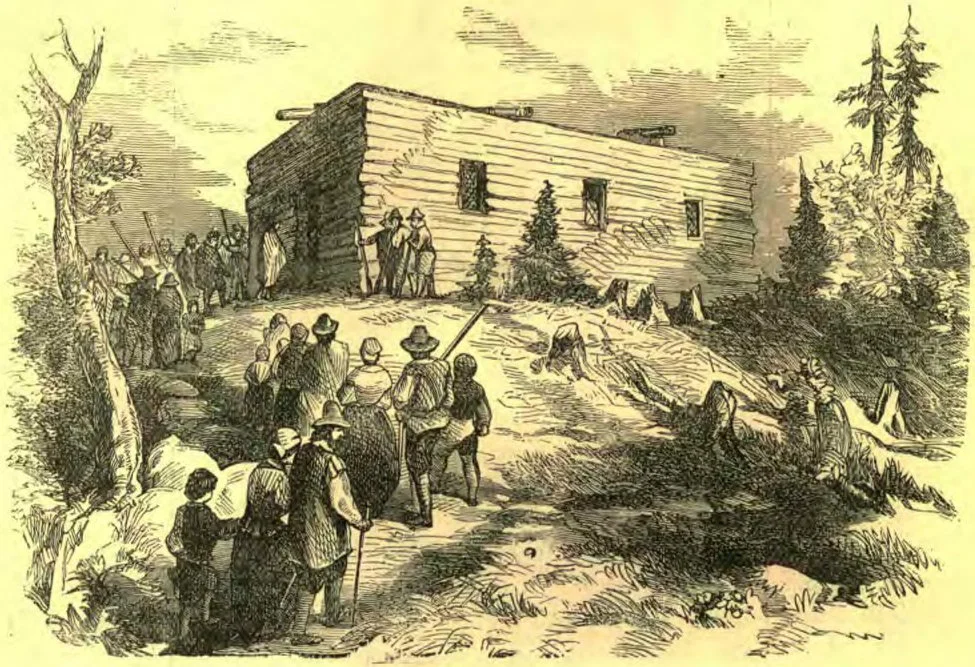
In March, 1621, the settlement was surprised by the visit of an Indian, who, to their astonishment and joy, spoke to them in broken English, and bade them “Welcome.” Through him they learned of the plague which had swept over the country where they were, and many other things of interest. From this time the visits of the Indians were quite frequent, and not always of so pleasant a character as this first one. The colonists finally thought it wise to build a log fort on the hill, in which they placed their two cannon and stored their ammunition. This helped to intimidate the Indians, some of whom were getting bold and troublesome. This rude fort served also as a meeting-house, or place of worship, whither the Pilgrims went with their weapons on. The picture on the first page gives a good view of this church in the wilderness, and the Pilgrims wending their way to the place of prayer, with their guns in hand.
During the first summer of their settlement, the Pilgrims were comfortably provided for. The weather was mild, their corn was productive; fish were obtained in considerable quantities; and later in the season wild ducks and venison were plenty. As the cold weather came on, they repaired their houses, so as to be the better ready for the approaching winter. When it commenced, they were in health, and had “all things in plenty.” After the harvests were gathered in, Governor Bradford deemed it a fit and proper thing that, in imitation of the Hebrew feast of tabernacles, or of ingathering, they should set apart a day of thanksgiving to the Almighty God who had preserved them from so many dangers, and given them a bountiful harvest in this new land. A few days previous, he sent four men out fowling, that they “might after a more special manner rejoice together.” So after the thanksgiving service in their rude log church, they together partook of the bounties of the year, not riotously, but with thankfulness of heart and lips.
And so came about the custom which gives us “Thanksgiving Day” every autumn. The President has appointed the 29th of November as the day which we shall observe this year. But how few of those who shall gather in the happy homes of our broad land, will thank God as fervently for their plenty, as did our Fathers for the bare necessities of life!
E. B. G.

WHOSE SERVICE HAVE YOU CHOSEN?

Written for the Instructor.

WHOSE SERVICE HAVE YOU CHOSEN?

In order to save man, Jesus laid aside his honor as commander in heaven, left the world of glory, and came to earth to live as a man among men. He might have appeared with all the display of royalty, attended by ten thousand times ten thousand of his ministering angels. But he humbled himself, not only to take our nature, but to become a man of sorrows, to take upon him the form of a servant. He came to do good, to help the needy and the distressed; to heal the sick; to speak peace to the suffering; to deliver those whom Satan was afflicting; to bring redemption to all who would receive this heaven-sent blessing.
The great enemy of men was constantly working to turn their minds from Christ; and he succeeded to a great degree, because the natural heart chooses to do evil rather than good. There was an unceasing battle between Satan and his angels, and Christ and his angels. Our Saviour encountered this wily foe in the wilderness of temptation. During the forty days and nights of Christ’s long fast, Satan, concealing his real character, sought by every means which he could devise, to overcome the Saviour of the world. He finally disguised himself as an angel of light, a heaven-sent friend, and offered to show him an easier way than the path of trial and suffering upon which he had entered. But Jesus repulsed the enemy, and forced him to depart, a conquered foe.
Satan still comes with his temptations to the children of men. He employs every means at his command to conceal himself from view, and this is why so many are ignorant of his devices. A few days since, the question was asked me, “Do you believe in a personal devil?” “I do,” was the answer. “Well,” rejoined the questioner, “I do not believe that there is any such being; our evil thoughts and impulses are all the devil we know anything about!” “But,” I asked, “who suggests these thoughts? whence do they originate, if not from Satan?”
My young friends, be not deceived by this fast-spreading delusion. Just as surely as we have a personal Saviour, we have also a personal adversary, cruel and cunning, who ever watches our steps, and plots to lead us astray. He can work most effectually in disguise. Wherever the opinion is entertained that he does not exist, there he is most busy. When we least suspect his presence, he is gaining advantage over us. I feel alarmed as I see so many of the youth yielding to his power while they know it not. Did they but see their danger, they would flee to Christ, the sinner’s refuge. They would resist the devil. They would pray much for wisdom, grace, and strength, and would seek most earnestly to overcome every evil trait of character. They would walk in the path which Jesus trod, and shun that which Satan urges them to choose.
The tempter often whispers that the Christian life is one of exaction, of rigorous duties; that it is hard to be on the watch continually, and there is no need of being so particular. It was thus that he deceived and overthrew Eve in Eden, telling her that God’s commands were arbitrary and unjust, given to prevent men from becoming free and exalted, like himself. Satan’s object is the same now as then. He desires to deceive and ruin us. We should study the life of Christ, and seek to cherish his spirit and copy his example; and the more we become like him, the more clearly shall we discern the temptations of Satan, and the more successfully resist his power.
Selfishness cannot exist in a heart where Christ dwells; if cherished, it will crowd out everything besides. It will lead you to follow inclination rather than duty, to make self the subject of thought, and to gratify and indulge yourself, instead of seeking to be a blessing to others. Your wants, your pleasures, will come before everything else. In all this you exemplify the spirit of Satan. Your words and deeds represent his character, instead of the character of Christ.
Jesus bids you, “Take my yoke upon you, and learn of me; for I am meek and lowly in heart, and ye shall find rest unto your souls.” True happiness is to be found, not in self-indulgence and self-pleasing, but in learning of Christ, taking his yoke, and bearing his burden. Those who trust to their own wisdom, and follow their own ways, go complaining at every step, because the burden which selfishness binds upon them is so heavy, and its yoke so galling. They might change all this if they would but come to Jesus, and by his grace put off the yoke that links them to Satan, lay off the self-imposed burden, and take the burden which Christ gives them, and let his yoke bind them to him in willing, happy service.
Jesus loves the young, and he longs to have them possess that peace which he alone can impart. He bids them learn of him meekness and lowliness of heart. This precious grace is rarely seen in the youth of the present day, even in those who profess to be Christians. Their own ways seem right in their eyes. In accepting the name of Christ, they do not accept his character, or submit to wear his yoke; therefore they know nothing of the joy and peace to be found in his service.
If we have become the disciples of Christ, we shall be learning of him,—every day learning how to overcome some unlovely trait of character, every day copying his example, and coming a little nearer the pattern. If we are ever to inherit those mansions that he has gone to prepare for us, we must here be forming such characters as the dwellers there are to possess.
It is ours to choose whether we will be numbered with the servants of Christ or the servants of Satan. Every day we show by our conduct whose service we have chosen. Jesus says, “He that keepeth my commandments, he it is that loveth me.”
Dear young reader, what choice have you made? What is the record of your daily life?
MRS. E. G. WHITE.

MAKING SUNSHINE.

One morning, after a long week of rain, the sun peeped suddenly from behind a black cloud, and looked inquiringly around on the wet earth, as if to say, “I wonder, now, if I’m really wanted down there.”
He seemed to think that he was, for he climbed clear above the cloud as fast as possible, and sailed up into the blue. Plenty of light, feathery, white clouds were all about, but he laughed so hard at them that they scampered out of his way and hid. And then he turned his attention down to the neighborhood where Lucy lived, and found things quite wet and muddy and disagreeable there.
“Ha! ha!” he said, “here’s a little solid work waiting for me.” So he sent down a liberal supply of his warmest, cheeriest rays, and Lucy was soon at the window with a face as clear as if she had not all the week been running a race with the sky to see who could show the most clouds.
“O mamma,” she cried, “it’s beautiful! Do come and see how the trees are full of diamonds and how the flowers shine in the sun! Can’t you smell those lilies and the jessamine? And hear the little birds, what a twitter and chatter they are keeping up! There’s a robin picking up the crumbs you threw out. Oh, I do love sunshine!”
“But you haven’t tried to make much of it these rainy days, my little daughter. You seemed to prefer to cast clouds about. No one would think you were fond of sunshine.”
“But, mamma, my sunshine would shine only such a little way, no matter how hard I tried. Now, when the sun shines, he shines all over the world, he is so great and grand, but I am only a little girl.”
“Yes, but there is only one great sun, and think how many little girls there are—and boys, too. If every child made his own share of sunshine, how much would there be, do you think?”
“Why, mamma, it would reach all over the world!”
“Very nearly.”
“But we can’t get every little boy and girl to do it, mamma.”
“I am afraid not; but the best way to begin is for each one faithfully to do her own share toward it.”
Lucy thought so too, and resolved that she would try to make her share of sunshine, and to make it reach as far as she could.
I hope she learned the lesson taught by the sunshine, the birds, the flowers, and every other beautiful thing—that every child’s heart should, like them, give out brightness and music and sweetness, all to make light and happiness for those whom they love.—N. Y. Observer.

OUR LIVES.

Our lives are songs; God writes the words, And we set them to music at pleasure; And the songs grow glad, or sweet, or sad, As we choose to fashion the measure. We must write the music, whatever the song, Whatever its rhyme or metre; And if it is sad, we can make it glad, Or if sweet, we can make it sweeter.

A TALK ABOUT BEES.

Every one who has been in the country in the spring-time has seen bees. Two kinds are usually seen; the small brown and yellow ones, which are called honey-bees, and the larger black and yellow ones called humble-bees. Honey-bees are so called because making honey is the occupation of their life; they all follow the trade perseveringly. In this busy occupation they have always kept up a reputation for industry, and so, “as busy as a bee,” became, long, long ago, a proverbial expression.
How bees carry on the work has occasioned no small amount of study. They usually live in hives, and there they build their comb, which is composed of countless small cells, or little six-sided rooms, built of wax. When we look at a piece of honeycomb as it lies on our plate at the table, we wonder what marvelous method the bee could possess by which he builds so regularly and so beautifully; he must surely be a natural architect. The waxy building material is secreted in the form of scales under six little flaps situated on the under side of the insect. It is then pulled out by the bee, and molded with other scales, until the tough piece of wax is formed. How the bee manages to build these cells with such mathematical accuracy is not known. Six-sided is the best possible shape for strength and space combined. The edges of the cells are strengthened with a substance called propolis, a kind of gum procured from the buds of various trees. This propolis is also used to stop up crevices. After the bees have built their storehouses, they begin to manufacture honey. They go out in every direction, over field and forest, over meadow and garden, in search of the flowers.
They do not gather the honey as birds gather fragments for their nests, but they have pockets which they fill up before returning to the hive. In this gathering of honey from near and far, the bees distinguish themselves as hard workers. For instance, every head of clover contains about sixty distinct flower tubes, each of which holds a portion of honey not exceeding the five-hundredth part of a grain. The proboscis of the bee must, therefore, be inserted into five hundred clover tubes before one grain of honey can be obtained. Each pound of honey represents 2,500,000 clover tubes sucked by bees. Isn’t that a vast amount of labor for insects to perform!
The manner in which the bees govern themselves is very curious. Their political system is this: They have a queen-bee, who rules the household, and lays all the eggs from which the inhabitants of the hive are produced. She deposits from two to three thousand eggs daily for weeks in succession. The workers build combs and gather honey. The males are drones and gather no honey, and are for this reason killed off yearly by the workers in August.—Scholar’s Companion.

NEW-TESTAMENT HISTORY.

LESSON 162.—REVIEW.

1. When did Paul write what is called his First Epistle to the Corinthians?
2. Had he written to them before? 1 Cor. 5: 9.
3. Why are those we have in the Bible called the first and second, when they were really the third and fourth?
4. What causes had Paul for writing the letter now known as his first to that church? Chapter 1: 10-13; 5: 1-5; 6: 1-10.
5. In opening his letter, how does Paul prepare the minds of the Corinthians for the reproof he has to give them?
6. What does he then say to them about their dissensions?
7. What does he say about his own humble course among them? Chapter 2: 1-5; 9: 15-23.
8. What does he say about the worldly comforts of the Thessalonian brethren, as compared with the privations and hardships of those who had preached to them? Chapter 4: 8-13.
9. To whom must the simple gospel of salvation through Christ appear as foolishness? Chapter 1: 18.
10. What will it be found to be by those who have faith in it and obey it?
11. How does Paul show the folly of trusting in the wisdom of men rather than in the plan of salvation which God has ordained? Verses 19-29.
12. How does the apostle speak of the mysterious things that have been revealed to him? Chapter 2: 7-10.
13. Does he claim any honor because of these revelations? Chapter 3: 5-9.
14. From whom does all true wisdom proceed?
15. Whose work were the apostles doing?
16. Whose building is the church?
17. What caution does Paul give to careless builders? Chapter 3: 11-15.
18. How does he speak against rashness and pride? Chapter 4: 5-7.
19. How does he show the inconsistency of appealing to worldly magistrates for the adjustment of personal difficulties? Chapter 6: 1-8.
20. How does he teach that the human body, as a gift from God, should be regarded as sacred against all pollution? Chapter 6: 15-20; 3: 16, 17.
21. What warning is given against wounding the consciences of others? Chapter 8, and 10: 16-32.
22. How does the apostle teach the duty of generously supplying the temporal wants of preachers? Chapter 9: 7-14.
23. What lesson does he draw from the experiences of the Israelites in the wilderness? Chapter 10: 1-14.
24. What reproof does he give with reference to the communion service? Chapter 11: 17-34.
25. How does he illustrate the truth that the different gifts are all given through the same Spirit, and that all are important? Chapter 12.
26. How does he exalt charity above all gifts? Chapter 13.
27. What style of language, and what kind of teaching, does he recommend? Chapter 14.
28. How did Paul refute the error of those who did not believe in the resurrection of the dead? Chapter 15: 1-20.
29. What explanation does he give concerning the time when this shall take place? Verses 21-28.
30. What does he say about the manner in which it will be accomplished? Verses 36-50.
31. How suddenly will the change take place? Verses 51, 52.
32. What victorious shout will then be heard? Verses 54-56.

SAVING THE BITS.

I REMEMBER a busy man who had very little time for reading or study, but whose mind was a perfect storehouse of information on almost every subject.
“How does it happen that you know so much more than the rest of us?” I asked him one day.
“Oh,” said he, “I never had time to lay in a regular stock of learning, so I save all the bits that come in my way; and they count up a good deal in the course of a year!”
The other day, I heard a little boy explaining the meaning of several geographical terms to his brother.
“Where did you learn that?” I asked, in surprise.
“Oh, Miss Wells teached it to the big jography class, and I fought I’d member it too,” said he.

Speak Kindly to the Living While You Can

SPEAK to living ears as you will wish you had spoken when they are dead.

DON'T GIVE UP.

If a Sabbath-school is fairly recognized as a “live Sabbath-school,” it is easy enough to get workers for it, or to keep up the enthusiasm of those who are already its workers. But “a dead-and-alive Sabbath-school” is rarely an attraction to anybody. Those who are outside of it want to keep out, and those who are inside are tempted to get out. The same is true of a teachers’ meeting, or of a Bible class, or of a class of any grade. It is the successful one that succeeds. It is the failing one that fails. “Whosoever hath, to him shall be given, and he shall have more abundance; but whosoever hath not, from him shall be taken away even that he hath.” So true is this truth, that there are superintendents who will close up a Sabbath-school at the approach of hot weather, or of cold weather, as soon as they see that its members are falling off materially, because they are “bound to have a live Sabbath-school, or none at all.” They will have “nothing to do with a dead-and-alive Sabbath-school.” And many a teachers’ meeting has been suspended or abandoned for the same reason. Many a class, also, has been given up because it was running down; given up, too, with a certain self-complacency on the teacher’s part, as proving that he was not one to hold on to a failing concern. Yet, there is a sense in which it can be said, that the best Sabbath-school work in the world to-day, is the work which goes on in the “dead-and-alive Sabbath-schools,” rather than in the Sabbath-schools that everybody calls “live.” “They that are whole have no need of the physician, but they that are sick;” and he who represents the Great Physician ought to recognize his pre-eminent mission to those who are “dead-and-alive” rather than to those who are in bounding health. A man often deserves more credit for holding on to a dwindling school, or a scanty teachers’ meeting, or a thinning class, than if he held on where things moved briskly, and numbers were at their highest. Any worker, in a live Sabbath-school or in a dead-and-alive one, ought to do his best to secure an improvement in his charge; but the poorer the condition of the school the greater the need, and hence the possible value of his work. It is a shame for a Sabbath-school worker to close a school, to suspend a teachers’ meeting, or to give up a class, on the ground of its sickliness. The writer once visited a poverty-stricken home, where he saw an emaciated little child lying in evident neglect on an uncleanly bed. Asking the mother if a physician had seen that child, he learned that nothing was being done for the little one. “And why not?” he inquired. “Ah! it’s a sickly one. It’s not worth the raising,” was the cool-blooded response. That mother didn’t propose to waste her strength on a dead-and-alive little one. And she was of much the same spirit as a Sabbath-school worker who abandons his charge because of its sickliness.—Sunday School Times.

A CURIOUS HOUSE AND HOUSEKEEPER.

Did you ever live near a pond? If you have, maybe you have seen a queer animal that lives there, who always carries his house on his back. The roof is made of hard shell, and has short partitions on the sides to hold it firmly above the floor underneath. It has strong ribs to hold it in shape.
In between the roof and the floor the animal lives, and, strange to say, is fastened to his house so that he cannot leave it. At the opening in the forepart of the house, he can thrust out his head and two fore legs; and in the back opening, his tail and two hind legs. Whenever he sees any danger coming, he quickly draws in his head and legs, and looks not at all like an animal, but more like a piece of leather, or a very dirty shell.
He lives in the water a part of the time, but delights to sit on an old log and dry the roof of his house in the sun. His common name is mud-turtle.
He has a cousin, somewhat larger than he, but not nearly so good natured. Indeed, he is so very cross that people call him a snapping-turtle. Neither of these animals have any teeth, but their jaws are very hard and horny and hook over in front a little, so that they can bite things in two.
This snapping-turtle is very fond of fishes and small animals, and he is so fond of eating that he sometimes kills young alligators. But he gets paid back for eating other animals; for people often catch him, and cook and eat him. Sometimes it is not so easy to get hold of him even after he is caught; for he is so very savage that if a finger or toe comes within his reach, he stretches out his long neck, and bites it off as easily as you would cut leaves off with a pair of scissors.
Another kind of turtle lives on the land, and does not like to get near the water at all. He is very fond of lettuce, which he bites off as nicely as you could do. He likes to drink milk, and how do you suppose he does it? He opens his mouth, and scoops up milk with his lower jaw, just as you would with a spoon, then he tips back his head, and lets it run down his throat.
One man had a tame turtle, that he let stay in the house. It was fond of the fireside, and would stay for hours on a footstool by the fire. If it was taken off ever so many times a day, it would always come back and climb up on the stool again. It made a noise that sounded like the mewing of a little kitten.
The next time you find one of these strange creatures, you may like to turn him over and look at him; but be careful to take a long stick to do it with, or your fingers may suffer. It is very well to look at animals and bugs enough to see how they are made, but we hope that none of you will take delight in tormenting them, as so many children do.
W. E. L.

THE LITTLE GRASS-SELLER.

The Indians and negroes of warm countries carry heavy loads. They acquire great skill and strength in this way, and can support heavy burdens that a white man could hardly lift. Not only do they bear them upon their backs, but even upon their heads. I have had my trunks carried upon the heads of negroes, in the mountains of the West Indies, for many miles. As they practice this mode from the time they can walk, they balance almost any object upon their heads without holding it with the hands. Always, in going to market, they place their produce in a basket, or tray, on the tops of their heads, and walk gaily along, swinging their arms free. Even a small thing, like an apple or an orange, they carry in this way, they have got so in the habit of it. This practice has given them strong necks and broad, straight shoulders.
The Indians, though they can also carry great loads on their heads, yet prefer, as a rule, to carry them on their backs. In Mexico they take the load upon the shoulders, and keep it in place with a broad cotton or leather band around the forehead. They will trot many a mile in this way, and never complain of being tired. I say they will trot; and so they do, for their gait is much faster than a walk.
South of the United States is a country called Yucatan. It pushes itself into the Gulf of Mexico, and lies near to Cuba. Here it was that I saw the men and women used as beasts of burden. Going along the country roads at night, I have met hundreds of them coming into market. Some of them had walked forty miles. By leaving their homes at sunset, they would reach the market-place in the city next day. They walked in the night, because the scorching sun by day was worse than a load. Not only men and women, but children, boys and girls, carry burdens. Some, not more than ten years old, would have their share to carry.
As little grain is raised there, and only corn is used for food, grass and hay for the cities must be brought from a great distance. The laborers who brought it looked, a little way off, like walking hay-stacks. You could see only the feet of some of them, the grass covered them so. Even the children brought great bundles. From under some of them sweet girl-faces would look out at me; from others, the faces of little boys, toddling along under as much as they could bear. Some had no clothing on above the waist; some wore simple cotton garments, and carried their hats, if they had any, in their hands. None had stockings, but some wore leather sandals, tied on with rope.
Of course, with so much work to do, these boys and girls cannot have much time for school. They learn very little; but most of them can count, and many can read. The best thing about them is that they are honest and always clean. Their shirts and frocks are coarse, but white, and their manners are good. They seem to show by their behavior that they come from a great people. In truth, learned men tell us that the people of Yucatan were at one time the wisest in America. They built temples and palaces that now cover many acres with their ruins. No one knows when they were built, but they are great and grand.— Fred. A. Ober.
Continue reading: A YOUNG SEAMSTRESS