The Youth’s Instructor, Vol. 32, No. 40.

AT SHUT OF AUTUMN DAY

The Youth’s Instructor

Oct 1, 1884

S. D. A. Publishing Association · Battle Creek, Mich. · Oct 1, 1884

AT SHUT OF AUTUMN DAY.

Ah, who, at shut of autumn day, Has never wandered far away Where lone birds call, and brown leaves fall; Where quiet brooklets, leaf-besprinkled, Go slowly on where once they wrinkled, And curled, and danced, and laughed, and twinkled, O’er stock and stone, ’mid moss and fern, To where their waters, like a dream, Are mingled in a common stream.
'T was thus that Isaac strayed at even To meditate on God and heaven; 'T was thus, we’re told, that Christ, of old, Was wont to wander forth at night, And there, ’mid gloom or pale moonlight, To press his prayer that the God of might Would free mankind from the scourge of sin, Would break the power of the Wicked One, And give us grace till the race is run.
And thus each pensive, lonely place Should move our hearts to seek His face; Each sunny dell should have a spell To bind our thoughts in grateful prayer; Where nature reigns, sure God is there, Or bright or drear, or sad or fair; But sober autumn, russet-clad, Leads most to retrospective thought, Is most with meditation fraught.
E. R. L.

AUTUMN

As far back as the flood, the regular succession of the seasons was secured to our race. To Noah the Lord said, “While the earth remaineth, seed-time and harvest, and cold and heat, and summer and winter, and day and night shall not cease.”
Shot of Autumn Day.
Shot of Autumn Day.
Every season is beautiful in its place. To the truly educated and thoughtful mind, Nature, in all her moods, presents something to interest or charm. Whether on land or sea, in summer or winter, in storm or sunshine, there is always a lesson to learn, some beauty to admire, or something grand and awe-inspiring. Everywhere, and at all times, we may find something to lead the mind upward; everywhere are traces of the love, the wisdom, or the power of God. Happy are they who have learned to find—
“Tongues in trees, books in running brooks, Sermons in stones, and good in everything.”
By many people, spring is regarded as the most charming season of the year; and with its fresh, young leaves, its profusion of flowers, and songs of birds, it is delightful indeed; yet autumn, with its stores of grains and fruits, its painted leaves and sunset skies, is certainly richer. As we see man storing his harvest, the squirrel gathering his nuts, and the birds seeking a southern sky, we are reminded of the goodness of that Being who cares for the comfort and safety of all his creatures. We feel that it is safe to trust Him. There is deep satisfaction in knowing that an eye which never slumbers is upon us, and that although we may forget Him, He will never forget us.
There is a pensiveness in autumn, that comes with no other season. “There is a pleasure in the pathless woods,” even after the leaves have fallen and the birds have flown. There is such a quiet restfulness in the scene! The work of the year is finished. Our work, too, will soon be done. We review the past; we think of the future; we meditate, and bow the head in silent prayer.
The autumn picture on this page presents no thrifty farm houses, or well-filled barns; no stacks of hay or shocks of corn. Not a living creature is to be seen. And yet, to all appearance, these shrub-covered acres were once tilled and productive. Where are the hands that cleared away the primeval forests, and first turned this soil to the light of heaven! Where is the careful mother that protected helpless infancy and tender childhood! Where are the youthful feet that pattered along the paths, or skipped about the yard? They have all obeyed the mandate, “Dust thou art, and unto dust shalt thou return.”
So it will soon be with us. God grant that the close of our life may be as peaceful as this “shut of autumn day.”

“ONLY MOTHER.”

The July sun was almost overhead in the heavens, drinking up the water from the little brooks, and fairly scorching the grass in the pastures. The cattle left feeding in the meadows, and stood knee-deep in the pond, where the thick shadows of the wood fell over it.
It was far too warm to work or even to play, so the boys who had been standing all the morning with their fishing-lines dangling over the railing of the bridge, put up their hooks, and threw themselves down in the cool shade of the old elms on the bank.
He spread the paper on the grass, and began explaining the pictures to his companion, Archie Morris.
“If I was only old enough,” said Willie, earnestly, “I should enlist for a soldier. It would be so grand to go out and fight for the country, and help defend our liberties. Don’t you wish you were a man, Archie?”
“Yes,” said Archie, “I should like to be a man; but mother says we need not wait till that time to be brave; we can show our courage now.”
“I know,” said Willie; “Cousin Lyman joined the company, and he is only three years older than I; but then, he is as tall as father, every bit.”
“That wasn’t what mother meant,” said Archie: “She said a good soldier must be ready to undertake any duty, and it took a great deal more courage to do little disagreeable things than to march up in the face of an enemy to battle. Then she said the first duty of every soldier was to learn to obey orders, and that is just what we boys are doing.”
Willie looked a good deal dissatisfied, and did not seem to like this view of the matter; but just at this moment somebody came to the door of one of the white cottages just below the bridge, and called, “Willie! Willie!” He did not stir, but went on examining the paper.
“Somebody called you, Willie,” said Archie, looking toward the houses.
“It’s only mother,” replied Willie; “she wants me to go of some errand, and I am not going out in this hot sun.”
Archie looked at him a moment in astonishment, and then asked, “But what will she say when you go home?”
“Oh!” said Willie, carelessly, “she won’t know I heard her, for I didn’t turn my head a bit.”
“She is going to the spring for water,” said Archie, still watching the house; “I would scorch my face to a blister before I would lie here and let my mother do that.”
“Pooh!” said Willie, “that’s nothing; she is so used to being over the hot stove that she don’t mind it much.”
Just then a woman with a baby in her arms came to the window of the other cottage and called Archie.
“Ay, ay!” said Archie, springing up, and swinging his hat toward the house.
“Don’t go yet, Archie,” said Willie, “just wait till we finish this paper; it won’t make any difference.”
“I’m learning to obey orders,” said Archie; “besides, I know mother wants me to take care of baby while she gets dinner.”
“I do hate baby-tending; it’s girl’s work,” said Willie.
“So is cooking and washing clothes, but the soldiers have to do both. Right about, face!” said he, shouldering his fish-pole and starting for home, “my company has received marching orders.”
“Just in time, Archie,” said his mother, placing the baby in his arms. “I see my volunteer means to be on hand whenever his orders come.”
Now, Archie really disliked tending baby very much, especially on such a warm day, when it took all his patience and ingenuity to amuse his little brother, made unusually fretful by the heat. But one glance into the heated kitchen, where his mother was busy over the glowing stove, made him think himself very fortunate to be able to remain in the sitting room, with closed blinds and open windows. But baby was not at all pleased with the darkened room. He would not sit on the floor and roll Archie’s ball; he would not laugh at all Archie’s antics and grimaces; he wanted to be carried, and carried he must be.
“Come on, then,” said Archie, tossing him to his shoulders. “Now I’m on a forced march from Washington to Texas, and this is my knapsack and blanket;” and he commenced rapidly pacing the room, whistling Yankee Doodle, to baby’s great satisfaction.
Just as he was beginning to find it pretty hard work, the door opened, and his sister Sarah came in from school. “Turn out and relieve guard,” said Archie, dropping the baby into her lap, and throwing himself full length on the carpet.
“You’re full of your war nonsense,” said Sarah, laughing.
“Oh, well,” said Archie, “anything to amuse baby and keep a fellow good-natured this hot weather.”
Willie Downer lay still under the tree for a while after Archie left him, thinking what great things he would do when he grew up to be a man. When he thought dinner was about ready, he got up and sauntered slowly home.
His tired mother, with the baby on one arm, was hurrying about the kitchen trying to get dinner.
“O Willie,” said she, “I have wanted you to help me so much. Mary is sick with the headache; and while I was gone for cool water for her, the baby woke up, and I have had to carry him around ever since. I called you twice, but you didn’t hear me.”
Willie felt a little guilty at these words, but he did not make any answer, except to complain of the heat, and ask how soon dinner would be ready.
His listless attempts at amusing the baby only made him fret the more, till Mary rose slowly from her pillow, and took him in her arms.
“Oh, dear!” said Willie, dropping upon the sofa, where his sister had been lying, “I do wish I was a man, and could do something worth doing.”
“You might have found enough to do if you had been at home this forenoon,” said Mary; “mother needed you sadly.”
“I don’t like tending baby and bringing wood and water, and such tiresome work,” said Willie scornfully; “I think mother might keep a girl to do it for her.”
“You must have forgotten the first verse of your Bible lesson last Sabbath,” said his sister. ‘He that is faithful in that which is least, is faithful also in much; and he that is unjust in the least, is unjust also in much.’ Suppose a company of soldiers were going to be attacked by an enemy, and instead of preparing to defend themselves, should just lie idle and wait for their coming. ‘Why don’t you go to work and throw up some fortifications, and get your rifles all in order, and your big guns mounted?’ you would ask them. ‘Oh,’ they would say, ‘we don’t like digging trenches, and cleaning arms, and drilling and practicing; we are going to fight, and when the enemy comes, you will see how brave we are.’ What foolish soldiers! you would say, and so I say to you, what a foolish soldier! Here you are with your fort to build, and you haven’t laid up any store of ammunition, or learned how to use your weapons, and yet you are impatient for the enemy to come. Don’t you know that every time you give up your own pleasure for the good of others there is one big stone in your fort; every time you cheerfully submit to little, uncomfortable, unpleasant things, there is another stone? Every thing new that you learn is so much ammunition laid up for use; the great things are cannon-balls, and the little things are powder and shot. It takes a great deal of patient drilling to make a good soldier, Willie, but one good one can accomplish more than a great many poor ones.”
“I see after all I have been acting like a coward, and deserve to be drummed out of camp,” said Willie. “Give me the baby, and I’ll try to obey orders.”—Emily Huntington Miller.

A LITTLE BEHIND.

FORTY years ago I knew two smart boys, helpers in a grocery store. They were brothers. They seemed to be made of steel springs, so quick, prompt, and decisive were they in filling every order. They were poor boys, apprentices then. But they worked as if the concern was their own, and success depended on their energy, push, and faithfulness. Now they live on one of the fashionable avenues of New York in their own large mansions, retired from the grocery business in which they made their fortunes. Holding important trusts, they are useful and respected citizens and Christians. They owe their success solely, under God, to their own promptness in performing every promise, in being always ahead rather than behind time. And there are mechanics and tradesmen with whom I once had dealings and now have deserted, because they never would fill an order in season, would not send a thing home when they promised, and invariably kept me waiting, whatever might be my distress to be served. With the same chances, with equal health and wits, in the same field, one man succeeds and another makes a dead failure. And why?—Because one took time by the forelock, was ever prompt, and therefore prosperous. The other was always a little behind-hand, and by and by so far behind as to be considered of no account.—Selected.

SOME PORTIONS OF DENMARK

FOREIGN TRAVEL.—NO. 18.

SOME PORTIONS OF DENMARK.

Denmark is now but a small, feeble kingdom, with a population of only about 2,000,000 people. Like many other nations, it has had its periods of growth and power, to be followed by loss and feebleness. Nearly one thousand years ago the Danes conquered England, and ruled it for a considerable period. They also possessed Norway for a long time; and partly because of their occupancy of the country, no doubt, the Norwegians spoke the same language as the Danes. The Germans took from them Schleswig and Holstein, an important part of the country next to Germany, leaving but a small territory and few people.
The Danes are a smaller race than the Germans. Their country is colder, and not so inviting as Germany, though it is quite pleasant. It is almost surrounded by water. A portion of Denmark is composed of islands, and the sea is not far distant from every part of it. In its early history, the Danes used to swarm out of the channels and ravage the coasts of many countries, delighting in war and plunder. Now they are a very quiet, sober, peaceable race.
There are many windmills in the country, used for grinding grain. These are little, circular affairs, so arranged that when the wind changes, the fans or arms upon which the wind blows to furnish the power will be in the right position for the wind to move them. No corn is raised in Denmark, and but little wheat. Rye is much used, because it is more hardy, and can endure the climate better.
From our observation, we should judge that the houses in the country are rather poor, of one story, and many of them covered with straw. But the work of covering them is very neatly done. The straws are all straight and smooth, and are laid from six inches to a foot in depth. This roof sheds rain perfectly. It will last a few years, and then must be covered again; but straw is so plenty that it costs but little. Some houses are covered with earth. Many of these are damp, moldy, and uninviting.
The people in the country have a hard time to live. Both men and women work in the field. They do not receive for their labor more than from one-fourth to one-half what people do in our country; so large numbers of them go to America to live. Many of the millers have bakeries connected with their mills. The farmers let them have their grain, and they take bread in return. Much of it is black, and very hard and dry. Sometimes they do not have new bread oftener than once a month. It was hard for us to believe this; but it came from such good authority we did not dare dispute it.
As we passed through Denmark, we saw some most beautiful groves of large, fine, tall trees, nearly every one of which was beech. All the underbrush was cleared out, and the ground was clean and nice.
Copenhagen, the capital (called “Kobenhouen” by the Danes), is a very nice city. It was founded in the twelfth century by Axil, bishop of Ruskeld. It contains about 225,000 people. It early became the royal seat. It was greatly beautified by Christian IV., the greatest of the Danish kings. It suffered greatly when the English bombarded it, Sept. 25, 1807, and by the capture of the Danish fleet, which the English took to keep it from falling into the hands of the French. Copenhagen is now visited by about nine thousand ships every year, from all parts of the world.
This city is the birth place of Thorwaldsen, who was one of the greatest sculptors in the world. He left a museum of his works, which we visited. It is a large, dreary, tomb-like building, four square, with a court in the middle, where he is buried. He has no grave-stone or statue. The museum building, full of statuary, much of which is his own work, containing also his collection of pictures and his library, form his monument.
Copenhagen also contains a museum of northern antiquities, the best of the kind in the world. It was founded in 1807, and contains forty thousand objects, consisting of weapons, tools, domestic utensils, hunting gear, ancient inscriptions, etc. It has objects dug from the ancient mounds belonging to the flint period, before the inhabitants of these countries knew about metals and working them. Also of the bronze period, and the iron period, and of the Middle Ages. These show the progress of civilization from the earliest ages, of those living in this part of the world. Copenhagen has also a zoological garden, with quite a collection. Here we first saw reindeer, from Norway,—tall creatures, six feet high, with very slender limbs and large heads. They live in the snow, upon moss and twigs of trees. UNCLE IDE.

COMMON BLESSINGS.

I said it in the mountain path, I say it on the mountain stairs,— The best things any mortal hath Are those which every mortal shares.
The grass is softer to my tread, For rest it yields unnumbered feet. Sweeter to me the wild rose red, Because it makes the whole world sweet. —Lucy Larcom.

IMPORTANT BIBLE SUBJECTS.

LESSON 14.—RESURRECTION AND CONDITION OF THE DEAD.

[NOTE TO THE STUDENT.—Do not consider the lesson learned until you can give at least the substance of every text, with the correct reference for each. The references in black letters indicate those texts that should be committed to memory. A little diligent application each day will enable you to do this.]
“And many of them that sleep in the dust of the earth shall awake, some to everlasting life, and some to shame and everlasting contempt.” Dan. 12 : 2.
“What man is he that liveth, and shall not see death? shall he deliver his soul from the hand of the grave?” Ps. 89 : 48.
“Whatsoever thy hand findeth to do, do it with thy might; for there is no work, nor device, nor knowledge, nor wisdom, in the grave, whither thou goest.” Eccl. 9 : 10.
“For the living know that they shall die; but the dead know not anything, neither have they any more a reward; for the memory of them is forgotten. Also their love, and their hatred, and their envy, is now perished; neither have they any more a portion forever in anything that is done under the sun.” Eccl. 9 : 5, 6.
“As the waters fail from the sea, and the flood decayeth and drieth up; so man lieth down, and riseth not; till the heavens be no more, they shall not awake, nor be raised out of their sleep.” Job 14 : 11, 12.
“But the day of the Lord will come as a thief in the night; in the which the heavens shall pass away with a great noise, and the elements shall melt with fervent heat, the earth also and the works that are therein shall be burned up.” 2 Pet. 3 : 10.

QUESTIONS.

1. Concerning what did Paul wish the brethren not to be ignorant? 1 Thess. 4 : 13.
2. What is sleep often used to represent? John 11 : 11–14; Ps. 13 : 3.
3. What is the condition of a man in a sound sleep?
4. Then what must we conclude as to the Bible idea of the condition of man in death?
5. In what place are the dead sleeping? Dan. 12 : 2; Job 7 : 21.
6. What does Paul say that God will do for those who sleep in Jesus? 1 Thess. 4 : 14.
7. When will he do this? Verses 15, 16.
8. From what place will he bring them? John 5 : 28, 29.
9. In what sense, then, is it that God brings them “with him;” i. e., with Christ? Heb. 13 : 20.
10. Who are they who go into the grave? Ps. 89 : 48.
11. What kind of a place is the grave? Job 10 : 20–22.
12. How is it described by the psalmist? Ps. 88 : 11, 12.
13. What does Solomon say as to the activity of those who go to the grave? Eccl. 9 : 10.
14. Are we to understand, then, that the dead are entirely unconscious? Verse 5.
15. Do they not feel any of the emotions which sway the living? Verse 6.
16. Are they not affected even by the success or adversity of their best loved friends? Job 14 : 21.
17. If a tree is cut down, what may happen? Job 14 : 7–9.
18. What is said of the death of man? Verse 10.
19. How complete is the “wasting away” of man when he dies? Verses 11, 12.
20. How long will it be before the dead shall be raised out of their sleep? Verse 12.
21. When is it that the heavens shall pass away? 2 Pet. 3 : 10.
22. Then at what time did Job locate the resurrection?
23. Where did he expect to stay while waiting for this event? Job 14 : 13; 17 : 13.

NOTES.

SLEEP is thus defined by Webster: “A natural and healthy, but temporary and periodical, suspension of the functions of the organs of sense.” Of the verb he says: “To take rest by a suspension of the voluntary exercise of the powers of the body and mind, and an apathy of the organs of sense; to become unconscious.”
THE expression, “Them also which sleep in Jesus will God bring with him,” cannot mean that he will bring them from heaven with him, because they are not in heaven, as texts previously quoted clearly prove; they are in the “land of the enemy;” and 2. The apostle has not yet introduced the subject of the Lord’s return from heaven. He has, however, spoken of his return from the grave (compare 1 Thess. 4 : 14 with Heb. 13 : 20); and his statement is that as surely as God brought Jesus from the dead, just so surely will he bring from their graves those who are sleeping in him.

LITTLE THINGS IN RELIGION.

LITTLE words, not eloquent speeches or sermons; little deeds, not one great act of martyrdom, make up the true Christian life. The constant little sunbeam, not the lightning; the waters of Siloam, “that go softly,” not the waters of the river, “great and mighty,” rushing down in torrent noise and force, are the true symbols of a holy life.
The avoidance of little sins, little follies, little indulgences of self and of the flesh, little acts of indolence, of indecision, or moral cowardice; little equivocations or deviations from high integrity; little bits of worldliness and gayety; little indifferences to the feelings of others; little outbreaks of temper, or crossness, or selfishness, or vanity,—the avoidance of little things like these goes far in making up at least the negative beauty of a holy life.
And then, attention to the little duties of the day and hour, in public transactions or private dealings or family arrangements; to the little words and tones; little benevolences or forbearances; little plans of quiet kindness, and thoughtful consideration for others; punctuality, and aim, and true method in the ordering of each day,—these are the active developments of a holy life, the rich and divine mosaics of which it is composed.
What makes yon landscape so green and beautiful? Not the outstanding peak or the stately elm, but the bright sward that clothes its slopes, composed of innumerable blades of grass. It is of small things that a great life is made up; and he who will acknowledge no life great, save that which is built up of great things, will find little in Bible characters to admire or copy.—Pulpit and Pew.

DIFFERENT

A VERY pleasing anecdote is related in the Century Magazine of the late venerable Peter Cooper. He was one day watching the class in portraiture at the Cooper Institute.
Thirty pupils sat about the class-room, all engaged in drawing from the same model placed in the center of the apartment. One had the model before him in such a position that he could draw it only in profile; another saw the full face; another, the back of the head; and the result was that the thirty portraits of the same model were all different, without being necessarily incorrect.
After observing the class for a while, the wise old man said,—
“Such a sight as this should be a lesson in charity, when we perceive how the same person may be so different, according to the way he is looked at by various people.”—Sel.

Molly's Pennies.

THE young assistant editor of one of the most important magazines in New York is also the teacher of a class of little ragamuffins in a mission Sunday-school. These children are allowed to bring a penny each on Sunday, for the help of other children still worse off than themselves. Mind, they are allowed, as a privilege—not required, or even expected. It is set before them as an honor to help in the good work; and many of them bring their penny regularly, others when it is convenient, others seldom; but there is scarcely one so poor as not sometimes to produce it.
Among the class is one little mite, perhaps six years old, who always comes well-patched and clean, yet whose whole aspect shows her to be one of the very poorest of the poor. She is not a pretty child. Life has been hard on her, and pinched her little face, and made sharp angles where there ought to be soft outlines and dimples; but she has bright, eager eyes, and she never loses a word the teacher says to her, and he feels that she is one of his most hopeful scholars.
One Sunday in winter, when the times were very hard, he heard a small voice at his elbow,—
“Teacher!”
“Well, Molly?”
“Please, sir, here's four pennies, for this Sunday and three more Sundays.”
“Why do you bring them all at once, Molly?” the teacher asked, with curious interest.
“Because, please, father is out of work, and he said there might not be any pennies if I did not take them now;” and the thin little brown hand slipped into his a brown paper parcel in which the four pennies were carefully wrapped.
So the good work was not to suffer, however hungry the child's mouth might be before the month was over. The teacher wondered how many of the rich men, playing with fortunes as a child plays with toys, would remember, before making some desperate throw, to provide for the charities they were wont to help; lest there should not be any money in the weeks to come.—Selected.

Jack's Escape.

Such a pretty home as Jack had! Away back from the road stood the long, rambling old house. Tall evergreens and wide-spreading maples grew around it. Clinging vines clambered up its sides, and shaded the broad verandas.
Back of the house stood a row of bee-hives, whose inmates were busily humming among the clover blossoms. Turkeys strutted proudly back and forth between the barn and the house. The old white hen was scratching in the dirt, giving her little, fluffy chickens their first lessons in earning a living.
Jack stood leaning up against the woodpile, looking at the house and the garden. His fair face was covered with frowns. He had not liked his beautiful home since he came back from his uncle's last winter. His uncle was a sailor, and he had told Jack no end of stories about the sea, and the wonderful things to be found in strange lands. It seemed to the little boy as if there was nothing he would so much like to do as to be a sailor, and go where he pleased.
His father did not mean to have him become a sailor; he wanted him to grow up to take his place on the farm. But Jack was bound to go to sea. So his father got him a place as cabin boy in his uncle's vessel, and told him he might try it to see how he would like it.
He was very much pleased. He cried a little when he came to leave his kind mother. But he thought that since he was to be a sailor, he must be very brave; so he choked the tears back.
Then came a long journey on the cars, and at last he reached New York City, where he was put aboard the great vessel. Everything was new and strange. With the first feeling of seasickness came homesickness. At first he was afraid he would die; then, as he grew sicker, he wished he could die. His uncle only laughed at him. That did not make him feel any better. How he did want to see his mother!
In a day or two he was better, and able to go around and do his share of the work. I cannot tell you of all the things that happened to him in this strange life; of the temptations he met, and sometimes overcame, and sometimes yielded to.
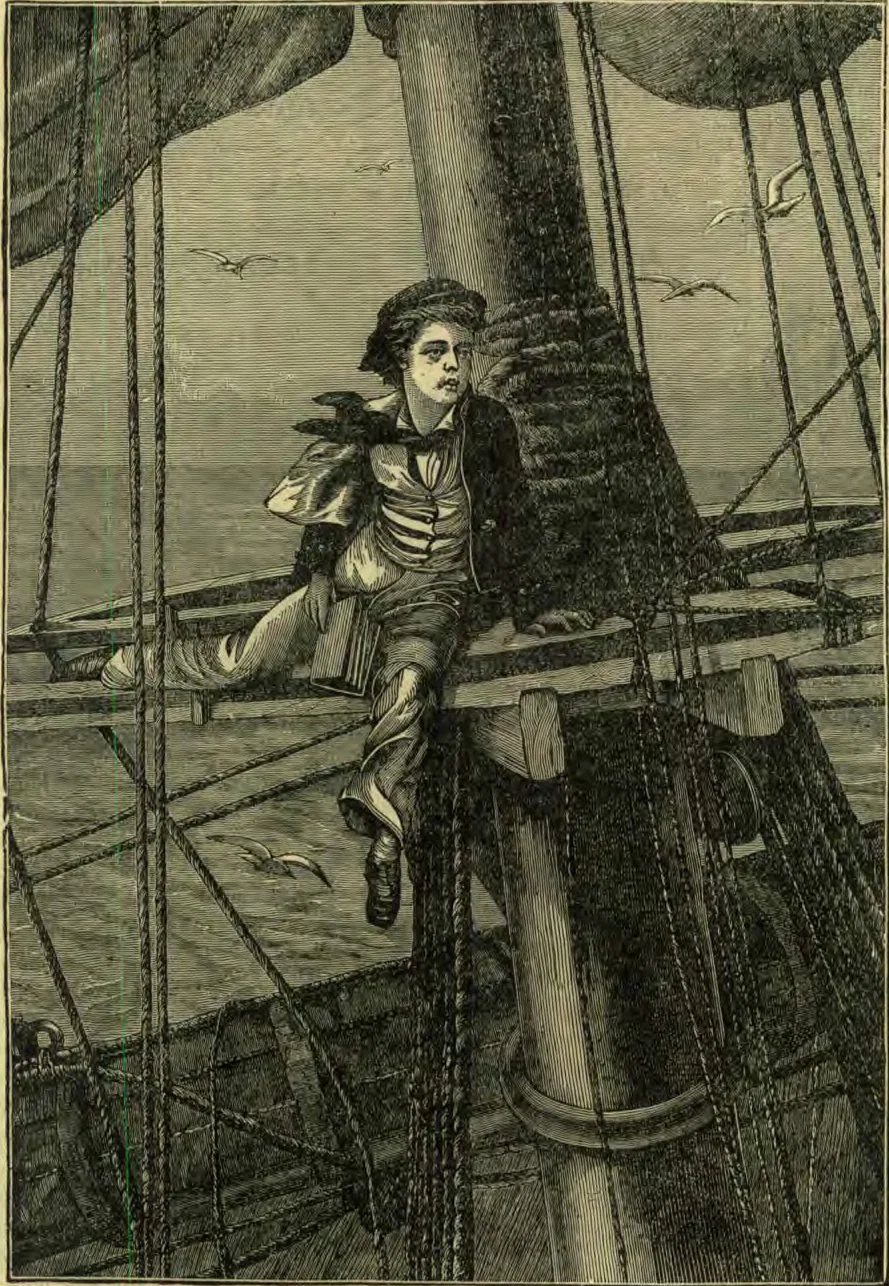
When he had nothing to do around the ship, he liked best to climb the rigging, and look out over the blue sea. There was water, water everywhere, as far as the eye could reach. The sky rounded over all like a huge bowl, and met the sea at the edges. For days and even weeks there was not a vessel anywhere in sight. Lone seabirds sometimes flew over the ship, and lighting on the rigging, would pause awhile to rest their tired wings.
When the voyage was half done, one day the sailors saw a large shark following the ship. The shark is a very powerful fish, with such strong, large jaws that he can bite a man right in two. The sailors were anxious to kill him, but they could not unless he came up nearer. So they fastened large pieces of meat to a chain, and let it overboard. Then they meant to thrust a sharp iron through him as soon as he came near enough. But they could not tempt him to stir away from the stern of the ship.
The next day the captain sent Jack up to the masthead to see if there were any vessels in sight. He could see nothing but water and sky; so he started down. But somehow his foot slipped, and losing his hold, he struck on a rope, and was whirled into the sea.
“Man overboard!” rang through the ship. The sailors rushed to the ship's side, and there was Jack struggling with the waves.
“Catch the rope!” shouted the first mate; and he hurled a coil with all his strength at Jack.
“Now hold on!” he shouted once more, as Jack seized the rope. Then they quickly hauled him out of the water, and placed him on deck. He had never once thought of the shark. Now that he was safe, he began to look for him.
“Sure enough, where is he?” cried the sailors. They rushed to the other side of the deck, and there he was, gliding quietly along in the water. He did not know what a fine meal he had missed.
You may be sure Jack was very glad to escape the jaws of this savage fish. I think he thanked God very earnestly that night for his care over him.
Jack is not this boy's real name; but the story of his wonderful escape from the shark is all true. He grew up to be a very good and useful man. After a time he left the sea. Then he went about from city to city, trying to help people to love Jesus and do right.
W. E. L.

Letter Budget.

VIVIAN L. HOWARD, of Oxford Co., Mo., writes: “I am still a reader of the INSTRUCTOR, and like it very much. Papa gave me the money for helping him in haying time, so I can pay for my own paper. I went out canvassing for it once, but did not get any subscribers; but I am going to try again. I like all the pieces in the INSTRUCTOR, especially Uncle Ide’s Foreign Travel. Mamma is sick, so I have to help her, and stay with her when papa is away. I have a little garden of my own. I like flowers very much. I have been taking music lessons the past year. I am nine years old. I study Bible Lessons, No. 1.”
We shall expect you to write again, Vivian; and we know our little friends will wish you to do so after reading your interesting letter.
MINNIE RICHARDSON, in writing from Colusa Co., Cal., to renew her subscription for the INSTRUCTOR, says: “I like the paper very much. There is no Sabbath-keeper living near us, though my mamma keeps the Sabbath as well as she can, and I try to keep it with her. I shall try to keep it better in the future. I have but one sister at home. She is fourteen, and I am twelve years old. We go to day school eight months in the year. I can write, but I did not know just how to write this letter, and so I got mamma to help me. We like to read the Budget. My sister says she would like to write sometime. My papa is a farmer. He says he believes the seventh day is the Sabbath, but that he hasn’t time to keep it. Since writing the above, I have obtained one subscriber for the INSTRUCTOR.”
Minnie says she shall try to keep the Sabbath better in the future. Shall we not all try to do so, remembering that it is God’s time? Not any of us want the Judgment to reveal that we have robbed God by doing our own work and ways upon his holy day.

THE BIRD’S SONG IN THE NIGHT.

When Ada woke one summer night (Asleep for hours she’d been), And saw outside her window some Moon-flowers peeping in; And from the sky the big, round moon Itself looked down on her, And in the whole wide world there seemed To be no sound nor stir.
So silent were all things, her heart Beat with a nameless fear, When suddenly a little bird Near by sang, loud and clear, A pretty, trilling song, that rang Out gaily on the night, As though the singer’s heart was full Of innocent delight.
And as he sang, “Dear birdie, thanks,” The child said, joyfully. “You tell me that if you are not Afraid, I should not be, For the angels who take care of you, Watch over me will keep. Good night, dear bird.” And very soon Once more she was asleep.
—Harper’s Young People.

You have reached the end of this edition.

The Youth’s Instructor · Oct 1, 1884