Your ShelfYour Projects

Signs of the Times, Vol. 37, No. 3.

What Is My Lord to You?

Signs of the Times

Jan 18, 1910

Pacific Press Publishing Association · Mountain View, California · Jan 18, 1910

What Is My Lord to You?

BY M. C. W.
To me He is Day, for His blessed light Struck all of my darkness through; He swept from my soul Despair's black night; He turned my heart from the wrong to right— Say, what is my Lord to you?
He is cleansing Power to my guilty soul, He bore the penalty due, And He touched my heart and He made it whole, And He set my face to the heavenward goal— O, what is my Lord to you?
To me He is Peace, for His righteous life, The life of this blameless Jew, Took away my sin with its awful strife, Took my feet from the path of dangers rife— Soul, what is my Lord to you?
To me He is Strength, for His mighty power, Athrob with His glad life new, Enclosed my soul as in armored tower, Bestowed upon me heavenly dower— O, what is my Lord to you?
To me He is Truth, He's my steadfast One, My Lord, my Friend ever true; He will finish the work He has begun, He will make me indeed an immortal son— Friend, what is my Lord to you?
My Peace, my Light, He is my Love, my Guide, My All—O soul, it is true. Ay, for me He lives as for me He died; In His love I'll trust, in His truth I'll hide— O, what is my Lord to you?

Hosea’s Marriage as an Object Lesson

3006.—W. F.—Hosea 1:2 is considered by eminent scholars and expositors to be simply a figurative description of what Hosea himself saw in vision; that in that degree he went through an experience which he tells to Israel who had proved false to God, in a way to win them to Him. There are others who think that the prophet married a woman who was a pure woman when he married her, but she afterward became corrupt even as Israel left the Lord. Upon the prophet was placed a great burden, and a striking lesson for the children of Israel. If the lesson was a natural object-lesson, it would show what God’s prophets themselves had to suffer in order that they might the more forcibly bring the truth to His children. As to whether it was literal, or a parable revealed to Hosea in vision which he told the people as a reality, we have no certain means of knowing. We may be sure of this, that the prophet was told to do nothing that was in any wise wrong. The course that he pursued was under the explicit direction of the Lord. Certain it is, too, that the relationship which he reveals as existing between himself and his wife was a picture of the relationship which existed between God and the children of Israel. As she is represented as proving false to Hosea, so were the children of Israel proving false to God. The whole thing was given with a view of bringing them back to obedience to the commandments of the Lord. There is no evidence in the record in either way to show that Hosea transgressed the seventh commandment.

3007.—What Is the Added Law?

Please explain Gal. 3:19. Christ said He did not change the law. A minister explained the above text as proof that the law was added until Christ came, and since then it is of none effect. How are we to understand this text?
We can better understand Gal. 3:19 perhaps by comparing it with a scripture that is parallel. We read in Rom. 5:20: “Moreover the law entered, that the offense might abound. But where sin abounded, grace did much more abound.” The apostle here refers to the giving of the law from Mount Sinai. God gave it that sin by the law might be seen to be exceeding sinful. This does not mean that they did not have God’s law before that, because the transgression of the law is sin; “for where no law is, there is no transgression.” Rom. 4:15. But sin has been in the world from the very beginning, because death, which came in consequence of sin, has been here since man fell. See Rom. 5:12, which proves conclusively that sin existed from the very beginning; and if sin existed, the law existed, because “sin is the transgression of the law.” 1 John 3:4; Rom. 3:20; 7:17.
Man by nature has a certain amount of the law written on his conscience, depending on how faithfully he himself walks in harmony with God. If he walks in sin and defilement, his conscience becomes defiled and blunted. The whole world had wandered far from God, so that their consciences were becoming deadened to a sense of sin. That was especially true of God’s children when they came out of Egypt; therefore He gave them the written law in addition to the law that was taught by the precepts of fathers and by holy men; so we read in Deut. 5:22 regarding the giving of the law upon Mount Sinai, “These words the Lord spake unto all your assembly in the mount out of the midst of the fire, of the cloud, and of the thick darkness, with a great voice; and He ADDED no more.” The law which God added, then, is the Ten Commandment law. The apostle Paul tells us that it was “added because of transgression,” added that men might know how sinful sin was; as expressed in Rom. 5:20, “The law entered, that the offense might abound.” Paul tells us that the law showed him to be a sinner, in order “that sin by the commandment might become exceeding sinful.” Rom. 7:13.
How long, in God’s purpose, would the law fill such an office as that? The answer in Gal. 3:19 is, “Till the Seed should come to whom the promise was made.” The Seed, we learn in verse 16, is Christ. The promise is that He should be “heir of the world” (Rom. 4:13), referred to in those words in Ezekiel, who thus speaks of the kingdom of God in this world as represented in Jerusalem: “I will overturn, overturn, overturn, it: and it shall be no more, until He come whose right it is; and I will give it Him.” Eze. 21:27. When Ezekiel spoke, Babylon already possessed the kingdom. Three overturnings were to follow: Medo-Persia, Grecia, and Rome were each to possess it in turn, and then Christ our Lord would come the second time to reign upon the throne of David. The law was added till the Seed should come to whom the promise was made; not the Seed as He was manifest to die for mankind, but the Seed as He would be manifest to restore all that man lost in the beginning. That is the second coming of Jesus Christ. The law was added, given in written form, until Christ should come the second time, in order that men might know how exceedingly sinful they were. After Christ comes the second time, there is no more need of a law to point out sin. That law will be written in the hearts of all God’s children, unchanged from eternity.

3005.—The Human Nature of Christ

Am surprised that you will dare to say that Christ was born of sinful flesh. Nothing could be more contrary to Scripture. It says He was born in the likeness of sinful flesh, but without sin. He was born, created, like Adam, without sin, but subject to all the temptations of man. He was not born of man, but of the Holy Ghost, so that He had not any inherited sin in sinful flesh. If Christ had sinful flesh He could not have been our Saviour. Any other good man could have been as well.
First, we have not said that Christ was a sinner; we have expressly said that He did not sin. In no way did He sin. He was “without sin,” “who did no sin, neither was guile found in His mouth.” Rom. 8:3 tells us that He was “in the likeness of sinful flesh.” But contrary to what our querist says, Gal. 4:4 declares that “when the fulness of time came, God sent forth His Son, born of a woman, born under the law.” So reads the Revised Version; “made of a woman, made under the law,” Common Version. “Under the law” means under condemnation, because He bore our iniquities and was counted even as we, because our sins were upon Him. More than that, the apostle Paul states the great fact, which is patent to all who accept the Word as it is, that He was “made of the seed of David according to the flesh.” Rom. 1:3. Not that He was made like Adam according to the flesh, but like the seed of David according to the flesh. And certainly the seed of David was not sinless flesh, but sinful flesh. If ever a family manifested it in the history of this world, it was manifested through the family of David.
Again we read, “For verily He took not on Him the nature of angels; but He took on Him the seed of Abraham.” Heb. 2:16. “Forasmuch then as the children are partakers of flesh and blood [not Adam, but the children, those who have descended from Adam], “He also Himself likewise took part of the same; that through death He might destroy him that had the power of death, that is, the devil.” Verse 14. “Wherefore in all things it behooved Him to be made like unto His brethren; that He might be a merciful and faithful High Priest in things pertaining to God, to make reconciliation for the sins of the people.” Verse 17.
So instead of saying, “If Christ had sinful flesh He could not have been our Saviour,” we must say that if Christ had not had sinful flesh He could not have been our Saviour; because the very ones that He saves, He saves out of sinful flesh; and therefore He came down to the very lowest depths to which man had fallen, and took upon Himself the nature of fallen man, in order that He might save men that were in that condition, and that every one in sinful flesh might feel that he had a friend in Jesus Christ, who knows all his temptations, all his trials, all his weaknesses; yet He did not sin.
Satan induced man, in whom God was incarnated, to turn from God and become a sinner; therefore sin became incarnated, infleished. Down into the depths of that bondage, the Lord Jesus Christ came, and lived above all the environments, by the simple power of faith in the Father; lived above it perfectly; lived above it always, and did not sin. It is not degrading Christ to say that He in His wonderful love came right down to share what we share, in order that He might make the way plain for us that there was victory. But it is taking away from humanity the hope, and from divinity the manifestation of His love, to say that He did not come down where humanity needed help. No man ever lived but what sinned, no man ever lived but what needed the Saviour; but Christ Jesus came where man needed a Saviour, and overcame for man.

3008.—A Discrepancy

Please explain the discrepancy in numbers between Acts 7:14 and Gen. 46:27.
This is one of the difficulties that is not easy to explain. The best explanation is that Stephen quoted from the Septuagint, which reads as follows: “And all the souls that came with Jacob into Egypt who came out of his loins, besides the wives of the sons of Jacob, even all the souls were sixty-six; and the sons of Joseph who were born to him in the land of Egypt were nine souls. All the souls of the house of Jacob who came with Joseph into Egypt was seventy-five souls.” Had we lived in those days, it might have been very easy for us to see this. The Hebrew Scriptures gave only a part, where the Septuagint seems to have included all. Of course the Septuagint was translated from the Hebrew Bible, but it was evidently translated from a different copy than that from which our Hebrew came. The Septuagint includes all of Jacob’s and Joseph’s descendants.

The Resurrection Hope

3009.—G. A. E. sends a clipping from the Kansas City Weekly Star, and asks us to answer it. But there is nothing in it particularly which needs any answer. It starts out by saying: “There is no death. There are none dead; no waiting for the resurrection.” And yet he quotes the words of Jesus to Mary, “Whosoever liveth, and believeth in Me, shall never die,” which show that those who do not believe in Him shall die, and this clearly shows that there is death. It is expressly said of Jesus that He died. Over and over it is said that He was raised from the dead. He tells us, and so also do His apostles, that the dead are waiting a resurrection, and the resurrection will take place at the last day. See John 5:28, 29; Acts 24:15; 1 Cor. 15: 51-54; and 1 Thess. 4:14-18. These and many other passages teach the same great fact that men die. The whole 15th chapter of First Corinthians shows that the only hope that there is set before those who die is the resurrection; for “if the dead rise not, then is Christ not raised: and if Christ be not raised, your faith is vain; ye are yet in your sins. Then they also that are fallen asleep in Christ are perished.” This we think sufficiently shows the unscripturalness of the statement.

Christian Speech and Thanksgiving

3010.—W. F.—Eph. 5:4. Read context. What should not be among God's children? “Neither filthiness, nor foolish talking, nor jesting, which are not convenient: but rather giving of thanks.” Christians should not indulge in filthiness in either act or word, nor in foolish talking. Compare with the other side of the apostle's admonitions in verse 19: “Speaking to yourselves in psalms and hymns and spiritual songs, singing and making melody in your heart to the Lord.” 1 Thess. 5:11: “Wherefore comfort yourselves together, and edify one another.” “Nor jesting” is in some translations rendered “lewd terms;” low jesting; “which are not convenient,” better as in the Revised Version, “which are not befitting,” or becoming to a Christian. Better than these is the “giving of thanks.”

False and True Worship

By Mrs. E. G. White
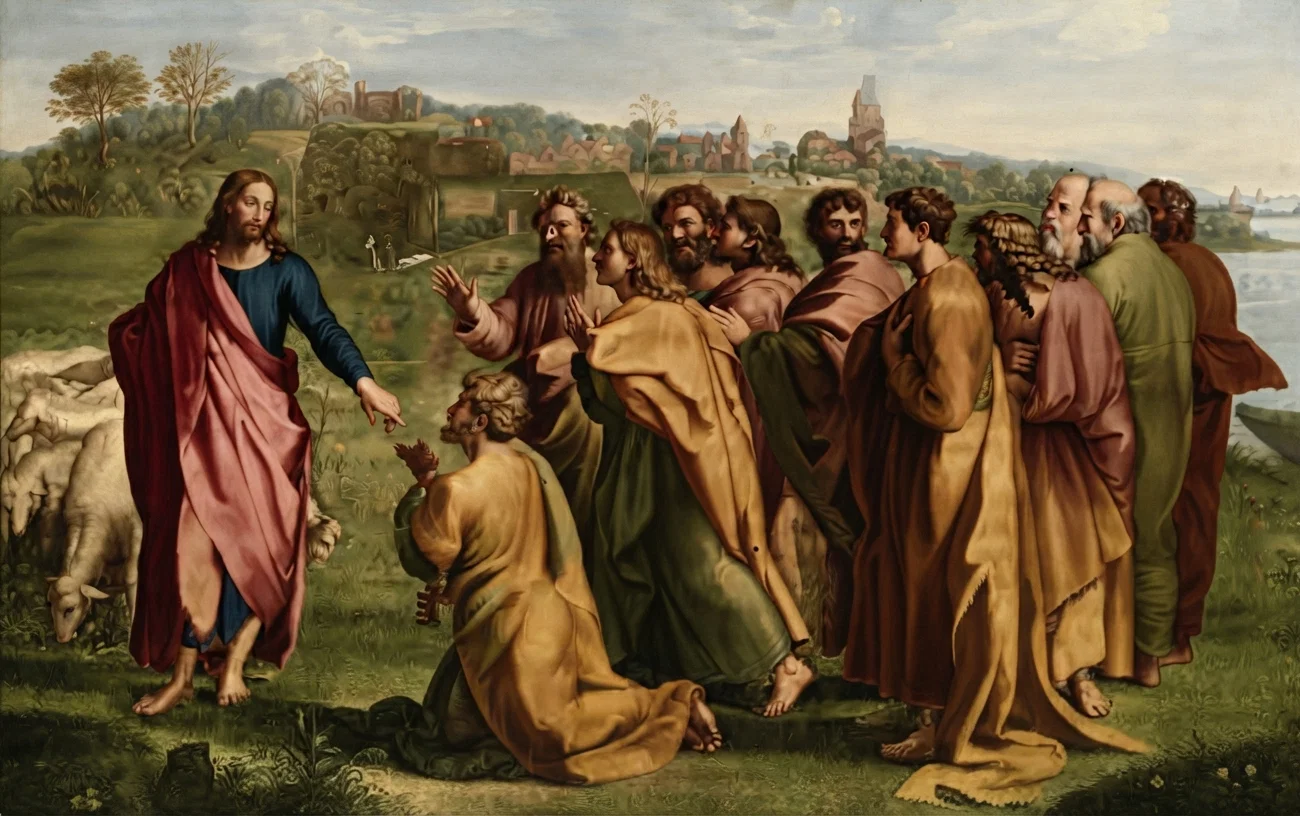
CHRIST'S COMMISSION TO PETER
Raphael
CHRIST'S COMMISSION TO PETER Raphael
"UNTO certain which trusted in themselves that they were righteous, and despised others," Christ spoke the parable of the Pharisee and the publican. The Pharisee goes up to the temple to worship, not because he feels that he is a sinner in need of pardon, but because he thinks himself righteous, and hopes to win commendation. His worship he regards as an act of merit that will recommend him to God. At the same time it will give the people a high opinion of his piety. He hopes to secure favor with both God and man. His worship is prompted by self-interest.
And he is full of self-praise. He looks it, he walks it, he prays it. Drawing apart from others as if to say, "Come not near to me, for I am holier than thou," he stands and prays "with himself." Wholly self-satisfied, he thinks that God and men regard him with the same complacency.
"God, I thank Thee," he says, "that I am not as other men are, extortioners, unjust, adulterers, or even as this publican." He judges his character, not by the holy character of God, but by the character of other men. His mind is turned away from God to humanity. This is the secret of his self-satisfaction.
He proceeds to recount his good deeds: "I fast twice in the week, I give tithes of all that I possess." The religion of the Pharisee does not touch the soul. He is not seeking godlikeness of character, a heart filled with love and mercy. He is satisfied with a religion that has to do only with the outward life. His righteousness is his own,—the fruit of his own works, and judged by a human standard.

What Trust in Self Means

Whoever trusts in himself that he is righteous, will despise others. As the Pharisee judges himself by other men, so he judges other men by himself. His righteousness is estimated by theirs; and the worse they are, the more righteous by contrast he appears.
His self-righteousness leads to accusing. "Other men" he condemns as transgressors of God's law. Thus he is making manifest the very spirit of Satan, the accuser of the brethren. With this spirit it is impossible for him to enter into communion with God. He goes down to his house destitute of the divine blessing.
The publican had gone to the temple with other worshipers, but he soon drew apart from them, as unworthy to unite in their devotions. Standing afar off, he "would not lift up so much as his eyes unto heaven, but smote upon his breast," in bitter anguish and self-abhorrence. He felt that he had transgressed against God, that he was sinful and polluted. He could not expect even pity from those around him, for they looked upon him with contempt. He knew that he had no merit to commend him to God; and in utter self-despair he cried, "God be merciful to me a sinner." He did not compare himself with others. Overwhelmed with a sense of guilt, he stood as if alone in God's presence. His only desire was for pardon and peace, his only plea was the mercy of God. And he was blessed. "I tell you," Christ said, "this man went down to his house justified rather than the other."
The Pharisee and the publican represent two great classes into which those who come to worship God are divided. Their first two representatives are found in the first two children that were born into the world. Cain thought himself righteous, and he came to God with a thank-offering only. He made no confession of sin, acknowledged no need of mercy. But Abel came with the blood that pointed to the Lamb of God. He came as a sinner, confessing himself lost; his only hope was the unmerited love of God. The Lord had respect to his offering, but to Cain and his offering He had not respect. The sense of need, the recognition of our poverty and sin, is the very first condition of acceptance with God. "Blessed are the poor in spirit: for theirs is the kingdom of heaven."

A Lesson from Peter

For each of the classes represented by the Pharisee and the publican, there is a lesson in the history of the apostle Peter. In his early discipleship Peter thought himself strong. Like the Pharisee, in his own estimation he was "not as other men are." When Christ on the eve of His betrayal forewarned His disciples, "All ye shall be offended because of Me this night," Peter confidently declared, "Altho all shall be offended; yet will not I." Peter did not know his own danger. Self-confidence misled him. He thought himself able to withstand temptation; but in a few short hours the test came, and with cursing and swearing he denied his Lord.
When the crowing of the cock reminded him of the words of Christ, surprised and shocked at what he had just done, he turned and looked at his Master. At that moment Christ looked at Peter; and beneath that grieved look, in which compassion and love for him were blended, Peter understood himself. He went out and wept bitterly. That look of Christ's broke his heart. Peter had come to the turning-point, and bitterly did he repent his sin. He was like the publican in his contrition and repentance, and like the publican he found mercy. The look of Christ assured him of pardon. Now his self-confidence was gone. Never again were the old boastful assertions repeated.
Christ after His resurrection thrice tested Peter. "Simon son of Jonas," He said, "lovest thou Me more than these?" Peter did not now exalt himself above his brethren. He appealed to the One who could read his heart. "Lord," he said, "Thou knowest all things; Thou knowest that I love Thee."
Then he received his commission. A work broader and more delicate than had heretofore been his was appointed him. Christ bade him feed the sheep and the lambs. In thus committing to his stewardship the souls for whom the Saviour laid down His own life, Christ gave to Peter the strongest proof of confidence in his restoration. The once restless, boastful, self-confident disciple had become subdued and contrite. Henceforth he followed his Lord in self-denial and self-sacrifice. He was a partaker of Christ's sufferings; and when Christ shall sit upon the throne of His glory, Peter will be a partaker in His glory.
The evil that led to Peter's fall, and that shut out the Pharisee from communion with God, is proving the ruin of thousands to-day. There is nothing so offensive to God, or so dangerous to the human soul, as pride and self-sufficiency. Of all sins it is the most hopeless, the most incurable.

Gradual Departure

Peter's fall was not instantaneous, but gradual. Self-confidence led him to the belief that he was saved; and step after step was taken in the downward path, until he could deny his Master. Never can we safely put confidence in self, or feel, this side of heaven, that we are secure against temptation. Those who accept the Saviour, however sincere their conversion, should never be taught to say or to feel that they are saved. This is misleading. Every one should be taught to cherish hope and faith; but even when we give ourselves to Christ and know that He accepts us, we are not beyond the reach of temptation. God's Word declares, "Many shall be purified, and made white, and tried." Only he who endures the trial will receive the crown of life.
Those who accept Christ, and in their first confidence say, I am saved, are in danger of trusting to themselves. They lose sight of their own weakness and their constant need of divine strength. They are unprepared for Satan's devices; and under temptation many, like Peter, fall into the very depths of sin. We are admonished, "Let him that thinkest he standeth, take heed lest he fall." Our only safety is in constant distrust of self, and dependence on Christ.
It was necessary for Peter to learn his own defects of character, and his need of the power and grace of Christ. The Lord could not save him from trial, but He could have saved him from defeat. Had Peter been willing to receive Christ's warning, he would have been watching unto prayer. He would have walked with fear and trembling lest his feet should stumble. And he would have received divine help, so that Satan could not have gained the victory.

Established

It was through self-sufficiency that Peter fell; and it was through repentance and humiliation that his feet were again established. In the record of his experience every repenting sinner may find encouragement. Tho Peter had grievously sinned, he was not forsaken. The words of Christ were written upon his soul: "I have prayed for thee, that thy faith fail not." In his bitter agony of remorse, this prayer, and the memory of Christ's look of love and pity, gave him hope. Peter's repentance was accepted by the sin-pardoning Saviour.
The same compassion that reached out to rescue Peter, is extended to every soul who has fallen under temptation. It is Satan's special device to lead man into sin, and then leave him, helpless and trembling, fearing to seek for pardon. But why should we fear, when God has said, "Let him take hold of My strength, that he may make peace with Me, and he shall make peace with Me"? Every provision has been made for our infirmities, every encouragement offered us to come to Christ.
Christ has pledged Himself to be our substitute and surety, and He neglects no one. He who could not see human beings exposed to eternal ruin without pouring out His soul unto death in their behalf, will look with pity and compassion upon every soul who realizes that he can not save himself. He will look upon no trembling suppliant without raising him up. He who through His own atonement provided for man an infinite fund of moral power, will not fail to employ this power in their behalf. In the whole satanic force there is not power to overcome one soul who in simple trust casts himself on Christ. "He giveth power to the faint; and to them that have no might He increaseth strength."

Mistaken Leadership

A young man who thought he had been converted in some special meetings, joined the church, and for a while left his old companions. It was not for very long, however. The church people "froze him out," to use his expression. He contended that they did not make him feel as much at home as they might have done. They were at fault, without doubt; but the young man was more so. Instead of following Christ, he was following his own longing for social recognition.
And this is sometimes the case with prospective church-members, and again with those who are already members. Instead of being controlled by their own or their fellows' mistakes and offenses, all men need still to give to Christ the control of their lives. Christ is not divided, nor has Christ offended. Shame the day, then, when any man called a Christian could be turned away from the Master by a fellow disciple's fault! Judas is not our leader — no, not even Peter, but Jesus the Christ. Not until the honest conscience has found a flaw in Him need any disciples think necessary to leave the fellowship of His followers.—Sunday School Times.

Condition of World and Church

THIS is the solemn hour of God's judgment. It is court week in heaven. Before this heavenly tribunal is passing in grand review the history of the human race. The destinies of men hang upon the decisions to be rendered, and by far the most practical and pertinent query for us to consider is the condition of the world to-day, and our relationship to the judgment hour. What is the situation presented in view of this solemn investigation now taking place? Is the world prepared to stand in the great day of the Lord? Will the nations of men pass muster in the eyes of the great Reviewer? Will the professed church of God stand the scrutiny of the great Judge? Let us glance briefly at the existing conditions.

Heathendom

Two thirds of the world's population are in the darkness of heathenism. They know no God of love; they have no faith in the blood of an atoning Saviour. Their gods are but the works of their own creation, the deification of their own sinful passions and propensities. As expressed by the apostle Paul, they are "without Christ, being aliens from the commonwealth of Israel, and strangers from the covenants of promise, having no hope, and without God in the world." Such is the condition of those who sit in the darkness of heathenism in our own day as truly as in the days of the apostles.

So-Called Christian Nations

In turning to so-called Christian nations of the earth, to those countries which for long years have shared the blessings of the Gospel of the Lord Jesus, we might naturally expect to find a better condition of affairs. Unfortunately such is not the case. Crime has reached a higher degree of enlightenment, and carries on its work with a certain delicacy and refinement; but it is still as vigorous, as insidious in its workings, as baneful and destructive in its results. In fact, among the western nations of the Old World and the nations of the Western Hemisphere crime has reached its highest scientific development at the present time.

Conditions in National Life

Intensity has taken possession of the nations of men to-day; wild dreams of conquest, the creation of large standing armies, the great increase of naval armament, the vying with each other to create or secure the most effective death-dealing instruments, the diplomatic play in formation of alliances and counter-alliances, only indicate the attitude of every nation of the world toward all of its fellows. Outwardly there is a portentous calm, inwardly a smoldering fire, which, Vesuvius-like, may break forth at any time, carrying carnage, bloodshed, universal war, and destruction among the nations of men. We sleep to-day in the crater of a volcano.
Closely akin to this national conflict is the controversy now existing between the social classes. Class is arrayed against class, organized capital on the one side and organized labor on the other. These confront each other in what promises to be the mightiest class struggle that the world has ever witnessed, compared with which the conflict between patrician and plebeian in ancient Rome sinks into insignificance. The growing conditions make this conflict more and more imminent. Every thoughtful observer, whether he may belong to either of these classes or not, must look with grave concern upon the outcome of this industrial conflict. We know not what a day may bring forth.
Another marked feature of national life is the corruption which exists in the national, state, and municipal affairs of the several countries of the world. Even in our own country of vaunted liberty and honesty, some of the highest offices are bought and sold. The votes of state legislatures are determined by party gold. Franchises which rob the people of thousands of dollars, are gained or extended as their owners are able to control the votes of those in official positions. The officers of justice close their eyes to crime, and too often connive with the law-breaker. True, there are exceptions to these conditions. God has many a noble man in high office who is using his influence against the great incoming tide of evil, and is trying to uprear the standard of truth in the midst of the gathering darkness. Yet the situation in national life presents indeed a sad picture.

Social Conditions

The condition of society to-day is aptly pictured by our Saviour when He likens it to the situations existing in the days of Noah and the days of Lot. In pleasure, in self-seeking, in vain, pretentious display, in eating and drinking, in wanton sin and licentiousness, in the mad, wild rush for gold and glory, the world is choosing its own way, and forgetting God. Note the great increase in intemperance, and the growth of its twin evil, licentiousness. The grog-shop and the brothel travel hand in hand. Insidious and insinuating, hydra-headed and adaptable, these twin evils are making their influence felt in all grades of society at the present time. The fairest of our maidens and the flower of our men become the prey. The satisfying of wanton pleasure in ministry to the appetite, the pride, and the passions is the spirit possessing the idle multitude at the present time.

The Home and Personal Life

The home is the bulwark of society even as society is the bulwark of the nation. With the nation corrupt, with society far departed from God, there may yet be hope if the home life be pure, if such a condition were possible. But in tracing the effect back to the cause, we find that the departure from the simplicity of home life in the world to-day is responsible for many of the evils enumerated above. There can be no truly Christian organization without Christian experience in the lives of those who compose the organization. Society can be purged of moral corruption only as the homes and the individuals which form the foundation of society are pure and undefiled. Chief among the dangers threatening the home to-day, is that of alienation. How many homes are made desolate, how many children left without the care and protection of parents, because alienation has done its deadly work! Divorce and separation result. This is a time when natural affection is fast waning. In many of our communities noted for their morality and home life, there is one divorce to every four marriages. The old-time simplicity of family life is fast departing.

The Condition of the Church of God

O, if the church of God would realize its responsibility in the midst of the growing darkness! If with clarion voice it would sound an alarm to the nations of men, rebuke sin and iniquity in high places, and raise a standard and beacon light for the succor of those who are now wandering in error's paths! But alas! the great church of God itself has become permeated by the evil influence which surrounds it. Religion to-day has become too much a form and theory. It is used too much as a profession for personal ends and material benefit. The vital breath of heaven, which once energized it for the conflict, has been lost; and the church which should have stood in the might of God, breasting the tide of evil, stands weak and powerless, totally unable to meet the situation. Above its altars an unseen hand has written "Ichabod."
The apostle Paul, in his letter to Timothy, thus describes the condition of the church of God to-day: "This know also, that in the last days perilous times shall come. For men shall be lovers of their own selves, covetous, boasters, proud, blasphemers, disobedient to parents, unthankful, unholy, without natural affection, truce-breakers, false accusers, incontinent, fierce, despisers of those that are good, traitors, heady, high-minded, lovers of pleasures more than lovers of God; having a form of godliness, but denying the power thereof: from such turn away." 2 Tim. 3: 1-5. Here is an enumeration of eighteen different sins which would be found among those who possess a form of godliness but in their lives deny the power of the profession made. Step by step the church of God has been retreating. It has ceased to be an aggressive, uncompromising moral force against the hosts of sin. True, we hear of its philanthropy of slum work, of the erection of orphanages, of its efforts in the halls of Congress to enact religious measures; but what of its vital godliness, the personal piety of its members? Does it stand in the purity and simplicity of Christian living, meekly and humbly following in the steps of the lowly Jesus? or has it degenerated into a great social, fashionable organization? We fear too much the latter. This, in brief, is the condition existing in the world and in the church of God. No optimistic outlook do these conditions present; and from a human standpoint the situation would appear well-nigh hopeless. Unpleasant indeed they are to contemplate; but we must not close our eyes to unpleasant things, but seek rather the remedy for bettering the conditions which exist.
And we are not alone in viewing the situation in this light; for even though Israel has fallen by its iniquity, God still has faithful children in every church and in every denomination; and these faithful ones, by whatever name they may be known, are burdened over the sins of Christendom. They deplore the conditions which exist, and mourn for the glory which has departed. With grieving hearts they long for a revival of old-time goodliness. Day by day their prayers ascend to high heaven, "Spare Thy people, O Lord, and give not Thine heritage to reproach." Will God heed this cry? Will He abandon His children? We must remember that even in the darkest hour light breaks forth from unknown quarters. It was when all seemed lost that Jesus appeared as the Saviour of men.
The doom of Sodom and of Nineveh was not without offers of mercy. The morning-star of the Reformation appeared from an unexpected quarter, when all the world seemed hopelessly sunken in the superstition and darkness of the middle ages. God's opportunity is best afforded in the hour of weakness. The condition of the world and the church to-day demands that God should again speak. In the very nature of the case, there is demand for a message of reproof and healing. His true and tried ones in every church need to be awakened to the dangers which exist. The nations of men need warning of the impending judgment, and afforded an opportunity for repentance of life unto salvation. That such a message is due the world to-day, and that it will be given to the world in the loving and tender mercy of our God, let the succeeding articles of this symposium demonstrate.

To Live Is Christ

YES, if He will that I should die, If in His plan 'twere best that I Should die, yea, die for Him, My faith would grasp His saving power, And I could bear e'en death's dread hour — And I could die for Him.
But that test may not be for me; Mayhap death's power I shall not see — I may not die for Him, But live to labor day by day, Walk where the Master leads the way — And I may live for Him.
So tho my faith to-day is strong That I could die, and with a song — Could die, yea, die for Christ — My purpose evermore shall be That all the world may know and see For me to live — is Christ. Max Hill.
Continue reading: The Healing Message