The Youth’s Instructor, Vol. 28, No. 52.

CHRISTMAS GIFTS

The Youth’s Instructor

Dec 22, 1880

S. D. A. Publishing Association · Battle Creek, Mich. · Dec 22, 1880

CHRISTMAS GIFTS.
CHRISTMAS is the most universal and widely celebrated of holidays. Each nation, American and European, has its own festivals peculiar to itself, yet one and all unite to do honor to the natal day of Christ,—to sing his praises, to revere his name.
It is pleasant indeed to think that within the same twenty-four hours in which we are gathered in our homes, enjoying the Christmas cheer, the day is being celebrated by thousands of families nearly over the whole habitable globe.
Then, too, the gifts that Christmas brings! pointing us back, as they do, more than eighteen hundred years to the time when God gave his Son a Christmas gift to the world, as an evidence of his divine love to all mankind. May the celebration of this day vividly recall to millions of minds the story of Christ’s mission to earth.
That Christmas may be truly a happy day, it must not in the least degree be a selfish one. In bestowing our gifts, they should not all be to near and dear friends; but the widow and orphan, the homeless, unemployed, and miserable should be remembered. Well indeed it is that this day should bring something of joy and gladness to the hearts of those to whom happiness is almost a stranger! Well indeed, if Christmas could be made the means to lead some of these to Him whose birthday it commemorates.
Then let us celebrate this Christmas in such a way that it may become more truly Christian than ever before. Let us unite in the praise song that floated over the plains of Bethlehem and was echoed by the mountains of Judea, “Glory to God in the highest.” And God grant that the proclamation of “Peace on earth, good-will to men” may extend to all our homes! V. A. M.
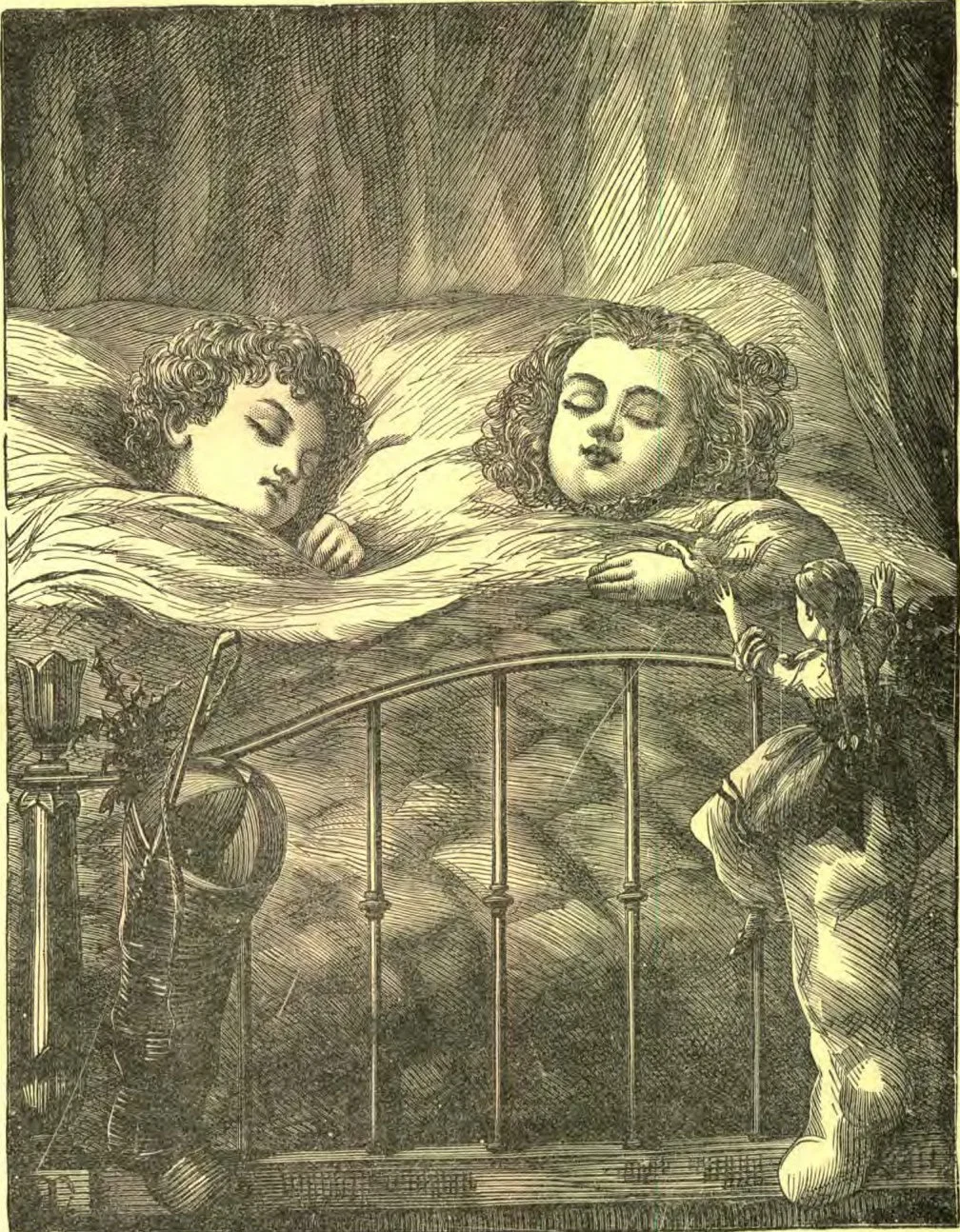
CHRISTMAS EVE.
CHRISTMAS EVE.

AN OFFERING

CHRIST of the manger, the garden, the cross! We bring our poor hearts as an offering to thee; In thy birth we have hope, In thy death we have life; Oh, touch us and cause us thy beauty to see. We will join with the angels on Bethlehem's plains, Our hearts sing responsive to heavenly strains; Glad tidings of joy in the world we proclaim, Salvation to all in the One hallowed name; Evermore may thy light be our guide through the gloom, Until “ashes to ashes” we sleep in the tomb; At last, washed in thy blood, and redeemed by thy grace, We will dwell, blessed Lord, in the smile of thy face.

Good Tidings of Great Joy

“BEHOLD, I bring you good tidings of great joy, which shall be to all people. For unto you is born this day in the city of David a Saviour, which is Christ the Lord.”

VALUE OF CHARACTER.

Mr. W. H. Baldwin recently delivered an address before a body of young men in Brookline, Mass., which is especially valuable on account of the speaker’s long association with the interests of young people.
“The brave young man,” said the speaker, “is the one who stands boldly up in the presence of companions and positively refuses to do that which his conscience tells him is wrong, when tempted, as so many young men are, and so very often. He is the brave young man who has the courage to say no, or to say yes, decisions which shall be at the time based upon the prompt action of his God-given conscience, the great guide and dictator which God has so kindly given to each and every child of his creation.”
“The coward is the young man who cannot, or rather does not, stand the pressure of evil companions or friends who tempt or urge him, and who, though he knows what is right, is weak, has not the moral courage he should possess,—in fact, he is a coward.
“Abraham Lincoln was once called upon to address some young people. He responded to the call, but said he would not attempt to give them an address, but rather a short sermon. The sermon was as follows: ‘Don’t swear, don’t gamble, don’t lie, don’t cheat, don’t steal, don’t drink, don’t smoke, don’t chew; love God and man, and be happy.’”
Our cities are full of young men seeking employment. The question is often asked, What kind of young men are needed in the city? To this question a part of the address of Mr. B., who has large acquaintance with the business men of the country, makes a conclusive answer.
“Young men of character are in demand. Young men without character are not wanted by business men and others in need of assistants.”
— Youth’s Companion.

WHY DECEMBER 25th?

“Father,” said Emma Sherman, “at prayers this morning you said we called this day Christmas because it was the day of the year on which Jesus was born. Is that strictly true?”
“I cannot say that it is,” replied Mr. Sherman; “but for more than fifteen hundred years the 25th of December has been accepted as the birthday of Jesus.”
“Why, father, that carries us back to within four hundred years of the birth of Christ!”
“Yes; and it seems that a tradition so old as that should have some good foundation.”
“Is there any foundation, father?”
“Yes; the old writers, Justin Martyr, Chrysostom, and Tertullian tell us that in the public archives at Rome a registry existed of the census under Augustus Cæsar, the Roman emperor, by which the Lord’s birthday was established.”
“How came it to be generally accepted as our Saviour’s birthday?”
“Why, sometime between the years 337 and 352 A. D., Julius, bishop of Rome, appointed it to be so observed; and Chrysostom, who lived in Antioch, in Asia, wrote in the year 388 that it was only within ten years of that time that the churches of the West had made known to the churches of the East that the 25th of December was the day of Christ’s nativity. But he says that the Christians at Rome had known it before through the records of the taxing preserved at Rome, which are mentioned in the second chapter of Luke. Before that time the churches of the East had celebrated the 6th of January as Christ’s birthday. After that time (the end of the fourth century), all the churches, both in the East and in the West, have celebrated the 25th of December as our Saviour’s birthday.”
“But, father, was it not too cold in December for the flocks and shepherds to be in the fields at night?”
“Not in that climate. Travelers tell us that the weather is very pleasant and agreeable in December in Southern Palestine. The earth is fully clothed with rich verdure, and there is generally an interval of dry weather between the middle of December and the middle of February, so that the period about Christmas, though coming in winter and in the rainy season, is generally one of the loveliest periods in the whole year. Tobler, a traveler, says the weather about Christmas is favorable to the feeding of flocks, and is often most beautiful. During December the wind begins to blow from the south and south-west, which brings rain and warm weather, and thus hastens forward vegetation.”
“So, then, father, as far as we know, Christmas-day is as likely to be the real day of our Saviour’s birth as any other?”
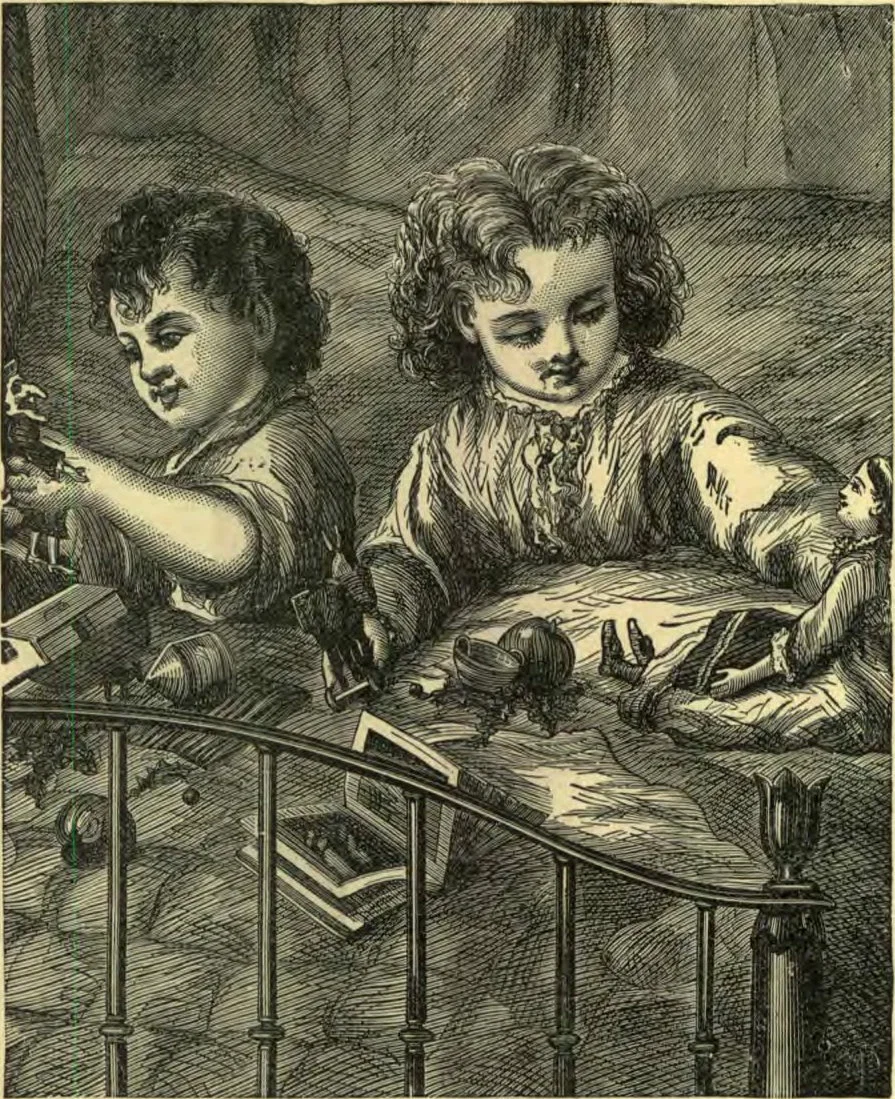
CHRISTMAS MORNING.
CHRISTMAS MORNING.
“Yes; it has most in its favor. And since it is now so generally observed as such, there is no likelihood nor necessity of any other day ever being substituted for it. God’s great Christmas-gift to man was the infant Saviour. So we have established the custom of making gifts and performing acts of charity as a token of our good-will.”—Kind Words.

ORIGIN OF THE CHRISTMAS-TREE.

Various origins are assigned to the Christmas-tree. Dr. Doran claims that its birthplace was in Egypt, and that the ceremony was in force long before the days of Antony and Cleopatra. The tree used was the palm, which, putting forth a shoot each month, symbolized the completion of a year. In Italy a fir-tree was employed, and its pyramidal tips were decorated with burning candles in honor of Saturn, whose festival was observed from the 17th to the 21st of December.
Those who claim a German origin, state that a tree was used in early times in honor of the goddess of spring; but after the introduction of Christianity, its symbolical character was transferred to the Christmas-tree. The evergreen fir-tree became an emblem of eternal spring. The lights symbolized Him who is the light of the world, and the gifts were to remind us that God gave his only Son for the world's redemption.

Home, Mother, and Heaven

HOME, mother, and Heaven are among the dearest words on earth.

LESSONS FOR CHILDREN.

LESSON CIV.—RECAPITULATION.

For some years, David, with a few faithful followers, went from place to place among the rocks and mountains, hiding in caves, and often finding it very hard to escape from Saul, who was so intent on killing him that, with the aid of his soldiers, he hunted him as he would a wild beast. On one occasion, he slew eighty-five of the priests, because they had given David and his men some bread. So long and bitter was Saul’s persecution, that David was obliged to seek refuge among the Philistines. At last, Saul was in great trouble; for the Philistines came up against him, and since the Lord would not hear him, he could get no counsel. Then he went to the witch of Endor, but got no comfort; for he was told that he should die the next day.
When David heard that Saul and Jonathan had both been killed in battle on Mount Gilboa, he was very sorrowful; for he had a noble spirit, that could not rejoice at the death of an enemy.
As soon as Saul died, David was called to Hebron, and anointed king. For seven years he reigned over the tribe of Judah only, while Ish-bosheth, the son of Saul, reigned over the other tribes. Ish-bosheth was killed by two of his servants, and David was invited to reign over the whole land.
Then the Philistines came up against him, but David defeated them in every battle. Gathering thirty thousand chosen men, David went down with great pomp to bring up the ark from Kirjath-jearim, but contrary to what the Lord had taught, he tried to bring the ark on a cart. Uzzah was smitten for touching it, and the ark was left at the house of Abinadab. Three months afterward, David brought it up to Jerusalem in a proper manner, and put it in a tent which he had prepared for it. David, having built himself a palace of cedar, was very anxious to erect a beautiful temple for the ark of God. This the Lord could not allow him to do, because he had been a man of war; but told him that his son Solomon should build such a temple, and that he himself might prepare materials for it. In the years that followed, David had many wars, and subdued his enemies on all sides. From the rich kings on the north-east, he took much gold and silver, which he laid up to be used in building the temple. In his prosperity, King David looked up all the unfortunate members of Saul’s family, and took great pains to furnish them with everything they could need.
In one thing David did wickedly. He took the wife of Uriah for himself, and then ordered that her husband should be put in the front of the battle, that he might be killed. Then the prophet Nathan came to David, and by a beautiful parable convinced him of his sin, and led him to repent of it.
Of all David’s sons, Absalom was the most beautiful, but his pride and rashness led him to do very many wicked things. He caused his own brother to be put to death, and for this, was obliged to go far from home and remain there for years. When his father allowed him to return, he repaid the kindness by taking every unfair means to turn the hearts of the people against the king. At length he went to Hebron, and sent messengers throughout all the land to gather the people together, to make him king. When David heard of this, he fled from Jerusalem, with a few faithful followers, and escaped beyond the Jordan. Many men on the east of the Jordan and from other parts of the country came to the help of David; and when Absalom came on with an army, there was a great battle. But the Lord was with David; Absalom was slain, and his followers fled every man to his own home. When the men went out to battle, David gave them a special charge not to harm Absalom; and when he heard that Absalom was dead, his grief was beyond expression. He cried out, “O my son Absalom! my son, my son Absalom! would God I had died for thee, O Absalom, my son, my son!”
Then David returned, and the people, coming out to meet him, welcomed him with joy; then quarreled for the honor of conducting him to Jerusalem.
After this, David displeased the Lord by numbering the people; and a plague was sent, by which many thousands of them perished in a few hours. Then David was greatly distressed for the innocent people, and besought the Lord so earnestly that the plague was stayed.

QUESTIONS.

  1. For some years, what did David have to do in order to escape from Saul?
  2. How were the priests punished for feeding David and his men?
  3. Where did David finally take refuge?
  4. How was Saul at last brought into trouble?
  5. Describe his interview with the witch of Endor. I Sam. 28 : 8, and onward.
  6. Relate the circumstances of his death.
  7. What were David’s feelings when he heard of the death of Saul and Jonathan?
  8. What call did David have as soon as Saul died?
  9. How long did he reign over the tribe of Judah only?
  10. Who reigned over the other tribes at the same time?
  11. When Ish-bosheth had been slain, what was David invited to do?
  12. What success did David have against the Philistines, who came up to make war?
  13. Relate David’s experience in bringing the ark up to Jerusalem.
  14. What was David anxious to do for the Lord?
  15. Why was he not permitted to do as he desired?
  16. What did David do in the years that followed?
  17. What did he do with the riches taken in war?
  18. What kindness did he show to the family of Saul?
  19. In what thing did David do wickedly?
  20. How was he convinced of his sin, and led to repent of it?
  21. Relate the parable.
  22. Describe the person and character of Absalom.
  23. Why did he have to go into exile?
  24. When his father allowed him to return, how did Absalom repay the kindness?
  25. What course did he at length take?
  26. What did David do when he heard of the conspiracy?
  27. Who joined David after he had escaped beyond the Jordan?
  28. What happened, when Absalom came on with an army?
  29. What became of Absalom and his followers?
  30. What were David’s feelings when he heard of the death of his rebellious son?
  31. What did he say?
  32. How was David received as he returned to Jerusalem?
  33. How did David displease the Lord after this?
  34. What followed?
  35. How was the plague stayed?

Second Sabbath in January.

LESSON CV.—RECAPITULATION; THE REIGN OF SOLOMON.

Adonijah, the son of David, sought to take the throne, even before his father’s death; but David found it out, and had Solomon anointed king at once; for the Lord had said that Solomon should reign on the throne of his father. David charged Solomon to be strong, and show himself a man; to walk in the way of the Lord, and keep his commandments.
Solomon asked the Lord for an understanding heart that he might discern good from bad. The Lord was so pleased with this, that he gave him, not only wisdom, but riches and honor in great abundance. He reigned over all the country from Egypt to the river Euphrates, and of the people of his kingdom it is said that they were as the sand of the sea-shore for multitude. He kept so many attendants that the amount of provisions required daily for his table was enormous. He had forty thousand stalls of horses, and twelve thousand horsemen; and the Bible says, “He was wiser than all men, . . . and his fame was in all the nations round about.” He was wise, not only in governing the people, but in understanding the works of God. He had a complete knowledge of plants and animals of all kinds. But the crowning work of Solomon’s life was the building of the temple. It was built of stone from the quarries, and cedar from the mountains of Lebanon. Every piece was so nicely prepared before being brought to the spot, that all went together without the sound of tools.
For seven years and a half, the “noiseless fabric grew”; and when it was completed, with all its beautiful carvings and gold platings, its two holy places with all their sacred vessels, the magnificent court with its great brazen sea standing upon twelve brazen oxen, it was called the glory of the whole earth.
When all was ready, the people came together at Jerusalem to dedicate the temple. And when their song of praise went up, the glory of the Lord so filled the temple, that the priests could not enter it. Then Solomon prayed, and when he had finished, fire came down out of heaven, and consumed the sacrifices which had been laid upon the altar. Afterward, the Lord appeared to Solomon in a dream, telling him that his prayer was heard, and that the house which he had built was accepted. He also told him that if the people should turn to other gods, the temple would be destroyed.
Among others who came to see Solomon was the queen of Sheba. She was so astonished at his wisdom that she cried out, “Blessed be the Lord thy God which delighted in thee, to set thee on the throne of Israel.”
Solomon became so wealthy that all his drinking vessels, and all the vessels of his house were of pure gold. He made a great throne of ivory, and overlaid it with gold. He also laid up enormous treasures of gold in the form of targets and shields.
But notwithstanding all Solomon’s wisdom and prosperity, his heart was finally turned away from the Lord by the idolatrous wives that he had married out of other nations. This shows how unsafe it is for any one to disobey God, even in the smallest things. After Solomon had forsaken the Lord, enemies began to spring up and trouble him. The most dangerous of these enemies was Jeroboam, a valiant man whom Solomon had made ruler of the house of Joseph. The prophet Ahijah had said that Jeroboam should rule over ten of the tribes of Israel. So Solomon tried to kill him, but Jeroboam fled to Egypt where he stayed until Solomon was dead.
Rehoboam took the throne of his father, but refused to yield to the request of the people when they asked to have their taxes made lighter. So the kingdom was divided, and ten of the tribes chose Jeroboam to rule over them. Jeroboam feared that if the people all went up to Jerusalem to worship, they would after a while forsake him, and go over to the king of Judah. So he made two golden calves, and set them up for the people to worship, one at Bethel, and the other at Dan. Although the Lord warned Jeroboam of his wickedness, he kept on, and led the people into idolatry. After his death, his son Nadab reigned two years, when he was killed by Baasha, who reigned twenty-four years. After Baasha, his son Elah reigned two years. Then Zimri, after reigning seven days, gave place to Omri, who reigned twelve years, and was succeeded by Ahab. All these kings were bad men, and worshiped idols. Ahab not only worshiped the calves which Jeroboam had made, but built a temple, and set up an altar to Baal, the god of the Zidonians. It was in the days of Ahab that, in answer to the prayer of Elijah, there was no rain for three years and a half.

QUESTIONS.

  1. Which one of David’s sons undertook to take the throne of his father?
  2. How was he prevented from doing so?
  3. What had the Lord shown in regard to this matter?
  4. What charge did Solomon receive from his father?
  5. For what did Solomon ask the Lord?
  6. How did the Lord show his approval of Solomon’s choice?
  7. What was the extent of Solomon’s kingdom?
  8. How numerous were the people that he ruled?
  9. What is said of the amount of provisions required daily to supply his table?
  10. What is said of his horses and his horsemen?
  11. What does the Bible say of his wisdom and fame?
  12. In what ways did he manifest his wisdom?
  13. Of what had he a complete knowledge?
  14. What was the crowning work of his life?
  15. Where did he obtain materials for building the temple?
  16. How carefully was every piece prepared?
  17. How long did it take to build the temple?
  18. Give a brief description of the building.
  19. What was it called?
  20. What miracles attended the dedication of the temple?
  21. What did the Lord afterward tell Solomon in a dream?
  22. How did the Queen of Sheba express her astonishment at Solomon’s wisdom?
  23. How did Solomon dispose of his wealth?
  24. How was Solomon led into evil, notwithstanding his wisdom and prosperity?
  25. What lesson may we learn from this?
  26. How was Solomon troubled?
  27. Who was the most dangerous of these enemies?
  28. What was foretold in regard to Jeroboam?
  29. What followed when Solomon heard of this?
  30. How was Ahijah’s prediction fulfilled?
  31. How did Jeroboam lead the people into idolatry?
  32. What kings reigned between Jeroboam and Omri?
  33. Who reigned next after Omri?
  34. Describe these kings.
  35. What new form of idolatry did Ahab introduce?
  36. What remarkable drouth occurred during the reign of Ahab?

Facing Class Difficulties Through Prayer

If you dread the difficulties and responsibilities that meet you in your class, as Jacob dreaded the meeting with Esau, tarry alone at the Peniel of Prayer and look into God's face, and your heart shall grow strong.—W. F. Crofter.

Christmas Eve Snow-Flakes.

ONE Christmas eve, as Deacon Brown Was homeward going from the town, A snow-flake fell upon his nose. Said he: “Well, I declare! it snows! If it will only snow all night, ’Twill give the children such delight. Ah! yes, they’ll think it jolly fun; But there is many a shivering one Will not be glad the snow to see. How many poor there are! Ah, me! Now there is poor old Widow Burr; I ought to have remembered her; And tried to manage in some way To make her happy Christmas day. I’ll do it yet! I’ll send some coal To-morrow morning,—yes, indeed,— And other things that she may need.” And onward cheerily, he went, His heart aglow with kind intent.
Just at that time another flake, As big and cold and wide-awake, Fell plump on farmer Dutton’s eye, As he was looking at the sky, To find what might the prospect be Of a clear Christmas day. Cried he: “‘As sure as I live, it’s going to snow! Don’t know as it’s much matter, though. The fowls are comfortable, I guess. They’re well penned in, and I confess There hain’t nobody round here got A bigger nor a finer lot Of fowls than I. And neighbor Glenn,— Don’t ’lieve he’s even got a hen For Christmas dinner, they’re so poor. Now ’twouldn’t hurt me, to be sure, To take a turkey over there; And chicken too, or perhaps a pair. I reckon more’n likely ’twould Do all of ’em a power of good. I’ll do it, sure’s I live,” said he. “One merry Christmas they shall see.” And off he went with eager will, His kindly purpose to fulfill.
Another frosty snow-flake fell Upon the hand of bright-eyed Nell, As she was passing out the doors Of one of the bright, crowded stores. “Ah! snow!” said she. “Well, let it snow; I’ve not much further now to go.” Into her muff her hand she slipped, And, as she onward gaily tripped, She thought: “How nice a muff to hold And keep one’s hands from snow and cold! There’s cousin Minnie, she has none; Uncle’s too poor to get her one. I wish she had nice things, like me. Why, I do declare! Just let me see! Why could not I buy her a muff? I think I’ve money left enough. I’ll buy it now, this very night, And send it round at morning light, Before she’s fairly out of bed.” And on her errand kind she sped.
While boot-black Jimmie stopped to hear Some Christmas carols, on his ear A snow-flake fell. Cried he: “Hallo! Hurrah! Hurrah! it’s going to snow! I’ll tell yer that’ll be just gay. But there’s poor little sister May A-lyin’ there so sick in bed She can’t so much as lift her head; She couldn’t see it, if ’t did snow. Too bad! she allers loved it so. Look here! I know jes what I’ll do. As soon as that there singin’s through, I’ll take that bit of ev’green tree Here in the street right home with me, An’ fix it up somewhere real straight; An’ don’t I hope ’twill snow fast-rate All night, an’ cover it with snow? An’ won’t it please her mighty though, To see me fetchin’ of it in? ’T will make her chirker than she’s been Since she was took. An’ I declare, I guess I’ve got some cash to spare, To buy somethin’ uncommon sweet An’ temptin’ like for her to eat. An’ she shall have a Christmas, too, The same as other peoples do.” So when he’d heard the singing out, His loving plans he went about.
But oh! ’t would take a week to tell The good the snow-flakes, as they fell, Did all unconsciously achieve Upon that merry Christmas eve,— What suffering ones they brought to mind, What hearts they moved with impulse kind, What chains of selfishness they broke, What Christ-like charity they woke, What tender thoughts they multiplied, What close-shut purses opened wide; And hearts there were that never knew How much the snow-flakes had to do With their unwonted happiness. Such power have little things to bless. —Fanny Percival.

Double Sabbath Lesson Issue Replaces Next Week's Paper

There will be no paper next week; and that the children may not be without a lesson on the Sabbath, this issue contains two lessons.

Call for Short Articles for Columns

We have no space for long articles, but any live article that can be packed into a column, we shall welcome.

LETTER BUDGET.

Clarence Copeland writes us from Sonoma, California. He says: “I am a little boy nine years old. I take the INSTRUCTOR, and like it very much. I keep the Sabbath with my parents. We live nine miles from the nearest Sabbath-school. I want to be a good boy.” To want to be a good boy, Clarence, is the first step toward being one. Now ask Jesus to help you.
Ella Curry, of Mason, Michigan, writes for the first time to the INSTRUCTOR. She says that she likes it very much. She attends day-school, Sabbath-school on the Sabbath, and Sunday-school on Sunday. She likes the Sabbath-school the best of all. She keeps the Sabbath with her mother. Her father does not keep the Sabbath, but says that he intends to by-and-by.
Ottie Stevens, of Fresno, Cal., says that this is his first letter to the INSTRUCTOR, which he has taken for five years. He likes it very much. He is trying to be a good boy.

You have reached the end of this edition.

The Youth’s Instructor · Dec 22, 1880