The Youth’s Instructor, Vol. 27, No. 15.

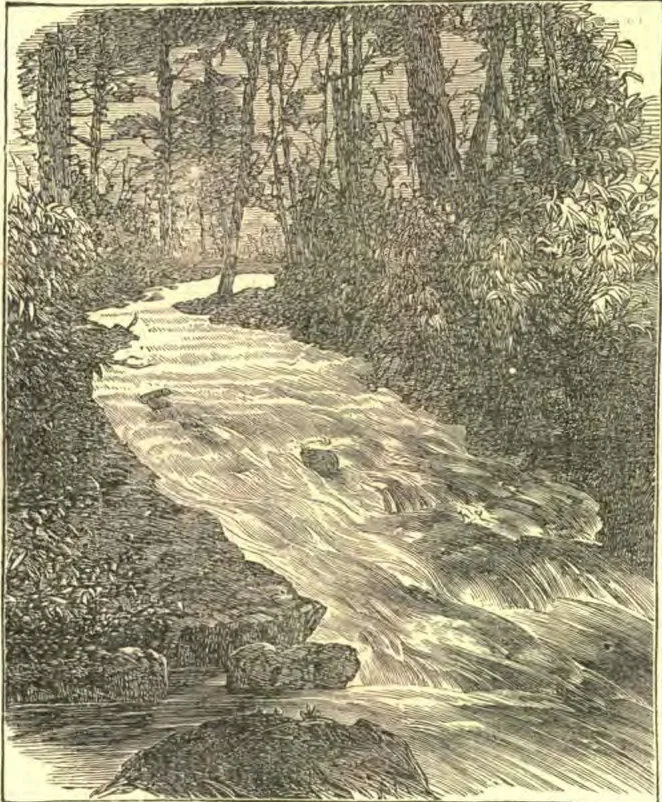
THE BROOK AND THE SPARROW

The Youth’s Instructor

Apr 9, 1879

S. D. A. Publishing Association · Battle Creek, Mich. · Apr 9, 1879

THE BROOK AND THE SPARROW.

A FABLE.

Oh, whither so fast, my Lady Brook, Oh, whither so fast to-day? Tarry awhile from your onward dance, And peep out here with your merry glance, To chat with a friend, I pray.” And the Brook made answer, “I cannot stay, Sweet Sparrow, to prate with you, For the morning hours are flitting away, And I have my task to do.”
“And what may your work be, Lady Brook, That you cannot stop to-day? Babbling over the stones you go, And a noisy tongue you have, I trow, But what your tasks, I pray? Nothing, I ween, but an idle song To sing as you wander by— Nothing, I ween, but to catch the gleam Of the sun in the deep blue sky; Nothing but dimple and flirt with the bee Or the yellow butterfly.”
“Friend Sparrow,” replied the little Brook, “Mine are but humble tasks; Yet a willing step and a cheerful look My great Employer asks, And gladly I fulfill them all, Simple although they be, And I sing, for the very joy of my heart, To the butterfly and the bee.”
“And what are these wondrous tasks, I pray?” Quoth the Sparrow, in disdain; And she laughed outright, while the little Brook, Made answer yet again: “I bathe the roots of the willow trees Beneath whose boughs I pass, And the hazel-bush and the alders low, And freshen the meadows through which I flow, And strengthen the tender grass; The sweet wild-flowers would droop and die If not for my nursing care, And on my marge is the greenest moss That groweth anywhere.
“The birds alight at the morning’s prime To splash in my cooling breast, And the weary oxen come down to drink At the noonday hour of rest, And the lowing kine from the meadows come, And I give them a draught so clear, You may believe they are loth to leave A fount of such dainty cheer; Simple, indeed, friend Sparrow, I know, Are the tasks that I fulfill, Yet methinks the humblest work should be Performed with an earnest will; It giveth a feeling of such content To do in all things our best. But now I must bid you a kind good-day.” Then the Rivulet hastened on its way, And the Sparrow, with nothing else to say, Flew back again to her nest.
—S. S. Visitor.

From Sea to Sea: Chalk Mountains and Alkali Land
FROM SEA TO SEA.—NO. 5.

Although the vast plain of sand and sage brush upon which our eyes rest at Wadsworth does not appear very flourishing, yet the careful observer will find some things of interest even here. To the north-east of us, among the Humboldt peaks, is a large mountain which, in appearance, is covered with huge drifts of snow; but upon inquiry, we find that this is a chalk mountain, in which are vast layers of chalk stone. When this is quarried out, bleached, and cut up into strips, it is used by students and others for marking purposes. To look at this mountain, one would think that it contained chalk enough to supply the world; but this article is so cheap, and the mountain so far from market that it does not pay to work it much.
The land lying east of Wadsworth is full of alkali, which sometimes performs curious freaks. An atmosphere alternately damp and dry causes it to come up out of the earth, and in some cases, spots of land as large as a house have been raised as high as ten feet by it. The people call this kind of earth “rising land.” It is very porous, and looks much like bread sponge which is being raised with yeast. And why should it not? This same alkali is refined, and made into soda with which bread and biscuit are raised, and what wonder if, in its natural state, it should begin to raise the land?
We have not time now to explore all the wonders of this barren-looking country; but as I spent the month of February, 1878, in this part of Nevada, I will speak of some things I then saw. A few miles below this city, on the east bank of the Carson River, is a place that the early emigrants to California named “Ragtown.” It is not much of a town now, however, although it has as many real buildings as it ever had; but it was formerly a city of tents. Before the railroad was constructed, one of the principal routes taken by those going to California in covered wagons, brought them to Carson River at this place. Both they and their teams being wearied by the long journey, they would pitch their tents here, and rest awhile before going over the Sierra Nevadas into the golden State. The appearance of so many kinds of tents, some looking old and much worn, gave the place its name.
A short distance from Ragtown are two lakes of a very peculiar nature. One of them, covering a surface of about one hundred acres, is called Borax Lake. By the side of this lake have been constructed large vats about two feet deep. These are filled with water from the lake, and as sun and wind dry away the water, a thick layer of crystallized soda is formed on the bottom.
When I was there, one year ago, the workmen were busily engaged taking the soda from these vats, and preparing to fill them with water again. All around the edge of the lake were spangles of this crystallized soda, making it look a little way off much like frost and ice on the edge of a pond of water.
One-half mile west of this lake, is a smaller one called Soda Lake. Near this lake there is a spring of pure, clear water; but in the midst of the lake, which covers some four acres, there is a seemingly bottomless spring, which constantly sends up alkali water like a strong lye from ashes. When I visited this lake, the workmen were engaged in taking up a layer of solid soda which had accumulated around its edges to the thickness of about one foot; and I was told that there were about a hundred tons of it to be taken up. They were sawing it into pieces for men to handle. After being removed to the store-house near by, it was broken up into smaller pieces, put into sacks, and shipped by rail to San Francisco to be refined, and thus fitted for cooking purposes.
These two lakes are about sixty feet lower than the surface of the surrounding country. They are indeed curiosities in the midst of the solitude of the desert surrounding them.
If we follow Carson River to a point some thirty-five miles below Wadsworth, we come to what is called the upper sink of the Carson River. This sink is literally a lake about six miles long and two miles wide, into which the Carson River empties. That which is curious about this lake, and of which I will tell you more hereafter, is that, although a large river is constantly running into it, it has no visible outlet; and here we will leave you to meditate a little while, that you may decide, if you can, what becomes of all this water.
J. N. LOUGHBOROUGH.

PRESENT TRUTH FOR THE YOUTH.

THAT the second coming of Christ is at hand is a truth in which all living are deeply interested. But it is of special importance that the youth should know and realize this truth; for they naturally look forward to mature years, and are laying plans for the future; and these plans should be modified by the fact that their probation, as well as that of older persons, is soon to be closed.
The time must come when Jesus will cease his intercession before the throne in Heaven. And it must necessarily be that at that time there will be persons of all ages living upon the earth. The aged will naturally know that their time on earth is short; but the young must be specially warned, so that they may seek in earnest a preparation for that sudden event which will fix their destiny forever.
Besides all the general warnings, exhortations, and entreaties which God has addressed to mankind, in order that they may accept of the great salvation so freely offered in the gospel, he has promised a special warning to the last generation, which in his providence he is now giving. Faith in the word and promise of God surely leads to this conclusion. Our actions will tell how much faith we have; and our faith will be of no use, unless it works by love and purifies the heart. “He that hath this hope in him [the hope of seeing Jesus, and being made like him], purifieth himself, even as he is pure.”
The natural, sinful heart needs time for this purification, this great moral change. Time is graciously given. My young friends, you are being warned. Will you accept the warning, and get ready for the event? R. F. COTTRELL.

THE ISLE OF CYPRUS.

CYPRUS is specially famous for a species of cypress tree, which it is supposed derived its name from the island. This tree is possessed of such balsamic properties that anciently physicians used to send their patients to reside in the vicinity of these trees for their health. The wood of the cypress is almost imperishable, having been known to last for thousands of years. One species, mentioned in the Bible, is called gopher wood.
The language of Cyprus, in historic times, was Greek. Here the philosopher Zeno was born, in the ancient city of Citium; and here also Solon the Wise passed the latter part of his life, and died.
In the southern part of the island is a headland, or promontory, called Cape Gatto, doubtless from the Italian word gatto, which in that language signifies “cat.” The living author, Di Cesnola, says that a certain species of cats are imported from Constantinople to kill the serpents which abound in the neighborhood of the cape. At the tolling of a particular bell in the convent, the cats all gather in to be fed, and after having finished their meal they return again to pursue their work of destruction.
Cyprus is especially rich in antiquities and ruins, many of them being quite classic in character. Gen. Di Cesnola, the American consul to Cyprus by President Lincoln’s appointment, spent ten years on the island in making researches and excavations. In that time, in addition to his regular official duties, he discovered and explored fifteen ancient heathen temples, some sixty-five cemeteries, containing over sixty thousand tombs, and six ancient aqueducts, in various portions of the island.
He discovered over thirty-five thousand different objects in the way of busts, statues, vases, bottles, bas-reliefs, cylinders, lamps, coins, gems, bracelets, necklaces, rings, etc., etc. These were in terra-cotta, marble, bone, alabaster, crystal, ivory, lead, copper, bronze, silver, and gold. Many of them had ancient inscriptions in the Phœnician, Assyrian, Cypriote, and Greek languages. Most of these have been deciphered by the learned. The whole collection is now in the great Metropolitan Museum, of New York City. It is interesting to add that this indefatigable worker has written a large volume on “Cyprus, its Cities, Tombs, and Temples.”
It is the opinion of the learned that Cyprus is the country which is so frequently referred to in the Old Testament under the names of Kittim and Chittim; and some think that the name Caphtor has reference to this island. It is more than probable that it is, as Mr. Kitto says, at least included in the two former terms.
In the New Testament, the first mention of Cyprus is in Acts 4 : 36, where it is mentioned as the native place of the Apostle Barnabas. In Acts 11 : 19, it appears prominent in connection with the first spread of Christianity, which resulted from the scattering of the disciples at the death of Stephen. When Paul was sent out with Barnabas on a missionary tour, Cyprus was their first field of labor. Acts 13 : 4. It was on this island that the sorcerer, Elymas, withstood Paul, and was struck with blindness when the deputy, or pro-consul of the isle, was converted. Verses 11, 12. Here Barnabas and his relative, Mark, made another preaching tour. Acts 15 : 39. The other New Testament allusions are mostly geographical.
May we not expect that the glorious doctrine of the coming reign will yet be proclaimed in the cities and towns of the isle of Cyprus? G. W. A.

HOW DO YOU MEET TEMPTATION?

LITTLE boy upon seeing an open gate through which he was forbidden to pass, shut and fastened it at once; for he said it “temptationed” him to disobey. He meant tempted. Well, temptations meet us all, the children as often as any. How do you meet them? Do you bravely resist them? or, like the little boy, do you avoid them, by shutting them as far away as possible? It is best always to avoid temptation when it can be done, therefore we should pray much, and earnestly, “Lead us not into temptation,” at the same time shutting the gate between ourselves and it.
But as temptation cannot always be avoided, in order that it may not get the better of you, you must understand how to meet it. If, when it comes, you begin to parley with it—if you hesitate, and debate with yourself regarding it, most likely you will yield to it; on the contrary, if you set yourself firmly to do the right, regardless of consequences, and then, from the heart, ask God to help, you will be delivered from evil. No temptation is so great but that he can deliver you; and he is pleased to do so when you sincerely ask his aid. Therefore remember that the right way to meet temptation is,—
First, Always to avoid it when possible.
Secondly, Never, upon any occasion, to parley with it; but to seek deliverance from the One who has promised with every temptation to make a way of escape.
M. J. C.

GENERAL DUTIES OF SUPERINTENDENT.

The duties of the Superintendent are so many and so various that it is difficult to enumerate them. I will merely mention some of them. As the title of his office denotes, he should have general supervision of all the work of the school. He should try to awaken an interest in the minds of parents, teachers, and scholars. He should see that all the officers and teachers do their work promptly and well; that the school is furnished with everything necessary to its success, so far, at least, as is consistent with the means at his disposal. He should see that the room is clean, comfortable, and pleasant; that all are made welcome; that all who come in receive prompt attention; and that they are at once placed in some class, if they will consent to join the school. He should conduct the general exercises, or appoint some one to do so. He should, under God, mold and guide all the work. How important, then, that he should be a man of God; that he should be devoted to the work; that the love of God and man should fill his heart. In general, the school will be just what he makes it. If others do not do their work well, he should take hold and show them how to do it. He must not be easily discouraged; he must cheerfully adapt himself to circumstances, until the circumstances can be improved; he must patiently work and wait, cultivating that charity which hopeth all things, endureth all things.

THE ASSISTANT SUPERINTENDENT.

The Assistant Superintendent should be just what his title of office implies,—an assistant, ever ready to aid the Superintendent in carrying out his plans, and to do any work that may be assigned him. When the Superintendent is absent, from sickness or from any other cause, the Assistant should take his place. G. H. BELL.
If you see anything your duty, the sooner you attend to it the better. David says, “I made haste, and delayed not to keep Thy commandments.”

BIBLE LESSONS FOR YOUTH.

LESSON XLI.—SERVICES OF THE SANCTUARY.

1. How did the people respond to the invitation to bring materials for the sanctuary? Read Exodus 35.
2. How was Moses enabled to find workmen that could do such curious and difficult work as was required in building the sanctuary and its vessels? Verses 30-35.
3. How was the sanctuary consecrated, after it had been finished and set up? Ex. 40.
4. Who were set apart to the priesthood? Ex. 28.
5. How did God show that he accepted this sanctuary? Ex. 40: 34, 35.
6. What kind of offerings were presented in the sanctuary service? Read Leviticus.
7. What was offered each day, continually? Ex. 29: 38-42.
8. How did the services of the Sabbath differ from the services of other days? Num. 28.
9. For whom were the sin-offerings, burnt-offerings, etc., made? Lev. 4.
10. What was any one required to do who presented a sin-offering? Lev. 4.
11. What did the priest do with some of the blood of the victim?
12. What was thus done in a figure?
13. What was done at the close of each year? Lev. 16.
14. What did they show by these ceremonies? Ans. Their faith in Christ.
15. What was done with this sanctuary, when the children of Israel journeyed in the wilderness? Num. 4; 7: 1-9.
16. By what was it finally succeeded?
17. What rested on the tabernacle continually while the people remained in camp? Ex. 40: 36-38.
18. How did they know when and where to journey? Num. 9: 15-23.

SYNOPSIS.

We have noticed that the people were invited to bring materials for the tabernacle. Ex. 25: 1-7. This they cheerfully did, till there was more gathered than could be used, and Moses had to tell them to cease bringing. God raised up skillful men to perform the work, and Moses saw that it was all done as the Lord had commanded. When all the parts and all the holy vessels were finished, the tabernacle was set up, and everything put in its place. Then the sanctuary and all the vessels were consecrated by being anointed with holy oil.
Aaron and his sons were set apart as priests, and consecrated in the most solemn manner, according to the command of the Lord. Then a cloud covered the tabernacle, and the glory of the Lord so filled the sanctuary that even Moses could not enter it. Thus God showed that he accepted the sanctuary which Moses had built.
The ceremonies of the sanctuary service were various. There were burnt-offerings, sin-offerings, meat-offerings, peace-offerings, trespass-offerings, etc. There was offered every day a lamb in the morning, and another at evening. With each lamb there was offered a tenth deal of fine flour mingled with the fourth part of a hin of oil, as a meat-offering, and the fourth part of a hin of wine, as a drink-offering.
The services on the Sabbath day were the same as on other days, except that two lambs were offered in the morning and two in the evening, and the other offerings were double in quantity.
There were special services for the feast days, new moons, and annual sabbaths.
The sin-offerings, burnt-offerings, etc., were sometimes made for one of the common people, sometimes for a priest, and sometimes for the entire congregation. When any one presented a sin-offering, he laid his hand on the head of the victim, to show that his sins were transferred to it, and then killed it with his own hand. Some of the blood thus shed was taken by the priest into the holy place, and sprinkled before the second vail. Thus the sins of the people were figuratively transferred to the sanctuary.
At the end of each year, there was a most solemn ceremony for removing the sins from the sanctuary. This was called the cleansing of the sanctuary.
The children of Israel took this tabernacle with them throughout all their journeyings in the wilderness, and into the land of Canaan. It was finally succeeded by the temple of Solomon. While they were in the wilderness, the cloud rested on the tabernacle by day, and the pillar of fire by night. While it remained there, they rested; but when it was lifted from the tabernacle they journeyed, following wherever it led.
G. H. BELL.

THE SABBATH-SCHOOL.

THIRD Sabbath in April.

LESSONS FOR CHILDREN.

LESSON XV.—ISRAEL OPPRESSED BY MIDIAN.

“And the children of Israel did evil in the sight of the Lord; and the Lord delivered them into the hand of Midian seven years. And the hand of Midian prevailed against Israel; and because of the Midianites the children of Israel made them the dens which are in the mountains, and caves, and strong-holds.
“And so it was, when Israel had sown, that the Midianites came up, and the Amalekites, and the children of the east, even they came up against them; and they encamped against them, and destroyed the increase of the earth, till thou come unto Gaza, and left no sustenance for Israel, neither sheep, nor ox, nor ass. For they came up with their cattle and their tents, and they came as grasshoppers for multitude; for both they and their camels were without number: and they entered into the land to destroy it.”
When the people cried unto God, he sent a prophet to tell them that all this trouble had come upon them because they had not obeyed his voice.
And there came an angel of the Lord, and sat under an oak which stood by a threshing floor where Gideon the son of Joash was threshing wheat. The angel said unto Gideon, “The Lord is with thee, thou mighty man of valor.” “Go in this thy might, and thou shalt save Israel from the hand of the Midianites.”
“And he said unto him, O my Lord, wherewith shall I save Israel? behold, my family is poor in Manasseh, and I am the least in my father’s house. And the Lord said unto him, Surely I will be with thee, and thou shalt smite the Midianites as one man.”

QUESTIONS.

  1. Why did the Lord deliver his people into the hand of the Midianites?
  2. How long did these people prevail against the children of Israel?
  3. What did the Israelites do, in order to escape from their enemies?
  4. What did these Midianites do, when the children of Israel had sowed grain and raised crops?
  5. What else did they take?
  6. What did they bring with them, when they came up into the land?
  7. How numerous were these people?
  8. What did the Lord do when the people cried to him?
  9. What did the prophet tell them?
  10. To whom did an angel appear?
  11. Where was the angel when Gideon first saw him?
  12. What was Gideon doing?
  13. What did the angel say to him?
  14. What reply did Gideon make?
  15. What encouragement did the Lord give him?

THE CULTURE DERIVED FROM THE SABBATH-SCHOOL.

THE primary object of the Sabbath-school is to impart religious truth, and to impress its principles upon the hearts of the youth. But besides this, there is a mental culture that necessarily results from the faithful labor of every Sabbath-school scholar, which is an attainment of no trivial importance.
In all our educational efforts for the youth, our chief desire is not so much that they may gain a knowledge of the sciences, an acquirement of facts, as that the powers of their minds may be fully developed. This can only be accomplished by a proper exercise of the mind in study, and what better themes for thought are given us than those found in the sure word of God?
There is no other study so well adapted to develop the mental faculties as that of the Bible. Though it is not a scientific treatise, it nevertheless embodies all the principles necessary to a perfect human development. A careful study of it trains the reason, excites the imagination by contemplating the glories of the future, and stimulates all the mental faculties to a healthful activity. Indeed, many have become eminent for mental power developed chiefly by a close application to the Bible.
My dear young friends, depend upon it; though you may be deprived of the advantages of a thorough school education, you may still accomplish much in mental training by wise and faithful efforts in the Sabbath-school.
S. BROWNSBERGER.

THE SEVEN WONDERS OF THE WORLD.

WHAT were they? And what are they? How many of our young readers can tell? How many will remember after reading them? Here they are:—
The seven wonders of the world were: 1. The Egyptian Pyramids. The largest of these is 693 feet square and 449 feet high, and its base covers 11¼ acres of ground. 2. The Mausoleum, erected to Mausolus, a king of Caria, by his widow, Artemisia. It was 63 feet long and 35 feet high. 3. The Temple of Diana at Ephesus. This was 425 feet in length and 220 feet in breadth. 4. The walls and Hanging Gardens of Babylon. These walls are stated, by Herodotus, to have been 87 feet thick, 350 feet high, and 60 miles in length; and the statement is deemed creditable by modern antiquarians. 5. the Colossus of Rhodes. This was a brazen statue of Apollo, 105 feet in height, standing at the mouth of the harbor of Rhodes. 6. The statue of Jupiter Olympus, at Athens, which was made of gold and ivory, and was wonderful for its beauty rather than for its size. 7. The Pharos of Ptolemy Philadelphus. This was a lighthouse 500 feet high, on the island of Pharos at Alexandria, in Egypt. A fire of wood was kept burning on its summit during the night, to guide ships to the harbor.
The seven wonders of the world are now given as follows:—
The steam engine, the electric telegraph, the printing press, the telescope, the microscope, the chemical laboratory, and the photograph.
We see much in the works of men’s hands to awaken wonder and admiration. But when the reflective mind looks into the great book of nature everywhere open before us, we may behold with admiration the handiworks of God, though all are marred and blighted by sin.
The lofty mountains, the majestic forest, the bounding streams, the peaceful rivers, the far-stretching ocean with its rolling billows and white-crested waves, the waving grass, the smiling flower by our pathway, the ripening grain, and the fruit upon thousands of trees and running vines,—all proclaim the goodness and wisdom of God, and should lead us to lift our hearts in gratitude and adoration to him.
But “eye hath not seen, nor ear heard, neither have entered into the heart of man, the things which God hath prepared for them that love him.”
Dear children, it is your privilege to be cleansed from sin, to be the followers of the Lamb, and to soon participate in the joy of the world to come, and live with Jesus who died to save us.
A. S. HUTCHINS.

LETTER BUDGET.

Salem, Oregon.
Dear Editors: I live in the country, and attend Sabbath-school in Salem. I am eleven years of age. Have taken the Instructor one year, and like it very well. I now send for the weekly paper. I would have sent before this, but I have been waiting for the Superintendents of the Sabbath-school to decide whether or not they would take it for the school. They have finally decided not to take it. I also thought that I might get a few subscribers; but the weather continues so bad that I cannot get out much. I think I could get several if the weather was good. Percy D. Howell.
Bowling Green, Ohio.
Dear Editors: My grandpa sends me the Instructor this year. I have never seen this paper before. I like it very much. I live so far from Sabbath-school I cannot attend every Sabbath, but I always get my lessons. It is so much nicer to get them out of the Instructor than it was to get them out of the question book. After I have read them, I lend them to my playmate, Charlie. He is just my age. I am ten. He enjoys reading them as much as I do. He does not keep the Sabbath, but I hope he will sometime. Charley P. Kloppenstein.
Perry, Georgia.
Dear Editors: I am nearly thirteen years old. Have been keeping God's Sabbath with my parents and brothers and sisters about sixteen months. We are the only white people in Houston County who keep the Sabbath. I have five brothers, and two sisters; we want to be among the saved when Jesus comes. The Instructor comes every Friday, and we have a Sabbath's school at home. We want to learn more of the sweet Sabbath songs. Pray for us. Eva Killen.
Serrell, Texas.
Dear Editors: I am eleven years old. I have been taking your paper nearly a year. I think it is splendid. I am not an Adventist, but I go to the Methodist Sunday-school. I have three sisters and one brother. I go to school. I can read and write very well. Yours truly, Annie Childress.

CHILDREN'S CORNER.

THE LORD'S PRAYER.

OUR heavenly Father, while we pray, Hallowed be thy name, Cleanse us from every evil way, Pity our feeble frame.
Thy kingdom, Lord, e'en here below, We pray may soon appear, When all delight thy will to know, And love and serve thee here.
Give us our daily bread each day, Our trespasses forgive; Help us to live in such a way, That we with thee may live.
Shield us from every evil, too, Thine is the power, we know; We give thee honor, glory due, May it be ever so. T. P. B.

THE JINGLE BELLS.

How many boys and girls know how the jingling sleigh bells are made? How do you think the little iron ball gets inside the bell? It is too big to be put in through the holes in the bell, and yet it is inside. How did it get there?
This little iron ball is called the “jinglet.” When you shake the sleigh bell it jingles. When the horse trots, the bells jingle, jingle, jingle. In making the bell, this jinglet is put inside a little ball of mud, just the shape of the inside of the bell. Then a mold is made just the shape of the bell. The mud ball, with the jinglet inside, is placed in the mold of the outside, and the melted metal is poured in, which fills up the space between the mud ball and the mold.
When the mold is taken off, you see a sleigh bell, but it will not ring, as it is full of dirt. The hot metal dries the dirt that the ball is made of, so it can all be shaken out. After the dirt is all shaken out of the holes in the bell, the little iron jinglet will still be in the bell, and it will ring all right.
It took a good many years to think out how to make a sleigh bell.—Sel.

Keeping Jesus in the Heart Against Infidelity

The best way to keep infidelity out of the head, is to keep Jesus in the heart.

WORTH KNOWING.

Sixty seconds make a minute, How much good can I do in it? Sixty minutes make an hour, All the good that's in my power; Twenty hours and four, a day; Time for work and sleep and play; Days, three hundred sixty-five, Make a year for me to strive Right good things each day to do, That I wise may grow, and true.

You have reached the end of this edition.

The Youth’s Instructor · Apr 9, 1879