The Youth’s Instructor, Vol. 38, No. 21.

THE LORD'S SWEET LESSON

The Youth’s Instructor

May 21, 1890

S. D. A. Publishing Association · Battle Creek, Mich. · May 21, 1890

“THE LORD'S SWEET LESSON.”

A WILDERNESS of fresh young green, A wilderness of bloom, Where icicles so lately hung, And chill winds piped bare boughs among, When winter snows were keen.
Now the blithe boughs in sunny air Stretch their glad lengths and sway, And mid their foldings, all unguessed, Lies hidden and shielded many a nest, Watched by some wingéd pair.
The oriole's pendent home hangs high, The lark's nest coucheth low, The swallow builds on rocky ledge, The heron in the sheltering sedge, The pine-tree hides the crow.
Each shy bird and each pretty bird Has her own will and way; To each the “viewless Mother” tells Those subtle secrets and fine spells Which man has never heard.
Oh, what a world of fluttering wings, Of eager hopes and fears, Of hidden joys and loves and cares, While we go by all unawares, And never note these things!
And for each flying shape in air, These myriads great and small, As much for wren on grass-blade swung As eagle strong the clouds among, The great God hath a care.
Each small, unnoted circumstance, Each nestling in each nest, Each plaintive chirp, each feeble cry, Each song that soareth loud and high, Falls in His cognizance.
And since all pitying, noting thus, He maketh room for them— As well the sparrow as the world Through a new orbit caught and whirled— Then how much more for us!
—Susan Coolidge.

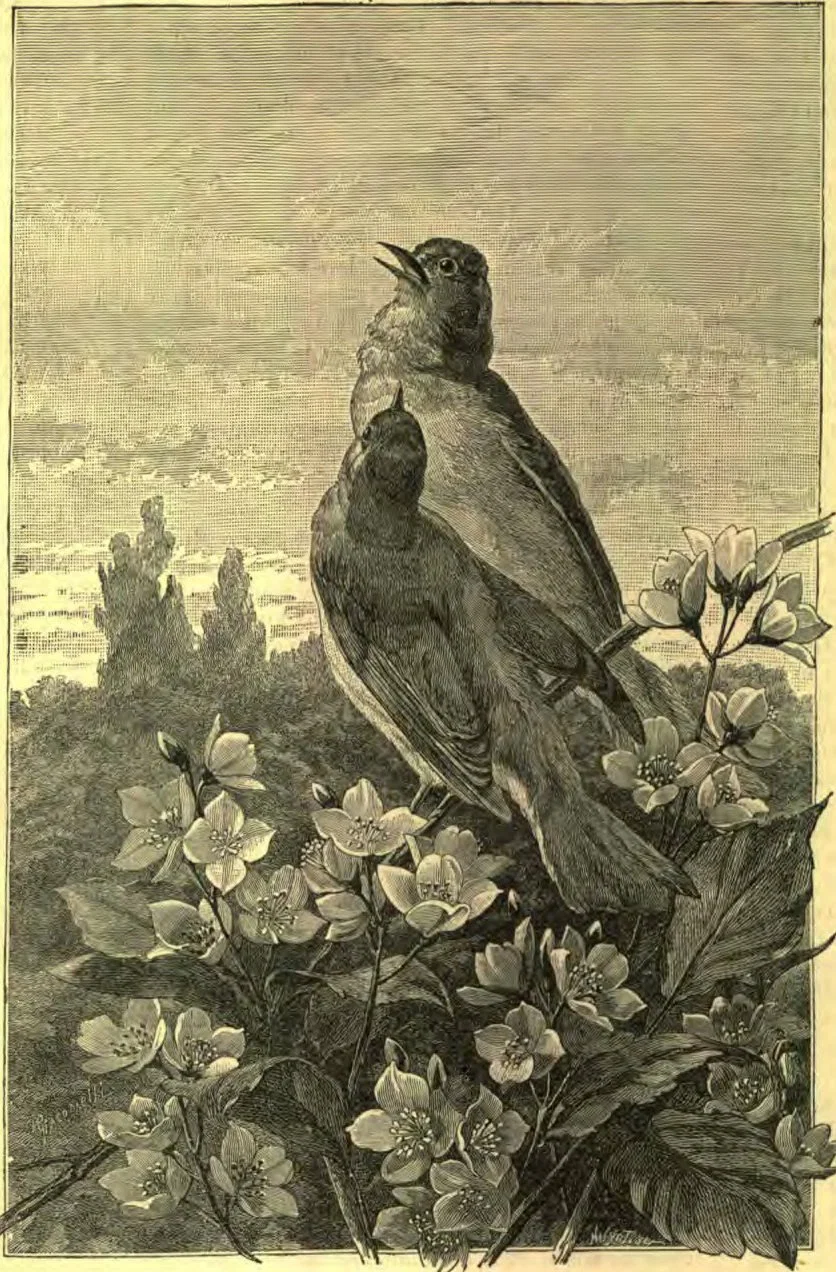
THE NIGHTINGALE.

THIS is the master artist, the very king of singing birds. It is small in size, grayish white and reddish brown in garb; it makes no outward show, and ought never to be seen but from a distance. It needs the soft twilight of the moon, the mystery of the leafy forest, or the darkness of the night; but beneath that more than humble garb is hidden a poet’s nature, a most passionate soul, served by a most marvelous instrument.
It makes its appearance at the end of April. It comes from the land of the ever fiery sun; there it learned those warm, metallic notes which seem to us the echo of the bright, glowing East. The extent of its voice is surprising, and yet more marvelous is the robust constitution of the frail little bird that can sing on, night after night. This artist requires a special food: no seeds, no watery, debilitating fruit, but live flesh. It lives exclusively on worms, insects, and the larvae of ants. By means of this strengthening nourishment, its muscles acquire a wonderful strength, and its voice unequaled volume and sound.
It chooses some sonorous glade or some solitary old tree in which to give its concert, and twilight or the silent night for the hour. Everything in this bird betrays an artist’s temperament, even the refined arrangement of its nest, composed outwardly of leaves that are superposed like the petals of a rose, and lined on the inside with long, slender, narrow blades of grass, artistically interwoven. The female nightingale lays three or five shining, greenish-brown eggs, and while she is brooding, the male is perched on a neighboring tree, charming the long hours with exquisite melodies.
It is the passionate hymn of a fiery soul. This ever-varying, masterly melody is truly enchanting. It expresses every emotion; melancholy and joy, tenderness and passion. The song begins with some bright, rapid, thrilling trills; then it changes slowly into a coaxing, tender lullaby; then the strain is broken by two deep, grave notes, which die away like long sighs; then, again suddenly the tone of the artist changes; brilliant, trills, staccati, sparkling, sonorous flourishes, succeed each other rapidly,—and then again they all blend in a dim, dreamy, melody. In that original strain, you seem to inhale the perfume of the lily of the valley and of sweet-scented forest flowerets, the sap of budding leaves, the gushing joy of life in its full bloom.
The divine strain itself lasts but a short time every year. After midsummer the nightingale sings no more. The young are hatched, and the cares and preoccupations of material existence put a stop to the poet’s inspiration. Their notes are now harsh, being a sort of plaintive, jarring, snapping noise. These last sounds seem intended for menace and defiance. The representation is over, the footlights are put out, the marvelous artist leaves the scene of his triumphs, and carrying his starving brood away with him, he takes his flight towards neighboring fields and bushes, where he will find a more plentiful provision of worms. When you meet him by chance in the autumn, fluttering wildly across some solitary foot-path, you will scarcely recognize in that silent bird, with its livery of a dull brownish-gray, the dazzling singer of those spell-bound May nights. It is then like those artists so animated and dazzling, apparently so young and brilliant when seen in the costume of the stage, the dim perspective of the background, and the sparkling footlights, and whom you are surprised to find so faded and old-looking, when you see them leave the theater, clad in an old overcoat, tramping along pitifully in the mud.—Song Birds and Seasons.

ROUND THE WORLD.—13.

SOMETHING ABOUT THE NATIVES OF SOUTH AFRICA.

It has been the studied object of some missionaries to combine with the teaching of religion as many as possible of the beauties of nature, and all those refinements which attribute to the true happiness of the Christian life, and Lovedale is no exception to this rule. The buildings are prettily situated on a gentle slope, and are surrounded with many beautiful trees, while the sweet odor of the jasmine bequeaths a fragrance to the soft, crisping breezes, which journey inland from the Indian Ocean to refresh and cheer weary and heated man and beast. This spot, so well watered by the never-failing Chumie River, seems like an oasis in the desert. In nature it sustains the same relation to the dreary plains around as the heavenly traits of character of a Christian do to an unhallowed community.
Lovedale is more of an educational institution than a mission station proper. All classes of the African race are here, and representatives from almost if not every tribe. The Bible is made the main object of study, and a good common-school education is imparted. As a rule, the higher branches and the sciences are not taught, as it is out of all reason to expect that the mental powers of the savage can be brought to that perfection of cultivation which it has taken Europeans hundreds and hundreds of years to acquire.
There are at present some four hundred students; the majority of these are native boys, with a comparatively small percentage of girls, and a few English. In age they vary from six or seven to twenty-seven or thirty. English and Kaffer are the languages mainly used. The latter is a very soft and musical tongue, and it is touching to hear them at their missionary meetings, singing the native hymns. They have a large literary society, in which they seem to take great pride and interest. Our visit was at the time of the closing of the session, and the president delivered the valedictory, in which he exhorted the natives to have courage in their studies, promising them that there were better days in store for them.
There are certainly great discouragements for the African, as so many of the Europeans who come to settle in their country are entirely opposed to having them educated, and would prefer that they remain in ignorance. The reason of this is that, when in ignorance, there is more excuse to treat them as slaves, and as such they obey their masters better than when they have received some mental training, and can think and reason for themselves. When educated, they can take the place of white help in stores and business places, and as they can live much cheaper than the European, they in many cases will receive employment on this account in preference to those who have emigrated to this country. It is wonderful and praiseworthy the eagerness which some of them manifest to acquire an education. Grown men, who have spent all their early days in the heathen kraal and at hard work in the diamond mines or at the gold reefs, will take their little earnings, and deposit it at a mission station or school, and beg to be taken in and taught. They care not for the ridicule of those of their race more fortunate than themselves, and will cheerfully enter classes with little children of from seven to eight years, and commence to learn the alphabet. Not being accustomed to study of any kind whatever, their progress is necessarily very slow, but, with a perseverance worthy of the highest admiration, they pursue their studies for sometimes two or three years, and if at the end of that time they are able to read simple language, they are perfectly content, and are as proud of themselves as any college graduate.
The difference between the educated and the uneducated African, so far as appearance is concerned, is very remarkable. The former are neat and tidy in their dress, and follow the fashions of the Europeans, and the expression of their faces shows refinement, intelligence, and gentleness of nature as compared with their savage brethren. These are in warm weather almost entirely destitute of clothing, and when it is cold, wear only a blanket. No matter what color this is when purchased, they always stain it red. In the summer their faces are daubed over with red clay, which is supposed to keep the heat of the sun from cracking the skin. They never wear a hat or anything on their heads. The savage lives in his kraal, surrounded by his family, smokes his pipe, and leads a life of effeminacy and laziness, while his wives, with pick and hoe, cultivate the ground for his sustenance. His food is corn and milk and Kaffer beer. He acquires his cattle by the dowry he receives from the suitors of his daughters. An ordinary Kaffer girl is worth six or eight cows, and one of attractive qualities sometimes doubles that amount.
The native has no knowledge of the true God, and, in fact, the missionaries found it necessary, in order to introduce the gospel, to create a word in the Kaffer language to signify God. In his system of religion he has a few rain doctors, but beyond these dignitaries he seems to have no priests for any other office. The chiefs in Pondoland, and other independencies where the native laws are in force, are despotic and arbitrary. One of their curious customs is what is known as “eating a man up.” If a subject appears to be acquiring too much wealth, this process is at once entered upon. It consists of gradually imposing taxes upon him, and making him pay fines, till all his property, or nearly all of it, is transferred to them.
P. T. M.

THE RIVER NILE.

Without exception the river Nile is the most wonderful river on the globe. The ancient Egyptians used to hold it sacred, and considered it the home of their god Nilus. For upwards of fifteen hundred miles it has no tributary. “Alone it opposes a burning sun; alone it flows and overflows, and brings each year the seed-time, and secures the harvest.” Its annual overflow is one of the greatest marvels of the world. For unknown centuries it has risen to nearly or quite the same height, and within a few hours of the same time. Its rise is measured by nilometers, the chief of which is at Rhoda. These nilometers are slender pillars of marble, upon which the measure is marked. So important is the height of the water that the amount of taxation was formerly regulated by it.
Pliny says that “a rise of twelve cubits meant famine, thirteen starvation, fourteen cheerfulness, fifteen safety, and sixteen delight.” For this reason many of the statues of the Nile of the Roman period are represented with sixteen children playing around the god of the river. In our time this river rises to a much greater height than formerly. Now nineteen cubits is considered tolerable, twenty excellent, twenty-one adequate, twenty-two complete, and twenty-four ruinous.
When the overflow approaches Cairo,—usually at or near the end of June,—then the “Nile criers” begin their work. They are men whose business it is to keep the people informed how much the Nile has risen during the last twenty-four hours. The day before the crier’s duties begin, he goes through the streets, accompanied by a boy, whose duty it is to respond at the proper moment; for the announcement is made in a sing-song tone, and this is what they sing:—
“God has looked graciously upon our fields.”
Response: “O day of glad tidings.”
“To-morrow begins the announcement.”
Response: “May it be followed by success.”
Before the crier proceeds to give the information, he, with the boy, gives a lengthy chant, in which he praises God, implores blessings on the prophet and on all believers, especially upon the master of the house before which he happens to stand, and all his children.
After all this has been gone through with, he tells how many inches the Nile has risen that day. Every day till September he goes through with this ceremony, when the river reaches its height. For his valuable services he claims his “backsheesh,” sometimes humbly, and sometimes saucily.—S. S. Advocate.

LITTLE MISSIONARY WORKERS.

It has been interesting to note, through the letters that come to the Budget, and in other ways, what the active brains and busy fingers of our little people are doing toward earning money to help build the missionary ship. One little girl we know of has earned her money by making and selling some neat pincushions. A bright-eyed little boy often tempts the appetite with his large basket of snowy pop-corn balls; and, now that spring has come, others are searching the brooksides and meadows for “greens.”
The other day a letter was handed to the INSTRUCTOR, telling how some little people had managed to earn money for missionary work and other worthy enterprises. The writer of it sent in a request to those who were going to the Minnesota camp-meeting, to be held in May. She did not wish her letter printed, but as the request can be better understood by printing it, and good suggestions may be made to others who have not thought of any plan of work, the letter is given, as follows:—
“Will you ask the people that come to the Minnesota camp-meeting in May to bring any pieces that they are willing to give away, to be made up into quilts? We would be glad to get any kind of pieces. We are a band of children who want to help build the ship. We have been working two years the first of this April. We make patchwork, aprons, and other small things, which we sell. Half the money we get goes for books to read, and the other half for missionary work. The Lord has been very good to us, and has put it into the hearts of many people, even strangers, to help us. The ladies can help us very much if they will bring us pieces for patchwork. There will be a tent on the ground marked F. M. Johnston, Fair Haven, Minn., and the pieces can be left there. “JENNIE ERICKSON, Sec.”
This society of “Busy Workers” have in the two years of their organization earned $120. They take a club of the Sentinel and another of the Signs of the Times, and have sent some money to foreign missions. Although the letter did not reach us in time for an earlier notice, we trust many will see it, and grant the favor asked by the society.
How many of the INSTRUCTOR family are doing what they can to help the missionary work along? We often look at the small sum we have to give, and think that it does not amount to much, and will never be missed if it does not find its way into the treasury. But if all the littles that are spent needlessly were saved up, they would amount to quite a sum in a year.
The story is told of a lady who became much interested at a missionary meeting, and wished she had something to give. When she came next year, she handed the treasurer a little box marked “’tis but.” The treasurer wanted to know what that meant, and the lady replied that formerly when she saw anything she wanted, and it could be purchased for a small sum, she would buy it, saying, “’Tis but a dollar,” or “’tis but fifty cents.” But during the year, when she had been tempted to make such purchases, she had saved the “’tis buts,” and they had amounted to a nice sum.
It is a great deal easier to plan how we would spend a large sum if we had it than it is to do good with the little that we do have. We should remember that God does not ask us to be generous with things he has never given us, but to use wisely what has been intrusted to our hands.
God does not require the children to give as much as if they were able to earn large sums; he blesses just as much the little that they give as he does the large amount some rich man gives. So let the children see how much they can earn and how many “’tis buts” they can save to help others know about the precious truths to be found in the Bible.
W. L. K.

A BONE THAT NEEDED BREAKING.

“Fred, I think I left my spectacles up-stairs,” said grandpa, after he had searched the sitting-room for his accustomed helpers.
“Oh, dear!” began Fred, who always thought it a great nuisance to go up and down stairs, unless he wanted something for himself, and couldn’t get any one to go; but before he had finished his grumbling sentence, little Lillie had deposited her lapful of patchwork on the sofa, and with a cheery, “I’ll get them, grandpa,” was on her way up-stairs.
“Fred, you forgot to put your tools away,” said mamma, a little later.
“Oh, dear! it’s such a bother to put everything away,” fretted Fred. “Can’t I leave them where they are till to-morrow, for I will want to use them again?”
“No, I want them put away at once,” said mamma, in such a decided tone that Fred knew she required instant obedience.
“Oh, dear! I never can learn this long lesson!” he grumbled that evening, when he sat down to prepare his recitations for the next day. “It’s such a lot of work to translate all these sentences.”
Dr. Morton had dropped in for a little chat with Fred’s father, and he looked up as he heard this impatient exclamation.
“What do you think I’ve been doing to-day, Fred?”
“What, sir?” asked Fred, glad of a diversion from his books.
“Breaking a little girl’s arm!”
“Don’t you mean mending it, doctor?” asked Fred, thinking that the doctor had made a mistake.
“No; I broke it,” answered the doctor. “Some time ago this little girl broke her arm, and it was very badly set, and has been so stiff ever since that she could not use it as she wanted to. She makes lace very cleverly, and her earnings have been a great help to the family, but since her arm was hurt, she has not been able to work at all. We held a consultation at the hospital to-day, and decided that the only way to help the child would be to break her arm again and reset it.”
“I think I’d rather never be able to do anything than have that done,” exclaimed Fred.
“Why, that’s unfortunate,” remarked the doctor. “I’ve been thinking that there is a bone about you that ought to be broken very soon, if you expect to become an active man. I’ve been meaning to mention it to you for some time.”
Fred turned pale. He was not at all fond of bearing pain.
“Where is the bone?” he asked, with a frightened tremor in his voice. “Will you have to break it?”
“No; I can’t very well break it for you,” answered the doctor. “You can break it better than any one else can do it for you. It is called the lazy bone!”
“Oh, is that what you mean?” And he was so relieved that he smiled at the doctor’s words.
“Yes, my boy, that is the bone I mean, and it is a bone you ought to break very soon, if you ever expect to be of any use in this world. It will take a pretty determined effort to break it; for it is one of the toughest bones I know anything about; but you can break it if you make the effort. Will you try?”
“Yes, sir; I will,” promised Fred, manfully, his face flushed with mortification at the thought that he had earned a reputation for laziness.—Selected.

HIS FATE.

SOME people learn in early childhood what others are half a life-time in discovering. Mr. T. A. Trollop tells a true story of a little boy, a relative of his own. The child, a fine little fellow eight years old, said something of which his mother disapproved, and she proceeded to reason with him.
“I do not like to hear you speak in that manner. You mean to be funny, but you are simply rude.”
The little fellow burst into tears, and said, amid his sobs:—
“There, mother, you have the secret of my life. I am always meaning to be funny, and I turn out rude.”
Poor boy! He was not alone in his affliction.—Sel.

WHAT IS IT?

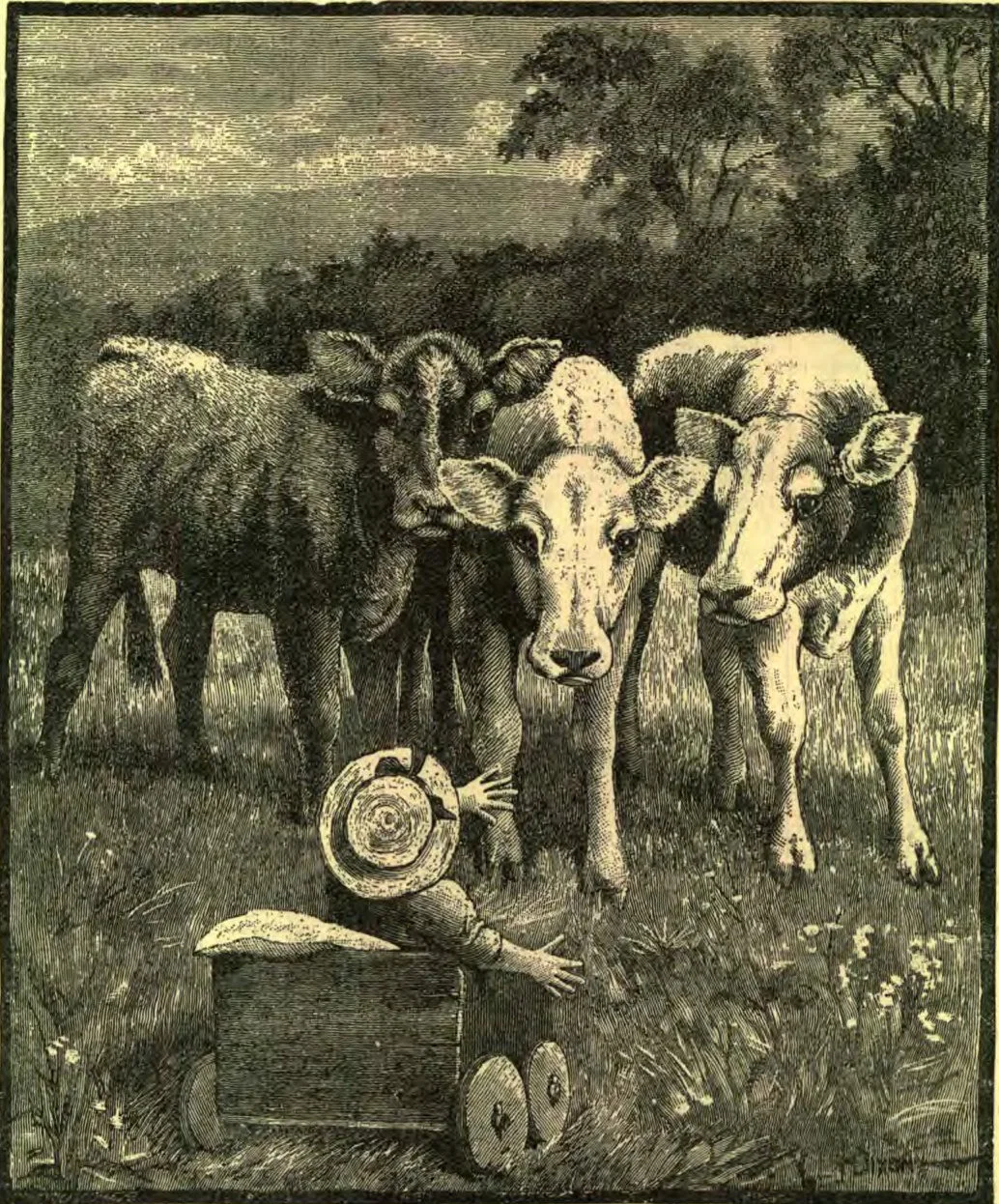
LITTLE Ray, little Ray, on a bright, sunny day, Wandered away to the meadow; There were flowers at his feet, and birds singing sweet, And three brown-eyed calves in the shadow. He sat in his cart, watched the wavy grass creep, And the first thing he knew, he awoke from a sleep.
My! There in his sight, it filled him with fright, The three brown-eyed calves looked him over. He struck left and right for fear that they might Think, perhaps, he was some kind of clover; And he cried for his "muzzer" as hard as he could, Before the big calves ate him up for their food.
"Do away! do away!" screamed the mad little Ray; "Muzzer says it is bad to be 'quisite.' And you all seem to say, 'Dis a'n't c'over or hay, Or daisies or dreens, but what is it?' I'm a boy five years old, and I'll soon be a man; Do away!" and the calves stuck their tails up, and ran.
Little Ray, little Ray came home crying that day, Dragging his cart in the shadow. And he sobbed, sobbed away the great tears of dismay, At the "defful bid flings" in the meadow; But when to his sweet, loving mother he ran, It all came out right for the brave little man.
FANNIE BOLTON.

THE ORIOLE FAMILY.

It was a cosy, snug little home in which the three young orioles first opened their eyes. It was not built of bricks, or boards, or logs, but of sticks and straws beautifully woven together into the shape of a bag, and hung to the branch of a large locust tree.
There was a hole in the side that served for door and window, and within, the walls, ceiling, and floor were made of the softest down, so that the little birds needed no feather-beds to sleep on; and while the father and mother were off hunting something for them to eat, they would huddle together in the bottom of the nest, and let the breeze rock them into many a sweet nap.
But it was rather small, and appeared to get smaller each day. And as their wings began to grow, how they longed for space to flap and try them! But father and mother knew when it would be time; they never forgot them. And what a splendidly handsome fellow their father was, in his new spring suit of bright orange-color and black velvet! The mother was pretty, too, with her dress of more quiet shades, and her sweet, low voice.
The little ones had no feathers on them at all, at first, and were very funny and ugly; but they were growing in beauty every day, and would soon be old enough to wear bright, gay dresses, like their father and mother. And instead of sleeping during their parents’ absences, as formerly, they often spent the time in vague wanderings about the world that lay outside of their little home.
This ought to have been a very happy family, and would have been but for the youngest; he was an impatient little fellow, that was always grumbling because they were kept at home so long, and thought he knew better than anybody else. This made it very hard for his mother to teach him anything, so that she sometimes had to get his father to come and give him a good pecking to make him behave.
His waywardness troubled his parents very much, but they hoped he would grow wiser as he grew older.
One day, when these little birds were at home by themselves, this disobedient one took it into his head to climb up to the door and look out. At first he was dumb with astonishment, so marvelously beautiful did it all seem; then he began to twitter with delight, and tell his brother and sister all the wonderful things he saw.
“Pshaw!” he said at last, “it doesn’t look so far down to the ground; I believe I could fly down there easily. I have half a mind to try.”
“Oh, don’t, brother, don’t!” the other two cried; “something will surely happen to you. Don’t you know mother told us never to venture even to the door in her absence, and to be content to stay quietly in the nest until she taught us how to fly?”
“Yes,” said his little sister; “and don’t you remember that she was telling us only the other day of the cruel cat who lives down there, and pounces upon every hapless young bird that chances in her way?”
“And have you forgotten the boys, the heartless boys, who often throw stones at us birds?” said the eldest brother. “What mercy would they show to a poor little fledgling?”
The mother’s voice in the distance put an end to his plans for that time; and, hoping he would give them up altogether, the others did not tell their mother.
But the next day, when they were again left alone, he clambered once more to the opening. “Ah! what foolish children you are,” he said, “to stay down there in the dark, when you might be up here enjoying the light and air; why, I feel as if I should grow an inch the more for it!” and he fluttered his wings exultingly. “I can’t for the life of me see why we should be kept shut up like a parcel of babies just out of the shell. There is not a thing in sight that could possibly hurt me, and there are crowds of birds down there hunting for bugs and things. I long to be among them—and so I will! Mother may keep her flying lessons for you; I am sure I don’t need them.”
Again the brother and sister begged and pleaded with him, even stretching up and trying to catch hold of him with their bills; but, jerking away from them, he spread his wings something as he had seen his parents do, and let go his hold of the nest.
The brother and sister heard him touch the ground with a little thump. After awhile they heard his excited twitter of enjoyment as he hopped about among the feathered tribe, as strange and new to him as if no kin.
Presently there came a cry of alarm, a great flapping of wings, and then a pitiful, helpless wail of mortal terror, an agonizing scream,—and all was still.
Fearfully they climbed to the opening, holding carefully as they peeped out, only to see a hideous monster—a cat, they knew it must be—stalking off with their dead brother in its mouth.
It was a sorrowful family that evening. The parents perched upon the tree, and flitted from limb to limb, mourning piteously the distressing end of their birdling. “And I was going to give you your first lesson in flying this very evening,” the mother twittered sadly, “if he had only waited; but now that hateful beast has tasted our blood, I shall be afraid to show your faces in this neighborhood for several days to come.”
Many a time did the other two recall their brother’s sad fate when tempted to murmur at their mother’s short lessons, or their own slow progress in flying. And long afterward, when they had homes of their own, they would tell the story as a warning to their own little nestlings.—Annie E. Wilson.

FETTERED IN LOVE.

Dash was a dog with very short legs, very curly hair, a very stumpy tail, and very bright eyes. His nose was so near the ground that when he sneezed, it always bumped hard on the floor; and then he would look very much astonished, as if wondering what had hit him.
Dash came late in the winter, and by spring he thought he knew all that a dog ought to know. He could bring bones and scatter them about the place, and dig deep holes in the newly made garden.
When warm days came, grandpa, who had given the dog to Tony and Phil and Tom, brought home one day a thing that looked almost like one of mamma's bracelets.
“It is a collar for Dash,” he said.
It was a cunning little thing of nicely stitched leather, with a brass plate, on which was marked Dash's name and address.
“Let me put it on him, please,” said Phil, and it was passed over to him. Every one was kind to Phil, for he had been hurt in an accident long ago, and had to lie on a sofa all the time.
They brought Dash to him, and he tried to put the collar on. But Dash seemed to have an opinion of his own about collars; for he gave a jump, and rushed out of the room.
When he was brought back, after a long chase, grandpa undertook to hold him while Phil slipped the collar on. And then all realized more than before that Dash had four legs and a head, and that they all agreed in a decided objection to a collar, and that they were all very strong for so small a dog. He fought and kicked and scratched, until it took the whole family force to lock the tiny padlock with the tiniest of keys.
And the moment he was let loose, he sprang away with a sharp little “wow,” and ran around the lawn as if he were crazy. He rolled in the grass, and tried to rub off or scratch off the collar. When he made up his mind that he could not, he hid under a bush, and would not come out, not even when Phil called him.
“Hadn't we better take it off, grandpa, he hates it so?” asked Phil.
“No; he must wear it,” said grandpa. “He would not be likely to live long without it.”
“Why, grandpa, how is that?” asked Tony.
“He cannot know we do it to save his poor little life, for he is only a dog. To him it is only a fetter, and he hates it.”
“I know,” grandpa went on, in more gentle tones, “a Father who puts fetters and bonds on his own children,—fetters much more painful to wear than Dash's collar.”
“A father? O grandpa!”
“He does it from a far tenderer love than we feel for Dash. He sees, in his great wisdom, that some danger awaits his dear child, so to guard him from it, he binds him fast with a fetter of sickness and suffering very hard to bear.”
“You mean like me, grandpa?” asked Phil, looking up. “But why should it be only me, and not the others?”
Grandpa pressed the little form closer, as he went on:—
“Dash can never know why we put a collar on him. But we shall know some day why our Father thinks best that some of his little ones should suffer. And we know already that it is done in love. Dash does not know even that.”
After a while, Dash crept out of his hiding-place, with a very woe-begone look, and stole up to Phil, who had never teased him as the other boys sometimes did.
“Poor doggy!” said Phil, stroking him softly, “don't you know we wouldn't hurt you for anything?”
Dash gave a little wag of his tail, but still looked as if he thought himself sadly abused. But in another hour he was tearing around with Tony and Tom, only once in a while stopping to give an impatient tug at his collar. And Phil watched him with a new light in his large, thoughtful eyes. Grandpa's little lesson had made him understand better than ever before that it was a loving hand which had bound the fetter upon him.—Sydney Dayre.

ABOUT MOSQUITOES AND GNATS.

“WHAT are mosquitoes good for, papa?” asked an angry boy one morning, as he took his seat at the breakfast-table. The poor little fellow’s forehead was dotted with painful red spots caused by the mosquitoes which had disturbed his rest during the night.
“Mosquitoes have their uses, my son,” replied his father. “They are very annoying, I know; nevertheless they are also useful little creatures.”
The boy was puzzled by this remark, as I presume the reader also is. The puzzle, however, is easily solved by learning the story of a mosquito’s life. Let us begin with its egg. When the mosquito wishes to deposit its eggs, it flies to the surface of still water, and lights on a floating leaf or twig. As she lays her eggs, she places them side by side, and fastens them together so that they form a fragile little boat, which is a sort of life-boat, in that it will neither fill with water nor upset, however much the surface of the pool or ditch may be disturbed. After floating about for a few days, the eggs are hatched by the heat of the sun. On the under side of each egg there is a little lid, which opens, and lets out what is called the larva, or first form of the mosquito, which descends at once to the bottom of the water.
It is while in this larva state that the mosquito is useful; for it then feeds on the decaying matter which is in the water, and which, if left to ascend into the air, becomes the source of fevers, possibly death, to those who inhale it. Thus you may understand that the larva of the mosquito is a sort of scavenger, purifying stagnant waters. The active little things which you may see wriggling about in any uncovered water-butt, or open cistern, or road-side ditch, are the larvae of mosquitoes. They are restless creatures, constantly eating, except when they repose with their heads downward, and their tails pushed up a little above the surface of the water. This is their way of getting a supply of air; for they breathe, not through the mouth or side, but through the tail, which is provided with means of drawing air down into the body.
After feasting several days like a glutton, the larva changes into what is called pupa, which is club-shaped, and floats or darts to and fro on or near the surface, eating nothing. After a few days, it is changed, by the splitting of its skin, to a full-grown mosquito. It then takes its flight into the air. If it be a male, it makes its home in the woods; for a male mosquito does not sting us; if a female, it soon finds its way to the abodes of men and beasts, to whom, by its humming and biting, it becomes a cause of annoyance and pain.
The mosquito’s weapon, with which it gratifies its insatiate thirst for blood, and torments its victim, is a very complex instrument. It consists of five bristle-like pieces, which are folded together in a hollow sheath. Some of these pieces are sharp like lancets, others are barbed, while the sheath, called the labium, forms an awl-like beak, which it thrusts into the flesh, and by which it draws in the blood through the channels formed by the fine bristles it incloses. Some naturalists think that the blood-thirsty creature instills a poisonous fluid into the wound, which causes inflammation; others, perhaps with better reason, are of the opinion that its barbed mandibles produce the irritation which accompanies its puncture.
The humming of the mosquito, if not so painful as its sting, is but little less annoying. It is caused by the rapid motion of its wings, which, it is said, are vibrated 3,000 times per minute!
Dr. Franklin, who was a notable observer of men and things, used to say that, although it may not be possible to prevent entirely the breeding of gnats and mosquitoes, their number would be greatly diminished if people whose homes are distant from stagnant waters, would dispense with open water-butts and cisterns.
The mosquito is such a delicate little insect, judging from its fragile structure, one would at once conclude that polar cold would quickly freeze it, and tropical heat destroy it. But as is too well-known, this insignificant, frail-looking creature is gifted with power to resist any degree of cold, and to bear any degree of heat. Some of Captain Hall’s scientific corps, when among the glaciers of the polar circle, found the mosquitoes so numerous and ferocious that the men were more than once compelled to quit the spot chosen for their observations, and take refuge on board their ships from the blood-thirsty beaks of their tormentors!
Dr. Clarke, the famous traveler, declares that, when traveling in the Crimea, the bodies of himself and his companions, in spite of gloves, clothing, and handkerchiefs, were so bitten as to be covered with eruptions which were so irritating as to excite a considerable degree of fever. One sultry night, he says, when not a breath of air was stirring, and he was exhausted by fatigue, pain, and heat, he sought shelter in his carriage. Though almost suffocated, he dared not open the carriage window. Yet his tiny tormentors found their way into his hiding-place, and though he bound up his head with handkerchiefs, they soon attacked his mouth, nostrils, and ears. Thinking he could better fight off his torturers by having a light, he managed to apply a match to one of his carriage-lamps. But his ferocious assailants, swarming upon it in countless numbers, extinguished it in an instant. He declares that they actually filled the glass chimney of the lamp, and formed a conical heap over the burner.
Have we not reason to be thankful that our mosquitoes are neither so numerous nor so troublesome as in some other parts of this great round earth?—S. S. Classmate.
Continue reading: TWO HUNDRED PINS A MINUTE