Your ShelfYour Projects

Review and Herald, Vol. 74, No. 52.

HE WAS WOUNDED FOR OUR TRANSGRESSIONS

Review and Herald

Dec 28, 1897

Seventh-day Adventist Publishing Association · Battle Creek, Mich. · Dec 28, 1897

“HE WAS WOUNDED FOR OUR TRANSGRESSIONS.”

MRS. E. G. WHITE.
“Now the chief priests, and elders, and all the council, sought false witness against Jesus, to put him to death; but found none: yea, though many false witnesses came, yet found they none. At the last came two false witnesses, and said, This fellow said, I am able to destroy the temple of God, and to build it in three days.” This was the only charge that could be brought against Christ. But these words had been misstated and misapplied. Christ had said, “Destroy this temple, and in three days I will raise it up. . . . But he spake of the temple of his body.”
Priests and rulers, with many others, taunted him with this false statement. While he hung upon the cross, it was repeated in mockery by the scribes and Pharisees, and echoed by the multitude. “They that passed by reviled him, wagging their heads, and saying, Thou that destroyest the temple, and buildest it in three days, save thyself.” But though misstated, Christ’s words were being fulfilled. Publicity was given to them, and they were made more impressive by the proclamations of his enemies.
“Likewise also the chief priests mocking him, with the scribes and elders, said, He saved others; himself he cannot save. If he be the King of Israel, let him now come down from the cross, and we will believe him.” Would they have believed on him had he come down? — No. In the resurrection of Lazarus a convincing proof had been given of Christ’s divinity. It was not evidence that the priests and rulers needed. This they had; but in spite of it, they sought for false witnesses, that they might mislead the minds of the people, and prejudice them against the truth.
In the parable of the rich man and Lazarus a representation is given of those who refuse light. While the rich man was suffering the punishment of his sins, he asked that Lazarus might be sent to warn his brethren, lest they also share his fate. Abraham is represented as saying to him: “They have Moses and the prophets; let them hear them. And he said, Nay, father Abraham; but if one went unto them from the dead, they will repent. And he said unto him, If they hear not Moses and the prophets, neither will they be persuaded, though one rose from the dead.” Yet to the Jews one had come who had been raised from the dead. Among them was Lazarus, who had lain four days in the grave, but who was now a living witness of the power of Christ. But in spite of this, the priests not only plotted to put Christ to death, but Lazarus also; for he was likely to be an obstacle in the way of killing Christ.
Those who placed Christ before the world, hanging on the cross between two thieves, bruised and wounded, bore a testimony to his work. Many heard the words of mockery addressed to him as he hung on the cross; for they were spoken in no whispered tones. Thus a testimony to Christ’s claims was borne in the hearing of thousands. Many minds entered on a track of thought that increased in intensity and earnestness as they searched the Scriptures for themselves. The conviction forced itself upon their minds that Jesus was the Messiah.
Those who in derision uttered the words, “He trusted in God; let him deliver him now if he will have him: for he said, I am the Son of God,” little thought that their testimony would sound down the ages. But although spoken in mockery, never were words more true. They led men to search the Scriptures for themselves. Wise men heard, searched, pondered, and prayed. There were those who never rested until, by searching the Scriptures and comparing passage with passage, they saw the meaning of Christ’s mission. They saw that free forgiveness was provided by him whose tender mercy embraces the whole world. They read the prophecies regarding Christ, and the promises so full and free, pointing to a fountain opened for Judah and Jerusalem. Hope sprang up in their hearts as they read the words:—
“For Zion’s sake will I not hold my peace, and for Jerusalem’s sake I will not rest, until the righteousness thereof go forth as brightness, and the salvation thereof as a lamp that burneth. And the Gentiles shall see thy righteousness, and all kings thy glory: and thou shalt be called by a new name, which the mouth of the Lord shall name. Thou shalt also be a crown of glory in the hand of the Lord, and a royal diadem in the hand of thy God. Thou shalt no more be termed Forsaken; neither shall thy land be any more termed Desolate: but thou shalt be called, Hephzibah, and thy land Beulah: for the Lord delighteth in thee, and thy land shall be married. . . . Go through, go through the gates; prepare ye the way of the people; cast up, cast up the highway; gather out the stones; lift up a standard for the people. Behold, the Lord hath proclaimed unto the end of the world, Say ye to the daughter of Zion, Behold, thy salvation cometh; behold, his reward is with him, and his work before him.”
Never before was there such a general knowledge of Jesus as when he hung upon the cross. He was lifted up from the earth, to draw all unto him. Into the hearts of many who beheld the crucifixion scene, and who heard Christ’s words, was the light of truth to shine. With John they would proclaim, “Behold the Lamb of God, which taketh away the sin of the world.” Truth is truth, and will remain truth, and in the end will triumph gloriously. The lamp of life is trimmed by the hand that lighted it. The Jewish leaders sought to remove it from the earth, but it shone on, and irradiated the world. Christ rose from the grave, and over the rent sepulcher of Joseph he proclaimed, “I am the resurrection and the life.” Men in this age will repeat the history of the past. By their falsehoods they think that they can quench the light of the world, but their efforts only make the light shine brighter.
“Now there stood by the cross of Jesus his mother, and his mother’s sister, Mary the wife of Cleophas, and Mary Magdalene.” As Christ’s mother stood by the cross upon which he hung, she realized the truth of the words spoken by Simeon, when he took the infant Saviour in his arms and blessed him. “Mine eyes have seen thy salvation,” he said, “which thou hast prepared before the face of all people; a light to lighten the Gentiles, and the glory of thy people Israel. And Joseph and his mother marveled at those things which were spoken of him. And Simeon blessed them, and said unto Mary his mother, Behold, this child is set for the fall and rising again of many in Israel; and for a sign which shall be spoken against; (yea, a sword shall pierce through thy own soul also), that the thoughts of many hearts may be revealed.”
That time had come. The hearts of the persecutors, the revilers, the murderers, were indeed revealed. Attributes which form character were developed. Unbelieving Israel took sides with the first great apostate.
Christ, bearing the sin of the world, seemed to be deserted; but he was not wholly left alone. John stood close by the cross. Mary had fainted in her anguish, and John had taken her to his house, away from the harrowing scene. But he saw that the end was near, and he brought her again to the cross. Even in his dying hour, Christ remembered his mother. He saw her distress, and he said to her, “Woman, behold thy son! Then saith he to the disciple, Behold thy mother! And from that hour that disciple took her unto his own home.” This thoughtful care lifted a weight from Mary’s mind; she would no longer be obliged to choose her own home, and run the risk of offending her relatives; for Christ’s wish was law. Christ knew what she most needed,—the tender sympathy of one who loved her because she loved Jesus.
“Now from the sixth hour there was darkness over all the land until the ninth hour.” Human passions were raging at the foot of the cross when the earth was bereft of the light of the sun. The Sun of Righteousness was withdrawing his light from the world, and nature sympathized with her dying Author. A great darkness clothed the earth as with sackcloth of hair, and enshrouded the cross. It was as if the sun in its noonday splendor had been blotted out. Thus was represented the night of woe that was settling down on the Jewish nation.
“And about the ninth hour Jesus cried with a loud voice, saying, Eli, Eli, lama sabachthani? that is to say, My God, my God, why hast thou forsaken me?” These words would not be misunderstood, but priests and rulers interpreted them to suit their own understanding. With bitter contempt and scorn, they said, “This man calleth for Elias.” Jesus said, “I thirst.” These words, which should have awakened compassion in every heart, were held up to ridicule by the priests, in whose hearts humanity was eclipsed by satanic malignity. One of the hardened Roman soldiers, touched with pity as he looked at the parched lips, took a stalk of hyssop, and dipping it in a vessel of vinegar, lifted it to the Saviour’s lips. But from the mockers came the words, “Let be, let us see whether Elias will come to save him.”
This scene was transacted in the sight of heaven and earth. Angels beheld the pitiless scorn and contempt shown to Jesus by those who should have acknowledged him as the Messiah. To this length they were led when unrestrained by the Lord of heaven. So it is with all religious zealots who separate from heavenly influences.
Again came the cry, as of one in mortal agony, “It is finished.” “Father, into thy hands I commend my spirit: and having said thus, he gave up the ghost.” Christ, the Majesty of heaven, the King of glory, was dead. The Jewish leaders had crucified the Son of God, the long-expected Messiah, him (so the people had hoped) who was to bring about so many reforms. They refused the only One who could save them from national ruin.
“And, behold, the veil of the temple was rent in twain from the top to the bottom; and the earth did quake, and the rocks rent.” Those who had induced the people to release Barabbas and crucify Christ, now trembled with terror. They were conscious of the wicked deed they had done. They realized that they had shed the blood of the Son of God. This blood they had invoked on themselves, saying, “His blood be on us, and on our children.” Christ had prayed, “Father, forgive them; for they know not what they do.” But they made this prayer an impossibility; for they would not be convicted, they would not repent and be converted.
Christ has said, “If they have persecuted me, they will also persecute you.” There is no greater evidence that Satan is working than that those who profess to be sanctified to God’s service persecute their fellow beings because they do not believe the same doctrine that they themselves believe. These will rush with fury against God’s people, stating as true that which they know to be untrue. Thus they show that they are inspired by him who is an accuser of the brethren, and a murderer of the saints of God. But if God permits tyrants to do with us as the priests did with his Son, shall we give up our faith, and go back to perdition? It is not because God does not care for us that he permits these things to be; for he declares, “Precious in the sight of the Lord is the death of his saints.”
With Satan at their head to imbue them with his spirit, men may afflict God’s people, they may cause pain to the body, they may take away their temporal life; but they cannot touch the life that is hid with Christ. We are not our own. Soul and body, we have been bought with the price paid on the cross of Calvary; and we are to remember that we are in the hands of him who created us. Whatever Satan may inspire evil men to do, we are to rest in the assurance that we are under God’s charge, and that by his Spirit he will strengthen us to endure. “He shall deliver the needy when he crieth; the poor also, and him that hath no helper. He shall spare the poor and needy, and shall save the souls of the needy. He shall redeem their soul from deceit and violence: and precious shall their blood be in his sight.”
The time is soon to come when the Lord will say, “Come, my people, enter thou into thy chambers, and shut thy doors about thee: hide thyself as it were for a little moment, until the indignation be overpast. For, behold, the Lord cometh out of his place to punish the inhabitants of the earth for their iniquity: the earth also shall disclose her blood, and shall no more cover her slain.” Those who love God need not be surprised if those who claim to be Christians are filled with hatred because they cannot force the consciences of God’s people. Not long hence they will stand before the Judge of all the earth, to render an account for the pain they have caused to the bodies and souls of God’s heritage. They may indulge in false accusations now, they may deride those whom God has appointed to do his work, they may consign his believing ones to prison, to the chain-gang, to banishment, to death; but for every pang of anguish, every tear shed, they must answer. For every drop of blood drawn forth by torture, for all they have burned with fire, they will receive punishment. God will reward them double for their sins. They have drunk the blood of the saints, and have become intoxicated with exultation. God says to his ministers of judgment: “Reward her even as she rewarded you, and double unto her double according to her works: in the cup which she hath filled fill to her double. How much she hath glorified herself, and lived deliciously, so much torment and sorrow give her: for she saith in her heart, I sit a queen, and am no widow, and shall see no sorrow. Therefore shall her plagues come in one day, death, and mourning, and famine; and she shall be utterly burned with fire: for strong is the Lord God who judgeth her.”

THE DYING YEAR.

MRS. L. D. AVERY-STUTTLE.
(Battle Creek, Mich.)
DECEMBER’S winds are chill and drear; They moan around my cottage door; A requiem for the dying year They sadly chant with ceaseless roar.
The white snow forms a winding-sheet To wrap the old year’s stiffening form; The hours pass by with noiseless feet, Nor pause they for the wintry storm.
The flowers are gone from hill and glen,— The flowers that filled our hearts with cheer; With them we fain would deck his shroud, And strew them on his cheerless bier.
E’en thus our years are hurrying by; We know not which may be our last,— Which seals our record-books on high,— Our alpha and omega past.
So may we live, through earth’s brief hour, That, when shall set life’s westering sun, And angel fingers close the books, Our Judge may say, at last, “Well done.”

SCIENTIFIC FARMING.

J. N. LOUGHBOROUGH.
(Chattanooga, Tenn.)
While laboring last summer in one of the Western States, I passed through a section of country where they said their wheat crop was only from three to seven bushels to the acre. They were then plowing their land for next spring’s sowing of wheat. I noticed that the plowing was about three inches in depth. They said that if they plowed deep, the soil would dry up; and yet their complaint was that the reason they had no more wheat to the acre this year was because the soil had dried before the crop matured.
Just then, in my regular reading in the Bible and the Testimonies, I came across some statements that were of deep interest to me, as having a bearing on the question of “short crops” and the cause of the same. In “Instruction on Educational Work,” 1894, we read:—
“There is hope in the soil, but brain and heart and muscle must be brought into the work of tilling it.
“The seed placed in thoroughly prepared soil will produce its harvest.
“False witness has been borne in condemning land which, if properly worked, would yield rich returns.
“A mere surface work is done in cultivating the soil.”
In the testimony of the prophet Isaiah, I read: “On all hills that shall be digged with the mattock, there shall not come thither the fear of briars and thorns: but it shall be for the sending forth of oxen, and for the treading of lesser cattle.” Isa. 7:25.
As I read this text, I said, Surely here is something deeper than “surface work.” The blade of the mattock is more than one foot in length. If this implement is thrust its full length into the earth, it will surely give us a thorough working of the soil. With the soil thus stirred, there could be a removing of all roots that would produce “thorns” and “briers.” It is intimated quite strongly that the result in produce, either in grasses or grains, will be good; for it says, “It shall be for the sending forth of oxen, and the treading of lesser cattle,”—calves, sheep, and goats. The quotations given above look to me like good instruction in true “scientific farming.”

THE SIXTH COMMANDMENT.

J. W. WATT.
(Sioux Falls, S. Dak.)
“Thou shalt not kill.” At the present time there is developing in this world a people of whom it is said, “Here are they that keep the commandments of God.” Not that they profess to keep them, and fail; but they keep the commandments of God,—they keep them just as God designed they should be kept.
In Matt. 5:21-24 the Saviour teaches us that if we keep the sixth commandment, we shall not hold aught against our neighbor; and as we are taught that all persons with whom we come in contact are our neighbors, therefore we cannot have any ill-will toward any one on this earth if we keep this commandment.
Jesus says, “Judge not, that ye be not judged.” Matt. 7:1. If we judge our fellow men, we by that act condemn them, and condemnation means death in the end; for no man who is justly condemned can be saved. If he can be truly condemned, he is guilty of sin; and no sinner can enter heaven if he remains a sinner. If I, then, judge my fellow man, by that act I have said he is worthy of death. But God has not given judgment into my hands, because he knew I would not be capable of judging. Therefore I have taken into my hands a work which the Lord has not given me to do, and have been guilty of breaking one of his commandments. Who, then, will receive the greater condemnation, I or the other man?—I!
We read, in James 4:11: “Speak not evil one of another, brethren. He that speaketh evil of his brother, and judgeth his brother, speaketh evil of the law, and judgeth the law: but if thou judge the law, thou art not a doer of the law, but a judge.” This scripture sets before us a more important phase of this subject than that which we have already considered. If we judge and condemn our fellow men, we judge and condemn the law; and if we judge and condemn the law, we judge and condemn the Lawgiver, who gave us the law. This would be exalting ourselves above God. What more did Satan ever try to do?
The law of God is a law of love; for “God is love.” A God of love could give forth nothing but a law of love, for the law must be like its author in character. Those who keep the law must keep it in the spirit of him who gave it,—the spirit of love. No part of the law can be kept in any other spirit. Now we all well know that if we love our fellow men, we shall not judge and condemn them, and thus be found fighting against God.
Taking this view of the subject, we can understand why God has said we should stop our ears from hearing of blood. Isa. 33:15. We are to be so filled with love that we will not listen to an evil report spoken by another; we shall have no desire to have any part in this awful sin of evil-speaking, which is contrary to the spirit of heaven. We shall find no evil-speaking or judging one another in the heavenly world. No, no! There, all is love.
All who enter heaven will be commandment-keepers, not commandment-breakers, and they will learn to keep them in this world. “The change from earth to heaven will not change men’s characters.” Is it not time, then, that no evil report should be heard from any one who has a knowledge of the third angel’s message?
Truly the commandments of God are exceeding broad. May the Lord help his people to see the depth of his holy law, and by his grace be able to keep it.

“PREPARE WAR, WAKE UP THE MIGHTY MEN.”
A. O. TAIT. (Battle Creek, Mich.)
“PROCLAIM ye this among the Gentiles; Prepare war, wake up the mighty men, let all the men of war draw near; let them come up: beat your plowshares into swords, and your pruning-hooks into spears: let the weak say, I am strong. Assemble yourselves, and come, all ye heathen, and gather yourselves together round about: thither cause thy mighty ones to come down, O Lord. Let the heathen be wakened, and come up to the valley of Jehoshaphat: for there will I sit to judge all the heathen round about. Put ye in the sickle, for the harvest is ripe: come, get you down; for the press is full, the fats overflow; for their wickedness is great. Multitudes, multitudes in the valley of decision: FOR THE DAY OF THE LORD IS NEAR IN THE VALLEY OF DECISION.” Joel 3:9-14.
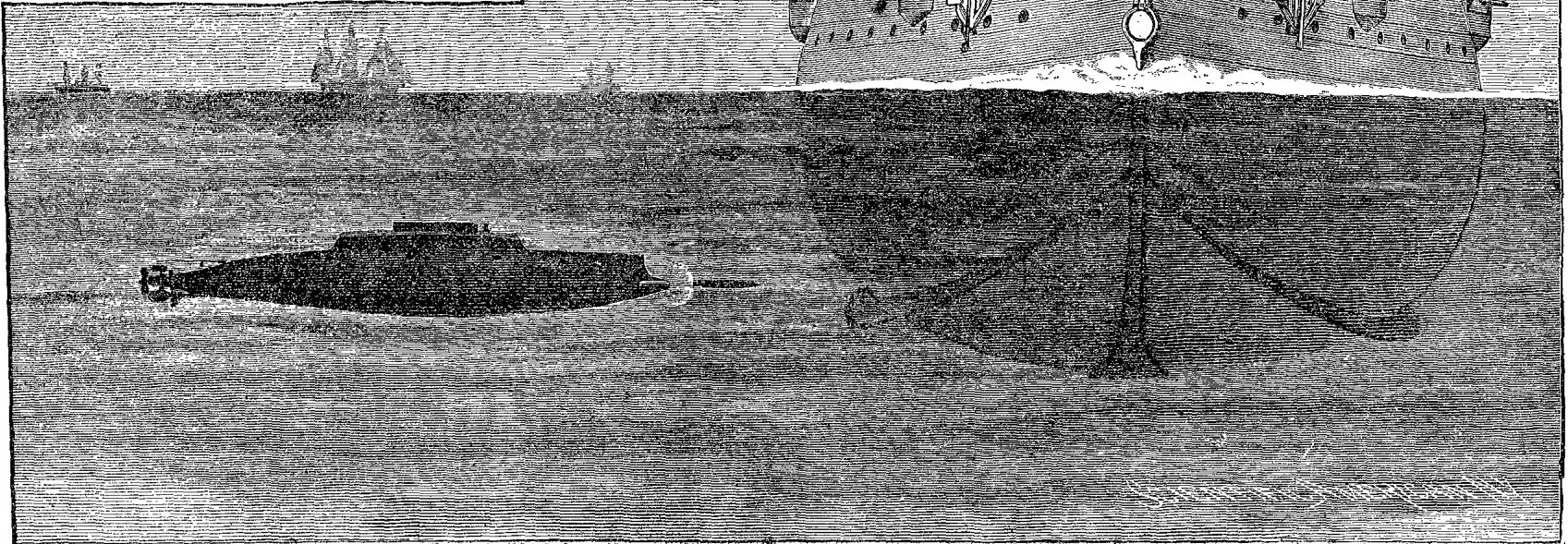
By permission of the “Scientific American.” The submarine torpedo-boat ready to discharge her torpedo against the man-of-war. Without any knowledge of an approaching enemy the great war-ship will be suddenly destroyed.
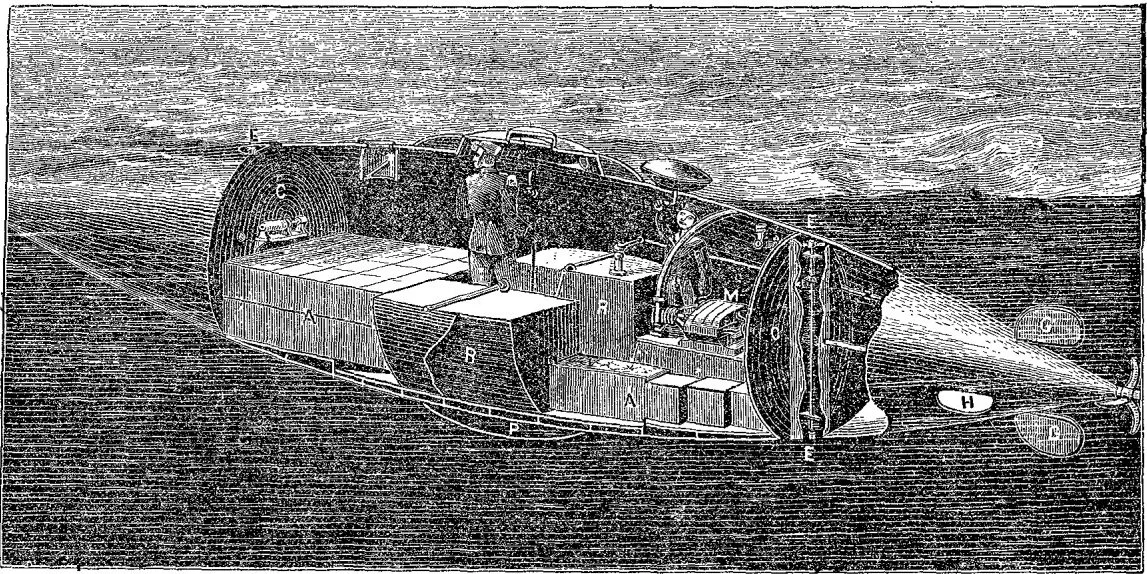
By permission of the “Scientific American.” The submarine torpedo-boat with side cut away, showing a view of the interior.
The foregoing scripture presents the same truth in regard to the “last days” that is given in the texts quoted in previous articles. How clearly does the Word of God inform us that the “last days” will be made to resound with the “waking up of the mighty men,” in their maddened efforts to “prepare war”!
In previous articles the great guns and men-of-war that are now being prepared in fulfilment of these prophecies, have been considered. But the torpedo-boat, armed with the most destructive of all modern weapons,—the torpedo,—has not been described.
There is no field in which the genius of man is more drawn out than in the development of “high explosives.” Nitroglycerin, dynamite, melinite, etc., in all their various compounds, are being continually experimented with in order to compress within the least possible space the most powerful explosive. And the modern torpedo, charged with the well-nigh inconceivably vast power of these explosives, is well reckoned as the deadliest of all inventions for destruction.
The marine torpedo of to-day is a veritable log of steel, pointed at the front end, and provided at the rear with a screw propeller that is driven by electricity from a storage-battery within the torpedo itself. There is a large percussion-cap on the point in front; and when the torpedo strikes the object at which it is aimed, it explodes, with terrible results, the charge of dynamite within.
All the large war-ships have half a dozen or more of these torpedoes on board, and the various nations are now providing themselves with “torpedo-boats.” The torpedo-boat is built light, in order to have the highest possible speed. It carries no guns except a few small “rapid-fire” pieces, and depends on keeping out of the way of the big cannon of the men-of-war, while it shoots out its torpedoes with the most destructive results.
By permission of the “Scientific American.”
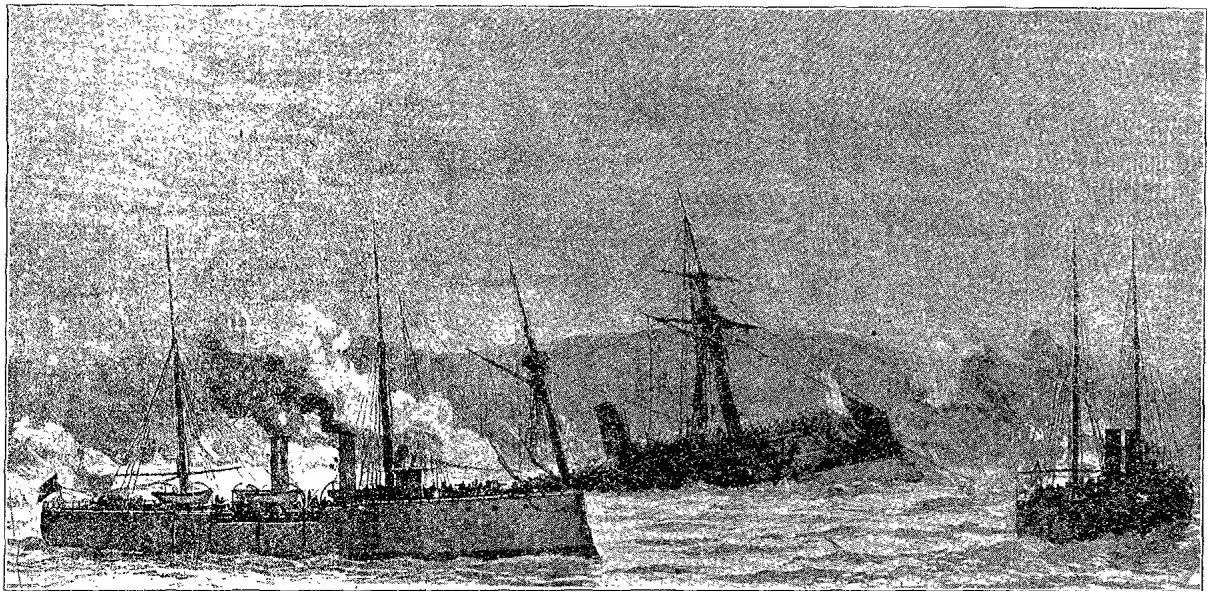
The “Almirante Condell.” The “Blanco Encalada.” The “Almirante Lynch.”
The short but disastrous fight between the torpedo-boats and the big man-of-war.
By permission of the “Scientific American.” The “Almirante Condell.” The “Blanco Encalada.” The “Almirante Lynch.” The short but disastrous fight between the torpedo-boats and the big man-of-war.
The torpedo is shot through the surface of the water out of a pneumatic tube or gun. As soon as it is shot out, the electric propeller with which each is provided begins to work, and the torpedo goes straight on her course to her object, several miles away. The only thing with which fittingly to compare the results is the convulsions of an earthquake.
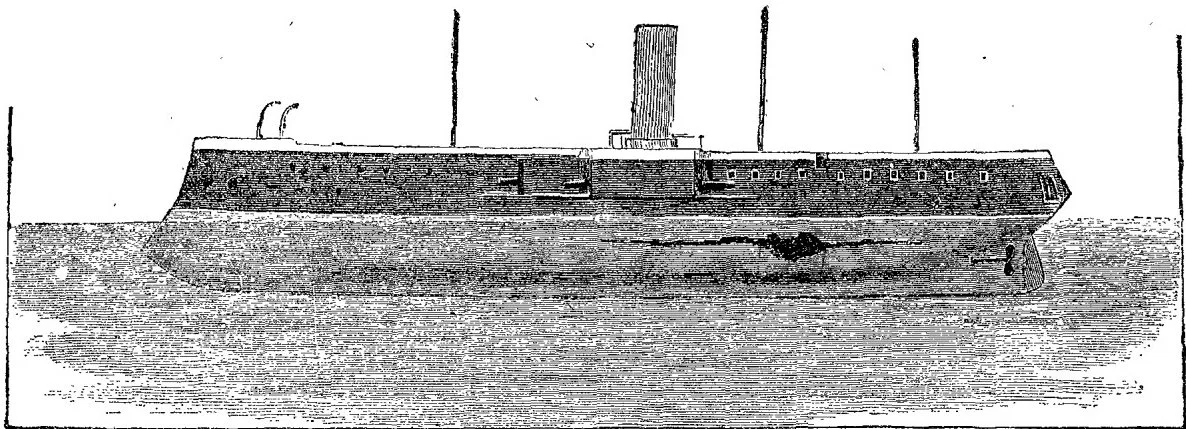
What these torpedoes will do is forcibly presented in the accompanying illustrations of a fight of only a few minutes’ duration between the iron-clad “Blanco Encalada” and the two torpedo-boats, the “Almirante Lynch” and the “Almirante Condell,” during the civil war in Chile a few years ago. The “Encalada” was lying at anchor in the harbor, and the two torpedo-boats, under cover of the night, came swiftly into range, and discharged their torpedoes. The “Encalada” saw her antagonists coming; but being taken by surprise, only a few shots from her guns could be fired, and none of these struck the torpedo-boats; one of the torpedoes from the “Lynch” struck her, and blew a hole four feet wide and sixteen feet long in her side, making a further rent of twenty feet each way from this main break.
Of course the “Encalada” went down immediately, only her mast remaining above water to mark the spot. So great is the explosive energy stored in one of these torpedoes, that the big man-of-war, with its seemingly impenetrable armor, is torn open and sunk almost like a wooden toy.
The “submarine” torpedo-boat, shown in our accompanying cuts, is also about perfected, and is looked upon as a most important adjunct to the modern navy. The reader will see, from the illustrations, that the plan is to have this boat advance under the water, and when at a proper distance, discharge her destructive torpedo at the unsuspecting enemy’s ship.
Still another vessel, called the “torpedo-boat-destroyer,” is worthy of mention in this connection. The terrible destructiveness of the torpedo-boat, as she casts out her torpedoes, has led to the construction of a boat with light armor, equipped with “rapid-fire” guns, and arranged for the highest possible speed. It is hoped with these vessels to run down the enemy’s “torpedo-boats,” and destroy them before they can get in their deadly work. And so the manufacture of death-dealing instruments goes on. One nation prepares a weapon that it thinks cannot be excelled, and immediately another is devised to render it powerless by doing a more destructive work. What is considered the very best weapon to-day is found to be far behind the times to-morrow. All the great nations are becoming hopelessly bankrupt in their maddened efforts to keep themselves supplied with the most recent and improved weapons.
By permission of the “Scientific American.” The “Encalada,” showing the rent in her side, fifty-six feet long, sixteen feet of it in the center being four feet wide.
It is not intended to make these articles exhaustive. We cannot attempt to give more than a small part of the evidence which shows the great preparations for war that are being made; but it is hoped that enough will be presented to arouse every one who reads to a realization of the great fact that the “nations are angry,” and that the “unclean spirits” have already gone to the “kings of the earth and of the whole world, to gather them to the battle of that great day.” The sincere student of the Word of God can come to no other conclusion, and knows in his heart that time is very short.
When we take into account, in connection with these “signs of the times,” the wonderful power that God is now pouring upon those who are consecrating themselves to his service, and consider how souls are at present coming into the truth in a day, when a few years ago it took weeks and sometimes even months to reach them, who can doubt that we are even now in the very midst of that time when God has set his hand to “finish the work, and cut it short in righteousness: because a short work will the Lord make upon the earth”?
The work is most truly closing very rapidly. Some will heed the Word of God and see it; and, seeing it, they will zealously work in every way they can speedily to proclaim to the world the joyful news that Jesus is about to return. There will be others who will drown themselves in the cares and the so-called pleasures of this world, and hence will not heed the rapid flight of the third angel as he speedily flies to the ends of the earth with the closing notes of the everlasting gospel upon his lips. In just a little time from now they will join in that wailing cry, “The harvest is past, the summer is ended, and we are not saved.”
Brethren and sisters, friends,—all,—now is the time to be up and doing; “for the day goeth away, for the shadows of the evening are stretched out.”

"GO, PREACH."

MRS. M. E. DURKEE.
(Graysville, Tenn.)
CHRIST said, “Go, preach.” There are many ways to preach the gospel. It is not all done from the pulpit. The smallest act, as well as the greatest sacrifice, if done in the spirit of the Master, will preach the gospel.
Not alone the spoken word or the printed page, but also the feeling heart of sympathy for others’ woes, and the kind manner that renders gifts acceptable,— these are ways whereby some who can neither go to foreign lands nor send others there, may preach the gospel.
Nimble hands and willing feet may perform services of love for the needy. Some may be eyes for the blind, feet for the lame or weak ones, or ears for the deaf. These little services, if done for the Master, preach for him. Gathering up garments for the poor, writing missionary letters, and mailing our good papers,— all these things, if done for Christ’s sake, are preaching his everlasting gospel. If the desire is, first of all, to win souls to Christ, then our preaching will not be in vain.
To feed the hungry and clothe the naked, is Christlike. The heart is more often touched to receive spiritual truths if the wants of the body have first been relieved. Therefore let us all obey the command, “Go, preach.”

PERSONAL DECISION.

The surest mark of a weak character is the tendency to shift upon others what ought to be decided in person. Not only does this trait exhibit instability of mind, but it usually indicates insincerity of purpose. Those who oftenest ask advice usually seek it from a prejudiced source; and the man who falls into the habit of transferring important questions from the forum of his own conscience or judgment to that of his neighbors’ or his friends’, seeks a change of venue only to confirm some secret wish, while appearing to escape responsibility.
It is the mark of a fine character when a man dares to decide all life’s issues for himself, from the putting on of his overshoes to how to serve his God.
What the world needs is not wind-engines but steam-engines,—self-centered forces, which do not wait for favorable winds to blow, but generate their own powers of propulsion. Better make a dozen mistakes than never make a decision. One Luther is worth a regiment of Erasmuses; in the long fight between a hero and an empire, the hero always wins. No man becomes a Christian who lingers to “confer with flesh and blood.” The question of our personal allegiance to Jesus Christ is not one that we can transfer to any other court than that of our own conscience; and “he who hesitates is lost.” No one else can decide this duty but the individual, and it may be reserved to no other time than now.—Interior.
Somehow after the critics have shown to their own satisfaction that there is nothing especially authoritative in the Bible, men feel that there is. The Bible speaks to them in a tone that no other book can rival. It searches out the deep things of the Spirit, and reveals a man to himself and God to him. You may explain just how the books of the Bible were written, and make everything in it very human and commonplace, but you cannot get rid of the divine element in it that appeals to every one who honestly studies it.—The Watchman.
Continue reading: THE ONLY TRUE TEMPERANCE