Your ShelfYour Projects

Signs of the Times, Vol. 23, No. 17.

FAITH IN THE RESURRECTION

Signs of the Times

Apr 29, 1897

Pacific Press Publishing Company · Oakland, California · Apr 29, 1897

FAITH IN THE RESURRECTION.

Its Meaning.

WE considered in these columns last week the resurrection of Jesus Christ, and what that resurrection meant. We found that it was not an event to be celebrated by a day in a year, or a day in a week, but that it meant power over death, and hence power over sin. It means to all those who have faith in Christ's death, burial, and resurrection, death to sin, death to the world, and "newness of life" in Christ Jesus. The old man of sin is dead and buried, we are "planted together [with Him] in the likeness of his death," a tree of righteousness, to bring forth in newness of life fruit unto God.
The beginning of that new life in its outward symbol is baptism. It is putting on Christ before the world. Gal. 3:27. It is being married "to Him who is raised from the dead," that we should "bring forth fruit unto God." Rom. 7:4. It is taking his name, his life, his law, becoming one with him.
It was for this that the Spirit, through Paul, prayed concerning the Ephesian Church, and all the people of God, "That the God of our Lord Jesus Christ, the Father of glory, may give unto you the spirit of wisdom and revelation in the knowledge of him; the eyes of your understanding being enlightened; that ye may know what is the hope of his calling, and what the riches of the glory of his inheritance in the saints, and what is the exceeding greatness of his power to usward who believe, according to the working of his mighty power, which he wrought in Christ, when he raised him from the dead, and set him at his own right hand in the heavenly places, far above all principality, and power, and might, and dominion, and every name that is named, not only in this world, but also in that which is to come; and hath put all things under his feet, and gave him to be the head over all things to the church, which is the body, the fulness of him that filleth all in all." Eph. 1:17-23.
The power necessary to the Christian is that which raised Jesus Christ from the dead, and that is the power of righteousness. This means the absolute renunciation of all sin. Thus the apostle expresses the true principle; for while he could boast of many things from a worldly, outward view, he declares: "But what things were gain to me, those I counted loss for Christ. Yea doubtless, and I count all things but loss for the excellency of the knowledge of Christ Jesus my Lord; for whom I have suffered the loss of all things, and do count them but dung, that I may win Christ, and be found in him, not having mine own righteousness, which is of the law, but that which is through the faith of Christ, the righteousness which is of God by faith; that I may know him and the power of his resurrection, and the fellowship of his sufferings, being made conformable unto his death; if by any means I might attain unto the resurrection of the dead." Phil. 3:7-11.
Here is giving up all for God, not only the evil, but what worldly wisdom might count good. Paul says that they are all nothing, that they are to be reckoned as refuse, that he might obtain that of infinite value. The end, the ultimate goal of his longing, was that he "might attain unto the resurrection from the dead." That this might be he must have the "knowledge of Christ Jesus," he must "win Christ." This meant not having his own righteousness, which carnal pride had wrought by outward obedience to the law, but the inward righteousness of God that was in Jesus Christ, implanted in the heart by living faith, and manifesting forth God's power. Having this righteousness is to "know Him," to know "the power of his resurrection;" for this is the power over all sin.
But to know the power of his resurrection, we must know "the fellowship of his sufferings, being made conformable unto his death." The cross precedes the grave and the opened sepulcher. Calvary comes before Olivet. But his way of death and suffering leads to life and glory. By the very means of death Christ conquered him who had power over death, the devil. His death was unto sin, our sin; for he had none of his own. His life was because of his own inherent righteousness. "Likewise reckon ye also yourselves to be dead indeed unto sin, but alive unto God through Jesus Christ our Lord." Rom. 6:11. Such death, such living, entitles the believer to the "resurrection of the dead," or, as Rotherham translates, "the out-resurrection, that from among the dead." For even as there are two lives, purposes, characters, here among the children of men, so are there

Two Resurrections

of the dead. The first is the resurrection desired by Paul, the resurrection from among the dead, for which Paul longed, which must have been preceded by a death to sin, and a life of righteousness. The other is the resurrection of those who are left. When the righteous are raised at Christ's coming, some remain dead. They did not believe in him, they were not clothed in the righteousness of God. But "there shall be a resurrection of the dead, both of the just and unjust." Acts 24:15. Both classes will come forth; it is of eternal importance in which class we are found.
God has revealed to us the order of these great events, and the time by which the resurrection from among the dead precedes the resurrection of the remainder. At the beginning of the thousand years, often called the millennium, Jesus Christ comes in glory, raises the sleeping saints, and takes them home to heaven (1 Thess. 4:16, 17); there they live and reign with Christ a thousand years. This is the first resurrection. "Blessed and holy is he that hath part in the first resurrection; on such the second death hath no power, but they shall be priests of God and of Christ; and shall reign with him a thousand years." Rev. 20:6. This resurrection, in which is the power of Christ's resurrection, it is plain, occurs at his second coming, at the beginning of the millennium. "But the rest of the dead lived not again until the thousand years were finished." Rev. 20:5.
O, it is not of so much importance as to whether we shall be raised from the dead, but in what resurrection shall we rise? He who rises in the latter, who knows not Christ's power here, will meet the second death, to die forevermore. But he who shares the first, will have a part there, because he has known the power of Christ's resurrection here. Never did the church of Jesus Christ need more to heed the injunction of the apostle: "If ye then be risen with Christ, seek those things which are above, where Christ sitteth on the right hand of God. Set your affection on things above, not on things on the earth. For ye are dead, and your life is hid with Christ in God. When Christ, who is our life, shall appear, then shall ye also appear with him in glory." Col. 3:1-3.
Even "now are we the sons of God, and it doth not yet appear what we shall be; but we know that, when he shall appear, we shall be like him; for we shall see him as he is." 1 John 3:2. Weary, toiling pilgrim, Christian brother, be faithful to God; in a "little while" the azure vaults of heaven will reveal the coming "King in his beauty." If we are his, if we know him, whether "we wake or sleep," we shall be glorified with him forevermore. Most blessed event to the child of God, blessed hope to the faithful sleepers in Jesus Christ, who will rise triumphant and sing, "O grave, where is thy victory?"

Editorial

The Importance of the Now.—Now is the most important moment of our life. We can not recall the past; we can not bring nearer the future. We can not live yesterday over to-day. We may add to its fruitage of evil or good, but its hours are gone forever. Neither can we meet to-morrow's troubles to-day. To live in the past, to long for its pleasures, to despairingly mourn over its failures, or to endeavor to anticipate the troubles of the future, is neither wise nor helpful. God gives us now, this moment, to use as we will

The Decision Ours.—But the responsibility of the decision God has placed with us. He sets before us, as he did Israel of old, "life and death, blessing and cursing;" and tho Infinite Love and Wisdom pleads, "Choose life, that both thou and thy seed may live," Infinite Power will not compel us to choose. We ourselves must make the decision; we can not shift the responsibility if we will. God made the human mind free, bestowed upon it his Spirit, the

Spirit of liberty. 2 Cor. 3:17. He marked out the way by which man could maintain his liberty, by obedience to "the perfect law of liberty." James 1:25; 2:12. But God also gave to man the tremendous and awful responsibility of deciding for himself whether he would walk in liberty, or sell himself into bondage. Man chose the latter, because in himself a helpless, hopeless slave of sin. But God did not leave him here. In man's slavery Infinite Love speaks to every soul. You may be free by the way of Jesus Christ and his cross.

There Is No Neutral Ground.—In great political questions, in the affairs of human strife, in purely speculative, "scientific," and theological theories, we may take neutral ground, and decide neither way. But we can not do this in

the questions between our soul and God. To not decide for the right is to decide against it. To put the question off till a later time is to weave a bad thread in the web of character, and to run the awful risk of never being given the opportunity again. It is to take a step in a false path, which we may not retrace. We can not leave the choice with some one else. God in his Word has told us the way. To acquiesce, to choose, to accept with all the heart, is the only way we can decide aright. But to refuse to decide is to say that we do not believe God. To place the responsibility of decision upon some one else is to decide against God, for we put man in the place of God; he intervenes between ourselves and our Maker.

Washing Our Hands of Evil.—It is by the

right decisions in the now that great characters and great results are wrought out. To parley with the enemy, to question whether Right is just now expedient, means weakness if not death. When the Right and the Wrong come before us, we may not, as did Pilate when the Righteous One stood in his presence, wash our hands before the multitude, and say, "I am innocent of the blood of this just person; see ye to it." The multitude may answer, "His blood be on us, and on our children," but that will not clear our skirts. Pilate failed in that moment when he thought to compromise with the Jews, and said, "I will scourge him, and let him go." He compromised when he set Jesus, the Innocent, and Barabbas, the murderer, before the multitude, and asked, "Whither of the twain will ye that I release unto you?" He feared the people, feared for his position, his influence, his wealth, his honor, his standing before Caesar, and in the little moments of compromise, policy, and expediency, bartered away the eternal years of principle, character, and life; and, at the same time, lost the very influence he hoped to strengthen over the people he ruled. We may not wash our hands of evil unless we stand positively against it. Others may be more deeply involved than we, as the Jews were than Pilate, but others' greater guilt or prominence will not clear us. We must stand as in the sight of God, without respect to others, and then Christ will wash heart and hand free from all stain of sin.

The Greatness of Now.—Now is only a point in time. It vanishes as we speak the word. It seems so small to many as to be insignificant. But in it are wrapped up eternal possibilities, eternal fruitage, eternal life. If every soul that ever decided wrong could have seen at the time of his decision the results of that decision, it is probably true that none would have so decided; but they decided, and allowed themselves to be deceived into believing, that the ultimate results would be different, looking only to present pleasure and profit. Thus it is with wrong decisions; a selfish motive lies underneath. But they who decide aright, out of whose decisions grow the great things of God and eternity, rarely or never see what may grow out of it, or pause to count the results to themselves. They saw the right, and the duty to right and God and humanity, and they decided there and then. There is no other true way to build character, to truly live for God, except in the living now, the momentary life. All other is false, deceptive, disappointing. This only is true and abiding. "To-day if ye will hear his voice." "Behold, now is the acceptable time; behold, now is the day of salvation."

WHAT CAN HE SAY?

IN a meeting of the Foreign Missionary Society of the American M. E. Church, a returned missionary to Persia, who was described as "full of enthusiasm for his work," spoke as follows:
I am often asked by the Persians how it is, if the Christian religion be the pure Gospel I claim, that my nation, Christian America, has a far longer list of crimes than Persia? What can I reply? What can I do but bow my head in shame, and raise my heart in prayer to God to lift the cloud from rum-cursed America? O, this Christian nation will have to rouse from her slumber, and sweep this evil from her borders, ere she can hold out pure hands to other nations, asking them to accept her Bible and her God!
A man who would have any trouble in answering such a question as that asked by the Persians, ought to get better acquainted with the Gospel before going out as a missionary. He should learn that the Gospel is "the power of God unto salvation to every one that believeth," no matter in what land he dwells. He should be able to assure the questioners that the Gospel is an individual matter, and that therefore America is not, never was, and never will be Christian, and that it is not possible that any nation on earth, as a nation, can be Christian.
The fact that America "has a far longer list of crimes than Persia," is all the evidence that is needed to show that it is not Christian; for Christianity means freedom from sin. America is no more a Christian nation than Persia is.
But it would doubtless be most galling to the missionary's "patriotism" to make such an answer as that. And that is the trouble with too many missionaries, both home and foreign. A mistaken loyalty to their native country interferes with their loyalty to the Gospel. If they could but learn that the true Christian is only a sojourner on this earth,—a pilgrim and a stranger even in the land of his birth,—and that his citizenship is in heaven, they would not be embarrassed by such questions as were asked the missionary to Persia. The only country in which they would have a special interest, as a country, would be the heavenly country.
But would not the same charge against the Gospel remain unanswered, namely, that it can not be as pure as is claimed, or else it would have more influence in diminishing crime in America?—Not by any means. The Gospel cleanses from sin and crime all who accept it, and no others. If it were less pure than it is, it would be more generally accepted; but then it would be of no use. The Lord himself gave no warrant for supposing that the majority of men in any nation would accept the Gospel, but, on the contrary, warned his followers that they must always be comparatively few in number, and must suffer persecution.
The Gospel knows nothing about natural or artificial boundaries on this earth. It is to be "to all people." It knows nothing about states and governments. Its mission is to "every creature." Kingdoms may rise and fall, nations may extend their boundaries, and others may be absorbed, but none of these things concern the ambassadors for Christ. They are the representatives of no country but heaven, and are accredited to no earthly government, but to the world as a whole, and to the whole world considered as individuals, who are to be transformed by it, and made to live a different life as individuals. When all of Christ's ambassadors fully realize this truth, then will their mission be clothed with a dignity and power befitting its exalted origin.
E. J. W.

Be Not Deceived

“Be Not Deceived.”—This is one of the oft-repeated admonitions of Scripture. Apply it to the Sabbath question; for by many devices the enemy of all truth is seeking to confuse and deceive the honest in heart. One of his means is the “chronology” of the world. “How do we know,” he asks, “which is the seventh day?” “Be not deceived.” Chronology makes no difference whatever in the Sabbath question. There are a dozen different systems of chronology, more or less, varying in the aggregate thousands of years between the creation and the present time, and yet those who hold to the various systems have the one week. Russia still reckons time by Old Style, America by New Style, twelve days difference, but the weeks and the order of its days are the same. Jesus, our divine Lord, kept the true Sabbath; there has been no change in the week since that. Be not confounded or deceived by the theories of men; rest in God’s Word.

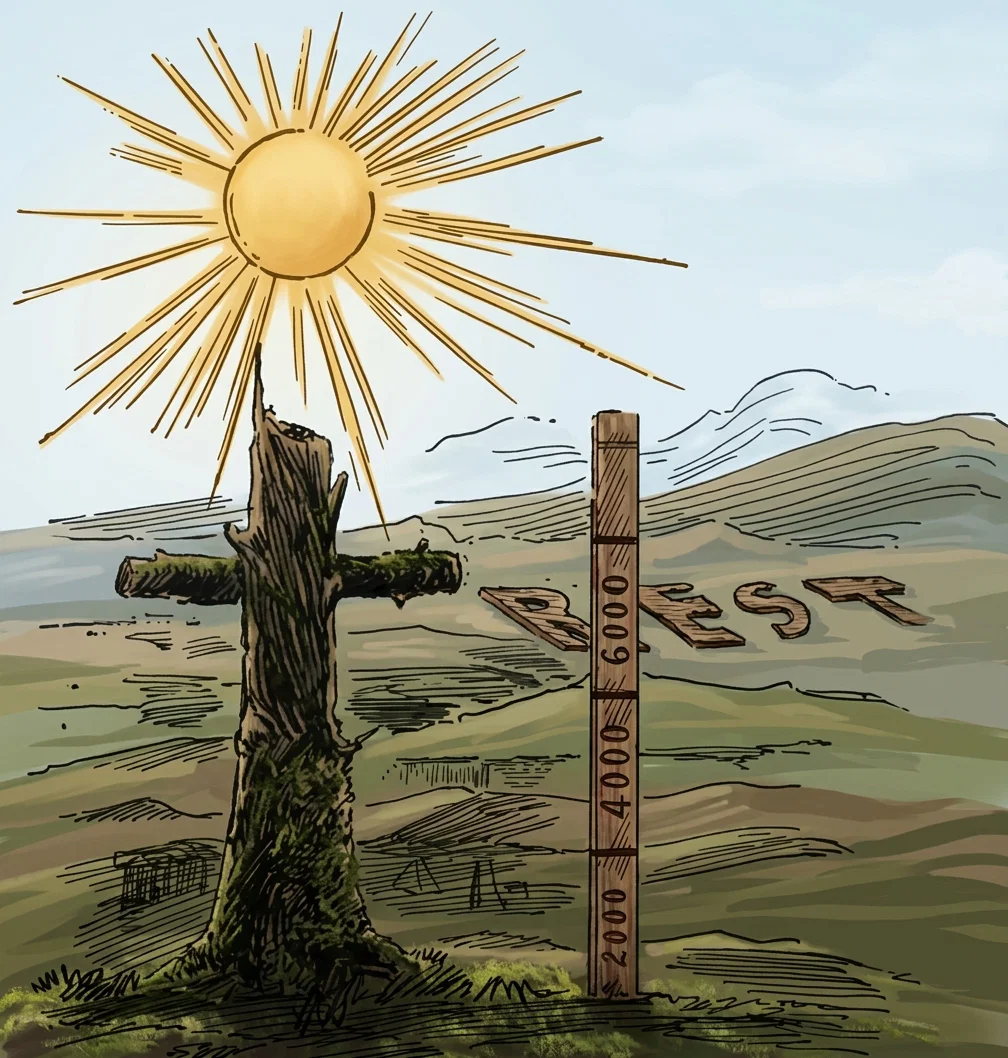
THE CROSS OF LIFE.

As reverently I bowed in prayer, I saw the Cross of Life uprear, And there, before my eyes, Stood not the sculptured marble pile Which men oft view with senseless smile, But simple, plain, and rugged cross, With half its body grown with moss. Did I affect surprise?
Its distance from my point of view Seemed so uncertain that I knew I could not tell its length. But as I gazed more steadfast there, Its measurement appeared more clear; Its ruggedness, its knots and thorns Stood out upon its stem and horns, Which were of giant strength.
A measuring rod beside it stood, A rod of hard and blood-stained wood, All marked in perfect scale. The measuring rod was human strife; The cross was long as human life; I cried aloud: "Is there no rest? Can none escape this fearful test Where toil and strife prevail?"
Then nearer drew the Cross of Life; Less fearful seemed the toil and strife; A disc above it pressed. I saw the Sun of Righteousness Was throwing rays upon its crest; And there beyond the measuring rod, As none could write, no, none but God, I read the sweet word "rest." William T. Heald.

THE COMING OF THE LORD.

THE Christian Advocate of April 8 contains quite a lengthy reply to a question raised by a correspondent in regard to William Miller and the nature of his teaching. In reading this reply, I am struck with the thought of how easily a great man's work and a great religious movement may be belittled by one who writes of it from the attitude of an opposer. It has been said of a certain historian that he wrote a history of England at the very time that Methodism was making itself felt as a great power in that country, but that he was too bigoted to mention it in his writing. Something of the same feeling may be discovered in many writers of the present day when the names of those who have, during the last fifty years, taught the doctrine of the near coming of the Lord, are under discussion. The Advocate acknowledges that Mr. Miller "became a very powerful preacher, and a very interesting lecturer, and, being a godly man and an evangelist, he produced tremendous effects." But,
on the whole, he would have it appear that he was rather an uneducated man, not acquainted with church history, and that, while "some very distinguished and able men accepted" his views, "the more intelligent and well educated generally opposed it."
Allowing that the Advocate has told the truth in this matter, the conditions here described are so very similar to the conditions relating to the proclamation of the Gospel by the apostles that one can not fail to notice the similarity. Christ selected humble, and, to the Jewish people and to the world, unknown men to begin the greatest and grandest work the world ever saw. In the language of that time they were called "unlearned and ignorant men." Of course this was from the standpoint of the scholarship of that day. Time has to a great extent reversed this view of the apostles, or made it of little account. It may do the same in reference to the standing and labors of other men. What more can be said for Peter, James, and John than that they were powerful preachers, interesting lecturers, and godly evangelists? Measured by other standards of their day, they were very deficient men. Even to-day those who revere them the most do not look upon them as great scholars. We only know, or care to know, that they had a message of warning, power, and salvation for a lukewarm church and a corrupt world. That they had "been with Jesus and had learned of him" is to our minds a sufficient excuse that they had not acquired much of the learning of that time.
Later, Paul, a learned man for that day, was called into the work, and Apollos, the eloquent man, carried conviction to thousands; but these men did not depend on their scholarship to win souls. Paul says that he did not use enticing words of men's wisdom in preaching, and he explains the paucity of learned men among them and his own simpleness of manner in these words: "For ye see your calling, brethren, how that not many wise men after the flesh, not many mighty, not many noble, are called; but God hath chosen the foolish things of the world to confound the . . . mighty; and base things of the world, and things which are despised, hath God chosen, yea, and things which are not, to bring to naught things that are; that no flesh should glory in his presence." 1 Cor. 1:26-29.
The above principle is given through the ablest scholar of the apostolic period, not by one of the "unlearned and ignorant" apostles. It is therefore approved by the highest scholarship ever in the church, sanctified by the Holy Spirit, that God, for the purpose that "no flesh should glory in his presence," chooses humble and unknown men to accomplish his purposes.
It is also true that the preaching of the near coming of the Lord has been largely done by earnest, devoted, and intelligent men and women, with no great claim to superior culture, and with them a few men of eminent ability. This is in striking harmony with the acknowledged ways of God in his working, as illustrated by the work started out under his personal direction, and supplemented after his departure by the direction of the Holy Ghost sent down from heaven.
But what about the doctrine of the near coming of the Lord? Is there any good reason why one should believe it? Referring to those who first preached that Christ's coming is near, the Advocate said: "The simple fact was that they did not understand the Bible; and there are thousands in the Christian churches now as thoroughly deceived as ever Miller was, some of them very conspicuous. By their Biblical interpretation they love to prove the world is growing worse all the time, and are confident the time is near at hand."
Perhaps it will now be in order to see what the Bible does say about the coming of the Lord. Will Christ come again?—"If I go and prepare a place for you, I will come again, and receive you unto myself." John 14:3. He will be seen "coming in a cloud with power and great glory." Luke 21:27. That coming will be personal and visible. "This same Jesus, which is taken up from you into heaven, shall so come in like manner as ye have seen him go into heaven." Acts 1:11. "Behold, he cometh with clouds; and every eye shall see him." Rev. 1:7.
The wicked will be unprepared for that day; "for as a snare shall it come on all them that dwell on the face of the whole earth." Luke 21:35. "For as in the days that were before the flood they were eating and drinking, marrying and giving in marriage, until the day that Noe entered into the ark, and knew not until the flood came, and took them all away; so shall also the coming of the Son of man be." Matt. 24:38, 39.
The saints will be looking for Christ and believing that his coming is near. "And it shall be said in that day, Lo, this is our God; we have waited for him; . . . we will be glad and rejoice in his salvation." Isa. 25:9. "But ye, brethren, are not in darkness, that that day should overtake you as a thief. Ye are all the children of the light, and the children of the day. . . . Therefore let us not sleep, as do others; but let us watch and be sober." 1 Thess. 5:4-6. See also Luke 21:28.
The unbelieving will scoff at the idea of Christ's coming. "There shall come in the last days scoffers, walking after their own lusts, and saying, Where is the promise of his coming?" 2 Peter 3:3, 4. But some will know when his coming is near. "So likewise ye, when ye shall see all these things, know that it [margin, 'he'] is near, even at the doors." Matt. 24:33. Those who know this will teach it to others. "Who then is a faithful and wise servant, whom his lord hath made ruler over his household, to give them meat in due season?" Matt. 24:45. Inasmuch as the "evil servant" says, "My lord delayeth his coming," it is evident that the "faithful and wise servant" says that the lord will not delay his coming; and in saying this, he gives the household "meat in due season." In other words, he gives important truth when it should be given.
These positions might be reinforced by many more texts; the Bible is full of them. Great and scholarly men may see a way to avoid their force, but what God's Word says is more than human learning, more than modern scholarship. Some are willing to believe the Word. The Advocate says that there are "thousands in the Christian churches" who believe this. This is true, not mentioning the large numbers of Christians who are distinctively known as Adventists. The doctrine is permeating the churches. Never were there so many Christians looking for the speedy fulfilment of the promise of Christ's coming as now. Among them are such men as Mr. Moody and Dr. Pierson, who are conspicuous before the world for piety, zeal, faithfulness, and great success in the Master's work. They acknowledge that this faith and hope are the mainspring of their actions.
If the preaching of such men was not so nullified by the scientific doubt of the age, the "higher criticism" and the "peace-and-safety" cry of so many of the clergy, who can tell what the preaching of the Lord's coming might not yet do for the world? We fully believe that it would take many thousands of that class who in that day will vainly cry for the rocks and mountains to fall upon them (Rev. 6:16), and place them among those who, abiding in him, will "not be ashamed before him at his coming" (1 John 2:28).

God's Presence in His Word.

God's presence cleanses from sin. When our Lord appeared to Moses in the burning bush and to Joshua as the Captain of the Lord's host, his presence made the ground holy. Ex. 3:5; Joshua 5:15. Mount Sinai was made holy by the same presence, and it seemed to sinful Israel as a consuming fire, but it only consumes sin. God's life and presence in his Word give it power to cleanse whoever receives it. Jesus spoke, and the leper was cleansed. Matt. 8:3. He said to the disciples: "Now ye are clean through the word which I have spoken unto you." John 15:3. He cleanses his church "with the washing of water by the Word." Eph. 5:26. Let God's Word reign in the heart, and it will purify and sanctify the life.

Do We Love God?

We say we do. But is that our only test? If it is, it is not the Bible test. This is the Bible test of love: "If ye love me, keep my commandments;" "This is the love of God, that we keep his commandments; and his commandments are not grievous." This is the only true test of love.

"DRIVE THE TURKS OUT OF EUROPE!"

STRANGE as it may seem, this is the slogan of many people who profess to be Christians. From a Christian standpoint we would ask those so-called Christians, Why drive the Turks out of Europe? The mission of Christianity is to make men better, to influence them by precept and example to lead better lives, to the glory of God. But suppose Christians take up arms, carnal weapons, and "drive out the Turks," robbing them of their homes, will that be likely to give the Moslems any better opinion of Christianity? Will such a manner of presenting Christ be likely to draw the Turks to him? Christ says to his disciples, "Go ye into all the world, and preach the Gospel to every creature." Will the Turks be any more accessible to the Gospel missionary if driven across the Bosphorus and the Hellespont than they are in the European dominion of the sultan? Or is it supposed that European soil is any more sacred than that of Asia? And is it necessary that the unhallowed foot of the Mohammedan must be removed from the sultan's European territory before that region can be Christianized? Suppose all this to be a necessary part of Gospel work, how are we to evangelize Asia Minor and other parts of Asiatic Turkey while the Turks remain? Shall we drive them on and on, into the sea, in order to Christianize the land?
But if "Christian" Europe be too sacred for the dwelling-place of the Turk, what about the so-called "Holy Land," which is also a part of his domain? There is no doubt that he will be driven out of Europe, for the prophecy says, a prophecy which many understand to apply to the Turk: "He shall plant the tabernacle of his palace between the seas in the glorious holy mountain." And not only so, but he is then to "come to his end, and none shall help him." But the Word does not say that Christians will do any part of the driving out and destroying. Under whatever name it shall be done, it will not be a Christian work. Why?—Because nothing but the force of arms, physical force, can accomplish such a work, and "the weapons of our warfare are not carnal." But is it not said "they are mighty through God to the pulling down of strongholds"?—Yes, but not strongholds in the sense of temporal kingdoms; "for we wrestle not against flesh and blood, but against principalities, against powers, against the rulers of the darkness of this world, against spiritual wickedness [margin, "wicked spirits"] in high places." Whatever these enemies be, against which the Christian is authorized to contend, they are such as can be overcome by the "armor of God." "Wherefore take unto you the whole armor of God, that ye may be able to withstand in the evil day, and having done all, to stand." Then all that the Christian is to do in the way of warfare is to be done and can be done with the "armor of God." The manner of the Christian's warfare is thus set forth in the Word of God:—
"Stand therefore, having your loins girt about with truth, and having on the breastplate of righteousness; and your feet shod with the preparation of the Gospel of peace; above all, taking the shield of faith, wherewith ye shall be able to quench all the fiery darts of the wicked. And take the helmet of salvation, and the sword of the Spirit, which is the Word of God; praying always with all prayer and supplication in the Spirit, and watching thereunto with all perseverance and supplication for all saints." Eph. 6:14-18.
Then Christians have nothing to do with driving the Turks out of Europe, or with driving any people out of any country, or with driving men at all. "Knowing therefore the terror of the Lord, we persuade men," and this is the message to "every nation, and kindred, and tongue, and people." "Now then we are ambassadors for Christ, as tho God did beseech you by us; we pray you in Christ's stead, be ye reconciled to God."
W. N. G.
Continue reading: A LESSON FROM THE KING OF BABYLON