The outlook of the work being carried on by Seventh-day Adventists never appeared brighter and more assuring and cheering than it does to-day. And yet Seventh-day Adventists never faced a graver situation than they do at this present time.
We shall be better prepared to recognize and appreciate the evidences relating to the outlook, or the future, of our cause by a brief review of its beginning and history. The more clearly and fully we understand the providences of God which have shaped it in the past, the more readily shall we understand the providences that are directing it now.
The cause of which we speak, and of which we are a part, is the great religious movement set on foot and carried forward by the proclamation of the threefold message recorded in the fourteenth chapter of Revelation. “The advent cause,” wrote James White in 1852, “owes its very existence to the first and second angels’ messages of Revelation 14.”
This cause is not of human origin. It was not conceived by any human mind. It was not begun by the will or choice of man. It has not been carried forward by the mere plans and power of men. This movement is the fulfilment of prophecy. It is here by divine arrangement. The time is fulfilled; the kingdom of God is at hand; the threefold message of Revelation 14 must be proclaimed to the world. This movement is that proclamation. It came at the appointed time, just as a planet sweeps into view at the right time. It has moved forward with an irresistible force like that which moves the worlds.
This cause is seventy-three years old. It began in August, 1831, when William Miller, of Low Hampton, N. Y., sounded the first trumpet blast of the first angel’s message. Its history, as represented by the people who have embraced it, and the work they have done to make it known to the world, is of thrilling interest. It presents an unbroken chain of divine providences for seventy-three years. It furnishes abundant evidence that the days of apostolic victories reach down to the twentieth century.
William Miller was the man chosen, instructed, and disciplined for the great task of inaugurating this world-wide advent movement. He became a devoted Christian in 1816. From that time he spent fifteen years in preparing for the work. His first sermon proclaiming this message was preached at Dresden, N. Y., in August, 1831. His first written statement explaining the message was printed in the Vermont Telegraph, a Baptist paper published at Brandon, Vt., May 15, 1832. His first pamphlet giving an exposition of the message was printed at the office of the Vermont Telegraph, in March, 1833.
For years the cause made slow but steady progress. In 1838 Josiah Litch, a talented minister of Lowell, Mass., embraced the message, and began to proclaim it by voice and pen. Near the close of 1839 Joshua V. Himes united with the movement, and devoted his talents and energies to its advancement.
This marked a new era in a work begun in great weakness nine years before. From this time, the message went to the world with mighty power. Thousands accepted it, and joined in its proclamation. Papers were started in different parts of the country, tracts and pamphlets were printed and distributed by the millions of pages, and lectures were given in tents, halls, and schoolhouses everywhere. William Miller estimated that he, alone, during the year and a half from Oct. 1, 1839, to April 15, 1841, had “traveled 4,560 miles, and preached 627 sermons, averaging one and a half hours each, resulting in about five thousand hopeful conversions.” “The work spread with a power unparalleled in the history of religious movements.”
The climax of this special work of the first angel’s message was reached in 1844, when the twenty-three hundred years closed, and the judgment opened. In America alone fifty thousand people had embraced the message, and three hundred ministers and lecturers had publicly proclaimed it. The whole country was stirred. “No cause of moral or religious character, probably ever made so rapid advance as the cause of Adventism . . . Never have a set of men labored more faithfully and zealously in the cause of God, or with purer motives.”
Those who understood and believed the message, fully expected that the Lord18would come in 1844, and rejoiced in the blessed hope of seeing him. “Shortly before the definite day the traveling brethren returned to their homes, the papers were suspended, and all were waiting in ardent expectation for the coming of their Lord and Saviour.”
But he did not come. They were disappointed. The message that had been so sweet became bitter,—more bitter than pen can describe. All was wrapped in profound mystery. No one could understand or explain the situation. Confusion followed. Some rejected the whole movement as a great deception. Others searched for the meaning of the disappointment, finding comfort in such scriptures as Revelation 10, and the closing verses of Hebrews 10, where the disappointment itself was foretold. Of this time and experience Sister White has written:—
Mr. Miller, and those who were in union with him, supposed that the cleansing of the sanctuary, spoken of in Dan. 8:14, meant the purifying of the earth prior to its becoming the abode of the saints. This was to take place at the advent of Christ, therefore we looked for that event at the end of the twenty-three hundred days, or years. But after our disappointment, the Scriptures were carefully searched with prayer and earnest thought, and after a period of suspense as to our true position, light poured in upon our darkness; doubt and uncertainty was swept away.
Instead of the prophecy of Dan. 8:14 referring to the purifying of the earth, it was now plain that it pointed to the closing work of our High Priest in heaven, the finishing of the atonement, and the preparing of the people to abide the day of his coming.
The explanation of the disappointment revealed the fact that the second and third messages must follow the first message that had been given by William Miller and his co-workers. And those to whom this explanation was revealed were called upon to continue the work begun under the first message. Joseph Bates, James White, and Mrs. E. G. White were the believers to whom this light had come. To them was committed the responsibility of picking up the work at the point to which William Miller had brought it.
Light on the Sabbath question began to dawn on the Adventist people before the disappointment. The Midnight Cry, in its issue of Sept. 5, 1844, said: “Many persons have their minds deeply exercised respecting a supposed obligation to observe the seventh day.” In the same year, Elder T. M. Preble, one of the Adventist preachers, began to keep the Sabbath. Feb. 13, 1845, he printed an essay setting forth the origin of the Sabbath, its place in the decalogue, and that the change to Sunday had been made by the Catholic Church. It is to be regretted that this first able and earnest advocate of the Sabbath among the advent believers did not long continue to observe it.
Joseph Bates, who had taken a very active part in proclaiming the first angel’s message, began to keep the Sabbath in 1845. In the same year he wrote and published a pamphlet on the Sabbath question. In 1846 he met Ellen G. Harmon, and placed the Sabbath truth before her. She recognized it as Bible truth, and began at once to keep the Sabbath. She communicated the new light to James White, and he accepted it. In the fall of 1846 they were united in marriage, and from that time labored together to advance the cause committed to them.
These pioneers had no congregations to preach to, and no literature to distribute, except the little pamphlet on the Sabbath question printed by Brother Bates. Their first work was to visit their friends and acquaintances, and tell them of the light that was coming to them as a satisfactory explanation of the past movement. This they did with encouraging success. Here and there people began to observe the Sabbath. The first general meeting of Sabbath-keeping Adventists was held at Rocky Hill, near Middletown, Conn., in the spring of 1848. In September a second meeting of this kind was held in Volney, N. Y. The number of believers present was about thirty.
A CHINESE STUDENT
In July, 1849, James White published Vol. I, No. 1, of The Present Truth. In 1850 he began the publication of the ADVENT REVIEW. Through the influence of these papers and the labors of Brethren Bates and White, men and women in different States accepted the Sabbath.
In the spring of 1852 a hand printing-press, with the necessary equipment for the publishing work, was purchased at a cost of $652.93. Gospel tent-meetings were inaugurated during the summer of 1854. The Review and Herald printing outfit was removed to Battle Creek, Mich., in the fall of 1855. The name “Seventh-day Adventists” was adopted in 1860. The first churches were organized in 1861.
In May, 1863, the General Conference was organized. No statistics were given at the time, but from the first report made afterward, it appears that there must have been about six State conferences, three thousand five hundred Sabbath-keepers, and thirty ministers. This was nineteen years after the disappointment, when there were fifty thousand believers, and more than two hundred ministers identified with the advent message.
These were years of toil, sacrifice, battles, and marches. It was a time that called for faith, courage, and wise generalship. One of the great battles fought and won during that period was over the question of organization. When the principles of order and organization prevailed, unity and progress came to the cause. Here the work took definite, permanent shape.
From this point but little more can be said in this reading regarding the history of this work than to note its growth in decades. From 1863 to 1873 evangelistic work was pressed into new fields with great zeal and success. The work was pushed westward as far as California. During that decade the medical and the educational work were permanently established as important features of this cause. The statistical report for 1873 shows that there were 13 conferences, 239 churches, 6,500 Sabbath-keepers, 135 ministers, and about $30,000 tithe.
During the next decade, from 1873 to 1883, the cause crossed the Atlantic Ocean, and took permanent root in Great Britain, Scandinavia, and other parts of Europe. Many conferences were organized, and general advancement was made, as the report for 1883 shows. There were 26 conferences, 680 churches, 17,436 Sabbath-keepers, 300 ministers, and $96,418.62 annual tithe.
The next decade brings us to almost fifty years this side of the disappointment. The statistics for 1893 show the progress made during half a century. The report for 1893 shows 34 conferences, 11 missions, 1,151 churches, 37,404 Sabbath-keepers, 460 ministers, $350,690.56 annual tithe, and $108,572.11 annual offerings to missions.
Ten years more bring us to 1903, or to within a year of the present time. The report for this year was prepared with great care. It is believed that the details do not overstate the facts in any particular. Here are the figures: 78 conferences, 48 missions, 2,120 churches, 77,554 Sabbath-keepers, 936 ministers, $684,030.54 annual tithe, and $216,342.98 annual offerings to missions, or nearly one million dollars in tithe and offerings combined.
From these brief reports it will be seen that the number of conferences, missions, churches, Sabbath-keepers, ministers, and the amount of tithe and offerings have practically doubled every ten years since the organization of the General Conference in 1863. Some of the items have much more than doubled, while a few fall a little short. This shows a healthy, steady, substantial development of this cause, for which every believer may be truly grateful.
Few realize that this cause has made as great progress during the last ten years as it did during the entire fifty years preceding. But this is true. From the disappointment in 1844 to Dec. 31, 1893, a period of forty-nine years, there had been developed thirty-four local conferences and eleven missions. Ten years later, in 1903, there were seventy-eight conferences and forty-eight missions. In 1893 there were 34,404 Sabbath-keepers and 1,151 churches. In 1903, ten years later, there were 77,554 Sabbath-keepers, and 2,120 churches.
In 1893 there were 460 ministers. Ten years later there were 960. The tithe for 1893 was $350,690.56, and in 1903 it was $684,030.50. In 1893 the annual offerings to missions amounted to $108,572.11, while in 1903 they reached $216,342.98.
Let none imagine that this reference to statistics indicates an inclination to trust in numbers, or to boast of what has been done. Not so. Much more should have been accomplished. Greater progress would have been seen had all who are connected with the work been faithful to duty.
But the progress indicated by these reports shows that He who began this work has carried it forward notwithstanding the unfaithfulness of any or all of those connected with it. An unseen power has forced this work steadily forward against a mighty current.
But the reports given above, encouraging as they are, do not touch some of the strongest and most important features of our cause as it stands to-day. They do not tell of the literature that has been developed in almost every variety, covering all phases of our message, and in many languages. Our papers, tracts, pamphlets, and bound books setting forth the truths we hold regarding Bible doctrines, Christian education, and gospel temperance principles, constitute a factor of priceless value.
These reports do not include the publishing, educational, and medical institutions that have been established and put in successful operation in all parts of the world. Connected with these institutions is an army of nearly two thousand workers, composed of editors, printers, teachers, physicians, nurses and helpers, who are doing a grand work for the advancement of this cause.
Nor do these reports place before us what has been done in developing mission fields in all lands. They do not tell of the open doors in all the world, nor of the earnest calls coming from all directions to us for the light we have.
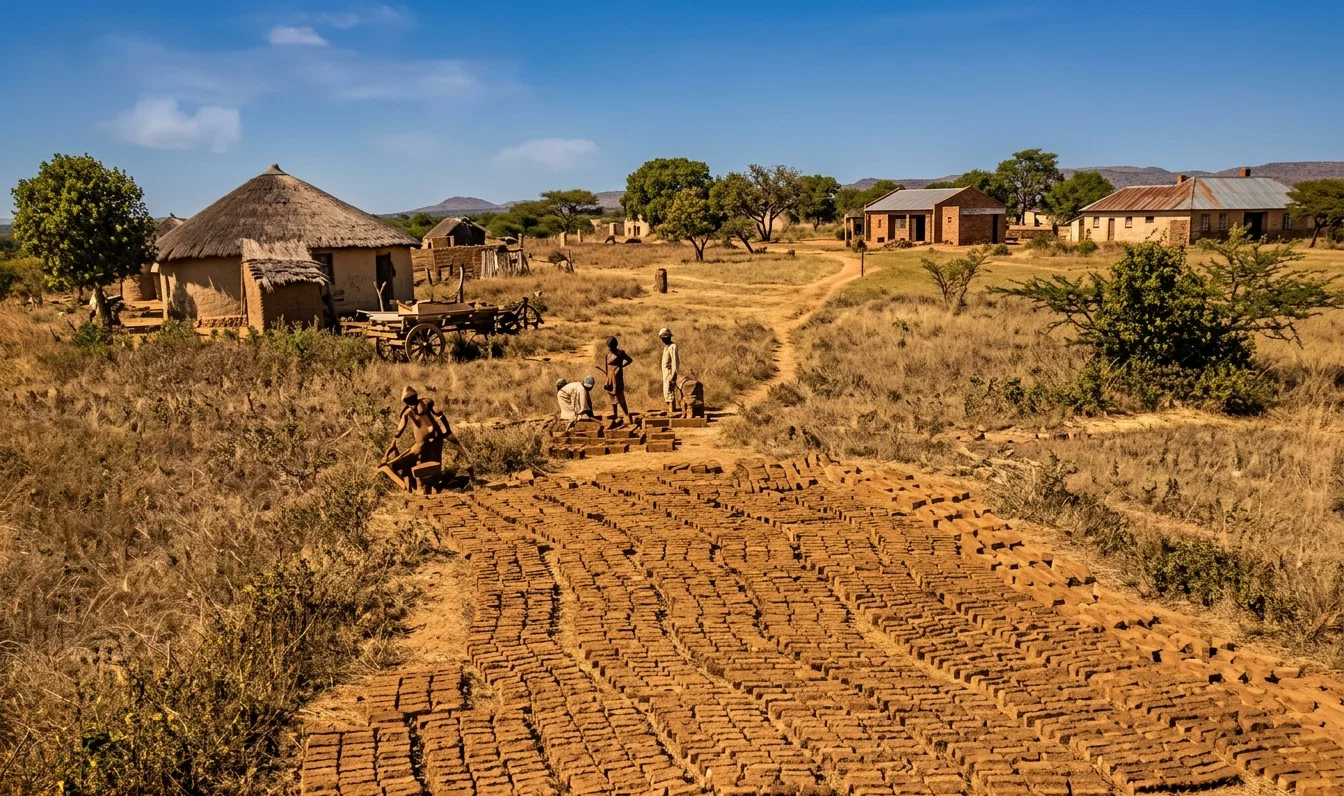
MATABELE MISSION. BRICK-MAKING
The simple statement that we have seventy-eight local conferences and forty-eight missions does not make it plain that this message is being preached in every State in the United States; that it has entered every province of Canada from Newfoundland on the Atlantic to Victoria on the Pacific; that it is established in Mexico, British Honduras,
FILIPINOS — AN UNENTERED FIELD
Central America, and the West Indies. It does not tell of the work being done in all parts of South America, in Australasia, and in the south, east, west, and central parts of Africa. It does not convey to us the facts regarding the missions being operated in Turkey, Palestine, Egypt, the Balkan States, India, Ceylon, East Indies, China, Japan, and the many island groups of the Southern Pacific.
In all these countries named this cause has taken permanent root. In all of them there are earnest, self-sacrificing men and women, working with all their energies to give this message to the people. The missions now being operated place us in touch with nearly the entire population of the world.
The situation we now face is truly remarkable. Whose heart is not stirred and thrilled as he looks over the battlefield and sees the army of devoted soldiers facing the enemy? Whose heart is not encouraged as he sees the splendid victories being gained over that enemy? Whose heart does not rejoice to see the captives being set free?
Brethren, what is this great movement which we behold? Whence comes its power? It is not popular with the world, and it never can be. It strikes down every idol of the carnal heart. It is laden with crosses, self-denial, and sacrifice. It leads its votaries against the whole current of the world; and yet it attracts and holds them with a power they can not resist. For it men and women abandon evil habits and ways, and break old and hallowed associations. To it they contribute their gold and silver, consecrate their sons and daughters, and give their lives. Wherever this cause touches the world, it exerts this power over the hearts of men.
Our General Conference reports record seven and a half million dollars of tithe paid to this cause since 1866, and one million and a half in contributions to missions since 1888. This does not include the millions of dollars that have been given to erect institutions and church buildings, and for home missionary work. But a greater gift than money is the surrender and consecration of the life to the service of this cause. This is seen partly in the two or three thousand men and women in all parts of the world devoting their entire time to some phase of the work; and it is seen further in the faithful, conscientious service rendered in various ways by the many thousands of our people who can not leave their homes and give their lives in a public way to the work.
And still, after all that has been done, and is now being done, we are pressed to do more. We must do more. We can not evade it. For years we have yielded to that compelling power, taking one step after another forward, enlarging the circle of our operations, and increasing our responsibilities, until the demands upon us are tremendous.
And now, brethren, what shall we do? In the name and might of Israel’s God we will face this situation with courage. We will make larger gifts of our means, and we will send more consecrated men and women to mission fields. This is the only answer we can make to the situation we are in. Had we not intended to do this, we should have stopped before creating this condition. And if we do not intend to do a great deal more than we are now called upon to do, we had better stop now; for as surely as we answer to-day’s calls, they will be multiplied to-morrow. There is no stopping in this work until the whole world is warned, and the end has come. But who wants to stop or turn back?—Surely not one whose heart is filled with the love of the truth.
Let us thank God for this outlook. It is evidence that we are nearing the end.19
We are surely in the time of the latter rain, and the showers are falling. The loud cry of the third angel has begun. It may not be sounding exactly as we had supposed it would, but it is sounding, and the heathen are hearing it.
“Everything in the universe calls upon those who know the truth, to consecrate themselves unreservedly to the proclamation of the truth as it has been made known to them in the third angel’s message.”
Letters From the Fields
By J. N. Anderson
Urgent Call From a Province of China
CANTON, CHINA, Sept. 19, 1904.
DEAR BRETHREN: In the providence of God an opening for work has been made at Amoy, a distance of about four hundred miles as we travel by water northeast of Canton, in the Fukim Province. The call for a worker for that field is so pressing that I shall lay the case before you quite fully, and beg that you take immediate action in order that we may have a man on the ground there before the new year.
As you are doubtless aware, Brother Munson's Chinese helper, Timothy Tay, was sent in the month of March to Amoy to study the Fukim dialect, in order to carry on work among the Chinese in Sumatra, who are mostly immigrants from Fukim Province. Through his influence the message has taken root in Amoy. In August Brother Timothy returned to make us a visit, bringing with him an ordained minister of the English Presbyterian Mission, who had begun the observance of the Sabbath, and in this trip was taking advantage of his summer vacation to study the truth further, and to become acquainted with our company here in Canton as its representatives. Brother Timothy is not familiar with school and official phrasing, but described him as the leading native teacher in the English Presbyterian Theological Seminary at that place, and the chief of their consistory of seventy ministers. He could not explain to us their plan of organization, nor make us understand just what rank this position gives him; but it is quite evident that he is a man of very unusual ability and consecration. It was his zeal to reclaim Brother Timothy from Sunday desecration that led him to investigate the Sabbath question. It appears he made a hard fight, with all the scripture he could command, but when once he saw the light, the question of his position or reputation with the mission was nothing. After several days of Bible study, I baptized him, understanding that he would return to his former position in the school, where, under the guidance of the Spirit, which he testified he had received in new measure, he would endeavor to make the most of his influence to bring the truth to his fellow workers, and the students of his school; that when the mission should indicate a desire for him to resign, he would comply with their request, and consider himself free to disseminate the light he had received, in the name of the Seventh-day Adventist Mission.
He is receiving a salary much above what he knows we could give, with the use of parsonage free, but the question of salary was never raised by him, although he has four or five children of his own, and is rearing and educating two orphans, and supporting his wife's mother in his home. The Chinese as a class are not apt to forget the financial part of their arrangements, but he expressed to Brother Timothy his belief that God could provide for his support wherever he should lead. He was born of Christian parents, who were among the early converts of that place; has apparently had the most careful training and the best education; and there can be no doubt that if he gets the right start, and continues faithful to the light as he receives it, he will be able to do a grand work among his fellow countrymen.
A few days ago a letter received from them at Amoy, states that both he and Brother Timothy are out of the school, that another native preacher has accepted the truth and begun the observance of the Sabbath, and that a young preacher in the seminary had expressed himself as determined to be obedient.
Brother Timothy is a young man of insufficient experience and judgment to be left in charge of such an opening. In fact, the experience of other missionaries for a half century proves that it is unwise and unsafe to leave work to the direction of natives. A man who can direct the labors of these men, and under God give mold and character to the work, is needed at once. As I understand, these men are from different missions, and no doubt their theology will need recasting in order to coalesce.
Amoy is one of the oldest open ports in China, having a considerable foreign population and a prosperous foreign concession. The English Presbyterian, the London Mission, Reform Church in America, and Catholics have each strong mission stations at this place, which is one of importance, considered evangelically, since it is really the port of entry to the people of the Fukim dialect, which is one of the leading dialects of southern China, and is the language of millions.
We were unable to converse with our new brother, Mr. Gae, as he has learned but a very few English words, and his dialect differs as widely from the Cantonese dialect, which we are engaged with, as the English differs from the French. This same difficulty prevents me from taking personal oversight of work there. The case is urgent, and demands speed as well as caution. The work is not one of our planning or beginning, but has sprung up spontaneously, and we certainly must recognize it as an indication that the field is already ripe. May God put it into the hearts of his people to act promptly and wisely in planning for this opening. J. N. ANDERSON.
C. H. PARKER
By C. H. Parker
FIJIANS BUILDING A HOUSE
From One-time Cannibal Fiji
SUVA, FIJI, Aug. 25, 1904.
DEAR BRETHREN: As you will see by the date line of this letter, I am here at Suva. There were some things that we as workers needed to talk over, as Brother Fulton and his family have now returned to the field to take up the duties that they had to lay down because of ill health.
Before leaving the Lau district, I had the pleasure of taking the buli (district chief) over to the roko's (native governor's) island, Lakemba. Only a short time ago this buli and roko did all in their power to banish us, but now they are our best friends. Both are frequent visitors at our house, and give us all the favors possible. All this the Lord has brought about, and we see and feel his Spirit brooding over this people.
The roko asked me to give him a reading on the “new earth” and “destruction of the wicked,” which I did, and he was much pleased. Afterward he told me that it cleared up some things to his mind. He is a preacher in the Wesleyan Church, as well as native governor. He told me plainly that all they preached was idle words; for they were not preaching the Word of God. He asked me to write out a number of readings for him. We held three services in his town, which were well attended. We sold thirteen of our native21books, and gave out about four hundred of our native papers. The people of that island are waiting for the message. We were sorry we could not stay longer than three days, but a little later will return again and hold a regular series of meetings.
We are all well, and of good courage. True, perplexing things arise, but then the Lord is our efficiency.
Your brother in Christ,
C. H. PARKER
J. L. SHAW
By J. L. Shaw
Burma
I HAVE just returned to Calcutta from a trip to Burma, about eight hundred miles across the Bay of Bengal. I found the journey at this season of the year very trying, owing to the monsoon winds which blow incessantly from the southeast, and beat the waves into foamy caps continually. There are many things about the work in Burma to encourage us. The Burmese are a very interesting people. They have more independence than the natives of India, and when they see what is right, are liable to take a stronger stand. Already there are six or eight Burmese brethren, who are keeping the Sabbath. One brother lost a very good position about two years ago for the sake of the Sabbath, and since that time he has been doing all he could to enlighten others, and explain the different points of truth to his fellow countrymen. In fact, he has given his whole time without pay. As I sat and talked with him, and saw how earnest he was, and how faithfully he was studying the Word of God, I was moved to tears by his appeal for help. When I told him that I would do all I could to get a man to work among his people, his countenance lighted up with joy. He has written a tract in the Burmese language. The subject is, “The Law of God Written in the Heart.” On the outside of the tract is a picture of the heart, with a hand writing on it, “The Law of God.” We can do very much by getting our literature published in that language; for all Burmese can read. The children are taught by their poonghees, or priests, to read when very young. In this particular they are far ahead of the people of India; for, in the latter country, only a limited number can read, compared with the large number who scarcely know their right hand from their left.
The Burmese work appealed to me very much both times I was in Burma. There is a real need that a young minister go to that field at once to take up the study of the language, and work with Brother Mong Mong, whom I have mentioned before. He is continually holding meetings, and native Christians are being stirred by what he is saying concerning the law of God and the Sabbath question. If we could get a man to connect with him, Brother Mong Mong would teach him the language, and he, in turn, could further instruct Brother Mong Mong in points of truth. We are glad for the help that is coming, and it may be possible that one can go to Burma. Our corps of workers has been so diminished by those who have been compelled to leave that six will little more than fill the vacancies.
My health is better than when I returned from Burma. I think that when more help gets into the field upon whom I can lay some of my burdens, my health ought to greatly improve during the next cool season.
We have been very sorry to have any of our workers go from us. But the Lord has sustained us, and we are of good courage. As we keep our eyes on Jesus and go forward, the truth will triumph. Our hearts are very much encouraged by the progress the work is making in Washington, and the move our people in general are taking on the right side.
J. L. SHAW
The Light Spreading in Korea
By F. W. Field
CHINNAMPO, KOREA, Sept. 14, 1904.
THE work in Korea continues to develop in a wonderful manner. In response to the urgent invitation received, as reported in the REVIEW recently, Brother Kuniya sailed for Korea, reaching Chinnampo, August 10. Four days later he wrote me concerning conditions as he found them; so I decided to join him in the work, and see the needs for myself. I arrived last evening after a very pleasant voyage of over a week from Kobe. The distance is not so great, but considerable time is required to discharge and receive cargo at intervening ports.
KOREAN BRETHREN WHO LEARNED THE TRUTH IN JAPAN
During the five weeks that Brother Kuniya has been here, two of the brethren first interested have been with him almost constantly; and together they have gone from village to village, presenting present truth to the people. In all, sixteen places have been visited, the farthest being about fifteen miles from here. As results thus far, forty-nine have received baptism, four are to be baptized here to-day, and twenty-three more request baptism. These believers live in thirteen of the localities visited. This brief statement will give a general idea of the present state of the work. Others are inquiring, and we are planning to start to-morrow for Ping Yang, an important city a day's journey up the Tadong River. Here reside most of the foreign missionaries in these parts. Our brethren have friends here, who desire to hear. To present the truth to these and other inquirers, to prepare over twenty believers for baptism, to further instruct and organize the whole body of believers, is the work before us; so we expect to be very busy during the fortnight we are planning to remain.
In the work here, the brethren have met the same experiences that accompany the work in other fields. The people have appealed to their teachers for reasons for Sunday observance, baptism by sprinkling, etc., with the usual result. Some who were interested at first have drawn back rather than lift the cross. Some of the believers were using tobacco, although members in good standing in other churches. But there is power in the third angel's message to raise people to a higher standard.
It certainly seems that the time has come for the third angel's message to be presented to this people. The Koreans are a noble race in many respects; but centuries of oppression and misrule have well-nigh broken their spirit. Dishonest officials rob the people of their possessions, often leaving barely enough for a meager living. Under such conditions the people have lost heart, and make but feeble efforts to better their affairs, knowing that their extra gains would be extorted from them. So, being generally poor in this world's goods, and having little hope of earthly enjoyment, they gladly receive the good news of salvation, and the hope of eternal life.
We feel somewhat perplexed to know how the work here is to be continued. We ought to have workers located here as soon as possible. I hope to have some definite recommendations to make at the close of our stay in this place. But there needs to be no delay in starting a fund to support the work here; and we trust that God will move upon some hearts to respond to this call. We are praying also that the Lord of the harvest will send some laborers to this part of his vineyard. F. W. FIELD.