The Youth’s Instructor, The Youth's Instructor, Vol. LI, No. 45
A Trip Through Egypt — VII
Page 1
The Youth’s Instructor
November 10, 1903
Review and Herald Publishing Assn. · Washington, D. C. · November 10, 1903
A Trip Through Egypt — VII
By Glen Wakeham
Edfu and Denderah
SEVENTY miles north of Assuan on the west bank of the Nile is the town of Edfu. Leaving the train at the station on the east side, we enter the small ferry-boat and cross the river. The usual fare (for natives) is two millimes (one cent), but a foreigner must pay three or four piasters (fifteen or twenty cents). This is an example of what the traveler may expect everywhere in Egypt.
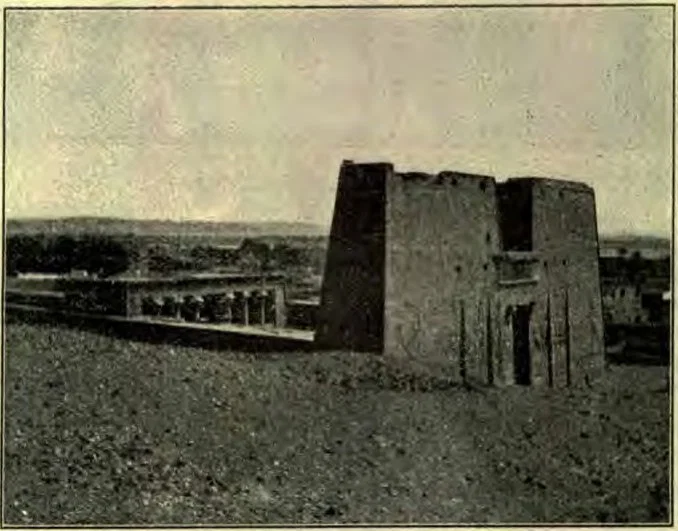
Leaving the river, we proceed along the narrow, crooked, dusty lanes that lead through the clusters of mud huts to the large temple of Horus, one form of the sun-god of Upper Egypt. This temple was built by the Ptolemies, and is one of the best-preserved in Egypt. The attractive view of the city of Edfu and the beautiful palm groves around it, obtained from the top of the unusually large pylons, is always greatly admired. Passing through the large court back of the pylons, we enter the vestibule, the roof of which is supported by twelve stately columns with beautiful floral capitals. In the sanctuary we find a large stone shrine which appears to have been used as a safe for the temple treasures. The sanctuary is surrounded with numerous chambers. One of these, which was used as a laboratory, is very interesting. With the ancients, chemistry was closely allied with magic; and all the Egyptian priests manifested profound skill in deceiving the multitudes with wonderful and apparently miraculous demonstrations of chemical phenomena. In leaving this temple we notice the complete calendar portrayed on the roof of the large vestibule.
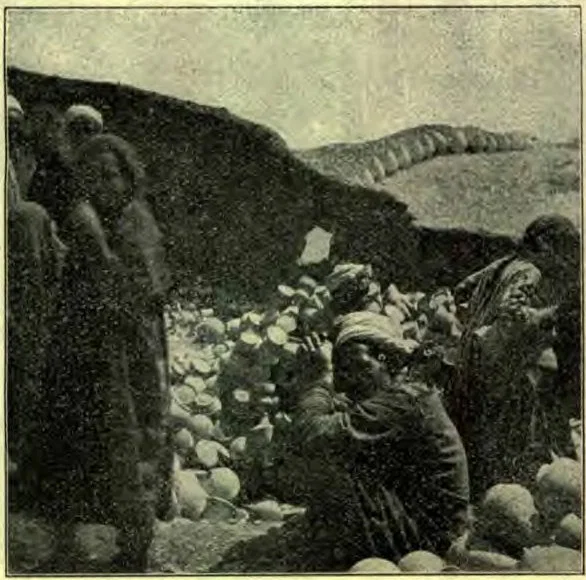
Continuing our journey down the Nile, we pass the familiar scenes around Luxor, and soon arrive at the large town of Kena, the principal center of the Copts in Upper Egypt. Here are situated the far-famed potteries; but the tourist is considerably disappointed to find that they consist only of a large collection of low mud huts, in which the most primitive hand machinery is used. In spite of this the “skilled workmen,” who receive about twenty-five cents a day for their services, manifest great ingenuity and dexterity at their tasks.
IN THE KENA POTTERIES
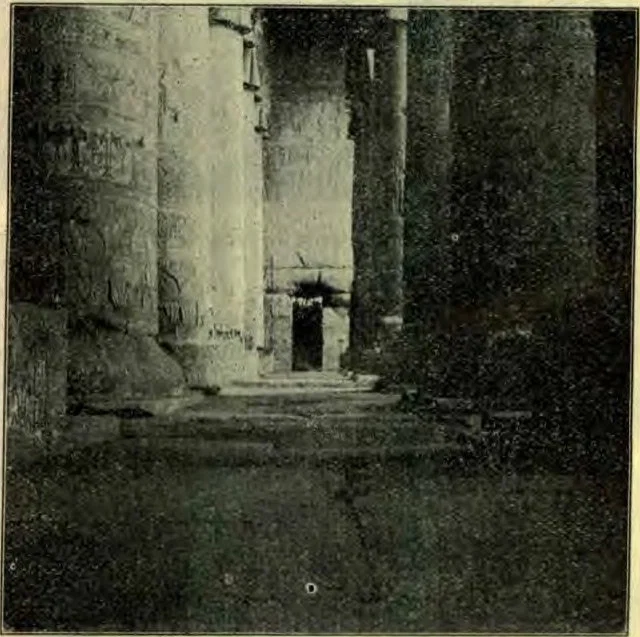
Crossing the river near Kena, and riding for about an hour, we come suddenly upon the temple of Hathor (the goddess of joy and love, corresponding to the Greek Aphrodite), at Denderah. The novel style of the architecture of this elegant temple, and its complete, clean-cut freshness, are quite a relief after the tremendous piles of ruins at Karnak. The pylons and court are conspicuous by their absence, having never been built; so we enter at once the great vestibule, the roof of which is supported by eighteen massive columns. Leaving this imposing hall, we proceed to explore the various storerooms, treasuries, laboratories, toilet-rooms, etc., which lie beyond, entering at last the sanctuary, which is perfectly dark. Only the king could enter this chamber, and he but once a year, at the new-year feast, arrayed in his sacerdotal robes; for the kings of Egypt were also high priests, and occasionally stepped into the shoes of the gods themselves as well.
TEMPLE AT EDFU
Under this temple are some very interesting subterranean crypts, doubtless the remains of an older temple, which originally stood on the site of the present one, the reliefs on their walls showing that they date from the sixth dynasty. The stairways and long, pitch-dark passages which lead to these chambers are in some places less than two feet high, making them very difficult of access, especially to stout persons; but the persevering traveler, armed with a magnesium lamp, is amply rewarded for his trouble. The freshness and clearness of the colors in the wall-paintings, executed perhaps four thousand years ago, are remarkable. In these secret chambers we can witness much of the chicanery with which the so-called miracles and mysterious marvels of deep-voiced idols, which deceived the multitudes of devotees, were produced.
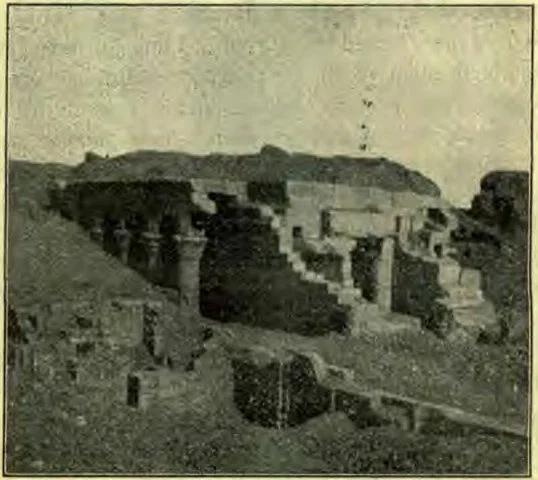
Near the temple of Denderah is the birth-house, connected with all the large Ptolemaic temples. These birth-houses are small temples dedicated to the worship of the offspring of the deity worshiped in the large one. The reliefs portray various scenes in the education and bringing up of these youth.
IN THE VESTIBULE OF THE TEMPLE AT DENDERAH;
NOTED FOR ITS LARGE COLUMNS
Having completed our explorations, we return to Kena, board the evening express for Cairo, settle ourselves in the best seats we can find; and as the roar of the train drowns out all communication, lose ourselves in reflections upon the strange and mystical wonders and beauties of Egypt, mingled with thoughts of friends and loved ones far away.
Egypt as a Mission Field
Egypt is essentially a Mohammedan country under English occupation. The government is mild and tolerant, and the native population seldom give vent to any feeling of fanatical hostility against the large foreign element. From the standpoint of the government, then, Egypt is more open to missionary effort than any other European country save England.
There are several distinct classes among the Mohammedans. The fellahs, or tillers of the2soil, are the chief strength of a nation whose resources are entirely agricultural; but they are desperately poor, and as a rule deeply in debt.
THE “BIRTH-HOUSE” AT DENDERAH
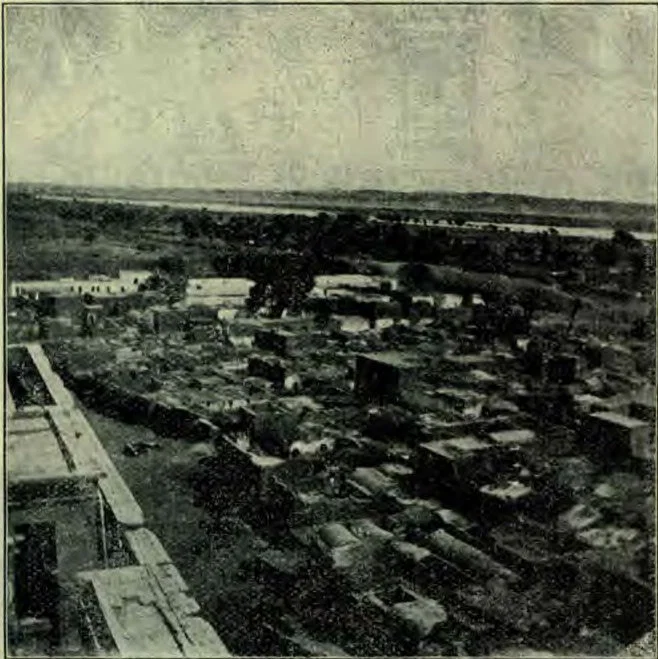
DISTANT VIEW OF THE TOWN OF EDFU
The recent establishment by the English of an agricultural bank, which loans money without interest, ostensibly to relieve the intolerable situation, has been successful principally in transferring the debts into the hands of English creditors.
In disposition these people are very affectionate, being strongly attached to one another, and most hospitable to strangers, it being their rule to keep a traveler three days before allowing him to go on. Naturally, also, they are superstitious, fanatical, and ignorant, seldom being able to read or write.
The Beduins were originally nomadic tribes of Arabs; but most of them have settled in the villages, where they eke out an existence from their small herds of goats and cattle. Many of them, however, still roam over the desert. They are often employed as antiquity guardians, guides, dragomen, etc., the latter business being a very lucrative one. The Beduins are remarkable for their fine physique and dark-bronze complexion. They are bright and intelligent, often possessing a tolerable smattering of four or five languages; but they are proud, cunning, avaricious, and notoriously untrustworthy.
The large class of townspeople who inhabit the cities are the artisans, laborers, clerks, shopkeepers. They are courteous, affable, and often quite intelligent, sustaining a conversation with remarkable ease and readiness. They are sensitive and excitable, punctuating their rapid discourse with nervous, animated gestures, and their earnestness is so great that one not understanding the language is likely to mistake an ordinary discussion for a furious quarrel. They will cheat and steal, however, to any extent, at the least opportunity; and lie with a fluency and consistency that betrays long practise. Cunning knavery passes for cleverness, and is perfectly compatible with their religion.
The dervishes are a fanatical sect, many of whom are found in Egypt. Long practise has enabled them to throw themselves into a sort of mechanical ecstatic trance, often resembling an epileptic fit. Until recently their leader, the Khalifa, reigned over the Sudan; but his power was broken by Lord Kitchener in 1898, when his fine army of forty thousand men was destroyed in the battle of Komera. The performances of the dancing and howling dervishes form a terrible spectacle of heathen fanaticism.
Living in the midst of this dense Mohammedan population is the small, but ancient and well-organized native Christian Coptic church, the members of which have, with true Semitic tenacity and fortitude, stuck to their religion through the hundreds of years of bitter persecution brought on largely by their own pride and stubbornness.
This sect is the remnant of the Egyptian branch of the Greek Catholic Church. The Copts are the direct descendants of the ancient Egyptians. They are more intelligent than the mass of the Mohammedan population. Living mostly in the cities, they are usually shopkeepers, skilled artisans, or government employees, many of them being very wealthy.
It is among the Copts that the only successful missionary efforts have been directed. Over fifty years ago the United Presbyterians sent a company of missionaries to Egypt, who founded the “American Mission” in Cairo. For several years they endeavored in vain to obtain a foothold among the Mohammedans, and then turned their attention to the Copts, with immediate success. Since then they have poured scores of missionaries and hundreds of thousands of dollars into Egypt, until now they count their schools by the dozen, and their converts by the thousand. They have schools all over Egypt, and the more promising pupils are sent to their college at Assiut. By special arrangement, the graduates of this college are placed in the way of government positions. This has proved a great attraction to Christianity; and hundreds of the postal and railway employees have attended this school, which is, at least nominally, a Christian institution.
THE TEMPLE AT DENDERAH
This class is the easiest to reach with the message, as they are intelligent, unprejudiced, and speak English. They become interested at once, and are eager for further instruction. After a few Bible readings, they usually admit the correctness of what is presented; but here is where the trouble comes. In Egypt there is no rest day. All government, railway, and general business runs on uninterruptedly seven days in the week. There is no employment to be found where one can keep the Sabbath, or any other day. The resident Europeans have so far fallen in with this custom that even the professedly religious interrupt their work long enough to attend a Sunday-evening service,—if they happen to feel like it. Of course the standard among the native Christians is no better than that of their teachers; thus the difficulty of getting these people to see the necessity or even the possibility of a strict observance of the Sabbath is very great. Most of them are dependent on their positions for the support of their families.
Another great obstacle to the progress of the work we love is the almost universal practise, among both sexes, of smoking. This terrible habit, combined with the enervating climate, has so enslaved their minds that they are not able to comprehend what it is to make a strong effort of the will. Nothing but a miracle will ever save them; but this is an age of moral miracles, and we feel sure that the Lord has a work to do among these people.
From a human point of view, the work among the Mohammedans is even less encouraging. There is no religion which presents such a satisfying element of truth, offering at the same time such an attractive license for the gratification of a man’s lower nature as Islamism: no theology which promises a future life so pleasing to the sinful soul of man, and so easy of attainment. It is just the kind of religion they desire to believe, so they cling to it, and blindly refuse to listen to anything else. The unusual difficulty of the Arabic language is another great hindrance to this work, but something must be done for these people. Native workers must be trained. The third angel’s message must be sounded in Egypt, and we know that no obstacles are too difficult for the Lord.
The most encouraging openings in Egypt are along the line of medical missionary work. The destructive epidemics of cholera have awakened a wide-spread interest among the better classes in sanitary improvements. The vegetarian pension, or restaurant, has prospered from the first, and well-conducted treatment rooms would doubtless be equally successful. A vast field of work of this kind is open to women nurses among the thousands of shut-in women of the better classes. A physician and nurses are expected in Egypt, and it is hoped that this “entering wedge” of the message will soon be in vigorous operation.
On the whole, the work in Egypt is very encouraging. We have a foothold in the largest cities, and the thousands of Arabic tracts that have been scattered are creating a wide-spread interest. The work is onward; and we doubt not that when the message is completed, and the Lord comes to take his people, a goodly company of faithful ones will be found here.
GLEN WAKEHAM.
We Shape Ourselves the Joy or Fear
We shape ourselves the joy or fear
Of which the coming life is made,
And fill our future’s atmosphere
With sunshine or with shade.
The tissue of the life to be
We weave with colors all our own,
And in the field of destiny
We reap as we have sown.
— Whittier.
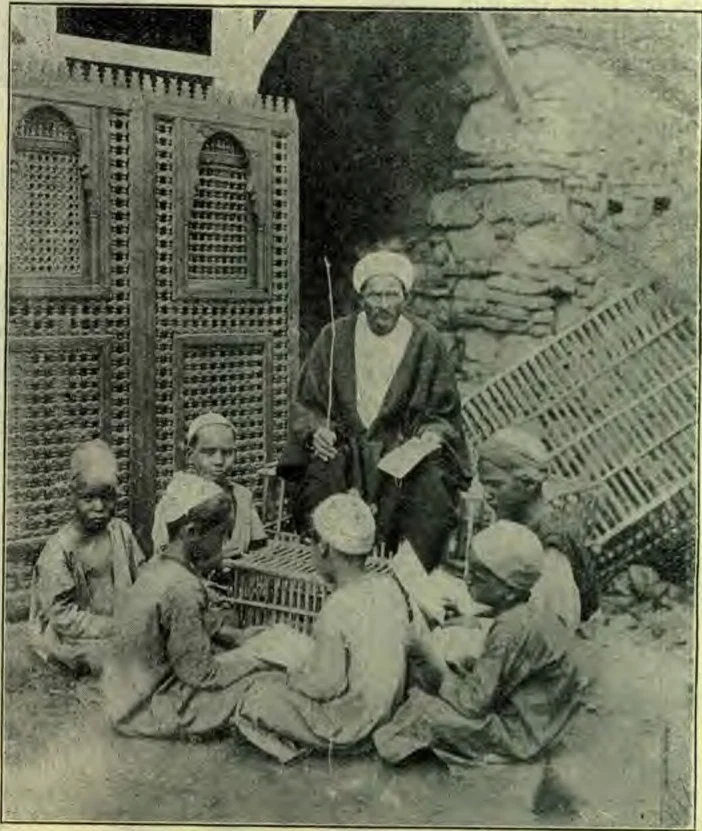
A MOHAMMEDAN SCHOOL, CAIRO, EGYPT
The Influence of Books
By W. A. COLCORD
One’s reading is, usually, a fair index to his character. Observe, in almost any home you visit, the books that lie on the center-table, or note those that are taken by preference from the public library; and you may judge, in no small degree, not only the intellectual tastes and general intelligence of the family, but also—and what is of far deeper moment—their moral attainments and spiritual advancement. “A man is known,” it is said, “by the company he keeps.” It is equally true that a man’s character may, to a great extent, be ascertained by knowing the books he reads. You may, indeed, judge a man more accurately by the books and papers he chooses than by the company he keeps; for his associates are often imposed upon him, but his reading is the result of choice.
All the life and feeling of a young girl fascinated by some glowing romance is colored and shaped by the page she reads. If it is false, and weak, and foolish, she will be false, and weak, and foolish, too; but if it is true and tender and inspiring, something of its truth and tenderness and inspiration will grow into her soul, and become a part of her very self. The boy who reads deeds of manliness, or bravery and noble daring, feels the spirit of emulation grow within him; and the seed is planted which will bring forth fruit of heroic endeavor and exalted life.
In reading it is a safe rule to abstain from all books which, while they have some good things about them, have also a mixture of evil. You have read books that had the two elements in them—the good and the bad. Which stayed longer in your memory?—Always the bad! The heart is often like a sieve, which lets small particles of gold fall through, but keeps the great cinders. Once in a while there is a mind like a loadstone, which, plunged amid steel and brass filings, gathers up the steel and repels the brass; but it is generally just the opposite. If you attempt to plunge through a hedge of burs to get one blackberry, you will get more burs than blackberries. You can not afford to read a bad book, however good you are. You say, “The influence is insignificant;” but I tell you that the scratch of a pin has sometimes produced lockjaw. Alas, if, through curiosity, you pry into an evil book; your curiosity is as dangerous as that of a man who should take a torch into a gunpowder mill merely to see if it really would blow up.
To read with profit, books must be of a kind that will inform the mind, correct the head, and make the life better. These books should be read with attention, understood, remembered, and their precepts put in practise. One good book, so read, is of more value than a superficial reading of fifty books, equally sound. Books of the right character produce reflection and induce investigation. They are a mirror of mind, for mind to look in. Of all the books ever written, there is not one that contains lessons and precepts so instructive, so sublime, and in so great variety, as the Bible. Resolve to read three chapters of this wonderful Book each day, for one year, and you will find realities more wonderful than any pictures of fiction.
A little library, growing larger every year, is an honorable part of a young man’s history. A library is not a luxury, but one of the necessaries of life. It is not like a dead city of stones, yearly crumbling, and needing repairs; but, like a spiritual tree, it yields its precious fruit from year to year and from age to age.
A book is the most appropriate gift that friendship can make. It never changes, it never grows unfashionable or old. It is soured by no neglect, is jealous of no rival; but always its clean, clear pages are ready to amuse, interest, and instruct. The voice that speaks the thought may change or grow still forever; the heart that prompted the kindly and cheering word may grow cold and forgetful; but the page that mirrors it is changeless and faithful. The Book that records the incarnation of divine love is God’s best gift to man, and the books which are filled with kindly thought and generous sympathy are the best gifts of friend to friend.
Make up your mind what is best for you to read, and read it. Master a few books. Life is short, and books are many. Instead of having your mind a garret crowded with rubbish, make it a parlor with rich furniture, beautifully arranged, in which you would not be ashamed to have the whole world enter.
“There are many silver books,” says one writer, “and a few golden books; but I have one book worth more than all, called the Bible, and that is a book of bank notes.” Some books are to be tasted, others to be swallowed, and some few to be chewed and digested; that is, some books are to be read only in parts; others to be read wholly, and with diligence and attention.
In our libraries we meet great men on a familiar footing, and are at ease with them. We come to know them better, perhaps, than do those who bear their names and sit at their tables. The reserve that makes so many fine natures difficult of access, is entirely lost. No crudeness of manner, no poverty of speech, no unfortunate personal peculiarity, mars the intercourse of author and reader. It is a relation in which the interchange of thought is undisturbed by outward conditions. We lose our narrow selves in the broader life that is opened to us.
Hazlitt has told us of his first interview with Coleridge, and of the moonlight walk homeward, when the eloquent lips of the great conversationalist awoke the slumbering genius within him, and made the old, familiar world strange and wonderful under a sky that seemed full of new stars. Such intercourse with gifted men is the privilege of few; but in the library there often grows up an acquaintance more thorough and inspiring.
Books are rich, not only in thought and sentiment, but in character. The best society in the world is that which lives in books. To the weak, as well as to the strong in their hours of weakness, books are inspiring friends and teachers.
W. A. COLCORD.
Echoes From a Story Worth Remembering
By H. Clay Trumbull
Just when and where it was that I first heard the story I do not remember; but I do remember the story, and I know that it was in my heart and memory, influencing my thoughts and life-purposes in my earliest young-manhood. And it was a story well worth remembering. It was the story of the Rev. Thomas Charles of Bala and little Mary Jones and her Bible.
Both lived in the later years of the eighteenth century, and in the early years of the nineteenth. Bibles were not as numerous, or as much valued, in Wales or out of it, then as now. At the time that “Charles of Bala” was the chief instrument in introducing Sunday-schools into Wales, he found, in a large stretch of country there with which he was familiar, that not one person in twenty could read the Bible, while in entire neighborhoods only a single person had received instruction in reading of any kind. Yet, largely through the agency which he introduced, and as a result of his labors of love, the Bible came to be more generally studied and prized by both young and old in Wales than in perhaps any other portion of the world of like extent, and so it is to-day. That great fact was a stimulus and an inspiration to me and to many another.
Mary Jones was one of the little girls in Wales who learned to read and to love the Bible through the agencies set in motion by “Charles of Bala.” She had no Bible of her own, so she was accustomed to go quite a distance to read one in a neighbor’s home, where she could enjoy the privilege. But her heart longed to possess a Bible for herself, and she set herself to secure it by honest toil. There were then no popular Bible societies in Wales or elsewhere, and it was quite a matter to obtain a Bible or to pay for one. For six years Mary Jones toiled and prayed and saved, and then “she started with a brave heart to walk twenty-five miles on her bare brown feet to buy the sacred book from ‘Charles of Bala,’” and twenty-five miles back again,—fifty miles in all. But when she made known her wish to the good pastor, he had to tell her that the only unsold copy of the Bible in his possession was already promised to another, and he could not let her have it.
This almost broke the heart of the little girl, but it touched and fired the heart of the man of God. He roused up and saw to it at once that Mary Jones had a Bible; and then he determined that in some way Bibles should be available to all others of her spirit and needs. So he went down to London, where he had an appointment to meet a number of prominent Christian workers, lovers of God and lovers of their fellows, and to them he told this touching story. Among those men then and there touched and influenced by the story of Mary Jones were William Wilberforce, Zachary Macaulay, and Granville Sharp, and perhaps other world-movers. He was just then at the world’s center, and he had power to move the world from that center. An almost immediate result was the forming of an organization that ultimately became the British and Foreign Bible Society, the parent, or pattern, of all the Bible societies of all countries. That meeting of little Mary Jones and “Charles of Bala”4proved an epoch in the world’s history, from which results have come that must be recognized as the more prominent events and factors in the recently closed great century.
To that story, illustrative of the power and results in God’s service of a child’s love of the Bible, and of the love of children by Bible-lovers, I owe much of the impulse and inspiration of my best life-work. It came to possess and inspire me in the years after I first heard it, and I wanted others to feel its power and influence. Accordingly, I repeated and applied it in my efforts to arouse and encourage my hearers, in country schoolhouses and in city auditoriums, and in churches large and small, from Maine to California, and from Minnesota to Florida, and all the while it was more to me than to any to whom I told it. Its truth was, as it still is, a potent force in my life thought and action.
Nearly half a century after my earlier memories of that story, I was, one Sunday morning, at a church service in English in the Kurhaus, in Carlsbad, conducted by the Rev. Dr. Alexander Duff Watson of Scotland, a grandson of the great Alexander Duff of India. Believers from the ends of the earth worshiped together that day with one thought and purpose, as swayed by varying memories, but by a common hope. One whom I there saw for the first time, was a sunny-faced, snowy-haired, saintly appearing man of God.
At the close of the service I was presented to this stranger, and found, to my surprise and delight, that he was the Rev. “Thomas Charles” Edwards of Bala, a grandson of the great Thomas Charles of Bala, who had been so much to me, and to so many others all the world over. He not only bore his revered grandfather’s name, but he was in his sphere and parish, following in his steps, and in a sense continuing his work. It seemed to me, as I looked into his face, as if the dead had been brought to life, or as if he had never died. It was a pleasure and a profit at that time to talk of the inspirer of so much of my life-work with one of his admiring and honored descendants. He wrote valued New Testament commentaries and other religious works. My interest in him intensified and extended my interest in “Charles of Bala.” Every word from the good grandson was as an echo from the remembered story of the great and good grandfather.
On my way home from Carlsbad, after that meeting, I stopped in London to see my valued friend, Dr. William Wright, editorial secretary of the British and Foreign Bible Society. As I spoke of my long-time interest in little Mary Jones and her Bible, and of the results flowing from it, and of the recent revival of that interest in Carlsbad, Dr. Wright opened a glass case in which that treasure was carefully preserved, and permitted me to take the treasure in my hands. It was the identical Bible that “Charles of Bala” had given to little Mary Jones when she had walked the twenty-five miles over the rough road with her bare brown feet, and with her six years’ savings, in her hope of securing it. The name of the godly child was in the sacred book, as written by the man of God. And the names of both giver and receiver, and of a multitude whom no one can number, are written in the Lamb’s book of life as a result of the truth made known through the work that had its beginning in the seeking and securing of that precious volume.
Were not these incidents in Carlsbad and London, pleasant echoes of a remembered story that was worth remembering? —H. Clay Trumbull.
The Heart of the Home
By The Visitor
HER face is all freckled — this girl whom I know, And her nose has a tilt in the air; And not even her mother, with mother-love blind, Can truthfully say she is fair; Her hair is the color that may be called red, And straight as a ruler hangs down; Her eyes are pale-blue, and her forehead is low,— Though it never is drawn in a frown.
Her sisters are graceful and bonny young things And her brother is handsome and bright, And all of them think in their innermost hearts, That their sister is truly a sight. But the soul of this girl is a beautiful thing, And her voice is as sweet as a bird’s, And her goodness of heart and her wisdom of mind Are seen in kind actions and words.
And the mother has ever a fond word and smile For this child of her daily delight, And her father’s eyes glisten with tenderest love As he kisses and bids her good night. And O, they would miss her, would miss her full sore, If out in the world she should roam; For the girl with no beauty of face or of form Is most truly the heart of the home!