Seventh-day Adventist Publishing Association · Battle Creek, Mich. · Oct 1872
TRIP TO CALIFORNIA.
By W. C. White
WHILE at the Knoxville, Iowa, Camp-meeting, my parents decided to go to California, there to rest and regain their health, which had been rapidly failing for some time.
They wished me to go with them, which I was glad to do, although I had intended to return to Battle Creek, and go to school. I was then with Eld. Littlejohn, who is almost totally deprived of eye-sight, leading him, and reading to him, as he attended the western camp-meetings.
Had we gone directly to San Francisco, Cal., without delay, as we intended at first, it would have taken only six days. But we took the Southern Branch of the Chicago, Rock Island and Pacific R. R., connecting with the Kansas Pacific, to Denver, Colorado, because we wished to visit friends living on that route.
Through Southern Iowa and Northern Missouri, the spring crops, especially the corn, were late and poor, on account of the heavy rains and the cold weather. After passing through the eastern part of Kansas where the crops are quite late, we enter the Kansas Valley, which contains the finest farming lands we have ever seen. Here the crops look better, the fields well fenced, and the houses comfortably built. But, alas! how soon we leave this fertile valley, and enter the barren plains of Western Kansas and Eastern Colorado. As we advance, the villages are smaller and farther apart, farm-houses and cultivated fields are seldom to be seen, and trees are only found near streams of water, which, in this region, are few and far between.
The greater part of these plains is too dry and barren to produce grain, but affords pasture for great numbers of cattle. Near the villages we have often seen small herds of from fifty to one hundred cattle, each kept by a boy, who, mounted on an Indian pony, watches, or, as it is called, herds them by day, and drives them home at night. But here are large herds, kept by men who live in their covered wagons, and move about from place to place where the grass is best and water is most abundant. As we near a small stream, here are quite a number of covered wagons, and at a little distance the plain seems literally alive with cattle. It is estimated by gentlemen on the train that there are five thousand in this herd.
The last town we passed was composed of a water tank, a coal bin, and four or five dugouts, or turf houses. In the town we are just entering, there seem to be eight or ten dugouts, and a five-acre lot, fenced with turf, and planted to vegetables. While the train is waiting, let us look into one of these dugouts, which, like nearly all the rest, is occupied by men who work on the railroad. We pass down six or eight steps cut in the ground, and from the inside can see that the house was built by first digging a cellar-like hole four or five feet deep. Upon the edges of the bank, logs were placed, and upon these, poles were laid for the roof. Then the whole thing was covered with turf, except the door-way, and a small window cut through the logs which support the roof. This house is furnished with a rough board bedstead, a cross-legged table, two chairs, a large box, and a stove, over which a large piece of buffalo meat hangs drying.
To-day, we have seen buffalo bones all along the road, but here are great numbers of dead buffaloes scattered over the plain. In one place, forty carcasses were counted on less than ten acres. Most of these were killed in the winter by the settlers, and by people who sometimes come from a distance for the sport of hunting, and to obtain the buffalo meat, which is considered as good as beef. The parts of the buffalo most used for food are the loins and hind quarters, which are taken off with the skin on, to preserve the meat longer. Little use is made of the remaining parts. This accounts for there being so many carcasses along the track. A few buffaloes are killed in the summer for their hides, which are shipped to St. Louis, where they are tanned into leather.
We have watched all day for live buffaloes; but, although trains sometimes come upon large herds crossing the track, and are compelled to wait till they get out of the way, we have seen but one small herd. Most of them have gone north, where there is more water. It is growing dark, and tired of looking out on the dreary plains, we retire to our berths in the sleeping car, expecting to wake in the morning in Denver City, Colorado.
W. C. WHITE.
Who Is Little Sunshine?
The child who does not pout, or frown, or say cross words, but goes about the house laughing, smiling, singing, saying kind words, and doing kind deeds—that child is Little Sunshine.
KEEP THYSELF PURE.
JESUS was an example of purity. Every professor of religion should be an example of purity. “Pure religion and undefiled before God and the Father is this, To visit the fatherless and the widows in their affliction, and to keep himself unspotted from the world.”
The heart of man, unrenewed by the grace of God, “is deceitful above all things, and desperately wicked.” Nothing can cleanse it from its impurities, but the blood of Christ.
Having been cleansed, we must be exceedingly watchful, and prayerful, or sin will enter the heart unawares. We must
“Leave no unguarded place,
No weakness of the soul.”
The appetites must be controlled. Professed Christians, and even ministers, by using tobacco to gratify their depraved appetites, violate the command, “Keep thyself pure.” Going to the theater is a practice with many professors; “but thou, O man of God, flee these things; and follow after righteousness, godliness, faith, love, patience, meekness.”
Others contract impurity by reading novels and fictitious papers. These corrupt the heart and poison the mind. To keep ourselves pure, we must put on “the whole armor of God.” Purity and happiness are inseparably connected; so are sin and misery. An impure person cannot be happy in this world, nor in the world to come.
Be careful what company you keep. A pure stream of water cannot run in the same channel with an impure one, without mingling with it, and becoming impure itself. So, if you go in company with ungodly men, you will drink in their spirit, and lose your religion. “Keep thyself pure.”
There is a good deal said by professed Christians, about “innocent amusements.” “We need recreation and exercise,” they say; so they go to the theater, the base-ball ground, and the horse-race, and mingle with the ungodly crowd of pleasure-seekers that frequent such places. If you remonstrate with them, they will tell you that “there is no harm in innocent amusements.” But is there no harm in wasting your time? Is there no harm in keeping bad company? Is it not sin to disobey God? He says, “Come out from among them, and be ye separate.” “See that ye walk circumspectly, not as fools, but as wise, redeeming the time, because the days are evil.” “The pure in heart shall see God;” but the “wicked shall be turned into hell.”
Is your heart pure—cleansed from all sin? Does Jesus reign without a rival there? Remember, that nothing impure will ever enter Heaven. If you have not already given all to Jesus, now give yourself to Him, and, by a simple act of faith, the blood will be applied, and your heart will be cleansed.—Earnest Christian.
DAY
By Geo. Cooper
This is the way the morning dawns:
Rosy tints on flowers and trees,
Winds that wake the birds and bees,
Dewdrops on the fields and lawns,—
This is the way the morning dawns.
This is the way the sun comes up:
Gold on woods and glossy leaves,
Mist that melts above the sheaves,
Vine and rose and buttercup,—
This is the way the sun comes up.
This is the way the daylight dies:
Cows are lowing in the lane,
Shadows creep o'er hill and plain;
Yellow, red, and purple skies,—
This is the way the daylight dies.
—Geo. Cooper.
Books of the Old Testament in Verse
"Genesis" tells the world was made
By God's creative hand;
"Exodus," how the Hebrews marched,
To gain the promised land.
"Leviticus" contains the law,
Holy and just and good;
"Numbers" records the tribes enrolled,
All sons of Abraham's blood.
Moses in "Deuteronomy,"
Recounts God's mighty deeds;
Brave "Joshua," in Canaan's land,
The host of Israel leads.
In "Judges" their rebellion oft
Provokes the Lord to smite;
But "Ruth" records the faith of one
Well pleasing in his sight.
In first and second "Samuel,"
Of Jesse's son we read;
Ten tribes in first and second "Kings"
Revolted from his seed.
The first and second "Chronicles"
See Judah captive led;
But "Ezra" leads a remnant back
By princely Cyrus' aid.
The walls around Jerusalem,
"Nehemiah" builds again;
Whilst "Esther" saves the Israelites
From plots of wicked men.
In "Job" we read how faith will live
Beneath affliction's rod;
And David's "Psalms" are precious songs
To every child of God.
The "Proverbs" like a goodly string
Of choicest pearls appear;
"Ecclesiastes" teaches man
How vain are all things here.
The mystic "Song of Solomon"
Exalts sweet Sharon's rose,
Whilst Christ, the Saviour and the King,
The rapt "Isaiah" shows.
The mourning "Jeremiah,"
Apostate Israel scorns,
His plaintive "Lamentations"
Their awful downfall mourns.
"Ezekiel" tells in wondrous words
Of dazzling mysteries:
Whilst kings and empires yet to come,
"Daniel" in vision sees.
Of judgment and of mercy,
"Hosea" loves to tell;
And "Joel" describes the blessed days
When God with man shall dwell.
Among Tekoa's herdsmen,
"Amos" received his call;
Whilst "Obadiah" prophesies
Of Edom's final fall.
"Jonah" displays a wondrous type
Of Christ our risen Lord;
"Micah" pronounces Judah lost—
Lost, but again restored.
"Nahum" tells on Nineveh,
Just judgment shall be poured
A view of Chaldea's coming doom,
"Habakkuk's visions give;
Next, "Zephaniah" warns the Jews
To turn, repent and live.
"Haggai" wrote to those who saw
The temple built again;
And "Zechariah" prophesied
Of Christ's triumphant reign.
"Malachi" was the last who touched
The high prophetic cord;
The final notes sublimely show
The coming of the Lord.
"Matthew," "Mark" and "Luke" and "John,"
The holy gospels wrote,
Describing how the Saviour died,
His life and all he taught.
"Acts" proves how God the apostles owned,
With signs in every place;
St. Paul in "Romans" teaches us
How men are saved by grace.
The apostle in "Corinthians"
Instructs, exhorts, reproves;
"Galatians" shows that faith in Christ
Alone the Father loves.
"Ephesians" and "Philippians" tell
What Christians ought to be;
"Colossians" bids us live to God,
And for eternity.
In "Thessalonians" we are taught
The Lord will come from heaven;
In "Timothy" and "Titus," too,
A bishop's rule is given.
"Philemon" marks a Christian's love
Which only Christians know;
"Hebrews" reveals the gospel,
Prefigured by the law.
"James" teaches, without holiness
Faith is but vain and dead;
"St. Peter" points the narrow way
In which the saints are led.
"John," in his three epistles,
On love delights to dwell;
"St. Jude" us awful warning gives
Of judgment, wrath and hell.
The "Revelation" prophesies
Of that tremendous day,
When Christ, and Christ alone, shall be,
The trembling sinner's stay.
TOO LATE.
By M. Wood
George, it's no use trying; don't you see that they are closing the gates? Don't run; there is no need of hurrying, we shall be in time for the train. But George don't stop. Waiting is out of the question. He sees there is a possibility of gaining the opposite side before the draw is taken off, and presses forward with men, women, and children, toward the still opened gates. He exerts every nerve, strains every muscle, in his young body, that he might gain an entrance through the gates and across the bridge before it is drawn off to allow a vessel to pass through, and while George is running as for dear life, fully determined not to be shut out, his companion walks along quite leisurely and arrives at the gates in time to have them closed in his face.
But George was successful. He crossed the bridge, and arrives at the depot where he waits, and looks very anxiously for his friend to appear in sight. Soon the conductor's voice is heard: “All aboard for New York,” and George takes his seat in the car, still hoping his friend and companion will yet be in time. But the bell rings, the whistle blows, the gate is dropped, and George realizes for the first time that his friend is too late.
So will it be in our cases, my young friend, unless we are in earnest, and exert every nerve, strain every muscle, and, like George, be fully determined to secure a passage on board the gospel train, bound (not for New York, but) for that holy city whose builder and maker is God, we shall be too late. Did you ever think what a dreadful thing it would be, to see your friends enjoying the pleasures of Heaven and you yourself thrust out? My dear young friend, the time is hastening when we shall be admitted in through those pearly gates or forever excluded. Which shall it be? It is our privilege to walk those golden streets, to eat of the tree of life, and drink of the water of life; to become citizens of the New Jerusalem, to dwell in the presence of God, to sit down on the throne with Jesus.
Oh! how glorious will that period be when all the elect of God shall be gathered in, when not a grain of the precious seed will be lost, when even the feeblest lamb shall be housed from the storm.
There no tears bedew the cheeks, no sorrow rends the hearts of its blissful inhabitants. In those celestial regions there is no pain, neither painful separation of fond friends—all is blooming health and immortal vigor. There death shall strike its dart no more, for death is swallowed up in victory.
Let us commence anew, and seek a closer walk with God, cut loose from the transitory things of this life and seek earnestly the sweet graces of the spirit, love, humility, and purity. These will make us like Jesus, whose whole character bore these sacred features, and whose gentle command is, “Learn of me, for I am meek and lowly in heart, and ye shall find rest unto your souls.” M. Wood.
A SERMON ON "PUSH."
When Cousin Will was at home for vacation, the boys always expected plenty of fun. The last frolic before he went back to his studies was a long tramp after hazel-nuts.
As they were hurrying along in high glee, they came upon a discouraged-looking man and a discouraged-looking cart.
The cart was standing full of apples before an orchard. The man was trying to pull it up hill to his own house. The boys did not wait to be invited, but ran to help with a good will. "Push, push!" was the cry.
The man brightened up; the cart trundled along as fast as they could make it, and in five minutes they all stood panting at the top of the hill.
"Obliged to ye," said the man; "you just wait a minute," and he hurried into the house, while two or three pink-aproned children peeped out of the door.
"Now, boys," said Cousin Will, "this is a small thing; but I wish we could all take a motto out of it, and keep it for life. 'Push!'—it is just the word for a grand, clear morning like this; it is just the word for strong arms and young hearts; it is just the word for a world that is full of work as this is. If anybody is in trouble, and you see it, don't stand back; push! If there's anything good doing in any place where you happen to be, push! If there's any work going on in the Sabbath-school, push! Don't drag back, I beg of you. You'll do one or the other. Whenever there's a kind thing, a Christian thing, a happy thing, a pleasant thing, whether it is your own or not, whether it is at home or in the town, at church or at school, just help with all your might; push!"
At that minute the farmer came out again with a dish of his wife's best dough-nuts, and a dish of his own best apples; and that was an end of the little sermon.—Presbyterian.
Fatherhood of God and Brotherhood of Man
LET no man call God his Father, who calls not man his brother.
THE BOOKS OF THE BIBLE.
By G. W. Amadon
The following is a neat metrical catalogue of the books of the Bible. The writer has ingeniously given something of the character of each book in connection with its name. These verses are taken from the Sunday-School Times, and were sent to this country from Scotland some twenty years since. The author is unknown. A good way to retain the order of the books of the Sacred Volume will be in memorizing these lines. It would also be an interesting exercise in Sabbath-schools to have the younger classes recite them in concert.
G. W. AMADON.
ALEXANDRIA
By J. E. White
Wonderful Sights and Ruins. No. 2.
ALEXANDRIA
Several things worthy of notice are to be seen in Alexandria, one of which is Pompey's Pillar. It consists of a block of granite about ten feet square, on which is placed a thinner and broader stone, which forms the base of the column. From this rises a round and smoothly-polished shaft of red granite. On the top of this is a capitol, of different kind of stone and inferior workmanship.
The shaft is all of one piece, seventy-three feet high, and twenty-nine feet and eight inches in circumference. The whole hight of this pillar is one hundred feet. It has long been left unprotected, and the lower part of it has been much defaced by travelers who have clipped off pieces as mementos of their visit. It is supposed that it was built by Cæsar to commemorate the overthrow of Pompey.
We will next look at Cleopatra's Needles. They are situated in the north-east corner of the city. One has fallen, but the other remains standing. They are composed of red granite, the same material as Pompey's Pillar. The standing shaft is seventy-five feet high, seven feet and seven inches in diameter at the base, and tapering to five feet at the top. Three long lines of hieroglyphics (the characters in which the ancient Egyptians wrote), reach from bottom to top of this huge shaft. No one as yet has been able to read what is written on its sides. They are supposed to have been built 1495 years B. C. The hieroglyphics on two sides remain fresh to the present day. On the other side they have been defaced by the sand storms from the desert.
Let us next notice the Catacombs, or burying place of ages in the past. They are two and one-half miles to the west of the city. The grounds near the entrance to those wonderful underground structures were once covered with costly dwellings and beautiful gardens of the suburbs of the city.
The vast extent and beautiful symmetry of these underground vaults excite the wonder and admiration of all who view them. They are the more wonderful and interesting from the fact that they are chiseled in the solid rocks. Entering them we find vaults, chambers, vast churches and palaces. They have been explored quite extensively, and although the sands of the desert have so choked up the chambers that examinations cannot be extended far, yet it is supposed that passages and rooms extend for miles underground.
In these tombs Egyptians, Persians, Greeks, Romans, and Saracens, have no doubt deposited their dead, generation after generation. Most of the tombs are now empty, as they have been rifled of their sarcophagi (coffins made of stone), mummies, gold and silver ornaments, and curious vases of different materials, which now enrich the museums of Europe and America.
Ancient Alexandria, with all her magnificence and splendor, is now a heap of ruins, and the modern Alexandria stands upon the ruins of the past. Something can be understood of the difference in the importance of ancient and of modern Alexandria, from the fact that ancient Alexandria contained 600,000 inhabitants and slaves, while modern Alexandria has only 12,600 inhabitants.
The native inhabitants are a dirty, squalid set of beings. Their children grow up about on a level with the dogs, great numbers of which are to be seen running around in a half wild state. But few native children are to be seen with two good, sound eyes, as they generally lose at least one eye in infancy, their sight being destroyed by flies.
Travelers say that hardly an infant is to be seen without a bunch of flies completely hiding his eyes from sight. The mother seems totally unconcerned, however, and seldom tries to drive them off, although she knows that it will most surely result in the blindness of her child.
J. E. WHITE.
The Bible as a Common School Book.
MR. MATTHEW ARNOLD, the son of the famous head-master of Rugby School, has offered a solution of the problem of Bible-reading in schools, which is free from all sectarian objection. It is briefly the preparation of selections from the text, sufficiently extended to make a complete unity, to be read with a view chiefly to literary culture. In illustration of his method, he has combined together Isaiah’s prophecy of the restoration of Israel, chaps. 40-66. This, as is well known, is one of the sublimest portions of the Old Testament, and exhibits the majesty and compassionate tenderness of God, with an affluence of imagery to be found nowhere else in the sacred volume. Our authorized version is the basis of the text, with such changes as are needed to make the sense clear. In the introduction of these changes, Mr. Arnold has been duly cautious. Explanatory notes are added at the end of the manual, which is got up in the ordinary style of a Latin or Greek classic for school purposes.
Mr. Arnold reasons that “if poetry, philosophy, and eloquence—if what we call, in one word, letters, are a power, and a wonder-working power in education, through the Bible only have the people much chance of getting at poetry, philosophy, and eloquence. The Bible is for the child in an elementary school almost his only contact with poetry and philosophy. What a course of eloquence and poetry is the Bible in a school which has and can have but little eloquence and poetry! All who value the Bible may rest assured that thus to know and possess the Bible is the most certain way to extend the power and efficacy of the Bible.”—Sel.
SOCIETY
Washington Irving, after running the rounds of society for the greater part of half a century, leaves this striking testimony: “I am sick of fashionable life and fashionable parties. I have never let myself into the current for a time, but I have been ultimately cast, exhausted, and spiritless, on the shore.” Irving was diffident in large circles, but specially genial among a few friends.
All are not alike, yet all have gifts which, when called into use under favoring circumstances, both cheer and inspirit. Man is social in nature. A great part of his life is to give joy to others, while he heightens his own. A genial sociability is a very fountain of sunshine and gladness. It is wrong to seal it up. It must flow out in blessing to others and to ourselves. A little company of kindred spirits, imparting to each other their best thoughts, is a priceless privilege. It is a mart where the noblest commodities are freely offered. It is a bourse where the richest treasures are open to all. Thought answers to thought, as the electric spark in the battery. But society for mere show and fashion and vanity and trifling, is often a very trap, a waste, a drag upon the spirit.
True Christian sociability, where one draws out another, deepens life. It sweetens it, it inspirits it, it enriches it. It widens thought, it breaks narrow bounds. It stirs an interest in others. It offers an exchange where there is no robbery, blessing him that gives and him that takes. Seek cheerful, edifying society. It is eminently Christian. Let none discard its inspirations. Let none undervalue its opportunities.—American Messenger.
LITTLE SINS.
In a California forest of a thousand acres, you can scarcely find a tree that is not dead and crumbling to decay. No fire has swept over it, no lightning scathed those naked, bleaching pines. This ruin was wrought by a little insect's larvæ, not larger than a grain of rice. What a hundred axmen could not accomplish by years of hard labor, this seemingly insignificant insect sent its feeble offspring to perform. One alone could have feeble power, it is true; but millions were marshalled, and all the skill of man could not stay their course. Such is the power of little sins. Performing the same act for even two or three times in succession, the habit is formed.—Young People's Helper.
Choosing Companions Like Honeybees, Not Wasps
LET the society thou frequentest be like a company of bees gathered to make honey, and not wasps, which do nothing but hum, devour, and sting.
WE ALL MIGHT DO GOOD.
By Sel.
We all might do good
Where we often do ill;
There is always the way,
If there be but the will,
Though it be but a word,
Kindly breathed or suppressed,
It may guard off some pain,
Or give peace to some breast.
We all might do good
In a thousand small ways—
In forbearing to flatter,
Yet yielding due praise;
In spurning all rumor,
Reproving wrong done,
And treating but kindly
The hearts we have won.
We all might do good,
Whether lowly or great,
For the deed is not gauged
By the purse or estate;
If it be but a cup
Of cold water that's given,
Like the widow's two mites,
It is something for Heaven.
— Sel.
THE LOVE OF GOD.
The love of God is a vast theme for contemplation. All the mysteries of his boundless love can never be fathomed by mortal man. Many have indulged infidel thoughts because of their failure to appreciate the matchless depths of God's love for a sinful race. They have argued that ours is such an inferior race God would not freely give the life of his only Son to redeem it. Could we more fully understand how dear to him are all the works of his hand, we would know that there was no sacrifice too great to be made for man, who was created but a little lower than the angels of light.
It is only through sin that our race has become so degenerated. After man had sinned, and thus forfeited all right to divine love, it is truly wonderful that that love should still continue, and a plan be devised by which he could again be restored to divine favor. Well might the psalmist exclaim, “What is man, that thou art mindful of him? and the son of man, that thou visitest him?” Ps. 8:4. In the broad universe are many worlds, and many systems of worlds, most of them far superior to ours. As one leaf from the forest does not, in the least degree, diminish the glory of that forest, so this world, were it stricken out of existence, would not, perhaps, be missed, so vast is the universe and so numerous its planets. Yet in the tiniest leaflet we see manifest the wisdom of God; and it has his care. The sunshine, the rain, and dew, are sent to the humblest plant or flower as well as to the giants of the forest. All share equally his protection.
The learned Thomas Chalmers says it is this littleness, this insecurity, that makes the Creator so dear to us. “I am as much known to him as if I were the only object of his attention. He marks all my thoughts. The same God who sits in the highest Heaven and reigns over the glories of the firmament, is at my right hand, to give me every breath and every comfort which I enjoy.”
Indeed, our minds are too feeble to grasp or comprehend with a single effort the immensity, sublimity, and magnificence, of the handiwork of God. Astronomy teaches us that there are “eighty millions of suns, each occupying his own independent territory in space, and dispensing his own influences over a cluster of tributary worlds.” So this world sinks into insignificance in the minds of those who look at the magnitude and variety of those by which it is surrounded. Oh! how great is the love of Him who has peopled immensity with these wonders, “who sits enthroned on the magnificence of his own works,” to give his Son to suffer and die, that this earth may be restored to its original purity. Shall not our hearts overflow with gratitude to him for this priceless gift?
The all-seeing eye of the great God can survey all nature to the uttermost limits of its boundaries, and yet the very humblest objects share his love and tender care. Again, Chalmers says: “Is it not adding to the bright catalogue of his other attributes to say that, while magnitude does not overpower him, minuteness cannot escape him, and variety cannot bewilder him; and that at the very time while the mind of the Deity is abroad over the whole vastness of creation, there is not one particle of matter, there is not one individual principle of rational or of animal existence, there is not one single world in that expanse which teems with them, that his eye does not discern as constantly, and his hand does not guide as unerringly, and his Spirit does not watch and care for as vigilantly, as if it formed the one and exclusive object of his attention?”
There is nothing of which the mind can conceive that is not the result of his creative power. And he never loses sight of anything he has created. Christ teaches that even the sparrows, insignificant as they may be in the eyes of man, are not forgotten of God. He says the fowls of the air neither sow nor reap, but still have the care of our Heavenly Father; and adds, “Are ye not better than they?” Yes; we may safely trust ourselves in the hands of Him who careth for us.
INDIAN CORN.
By J. E. White
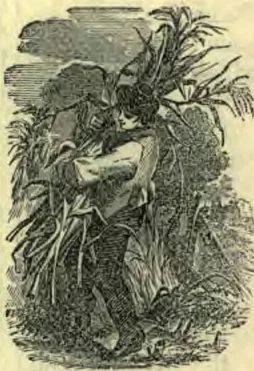
Do you see what the man in this picture is doing? He is cutting corn. You see he has cut all he can well carry, and is taking it to the bunch, or “stook” as the farmers call it. Boys, do you not think it is fine sport to cut corn?
Perhaps you would like to know the history of corn. It was not known in olden times. In the Bible when it speaks of corn, it means wheat, barley, or any other kind of grain. The first that was known of corn was after Columbus discovered America, where he found it cultivated by the Indians. On account of this, it was called Indian corn.
It is supposed that corn first came from Paraguay, where it grows wild. It is different, however, from the corn we raise, as each kernel is enveloped in a small husk, and then the whole ear is covered with still another husk like ours. But after it is cultivated a few years, the husk around each kernel disappears. Some years ago, we had three kernels of this corn sent to us from California. We planted them, and raised several ears of very fine corn, only each kernel had a little separate husk. The next year we planted some from one of these ears, and only a few kernels on each ear had husks. I presume if we had planted them a few years more that they would have entirely disappeared.
J. E. WHITE.
SUCCESS
By J. W. Bacheller
He has made life a success. Such was the remark we heard made, a few days since, concerning a certain individual. It brought to our mind reflections something as follows: In what sense has he made his life a success? What has been his idea of success? Judging from all outward appearances and evidences, it has been the accumulation of wealth—the possession of the honors and good things of this life. And certainly he has succeeded well. The world call him rich. Around him he has gathered everything necessary for comfort and pleasure. Nothing that wealth can furnish is denied him. Great respect is paid him by his fellow-men. His fame is on every tongue. And why? Because he is rich.
And yet others look in different directions for the object of their desire—success. All are seeking for it. Alexander sought it in universal empire. He succeeded, until his rule extended over the whole world, and all nations yielded obedience to his authority. But alas! his success was his ruin. When he had reached the summit of success, he closed his career disgracefully in a drunken brawl. What a miserable success!
The statesman sees the coveted goal in the highest offices of his country. The warrior sees it in the triumphs and conquests of war. The merchant sees it in the wealth accumulated by vast commercial enterprises.
Thus it is in every walk of life. All are seeking for success. But is this the true idea of success? We think not: Says the apostle James, “For what is your life? It is even a vapor, that appeareth for a little time, and then vanisheth away.” Like the cloud in the sky, appearing for a time, but constantly changing, and finally vanishing from sight, so is our life. And Matthew asks the question, “What shall it profit a man if he gain the whole world, and lose his own soul?” Nothing, certainly.
But, dear friends, we may, if we will, make our life a glorious success. Do you ask how? In the salvation of the soul. If we shall gain the whole world, and finally lose the soul, our life will have been a dreadful failure. But if we are finally saved, what a glorious success will our life be. Our blessed Saviour has opened the way, and provided the means, for our success. His life is our example. Was it spent in the eager pursuit of wealth and worldly honor? No. No selfishness was shown in all his actions. His life was one of benevolence and good will to all. The rich and poor, the high and low, all shared alike his gracious gifts of love.
And when shall this success be ours? When we shall have spent this life in humbly serving Him who gave his life for us,77and shall have finished our course with joy—when the pearly gates of the city of God shall open to bid us enter in—when the welcome, “Well done,” shall be spoken to us—then, and then only, shall we have made our life a success. Dear young friends, let this be our earnest life-work.