The Youth’s Instructor, Vol. 32, No. 31.

THE MALLARD DUCK

The Youth’s Instructor

Jul 30, 1884

S. D. A. Publishing Association · Battle Creek, Mich. · Jul 30, 1884

THE MALLARD DUCK.
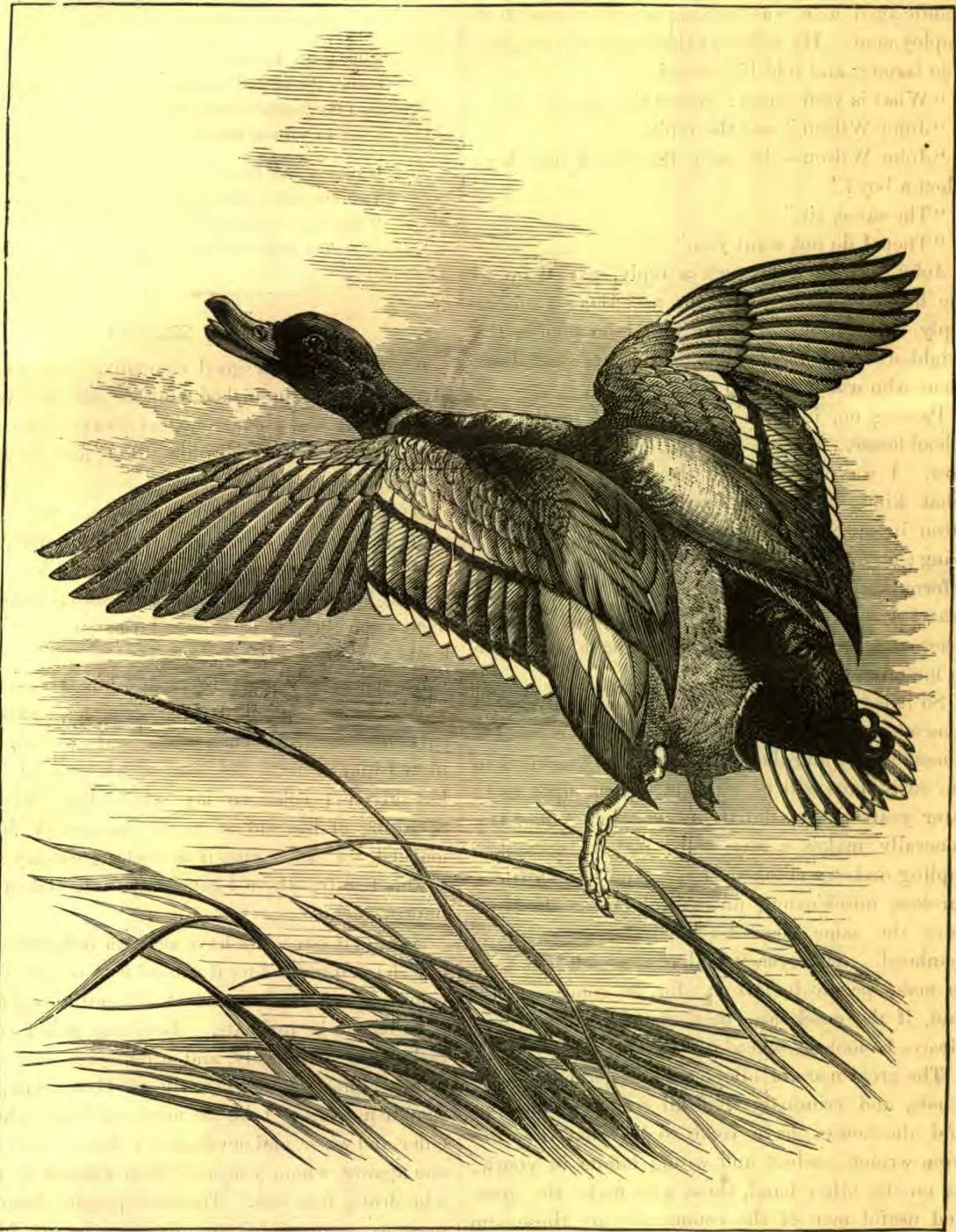
In the accompanying picture is given a view of the common wild or Mallard duck, from whose parent stock came our well-known domestic duck. It is really a most beautiful bird; and if it were not so common, would, undoubtedly, receive a greater amount of admiration than at present is given it. Its head and neck are a rich, glossy dark green, with a ring of white around the lower part of the neck. The back is a rich chestnut brown, merging into black on the upper part of the tail. The four central tail feathers are black, and curl over; while the rest of the tail feathers are gray, edged with white. The wings are shining purple, snowy white, and velvety black; the breast is chestnut, and the under part white, penciled with dark lines. So closely do the tame ducks resemble their wild brethren, that an inexperienced eye could hardly perceive the difference between them.
The female is not nearly so beautiful as the male, as her plumage is a dull brown, and her wings but slightly tipped with white.
During the summer months, such a change takes place in the plumage of the drake that he can hardly be distinguished from his less pretentious mate. In describing this change, a naturalist says: “About the 24th of May, the breast and back of the drake exhibit the first appearance of a change of color. In a few days after this, the curled feathers above the tail drop out, and gray feathers begin to appear among the lovely green plumage which surrounds the eyes. Each succeeding day now brings marks of rapid change. By the 23d of June, scarcely one single green feather is to be seen on the head and neck of the bird. By the 6th of July, every feather of the former brilliant plumage has disappeared, and the male has received a garb like that of the female, though of a somewhat darker tint. In the early part of August, this new plumage begins to drop off gradually; and by the 10th of October, the drake will appear again in all his rich magnificence of dress.”
Its favorite haunts are on little inland ponds in the western and southern portions of the United States, where it is commonly seen from autumn till spring. It mates and breeds in the far North, usually during the months of February and March, but sometimes at even an earlier period than this.
It builds its nest near the water, close to the ground, in some sedgy, sheltered spot, and there lays its eggs, from eight to eleven in number. They are rather large, and of a greenish white color. The nest itself is made of dried grasses, and is lined with down plucked from the mother duck’s breast. She never leaves the nest for food after she has commenced setting, without her mate first makes sure that there is no danger near.
The ducks find enemies in water as well as on land, the large fish in the lakes, where they are hatched, being very fond of the young ones.
About September or October the little ducks are full-grown, and, with their parents, fly away to a warmer climate.
Wild ducks are very fine eating, and hunters resort to every device to capture so desirable game. The most common method is to build “blinds” along the shore. These are little coverts made so as to resemble a thick patch of reeds. Behind this the hunter stations himself, with his gun, and shoots them as they fly over. Or he places in front of this innocent clump of rushes a wooden duck as a decoy, and then he has a fine chance to shoot the ducks as they unsuspectingly fly down to make the acquaintance of the stranger. Foolish indeed it seems for them to allow themselves to be led to destruction by painted decoys; yet boys and girls not unfrequently use as little caution in making new acquaintances.
W. E. L.

Consider the Lilies.

SWEET in the dusk and the dew, Sweet in the noonday’s shine, Spotless their beautiful lifetime through, As vestals who stand at a shrine, The lilies, the fair white lilies, To my soul bring a thought divine.
Mine in the early morn, Ever to toil and spin; Mine when the night-breeze stirs the corn, Little of rest to win; But the lilies, the pure, sweet lilies, They are quiet their sphere within.
Sphere of a matchless peace, Sphere of a still content, While the white clouds scatter their silver fleece, Or the black are over them bent; The lilies, the brave, bright lilies, Under God’s firmament.
Chiding the fears of my heart With their radiance of repose, They bid me cheerily bear my part, Sure that the Master knows How gentle a lesson his lilies To the listening ear disclose.
To be sweet in dusk and dew, To be pure in the day’s hot strife, To be trustful and tender through The storm of this human life. O lilies, wonderful lilies, With love’s own love ye are rife!
—Margaret F. Sangster.

Foreign Travel: From Naples to Venice

FOREIGN TRAVEL.—NO. 12.

From Naples to Venice.

The route from Naples to Venice passes through Rome, Florence, and Bologna. Much of it is very pleasant indeed. Our train stopped two or three hours at Rome, so we took a carriage, and visited St. Peter’s again for a short time, to see the large frescoes that were covered up on our former visit. It was during what is called “Holy Week,” which is designed to commemorate the period of our Lord’s sufferings, crucifixion, and resurrection, the ancient Passover, etc. The Catholic church, many centuries since, changed the day of celebrating the Passover, so that the principal day always falls on a Sunday. This was one of the first steps toward the change of Sabbath to Sunday, which the same church afterward undertook to accomplish. There are various fasts and festivals which center around the time of our Lord’s crucifixion. The time for a short period before the principal day is looked upon as a period of mourning, so that all the fine mosaic pictures are kept covered; but after that point where Christ was supposed to have arisen, all is changed to rejoicing.
On the morning of our return to St. Peter’s, we found the religious services of the Catholic church in progress. We had only a short time to remain; but the scene was quite interesting. In the different recesses of the vast church are found altars where religious services are held. At one of these altars a large number of priests and magnates of the church were assembled, dressed in their robes and strange-looking costumes. There was more or less singing in Latin, chanting and reading in the same tongue by different individuals, considerable bowing before images, and other different forms of adoration. It seemed to us not the true worship of God, but an elaborate effort to make a show, and to fill the minds of the devoted Catholics with awe. It did not, however, have that effect upon us. We could not see in it much resemblance to the worship in which our Lord and his apostles engaged. It looked far more like the system of heathenism from which it was derived. After spending some time in observing the worship, we resumed our journey.
The scenery between Rome and Florence is, in many respects, very pleasant. We passed many pretty villages and one or two lakes. The railroad, in one place, climbed the mountain’s side, now passing through tunnels, and now high up on ridges, from which we had a very beautiful view of the valleys and scenery below. It seems wonderful to persons coming from America to see how the people improve all the tillable ground on the mountain sides. Where it is so steep that, in America, one would not think it possible to cultivate the soil, they have, in this country, raised terrace after terrace on the steep sides of the hills. They do this by building up, from below, stone walls two or three feet in height, and then filling this up with soil, so that its surface will be much less steep than the hillside on which it is built. Then another wall, and another, and so on, so that in many places there are scores, and, in some instances, hundreds, of these terraces, rising one above another up the mountain height. In these plats, vines and fruit trees are planted, as well as various kinds of plants. Little patches of irregular shape, containing from one to a few rods, hedged in on the sides by rocks, are cultivated wherever there is soil enough to raise anything. This must have cost an immense amount of labor.
Florence is one of the finest cities of Italy. But we had no time to stop and see its many attractions. It contains about 150,000 inhabitants, and was founded during the first century before Christ. Since the fourteenth century, it has become famous for its advancement in the arts and sciences. Thousands come here from all parts of the world to become more proficient in sculpture, painting, and music. It has a fine cathedral, and many other buildings which it would be interesting to visit; and the finest galleries of paintings in the world are found here.
Bologna, the next large city on our route, contains nearly 100,000 inhabitants. It is over 2000 years old, and has been an important place for many centuries. The study of medicine and philosophy was introduced here at an early period, and the anatomy of the human frame was here first taught in the schools in the fourteenth century. Galvanism was here discovered by Joseph Galvani, in 1789.
Leaving Bologna, we again pass through a portion of Lombardy, the level country of Northern Italy lying between the Alps and the Appennines. In this section of the peninsula is the most level country we have yet passed through. As far as the eye can reach in all directions, are thousands upon thousands of mulberry trees. Northern Italy is one of the greatest silk-producing countries in the world. A few years ago, a disease attacked the silk-worms, and very seriously interfered with the profits of the business.
We here crossed the River Po, which is quite a large stream. As we drew near the city of Venice, the land became very flat and wet. The city is built on islands lying a few miles from the mainland; but the railroad is graded across to the city, so that it can now be no longer called an island. Venice has, in its day, been a very famous city, occupying something the same position in the commercial world that London, Liverpool, and New York do at the present time. The commerce of the East and West passed through it, and its shipping extended to all parts of the Mediterranean. It exerted its greatest influence between the eleventh and the fifteenth centuries; and, during this period, it was the great focus for the commerce of Europe. It then contained 200,000 inhabitants, with some three hundred sea-going vessels, manned by 8,000 sailors, and three thousand smaller vessels, manned by some 17,000 men, as well as a fleet of forty-five galleys, carrying 11,000 men, who maintained the supremacy of the republic over the Mediterranean. About that time the Turks conquered Constantinople, and through routes to far distant India were discovered, by which the commerce of the world was turned into new channels; so that since that time, Venice has greatly declined. The population is now over 100,000, of whom over one fourth are paupers.
Venice is a very peculiar city. Its streets are canals, the carriages, gondolas, a novel kind of boats. We did not see a single horse in the whole city. It seemed strange to step out of the buildings into boats whenever we wished to go from place to place. The streets do not afford a very good playground for the children. The 15,000 houses and palaces of Venice are situated upon three large and one hundred and fourteen small islands, separated by 150 canals, that are spanned by 378 bridges, most of them stone. Altogether, the city is about seven miles in circumference. It was formerly ruled by an aristocracy, the principal ruler being called the Doge, or duke. The Piazza (Place) of St. Mark is the most interesting point in the city. It is a large square, paved with blocks of stone, 192 yards in length on the west side; on the east, 90 yards. On three sides it is inclosed by imposing structures, which appear to form one vast marble palace, blackened by age and exposure to the weather. The Palace of the Doges is one of the largest structures. It contains many statues of these ancient worthies. On the back side of it, across the narrow canal, is a very large prison; and a bridge connects the palace with the prison. This is called the Bridge of Sighs. It is said that those who passed over this bridge from the palace to the prison never appeared again to the light of day. There were torture chambers in this prison, and cruel scenes were enacted here.
The grand canal forms the main street of the city, nearly two miles in length, from 33 to 66 yards in width, being in the form of a huge letter S. Hundreds of gondolas and other craft are seen here, gliding in every direction. It is a very beautiful scene to see the boats in the evening, gliding here and there, each one carrying a light. In different places may be heard bands of music giving serenades, and all seems strange and unreal. We do not fancy Venice as a place of residence, as we would much prefer the solid earth to a city whose streets are water. Probably there is not another such city on the face of the globe.
UNCLE IDE.

A BAD CHARACTER, AND HOW IT FOLLOWS US.

Some years ago, in a farming neighborhood, a middle-aged man was looking about in search of employment. He called at the house of a respectable farmer, and told his errand.
“What is your name?” asked the farmer.
“John Wilson,” was the reply.
“John Wilson—the same that lived near here when a boy?”
“The same, sir.”
“Then I do not want you.”
John, surprised at such a reply, passed on to the house of the next farmer, and there a similar reply was given. And he found no one in the neighborhood where his earlier years had been spent who was willing to employ him.
Passing on, he soon came in sight of the old school-house. “Ah,” said he, “I understand it now. I was a school-boy there years ago; but what kind of a school-boy? Lazy, disobedient, often in mischief, and once caught in deliberate lying; and though since I have been trying to reform, they all think I am just the same as a man that I was as a boy. If I had done as I ought when at school, then people would have confidence in me now!”
So it is; and school-boys and school-girls should remember this,—that character follows us, and is remembered; and that those who have known us in our early days will be very apt to look upon us in later years as they did in our youth. A lazy boy generally makes a lazy man, just as a crooked sapling makes a crooked tree. And so a shiftless, careless, mischievous, untruthful boy is likely to have the same character when he grows up to manhood. And even if he has changed, it is hard to make people believe it; for, as some one has said, if the crack has been mended, people will always be looking where it was.
The great mass of idlers, thieves, paupers, vagabonds, and criminals that fill our penitentiaries and almshouses have come to be what they are from wrong conduct and wrong habits in youth; as, on the other hand, those who make the great and useful men of the community are those who began right in their early days. As a general rule, we expect to see the traits of youth continued into manhood, and confirmed and strengthened, rather than weakened, by years. And even where the character is really reformed, one often suffers for a lifetime for the errors and sins of youth; as the father told his son, “You may draw out the nails you have driven, but the holes in the post will remain?”
Let all the young remember that character is early formed, and follows us wherever we go.—The Child’s Paper.

THE BEST SOCIETY.

“No company, or good company,” was a motto given by a distinguished man to all his young friends. It was a motto he had always endeavored to follow as far as lay in his power, and it was a very wise one.
Another man of high position in the world, made it a rule to associate with high-minded, intelligent men, rather than fashionable idlers; and he said he had derived more intellectual improvement from them than from all the books he ever read.
Sir Thomas Fowell Buxton often spoke of the great benefit he had derived from his visits to a particular family. Their works and example stimulated him to make the most of his powers. “It has given a color to my whole life,” he said. Speaking of his success at the university, he remarked, “I can ascribe it to nothing but my visits to this family, where I caught the infection of self-improvement.”
Surely, if our visits have such an influence upon our characters for life, it should be a matter of serious importance to us in what families we allow ourselves to be intimate. Boys and girls form attachments very easily, and often with very little forethought. In this, as in all things else, you should not fail to take the advice of those who are older and wiser, and never, never choose for a friend one against whom you have been warned by those who dearly love you. There are people whose very presence seems to lift you up into a better, higher atmosphere. Choose such associates whenever in your power; and the more you can live in their society, the better for both mind and heart. “He that walketh with wise men shall be wise; but a companion of the fools shall be destroyed.”—Selected.

Rules of Kindness for Young Children

Be careful to injure no one's feelings by unkind remarks. Never tell tales, make faces, call names, ridicule the lame, mimic the unfortunate, or be cruel to insects, birds, or animals.

THE GOLDEN GRAIN.

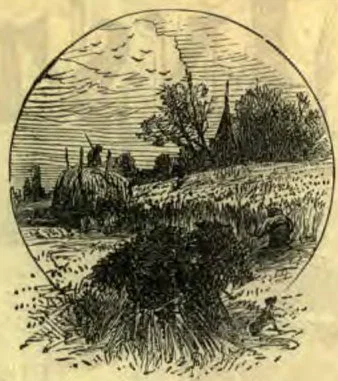
The grain! the grain! the beautiful grain! How it laughs to the breeze with a glad refrain, Blessing the famishing earth in her pain, Making her smile with glee.
Lifting in praise each bright golden crown As it drinks the dew the Father sends down, Courting the sun’s warm lover-like frown, Returning it smilingly.
The grain! the grain! the beautiful sheaves! A song of joy their rustling weaves, For the gracious gift that the earth receives, Given most royally.
From every hillside, every plain, Comes the farmer’s song as he reaps the grain; And the gentle breeze wafts on the strain, In wildest harmony.
He pours o’er the earth his brimming horn, That the valley may laugh and sing with corn, While hope from her death trance rises new born, The brighter day to see.
—Selected.

IMPORTANT BIBLE SUBJECTS.

LESSON 5.—THE END NEAR.

[Note to the Student.—Do not consider the lesson learned until you can give at least the substance of every text, with the correct reference for each. The references in black letters indicate those texts that should be committed to memory. A little diligent application each day will enable you to do this.]
“Now learn a parable of the fig-tree; when his branch is yet tender, and putteth forth leaves, ye know that summer is nigh; so likewise ye, when ye shall see all these things, know that it is near, even at the doors. Verily I say unto you, This generation shall not pass, till all these things be fulfilled. Heaven and earth shall pass away, but my words shall not pass away.” Matt. 24 : 32–35.
“But as the days of Noe were, so shall also the coming of the Son of man be.” Verse 37.
“And take heed to yourselves, lest at any time your hearts be overcharged with surfeiting, and drunkenness, and cares of this life, and so that day come upon you unawares. For as a snare shall it come on all them that dwell on the face of the whole earth. Watch ye therefore, and pray always, that ye may be accounted worthy to escape all these things that shall come to pass, and to stand before the Son of man.” Luke 21 : 34–36.
“And what I say unto you, I say unto all, Watch.” Mark 13 : 37.

QUESTIONS.

1. What events did Christ name as signs of his coming?
2. What have we learned as to their fulfillment?
3. How surely do these signs prove his coming to be near? Matt. 24 : 32, 33.
4. What expression shows the nearness of the coming?
5. What did the Lord say would not pass before his words would be fulfilled? Verse 34.
6. To what generation must he refer?
7. Cite another instance where the term, “this generation,” is used with reference to a people not living at the time. Ps. 95 : 8–10.
8. What reason had the disciples for not expecting the Lord’s coming in their day? Matt. 24 : 4–8.
9. What was Paul’s teaching on this point? 2 Thess. 2 : 1, 2.
10. What did he say must first come? Verses 3, 4.
11. Why may we be so confident that the Lord will come in this generation? Matt. 24 : 35.
12. Can any man tell the exact time when the Lord will come? Verse 36.
13. Show how we may know a thing to be near, and yet not know just when it will come?
14. Are we to expect that all will heed these signs of Christ’s coming? 2 Pet. 3 : 3, 4.
15. Will the last days be days of quiet to the humble Christian? 2 Tim. 3 : 1.
16. What will make the last days perilous? Verses 2–4.
17. To what time does Christ liken the days immediately preceding his coming? Matt. 24 : 37.
18. How wicked were the people in the days of Noah? Gen. 6 : 5.
19. Upon what were they wholly intent? Matt. 24 : 38, 39.
20. Against what does Christ warn us? Luke 21 : 34.
21. In what condition does he say we must be? Luke 12 : 35, 36.
22. Can we be said to be waiting for that which we are not prepared to receive?
23. Since the times are dangerous, and we know not how soon the Lord will come, what are we exhorted to do? Mark 13 : 37.
24. While waiting and watching, what else must we do? Luke 21 : 36.

NOTES.

“This generation shall not pass.”—That is, the generation of which he was then speaking,—the one that would witness the signs. When the Lord said (Ps. 95 : 10), “Forty years long was I grieved with this generation,” we know that he did not mean the generation in which David lived, but the one that had provoked him in the wilderness, hundreds of years before. The words of Christ are in exact parallel to this. The disciples themselves must have understood him in this way, because he had plainly told them not to expect his coming immediately. Matt. 24 : 4–8.
When we see the buds begin to swell, and the spires of grass to peer up through the ground, we know that summer is near at hand. No one could make us believe to the contrary. Yet we never presume to predict the exact hour when spring ends, and summer begins. We may stand by the railroad track, waiting for a train to come in sight around the curve. The smoke rising above the intervening hills, and the rumble of the wheels, prove to us that the train is not far off, and is rapidly approaching, but we cannot tell just what moment it will be in sight. So the signs assure us that Christ’s coming is near, “even at the doors,” but no man can tell at what time he will appear.
This uncertainty as to the exact time of Christ’s coming is necessary in order that we may be continually watching. If the time were revealed, many would put off their preparation until near the appointed time, and would then probably find that they had not time enough. Their evil habits would have become so fixed that they could not easily break them off. God would have us constantly prepared; he wants us to serve him all the time.
To be waiting implies previous preparation. If we have made an appointment with a friend to go to a certain place together, we cannot say that we are waiting for him, until we ourselves are all ready. So if we are doing things that we know the Lord would not approve; if we have not confessed our sins, and found pardon; if we are not constantly gaining victories with the help of Christ; and if he is not our hope and comfort, we cannot truthfully say that we are waiting for his return.

Keeping the Ship Sound in Life's Storms

A SAILOR seldom fears a storm, so long as he treads sound planks, and has steady command over the steering apparatus. Given these two things, the storm may speed him on his way, rather than endanger him; and if, on the other hand, he has to battle slowly through and against the storm, each resisted shock, each mounted wave, gives him a new confidence and joy in his vessel. It is vain to wish that in our life-voyage we may not have to encounter storm. Times of peril and stress will come, times when every foot of progress must be battled for, inch by inch; but all our present duty with regard to these storms to come, is to keep the planks of our life-ship sound, and to maintain a firm control over the steering apparatus. Every false principle adopted into our life, means an unsound plank in our ship; every time when the controlling will gives up the place of command to evil passion or to evil purpose, means lost power over the steering apparatus. It is God's part to rule the storm, and to say what tempests we shall meet; it is ours to guard the soundness of our planks, and to keep a firm hand and a watchful eye at the helm.—Trumbull.

Charity, the Bond of Perfectness

Christians leave behind some early phases of experience. But there are some things that we shall never get beyond, some things that we shall never outgrow—and the chief of these is charity. For charity is “the bond of perfectness.”

Sabbath School Notes in the Review

For additional notes, see the S. S. department in the Review for July 13.

HEART GARDENS.

It would be very pleasing to take each one of our great flock of little friends by the hand, peep into their bright eyes, and hear their merry chatter while giving a bit of history of their own homes and themselves. We have never looked upon many of your faces. A few INSTRUCTOR boys and girls have visited us at different times, and interested us with their innocent, childish ways. We love them dearly, and wish they might always be kept free from guile.
And so we love all this great family of boys and girls. Although we cannot have the pleasure of looking into your faces, we want to help you all in looking into your hearts, to see if all is right there. The heart is many times compared to a garden; and a good comparison it is, too, as you will know if you have one growing this summer. How the troublesome weeds do hinder the growth of the tender plants, if they are not all kept out. Sometimes they will get the advantage of you, by growing so close to a choice plant that you overlook them until they have grown so large, that, in pulling them up, there is danger of pulling up the plant too, or, at least, of disturbing its roots so as to hinder its growth. Then the troublesome insects, how hard it is to keep them from destroying everything!
Your experience in gardening will teach you some useful lessons,—one of them is patience, and another is watchfulness. And now just turn right around and apply the experience to that other garden—the garden of the heart. As you have been trying to keep the weeds and insects out of the one, so try to keep the weeds of sin out of the other. As you have tried to enrich the soil and water the plants in the one, so try to cultivate all that is lovely—the little Christian graces, in the other, watering it from the well from which, if you drink, you will never thirst.
The Saviour said, when he was talking to grown-up people, “Except ye become as little children, ye shall not enter into the kingdom of heaven.” He meant little children who had not defiled themselves with sin. So long as you keep yourselves pure, so long you are sure of the Saviour’s tender love and watchful care; for he says, “Of such is the kingdom of heaven;” and they will be kept as the apple of his eye. And again he says, when speaking of the good, “I give unto them eternal life, and they shall never perish, neither shall any man pluck them out of my hand.” Is it not an enviable position,—to be loved of the Father, and of his Son, and of the holy angels, and finally to share in their glorious home forever?
The editors of the INSTRUCTOR love the children dearly. May we not have your affections, and your attention to what we shall say for your good? If we shall never behold your bright faces here, we do desire to clasp glad hands with you in the new-earth home. Will you be there?
M. J. C.

PRICE OF BOOKS 400 YEARS AGO.

Thanks to the labors of the inventors and improvers of printing-presses, good books can now be sold at prices within the means of every one; but it is not so very many years—only about four centuries, and that is not so much in the age of the world—since our ancestors were glad to mortgage an estate, or to leave in pawn hundreds of golden crowns to obtain even the loan of a valuable book.
Louis XI. of France was one of the most absolute monarchs of a time when almost all monarchs possessed a nearly unlimited power; yet even he could not obtain so much as the loan of a valuable manuscript from the library of the Faculty of Paris, to have a copy made, without pledging a hundred golden crowns. To obtain this sum—then a very large one—Louis’ treasurer was obliged to sell a portion of the royal plate.
Coin in those times was very scarce, and people often bartered one thing for another; so a countess of Anjou, in order to obtain a favorite book, gave in exchange for it 200 sheep, some skins of martens, (then a very choice fur,) and a quantity of wheat and rye.
A student of Pavia, reduced to poverty, raised a large loan, which became the foundation for a fortune, by leaving in pawn a book of laws; and another student, who was ruined by a fire, was able to rebuild his house by the price obtained for two small volumes of Cicero.
Of course, these books were all manuscripts; and it was the immense labor and skill required to produce a perfect copy, that made the cost of each volume so great. Years were often consumed in making one handsome copy of a moderately-sized book.
—Christian Weekly.

A GOOD NAME.

It is related that Accoltus d’Arreggo, a celebrated lawyer who lived some four hundred years since, once went to a neighboring butcher’s shop, and helped himself to several pieces of meat.
Two of his scholars, whose reputation was bad, were suspected of the theft, accused, and put in prison for the crime. Accoltus tried to save them. He declared that he himself had taken the meat; but it was all in vain; no one would believe him to be guilty of such an offense; but they thought he had accused himself for the sake of screening his students.
After the young men had paid their fines, and were liberated, the lawyer brought clear proof that he was the offender, and that the students knew nothing of the matter; and when asked why he had done a thing so contrary to his character that no one would suspect him of doing it, he replied that he did it to show the people the importance and advantage of having a well-established character and reputation.
Many a poor fellow has suffered for crimes he never committed, because people have come to believe that he was a man who would be likely to do such things. Liars are not believed when they tell the truth; and rogues are not trusted when they try to be honest.
Let all, both young and old, live so carefully that no evil can be said of them unless it is said falsely, and for the sake of the name of Jesus.—Little Christian.

Saving Gold Dust and Saving Minutes

In the rooms in the United States mints, where gold is made into coin, the floors are double, the upper one being pierced with innumerable little holes, like a sieve. This is to allow the gold dust to sift through; and the amount thus saved, during the course of a year, is valued at $30,000. Suppose fragments of time were saved with equal care, how much might be accomplished in one's odd minutes!
Continue reading: Letter Budget