The Youth’s Instructor, Vol. LIII, No. 19

A Visit to Riga of Russia

The Youth’s Instructor

May 9, 1905

Review and Herald Publishing Assn. · Washington, D. C. · May 9, 1905

A Visit to Riga of Russia
The city of St. Petersburg, as you can see by taking a good map, is located between two seas, the Baltic and the Ladoga, and all the country round about is low. The trip from St. Petersburg to Riga, which was our next stopping place, lay through some fertile tracts of land. There were well-cultivated farms, and forests now and then. This was my first trip on a Russian train, and I saw that the third-class cars offered one a good opportunity to observe the customs, dress, manners, habits, and characters of the middle and lower classes.
As we left the city, our companions crossed themselves three times. This is done by the members of the Greek Catholic Church as a sort of prayer, on starting to travel, or at the completion of a journey, or before and after meal-time.
I am sure you would be interested in the home-made sheepskin head-gear, and the heavy fur or sheepskin coats the peasants wear. The smooth side of the skin is out, so the fur of the coat comes next to the clothing underneath.
We passed through lands tilled by the Esthonians and Lettonians, as well as those worked by Germans, Poles, and Russians. The cars are separated into sections, intended to accommodate twenty-four or more persons, giving them sleeping room at night. The upper shelf, intended for the luggage, of which there is a great deal, can be cleared off, and also used to lie on. Indeed, I prefer this, as it is in the top of the car, and nearer one of the three small circular ventilators. The windows are double. There are so-called non-smokers, but only so-called, and every one is supposed to smoke—if not from choice, at least from compulsion, taking his inhalations of that cheap, foul, poisonous, barbaric North American weed, second-hand. At every station the passenger can secure hot water for his tea. The Russians are great tea-drinkers, and always carry their teapots with them on the journey.
One of the chief places we passed between Petersburg and Riga was Pskow. It is situated in the midst of great flax farms, and produces linen, leather, and canvas for sails of ships. The city was founded perhaps by Ogla, wife of Igors, in 975 A. D., and became a great trading place during the Middle Ages,—a republic belonging to the Hausa league,—but lost its independence under the Mongolian dominion. The city had a day of great anxiety in 1570. It was besieged by Ivan IV (The Terrible), as he suspected its citizens guilty of treachery. The czar had just come from the church where he had been worshiping, and passed by the cell of a monk, who, feigning imbecility, offered him a piece of raw meat. The religious monarch answered: “I am a Christian, and eat no flesh during the great fasts.” “But,” replied Monk Salos, “you do much worse; you nourish yourself from human flesh and blood, forgetting not only the fasts, but God himself. If you will lift your hand against a single citizen of this city that is consecrated to God, the Most High will destroy you with lightning.” At these words the hitherto clear sky became covered with clouds, and Ivan departed.
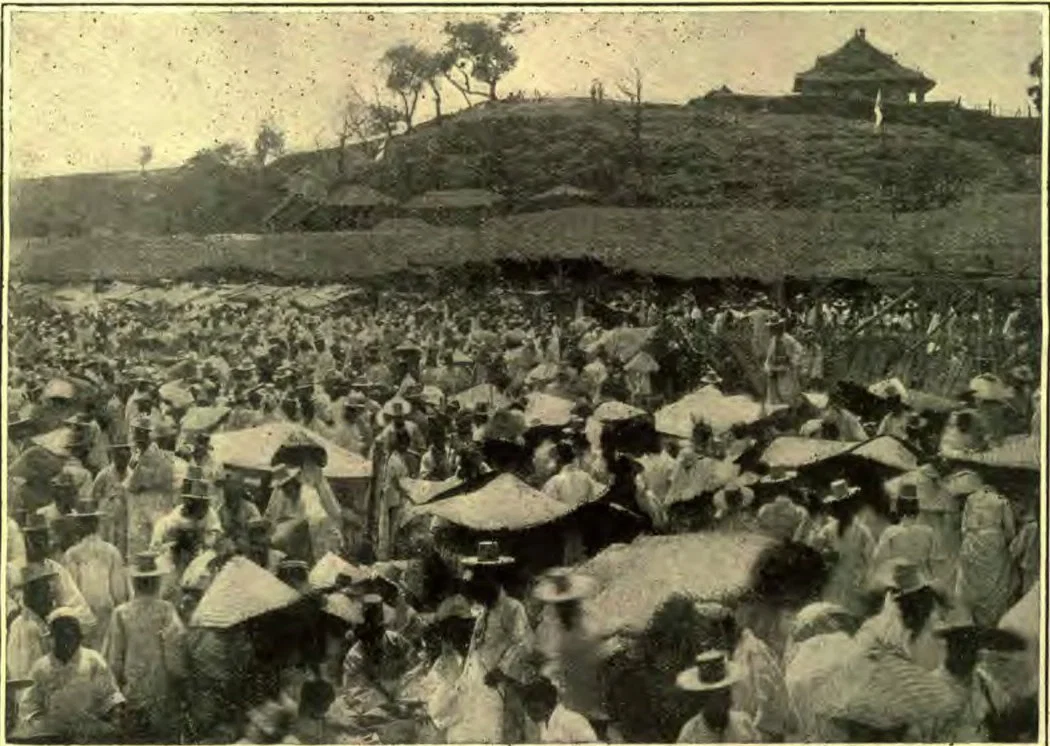
MARKET SCENE IN A LARGE INTERIOR KOREAN TOWN
Near by is the village of Wibutska, the birthplace of the holy Olga, a country maiden, whom Igor of Kief met on a hunting tour, and elevated to become his consort. After he was killed in a battle with the Drewlier, she conducted the government herself during the minority of her son Swjatoslaw. She was a woman of strong spiritual tendencies, and was baptized in Constantinople, and received the name of Helena, and when she died she was canonized. The eleventh day of July is observed in her honor.
As we came into Riga, at the first depot Brother Gaede came into our car, and said: “Well, the police are after us. Sabbath they came into our meeting, and took the names of all present, broke up the meeting, took away our passports, and forbade our having any other gathering. But we must trust God, and it may yet come out all right. They came to my house, and took all my reports, and books, and papers—everything. However, we have fortunately secured a hall away off in another part of the city.” We were instructed to recognize and greet none of our brethren whom we might see at the depot, and to take separate hacks, and drive to our lodgings in separate parties, so as to avoid attracting attention. We quickly left our car, and were off from the depot in short notice. I was not permitted to attend a single meeting, and after two days Brother Conradi had me separate entirely from him, taking a room with his most dangerous papers and books, in the hotel Victoria. As they spoke German here, I got on all right. We secreted part of his things in various secure places, so that we hoped they could not be found. I never knew so fully what a loss of liberty means, as I did in Riga. The first Russian prisoner I saw was in this city. He was dressed in the dirty grey prison clothes, marched through the streets between two saber-armed soldiers. Said Brother Conradi to me: “That’s just the way they do here. I know what that means, I tell you.”
I used to wonder how I would feel to be in a place where there was some genuine danger to me or my friends. I do not wonder about that any more; I know just how I should feel. I was not in danger, as I was kept away from all the meetings, and was not connected with them in any way. But I did feel anxious that God might protect our brethren, especially Brother Conradi, because I knew of the important appointments he wanted to meet in the immediate future. I can assure you there is no particular pleasure in the sensations one has during such a time as our Riga experience gave us.
Riga is really a German city. It also belonged to the Hausa league. In some respects the place is in advance of St. Petersburg. The streets are better paved, and cleaner, and there are electric street-cars. The Germans, Lettonians, and Esthonians are, in general, Lutherans. The population of this city is about two hundred eighty-three thousand. It surprises me that in the older part of the city they still maintain their narrow streets. I saw fine buildings on some of the narrow, crooked streets. In the town, I saw several large cannon-balls, which had lodged in the walls, I suppose, during some siege or battle. There is some building going on, and Riga seems to be a growing, prosperous city.
Of course the Russians belong to the established church; though I noticed that the pictures of saints, and the other things pertaining to this worship were not in the depot itself, as in most Russian cities, but in a small chapel built in front of the station. There are a number of Jews here, and some Poles.
The city is in a sandy location, on both sides of the Duna, which forms a harbor deep enough for the accommodation of ocean steamers. There are a number of factories; but commerce is of the greatest importance, and it is carried on by German and English capitalists. Salt, herring, coal, petroleum, railroad rails, and building stone are the chief articles of import, while flax, hemp, linseed-oil, tobacco, grain, and ship-building lumber are exported.
We left Riga on the evening after the Sabbath.
GUY DAIL.

City Scenes in Korea

THE ports of Korea are lively places, with their mixture of native, Japanese, and Chinese inhabitants; and there is much of interest to be seen in these cities. But for a genuine view of Korean city life, one should visit one of the large interior cities, where foreign influence has not penetrated deeply. Such a place is Pyeng Yang, the ancient capital, situated on the Tadong River, about seventy miles from the western coast.
The authentic records of Pyeng Yang are said to reach back to the times of David and Solomon. The city is surrounded by a wall of stone and earth, only the outer facing of stone, and the inner facing of the battlement, being laid with lime mortar. Of the several gates, the principal one is in the east wall, next to the river. It is surmounted by an imposing pavilion supported by immense pillars of cedar. The tiled roof of this pavilion has widely projecting, deeply curved eaves, so characteristic of Oriental temples and similar structures. The wall has not been kept in repair, and in several places it is so broken down that foot-paths run over it into the city.
Passing along the main streets, we find them thronged with white-robed people. The shops are quite small, and open to the street. Many traders, both men and women, sit in the street with their small stock of wares before them. There is loud bantering and sharp bargaining over prices; for there seems to be no “one-priced stores” in Korea. Men driving cattle or ponies bearing bulky loads of fuel or fodder, shout to the people to make room; for even the principal streets are quite narrow. In front of the butcher shops the fresh hides of the beeves are spread down in the street under the feet of the crowd, till dry. Women of the better class glide along with eyes peering from the folds of long white or green garments thrown over their heads and clutched about their faces. Here comes another shy woman almost hidden by a basket-like hat larger than an ordinary clothes-basket. She supports the sides with her hands, and elevates the front end enough to enable her to see the way.
Many of the houses in the main part of the city are two stories in height, with tile roofs. But in the outskirts they are little, if any, superior to the country cottages. We notice that some of the dwellings lack doors and windows, and are told that these were broken up and used for fuel last spring by the Japanese soldiers while on their way to the war. The soldiers forcibly occupied many houses, as the weather was still cold; and the people have not all been able to repair the damage done to their dwellings.
Passing now toward the great eastern gate, we notice a constant stream of men carrying buckets of water from the river, which we learn is the source of the city’s water-supply. This river water, dipped up among the boats which line the bank, is doubtless not the cleanest; but it is probably cleaner than the water from any wells that might be sunk within the city walls. For there seems to be an utter lack of sewers and drains, and of any provision for removing the filth of the streets. The wonder is that people in such spotless garments can keep looking so clean in the midst of such surroundings. Pyeng Yang is certainly in dire need of proper sanitation.
The space between the eastern wall and the river is well covered with buildings. Here are to be found many Japanese houses. The river front is crowded with sampans and strange-looking Korean and Chinese junks. All is now bustle and confusion; for the tide is just beginning to ebb, and many boats are preparing to start down the river. A din of voices fills the air. The hoarse shouts of the crowd on shore mingle with the sonorous chant of boatmen as they labor together at the heavy cable which draws in their anchor. We step into our sampan, and are soon floating along between bold, rocky bluffs and pleasant fields, far from the city’s noise.
F. W. FIELD.

Hothouses for Germs

Do you know what an incubator is?
Certainly; it is a box for keeping eggs warm so they will hatch.
Right; but there are incubators for growing germs, as well as for hatching eggs.
Incubators for growing germs! Do not germs grow fast enough without having incubators?
It is necessary sometimes to grow germs in order to study them, or in order to determine the nature of certain diseases. As you have already learned, many germs grow better in a moderately warm temperature than in a cool one.
If I were to ask you what a refrigerator is, you would probably answer, It is a box for keeping foods cold so they will not spoil. But why does cold keep the food from spoiling? — Because the germs, when it is cold, grow very slowly, if at all.
Some germs which grow slowly at ordinary room temperature, grow more rapidly at the temperature of the body. Some are so particular that they will not grow at all unless the temperature is exactly to suit them. It is fortunate for people that such germs do not grow well outside of the body; for some of them are most dangerous disease germs, and if they could multiply outside of the body, they would be able to do more damage than they now can.
As a rule, disease germs grow much better at body temperature than at a lower temperature; and some will not grow at all unless the temperature is very near that of the body. There are a few, as the germs of cholera and typhoid fever, which may grow at much lower temperatures.
Sometimes bacteriologists want to study these germs, their habits and growth, or perhaps they want to test some water or milk in order to determine whether it contains certain dangerous bacteria. For this purpose it is often necessary to plant the germs in the proper “soil” in a glass tube or other vessel prepared especially for that purpose, and set it in the incubator for one or more days. In growing germs artificially the attempt is made to find the “soil” on which the germ grows most readily, and then keep it at the temperature most suitable. In some cases (the germ of consumption, for example) the growth is very slow, several weeks being required to make a perceptible growth, even when the conditions are most favorable.

Disease Germs

I have spoken about how plants and animals help each other to live, and how we germs help both plants and animals. Now one does not help the others from any benevolent motive. There is, between the different forms of life, a constant struggle for existence. The cow crops off the grass as fast as it grows. The pig picks up the acorns; and, if he is successful, he leaves none to be buried and form new trees. One animal or bird or fish preys upon another. So while each living thing in some way contributes to the lives of others, it is also true that many live at the expense of others.
In some cases this is more marked than in others, one being sometimes living completely at the expense of another. The mistletoe gets its main subsistence from the oak; and many growing mistletoes cause the tree to become unhealthy. Tapeworms in men and animals exist at the expense of the higher life, using the nourishment that was intended for their host. They can not gain a living otherwise. These are called parasites, the animal or plant on which they live, being called the host.
There are parasites among plants, among animals, and among germs. The parasites among germs are capable of living in the body of some living animal, and of producing substances injurious to the health of the animal. What we call contagious and infectious diseases are usually produced by some parasitic germ which gains a foothold in the body, and is transferred in some way from one animal to another or from one person to another.
There is a vast difference between the germ as a parasite and most other parasites. The mistletoe damages the oak principally by stealing its nourishment. In the same way a tapeworm injures the person whose intestine it inhabits. The person has an enormous appetite, and eats
large quantities, but remains thin because a goodly portion of the nourishment intended for the man goes to feed the worm.
There are many germs—millions of them—in the intestines of man, using the food, and, worse still, converting it into substances more or less injurious to the man. They are always present, and in case of overindulgence or when wrong combinations of food are eaten, as milk and sugar, or milk and fruit, or fruit and vegetables, especially when in large amounts, these germs seem to have a regular picnic; but it is not a picnic for the person who ate injudiciously.
What is known as a “weak stomach” is often the result of allowing these germs to grow too rapidly by wrong habits of eating. It is much easier to avoid a “weak stomach” by right living than it is to cure the stomach after it has become weak.
But these germs are not necessarily parasites, as the word is generally used. There are still other germs, which, perhaps, can not thrive well outside of the body, that, as they consume food and grow, produce certain poisons, some of them much more violent than strychnin,—poisons of which the very minutest dose, too small to be measured by any but the most delicate instruments, will produce alarming symptoms, and even death. Such germs as the lockjaw and diphtheria germs belong to this class.

Lockjaw

Long before any one knew anything about germs, there were savage tribes who used to poison their arrows by dipping them into garden soil, or into the blood of some animal which died of lockjaw. Even a slight scratch on a person from an arrow so infected, was liable to be followed by lockjaw and death. It is now known that these lockjaw germs are often present in ordinary garden soil, and may be on old nails, so that a wound by a hoe or rake or by a nail (it does not need to be rusty) may end in lockjaw.
Many cases of lockjaw have occurred as a result of using toy pistols, because the earth used in making up the cartridges happened to contain some of the lockjaw germs. Accidental wounds with these toy pistols, some of the infected earth being left in contact with the wounded surface, often ended fatally. But I shall say more later about how doctors now go to work to save people who have been infected with lockjaw germs.
It is well now to remind you that any wound made by a dirty tool, and which does not cause free bleeding, is especially dangerous, and should be freely opened and disinfected. It takes two or three weeks to develop lockjaw so that it can be recognized, and when it gets that far, the patient usually dies.

Diphtheria

The diphtheria germ produces a poison which not only cooks the lining of the throat, turning it white, but which damages the kidneys, causes a fever, paralyzes muscles, and often ends in the death of the patient.
So far as is known, diphtheria germs do not grow in a state of nature outside of the animal body; so that every case of diphtheria must come from some other case, or from somebody who is carrying around a growth of diphtheria germs in his throat.
For it seems now that the diphtheria germs, and pneumonia germs also, may be present in the mouths of many persons who do not have the disease. This is especially so in the case of pneumonia germs, which are found in the mouths of many healthy persons.
These germs are there, and grow, but do not get a foothold in the tissues until, perhaps, “a cold is caught” as a result of exposure, and the pneumonia germs then easily get a start in the weakened tissues, and produce their dangerous poisons from which one seldom fully recovers.

Germ Diseases

Diseases which are “catching” or infectious, which travel in epidemics, attacking many persons in one locality at a time, are usually due to the presence of micro-organisms. In regard to some of the most common diseases, as scarlet fever and measles, it is not yet definitely known what is the nature of the cause, though from the similarity to other infectious diseases it is supposed that each must result from some kind of micro-organism.
The diseases which are now recognized as due to some germ, or micro-organism, include the following: typhoid fever, diphtheria, influenza, or “grip,” Asiatic cholera, dysentery, plague, yellow fever, leprosy, erysipelas, tuberculosis, malaria, lockjaw, pneumonia, boils, abscesses, etc.; among the diseases which are generally supposed to be due to micro-organisms are smallpox, measles, scarlatina, and cancer.
To this list might be added rheumatism, with valvular heart-disease, and disease of the kidneys.
MIKE ROSE.

Just Be Glad

A MOCKING-BIRD is singing on a limb of the China-tree by the gate, and he hops and dances about, his little black eyes gleaming like stars. Every morning for a month or more he has been there singing, and it is always the same joyful, thankful song.
He has learned a lesson that some persons have not yet learned. While his heart is filled with thankfulness, there is no room for envy, covetousness, or any of the peace-destroying sentiments; so he thinks of his blessings, and begins each day with his cheery song; and if his duties are not pressing, he comes back again and again during the day and sings. Wise little bird!
He is not singing alone for his own enjoyment; for near by, hidden in the fragrant honeysuckle vine is a little nest woven very skilfully, and in the nest are four dainty, spotted eggs, and his mate. She is too busy to sing if she could, but why should she sing when her protector keeps guard and sings for her the daintiest of cradle songs? Many of these songs he has learned from his feathered friends, and a few are of his own composing. Each of the concerts given for his mate are concluded with one of his own, and it sounds something like the cry of a sentry on guard, and his mate, watching him so proudly, understands that “all is well.”
His life is a simple one, and he has to work hard sometimes to keep himself and his little family from hunger, but it makes no difference in his song, and why should it? The work only gives him strength, and his voice a clearer tone: it is one of the blessings for which he is thankful.
There are people whose lives are simple and filled with homely duties. They have health and loving families and friends; but their days are seldom begun with a song of thanksgiving. You can tell by looking at their faces that their hearts are filled with something besides peace and gratitude. I wonder why.
“Oh, heart of mine, we shouldn’t Worry so! What we’ve missed of calm we couldn’t Have, you know! What we’ve met of stormy pain, And of sorrow’s driving rain, We can better meet again. If it blow.
“For, we know, not every morrow Can be sad; So, forgetting all the sorrow We have had, Let us fold away our fears, And put away our foolish tears, And through all the coming years Just be glad.”
J. W. PEABODY.

Cement Buildings

INQUIRY has been made by some interested in the Washington work, about the kind of buildings which have been erected, and especially concerning the material used for building purposes. I shall endeavor to give the desired information briefly and plainly.
Three buildings have been erected, which are of an economical, yet neat, design, being simply plain, straight structures with hipped roofs. These buildings are called cement because the first story of each is composed of a mixture of cement and stone. As the stone is kept from the outside of the wall, the appearance is that of a solid cement structure.
To construct a cement wall equal in durability to an ordinary stone wall, is a simple matter, and costs much less than one made of brick. As the cement is put into the wall while it is soft, the first thing to do is to erect what is known as a “form,” which is simply a box built just the height, size, and shape of the desired wall. Care must be taken to keep it straight and plumb on the sides, and level on top. The form should be made of two-inch-thick material, with sufficiently heavy standards, or upright pieces, placed four or five feet apart, to prevent it from springing, which would make an ugly bulge in the wall. Dressed plank of a uniform width should be used for the outside of the wall, covering the cracks with molding of some plain design, to give the appearance, when the form is removed, of mortar joints or of cut stone.
The two sides of the form are securely fastened together either by passing long bolts through the bottom of the standards or by twisting a heavy wire around them, and nailing a strip across the top of the wall. The window- and door-frames are all set in place before any cement is put into the form.
Now everything is ready for the cement, which is a mixture consisting of one part of cement and two or two and one-half parts of good sharp sand.
The stones are placed in the form, care being taken not to put too many in one place, or closer than one inch to the face of the wall. Now water is mixed with the cement and sand until a thin mortar is produced; this is poured over the stones, and the operation is repeated until the form is full. Then it is allowed to stand until well hardened, which takes about thirty-six hours.
After the cement has hardened, the form is removed, and the wall is better than one of brick or stone, as it is all one solid piece.
Persons desiring to build will find cement an economical and very substantial foundation for any frame or brick building.
The construction can be made even more simple than by the method described, as any good heavy boards, whether rough or smooth, may be used for the form. The cement may be mixed with coarse gravel, using one part of cement with seven parts of gravel. This should only be dampened with water, and shoveled into the form, no stone being used except that which is in the gravel.
A. L. PHILBRICK.

Tame Humming-birds

Of all birds the humming-birds, especially when young, seem to display the least fear, says a writer in Country Life in America. It is a difficult matter to train a young canary bird to follow one about the house or to come when called, yet we have had several humming-birds which were perfectly domesticated, and more thoroughly tame than any other bird I have seen. Two humming-birds that grew up with us were given a small place in a closet in our sleeping apartment. At the first approach of daylight they would fly out into the room, the door being left ajar, and directly to the bed, hovering over my face, their loud humming noise awakening me at once. There was no mistaking that the birds wished their breakfast, and they could not be driven away. At times I would pretend not to see them, and they would finally alight on the bed, uttering the quaint little sound, now perhaps a protest, then would hover over my eyes, so near that the wind from the rapidly moving wings was quite sufficient to arouse me. When I held out my finger, one or both would alight upon it, and gaze at me in a manner which spoke volumes to any one imaginative enough to think he understood the language of birds when they are hungry.
Their food consisted of sugar and water, which was fed to them with a chopstick-like straw. Immediately upon seeing it they would poise in the air and lick the drop on the tip until they were satisfied. Occasionally they would poise before the big red flowers printed on the curtains. They recognized the pictures of flowers on sight, and endeavored to press their bills into them. Artificial flowers were approached in the same way. In a word, these most helpless, the smallest of all birds, required no education, no training from parents; it was all instinctive.
The absolute lack of fear was the most interesting. The birds followed us about the house, went to their mistress when called, flew down from an upper room at a call, following the stairway, when an ordinary bird would have kept close to the ceiling, butting its head against it. At meal-times they would often come to the table, perching among the flowers or upon some object on the table or about the dining-room,—Selected.

How Fishes See in Deep Waters

PROF. A. BRAUER, of Marburg, describes the light organs of deep-sea phosphorescent fishes. He says there are four important kinds of light organs. One kind of tentacle light organ consists of strands of the dorsal fin. One or two of these are usually on the forehead; but in some fishes they are on the nose and can be thrown forward while the fish is swimming. Another kind lies on the lower side of the body toward the tail, and is provided with a circular reflector that sparkles with violet, red, or green light. Another kind consists of masses of closed glands on barbels at the base of the tail fin, or on the gill covers. A fourth kind consists of small flat plates or cells massed in the skin over the stomach or back. These cells are filled with highly refracting granules. In all these various kinds, the light seems to be made by the gland cells.

A Fine Puzzle Aquarium

WHEN cousin Tom sent me a list of the contents of his aquarium, I was very much surprised, but when I came to see them, they did not seem so strange to me, in fact, they are just what any one would expect to see in a well-stocked collection of fish. Do you recognize them?
  1. A sphere.
  2. A heavenly body.
  3. A heavenly body.
  4. A shaft of light.
  5. Something often worn in winter.
  6. A beautiful insect.
  7. A weapon.
  8. Part of a shoe.
  9. A carpenter’s tool.
  10. A sovereign.
  11. A dog.
  12. A part of the ear.
  13. A ferocious animal.
  14. An implement used by blacksmiths.
  15. A bowman.
  16. A guide.
  17. Master of a trading vessel.
  18. A machine for destroying ships.
[I will print the list as given by the first boy or girl who sends in a correct solution to the puzzle. Get the names any way you can.—Ed.]
— The Brown Book.

THE WEEKLY STUDY

Paul’s Arrival at Jerusalem

OPENING EXERCISES.
TEXT FOR PERSONAL STUDY: Luke 14:33.
SCRIPTURE FOR STUDY: Acts 21:1-15.
REFERENCE STUDY: “Sketches from the Life of Paul,” pages 203-207.
TOPICS FOR STUDY:— Leaves Miletus. Reaches the island of Coos. Arrives at Rhodes. Stops next at Patara. Changes ship. Sails past Cyprus. Lands at Tyre. Prays on beach. Departs for Ptolemais. Reaches Cæsarea. Departs for Jerusalem.

Notes

The island of Coos lies south from Miletus about forty miles, and is about twenty-three miles in length. It contained a town of the same name, which was surrounded with fortifications, and was the seat of a medical school, also a temple of the god of healing.
Rhodes was a noted island in Paul’s day. It was the point from which Greek geographers reckoned their meridians of latitude and longitude. It contained the celebrated “Colossus of Rhodes,” one of the wonders of the world, which was destroyed by an earthquake in B. C. 224.
The distance from Patara to Tyre is over three hundred miles. Read Ezekiel, chapters 26, 27; Isaiah, chapter 23, for a description of Tyre. Paul improved the days spent here while waiting for the ship to exchange cargoes to strengthen the brethren. As at Miletus, they held a most precious prayer-meeting on the beach, and Paul, regardless of their exhortation not to go up to Jerusalem, continued his journey.
Paul remained one day at Ptolemais, and here, as at Tyre, he visited the believers, and gave them the consolation of the gospel. In some of these things is revealed the tremendous burden carried by the apostle for the churches.
The journey to Cæsarea was doubtless made on foot. Here was the home of Philip, the evangelist, who was one of the seven mentioned in Acts 6:1-6. Four of his daughters had the spirit of prophecy, and gave such instruction to the church as the Lord was pleased to reveal in vision. Here the prophet Agabus gave a dramatic revelation of the trials which awaited the apostle at Jerusalem.
Note the rendering of Acts 21:13 in the American Revised Version. “Then Paul answered, What do ye, weeping and breaking my heart?” The tendency of the weeping and exhortations of Paul’s brethren was to take the heart out of him, so to speak. But note his indomitable determination and dauntless courage: “I am ready not to be bound only, but also to die at Jerusalem for the name of the Lord Jesus.” This is the spirit of a true missionary.
“Philip, the evangelist, was bound to Paul by ties of the deepest sympathy. A man of clear discernment and sterling integrity, Philip had been the first to break away from the bondage of Jewish prejudice, and thus had helped prepare the way for the apostle’s work. . . . Precious hours were these that Paul and Philip spent in each other’s society; thrilling were the memories that they recalled of the day when the light which had shone upon the face of Stephen, upturned to heaven as he suffered martyrdom, flashing in its glory upon Saul the persecutor, bringing him, a helpless supplicant, to the feet of Jesus.”
“The time soon came for the brief stay at Cæsarea to end, and, accompanied by some of the Cæsarean brethren, Paul and his company set out for Jerusalem, their hearts deeply shadowed by the presentiment of coming evil.”
G. B. T.

No God?

IN earth and sea and sky is seen A wondrous, mighty plan, Produced upon a living screen, With skill unknown to man.
O! fool that in thy heart hath said, “I know there is no God.” How couldst thou look above thy head, Or touch the common clod,
Or hear the birds, or smell the bud, With bursting fragrance sweet, And fail to recognize thy God In each pulsating beat?
Throughout his boundless universe His ceaseless scepter sways, And all except thy heart perverse His sovereign will obeys.
There’s reverence in every part, There’s worship in the whole, There’s nothing heedless but thy heart, Or senseless but thy soul.
J. M. C. JOHNSON.

Bird Sympathy

A FOURTEEN-YEAR-OLD North Carolina boy tells in Bird-Lore how he observed the sympathy that birds have for one another. Noticing a crippled sparrow, he caught it to see if he could do anything for it. While he sat on a stump to examine it, the hurt bird screamed and fluttered in a pitiful way. Soon thirteen partridges (bob-whites) came down near the place, and he counted seven jays, four brown thrashers, eleven towhees, sixteen chipping sparrows, and about twenty-five white-throated sparrows, or peabody birds, all of which began to scream and scold at him. Besides these, a red-headed woodpecker kept flying around his head, threatening to attack him.
He was glad to find that the bird had not been shot, but was the victim of a large tick, of which he relieved it. He carried the sparrow home, and fed and nursed it until it was strong enough to be set free.—Girls' Companion.

The Present Moment Is Divinely Sent

“The present moment is divinely sent. The present duty is thy Master’s will. O thou who longest for some noble work, Do thou this hour thy given task fulfil; And thou shalt find, though small at first it seemed, It is the work of which thou oft hast dreamed!”

Death of the Children

ONE by one we lay away the children, Weeping, lay them in the silent tomb; Pure are they from all the earth’s pollution, Fair as summer roses in their bloom. Sweeter are their voices than the morning, Sweeter than the notes the wild birds pour; Long we list, but silence is unbroken; We shall hear their tones on earth no more.
One by one I see the children dying, Hushed by death, the sweet and childish tone, And for them I hear the mourners crying, Some in palace, some in hovels lone. Many mothers, with heart-broken grieving, Look on vacant crib, with empty arms; Death has called the young, the home bereaving; And the joys of life have lost their charms.
One by one our household buds are falling, In the morning, noon, or close of day, And for them are sad hearts vainly calling With a cry of pain that swells for aye; Dimpled hands, and shining baby tresses, How the childish tones our hearts did thrill! How we yearn to give them our caresses! But, alas, the baby heart is still.
One by one the angels cull our flowers, But they’ll blossom in the shining land, And within fair heaven’s fadeless bowers We shall see the dimpled baby hands, Childish notes will swell with angel chorus Where life’s crystal waters gently flow; Sunny curls will rest on baby foreheads, Like fair sunbeams resting on the snow.
L. D. SANTEE.

“BETTER die than lie.”

He Is All Fault Who Hath No Fault At All

“He is all fault who hath no fault at all.”
Continue reading: Hoping Without Despondency