The Youth’s Instructor, Vol. 27, No. 1.

THE SNOWBALL

The Youth’s Instructor

Jan 1, 1879

S. D. A. Publishing Association · Battle Creek, Mich. · Jan 1, 1879

THE SNOWBALL.
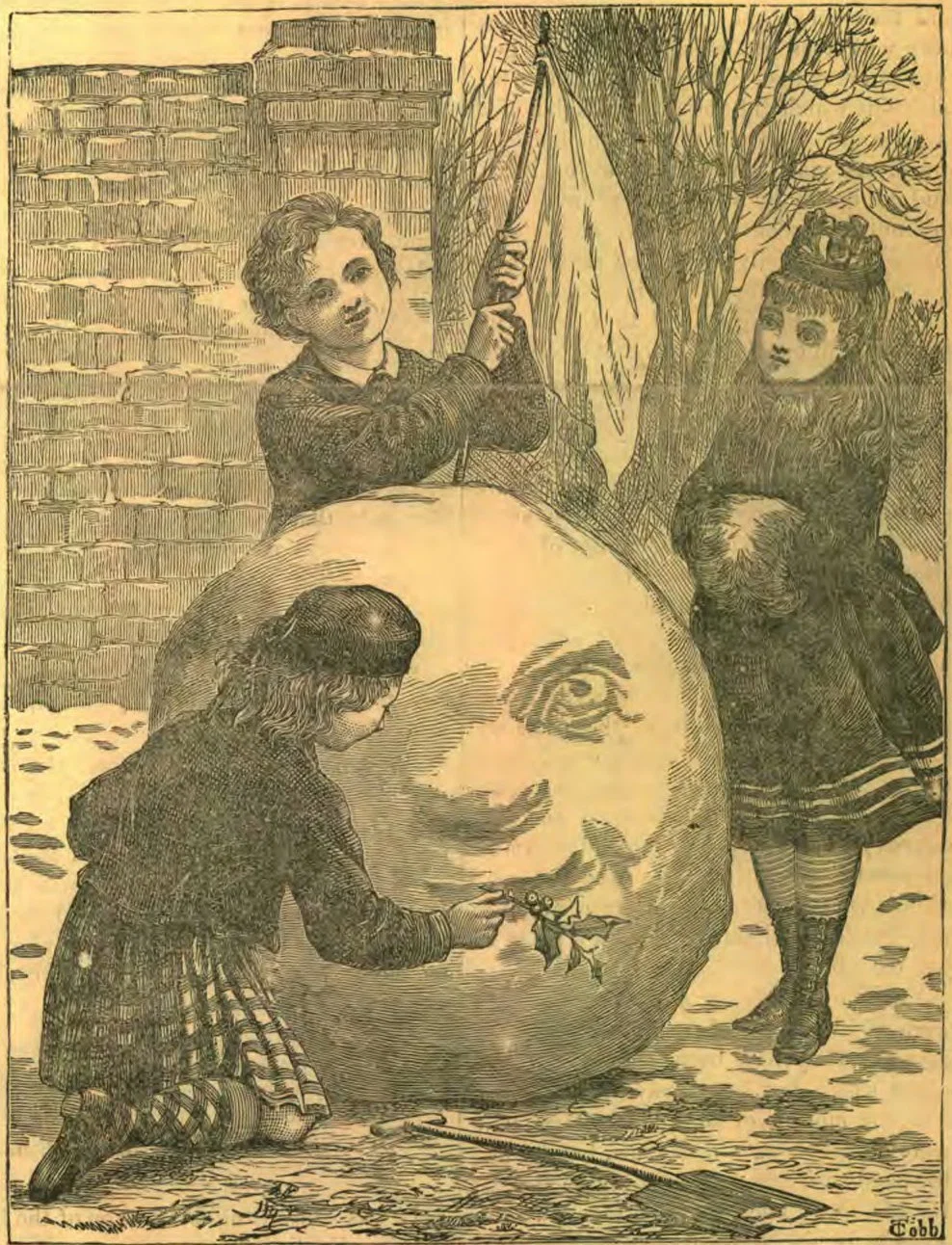
“Roll away, roll away,” cried Fred; “we shall make a fine large snowball before we have done with it.”
“Now for another turn or two,” shouted his brother Charles.
“Hurrah!” again cried Fred; “we shall soon make it as big as ourselves.”
They now stopped for a few minutes, and thrust their hands into their pockets, for they found that the snow was very cold. When they began again, they had to push harder than before, for the snowball had become more difficult to move.
After they had toiled at their sport for some time, and tried to form a man's face on the ball, their cousin Gracie came to have a look at it.
It was now time to go indoors, and they were soon seated around a good fire. They then told their father about the famous snowball they had made, and how many yards they had rolled it along the ground.
“Very true,” said their father; “it was a large snowball indeed. I have been looking at you from the parlor window, and I must tell you that your snowball has set me to thinking.”
“Set you to thinking, father!” said they; “why, what thoughts could come into your mind at the sight of a snowball?”
“First, then,” said their father, in his usual quiet way, “I thought your snowball was like knowledge, of which a child, who begins to learn, makes but a very little ball at first; but as he goes on, with pains and diligence, he rolls it along, and keeps gathering up, until it becomes a great ball of knowledge. All the wisest men who have ever lived began in a very humble way; but they went on until they had stored up a great amount of learning and knowledge.”
There was, many years ago, a little boy who was engaged to open the gates for the men on the farm as they went in and out, and at other times to attend to the sheep and cattle. One day, after work, he was found in a hay-loft, studying a learned book. He was then sent to school, and he lived to become one of the wisest and most learned men that ever lived; and he is now known to us as the great Sir Isaac Newton. ‘Little by little’—thus it is said some of those lovely islands which are found in distant seas are reared up by the little coral insect, which places one grain at a time upon another. So, little by little, the acorn becomes the strong oak; stone upon stone, the greatest palaces in the world are built; and line upon line, large books are written.”
“We shall not forget that, father—‘Little by little.’”
“I thought, again, that the snowball was like a bad habit, or sin, in youth. It is small at first, but it grows bigger and bigger until it is almost like a mountain. Persons do not become very wicked all at once. Read the story of Achan as it is given us in the seventh chapter of the book of Joshua. He looked upon the forbidden things, then he coveted, and then he took them. Sin in the look, sin in the desire, and then sin in the act. And so it has been with tens of thousands of other persons in every age. They began, it may be, with sins which did not attract much notice at first, and ended in open crime and disgrace. A man, when about to be hung, said, ‘I began by stealing a penny out of my mother’s pocket, and have ended with murder.’ The only way to be saved from the guilt and power of sin, is to believe on the Lord Jesus Christ, and to do his will. His grace in our hearts is the only sure defense against evil.”

THOUGHTS FOR THE NEW YEAR.

LIFE is like a book, And new years are the openings of fresh pages, Each number in its order. Books are prized Not for their strength, but for the thoughts that crowd In lustrous halos round their hallowed leaves; And though the book of life may be but short, Yet if from every page there shimmers out The one word, Love, that volume will at last Rest in a golden binding on the shelves, The mystic shelves of God's great library. We measure life by years; but not so God. A thousand ages are as one short day With him. He counts by deeds, not fleeting hours, And he who speaks a gentle word, or gives A cup of water to a fainting one, Will count more birthdays in Heaven's register Than if he lived a million centuries Unto himself alone. The seed-time now is ours, And with each new year we begin to sow Another furrow in life's fertile field; And at the coming harvest we shall reap As we have sown—rich golden grain or weeds. —Sel.

THE GATE SHUT.

In many Eastern countries the cities are surrounded by high and massive stone walls. The people pass in and out of these cities by gates, which remain open by day, but are always closed at night. They are shut at a certain time each night, and just before that time a signal-gun is fired, to let any who may be without the walls know that they must hasten in, as the gates are to be closed. When the appointed time arrives, the heavy gates are swung to, and barred; and woe to the luckless one who arrives just too late; for it is said that under no consideration will they open the gate after it is once closed; so there is no other way but for the laggard to seek a place of rest outside the walls.
Not many years ago a party of travelers were visiting one of these old cities in Egypt. They had been out of the city many times, but had always returned before the closing of the gates. Now they were to leave on the morrow, but wished to spend their last day in sailing on the far-famed Nile. They went out in a row-boat, so as to be able to land when they chose.
The day passed very pleasantly; sometimes they landed to look at the ruined temples by the side of the river, or to pluck the gay blossoms that grew on the banks. Finally one of their number suggested that the boat be turned about; for they had gone some distance from the city, and must return that night, as they were to sail early in the morning, and must obtain their passports that evening.
So the boat was turned about; but now that they had started toward home, they would surely be in good time; there was no need to hurry. So they proceeded very leisurely, frequently landing to see some new curiosity, or to gather some bright flower. Sometimes they would row for a while, and then again would let the boat drift back with the current.
By and by the golden gleam of the sun was seen on the broad waters, warning them that it would soon set; still they thought only of their own pleasure, or that they could, by rowing diligently, make up for lost time. At last the sky began to darken; and, as if for the first time, the thought occurred to them that they might, after all, be too late. The hour for shutting the city gates they knew was not far off. Now the rowers pulled at the oars with all their might. They reached the place where they were to land, and, springing from the boat, ran toward the gate, which was not far distant. Only a little way more; but all at once a flash, and the report of the signal-gun. The hour had come; the gates were shut; the travelers were a little too late. They cast away their flowers, whose beauty seemed half gone, now that they could not repay the delay and loss. The next day the ship sailed, leaving the travelers behind, with no one but themselves to blame for their disappointment.
Our life is a journey, a voyage. There is a gate—“a strait gate”—which we should strive to enter. How often are we so taken up with the pleasures that lie by our path, that we loiter by the way. As the travelers lost their time in gathering flowers on the banks of the sunny Nile, so may it be with us. We may be so busy in pleasing ourselves, that we shall forget to row; and how shall we feel, if we wake too late, to find the door of mercy closed,—the gate shut?
It is not enough to start toward the city; we shall never reach it unless we keep pulling. If we stop to gather flowers, we shall drift back with the current, as did the travelers. And, ah, how worthless will seem our fading treasures, as we stand before the shut gate! How we shall have only ourselves to blame, if we reach not the gates of the shining city!
“Seek, my soul, the narrow gate. Enter ere it be too late; Many'll ask to enter there When too late to offer prayer.”
EVANGELINE BELL.

Making Room for Learning in Busy Lives

It was a beautiful observation of the late William Hazlitt, that “there is room enough in human life to crowd almost every art and science into it. If we pass no day without reading a line—visit no place without the company of books—we may with ease fill libraries or empty them of their contents. The more we do, the more we can do; the more busy we are, the more leisure we have.”

COMFORTING ASSURANCE.

A MISSIONARY once asked the question at a mission school, ‘Where does Jesus live?’ A little boy who had lately found the Saviour, answered, ‘Please, sir, he lives in our alley, now.’”
As we read the above incident our attention was particularly attracted by this little boy’s assurance. Such a change had been wrought in his feelings and in his life, and perhaps in the lives of others who lived in the same alley, that his confidence was equal to Job’s when he said, “I know that my Redeemer liveth.”
Dear children and youth, we have begun a new year. Can any of us say that Jesus lived in our hearts last year? It was well with us if his abode was with us then, but that will not suffice for the present. The important question with us should be, Does he live in our hearts now? It is well with us now if we have the assurance that he is a present Saviour. Let us resolve that if our lives are spared till the close of the present year we will be able to say at all times, as confidently as did the mission boy, He lives in my heart now. M. J. C.

TO OUR FRIENDS.

We come to greet you; and we anticipate a warm reception at your homes to-day, for we introduce ourselves as the “weekly INSTRUCTOR,” which you have so long desired might be furnished you. Naturally, you at once scan our pages to acquaint yourselves with your new friend. We feel sure that you will be more than pleased with our general appearance, particularly with our new head. This, of itself, will afford much pleasure for the children, who can fancy themselves in the little group at the left, learning their INSTRUCTOR and Bible Lessons; or on their way to the church, where the beautiful ferns and grasses by the wayside inspire feelings of reverence for the Creator, whom they are going up to worship.
Yet not for appearance only, but for real merit, we desire to be appreciated; and to this end we shall labor to make the weekly issue worthy of your patronage. Believing that we shall have your hearty co-operation in this, we exchange with you the greeting of a Happy New Year.

SABBATH-SCHOOL DEPARTMENT.

One feature of the weekly INSTRUCTOR deserves special notice. We refer to the Sabbath-school Department, where will be furnished each week two lessons,—one for children, and one for youth; also hints how to study, and how to teach a good Sabbath-school, by experienced S. S. workers. Those who wish to avail themselves of practical instruction in Sabbath-school work will have no better opportunity than through the weekly issue of the INSTRUCTOR.
M. J. C.

BIBLE LESSONS FOR YOUTH.

LESSON XXVII.—MOSES.

1. WHAT degree of prosperity attended the children of Israel after the death of Joseph? Ex. 1:6, 7.
2. Why was the king of Egypt alarmed at the wonderful prosperity of the Israelites? Verses 8–10.
3. What course did he take to prevent the increase of the children of Israel? Verses 11, 13, 14.
4. What result attended this course of treatment? Verse 12.
5. What did Pharaoh charge his people to do when he found that his first plan had failed? Verse 22.
6. What remarkable person was born at this time? Acts 7:20.
7. What did his mother do when she could no longer conceal him? Ex. 2:3.
8. Who was appointed to watch the child?
9. By whom was Moses adopted? Acts 7:21.
10. Whom did she employ to nurse the child? Ex. 2:7–9.
11. What is said of the learning and ability of Moses? Acts 7:22.
12. What rash act did he perform when he had grown to manhood? Ex. 2:11, 12.
13. How did he learn that his crime was known? Verses 13, 14.
14. How did Moses escape from the wrath of Pharaoh? Verse 15.
15. With whom did Moses dwell in the land of Midian? Ex. 2:16–21; 3:1.
16. How was he connected with the family of Jethro? Ex. 2:21.
17. How long did he dwell in this land? Acts 7:30.
18. How was he employed during this time? Ex. 3:1.
19. What opportunity was afforded Moses by the solitude of this wilderness life?
20. What benefits did he probably receive from the priest of Midian?

SYNOPSIS.

After the death of Joseph, his brethren and their descendants continued to dwell in Egypt. They were greatly prospered and became so numerous that the king was alarmed, fearing that in case of war they would join his enemies. This king belonged to a new line of kings, that knew not Joseph. He ordered that the Israelites should be put to the severest labor, thinking that this would prevent their further increase in numbers; but the more they were afflicted, the more they multiplied. Then the king ordered that every son that was born among them should be cast into the river.
About this time Moses was born. After keeping him hid three months, his mother put him in an ark of bulrushes, and laid it in the flags by the river’s brink. As Pharaoh’s daughter was walking with her maids beside the river, she discovered the child, and was so moved with pity as to adopt him as her son, in order to save his life. The sister of Moses, who had been watching him, then stepped forward and offered to procure a nurse. The offer was accepted, and the mother of Moses was employed and paid for nursing her own son. Moses was educated in the court of Pharaoh, and became learned in all the wisdom of the Egyptians. He was mighty in words and in deeds.
When he was forty years of age, he went out to visit his brethren, and in trying to defend one of them, he killed an Egyptian. He was then obliged to flee to the land of Midian to escape the wrath of Pharaoh, who threatened to kill him. In that land he married the daughter of Jethro, a priest of Midian, and followed the life of a shepherd. Here in the solitude of the wilderness, Moses was alone with nature and with God. Forty long years he had for meditation and prayer; and it is not improbable that the wise priest of Midian gave him good instruction. G. H. BELL.

HINTS ON STUDYING THE LESSONS.

In studying the lessons it is a good plan, first to read the synopsis once or twice, without making any effort to learn it, but for the purpose of getting a general idea of what the lesson is meant to teach. While engaged in this part of the work, be sure to notice how this lesson connects with those just before it. To this end, go back and read the synopsis of a few lessons, taken in order, till you come to the lesson that you now wish to learn.
When you have thus learned just what the lesson is intended to teach, and what relation it bears to other lessons, take up the questions, and study most thoroughly, the scriptures referred to. Remember that these are Bible lessons, and that we are to learn them from that book just as far as possible. It is all-important to be able to give scripture proof for every statement we make. When you can, without looking at your Bible or lesson sheet, both ask and answer every question, giving references, and telling the substance of what is found in the passages referred to, try to recite the whole lesson without questions, somewhat as it is told in the synopsis, but mainly in your own words. It is a good plan to write a synopsis of your own, and then compare it with the synopsis on the lesson sheet to see how well they agree.
Thus we see that the synopsis, as given in the lesson sheets, is not to be committed to memory, but to be used as explained above, and as a model for connecting the thoughts brought out by the questions.
G. H. BELL.

TEACHERS, STAND UP.

By observing, I find that in the best conducted Sabbath-schools, where the most life and enthusiasm is manifested, all the teachers stand while conducting the recitations of their classes; and that the pupils also stand when answering the questions. Now I think that this is as it should be. It looks decidedly indolent for a teacher to sit down while teaching his class. A standing position has many advantages. You can see every member of your class much better. You can look each one in the eye. All can hear your questions more distinctly. When a person stands, his voice is fuller, as his lungs have better play. His blood circulates better and his thoughts are quicker and more active, and hence he can arouse more life and create more enthusiasm. Then it can be seen by a glance who are the teachers in the school.
Just so with pupils. If they rise to answer the questions, they will speak more distinctly, others can hear better, and better attention will be paid. Therefore we say, Teachers, stand up; and, pupils, follow their example when reciting.
D. M. CANRIGHT.

LESSONS FOR CHILDREN

In offering the following lessons to the Sabbath-school, it has been our aim to meet the wants of the greatest number possible in two series of lessons. The Lessons for Children are designed for those between the ages of ten and sixteen; the Lessons for Youth, for those that are sixteen years old and upwards. Those wishing the first 26 lessons of this series can get them in the form of Lesson Sheets at this Office. Children under ten years of age should use Bible Lessons for Little Ones, a book of 52 lessons for infant classes. Bible Classes should supply themselves with lessons on the prophecies, issued in “Lesson Sheets for Bible Classes.”

LESSONS FOR CHILDREN.

LESSON I.—JOSHUA.

Moses was appointed of God to lead the children of Israel out of Egypt into the land of Canaan. He was a great prophet. God even talked to him face to face. No man was ever so honored of God as was Moses. Yet he disobeyed God at Meribah, when he brought water from the rock near Horeb; so God said that he should not lead the children of Israel into the land of Canaan: and when, after many years of wandering in the wilderness, they were about to enter that land, the Lord commanded Moses to go up to the top of a high mountain, where he showed him in vision all the land of Canaan; and Moses died there in the mountain, and God buried him.
Before the death of Moses, God appointed Joshua, the son of Nun, to take his place, as leader of the people. It was the same Joshua who had, nearly forty years before, been sent up, with eleven others, to spy out the land of Canaan. Ten of these spies brought back an evil report, but Caleb and Joshua brought a good report. They said, “The land which we passed through to search it, is an exceeding good land. If the Lord delight in us, then he will bring us into this land, and give it us.”
God told Moses to take Joshua and set him apart as a leader of the people, so Moses laid his hands upon Joshua’s head before all the people, and said, “Be strong and of good courage.” He told him not to fear; for the Lord would go before him.

QUESTIONS.

1. Who was appointed of God to lead the children of Israel out of Egypt into the land of Canaan?
2. How did God honor Moses? Read Deut. 34:10–12.
3. Why was not Moses allowed to lead the children of Israel into the land of Canaan? Deut. 32:51.
4. What did God say to Moses when the children of Israel were about to go into the land of Canaan? Deut. 32:48–50.
5. What did the Lord show to Moses in vision? Deut. 34:1–3.
6. What happened to Moses here in the mountain? Verse 5.
7. How was he buried? Verse 6.
8. How old was Moses at his death? Verse 7.
9. What was his condition of health?
10. Who was appointed to take the place of Moses as leader of the children of Israel? Read Num. 27:15–23.
11. On what errand had Joshua been sent nearly forty years before? Read Num. 13:1, 2, 4, 8, 16–20.
12. How many of those spies brought back an evil report?
13. Who gave the good report? Num. 14:6–9.
14. What did they say of the land? Verses 7, 8.
15. How did they think that the children of Israel might be able to enter into the land?
16. How was Joshua set apart as a leader? Num. 27:22, 23.
17. What charge did Moses give Joshua? Deut. 31:23.

A HAPPY NEW YEAR'S DAY.

It was only a few days before the first of January, and farmer John said to his wife, “How would you like, Martha, to make a visit to your father and mother this New Years?”
“Dearly, John, only it’s a long ride for the children.”
“Bundle them up warm. Twenty miles wasn’t far when I was a boy. They will enjoy it, and so will the old people, and Aunt Mary, and little Dolly and Carrie.”
So a letter was written announcing their coming, and the day before New Years the merry party set out in their large double sleigh, with a span of strong bays stepping off briskly to the music of the sleigh-bells.
It was almost dark when the sleigh drew up before grandpa’s door, but bright eyes were eagerly watching for them, and glad hearts gave them a warm welcome.
You know what a bustle and hum it makes, when such a party of gay little cousins get together in grandpa’s house. And how delightful it seemed to little Dolly and Carrie to have so many playmates!
The next morning every one was awake at an early hour, and shouts of “Happy New Year” rang through the house. Each of the children received a New Year’s gift, while grandpa was surprised to find his little store-room filled with good things from farmer John’s big sleigh-box.
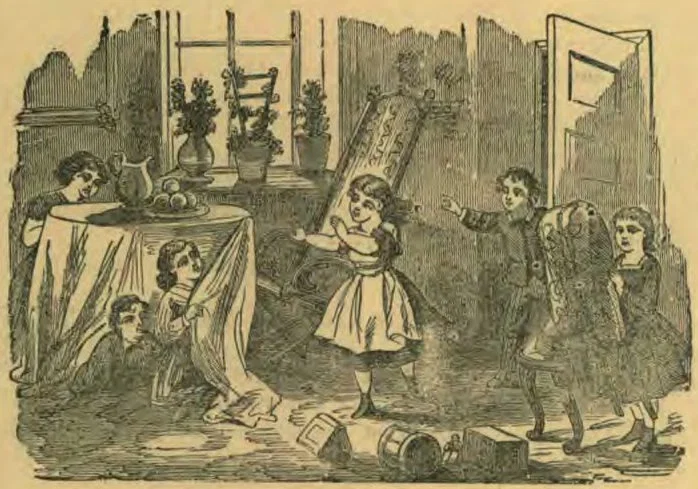
After dinner the older people gathered around the open fire in grandpa’s room to enjoy a quiet talk, and the children played hide-and-seek and blind-man’s-buff in Aunt Mary’s pleasant sitting-room. Do they not look as if they were having a merry time?
The day passed very swiftly, and the next morning, when the party started for home, all agreed that it had been the happiest New Year’s day they had ever spent.

LETTER BUDGET.

It was stated in the last INSTRUCTOR that the one who should first send the paper as a gift to a friend should have his name published in the next INSTRUCTOR. A good many have since donated the paper to others, but the first donation received was from Elmer E. Beeson, whose letter here follows:—
PARMA, MICH.
DEAR EDITORS: I am a little boy, but even little boys can do good sometimes. I have a silver fifty-cent piece that belonged to my little sister who sleeps. I have had it a number of years, and mother says I must not let it rust. Last evening, when I read the offer for the circulation of the INSTRUCTOR, I determined to use my money in sending the paper to a little friend.
I cannot hope for this to be the first letter that you will receive, for I go to school, and this letter must take its chance to get to the office; but it must go to-day, if I have to take it after school. We live four miles from Parma, so you see I am in earnest.
ELMER ELLSWORTH BEESON.
The next to send, only one mail later, was W. P. Landsdown, who writes thus:—
CAMDEN, N. J.
DEAR EDITORS: I have received the December number of the INSTRUCTOR, and I now send fifty cents to pay for the paper as a Christmas or New Year's present to a little friend who keeps the Sabbath with us. I do not know whether I shall be the first to make this present or not, but I shall be counted one among the others.
I am ten years old. There are only two Sabbath-keepers here besides my parents, but we meet together every Sabbath. We have no Sabbath-school yet, but hope to have one soon. We love the INSTRUCTOR very much.
WILLIE P. LANDSDOWN.
At about the same time two names were sent in by A. A. Bradford, So. Lancaster, Mass.

THE WEEKLY YOUTH'S INSTRUCTOR.

IN sending you this first number of the YOUTH'S INSTRUCTOR as a four-page weekly paper, we would say that it shall be our endeavor to make it the best youth's paper in the land. Its stories shall be short and spicy, its Children's Corner lively and attractive, and the Sabbath-school Department practical and full of thorough instruction, just such as every family and Sabbath-school will enjoy.

WILL YOU SUBSCRIBE?

We offer the INSTRUCTOR at a price within the reach of all, and we ask you to whom this copy is sent to subscribe at once.

A BEAUTIFUL PREMIUM,

called The Child's Poems, will be given to each subscriber who has never had the INSTRUCTOR before. This little book has 128 pages of the choicest poems for children, illustrated and neatly bound in red, richly embossed with gold and black.
Subscribe at once, so you will get all the first numbers. Price in advance, 75 cts. a year. In clubs of TEN COPIES to one address, without premium, 60 cts. each. Address, YOUTH'S INSTRUCTOR, Battle Creek, Mich.
If you now have the Monthly edition of the INSTRUCTOR, and wish to exchange it for the Weekly, you can do so by making the request at once. If you have paid six months ahead for the Monthly, we will send you the Weekly for four months. If you have paid for a year, we will send you the Weekly eight months, or you may send us 25 cts. more and we will send the Weekly for a year. W. C. W.

A SEALED POSTMAN.

You have all heard of sealed letters, of course, and seen some, too, no doubt; but did you ever hear of the letter-carrier, also, being sealed? Well, a bit of news has come saying that, among the Himalaya Mountains, the men who carry the mails on horseback are sealed to their saddles, in such a way that while they can ride easily enough they cannot get down from their seats; and what is more, the mail packages are sealed to the men! Once started on the route, the seals are not allowed to be broken, except by the postmaster at the next station; and, if they happen to get broken otherwise than by accident, the carrier is severely punished.
The result of this sealing is that a mail-carrier who wishes to steal the letters in his charge is obliged to steal also the saddle and horse—and himself as well, I suppose.
Nice places these carriers have to ride through, at times! Why, in some parts the road is so steep that, in going down, the rider is kept upright by a rope passed under his arms and held in the hands of two men who are above him on the mountain. If it were not for this, the rider would fall over the head of his horse, or else cause the horse himself to go over head first.
Altogether, the postmen of Himalaya must have a hard time of it.—Jack in the Pulpit.

THE FIRST SNOW.

Stay in the house! why, mother, I'm six years old, you know! Never a boy as big as I Would be afraid of the snow!
Cap and mittens and tippet? I must have them, I s'pose! Overcoat? No! What could I do All bundled up in clothes?
Watch, now, and see me tumble Right into the snow-drift there; Snow all over my jacket! Snow all in my hair!
Isn't it glorious fun, mother? Buy me a brand-new sled— The runners of shining steel, mother, The top of brightest red.
Boys like winter and cold and snow, 'Cause they are strong and tough; And I am the gladdest boy in town, For now there'll be fun enough.
—JOY ALLISON, in the Companion.

You have reached the end of this edition.

The Youth’s Instructor · Jan 1, 1879