The Youth’s Instructor, Vol. 30, No. 14.

DANIEL WEBSTER

The Youth’s Instructor

Apr 5, 1882

S. D. A. Publishing Association · Battle Creek, Mich. · Apr 5, 1882

DANIEL WEBSTER.
This was not the man who wrote the spelling-book and the large dictionary. That was Noah Webster, one of our most learned men and greatest writers. But Daniel Webster was a lawyer, a senator, and a great statesman,—perhaps the greatest statesman that ever lived in the United States. It is now about thirty years since he died, at the age of seventy.
You do not care much about great men? Well, but they were all boys once, and then they had no more idea of becoming great men than you have now. This Daniel was a boy once, and a poor boy too. He was born in a log house, within sight of Mount Washington, New Hampshire. His good mother taught him to read when he was so little that, as you would say, he “could not remember it;” and when he was four or five years old, he trudged off to school with his spelling-book and his dinner basket half a mile to a log school-house. When he became old enough to work, he went to school only in the winter, just as many another poor boy has done. But he was no dunce; he learned his lessons quickly, and learned them well, too, and then spent the rest of his time at work or at play. He was very fond of rambling about in the fields and woods, and as he was of delicate frame, that strengthened his constitution, and probably saved his life.
Daniel loved his books. As soon as he was old enough to help his father in the saw-mill, he would set the saw, and then read in some book of history or biography while the saw ran through the log. While yet a small boy, he one day saw at the store a cotton pocket handkerchief with the Constitution of the United States printed on it. This was the first copy he had seen, and he was so eager to get it that he paid for it twenty-five cents, all the money he had, and he spent the whole evening intent upon its study.
His brother Ezekiel and he often had disputes about things that they had learned, and one night after they had gone to bed, they became so much excited in debate that they got up to look at their books to find out which was right. Unfortunately, however, they set the bedding on fire, and came near burning up the house. Daniel, on being questioned afterward about the cause of the accident, said that they were in pursuit of light, but they got more than they wanted.
When Daniel learned that his father, with all his poverty, had determined to send him to college, “a strange thrill” ran over him, and he leaned his head on his father’s shoulder, and burst into tears. But he improved his time well; and when he had graduated, he taught school to get money enough to send his brother through college, and while yet studying law, he gave his first earnings to pay off his father’s debts.
When you are old enough to “like such things,” I hope you will read his life, to learn what a great man he became, what eloquent speeches he made in defense of the noble Constitution of his country (which he first read on the cotton pocket handkerchief), and how all the people honored him, turning out in crowds to greet him, calling him the “Defender of the Constitution.” And if you learn, too, that toward the last he clouded his great fame by intemperance, take timely warning. If he had fallen into this vice in youth, he never would have gained renown.
Mr. Webster was a farmer, and took great delight in country things,—in trees, in loads of hay, in noble Indian corn, in fine sheep and cattle. When at the height of his fame, he still spent much time on his model farm at Marshfield, Massachusetts, which he took great pains to make both beautiful and productive. Here he died; and it is related that only three days before his death he had his great oxen driven up to the door, that he might smell their healthy breath, and take his last look of those broad generous faces that were never false to him. On returning from Washington at one time, after a perplexing session of Congress, he said to a friend: “I am satisfied that a farmer’s is the most rational mode of existence. Good food, home-raised, with healthful work for the day and sound sleep for the night, give a man a clear head, a large heart, and strong hands.”
Although, toward the latter part of his life, Mr. Webster made some sad mistakes, still he was in the main a noble man, and we may learn many good lessons from his life.—Aunt Julia.

THE NORTHERN SEAS.

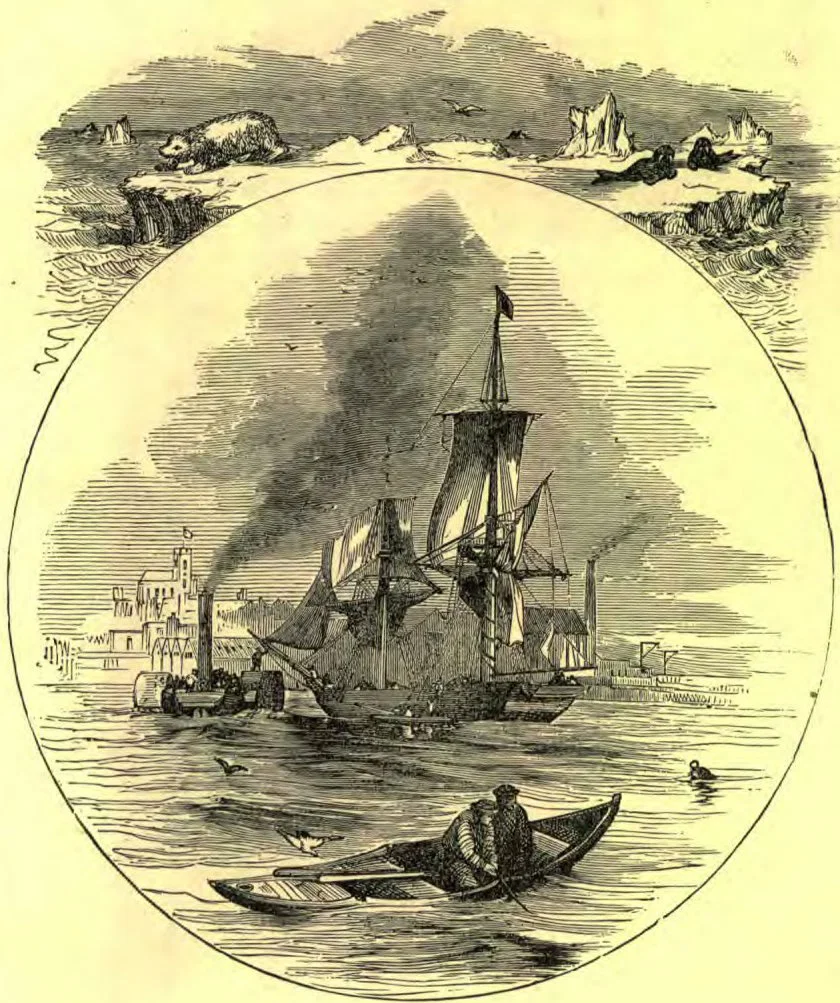
Up! up! Let us a voyage take; Why sit ye here at ease? Find us a vessel tight and snug, Bound for the Northern seas.
I long to see the Northern lights, With their rushing splendors fly, Like living things with flaming wings, Wide o'er the wondrous sky.
I long to see those icebergs vast, With heads all crowned with snow, Whose green roots sleep in the awful deep, Two hundred fathoms low.
I long to hear the thundering crash Of their terrific fall; And the echoes from a thousand cliffs, Like lonely voices call.
There shall we see the fierce white bear, The sleepy seals aground, And the spouting whales that to and fro Sail with a dreary sound.
There we may tread on depths of ice, That the hairy mammoth hide,— Perfect, as when in times of old, The mighty creature died.
And while the unsetting sun shines on Through the still heaven's deep blue, We'll traverse the azure waves, the herds Of the dread sea-horse to view.
We'll pass the shores of solemn pine, Where wolves and black bears prowl, And away to the rocky isles of mist, To rouse the Northern fowl.
Up there shall start ten thousand wings With a rushing, wrestling din; Up shall the auk and falmar start,— All but the fat penguin.
And there in the wastes of the silent sky, With the silent earth below, We shall see, far off to his lonely rock, The lonely eagle go.
Then softly, softly will we tread By inland streams to see, Where the pelican of the silent North, Sits there all silently.
But if thou love the Southern seas, And pleasant summer weather, Come, let us mount this gallant ship, And sail away together.
—Mrs. Howitt.

COMMON SCENES.

AMID THE WATERS.

In what endless and pleasing forms is water presented to the eye! We have already learned to admire the infinite cloud-forms for their beauty; let us now notice the dew, the rain, the ice, and the snow, and finally the flowing water.
Can a more exquisite sight be imagined than the ten thousand times ten thousand sparkling, trembling dew-drops, pendant upon the countless grass-spires of living green, upon every delicate flower-cup, and upon every new-born leaf? A hundred mornings every year this scene repeats itself, and we may draw pleasure from it without expense.
There is beauty in the falling shower,—a beauty not wholly dependent upon the form and motion of its countless drops; it suggests to the mind something of the fullness, and purity, and freedom of the heavens.
With the formation of ice and snow is connected an unthought-of change, the formation of heat. When large quantities of snow are crystallized in the air, or large surfaces of water are frozen, great quantities of heat are set free. You may have often noticed on such occasions that the weather is much warmer, particularly during a heavy fall of snow.
When the wintry fog and frost have crystallized every plant of the fields, every brown forest leaf, and every swaying branch, what a glittering array of icy pinnacles does the wintry moonlight reveal through the old woods! while beneath our feet with a brighter light flash the crystals of the snow.
We have all, perhaps, had our favorite brookside by which we played in childhood, and by it some of us still linger in imagination; for there is something inspiring in the sight of running water. One’s favorite brook winds through the prairies. Deep among the yellow flowers and nodding grasses it watches over its steep banks for the morning sun,—now lingering to mirror the bright flower, then hurrying on, it finally turns between its steep banks, and stops to form a little lakelet in the warm sunlight, where the loosened bank has fallen across its way. Growing on an island in the little lake, is a green willow, grateful to the eye, for no other tree has dared to grow for miles around. The placid water, seemingly surprised at its own sudden motion, leaps over the little barrier below, and goes hurrying on. Meeting another of its own genial nature, both run laughing and sparkling to meet the broad river.
On one of our great rivers, let us watch the moving scene. Broad and strong and deep is the current. Tangled water-plants, floating driftwood or broken boxes, remind us of the shoals, the vast forests, or the busy cities above. An ever-lengthening, ever-fading line of smoke from a receding tug, with its train of barges, gives a bold relief to the scene. Beautiful steamers and freighted schooners are constantly passing us. Blue sky and fleecy clouds above, are reflected below. Now a denser cloud at the right turns the water beneath to ink, while to the left is a sea of green. Before us and behind, purple is reflected from every wave—then all is silvered with sunlight.
Though most of us may never gaze upon the ocean, we may at small expense look out upon the Great Lakes. The horizon, boundless as the sea; the rolling waves, white-capped and resistless; the swelling breeze and the yielding sands upon the shore, fill the mind with a feeling of the sublime, when the ponderous engine, the massive building, and the lofty tower are powerless.
GEO. R. AVERY.

A TALK WITH THE GIRLS.

We talk so much to the boys about being noble and true, we feel so anxious that they, with their restless natures, their excitable temperaments, and kind, generous hearts, should be directed into the right road to begin life's journey,—should be manly and brave to resist temptation,—that I fear we sometimes overlook the girls, thinking that society holds them back from the fiercer temptations to which the boys are exposed.
But do you suppose that those fun-loving, thoughtless, perhaps foolish, girls never think? You are mistaken: after all the gayety of the day is over, if you could look into their hearts, you would find more than a mere desire for fine clothes and amusement, more than a wish to attract attention; you would discover a desire to be a true woman, one without deceit,—a woman whose heart is pure, whose life is noble. Am I not right, girls? You are not satisfied with yourselves, yet perhaps fancy you can somehow be transformed from selfish, willful girls to amiable women. That is a mistake; as your characters are formed for the next few years, so will they doubtless remain. You will be, as a rule, no better women than you are school-girls.
Under all the rubbish of foolishness and sin, there lies in every girl's heart a beautiful model of what constitutes a perfect woman. Have you never found it? Then commence the search at once. It may be defaced or even broken, but it was once beautiful. True beauty is of the soul, girls. The first evil thought that enters the mind, cowers and trembles before this silent monitor; then others follow, perhaps are whispered by some bad companion; the beautiful model becomes defaced and finally destroyed. That little image of beauty in the heart was given for a pattern by which to make your character; if you allow the pattern to be marred, you will fail to fashion a perfect nature.
Spend a few moments then, I ask you, in studying yourselves. Study each trait of character, each action, your words, your thoughts; and choose those that you would admire in another, and cast the rest away. The girl who brings sunshine home from school with her, and always creates sunshine in the family-circle, who loves home better than the street, who will hear nothing that she would be ashamed to tell her mother, the one who never seeks to attract attention,—will make a beautiful woman, I care not how plain the features, or how simple the attire. The universe is teeming with beauty; yet exceeding them all, yes, the loveliest work of God's hand, is such a woman. Girls, keep the heart pure! L. M. S.

ONLY ONE GATE.

THE old city of Troy had but one gate. You would search in vain for a second through all its high walls in all their ample circumference. There was only one way, and no other could be found that led into the city. Nevertheless, the one gate was passable for all save an enemy.
Even so is the way into life eternal in the city of God. “I am the door,” said Christ. “Strait is the gate,” he also said; and again, “Enter ye in at the strait gate.” Troy was, but Jerusalem the golden is. Its door is wide open, its gate ever accessible. The way there is narrow, but all the lowly can walk in it. The gate is difficult, but all may find it. There is room enough within the pearly gate of the ample city for all who will enter. None need remain outside.
But the one way, the one gate—do you find it? Are you seeking it? Is your hand on the latch, and hold of the door? Do you hear the wide, wide welcome shouted through the shining portal,—
“Come in; come in! Eternal glory thou shalt win!”
Will you pass in by the only appointed way, the one gate, and be forever blessed? Come and enter now, before the door is closed against you, and the star of hope sinks from sight behind the dark mountains of judgment.—Selected.

Build Thy Studio on Calvary

O YOUNG man, build thy studio on Calvary! there raise thine observatory, and scan by faith the lofty things of nature. Take thee a hermit's cell in the garden of Gethsemane, and lave thy brow with the waters of Siloam. Let the Bible be thy standard classic,—thy last appeal in matters of contention. Let its light be thine illumination, and thou shalt be more wise than Plato, more truly learned than the seven sages of antiquity. —Spurgeon.

EASTER MORN.

Awake, thou wintry earth! Fling off thy sadness; Fair vernal flowers laugh forth Your ancient gladness! Christ is risen!
Wave, woods, your blossoms all,— Grim death is dead! Ye weeping funeral trees, Lift up your heads! Christ is risen!
Come see! the graves are green; It is light; let us go Where our beloved rest In hope below! Christ is risen!
All is fresh and new, Full of spring and light; Wintry heart, why wear'st the hue Of sleep and night? Christ is risen!
Leave thy cares beneath, Leave thy worldly love! Begin the better life With God above! Christ is risen!

SCENES IN THE LIFE OF CHRIST.

LESSON 63.—THE HEALING OF THE MAN WHO WAS BORN BLIND.

One day, as Jesus and his disciples were passing along, they saw a man who was born blind; and the disciples said, “Master, who did sin, this man or his parents, that he was born blind?” But Jesus told them that the man had not been born blind for any such reason as they supposed, but rather to give opportunity for showing the power of God. Then, after saying something about the importance of working while there is opportunity, he mixed clay with spittle, and anointed the eyes of the blind man, telling him to go and wash in the pool of Siloam. The man obeyed, and when he came back from the pool, he could see, like other men.
When the man who had always been blind, came among his friends and neighbors, they hardly knew him. When the question was asked, “Is not this he that sat and begged?” some said, “It is he”; others said, “He is like him”; but the man himself said, “I am he.” Then they said, “How were thine eyes opened?” and when he had told them, they asked where Jesus was, but he could not tell them.
Then they brought him before the Pharisees, who wanted him to tell how he had received his sight. Referring to Jesus, the man said, “He put clay upon mine eyes, and I washed, and do see.” Now it was the Sabbath-day, when the man was healed, so the Pharisees said of Jesus, “This man is not of God, because he keepeth not the Sabbath-day.” But others said, “How can a man that is a sinner do such miracles?” And so there was a division among them.
Then the Pharisees questioned the man again, saying, “What sayest thou of him, that he hath opened thine eyes?” And the man answered, “He is a prophet.”
But the Jews would not believe that he had been born blind. So they called the parents of the man, and questioned them, saying, “Is this your son, who ye say was born blind? how then doth he now see?” His parents answered, “We know that this is our son, and that he was born blind: but by what means he now seeth we know not: or who hath opened his eyes, we know not; he is of age; ask him: he shall speak for himself.” The parents spoke in this way because they were afraid of the Jews, who had agreed already that if any man should confess that Jesus was Christ, he should be put out of the synagogue.
Then the Pharisees again called the man that was blind, and told him to give God the glory, since they knew Jesus to be a sinner. But the man said, “Whether he be a sinner or no, I know not; one thing I know, that whereas I was blind, now I see.” Then they said, “What did he do to thee? how opened he thine eyes?” Then he answered them, “I have told you already, and ye did not hear; wherefore would ye hear it again? will ye also be his disciples?” Then they were angry, and “reviled him,” saying, “Thou art his disciple, but we are the disciples of Moses. We know that God spake unto Moses; as for this fellow, we know not whence he is.” Upon this, the man said, “Why, herein is a marvelous thing, that ye know not whence he is, and yet he hath opened mine eyes. Now we know that God heareth not sinners; but if any man be a worshiper of God, and do his will, him he heareth. Since the world began, it was never heard that any one opened the eyes of one that was born blind. If this man were not of God, he could do nothing.” Then said they unto him, “Thou wast altogether born in sins, and dost thou teach us?” And they cast him out of the synagogue.
When Jesus heard that the man was cast out, he came to him, and said, “Dost thou believe on the Son of God?” He said, “Who is he, Lord, that I might believe on him?” And Jesus said, “Thou hast both seen him, and it is he that talketh with thee.” Then he said, “Lord, I believe,” and worshiped him.

QUESTIONS.

  1. Whom did Jesus and his disciples notice, as they were passing along one day? John 9:1.
  2. What question did the disciples ask their Master?
  3. What did Jesus teach them in regard to this?
  4. On what subject did Jesus make some remarks?
  5. What did he then do for the blind man?
  6. What did he tell the man to do?
  7. How did the man show his faith?
  8. What was the effect?
  9. Was this effect produced by the water, or was it the result of the men’s faith and obedience?
  10. What question arose among his friends and neighbors when he returned from washing in the pool?
  11. What did the man say of himself?
  12. What question did they then ask him?
  13. After he had told them how the miracle was performed, what did they then want to know?
  14. To whom did they take him?
  15. How did he describe to them the miracle of his healing?
  16. On what day of the week did Jesus give sight to this man?
  17. What accusation did this enable the Pharisees to bring against him?
  18. What reply did some of the people make to this accusation?
  19. What question did the Pharisees then ask?
  20. What opinion did the man express in regard to Jesus?
  21. How did the Jews receive the man’s account of the miracle?
  22. When they had called his parents, what question did they ask them?
  23. What answer did the parents give?
  24. Why did they speak as though they did not know who had given sight to their son?
  25. When the Pharisees had again called the man, what did they say to him?
  26. What did he say about the character of Jesus?
  27. What question did the Pharisees then ask?
  28. What reply did the man make?
  29. How were the Pharisees affected by this answer?
  30. What did they tauntingly say to the man?
  31. What did he think about their not being able to tell the character of a man who could open the eyes of the blind?
  32. What did he state as a well-known fact?
  33. What did he say had never been heard of before?
  34. What reply did they make to his reasoning?
  35. How did they punish him for his boldness?
  36. What did Jesus do when he heard how it had fared with the man?
  37. How did the man answer him, when he said, “Dost thou believe on the Son of God?”
  38. Repeat the answer which Jesus gave him.
  39. When the man heard these words, what did he say and do?

NEW-TESTAMENT HISTORY.

LESSON 76.—THE JEWS COUNSEL AGAINST JESUS TO PUT HIM TO DEATH.

Many of the Jews who witnessed the raising of Lazarus were convinced that Jesus was sent of God, and they believed on him as the Messiah; but others went to the Pharisees, and told them what Jesus had done. “Then gathered the chief priests and the Pharisees a council, and said, What do we? for this man doeth many miracles. If we let him thus alone, all men will believe on him; and the Romans shall come and take away both our place and nation. And one of them, named Caiaphas, being the high priest that same year, said unto them, Ye know nothing at all, nor consider that it is expedient for us, that one man should die for the people, and that the whole nation perish not. And this spake he not of himself; but being high priest that year, he prophesied that Jesus should die for that nation; and not for that nation only, but that also he should gather together in one the children of God that were scattered abroad. Then from that day forth they took counsel together for to put him to death. Jesus therefore walked no more openly among the Jews; but went thence unto a country near to the wilderness, into a city called Ephraim, and there continued with his disciples.”
While Jesus was still on the farther side of Jordan, before he came to Bethany at the call of Mary and Martha, the apostles said unto him, “Lord, increase our faith.” In answer to this request, Jesus immediately replied, “If ye had faith as a grain of mustard-seed, ye might say unto this sycamore tree, Be thou plucked up by the roots, and be thou planted in the sea; and it should obey you.” It may be that our Lord discovered in this request an element of pride,—a desire for the honor that they would receive through the working of miracles; for he immediately gave them a lesson of humility in the following words: “But which of you, having a servant plowing, or feeding cattle, will say unto him by-and-by, when he is come from the field, Go and sit down to meat? And will not rather say unto him, Make ready wherewith I may sup, and gird thyself, and serve me, till I have eaten and drunken; and afterward thou shalt eat and drink? Doth he thank that servant because he did the things that were commanded him? I trow not. So likewise ye, when ye shall have done all those things which are commanded you, say, we are unprofitable servants; we have done that which is our duty to do.” It is possible, too, that he meant to intimate that their time for working miracles would be more especially after his death.
The exact time and place of some of our Lord’s discourses cannot be determined with certainty, but it is supposed that the one recorded in Luke 17:20-37, was given after he went to “the city called Ephraim.” Some parts of it are strikingly similar to portions of the discourse recorded in the twenty-fourth chapter of Matthew.
“And when he was demanded of the Pharisees, when the kingdom of God should come, he answered them and said, The kingdom of God cometh not with observation; neither shall they say, Lo here! or, lo there! for, behold, the kingdom of God is within you. And he said unto the disciples, The days will come, when ye shall desire to see one of the days of the Son of man, and ye shall not see it. And they shall say to you, See here; or, see there; go not after them, nor follow them. For as the lightning, that lighteneth out of the one part under heaven, shineth unto the other part under heaven; so shall also the Son of man be in his day. But first must he suffer many things, and be rejected of this generation.”

QUESTIONS.

  1. What good effect was produced upon many of the Jews by the raising of Lazarus? John 11:45.
  2. What did others of their number do?
  3. What step was taken by the chief priests and the Pharisees?
  4. How was the case stated in their council?
  5. Who was the high priest that year?
  6. How did he address the council?
  7. How did this man come to speak such words?
  8. Give his complete prophecy.
  9. What course was pursued by the chief priests and Pharisees from that day forward?
  10. How did Jesus avoid them? Verse 54.
  11. While Jesus was still on the farther side of Jordan, before he came to Bethany to raise Lazarus, what did the disciples ask him to do for them? Luke 17:5.
  12. What reply did Jesus make to this request?
  13. What did our Lord possibly discover in this request?
  14. Why does it seem somewhat probable that this was the case?
  15. Repeat the parable as recorded in verses 7, 8.
  16. By what question and answer does the Saviour, at the close of the parable, show its chief application?
  17. What incidental application may be made?
  18. What admonition did he finally give his disciples?
  19. Is it possible to fix the exact time and place of all our Lord’s discourses?
  20. When is he supposed to have given the one recorded in Luke 17:20-37?
  21. Where is the “city called Ephraim” supposed to have been situated?
  22. To what are some parts of this discourse strikingly similar?
  23. What answer did Jesus make when asked by the Pharisees when the kingdom of God should come? Luke 17:20, 21.
  24. What is meant by the words “within you”?
  25. What did he say to his disciples about the days that were to come? Verse 22.
  26. What caution does he give them? Verse 23.
  27. By what figure did he show them that his second coming will be wholly free from obscurity, and visible to all men? Verse 24.
  28. In what words did he refer to the suffering that was to attend the close of his first sojourn upon earth? Verse 25.

NOTES.

The city called Ephraim.—This is thought to have been a town about five miles west of Jericho, and within the boundaries of the tribe of Ephraim. It was a small but very strong city adjacent to and overlooking the broad tract of desert country lying between it and the valley of the Jordan.
The kingdom of God is within you.—That is, among you; the Messiah, who is to usher in the new dispensation, has come, and is even now among you.

LITTLE THINGS.

LITTLE people and little things have often brought to pass great things. This large world, says one, is made up of little particles as small as the sands of the sea-shore. The vast sea is composed of small drops of water. The busy little bee which you have, no doubt, watched humming about the flowers in your garden, little by little gathers much honey. So do not be discouraged, dear children, because you are little, and think you must wait until you are big before you can do anything worth while. A little star shines brightly, way up in the sky on a dark night, and yet it may be the means of saving from shipwreck many poor sailors who take it for their guide. And earnest little Christians may do a great deal of good in this world, if they try. There is nothing like trying.
Shall I tell you what tiny insects have accomplished? They have built whole islands. A long way from here, in the South Sea, rises a narrow ridge out of the fathomless ocean. Cocoanut-trees grew on the ridge, and lizards were found creeping here and there, while far and wide no coast nor land was to be easily reached. Who could tell who built this ridge, and planted these trees in the boundless ocean?
Through close study into the matter, it was found that hundreds of years ago, little industrious insects called corals lived there. They did not like to build in the midst of the surge near the shore, and they died when exposed to sun and air.
After they had been building some time in the bosom of the ocean, they stopped; for they had reached the surface of the water. Then, it is said, there came an earthquake, of which there are so many in the South Sea, and the ground sank by degrees, and the tiny corals commenced building again, and went on and on until a volcano convulsed the bottom of the sea, and the great reef was suddenly raised above the water, and then the little workmen died.
The waves broke off bits of the reef, and the constant friction ground them into dust and sand; dead shells, sea-urchins, etc., washed upon the reef, also helped to make it into hard and solid rock. Then the waves carried stray seeds, that lodged in the sandy soil, and grew into great trees.
Years passed by, and one day the strong waves washed an old trunk of a tree onto the reef; and when it had lain there a few days, two little lizards, it is supposed, crept out of it. They had traveled more than a thousand miles, and no doubt had had a very long sleep in their snug quarters.
They made their new home in the roots of one of the cocoanut-trees. And soon, to the surprise of many, there were plenty of cocoanut-trees and lizards living on this Coral Island way out in the sea.
Thus you see even tiny insects can accomplish great and mighty deeds, little by little.—Josie Keen.

FAMILY WORSHIP.

The bell rang at Mr. Stuart’s just as the boys were combing their hair.
“I do say!” exclaimed Harvey, “I wish we didn’t have prayers so early in the morning. My boots are not blacked and my cravat isn’t on, and there’s the bell!”
They were late, of course, and they grumbled a little, and declared that for their part they thought the prayer-bell rang entirely too early. This made Uncle Henry laugh.
“Early?” he said; ‘why, the sun has been up for nearly three hours. I tell you what it is, boys, if you lived in Moqui town, you would have to get up earlier than this for prayers.”
“Where is Moqui town?” asked both boys at once.
“Over in New Mexico, on the rocks. Don’t you know about the Moqui towns? Why, there is a rock seven hundred feet high and three-quarters of a mile long, and a quarter of a mile wide. What do you think of such a stone as that?”
“And do the Moqui Indians live up there?”
“High and dry: three different villages, the people speaking three distinct languages, four, in fact, for they have one language besides, which they all know.”
The boys considered this state of things in silence for a few minutes; then Harvey said, “I guess they don’t have family worship up there.”
“Indeed they do. Your bell tinkling this morning reminded me of it; their bell is just about as large, I should say; but they want to waken the whole village, you see. How do they manage it? Why, they tie the bell to one strong fellow’s ankles, and send him scudding through the town; by this means all the people hear the bell, and they come pouring out of their houses, down the ladders, and seat themselves on the very edge of the rock, seven hundred feet above the valley. Suppose they fall? Then they are gone.”
“Do they read in the Bible and have prayers?”
“Not they; no Bibles there. They will some day, when you boys grow up and make money, and send it or take it, as you ought to, to Christianize these people. But meantime they watch the sun rise; he is their god, you know—all the one they hear about. They go through certain motions, which they call ‘thanking the sun for coming back to give them light and heat.’ I’m not much of a missionary, but I used to like to look at them and think of the time when the Sun of righteousness would rise for them; I mean, when you folks out here at home get ready to tell them about him. If I were a missionary, I’d start for the Moqui towns, and see what I could do. The people have been watching the sun rise for so many years, they will be all ready to hear about the ‘true Light which lighteth every man that cometh into the world.’”—The Pansy.

NOBLE COURAGE.

A poor boy was attending school one day with a large patch on the knee of his trousers. One of his schoolmates made fun of him for this, and called him “Old Patch.”
“Why don’t you fight him?” cried one of the boys. “I’d give it to him, if he called me so.”
“Oh,” said the boy, “you don’t suppose I’m ashamed of my patch, do you? For my part, I’m thankful for a good mother to keep me out of rags. I’m proud of my patch for her sake.”
This was noble. That boy had the courage that would make him successful in the struggles of life. We must have courage in our struggle, if we hope to come out right.

LETTER BUDGET.

HERE we have a neatly printed letter from Dora Isabella Harshey, of Brookfield, Mich. She says: “I am eight years old. My mother has been dead seven years. I have one brother. His name is Irving, and he is eleven years old. I go to Sabbath-school, and my papa used to belong, too. I have a good step-mother. I hope to see this letter printed.”
JOHN T. WHITE, of Cross Plains, Tennessee, says: “I am keeping the Sabbath with my parents and two sisters. I was baptized last April by Eld. Osborne. We have a small church, and a Sabbath-school of about ten members; but on account of bad roads and high water we have not had any school this winter. My sister and I have commenced reading the Bible through this year according to Eld. Canright’s plan. I have hurt my foot with an ax, and shall not be able to work for some time. I shall have a good chance to read and study. We have taken the INSTRUCTOR about four years, and like it very much. May it long continue its mission of good! I hope to live so as to meet you all in heaven. Pray for us here.”
THREE LITTLE MARYS.
THREE LITTLE MARYS.

THREE LITTLE MARYS.

Very early Easter morning, While the city streets were still, And the birds in St. Mark’s maples Waited with their songs until Some strong, happy singer, singing In the church at dawn, was through— Lightly stepping up the churchyard, Came the little Marys two; Each in pretty Easter bonnet, Each in pretty Easter gown, And the little arms with lilies— Pure white lilies—loaded down.
Slow along the silent pavement, Soft across the churchyard grass, And a-listening to the Gloria, Came another little lass, With no pretty Easter bonnet, With no pretty Easter gown, And no lily, but some early Grass-blades held all shyly down; Yet she crossed the soft green churchyard (And her name was Mary too), And the great church-doors swung open, And the Marys three went through.
Like the tender, Jewish Marys Going to the garden tomb, With their flowers to the altar Passed they down the golden gloom, Till the little dainty Marys In the pretty Easter gowns Stood and chose and chose the places For the crosses and the crowns; Then the other little Mary, Bending in her faded gown, Underneath a wealth of flowers Laid the wayside grasses down.
Hastily were white hands lifted; “That,” cried curling lips, “with these!” Gently little Mary murmured, “None will see it—let me, please!” Sweet, because they leave the grass-blades, Though they take their way with frowns, Sweet she thinks those little Marys In the pretty Easter gowns; But the giver of the grasses, Although priceless lilies be, Was the only little Mary Who the Easter Christ did see.
—Ella F. Pratt.

You have reached the end of this edition.

The Youth’s Instructor · Apr 5, 1882