The Youth’s Instructor, Vol. 35, No. 10.

THE REBUILDING OF JERUSALEM

The Youth’s Instructor

Mar 9, 1887

S. D. A. Publishing Association · Battle Creek, Mich. · Mar 9, 1887

THE REBUILDING OF JERUSALEM.
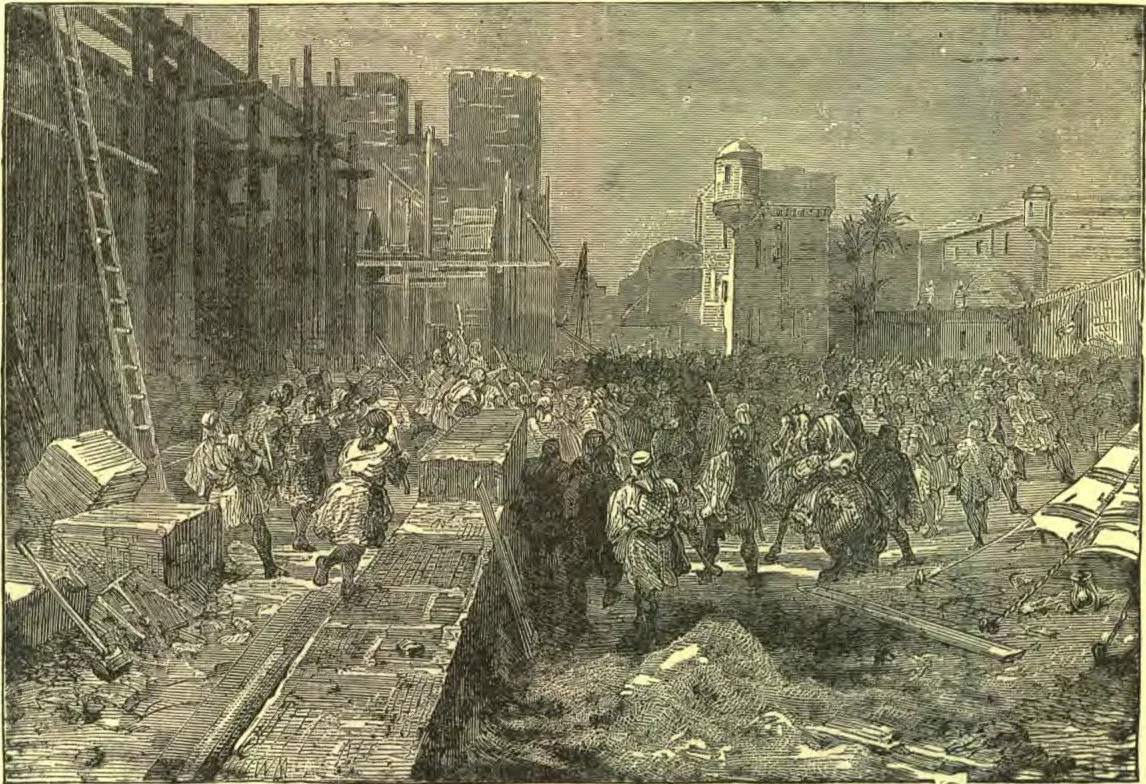
Among the Jews elevated to high positions at the Babylonian court was Nehemiah, the king’s cup-bearer. His office brought him into familiar and daily intercourse with the sovereign. For four long months he inwardly bewailed the defenseless condition of the city of his fathers, until at length a noticeable change came over his countenance, and the king kindly questioned his servant as to the cause. ‘Why is thy countenance sad,’ he asked, ‘seeing thou art not sick? This is nothing else but sorrow of heart.’
“The result was, that Nehemiah was allowed to go to Jerusalem, armed with the usual generous commissions which Eastern monarchs grant to their favorites, so that whatever material he needed for the work of restoring the walls and fortifications of the city might be forthcoming.
“On the third night after his arrival in Jerusalem, accompanied by a few associates, he rode out by moonlight and made a tour of the city-walls. He planned this excursion for the night, and kept his purpose even from the rulers and priests, for he was aware of the bitter feeling of the surrounding heathen, who would be sure to resist his project as soon as it was known. He knew, too, that there was treachery within as well as hostility without the city. But after he had fully informed himself and had laid all his plans, he took hold of the work with an energy and a consecration that carried everything before them. The whole community rose up as one man; ‘the people had a mind to work.’
“Their enemies of the surrounding tribes, neither few nor weak, ridiculed and threatened the wall-builders, who strengthened themselves by prayer and at the same time armed themselves with swords, spears, and bows. They remembered the Lord, the great and terrible. They resolved to fight for their families and homes. They were divided into two companies, half for work and half armed for defence. Even the working-parties went armed, some working with one hand and holding a weapon with the other. Nehemiah had by his side a trumpeter to give the signal for rallying the separated companies at any point where they might be attacked; ‘our God,’ he said, ‘will fight for us.’ He also required all to remain within the city by night, to guard against surprises by the enemy.”
“Disheartened by these precautions, Sanballat, Tobiah, the Arabians and the Ammonites gave up the struggle. They were compelled to look on while the walls steadily rose and were joined together, part to part, until no breach was left. They made vain efforts to call Nehemiah off from his great work and to entice him into their snares. He turned aside to no other duty or occupation until the wall was completed, smiling at threats of personal violence.
“On the twenty-fifth day of September, the wall was completed—in fifty-two days, a marvelously short space of time. Yet, as the labor was divided among not less than forty working-parties, the result cannot be regarded as beyond human power, especially when impelled by the most intense and urgent motives.
“The completed walls were dedicated by a religious ceremony. The princes of Judah and the Levites gathered from all places around Jerusalem. The sons of the singers, who had built themselves villages in the vicinity of the Holy City, the priests and the sons of the priests, were summoned to the dedication. Two great processions were formed upon the walls. One, led by Ezra, went in one direction, and the other, by Nehemiah, in the other. As they traversed the new-made walls, the pledge of Jerusalem’s security, they sang and rejoiced with so loud a voice, their wives and children joining in the song, that the joy of Jerusalem was heard a great way off.”
Yet we may well believe the walls would never have gone up if the people had not had a mind to work; nor the work have been completed if the good hand of their Lord had not been upon them. “Not by might, nor by power, but by my Spirit, saith the Lord of Hosts.” In all work for God it is well to remember that human strength is failure, but with His Spirit success is certain.

Gracie's Pleasant Day.

“Gracie!” called mamma from the foot of the staircase. The sound found its way to a sleepy little maiden upstairs, causing her eyelids to quiver and then open, and Gracie sat bolt upright in bed, trying in a confused way to remember what it was that was going to happen that day.
“Oh, yes!” cried she joyously, “the sleigh-ride!” for they were all to take a delightful ride in the new sleigh, and on their way back were to stop at Cousin Kate’s, and take her home with them. She sprang out of bed, and ran to the window to view the weather. It was perfect. Not a cloud was to be seen; and yonder the sun was peeping over the hill, making the snow glisten and sparkle as if old Earth were laughing a welcome to him. There to the south stretched the broad, white road, on which Gracie in fancy was already traveling, warmly wrapped in buffalo-robes, with bells jingling and the crisp air sweeping her face; it made her eyes grow bright and her cheeks red just to think of it. After dressing, she said her morning prayers very hastily, and ran down to the kitchen.
At the door she was met by little Freddy, whose face was unusually sober. “Gracie, we can’t go,” he said.
“Why not?” asked Gracie, turning to her mother, who was preparing the breakfast.
“Because Prince is sick, and cannot be used,” was the reply. “I know, darling, that it is a great disappointment, but you must try to”—Gracie heard no more; for closing the door with a bang, she flew up to her own room, flung herself down on the floor, and burst into tears. So this was the way the long-expected day was to end. In her unreasoning anger she blamed Prince, her father, her mother, and everybody.
“Breakfast is ready,” called her mother’s soft voice. “I don’t want any,” she replied, for she knew her mother too well to think she would come and coax her. Then closing the door, she sat sullenly for two long hours, resolved to see no one. How dreary everything seemed to her; just a long stretch of snow everywhere, and the bare brown branches of the trees looking so gaunt and forsaken. Not a house was to be seen, save the miserable little one at the foot of the hill. Mabel, the sick girl, lived there. She was a cripple, and confined to her bed much of the time. “How can she ever endure it?” thought Gracie; “yet she seems patient and contented.”
Just then there flashed into Gracie’s mind a verse of Scripture which she learned the day before,—did her good angel whisper it to her?—“for even Christ pleased not himself.” She had intended to profit by it, but how had she forgotten!
Gracie was a girl of quick impulses, and in a moment she was resolved what to do. Going downstairs, she stole up behind her mother, and putting her arms around her neck, asked her forgiveness, and told her of her new resolution.
“God bless you, my darling,” was all the reply, but that was enough.
Then hunting up little Fred, whose disappointment was probably as keen as her own, she bade him put on his cap and mittens.
“What for?” asked he.
“Why, you shall have a ride if you can’t go in the big sleigh,” she replied.
He brightened visibly, and in a few moments was flying over the snow, drawn on his hand-sled by Gracie. After half an hour’s sport, Gracie found a place where he could coast in safety, and left him.
A little later, with her arms full of books and a basket packed with dainties, she was wending her way to the little cottage at the foot of the hill, where Mabel lived. She found her in bed, propped up by pillows. Her face was pale and wan, but her cheeks flushed with pleasure when she saw Gracie. Soon Gracie’s fair head and Mabel’s dark one were bending together over the pretty pictures. “Oh, how nice they are!” exclaimed the sick girl. “I have looked at mine so many times that I am tired of them.”
Gracie stayed there all the afternoon, entertaining and amusing the little cripple, and before she was aware of it, the shades of evening were gathering.
“Thank you much for coming,” said Mabel, as Gracie rose to go. “You have made me very happy. But you are forgetting your books.”
“No, Mabel, they are yours; they will do you more good than they will me.”
“What! all these nice picture books for me!” and her eyes filled with grateful tears.
“Yes,” said Gracie, giving her a good-by kiss, “all for you, and I hope you will enjoy them.”
As Gracie went home that night, how lovely everything seemed. The sky was so blue, and she fancied it bent above her lovingly, and that the few stars glimmering through the twilight smiled upon her.
“After all,” said Gracie to her mother, as she laid her curly head upon the pillow that night, “I had a very pleasant day.”
“Yes,” replied her mother, “the way to make things appear beautiful is to do beautiful deeds.”
VIOLA E. SMITH.

THE SUMMONS.

DOOR-KEEPER of the year— April, the opener—hear! We wait without, and cry to thee; With the sunshine's golden key Open to us straight The grim and guarded gate, Whose frowning barriers rise Twixt us and softer skies.
We wait without and call; Myriads we of creatures small, Multitudes of living things, Sheathed blades and folded wings, Baby germs in close-coiled rings; Frozen earth-clods hold us down, Sullen skies above us frown; Thou alone canst liberate— April, free us from our strait!
We stand without and wait, We call and cry together— All in the wild March weather, Shrill and importunate Our summons thrills the air And pierces everywhere; And they who do not know— Who lack the finer sense Of nature-love intense— Crouch closer to the fire, Stirred till it blazes higher, And, shivering, mutter low, “How drearily the March winds blow!”
—Avis Gray, in St. Nicholas.

MR. MARSDEN'S LABORS IN NEW ZEALAND.

WHEN Mr. Marsden, to whom we introduced you in a former article, proposed to go to New Zealand for the purpose of converting a race of savage cannibals, the idea was looked upon as the dream of a pious enthusiast. “A good and useful man,” said those in power, “but one who must not be permitted to throw his life away, and the lives of others, among such a race of savages.” After much prayer and persistent entreaty, he was finally permitted to send two men, and if they returned in safety, he would be permitted himself to go. His faith was so strong that God would give success to the mission, that with his own means he purchased the “Brig Active,” and Sirs Kendall and Hall set sail for the Bay Islands. This was seventy-two years ago. They were the first to introduce the gospel to that country. Tuatara, the native of whom we have previously spoken, had told his countrymen of what he had seen and learned in his travels, but none would believe his testimony. Through his influence, these representative men were well received. They took presents with them. The most important of which was a hand mill for grinding corn. Tuatara had sown wheat, though he could not make them believe that the ears of wheat could ever be made into bread such as they had eaten on board of ships. But now the mill had come, and when the meal was produced, and they saw the cake easily baked in a frying-pan, they shouted and danced for joy. Tuatara was now believed in regard to what he had told about the missionaries. After a short stay, the two missionaries returned, accompanied by Tuatara and six other chiefs. They left the 22d of August, 1814. On the nineteenth of November following, Mr. Marsden embarked for New Zealand, taking with him the chiefs, and Sirs Kendall, Hall, and King.
On Christmas day, 1814, which fell on Sunday, Mr. Marsden opened his commission to the natives by preaching from the text, “Behold I bring you tidings of great joy.” Luke 2: 10. Tuatara interpreted it. That was a memorable day in the annals of New Zealand. The tribes of the Bay Islands and those of Wangora were at war with each other. Mr. Marsden took the Active to the scene of hostilities, where the crew of the Boyd had been destroyed, and had the satisfaction of making peace. He procured from the chiefs two hundred acres of land for the use of the missionaries, the first plot of ground ever transferred to foreigners in New Zealand. It was situated in Wangora. Mr. Marsden returned to Australia on the third of March, 1815, and received the congratulations of the governor on his trip.
Thus was the gospel introduced to this race of savages, and they became the friends of the white man. From this time Mr. Marsden was successful in enlisting the interests of his co-laborers in this field. In 1820 the matter was laid by him personally before a committee in London. They espoused his cause, and others were sent to this country. Finally it was decided that a mission should be established; so he returned, and a piece of land was procured in the pretty valley of the Kaeo, to which he gave the name of Wesley Dale. On the tenth of June, 1823, they took possession, and a building was soon finished. One Sunday a war canoe arrived, laden with slaves. One of them was killed and eaten. Such scenes were common in those days. The lives of the missionaries and their families were often threatened. They were in peril by the heathen, and had to endure many hardships; but they were laying the foundation stones for a great spiritual temple.
Mr. Marsden did not labor with them personally to any extent, working more effectually in selecting others to go, and encouraging them by frequent visits. In 1824 he made his fourth visit to New Zealand. Reinforcements were often sent, while some who could not endure the trying place returned. In 1824 a new house was finished, and portions of Scripture and elementary books were translated. Schools were opened for the children, and the gospel was preached. By kindness and firmness, and a constant hold upon God, they gained influence among the tribes. At times their lives were in danger, but no harm came to them. Violent men had been restrained by the Almighty's arm; they seemed to hear a voice saying, “Touch not mine anointed, and do my prophets no harm.”
The first convert to openly espouse the cause of Christ was Rangi, who was baptized in 1825, and soon after died in peace. In 1827 a war broke out among the natives of Wangora. The mission station was pillaged, and burned to the ground, and the family barely escaped with their lives. Other stations had, however, been established, and had begun to be a power in the land. Finally peace was declared. In due time the desire for religious instruction became general. The knowledge of God's word spread rapidly when it was once fairly started. But in 1830, a Roman bishop arrived with several priests at Honigro. This gave them much trouble. Forty-one years after the first conversion from heathenism in the valley of Kaeo, Joseph Hare's family moved from the North of Ireland to the same place, and through his influence the first Methodist meeting house was erected. This same beautiful valley, where the first convert from heathenism was baptized, has now become settled by over half a million of English-speaking people. From the history of the valley, it would seem that God regarded the sacrifice of Mr. Marsden, the pioneer missionary of this country; and though he sleeps, in the resurrection morn he may awake to see a harvest of souls which have been gathered year after year from among this people.
S. N. HASKELL.

Where Auntie Got Her Smiles.

When I was young, I had an aunt whom I loved very much. I used to wonder how she kept her face so lovely. When thirteen, I spent the winter with her, and had a delightful time. She had work and care and trials, but through all she had smiles. I often pondered the reason.
One day I went upstairs and opened a closet door in a retired part of the house, and was surprised to see my aunt there on her knees. As quick as a flash the thought darted through my mind, here is where she got her smiles.
Amazed at the heavenly beauty beaming in her face, I stood silent for a moment. Then I closed the door softly, regretting that I had interrupted her, for I was sure she was holding sweet communion with God. She loved to pray.—Journal.

PENNIES A WEEK, AND A PRAYER.

Two cents a week, and a prayer— A tiny gift, may be, But it helps to do a wonderful work For our missions across the sea.
Five cents a week, and a prayer, From our abundant store— It was never missed, for its place was filled By a Father's gift of more.
Ten cents a week, and a prayer, Perhaps 'twas a sacrifice; But treasure came from the store-house above, Outweighing by far the price.
Pennies a week, and a prayer; 'Twas the prayer, perhaps, after all, That the work has done and a blessing brought; The gift was so very small.
Pennies a week, and a prayer, Freely and heartily given; The treasures of earth will all melt away— This is treasure laid up in heaven.
Pennies a week, and a prayer, A tiny gift, may be, But it helps to do such a wonderful work For our missions across the sea.
—Selected.

A SCIENTIST AMONG SAVAGES.

A POPULAR magazine says that “the Russian scientist Dr. Maclay had a very hard time among the natives of New Guinea. One morning they found him sitting on his trunk on the beach; and as they had never seen a white man before, and had not seen the ship which landed him there in the night, they made up their minds that he had descended from heaven. The doctor encouraged them in this belief, but he soon found that he had accepted a character which it was very difficult to fill in a manner to satisfy his hosts.
“As they had never before entertained a living inhabitant of the sky, they did not want to lose him, so they kept him closely imprisoned. If he was from the gods, they thought, nothing should frighten him, and so they shot arrows close to his head and neck; indeed, two of the arrows wounded him severely. They tied him to a tree, and pressed their spears against his teeth until he was obliged to open his mouth, though what divine attribute this action was intended to test it is difficult to imagine. Then they deprived him of food for so long a time that his life was endangered, for surely, they thought, one who had come from the gods could have no use for earthly food.
“Finally they decided that a person who ate as much as the good doctor could hardly be a heavenly being, and as he must have come from somewhere, they decided that he was a recent arrival from the moon. This was fortunate for Dr. Maclay, as his captors did not seem to expect so much from a mere moon-creature, and his life among the naked inhabitants of the islands was comparatively pleasant. They could not help but admire the pluck with which he had endured their too pressing attentions on his first arrival, and when they found out that he was a very kind-hearted man, and that he had much skill in medicine, they treated him with great respect as a superior being.
“An English traveler who visited the islands after the doctor had left, found the name of Maclay a ‘name to conjure with,’ for no sooner had he spoken it than the natives crowded around him, eager to do honor to Maclay’s brother, as they called him.”

DON'T SWEAR.

AMONG the other good qualities of the noble George Washington was his great aversion to swearing. While he was still very young, having been placed in command of a small regiment of men, he gave a law which placed swearing under penalty of being punished quite severely.
It is said that one time, having invited the members of his staff to dine with him, one of them deliberately uttered an oath. Washington dropped his knife and fork and looked up as if he had been struck. There was a moment of silence and the attention of all was turned to him. He then said decidedly yet sadly, “I thought I had invited gentlemen only to dine with me.”

THE TWELVE GATES.

“The twelve gates were twelve pearls; every several gate was of one pearl.” By each of four months we enter upon a distinct and beautiful revelation of this world, which was meant to be the “City of the Living God.” The gate-ways that let in the cool of the north, the balm of the south, the glow of the east, and the tenderness of the west,—winter, spring, summer, autumn,—each brings earth its own peculiar charm. It is the same world, yet without sameness, seen through a halo of infinitely varying beauty.—Lucy Larcom.

POWER

WHAT we want is more of power, and we are apt to look every way but the right way for it. The multiplication of mere machinery will not bring it. A wonderful machine was that which the prophet Ezekiel saw by the River Chebar, with wheels upon wheels, and fire between the wheels; but it was far from being a mere machine, for he says: “This is the living creature that I saw by the river Chebar.” There were flaming cherubims that stood beside the wheels: “And when the cherubims went, the wheels went by them; and when the cherubims lifted up their wings to mount up from the earth, the wheels also turned not from beside them. When they stood, these stood; and when they were lifted up, these lifted up themselves also; for the spirit of the living creature was in them.” The wheels alone would have been utterly powerless. There was needed the presence of the mighty cherubims, and the pervasive spirit of the living creature to make the wheels go.
Even so we may have in our churches and Sabbath-schools the most approved methods, and the costliest and most superb appointments, and yet the whole church establishment shall be no better than a magnificent mausoleum, unless there be the bestowment of power from on high.
Such is the perversity of human nature that men are not apt to look up to the Lord, so long as there is anything else to depend upon. Some of the old-fashioned pioneer preachers, who were utterly ignorant of the learning of the schools, were, nevertheless, mighty through God to the pulling down of the strongholds of the enemy. Yes, “mighty through God,” and not through ignorance. A dull axe is not a good thing to cut with, for, “if the iron be blunt, he must put more strength thereto;” but a dull axe wielded in the strength of the Lord is infinitely better than a sharp axe wielded in the strength of man. And the trouble very frequently is, that the man with the keen-edged instrument is apt to trust in the keenness of the edge, rather than in the help of the Lord; and so he fails, not because of his learning, but because of his reliance on it.
So the completeness of the appointments of a church or Sabbath-school may become a snare to the Lord’s people, by leading them to look away from the hill whence all help cometh. If Jacob had been better equipped when Esau came forth to meet him, it is very likely that he would not have prayed, on the night before the meeting, with such desperate earnestness. It is conscious need that drives us to our knees. If when the patriarch learned that Esau was coming against him with four hundred men, he had been able to muster six hundred men, wherewith to resist him, the night, perhaps, would have been differently spent. It is a great blessing to be obliged to rely upon the Lord. “This poor man cried, and the Lord heard him, and delivered him out of all his troubles.” “I was brought low, and he helped me.” The Lord never hears any but a poor man; he never helps any man till he has been brought low. “God resisteth the proud, but giveth grace to the humble.” Jacob prevailed not, so long as in conscious strength he wrestled; but the moment that in conscious helplessness he surrendered, then the Lord was ready to bestow upon him any blessing that he wanted. He conquered when he surrendered; and no man can have power with God who does not unconditionally give up all to God. And this is the meaning of consecration. Very various are the degrees of it among professing Christians; but, beyond all question, just in proportion as we give ourselves to him, does he give himself to us, and fill us with his divine fullness. And just in the same proportion will be our power with men. And this is a power to be greatly coveted. Very wonderful was the display of it on the memorable morning when Jacob met Esau, who, for twenty years, had been nursing the deadliest hatred in his heart. Evidently the Lord had met with Esau before Jacob did, and the power of the Divine Spirit winged the words of Jacob, so that they broke the heart of Esau, and quenched the fire of enmity. The wisest of men has told us that “a brother offended is harder to be won than a strong city, and their contentions are like the bars of a castle.” But here was a brother very grievously offended, and very desperately resolved on vengeance; and yet he was won in a very wonderful way.
And yet who has not witnessed like marvelous manifestations of the power of a real man of God to move men, to conquer men, who were solemnly resolved that they never would yield to the invitation of the gospel? The fireworks of fancy will not capture men; the catapult of logic will not batter down the ramparts behind which they are intrenched; the hot shot of denunciation and threatening will not drive them from their stronghold. Even in the presence of a little child, for the salvation of whose soul we are pleading, we stand as powerless as we do before a stalwart infidel. We can have no power with men at all, or even with little children, unless it be given us from on high. And the way to have it given to us is to cling to God in conscious helplessness, and to cry with desperate earnestness, “I will not let thee go except thou bless me,” and we shall get the blessing, and go forth to victory. —Baptist Teacher.

PATIENT CONTINUANCE.

I SOMETIMES fear that as teachers we grow impatient to see the results of our work, and are inclined to undervalue the “line upon line and precept upon precept” plan of teaching. We are anxious to see the children under our care leading a godly life as professed disciples of Christ. We want to say something that we can see take effect in convincing them of their need of the Saviour, and in getting them to yield their hearts to him. It is this desire, I suppose, that sometimes leads zealous superintendents to address their teachers in words like the following: “Do not fail to draw from each lesson some practical truth that shall have a direct bearing upon the Christian life. Consider each lesson a failure that falls short of this.” Now is there not great danger that such statements, although well meant, are entirely too strong? Imagine the sighs of the conscientious teachers as they look over the historical lessons, and try to find in every one of them some barbed hook which they may be able to fix in the tender consciences of the restless children under their care.
It seems questionable that a lesson is a failure from which no such pointed spiritual appeal can be directly or naturally made. If in the aggregate the lessons had no tendency toward a life of purity and holiness, we might indeed consider our work a failure. But it is not all planting that brings forth immediate fruit. Children are slow to comprehend spiritual truths. They understand the things they can see and handle. They are interested in a narrative. See how earnest they grow, how their faces brighten, as they tell you some of the Bible stories. It is all a reality to them. Now watch them as you lead into some spiritual truth that may be drawn from the lesson, some comparison between the things of this life and the things of the divine life. Plan ever so carefully your method of introducing it, and ever so skillfully carry out your plan, yet the bright, interested look fades out of their faces, and one of perplexity or listless vacancy takes its place. Do not wonder at the change. You have taken them beyond their depth. A good brother was trying to impress on a company of children the necessity of building on Christ, the Sure Foundation, in order to withstand the storms of temptation. He chose for an illustration that parable of our Lord’s that so aptly tells the story that to us who are older it seems the easiest thing in the world to understand. Every eye was riveted on the speaker as he drew a vivid word picture of the houses of the wise man and the foolish man, and of the great storm that swept over them, demolishing the one that stood on a sandy foundation. So far all was a reality. But as he proceeded to draw his comparisons between this and the things of the spiritual life, restlessness took the place of attention. It was sad to notice the gloom that settled over their faces, varied only by slight illuminations whenever he happened to touch on anything they could understand. The effort was a failure. Their expectations had been raised only to be disappointed.
Do not consider your efforts fruitless simply because you do not in every lesson touch directly on these points that are of such vital interest to you. Beginning with the story of the creation, you Sabbath by Sabbath lead the children along in the history of God’s dealings with men, and thus lay a foundation, broad and deep, on which you can build with tenfold more effect than otherwise the spiritual house of Christ. There is power in the word itself, and we may trust a little to the influence of the Holy Spirit to set home that word to the hearts of our pupils.
How much more meaning can be put in the lessons of the life of Christ when taught to those who have become already familiar with the history of the Jews, and are thus prepared to appreciate the course taken by them and the meaning of our Saviour’s words to them. When you have arrived at this place in the lesson series, the children have reached an age that is usually a turning point for good or evil in their lives. Their minds are more fully developed, and they are beginning to think out some of the problems of life for themselves. At such a time, how potent for good are the practical lessons in our Saviour’s teaching!
We must not be in haste to see results. True, enduring growth is slow. The mushroom achieves a remarkable development in a single night, but perishes in the next day’s sun; the hardy oak is a century in growing. What would you think of a farmer who plowed, harrowed, and sowed his seed, and expected to return home at nightfall with a crop to show the results of his day’s labor? Or of the fruit grower who planted his trees, and looked for an ingathering the same season? What man expects his two-year-old son to perform the physical feats of which he is himself capable? Why should we manifest less good judgment in regard to spiritual things than we do in regard to temporalities?
The principles brought out by the Rev. Henry N. Hudson, late professor in Boston University, in one of his works on education, bear directly upon this point. He says: “Our education is kept at a restless fever-heat of ambition and emulation; and this naturally draws on an incessant urging of high-pressure methods. We have no faith in any sowing save where the seeds ‘forthwith spring up, because they have no deepness of earth.’ So eager and impatient are we for immediate results, that the conditions and processes of inward growth, are, as far as possible, worked off and got rid of. But the results attained by this straining and forcing are necessarily false and delusive; and presently wither away, because they have no root. . . .”
“For, in truth, when people, of whatever age, see themselves growing from day to day, they are not really growing at all, but merely bloating;—a puffing up, not a building up.”
And I take it that these things are as true in regard to spiritual growth as in regard to intellectual; and that one reason why we often see such a lamentable falling away among the young who make a profession of religion is because we have been so eager for large results that we have forced the process of spiritual growth. Our fruit soon ripe was, alas, soon rotten.
To again quote Mr. Hudson: “In the mental and moral world, as in the physical, the best planting is always slow of fruitage; generally speaking, the longer the fruit is in coming, the sounder and sweeter when it comes. . . . For growth is a thing that cannot be extemporized; and if you go about to extemporize it, you will be sure to cheat or to be cheated with a worthless surface imitation.”
“What a teacher, therefore, most especially needs (and parents need it too) is the faith that knows how to work and wait;—to work diligently, carefully, earnestly; to wait calmly, patiently, hopefully; that faith which, having its eye on the far-off future, does not thirst for present rewards, “Nor with impatience from the season ask More than its timely produce.”
We are told not to weary in well doing. To us is committed the sowing, and only the sowing. God gives the increase.
“In the unreasoning progress of the world A wiser spirit is at work for us, A better eye than ours, most prodigal Of blessings and most studious of good, Even in what seem our most unfruitful hours.” W. E. L.

THE STUDY OF THE WORD OF GOD.

The Word says: “Whatsoever thy hand findeth to do, do it with thy might.” And we hear it often said, “Whatever is worth doing at all, is worth doing well.” So in the Sabbath-school, whatever lesson is worth learning at all, is worth learning well. Many are satisfied with superficially skimming over the lesson, so as to be able to give some sort of answer to the question, and thus pass along, while they are strangers to real study.
Even as “eye hath not seen, nor ear heard, neither have entered into the heart of man, the things which God hath prepared for them that love him,” so in the Good Book there are depths not yet explored, there are heights not yet attained to, there is a breadth of meaning not yet spanned. How much comfort and consolation, how much strength and grace, how much truth and wisdom is lost by simply reading the inspired Word without studying it, meditating upon it, and praying over it!
Munkaczy’s world-renowned painting of “Christ before Pilate” is before us, perhaps. Our first view of the picture, as we get a glimpse of it through the dense crowd of people who have been drawn hither by this wonderful work of art, is somewhat vague, seeing only a number of figures without any particular harmony of grouping or color. But as our range of vision becomes clearer, and we have opportunity to study the work first as a whole and then to note more particularly the prominent figures, and especially the central one, Christ, we begin to see a beauty and a harmony in it, which we at first had no idea was there. The whole seems to stand out with the reality of life. Each character is portrayed so faithfully, the colors are blended so naturally, that we forget the frame, forget the canvas, forget that we have a picture before us, and stand there absorbed, as it were, in a scene of life. There is Pilate elevated on his judgment seat, with a look of wonderful interest in his face; there is the high-priest making his accusations; there is the rabble crowding toward Jesus, but kept back by the strong lance of the Roman guard; and among the crowd is a figure who, with uplifted hand, open mouth and revengeful look, seems to be crying out, “Crucify him, crucify him;” while in the foreground stands the “man of sorrows” with such an expression of pitying sorrow and grief pictured in his countenance, with no thought of malice or revenge, that it would seem as if the very spirit of the words, “Father, forgive them, for they know not what they do,” were expressed in his looks! And so after we had looked at the picture for about an hour and tried to drink in its spirit, we found depths and heights in it which we at first had not thought of.
So with the word of God. A hurried, superficial view gives us but an indistinct idea of what it would teach us. But as we draw nearer, as we fasten it in our mind and meditate upon it, comparing one scripture with another, and praying for the illuminating power of the Spirit of God, we begin to see a reality, a thing of life; the truth stands out in bold relief, and we discover a beauty and harmony, which draws us nearer to it and to the Source of all truth.
Let us in our study of the word of God as found in our Sabbath-school lessons, remember, (1) to get a general view or idea of the lesson; what is the topic, what is taught or brought out; (2) to discover the different parts in which it may be divided; (3) to get a good idea of the different texts which are given, to prove the points taken; (4) to understand the practical lessons taught so as to make a personal application of them. If this course be followed with each lesson, with aid from above, we may gather a store of Bible knowledge and truth, that will be to us a well of water springing up into eternal life.
And then we will not be satisfied with only learning the lesson “so that we can answer the questions,” but we will “delight in the law of the Lord,” we will gladly spend some time in study, meditation, and prayer, and we will be glad to see a growth in spiritual power and grace, and a nearness to God and his people, so that the Sabbath-school becomes a delight to us and the word of God a never-failing source of help, strength, and blessing. A. B. O.
Continue reading: HOW TO HELP THE CHILDREN