The Youth’s Instructor, Vol. 29, No. 30.

LUTHER RENOUNCES ROME

The Youth’s Instructor

Jul 27, 1881

S. D. A. Publishing Association · Battle Creek, Mich. · Jul 27, 1881

LUTHER RENOUNCES ROME.
In the year 1502, Frederic, Elector of Saxony, founded at Wittenberg, Germany, the celebrated university in which the Reformation may be said to have been born. The universities of that day were usually connected with some of the various monastic orders, and the monks were the instructors of the students who resorted to them. Frederic had selected St. Augustine as the patron saint of this new Wittenberg school, and it was therefore under the care of the Augustinian brotherhood.
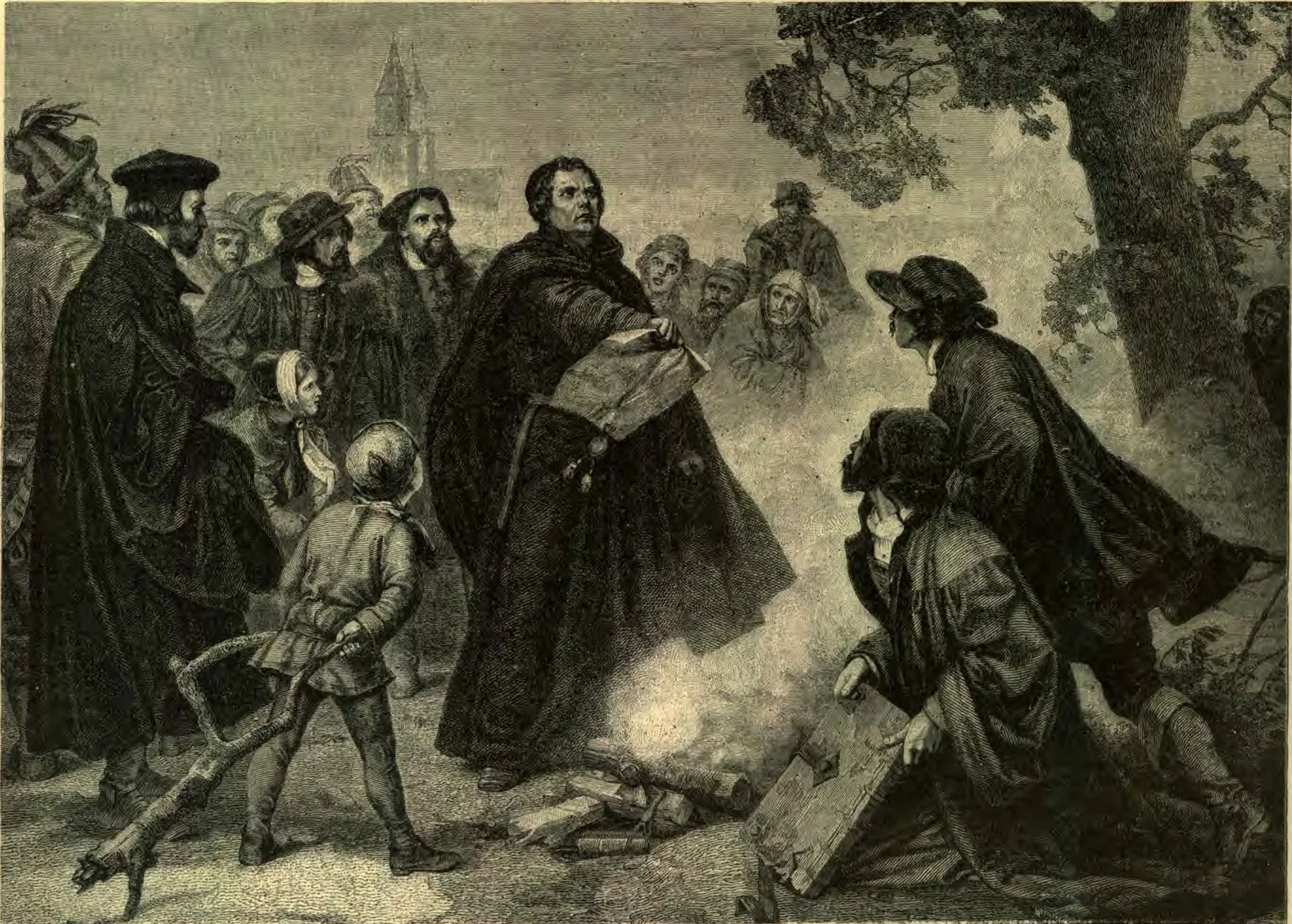
BURNING THE POPE'S BULL.
Luther, the man destined to be the father of the Reformation, who, in the midst of his university course at Erfurt, had suddenly decided to leave all and enter the Augustinian monastery, was now one of the most devoted of the brotherhood. He had, however, never given up the studious habits acquired at the university, and during the three years spent in the dreamy quiet of the cloister, had made rapid progress in his study of divinity as well as of the Greek and Hebrew languages. Thus by his studious and consistent course he won the universal esteem of the brotherhood. Accordingly, in 1508, the quiet monk was, much to his surprise, called to leave Erfurt and go to Wittenberg to accept a professorship in the new university. In 1509, he was, at his own choice, elected to the chair of Biblical theology. This he filled with honor to himself and the university. Of his steady growth in learning, eloquence, and power, as well as in the respect and esteem of the people, space forbids more than a mere mention.
In 1512 Luther, then but twenty-nine years old, was made doctor of divinity. The words of the oath which he was at that time required to take, “I swear vigorously to defend evangelical truth,” became the watch-word of his life. This he determined to do, though it be at the cost of life itself. Crowds flocked to hear his lectures and sermons (he now frequently preached in the city church); for there was something in his broad, whole-souled doctrines different from the senseless mummery of the priests, to which the people had so long been bound. But we cannot follow the Reformation step by step. A few years sufficed to make Luther the great man of Wittenberg, and a few more, of Germany itself.
The university grew in favor and popularity, and Wittenberg was fast becoming the center of learning and scholarship as well as of religious interest, in Germany. Little by little Luther had been letting go of the darkness of papal error; and as fast as he saw the new light, he did not hesitate to give it to the common people as well as to the university students. By thus exposing the corruption of the Romish Church he of course roused the anger of the pope and his cardinals; and time after time was the brave man summoned to answer before kings and prelates for the truths which he so boldly proclaimed. Again and again was he entreated and commanded to recant, and threatened with imprisonment, banishment, excommunication, and even death, if he did not do so; but he swerved not from his principles. Many times both he and his friends felt that he was surely going to death, but through it all he walked unharmed, even as did the Hebrews in the midst of the fiery furnace; and by his eloquence and power silenced emperors and cardinals. The character and purpose of his life are well expressed in his words when called to answer before the emperor, “Here I stand; I cannot do otherwise; God help me. Amen!”
At last, in 1520, the pope, Leo X, issued against Luther the bull of excommunication so long threatened, which was a decree shutting him off from all the rights and privileges of the Church, and venting against him the extreme wrath and abhorrence of the pope as the head of that Church. Copies of the documents were posted in the towns and by the roadsides. Luther received it all very calmly, for he had long lost all confidence in the Romish Church; and in this he had the sympathies of the larger part of the common people of Germany, as well as of many of the students and university men.
Notwithstanding the sacredness which had always been attached to the papal bull by the adherents of the Romish Church, Luther boldly declared his intention of burning this document; and, finally, on the morning of the 10th of December, 1520, in one of the market-places of Wittenberg, occurred the scene represented in our picture,—such a bonfire as is kindled but once in centuries. Crowds of people gathered to witness the strange spectacle,—men, women, and children from the town; and students, professors, and learned doctors from the university. A master of arts of some reputation lighted the pile of fagots, and then threw on it the decretals and other false epistles of the Romish Church, which for centuries had propped up the edifice of lies. And when the flames which consumed them had passed away, Dr. Luther himself, stepping forward, solemnly laid the pope’s bull of excommunication on the fire, saying amidst the breathless silence: “As thou hast troubled the Lord’s saints, may the eternal fire destroy thee.” Not a word broke the silence until the crackle and gleam of those symbolical flames had ceased, and then gravely but joyfully the crowd returned to their homes. Yet the light of that fire went not out with the dying embers, but has shone on and on, and still shines, growing brighter and brighter with each succeeding century. E. B.

THE POWER OF ELOQUENCE.

THE following story, taken from the Little Star, possesses peculiar interest at this date. Says the writer:—
“I shall never forget the first time I saw Gen. Garfield. It was the morning after President Lincoln’s assassination. The country was excited to its utmost tension, and New York City seemed ready for the scenes of the French Revolution. The intelligence of Lincoln’s murder had been flashed by the wires over the whole land. Fear took possession of men’s minds as to the fate of the government. Posters were stuck up everywhere, in great black letters, calling upon the loyal citizens of New York, Brooklyn, Jersey City, and neighboring places to meet around the Wall Street Exchange and give expression to their sentiments. It was a dark and terrible hour. What might come next no one could tell, and men spoke with bated breath. The wrath of the workingmen was simply uncontrollable, and revolvers and knives were in the hands of thousands of Lincoln’s friends, ready, at the first opportunity, to take the law into their own hands, and avenge the death of the martyred President upon any who dared utter a word against him. Eleven o’clock, A. M., was the hour set for the rendezvous. Fifty thousand people crowded around the Exchange building, cramming and jamming the streets, wedged in tight as men could stand together.
“Two men lay bleeding on one of the side streets, the one dead, the other next to dying; one on the pavement, the other in the gutter. They had said, a moment before, that ‘Lincoln ought to have been shot long ago!’ Suddenly the shout rose, ‘The World! the office of the World!’ and a movement of perhaps 8,000 or 10,000, turning their faces in the direction of that building, began to be executed. It was a critical moment. Just then a man stepped forward, with a small flag in his hand, and beckoned to the crowd. ‘Another telegram from Washington!’ And then, in the awful stillness of the crisis, taking advantage of the hesitation of the crowd, whose steps had been arrested a moment, a right arm was lifted skyward, and a voice, clear and steady, loud and distinct, spoke out: ‘Fellow-citizens! Clouds and darkness are round about Him! His pavilion is dark waters and thick clouds of the skies! Justice and judgment are the establishment of his throne! Mercy and truth shall go before his face! Fellow-citizens, God reigns, and the government at Washington still lives!’” The effect was tremendous. The crowd stood riveted to the ground in awe, gazing at the motionless orator. As the boiling wave subsides and settles to the sea when some strong wind beats it down, so the tumult of the people sank, and became still. All took it as a divine omen. It was a triumph of eloquence, inspired by the moment, such as falls to the lot of few men, and that but once in a century. What might have happened, had the surging, maddened mob been let loose, none can tell. The man for the crisis was on the spot. I inquired what was his name. The answer came in a low whisper: ‘It is General Garfield, of Ohio!’”
The words which thus stilled the excited mob seem a fit watch-word for the present trying hour: “God reigns, and the government still lives.”

THE CLOCK THAT DID NOTHING BUT TICK.

One morning on going into the breakfast room, I was surprised to see that the old family clock which stood in one corner was pointing to seven. I had been out late the evening before at the bedside of a sick friend, and as I had been very weary, I fancied I had overslept, and should not have been surprised if the clock had marked eight instead of seven. However, I supposed it was right, and without thinking to consult my watch, I seated myself at the table, dismissing at once the uneasy feeling that perhaps I had done wrong in sleeping so late.
“Tick-tick, tick-tick,” said the clock; but my back was turned to it now, and I did not see that the hands still pointed to seven. I finished my breakfast and took up the newspaper, thinking I had plenty of time before going to my business. Then I leisurely put on my coat, and was about leaving the house as the children ran in from their play.
“How is this?” I said. “You ought to be on your way to school.”
“Oh no,” said Johnny; “it is only seven o’clock.”
“You must be mistaken,” I said in amazement.
“We have had a very long morning to play,” said Mary, thoughtfully.
But Johnny ran into the dining-room and triumphantly exclaimed that the clock said seven.
“It must have stopped,” said I. But still it went on, “Tick-tick, tick-tick.”
In a few minutes, however, we were convinced that the hands were caught, in spite of its ticking, and on looking at my watch I saw it was already nine o’clock. The children were late at school, I was late at my business, the servants were behindhand in all their work, and my wife missed entirely a missionary meeting at which it was very important she should be present. And all this in consequence of a clock which made professions without carrying them out!
“It would have been better if it had stopped altogether,” said my wife; “then we should not have been deceived by it into thinking we were secure.”
“I am sorry,” said grandma, who is blind; “I have enjoyed hearing it tick so much. I should not like to have a silent clock.”
“Ah,” I thought, “is not this a lesson to Christians? Profession and practice must go together, or the best results cannot be achieved. It would not be right to be silent in the prayer-meeting or conference-room, for such a course would prevent us from encouraging and assisting others. We want, as grandma says, the cheerful ticking. But, on the other hand, how dreadful to continue to talk as before, and yet by our lives to point continually in the wrong direction, as the clock pointed at seven, and, as my wife said, to give people a feeling of fancied security, which in the end should prove their destruction!”—Sel.

Thy Will Be Done: Verses on Sun and Shower

He sendeth sun, He sendeth shower, Alike they're needful for the flower; And joys and tears alike are sent To give the soul fit nourishment. As comes to me, or cloud or sun, Father, thy will, not mine, be done!

STARLIGHT

THE evening star will twinkle presently. The last small bird is silent, and the bee Has gone into his hive, and the shut flowers Are bending as if sleeping on the stem, And all sweet living things are slumbering In the deep hush of nature’s resting time. The faded west looks deep, as if its blue Were searchable, and even as I look, The twilight hath stole over it, and made Its liquid eye apparent, and above To the far-stretching zenith, and around, As if they waited on her like a queen, Have stolen out the innumerable stars, To twinkle like intelligence in heaven. — N. P. Willis.

Never Despair: Verses of Hope in Trial

NEVER despair! never despair! The clouds may look black, But the sun in his track Is shining somewhere, And will surely come back. The wave may be deep and the night may be dark, But the God of the storm is guiding the ark.

PERFECT TRUST.

A GENTLEMAN was walking one evening, with his little daughter, upon a high bank, beneath which ran a canal. The child was pleased with the look of the glistening water, and coaxed her father to take her down to it.
“The water looks so pretty. Please papa, do take me down there,” she said.
The bank was very steep and the road a mere sheep-path. In getting down, the gentleman had to take hold of his little girl’s arms and swing her from point to point. While doing this, she would sometimes be hanging directly over the water. Yet she only laughed and chuckled, but was not the least bit afraid, although she really seemed to be in danger.
At last they got down the bank and reached the tow-path in safety. Then, taking up his daughter in his arms, he said: “Now tell me, Sophy, why were you not afraid when you were swinging in the air, right over the water?”
“Why,” said she, “papa had hold of Sophy’s hand; Sophy couldn’t fall!”
Here was perfect trust. And this is just the feeling David had toward God when he said, “What time I am afraid I will trust in thee.” Sophy would have screamed with terror to find herself hanging over the water in the canal, unless she had had confidence in the person who had hold of her arms. But it was her father—her kind, loving father—who held her, and so, what time she would have been afraid she trusted in him. And this is the feeling that we ought to have toward God. The thought of his power should lead us to trust him.—Richard Newton.

Charity Never Lost to the Giver

CHARITY is never lost. It may meet with ingratitude, or be of no service to those on whom it was bestowed; yet it ever does a work of beauty and grace upon the heart of the giver.

SCENES IN THE LIFE OF CHRIST.

LESSON 27.—JESUS ACCUSED OF BREAKING THE SABBATH.

Time after time the Jews accused Jesus of breaking the Sabbath. In one instance, as Jesus and his disciples were going through a field of grain, the disciples, being hungry, picked some of the grain, and rubbing off the chaff in their hands, began to eat the kernels. “But when the Pharisees saw it, they said unto him, Behold, thy disciples do that which is not lawful to do upon the Sabbath-day. But he said unto them, Have ye not read what David did, when he was an hungred, and they that were with him; how he entered into the house of God, and did eat the shew-bread, which was not lawful for him to eat, neither for them which were with him, but only for the priests? Or have ye not read in the law, how that on the Sabbath-days the priests in the temple profane the Sabbath, and are blameless?”
“And he said unto them, The Sabbath was made for man, and not man for the Sabbath. Therefore the Son of man is Lord also of the Sabbath.”
“And it came to pass also on another Sabbath that he entered into the synagogue and taught, and there was a man whose right hand was withered. And the scribes and Pharisees watched him whether he would heal on the Sabbath-day, that they might find an accusation against him.” “And they asked him, saying, Is it lawful to heal on the Sabbath-days?” “And he said unto them, What man shall there be among you that shall have one sheep, and if it fall into a pit on the Sabbath-day, will he not lay hold on it, and lift it out? How much, then, is a man better than a sheep! Wherefore it is lawful to do well on the Sabbath-days.”
“Then said he to the man, Stretch forth thine hand. And he stretched it forth, and it was restored whole, like as the other. Then the Pharisees went out and held a council together, how they might destroy him.”
In all these lessons, Jesus did not mean to teach that the Sabbath need not be kept carefully, but rather to show how it ought to be kept. Some of the Jews, especially the Pharisees, were very particular on points which the Lord did not require. They did not seem to realize that the Lord meant the Sabbath to be a blessing and a delight,—a day when we should rest from common labor, in order to think of the goodness of God, to study his word and his works, and to do deeds of mercy.

QUESTIONS.

  1. Of what did the Jews often accuse Jesus?
  2. What did the disciples do one Sabbath while going through a field of grain with their Master?
  3. When the Pharisees saw it, what complaint did they make? Matt. 12:2.
  4. Did Jesus think the disciples were breaking the Sabbath by doing as they did?
  5. What example did he bring up from the life of David? 1 Sam. 21.
  6. What was the shew-bread? Lev. 24.
  7. According to the law, who alone were to eat this shew-bread?
  8. What made it right for the priest to give this bread to David and his men?—Saul was hunting these men to take their lives, they were perishing with hunger, and there was no other food for them.
  9. What work did the priests have to do in the temple on the Sabbath-day? Num. 28:9, 10.
  10. What did Jesus say to show that the Sabbath was meant to be a blessing and not a burden to men? Mark 2:27.
  11. What did he say to show that he knew better than they could how the Sabbath ought to be kept?
  12. Since he is Lord of the Sabbath, what day of the week must be the Lord’s day?
  13. What miracle did Jesus perform on another Sabbath-day? Luke 6:6–11; Matt. 12:9–14; Mark 3:1–6.
  14. Why did the scribes and Pharisees watch him?
  15. What question did they ask him?
  16. Before answering, what question did he ask them?
  17. What answer did he then give?
  18. What did he say to the man that had the withered hand?
  19. When the man stretched forth his hand, what change took place in it?
  20. What did the Pharisees do when they had seen this miracle performed?
  21. Did Jesus mean to teach that the Sabbath need not be carefully kept?
  22. What did he show?
  23. On what were the Pharisees particular?
  24. What did they fail to realize?
  25. Why are we to rest from common labor on the Sabbath?

NEW-TESTAMENT HISTORY.

LESSON 40.—THE DEATH OF JOHN, AND THE FEEDING OF THE FIVE THOUSAND.

“At that time Herod the tetrarch heard of the fame of Jesus, and said unto his servants, This is John the Baptist; he is risen from the dead; and therefore mighty works do show forth themselves in him.”
After keeping John in prison a long time, Herod had beheaded him. The circumstances of this tragic event are given by Mark as follows: “And when a convenient day was come, that Herod on his birthday made a supper to his lords, high captains, and chief estates of Galilee; and when the daughter of the said Herodias came in, and danced, and pleased Herod and them that sat with him, the king said unto the damsel, Ask of me whatsoever thou wilt, and I will give it thee. And he sware unto her, Whatsoever thou shalt ask of me, I will give it thee, unto the half of my kingdom. And she went forth and said unto her mother, What shall I ask? And she said, The head of John the Baptist. And she came in straightway with haste unto the king, and asked, saying, I will that thou give me by and by in a charger the head of John the Baptist. And the king was exceeding sorry; yet for his oath’s sake, and for their sakes which sat with him, he would not reject her. And immediately the king sent an executioner, and commanded his head to be brought; and he went and beheaded him in the prison, and brought his head in a charger, and gave it to the damsel; and the damsel gave it to her mother. And when his disciples heard of it, they came and took up his corpse, and laid it in a tomb.”
When the apostles returned from their tour, they told Jesus what they had done. “And he said unto them, Come ye yourselves apart into a desert place, and rest awhile; for there were many coming and going, and they had no leisure so much as to eat. And they departed into a desert place by ship privately. And the people saw them departing, and many knew him, and ran afoot thither out of all cities, and outwent them, and came together unto him.” Matthew says that Jesus departed by ship into a desert place; John, that he went over the Sea of Galilee; and Luke, that he went aside into a desert place belonging to the city called Bethsaida. These accounts are all in perfect harmony; for the Bethsaida undoubtedly here meant was situated near the northern end of the Sea of Galilee and east of the River Jordan; so that the people, by crossing the river, could really go to the other side of the lake on foot.
“And Jesus went up into a mountain, and there he sat with his disciples. And the passover, a feast of the Jews, was nigh.” Jesus, moved with compassion toward the multitude, healed their sick, but, “when the day began to wear away, then came the twelve, and said unto him, Send the multitude away, that they may go into the towns and country round about, and lodge, and get victuals; for we are here in a desert place. But he said unto them, Give ye them to eat.” “And they say unto him, Shall we go and buy two hundred penny-worth of bread, and give them to eat? He saith unto them, How many loaves have ye? go and see; and when they knew, they say, Five, and two fishes. And he commanded them to make all sit down by companies upon the green grass. And they sat down in ranks by hundreds, and by fifties. And when he had taken the five loaves and the two fishes, he looked up to heaven, and blessed, and break the loaves, and gave them to his disciples to set before them; and the two fishes divided he among them all.” “And they did all eat, and were filled: and they took up of the fragments that remained twelve baskets full. And they that had eaten were about five thousand men, besides women and children.” “Then those men, when they had seen the miracle that Jesus did, said, This is of a truth that prophet that should come into the world.”

QUESTIONS.

  1. When Herod heard of the fame of Jesus, how did he account for his mighty works? Matt. 14:1, 2.
  2. What had Herod done to John the Baptist?
  3. On what occasion was this done?
  4. How did Herod come to give an order for the execution of John?
  5. Who instigated the damsel to make such a cruel request?
  6. Why did Herodias feel such hatred toward John?
  7. What did John’s disciples do when they heard of his death?
  8. What did Jesus say to his disciples when they returned from their preaching tour?
  9. Why was it necessary to seek a desert place for rest?
  10. What did the people do when they saw Jesus and his disciples departing?
  11. Tell what each of the evangelists says in regard to it. Matt. 14:13; Mark 6:32, 33; Luke 9:10, 11; John 6:1, 2.
  12. How can it be shown that there is no want of harmony in these different accounts?
  13. When Jesus had reached this desert place near Bethsaida, what did he do? John 6:3.
  14. How did Jesus feel toward the multitude that followed him?
  15. What did he do for them?
  16. As the day began to wear away; that is, as evening came on, what did the disciples advise him to do?
  17. What did he say?
  18. How did his disciples express their surprise at such a command?
  19. What question did he ask?
  20. What report did they make in regard to the amount of food at hand?
  21. What orders did Jesus give in regard to seating the multitude?
  22. How did he then supply them with food?
  23. How many were thus miraculously fed?
  24. When all were satisfied, how many baskets of fragments were taken up?
  25. What did some of the men say when they had seen this miracle?

THE DEAD SEA.

The Dead, or Salt, Sea is in some respects the most remarkable inland sea of the world. In shape it is an irregular oval. The shores are much indented in parts. A tongue of land, about five miles wide where it leaves the straight coast, projects into the sea about seven miles, and then curves toward the north; and at its end, near the west shore, it is nine miles long.
This sea is forty geographical miles in length, and its greatest width is nine miles, although these dimensions vary somewhat according to the time of the year. Its greatest depth is about thirteen hundred feet; and the surface of the sea is some thirteen hundred feet below the level of the Mediterranean Sea; thus making it the most depressed sheet of water in the world. This large body of water has no visible outlet, and it is believed there can be no invisible one; indeed, the evaporation is amply sufficient to carry off the supply without an outlet, though the volume of water daily poured into it by the Jordan and other smaller tributaries is immense.
The water of the Dead Sea is intensely salt—exceeding in this respect that of any known sea or lake. It is clear and transparent, and its specific gravity is so great that the human body will float upon it with ease; and those that cannot swim in other waters have no difficulty in doing so here. Eggs float in the water when only two thirds immersed. It has been thought that no life could subsist about the sea; that no bird could cross its waters; that the waters were dull and motionless, and their steam deadly. These notions are now nearly all exploded. On account of the rapid evaporation, during most of the year there hangs over the bosom of the lake a deep haze, which to the ancients gave the appearance of “the smoke going up forever and ever.” “Living creatures, though of a low type, have been found in the waters; and animals, birds, and especially reptiles, throng the neighboring thickets, while ducks and other aquatic birds have been observed swimming and diving in its waters. Most of these are said to be of a stone color, so as to easily escape notice. Lighted up by the rising or setting sun, the tints of the mountains around the sea are very gorgeous.”
Concerning the general aspect of the sea, Hodder, in his volume, “On Holy Ground,” says: “Before us, stretched the long chain of the mountains of Moab, like a huge blue wall, and beneath it lay that great and melancholy marvel, the Dead Sea. It was a view which I had not expected, never having associated the idea of beauty with the Dead Sea, or the wilderness of Judea; but from the height on which we were, the view was very fine. We noticed as we descended to the plain what so many travelers have observed and described, resembling an exhalation like a white cloud rising from the sea, in exquisite relief with the dark blue hills of Moab behind it.
“At length we reached the plain, and making our way through a strange jungle of curious vegetation, we came to the shore of the lake. Here again I was especially disappointed, and looked in vain for the awful gloom and deathliness I had expected to find. Though the shore in some places was strewn with masses of dead and whitened driftwood, the water looked bewitchingly bright and beautiful, and reflected every minute detail of the surroundings, as in a burnished mirror. But this was my first impression. After an hour or two upon its shore I experienced its awful stillness, and felt the absence of life. I cannot define the solitude of the place. There is something which you can feel more than you can see. It is a striking picture of mingled beauty and desolation.” Another writer says that no one can spend a day on its shores without instinctively feeling that the name which so many ages have attached to the lake is fitly applied.
These are only a few of the interesting facts that might be given in regard to this wonderful sea, but perhaps enough has been said to interest the reader, and thus lead him to further study of the subject for himself.
E. B.

Reporting Schools to State Secretaries Before the August Double Number

It is now time that all the schools were reported to the State Secretaries. Has your school done so? If not, why? It seems to be the general feeling of those who have written us that we should have a double number and print the reports as often as every other quarter. So if we have a double number in August, the reports should be got in promptly. Every superintendent should this very week ascertain if his school has been reported, and if not, see that it is done at once.

Greatness Lies in the Right Use of Strength

GREATNESS lies not in being strong, but in the right use of strength.

A ROYAL SHOEMAKER.

Professor Siddons, said to be a grandson of Mrs. Siddons, the actress, has been giving his “Recollections” in a lecture in Washington. Among other things, he said that in 1858 he was tutor in elocution to the Prince of Wales, and relates that, at one of the lessons, the Prince put one of his feet on the table, and said, “Look at those boots—I made them myself!” The Professor was of course astonished, and thought his royal highness was “chaffing;” but the Prince explained that his father, having in mind possible reverses, had insisted that each of his sons should learn a trade. Accordingly, the Prince himself was a very good shoemaker.
Prince Alfred was learning to make his own clothes, and little Prince Arthur worked occasionally with saw and plane, and, as soon as he was strong enough, was to be taught cabinet-making.

LETTER BUDGET.

Ella M. Brown writes from Harrisonville, Kansas: “As there was no Letter Budget last week, I thought that perhaps you would print my letter. We have a nice Sunday-school. We have the INSTRUCTOR for our lesson paper, and I like it so well. My pa says it is the best paper he has ever seen for youth and children, and he likes to read it himself. I have two sweet little sisters; one is big enough to go with me to Sunday-school. It is eight years since we came from Sweden to this place, and we have a pretty home and a nice school-house close by. I read in the third reader, and study arithmetic and grammar. I am eleven years old. I would like to know if there are any other of the little girls who take the INSTRUCTOR, that came from Sweden. This is the first letter I ever wrote for a paper; I hope you will print this one, and some time when I can do better, I may write again. I hope I may so live that I will meet the dear editor and all the INSTRUCTOR family in the home that Jesus has gone to prepare.”
We are glad to hear from this little girl. Let your letters come in. We have omitted the “Budget” twice lately, because we had no letters for it. If you want to have your letters printed, now is a good time to write, because there are so few ahead of you.

NETTIE'S GARDEN.

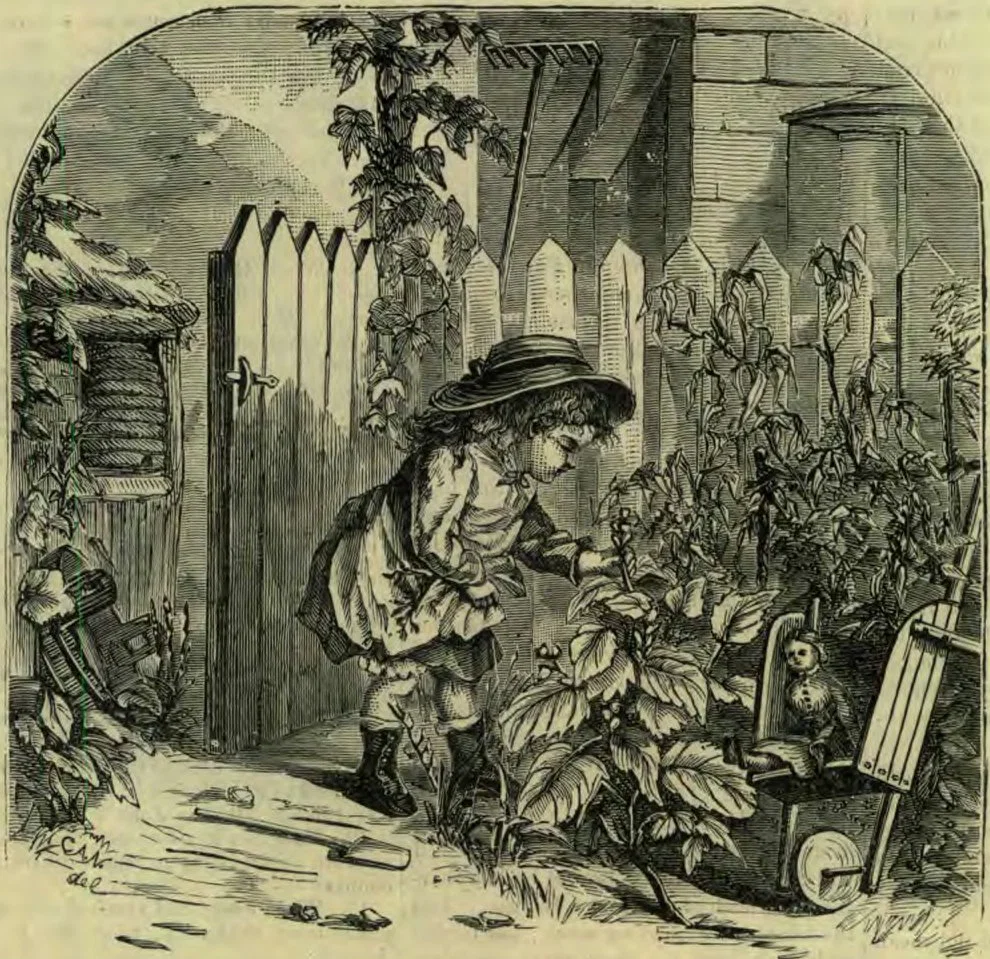
Have any of you children a garden of your own this summer? My little Nettie has one, and it has pleased me very much to see how nicely she has kept it, so free from weeds and grass.
I have not kept pace with her at all, for my garden is much larger than hers, and I have not as much time to weed as Nettie. There is one bed which has troubled me so much that I almost gave up in despair. The grass grew so fast and rank that it almost hid my border of mignonette. However, I kept to work at it, and now at midsummer feel quite rewarded; for my mignonette greets me with its sweet perfume every time I walk through the garden.
Now my Nettie is usually a happy little girl, but she has always had a hasty temper, and is never willing to take time enough for anything. If the buttons on her shoes happened to be set a little too far back, she would throw the button-hook across the room. If the tangles would not come right out of her hair in the morning, she would cry out, “Oh dear!” and away the comb would fly after the button-hook. When I talked to Nettie, and told her how much it grieved me to see her so impatient, she would feel sorry and promise to do better. But the next time anything came along to vex her, she would seem to have entirely forgotten her promise; and I felt as discouraged as when the grass would repeatedly grow up around the mignonette, after I had, as I thought, cleared it completely away.
One day not long ago, after one of her bursts of impatience, I said to her, “Nettie, you have taken good care of your garden out of doors this summer; but you have also a little garden in the house to tend, and this I fear you are not caring for so well. I see one weed, little now; but it is trying hard to grow large and strong, and outrank the beautiful flowers that are trying to grow with it. Can you tell me the name of this weed?”
“O mamma,” said Nettie, throwing her arms around my neck, “I know what you mean now, and you would call the weed ‘impatience.’”
“Well, Nettie,” I said, “I want you to be as diligent in rooting it up as mamma has been with the grass in her mignonette bed, or as you yourself have been with your own little garden.” And Nettie promised to try hard to do so.
Dear children, watch well this little garden in the house; pluck the weeds by the root while they are young and tender, or before you know it, they will claim the whole ground, leaving no room for the lovely flowers that should blossom in your hearts to cheer and delight not only yourselves, but all around you. AUNT LAURA.

THE BROKEN BRANCH.

A little branch on an apple-tree was heavy with blossoms and young fruit, and seemed as though it would bear a great many apples. It was the most promising branch in all the tree. But one stormy night, being tired of tossing to and fro with the wind, it grew proud and angry, and said, “Why should I hang here among all these barren branches, moving when they move, and resting when they rest? They have hardly any fruit themselves, and they hide my fruit. And what do I want with the great useless trunk below that has no fruit upon it? I should like to come down and grow by myself on the lawn, that all people might see me.”
No sooner were these words uttered, than a violent gush of wind, whirling through the tree, snapped off the discontented branch and dashed it to the ground. A little boy finding it there early next morning, stuck it up in the lawn for fun.
“This is capital,” thought the branch to itself; “now I shall take root and grow up by myself to be a famous tree.” But, alas! when the day grew toward noon, the sun shone with all its heat on the poor branch, and sent a pain right through it from one end to the other, spreading even to every little twig and leaf and blossom.
Now, when it was too late, the poor branch cried out, “Ah, how I wish I had remained on the old trunk! Now I begin to miss the sap and food that the trunk used to send up to me. I am dying with thirst, and all my body is scorching to death.”
Just then the master of the garden passed by, and he said to the gardener, “What a pity that fine branch has fallen! Clear it off the lawn at once, and chop it up for firewood.”
Every moment in our lives Jesus is helping us to be good. As the trunk gives sap to the branches, so Jesus gives us help to be good. But if we will not trust in him and pray to him, but go away from him and trust in ourselves, we lose the strength that he gives us, and, like the broken branch, we make ourselves fit for nothing but to be destroyed.
Remember that one branch cannot separate itself from the other branches. Your brothers and sisters and friends are all branches in the tree of Jesus. If you try to separate yourself from them and to think only of pleasing yourself, you are like the foolish broken branch.—Parables for Children.
Continue reading: THE HOMELY FACES