Review and Herald Publishing Company · Battle Creek, Michigan · May 14, 1903
Queenstown, the Port of Cork
By E. R. Palmer
“Land! Land!” the Emerald Isle
On the morning of the sixth day there is a stir of excitement on board. All eyes are strained to catch the first glimpse of the south-western point of Ireland, which, in fair weather, is the first land that is sighted. It is not difficult on this morning to pick out every Irishman on board, each is so proud of his native land, and talks with such enthusiasm of the wonders of the little “emerald isle.” In fair weather the sailing along the southern coast of Ireland is pleasant indeed. The numerous fishing-boats; the hills covered with greener grass than an American ever saw in his native land; the ruins of gray old castles, with an occasional white fort, its heavy guns looking out threateningly upon the sea,—all are items of absorbing interest. The enjoyment of the scenery is intensified in contrast with the monotony of the previous six days. The sight-seeing of a whole week seems to be crowded into a single day.
Queenstown, the Port of Cork
As we near Queenstown, the signals are run up the mast to inform the out-lookers that they must “come off” for the mails. Queenstown is the port of Cork. Vessels stop here long enough to leave the mail and the passengers for Ireland. These are taken to the town by a “tender” (a small boat), which comes out to the open sea to meet the largest vessels. In pleasant weather two or three rowboats usually come out to the ship to trade with the passengers over the ship’s side. One of the occupants of the little boat climbs aboard the ship, lets down a string for a basket of wares, and one thing after another is brought up for passengers to examine. Irish lace, blackthorn canes, and “schellales” are the most common articles offered for sale. Bits of shamrock are also sold at a shilling a bunch. “Will it grow?” asks a woman who wants a bit of sport at the expense of the poor peasant. “It will grow if you smile on it, lady,” answers the witty salesman, who is always ready for the many questions that are asked of him over the ship’s railing.
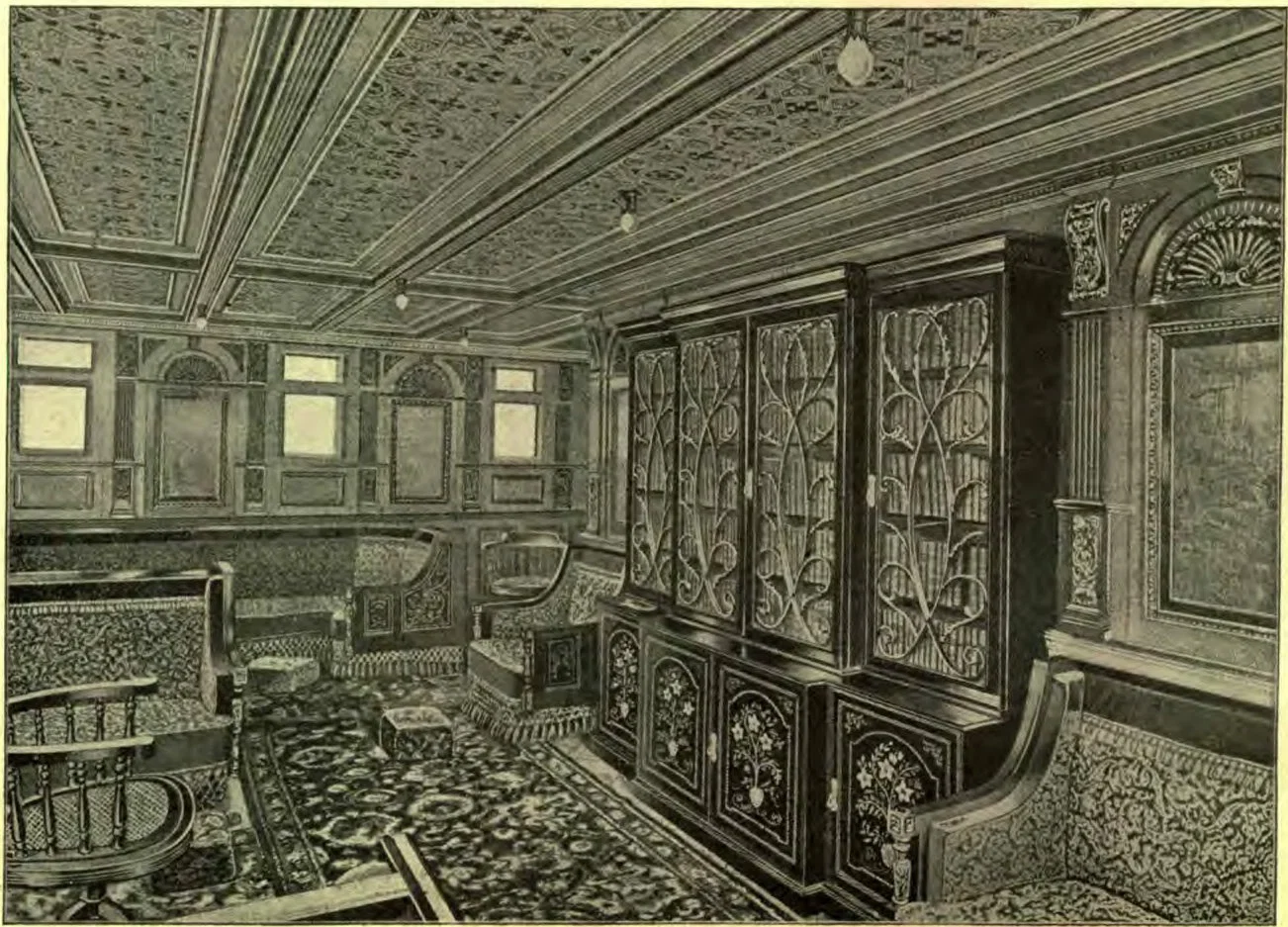
THE LIBRARY AND READING-ROOM OF THE “OCEANIC”
On to Liverpool
But the tender is soon loaded, and off to the town; and our good ship steams ahead again, through St. George’s Channel and the Irish Sea to Liverpool. The stately ship works her way carefully and proudly up the narrow channel of the River Mersey, among the hundreds and hundreds of other vessels going in and out, or lying at anchor. Little by little she finds her way to her position at the landing stage. The ropes are carried ashore in a small rowboat, and made fast, the donkey engines on board wind in the rope, and the ship is drawn to the side of the wharf and secured.
The landing stage at Liverpool is the largest and best floating dock in the world, being nearly a mile long, and about one hundred and fifty feet wide. It floats on the surface of the water, rising and falling with the tide, and is connected with the shore by run-ways on hinges. This is a fine arrangement; for ships fastened at this landing stage are not inconvenienced by the rising and falling tide, as the wharf rises with the ship, and their relation to each other is always the same. At an ordinary stationary wharf it is often difficult to manage a ship, and load and unload cargo, when the tide is rising and falling from four to twenty feet.
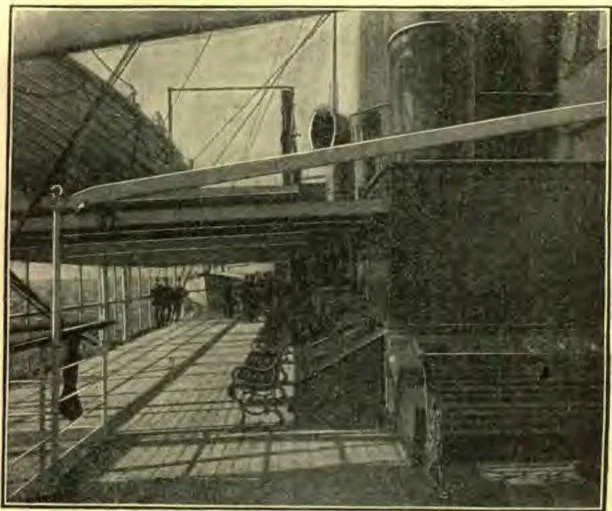
THE PROMENADE DECK
The second-class passengers must wait patiently while the gangway is thrown down for the first-class passengers, and the fine ladies and gentlemen go ashore, and get their baggage safely on the train. After waiting for the longest kind of a half-hour, the gangway is opened for the second-class; and we hasten down, and again enjoy the blessed privilege of standing squarely on the earth. What a pleasure to walk about on a surface that is not always tipping and falling out from under one’s feet!
But we must not waste time now. This is the one hour above all others on the way to London when it is necessary to be cool-headed and attend to business. We collect the hand baggage in one place; then secure the services of two or three pleasant-looking porters, and pay them a shilling each for giving us good service. They assist in finding the trunks, and in securing a customs officer to pass the baggage. Then it must be labeled for the special train which is waiting at the wharf to take the passengers to London. We are happy indeed when the trunks are all on board, and we have found places in the third-class compartments on the railway carriages.
English Railway Trains
Now, if you please, reserve your comments concerning the railway trains until you become better acquainted with them. Everything2looks new and strange; and we are likely to make unfavorable remarks concerning anything that is different from what we have previously been accustomed to. The railway carriages are short and low, and the entrance doors are in the side. Each car is divided by cross-sections into six or eight compartments; and each compartment will hold about eight passengers. The first experience in one of these compartments is a bit like being shut up in a box, and it does not strike an American favorably.
When our company of canvassers went from here to England last April, they greatly enjoyed thinking of the country to which they were going; and they fully resolved not to make any unfavorable comments, or introduce any national comparisons. In other words, they had rolled up the United States flag, and left it at home. They did first rate until they got into the railway train. Then one brother who did not understand about the first-, second-, and third-class compartments in an English train, found a pleasant corner for himself in a first-class compartment, though he had only a third-class ticket. When the porter went through the car to examine the tickets, he hustled this good brother with all his luggage into a third-class compartment, which was rather smoky and stuffy. This was too much; and he could not, or at least did not, restrain himself from remarking to the porter that he “ought to go to America, and see how they manage their railway trains;” but the other members of the party soon got this unruly brother into a corner, and refreshed his memory with his good resolutions.
Liverpool to London
It is about two hundred miles from Liverpool to London, and the run is easily made in four hours. This is a wonderfully charming ride after a long, monotonous voyage, and is likely to give the traveler a favorable impression of English country life. The far-famed hedgerows; the small, irregular fields; the beautiful country-seats, with an occasional ivy-clad ruin of some famous old castle or chapel; the greenest of all green grass; the great English oaks and elms; the numerous little patches of woodland, which are preserved with jealous care,—all unite in making landscapes of unparalleled beauty.
“What a short ride!” some one remarks. “I wish it were as long again,” says another, as we find ourselves actually drawing up to the Euston railway station, in the great city of London.
We are met by at least a half-dozen of our brethren, who are always careful that every missionary shall be properly looked after. Half of them at least are dressed in frock coats and shiny black hats; and we feel almost ashamed of our travel-stained condition, but there is something so cordial about an Englishman’s hand-shake and greeting that all are soon at ease.
A large ’bus has already been engaged. The passengers are hustled inside, trunks and boxes are stacked on the top, and off we roll for 451 Holloway Road, London N., the headquarters of our work in England. We are soon comfortably settled in lodgings, and are endeavoring to adjust ourselves to our new surroundings.
Now we are actually in London. I will not attempt to tell you about the little experiences through which one passes in learning how to do shopping, and how to get on pleasantly with the people. The man who keeps his eyes wide open, and who has thoroughly made up his mind to be pleased with everything, will soon find himself at home, and anxious to look about the grand old city, and see the interesting places about which he has heard from his childhood.
E. R. PALMER.
What the Heart Says
By Frank Walcott Hutt
If the heart says No, obey it,
Though a sacrifice it seems,
Till the earnest soul shall weigh it
In the scale with idle dreams.
All the good and noble say it:
If the heart says No, obey it.
If the heart says Yes, then follow,
Not to stop till something’s won,
And the false and mean and hollow
In the race are all outrun,
Swift and certain as the swallow,
If the heart says Yes, then follow.
FRANK WALCOTT HUTT.
Lessons from the Life of Daniel—II
By Ellen G. White
Causes of the Babylonish Captivity
“In the third year of the reign of Jehoiakim king of Judah came Nebuchadnezzar king of Babylon unto Jerusalem, and besieged it. And the Lord gave Jehoiakim king of Judah into his hand, with part of the vessels of the house of God: which he carried into the land of Shinar to the house of his god; and he brought the vessels into the treasure-house of his god.”
We also read of other invasions by the Babylonians a few years afterward, the first of which was in the reign of Jehoiachin the son of Jehoiakim:—
“Nebuchadnezzar king of Babylon came up against Jerusalem, and the city was besieged. And Nebuchadnezzar . . . carried away all Jerusalem, and all the princes, and all the mighty men of valor, even ten thousand captives, and all the craftsmen and smiths: none remained, save the poorest sort of the people of the land. And he carried away Jehoiachin . . . into captivity from Jerusalem to Babylon.”
“The king of Babylon made Mattaniah his father’s brother king in his stead, and changed his name to Zedekiah. Zedekiah was twenty and one years old when he began to reign, and he reigned eleven years in Jerusalem. . . . And he
“I did that which was evil in the sight of the Lord, according to all that Jehoiakim had done. For through the anger of the Lord it came to pass in Jerusalem and Judah, until he had cast them out from his presence, that Zedekiah rebelled against the king of Babylon.”
“And it came to pass in the ninth year of his reign, . . . that Nebuchadnezzar king of Babylon came, he, and all his host, against Jerusalem, and pitched against it; and they built forts against it round about. And the city was besieged unto the eleventh year of king Zedekiah. . . . And the city was broken up, and all the men of war fled by night: . . . and the king went the way toward the plain. And the army of the Chaldees pursued after the king, and overtook him in the plains of Jericho: and all his army were scattered from him. So they took the king, and . . . carried him to Babylon.”
“In . . . the nineteenth year of king Nebuchadnezzar king of Babylon, came Nebuzar-adan, captain of the guard, a servant of the king of Babylon, unto Jerusalem: and he burnt the house of the Lord, and the king’s house, and all the houses of Jerusalem, and every great man’s house burnt he with fire. And all the army of the Chaldees, that were with the captain of the guard, brake down the walls of Jerusalem round about. Now the rest of the people that were left in the city, and the fugitives that fell away to the king of Babylon, with the remnant of the multitude, did Nebuzar-adan the captain of the guard carry away. But the captain of the guard left of the poor of the land to be vinedressers and husbandmen. . . . So Judah was carried away out of their land.”
The prophet Nehemiah presents the evil-doings of the Jewish nation as the cause of their calamities. After recounting the Lord’s dealings with them, and their oft-repeated rebellion, he declares: “They were disobedient, and rebelled against thee, and cast thy law behind their backs, and slew thy prophets which testified against them to turn them to thee, and they wrought great provocations. Therefore thou deliveredst them into the hand of their enemies.”
God made Zion his holy habitation, the joy of the whole earth. But notwithstanding his goodness to his chosen people, they forgot him, and wandered into idolatry. Before their dispersion, repeated warnings came to them; but “they refused to hearken, and pulled away the shoulder, and stopped their ears, that they should not hear. Yea, they made their hearts as an adamant stone, lest they should hear the law, and the words which the Lord of hosts hath sent in his Spirit by the former prophets: therefore came a great wrath from the Lord of hosts.”
If men refuse to receive the admonitions of the Lord, if they persist in walking contrary to his instruction, he can not deliver them from the sure consequences of their own course. If they place themselves in opposition to his purposes, and forsake the principles of heaven, he permits their enemies to humble them.
Through Huldah the prophetess, God declared concerning the unrepentant nation: “Because they have forsaken me, and have burned incense unto other gods, that they might provoke me to anger with all the works of their hands; therefore my wrath shall be kindled against” Jerusalem.
And what was the result?—“Therefore came a great wrath from the Lord of hosts. Therefore it is come to pass, that as he cried, and they would not hear; so they cried, and I would not hear, saith the Lord of hosts: but I scattered them with a whirlwind among all the nations whom they knew not. Thus the land was desolate after them, that no man passed through nor returned: for they laid the pleasant land desolate.”
The children of Israel were taken captive to Babylon because they separated from God; they did not maintain his principles unadulterated with the sentiments of the nations around them. The people who should have been a light amid the surrounding darkness, disregarded the word of the Lord. They lived for themselves, and neglected to do the special work God had appointed them. And because of their failure to fulfil his purpose, he permitted them to be humbled by an idolatrous nation.
The Lord could not work for the prosperity of his people, he could not fulfil his covenant with them, while they were untrue to the principles he had given them to maintain, that they might be kept from the methods and practices of the nations that dishonored him. By their spirit and works the children of Israel misrepresented the righteousness of God’s character, and the Lord allowed the Babylonians to take them captive. He left his people to their ways; and in the calamities that befell them the innocent suffered with the guilty. MRS. E. G. WHITE.
Love for Christ as the Condition of Overcoming
“WHEN God made love a motive strong enough to conquer sin, he embodied it in the life of a man. Love for the living Christ is the condition of our overcoming.”
A Day of Rest
By Anna Burnham Bryant
“Hush!” With a tender frown, over her cradle-nest
Bendeth a mother down. “Hush! let my child have rest!”
And the wheels of the home are stopped and still
For the mother must have her own sweet will.
“Hush!” With a tender word, out of his heaven so blest
Leaneth the pitying Lord. “Hush! let my children rest!”
And the wheels of the world are stopped and still
For a Sabbath-rest: ’tis the Lord’s sweet will.
—Anna Burnham Bryant.
A Visit to an Old English City
By Flora Smith Corliss
AMONG the historical and interesting places near Liverpool, is the ancient city of Chester, situated on the banks of the River Dee, and about fifteen or sixteen miles from Birkenhead, England. It may be easily reached by the trains which run every hour or so during the day, on their way to and from the great city of London. Not long ago a company, of which the writer was one, visited Chester for a few hours to view the scenes and ruins of that city.
The main part of Chester is surrounded by a high stone wall, having five gates. This wall was first built by the Romans, who at one time invaded England, and had their headquarters at this place. This was during the early part of the Christian era, some say before that time. Who the founder of Chester was is not known; there is no history in existence which gives his name. Nearly all the wall has been rebuilt in later years; but a part of it, on the heights overlooking the River Dee, remains as originally built. The old castle at this point was probably erected at the same time as the wall on which it stands, but very little of the original structure has been able to withstand the storms which for centuries have beaten upon it. A little farther up the river is a dilapidated old mill, made famous by the song, “The Miller of the Dee.” Three times parts of this old mill have been destroyed by fire, the last one burning out the center, leaving both ends standing. What is left of the building shows that it was a large mill, but it is now fast crumbling to ruins. The window lights are all gone, and the older portions give evidence that it will soon be a thing of the past.
Just below this mill and the old castle, is a beautiful stone bridge, which was opened to traffic by the late Queen Victoria, in the year 1832. It has an arch two hundred feet in width, and when built, was the widest-spanned stone arch in the world.
The River Dee is very pretty at this point, with its clear waters and green banks. It is the dividing-point between England and North Wales. Up this river in an early day, vessels from the ocean came as far as Chester, so history affirms, though it requires some stretch of the imagination to understand how they managed to do so, except on the ground that the vessels then were tiny things compared with those of the present time.
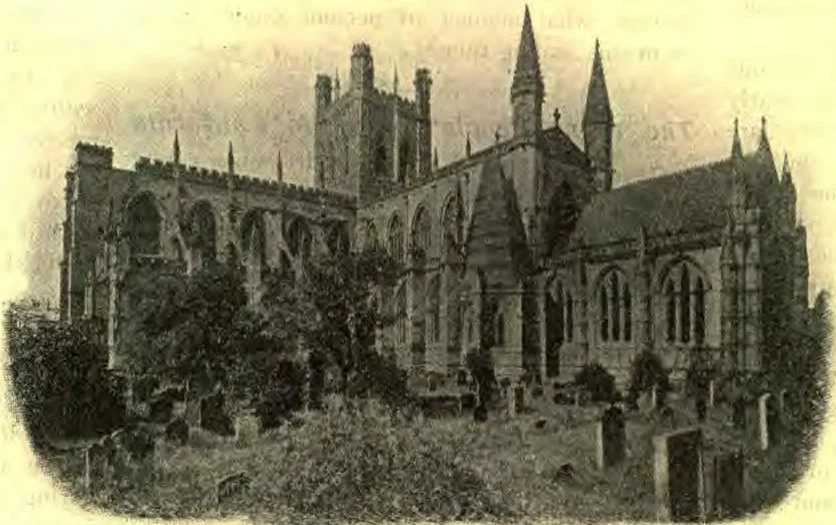
History tells of the visits of kings to this famous place. William the Conqueror came to vanquish this, the last English city to hold out against his dominion. Charles the First honored it with his presence, and Cromwell the usurper appeared, to terrorize its inhabitants. A section of the old cathedral walls still bears the marks of his inroads. A portion of this cathedral, erected in A. D. 1090, still stands as a monument to the faithful work done by its builders. New parts have, however, been added to keep it abreast of the demands of modern worshipers.
We chanced to be present in this mammoth structure during the time of service. The echoing and re-echoing of the grand organ tones through the various parts of the great edifice seemed quite strange, yet its effect was magical. At one time its resonant strain would repeat itself among the pendants of the high ceiling, seeming almost to make them tremble in their places; then a low, sweet note would start on its way, to die in the distance. This was in keeping with the part acted by the black-robed priest, who read his service in a tone of cadence which followed the round of the organ peals.
The ancient refectory, or refreshment room, of the cathedral is now used by the choir in their practise; but there yet remains the old stone pulpit in the wall, from which one priest used to read to the others while they partook of their repast. In this same cathedral we saw two faded and tattered flags which were in the siege of Quebec, at the time when General Wolfe was killed. Not far from the flags was the tomb of a soldier killed at the battle of Waterloo in 1815. People lie buried also in the massive stone walls, so that the church itself, as well as the yard which partly surrounds it, is a place of burial.
Many old dwelling-houses are still standing in this city. The oldest was built in 1003, nearly nine centuries ago. Over the door of one of the houses is written, in plain letters, “God’s Providence Is Mine Inheritance.” It is said that the family who lived in this house during the time of a terrible plague in this part of England, were the only persons who escaped the pestilence. Within the walls of this old city is a small green field, where it is said all the plague-stricken people were buried, though now not a vestige of their graves remains. The place, however, is kept free from buildings.
CHESTER CATHEDRAL
We visited another old house, in which an ancient Earl of Derby was imprisoned. Here for six weeks he was secretly fed by a servant, who afterward betrayed him. He was then taken to Bolton, where he was beheaded by order of Cromwell. There is still to be seen the room where he was imprisoned,—a little, dark closet, about four by six feet, with a massive door. To look at it, causes one almost to shudder at the thought of a human creature being imprisoned there for six weeks, and then escaping only to meet death. Through the lower floor of this house is a trap-door, the opening to a dark passage which led to the castle where the unfortunate earl was placed on trial.
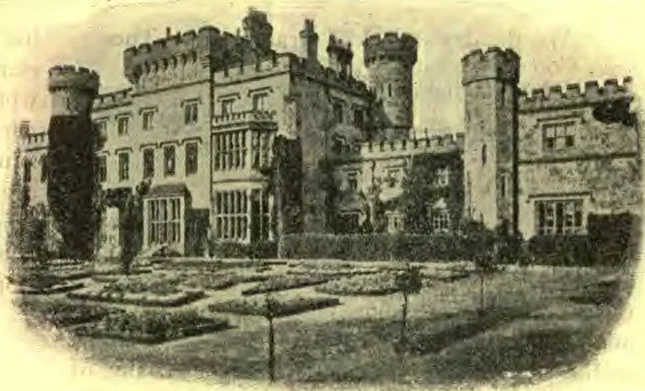
There are other interesting places in and near Chester, which there is not space in this article to describe, such as Eaton Hall, Hawarden Castle (the famous Gladstone home), and Grosvenor Park. We saw enough, however, to make us thankful that our lot had been cast in brighter days than those in which these ruins had their origin. FLORA SMITH CORLISS.
Birkenhead, England.
A Curious Bird's Nest
Those who are familiar with our common house-wren know how often it happens that very strange nesting-sites are at times decided upon by this bird. It is not so long ago that a small watering-pot, hanging within easy reach of a pump constantly used, was taken possession of, and the wrens, all unmindful of people constantly coming and going very near them, raised their broods, and returned the following summer. A permanent box was placed in the spot after the second season, and this has since been used.
HAWARDEN CASTLE, NEAR CHESTER
Wrens have been known to enter houses through open windows and attempt nest-building indoors, and in places, too, very inconvenient to the family, as in a card-basket on the piano, and on the pole supporting portières. But more curious than all other instances, it seems to me, is the following. In the spring of 1901 a hornets' nest that had long hung in my hall was temporarily placed in a covered porch. Some weeks later, a pair of wrens were noticed examining it very critically, and they finally decided that as a nesting-site it was in every way admirable. The fact that I was frequently sitting on that porch, often with two or three others, in no wise troubled them. The birds were absolutely fearless.
Having chosen the hornets' nest as a summer residence, the wrens first cleared out sufficient space for their use, and chipped a new circular entrance to it. This they made the more secure by placing in front a platform of twigs, many of which were thrust through the paper walls. This was not always easily done, and gave rise to some cross words, or so it seemed. Except a few feathers, there was nothing carried into the hole made by the wrens in the body of the hornets' nest. As soon as all was to their liking, eggs were laid, and the brood sufficiently reared.
While the parent birds were noticeably tame during the days of nest-making, they were even more so when there were young birds to look after. Without really troubling them, I tried in many ways to test their confidence in my good will toward them. Several times I leaned against the pillar supporting the roof of the porch, so as to bring my face within eighteen inches of the opening to the nest. Twice, under such circumstances, one of the old birds darted by me and entered, but at other times waited most impatiently until I again sat down in the chair near by.
One fact that interested me greatly was that when interrupted by my coming, the wren, firmly holding a wriggling worm in its beak, would scold crossly, making a loud whirring and shrill sound. How the bird could make the sound and yet retain the worm in its beak, I leave to others to explain.—Selected.
Called to Service Wherever You Are
WHEREVER you are, in whatever condition, the Master calls for your service.
Love's Daily Task: Work Offered to Thee
“ALL the day’s work — straight from Thee
Comes the task love sets for me.
I will attempt it;
For be the day weary, or be the day long,
At length it ringeth to evensong!”
Our Young People
By Mrs. S. M. Butler
The call which has come to our young people to enter the Lord’s vineyard is indeed encouraging. The time has come in the work of the third angel’s message when the energies and fresh enthusiasm of the youth are needed. Many of our youth have nobly responded to the call; they have dedicated their lives to the Master’s service, and have entered various lines of work. Others have entered our schools, that they may fit themselves by training for future usefulness. The time has come when the prophecy made in Mal. 4:6 is being fulfilled: “And he shall turn the heart of the fathers to the children, and the heart of the children to their fathers.”
Parents are beginning to work for their children; they are sacrificing that the children may be sent to schools where they will receive a Christian education, and be trained for service in the message. In other words, they are beginning to do missionary work in their homes, and to feel that it is as important to save their own children as those of foreign lands. The result of this work is beginning to appear, the leaven is working, and a large army of young people are entering the work. This should make our hearts rejoice, and encourage us to work more earnestly to bring others into the fold.
There are many of the young people in our churches who need encouragement. In nearly every company of Sabbath-keepers there are youth from twelve to seventeen years of age who are left to drift. They do not have the opportunity of attending the church school, so they do not have that counteracting influence. They believe the truth and attend the Sabbath-school and church services, but further than that little is done for them. Still they are the lambs of the flock, which we are especially commanded to care for. On account of there being so few young people in some of our churches, it is not thought best to start a young people’s organization, and so they are allowed to drift about without the aid that they are entitled to expect. But is this as it should be?—No; they should be encouraged to do something. If a regular young people’s society can not be formed, an hour should be appointed for Bible study sometime during the week, when all the young people can come together, and engage in studying the truths of the message. A leader should be chosen from the older people, “one who will talk little and encourage much,” and upon whose heart the burden of this work rests. The youth should be encouraged to take the lead occasionally, or in turn, that they may learn how to overcome their diffidence in working for the Master. Let the leader go with them among the people of the community, teaching them how to do practical missionary work. Visit the sick and the sorrowing, and minister to their wants, distribute our literature, etc. Get the youth to do something useful. When they have learned to perform well these simple duties, they will be prepared for larger responsibilities. Give them then some place in the Sabbath-school work, and encourage them, under wise direction, to start branch Sabbath-schools.
You may say that it takes time to do all this. Of course it does. Judson labored many years in Burma before he saw any fruits of his work, but the influence of his efforts has been going on ever since, and eternity alone will reveal the result. So in this work; it will require some of our time and of our best energies, but the harvest will be bountiful if the seed-sowing is faithfully done; for we are told that “no one can labor in the Sabbath-school or in the temperance work without reaping a bountiful harvest, not only in the end of the world, but in the present life.”
MRS. S. M. BUTLER.
The Young People’s Work in California
By C. A. H.
At Sanitarium, California, thirty-nine young people are working jointly with the church missionary society. They meet every Sabbath afternoon for the consideration of foreign missions and missionaries, different organizations and their work, and to hold social services. Collections are taken to assist in the distribution of the Signs, Sentinel, and Health Journal. The members are also selling “Christ’s Object Lessons,” and holding band meetings. A good interest is manifested, as attested by the encouraging testimonies in the social meetings.
The Young People’s Society at Stockton reports twenty-two members, with an addition of ten during the last quarter. The funds collected, $4.33, have been expended largely for tracts, which have been used in practical work by the members. Other branches of practical Christian work have also been carried on, such as visiting those in need, holding cottage prayer-meetings, and giving regular Bible readings. The Life Boat has been introduced into the State hospital, and two subscriptions obtained from the secretary of the Y. M. C. A. The subjects of home and foreign missions have been considered in the weekly meetings of the Society.
Every Sabbath at twelve o’clock, or immediately following the morning service, forty earnest-hearted young people meet at the San Francisco church in prayer and counsel, Bible studies and social service. The subjects discussed in the meetings have been, “How to Help Others,” “Using Our Talents,” “Young People as Real Workers.” The members are especially interesting themselves in missionary correspondence, visiting, Life Boat work, holding meetings at the jail and at the Sailors’ Home, etc. The secretary writes: “A good interest is shown in the work with The Life Boat, and this is giving the young people a good Christian experience.” Twenty dollars was raised to purchase copies of this paper. Ten members were added during the last quarter of 1902.
A Young People’s Society of twenty members meets every Sabbath at 3:15 P. M., at San Jose, California. Bible studies upon different subjects, and missionary work at home and abroad, form a basis of the meetings. The Society is raising a fund to assist in the education of a native of Fiji. Besides this the members are selling “Christ’s Object Lessons” and papers, and filling reading-racks.
At Fresno sixty-four persons are banded together for the purpose of carrying out the aims of the Young People’s work. Their meetings are held each Sabbath, when Bible studies are taken up, and home and foreign missions are considered. The members have been mailing The Signs of the Times, and distributing copies in the city. A good interest is manifested. A course of Bible studies was recently started, which all take part in heartily.
The Young People’s Society at Monterey has only ten members; but notwithstanding this, the secretary reports that the members “are all willing to do what we are able.” At their weekly meetings the lessons in the INSTRUCTOR and Bible studies have been considered principally. The Society has sold copies of The Life Boat and The Pacific Health Journal, visited the sick, and done “whatsoever” they find to do.
Surely our Heavenly Father is pleased with such efforts and with such willingness. If we all do “what we are able,” by and by we shall find that we have more ability. Soon, we hope, God will pour upon his people a pentecostal blessing. In his word we read, “Thy people shall be willing in the day of thy power,”—willing to receive his blessing when we are willing to work for him. What matter if we are “so inexperienced”? “God is able to make all grace abound toward you,” so that “your labor is not in vain in the Lord.” C. A. H.
THE WEEKLY STUDY
By W. A. S.
Onward Amid Difficulties
(May 17-23)
TRACE the development of the work under the early pioneers, as given in chapters XIII and XIV of “Rise and Progress.”
If possible have a map of the United States before you, and note the points where the truth had gained a foothold.
Contrast the literature of the message then with what the Lord has given us now.
In those days the messengers spared not themselves, going to and fro, searching out the Lord’s sheep among the advent believers. Now a great people are to be stirred to the same activity to search out lost sheep in all the earth. See Eze. 34:11-16.
Read “The Sealing,” page 29, “Early Writings,” as a selection for this meeting. With all heaven interested and active and desperately in earnest, what manner of persons ought we to be in this sealing time? W. A. S.
Reno, Nevada
“THE attendance is usually good, and the interest is also encouraging,” writes the secretary of the Reno Society. With a membership of but fifteen, this Society has raised a fund of $15.25 during the past three months, which has been used in helping the poor and paying for a club of the Signs. Jail work, selling and mailing the Signs and Life Boat, and distributing our literature in the station and paper-racks, constitute the principal work of this Society.
Question Hints
(To be given to different members, and answered in the meeting)
To whom is the gospel now to go? Notice in Rev. 10:7 that the gospel, or the mystery of God, is to close in the days of the voice of the seventh angel “when he shall begin to sound.” We have now reached the fifty-eight year since he began to sound. Can you prove this? A study of the seven trumpets of Revelation 8 and 9; 10:7; 11:15 is involved.
The Lord has promised to cut short his work in righteousness. Find the text; also show from the article entitled, “How Shall We Meet the Demand,” in the Review of February 24, how this will be done.
Clock Talk
I DREAMED I heard the little clock
Say, in measured speech, “Tick, tock;
I keep the time by day and night,
And always try to keep it right.
By watching me you’ll always see
The time when you in bed should be.
When morning light shall greet your eyes,
Then you may see the time to rise,
And when your breakfast you should eat,
And when your teacher you should meet;
So on and on through all the day,
The time to work and time to play.
Then always be on time—tick, tock.”
’Twas thus I heard the little clock.
— Selected.