The Youth’s Instructor, Vol. 31, No. 38.

MORNING IN THE MOUNTAINS

The Youth’s Instructor

Sep 19, 1883

S. D. A. Publishing Association · Battle Creek, Mich. · Sep 19, 1883

MORNING IN THE MOUNTAINS.
MORN on the mountains! streaks of roseate light Up the high east athwart the shadows run; The last low star fades softly out of sight, And the gray mists go forth to meet the sun.
And now from every sheltering shrub and vine, And thicket wild with many a tangled spray, And from the birch and elm and rough-browed pine, The birds begin to serenade the day.
And now the cock his sleepy harem thrills With clarion calls; and down the flowery dells, And from their mossy hollows in the hills, The sheep have started all their tinkling bells.
Lo the great sun! and nature everywhere Is all alive, and sweet as she can be; A thousand happy sounds are in the air, A thousand by the rivers and the sea.
The dipping oar, the boatman's cheerful horn, The well-sweep creaking in its rise and fall; And pleasantly along the springing corn, The music of the plowshare, best of all,—
The insect's little hum, the whirr and beat Of myriad wings, the mower's song so blithe, The patter of the school-boy's naked feet, The joyous ringing of the whetted scythe,—
The low of kine, the falling meadow bar, The teamster's whistle gay, the droning round Of the wet mill-wheel, and the tuneful jar Of hollow milk-pans, swells the general sound.
And by the sea, and in each vale and glen, Are happy sights as well as sounds to hear, The world of things, and the great world of men, All, all is busy, busy far and near.
The ant is hard at work, and everywhere The bee is balanced on her wings so brown; And the black spider on her slender stair Is running down and up, and up and down.
The pine-wood smoke in bright, fantastic curls, Above the low-roofed homestead sweeps away, And o'er the groups of merry boys and girls, That pick the berries bright, or rake the hay.
Morn on the mountains! the enkindling skies, The flowery fields, the meadow, and the sea, All are so fair, the heart within me cries, How good, how wondrous good our God must be!
—Alice Cary.

TYRE

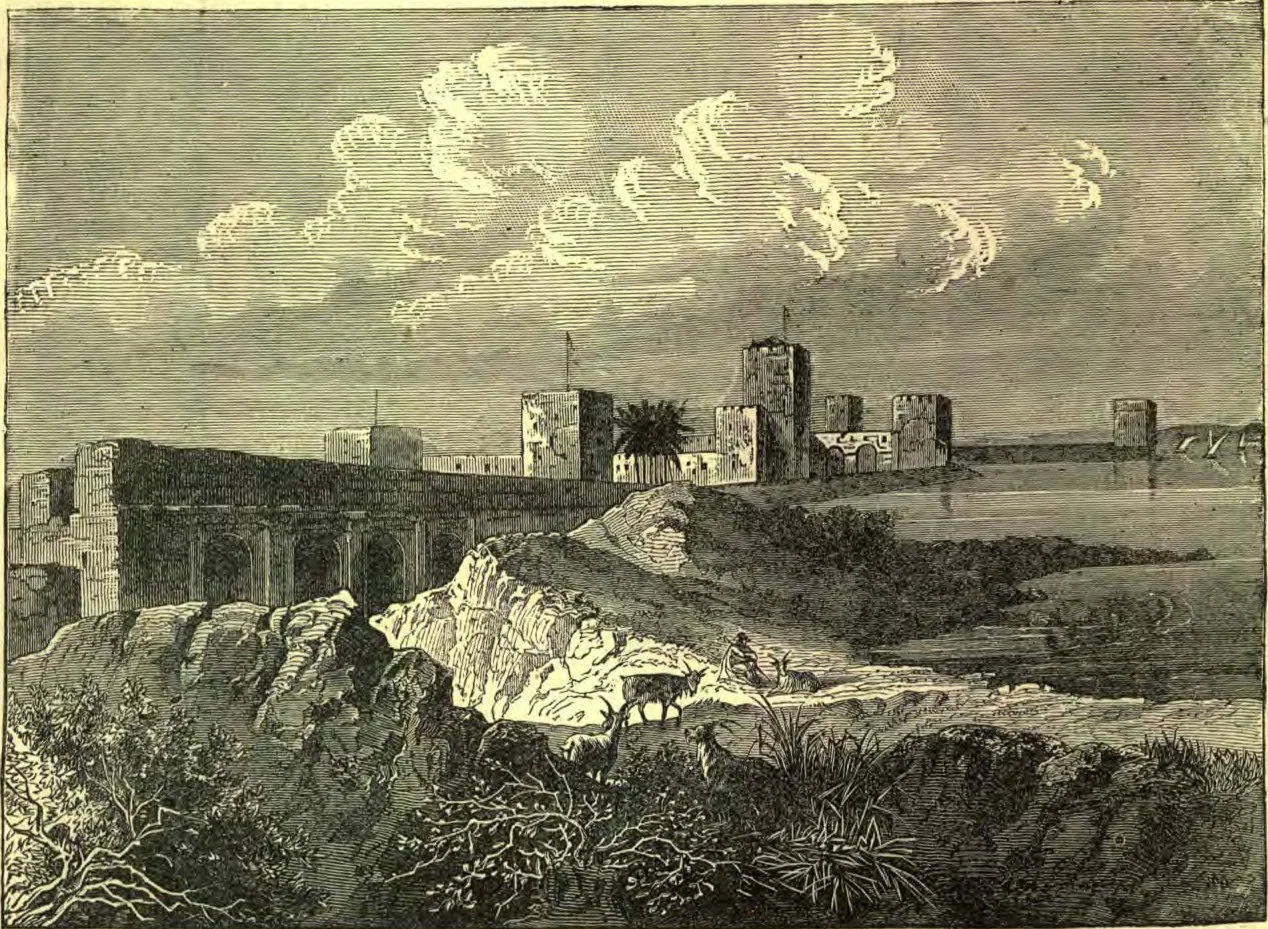
NEARLY a hundred miles north of Jerusalem, on the sea-coast of Phoenicia, stood a city “of perfect beauty,” called by the prophet “the crowning city, whose merchants are princes, and whose traffickers are the honorable of the earth.” This city, Tyre, was of no mean parentage; it was settled by the people of “great Sidon” before Joshua’s time, and even then was called “a strong city.”
There were two cities by the name of Tyre, one standing on the mainland, and the other on an island opposite from the shore and half a mile away. The former was called Old Tyre, and the latter New Tyre. The Tyrians possessed great wealth, which they had obtained by trading. Their ships—frail, crazy crafts they were, compared with the steamships of modern times—sailed to every part of the Mediterranean, and even ventured out on the Atlantic in search of precious things. Their principal manufacture was a purple dye made from an inexhaustible supply of shell-fish found near the coast. Although this dye was made by other nations, that manufactured by the Tyrians sold more readily than any other, and commanded a higher price, on account of its more brilliant hue.
Tyre was a dissolute and idolatrous city. A large part of the inhabitants were slaves, who had been obtained by stealth and fraud, the merchants and sailors carrying away all who came in their power.
In Solomon’s day, Hiram, the king, seems to have been on the most friendly terms with the Israelites, furnishing them with beams of cedar for the temple, and a workman “skillful to work in gold, and in silver, in brass, in stone, in purple, and in graving.”
The city was strongly fortified by high walls and towers, and her “borders were in the midst of the seas.” Yet these fortifications, which were deemed well-nigh impregnable, and her boasted wealth, caused her heart to be lifted up, and she brought down upon her guilty head the most scathing denunciations of prophecy. Says the prophet Ezekiel, “Because thine heart is lifted up, and thou hast said, I am a God, I sit in the seat of God, in the midst of the seas; yet thou art a man, and not God, though thou set thine heart as the heart of God; . . . behold, I will bring strangers upon thee, the terrible of the nations: and they shall draw their swords against the beauty of thy wisdom, and they shall defile thy brightness. . . . Thou shalt die the deaths of them that are slain in the midst of the seas.” 720 years before Christ, the king of Assyria destroyed Old Tyre, and laid siege to New Tyre, which, after a persevering effort of five years, he was unable to conquer. Later, Nebuchadnezzar besieged it thirteen years, but history gives no account of the result. From these attacks it recovered, regaining nearly all its former splendor.
Still later, Alexander the Great, king of Macedon, in his career of war and bloodshed, found Tyre in his path to glory. Bent on conquering the world and becoming sole monarch, he razed Old Tyre to the ground, and then laid siege to the island city. It was surrounded on all sides by a wall one hundred and fifty feet high. This wall reached down into the water, and extended out in such a way as to make it impossible for a fleet to come near enough the walls to tear them down. Notwithstanding the danger and difficulties attending such an undertaking, Alexander determined to lay siege to the place, knowing that if he left unconquered so important a maritime city, he would have serious difficulty in subduing Egypt.
So he made a causeway from the mainland to the island. Large cedars were hewn down and brought from Lebanon, and cast into the midst of the sea; on these were placed stones, and then more trees and stones, with a soft earth that cemented the whole together. The Tyrians at first mocked the army, flinging darts and taunting speeches from the city walls; but as they saw the vastness of the work, they became alarmed, and invented every means of hindering the men. Their divers swam under the water, and with grappling-irons tore away the trees cast into the sea. Boats full of archers came near, and hurled javelins and arrows, and even fire among the workmen. It was impossible to ward off these blows, on account of the swiftness and ease with which the boats darted over the water. As the work neared the city, all manner of deadly weapons were hurled from the wall on the workmen below. Large shields heated red hot and filled with burning sand were cast down. The sand penetrated every crevice of the armor, causing the workmen to tear off their clothes, so that they were exposed to the darts of the enemy.
To obtain stones and earth sufficient to carry on so great an undertaking, Alexander took the walls and ruins of Old Tyre, thus literally fulfilling the words of the prophet, “They shall destroy the walls of Tyrus, and break down her towers; I will also scrape her dust from her, and make her like the top of a rock. It shall be a place for the spreading of nets in the midst of the sea. They shall lay thy stones and thy timber and thy dust in the midst of the water.”
Several times the conqueror was on the point of raising the siege; yet, impelled by a power higher than any of earth, he, with increased energy, pushed forward the work, and at the end of seven months stood victor over “the mistress of the seas.”
The town he burned with fire, and took captive those who had not escaped, as predicted by the prophet: “I will bring forth a fire from the midst of thee, and I will bring thee to ashes upon the earth;” and (Joel 3) “I will return your recompense upon your own head; and I will sell your sons and your daughters.”
Yet after this, Tyre was rebuilt, and became a city of some importance. The apostle Paul, finding disciples in that city, tarried there several days. After his time it fell into the hands of the Turks, and has gradually sunk into insignificance. Says one who has visited this place, “I was at every point struck with the aspect of desolation: broken columns half-buried in the sand, huge fragments of sea-beaten ruins, and confused heaps of rubbish; with a solitary fisherman actually spreading his net upon the rocks. And this is all we see of the once mighty Tyre. Her columns are cast into ‘the midst of the waters;’ the sites once occupied by her palaces have been made bare ‘as the top of a rock;’ her harbors are filled up by drifting sand, and her commerce and her wealth have long deserted her. ‘What city is like Tyrus the destroyed in the midst of the sea?’” W. E. L.

TELL THE TRUTH.

“Lost your situation? How did it happen, my boy?”
“Well, mother, you’ll say it was all my own carelessness, I suppose. I was dusting the shelves in the store, and in trying to hurry up matters, sent a lot of fruit jars smashing to the floor. Mr. Barton scolded, and said he wouldn’t stand my blundering ways any longer; so I packed up and left.”
His mother looked troubled.
“Don’t mind, mother; I can get another situation soon, I know. But what shall I say, if they ask me why I left the last one?”
“Tell the truth, James, of course. You wouldn’t think of anything else?”
“No; I only thought I’d keep it to myself. I’m afraid it may stand in my way.”
“It never stands in one’s way to do right, James, even though it may seem to sometimes.”
He found it harder than he had expected to get a new situation. He walked and inquired, until one day something really seemed to be waiting for him. A young-looking man, in a clean, bright store, newly started, was in want of an assistant. Things looked very attractive, and so neat and dainty that James, fearing that a boy who had a record of carelessness might not be wanted there, felt sorely tempted to conceal the truth. It was a long distance from the place from which he had been dismissed, and the chances were slight for a new employer’s hearing the truth. But he thought better of it, and frankly told exactly the circumstances which had led to his seeking the situation.
“I must say I have a great preference for having neat-handed, careful people about me,” said the man good humoredly, “but I have heard that those who know their faults, and are honest enough to own them, are likely to mend them. Perhaps the very luck you have had may help you to learn to be more careful.”
“Indeed, sir, I will try very hard,” said James earnestly.
“Well, I always think a boy who tells the truth, even though it may seem to go against him,—Good morning, uncle. Come in, sir.”
He spoke to an elderly man who was entering the door, and James, turning, found himself face to face with his late employer.
“Oh, ho!” he said, looking at the boy, “are you hiring this young chap, Fred?”
“I haven’t yet, sir.”
“Well, I guess you might as well try him. If you can only,” he added, laughing, “keep him from spilling all the wet goods, and smashing all the dry ones, you’ll find him reliable in everything else. If you don’t like him, I’ll be willing to give him another trial myself.”
“If you think that well of him,” said the younger man, “I think I shall keep him myself.”
“O mother,” said James, going home after having made an agreement with his new employer, after such a recommendation from his old one, “you were right, as you always are. It was telling the truth that got it for me. What if Mr. Barton had come in there just after I had been telling something that wasn’t exactly so?”
“Truth is always best,” said his mother; “‘the truth, the whole truth, and nothing but the truth.’”
—The Standard.

STICK TO YOUR BUSH.

A successful business man said: “One day, when I was a lad, a party of boys and girls were going to a distant pasture to pick whortleberries. I wanted to go with them, but was fearful that my father would not let me. When I told him what was going on, and he at once gave me permission to go with them, I could hardly contain myself for joy, and rushed into the kitchen and got a big basket, and asked mother for a luncheon. I had the basket on my arm, and was just going out of the gate, when my father called me back. He took hold of my hand, and said in a very gentle voice, ‘Joseph, what are you going for, to pick berries or to play?’ ‘To pick berries,’ I replied. ‘Then, Joseph, I want to tell you one thing. It is this: When you find a pretty good bush, do not leave it to find a better one. The other boys and girls will run about, picking a little here and a little there, wasting a great deal of time, and not getting many berries. If you do as they do, you will come home with an empty basket. If you want berries, stick to your bush.’”
“I went with the party, and we had a capital time. But it was just as my father said. No sooner had one found a good bush than he called all the rest, and they left their several places, and ran off to the new-found treasure. Not content more than a minute or two in one place, they rambled over the whole pasture, got very tired, and at night had very few berries. My father’s words kept ringing in my ears, and I ‘stuck to my bush.’ When I had done with one, I found another, and finished that; then I took another. When night came, I had a large basketful of nice berries, more than all the others put together, and was not half so tired as they were. I went home happy. But when I entered, I found my father had been taken ill. He looked at my basketful of ripe black berries, and said, ‘Well done, Joseph. Was it not just as I told you? Always stick to your bush.’”
“He died a few days after, and I had to make my own way in the world as best I could. But my father’s words sunk deep into my mind, and I never forgot the experience of the whortleberry party; I stuck to my bush. When I had a fair place and was doing tolerably well, I did not leave it and spend weeks and months in finding one a little better. When other young men said, ‘Come with us, and we will make a fortune in a few weeks,’ I shook my head, and ‘stuck to my bush.’ Presently my employers offered to take me into business with them. I stayed with the old house until the principals died, and then I took their place. The habit of sticking to my business led people to trust me, and gave me a character. I owe all I have and am to this motto: ‘Stick to your bush.’”

NEW-TESTAMENT HISTORY.

LESSON 153.—THE GOSPEL PREACHED IN EPHESUS.

After the things related in our last lesson, Paul still remained in Corinth many days. Then, taking leave of the brethren, he embarked for Syria, accompanied by Aquila and Priscilla, whom he left at Ephesus, a city in the western part of Asia Minor.
Paul made but a brief stay in Ephesus at this time. While there, he went into the synagogue, and reasoned with the Jews. It seems that they were pleased with him; for they urged him to remain longer. Paul, however, went on his way, promising that, if it should be the will of the Lord, he would visit them on his return.
So, taking ship, he sailed to Cæsarea; and when he had gone up and saluted the brethren there, he went on to Antioch.
After remaining in Antioch some time, Paul took a tour throughout Galatia and Phrygia, visiting the churches, and strengthening the brethren, wherever he went.
While Paul was on this journey, there came to Ephesus a Jew by the name of Apollos. This man was fervent in spirit, well versed in the Scriptures, and very eloquent. Having been born in Alexandria, he had probably enjoyed good opportunities, and was a man of learning. This ardent believer instructed the Ephesians in the way of the Lord; but when Aquila and Priscilla heard him, they perceived that he knew only the baptism of John. So they took him home with them, and taught him more perfectly in the things which they had learned of Paul. This learned Jew from the proud city of Alexandria, although powerful in eloquence, and “mighty in the Scriptures,” was not above receiving instruction from these humble tent-makers with whom Paul had so long wrought.
After a time, Apollos had a mind to go into Achaia. When this was known to the brethren, they wrote him a letter of commendation, exhorting the disciples wherever he went to receive him with confidence. The labors of Apollos were very efficient; for he successfully confuted the Jews in public debate, proving from the Scriptures that Jesus was the Christ.
It seems that Apollos finally went to Corinth; for it is said that while he was there, Paul, having completed his tour through the upper country, came down to Ephesus. On meeting with the Ephesian brethren, Paul asked them if they had received the Holy Ghost. They replied that they had not so much as heard that there was any such thing. Then said Paul, “Unto what then were ye baptized?” They answered, “Unto John’s baptism.” Then said Paul, “John verily baptized with the baptism of repentance, saying unto the people that they should believe on him who should come after him, that is, on Christ Jesus.”
On hearing this, they were baptized in the name of the Lord Jesus. Then Paul laid his hands on them, and the Holy Ghost, coming upon them, caused them to speak in different languages, and to prophesy. After these things, Paul continued in the place for three months, disputing with the Jews about the things that concern the kingdom of God, and persuading them to embrace the Lord Jesus as their Saviour. After a time, however, some of the Jews hardened their hearts, and spoke openly against the things that Paul taught, trying to turn the people from the truth. So Paul withdrew from the synagogue, taking the believers with him, and reasoned daily in the school of one Tyrannus.
Thus Paul continued to teach for two years; so that the people in all that region, both Jews and Greeks, had opportunity to hear the gospel of the Lord Jesus Christ. They had the evidence, not only of the proofs which Paul brought from the Scriptures, but also of the startling miracles which the Lord gave him power to perform. Even handkerchiefs and aprons taken from Paul to the afflicted caused some to recover from sickness, and the evil spirits to depart from others.
Then certain strolling Jews, who were exorcists, were so bold as to call over those who had evil spirits the name of the Lord Jesus, saying, “We adjure thee by Jesus whom Paul preacheth.” Among others who did so were the seven sons of one Sceva, who was a Jew, and a chief priest. But the evil spirit answered them, saying, “Jesus I know, and Paul I know, but who are ye?” In one instance, the man who was possessed of the evil spirit “leaped on them, and overcame them, and prevailed against them, so that they fled out of that house naked and wounded.”
When this was known, great fear fell on all the Ephesians, both Jews and Greeks, and the name of the Lord was greatly magnified. Many of those who believed, confessed and made known their evil deeds. Among them were not a few who had practiced curious arts; and they, bringing forth their books of magic, burned them in the sight of all. The price of the books burned was estimated at fifty thousand pieces of silver. Thus the word of the Lord prevailed mightily.

QUESTIONS.

1. What persecution was raised against Paul at Corinth? Acts 18:12–16.
2. How did the efforts of his enemies come to naught?
3. How had he been encouraged to remain in that city?
4. On leaving Corinth, for what country did Paul set sail?
5. Who accompanied him a part of the way?
6. Where did he leave them?
7. What did Paul do there?
8. What evidence have we that the Ephesian Jews were pleased with his preaching?
9. To what place did Paul next go?
10. What is said about his stay there?
11. With what church did he afterward spend some time?
12. On what journey did he then set out?
13. What did he do as he traveled?
14. Who came to Ephesus while Paul was on this journey?
15. What were the qualifications of this man? Acts 18:24, 25.
16. How did he teach the way of the Lord? Verse 25.
17. How far did he understand the gospel?
18. Who noticed this deficiency?
19. What did they do for Apollos?
20. What noble trait of character did he manifest in listening to their instruction?
21. When Apollos wanted to go to another place, what did the brethren do for him?
22. What can be said of the efficiency of this man’s preaching?
23. To what city did he finally go?
24. When Paul had completed his tour through the upper country, to what place did he go?
25. What question did Paul ask the Ephesian brethren?
26. How did they answer him?
27. How did he show the necessity of their going further than the baptism of John? Acts 19:4.
28. How did they show their faith in Paul’s teaching?
29. What experience did they have when Paul laid his hands on them?
30. What course did Paul then take? Verse 8.
31. Why did he withdraw from the synagogue, taking the believing Jews with him?
32. Where did Paul then go?
33. How long did he continue to teach and reason in this school?
34. For what did this give opportunity?
35. What evidence had all the people that the Lord approved the teaching of Paul?
36. What special miracles are mentioned?
37. What experiment was tried by some strolling Jews who pretended to cast out evil spirits?
38. Who among them are specially mentioned?
39. What did the evil spirit say to them?
40. How were these men taught not to use the name of Jesus in this way?
41. How were the Ephesians affected when they heard of these things?
42. What course was taken by many who believed?
43. What had many of them been in the habit of doing? Verse 19.
44. What did these men do with their books of magic?
45. At what price were these books valued?

NOTES.

Acts 18:19. Ephesus. Ephesus lay in a fertile, alluvial plain south of the river Cayster, not far from the coast of the Ionian Sea, between Smyrna and Miletus, distant from the first-named city three hundred and twenty stadia, or nearly forty miles. Under the Roman government, Ephesus was a free city, with its own magistrates and other officers, and legal assemblies.—Whitney’s Hand-book. It could be approached at that time by water, though the site of the ancient city is now two or three miles from the coast. With a favoring wind, the passage from Corinth to Ephesus could be made in two or three days.—Hackett.
Ver. 22. Cæsarea. This Roman capital of Judea was the usual and most convenient port for travelers journeying to Jerusalem.—Rev. Com.
Ver. 24. Alexandria, a celebrated city in Lower Egypt, situated between the Mediterranean Sea and the Lake Mareotis, not far from the most westerly mouth of the Nile. It was founded by Alexander the Great, B. C. 332, and peopled by colonies of Greeks and Jews. Alexandria rose rapidly to a state of prosperity, becoming the center of commercial intercourse between the East and the West, and in process of time was, in point of both magnitude and wealth, second only to Rome itself. The ancient city was about fifteen miles in circuit, peopled by 300,000 free citizens and as many slaves. From the gate of the sea ran one magnificent street, 2,000 feet broad, through the entire length of the city, to the gate of Canopus, affording a view of the shipping in the port, whether north in the Mediterranean, or south in the noble basin of the Mareotic lake. Another street of equal width intersected this at right angles, in a square half a league in circumference.
Upon the death of Alexander, whose body was deposited in this new city, Alexandria became the regal capital of Egypt, under the Ptolemies, and rose to its highest splendor. During the reign of the first three princes of this name, its glory was at the highest. The most celebrated philosophers from the East, as well as from Greece and Rome, resorted thither for instruction; and eminent men, in every department of knowledge, were found within its walls. Ptolemy Soter, the first of that line of kings, formed the museum, the library of 700,000 volumes, and several other splendid works. At the death of Cleopatra, B. C. 26, Alexandria passed into the hands of the Romans; and after having enjoyed the highest fame for upward of a thousand years, it submitted to the arms of the caliph Omar, A. D. 646.
The present Alexandria, or according to the pronunciation of the inhabitants, Skanderia, occupies only about the eighth part of the site of the ancient city. The splendid temples have been exchanged for wretched mosques and miserable churches, and the magnificent palaces for mean and ill-built dwellings. The city, which was of old so celebrated for its commerce and navigation, is now merely the port of Cairo, a place where ships may touch, and where wares may be exchanged. The modern city is built with the ruins of the ancient. The streets are so narrow that the inhabitants can lay mats of reeds from one roof to the opposite, to protect them from the scorching sun. The population consists of Turks, Arabs, Copts, Jews, and Armenians.—Amer. T. S. Bib. Dic.
Chap. 19:1. The upper coasts. The upper or more elevated regions of Asia Minor. The writer refers here particularly to the provinces of Phrygia and Galatia. These regions were called upper, because they were situated on the high table-land in the interior of Asia Minor, while Ephesus was in the low maritime regions, and called the low country.—Barnes.
Ver. 13. The vagabond Jews. The word vagabond with us is now commonly used in a bad sense, to denote a vagrant, a man who has no home, an idle, worthless fellow. The word, however, properly means one wandering from place to place without any settled habitation, from whatever cause it may be. Here it denotes those Jews who wander from place to place, practicing exorcism.—Ibid.
Ver. 19. Fifty thousand pieces of silver. It was common in such designations to omit the name of the coin. The Attic drachm passed at this time among the Jews and Romans for a denarius, and was worth about fifteen cents; so that the books amounted to seventy-five hundred dollars. Some supply shekel as the elliptical word, which, reckoning that coin at sixty cents, would make the amount four times as great. But as the occurrence took place in a Greek city, and as Luke was not writing for Jews, it is entirely improbable that he has stated the sum in their currency. All books in ancient times were expensive, and especially those which contained secrets or charms held in such estimation.—Hackett.

THE BLUE JAY.

O BLUE JAY up in the maple tree, Shaking your throat with such bursts of glee, How did you happen to be so blue? Did you steal a bit of the lake for your crest, And fasten blue violets into your vest? Tell me, I pray you,—tell me true!
Did you dip your wings in azure dye, When April began to paint the sky, That was pale with the winter’s stay? Or were you hatched from a blue-bell bright, ’Neath the warm, gold breast of a sunbeam light, By the river one blue spring day?
O Blue Jay up in the maple tree, A-tossing your saucy head at me, With ne’er a word for my questioning, Pray, cease for a moment your “ting-a-link,” And hear when I tell you what I think,— You bonniest bit of the spring.
I think when the fairies made the flowers, To grow in these merry fields of ours, Periwinkles and violets rare, There was left of the spring’s own color, blue, Plenty to fashion a flower whose hue Would be richer than all, and as fair.
So putting their wits together, they Made one great blossom, so bright and gay The lily beside it seemed blurred, And then they said: “We will toss it in air; So many blue blossoms grow everywhere, Let this pretty one be a bird!”
—Susan Harley Sennett.

SOMETHING ABOUT ANTS.

An Englishman who has studied insects and plants for many years, has just written a book about ants.
He says that he had read so many stories about them that he thought were not true, that he decided to watch them for himself.
He made some nests of glass, with one side of wood, and kept them in boxes or on stands; then he went out of doors and dug up an ant’s nest, and put it over one of his nests, which had water around it, and was between two plates of glass, so that the water could not go away into the air.
After a while, when the ants’ own nest grew dry, they went to the moist earth, near the water, and began to dig a new home. One family has lived in the same glass case for eight years, and two queens have lived all that time; longer than some of you.
But, you say, how did the man know that they were the same queens?
He marked their backs with paint, which lasted a long time, until their friends cleaned it off little by little. Then he put on more.
Ants, bees, and wasps belong to the great family of membrane-winged insects.
If you look at a bee, you will see that its wings are somewhat like those of a fly, but that it has twice as many.
“But ants have no wings,” you say.
Some ants never have them.
The queens and workers, who take care of the young, are without them. The males, however, can fly.
Sir John, the man who observed the ants, is busy and away from home much of the time; but his young daughters and their teacher help him, by looking at the ants every hour.
Ants like honey and meat; and in their wild state live on other insects, or the sweet juices which are found in plant-lice, which are sometimes called ants’ cows.
Sir John has spent much time in watching ants’ behavior to each other.
One day a working ant had been hurt, although she was still able to feed. After a while another ant came up to her, crossed antennæ with her and began to feed. Afterwards three other ants went to get their syrup, but not one of them took any notice of their poor sick sister. The same thing happened several times.
One day, an ant had been almost drowned, and some of the others, whose backs Sir John had painted, went by eighteen or twenty times without noticing it.
On another day, after three had gone by without noticing another half-drowned ant, a fourth picked her up and carried her to the nest.
One poor ant had never had any antennæ, and for a long time did not leave the nest. One day, Sir John found that she had wandered out and lost her way. She soon met some ants of another kind, who attacked her and wounded her. After a while one of her own family came by, picked her up and carried her home.
Ants know their friends after they have been separated from them for a long time. Sir John took half the ants from a nest, and after six weeks marked one and put it into its old home with a stranger. The ants in the nest flew at the stranger, but took no notice of their old friend.
He did the same thing about once a week for a month, and every time the stranger was killed or driven out.
At last, after a year and nine months, he put back three ants into the old nest, and they were not noticed at all. Sometimes these ants were attacked by young ones who had not known them, but they were never killed or driven out of the nest.
Sometimes he put full-grown ants into a nest from which they had been taken in the chrysalis state, and found that they were almost always kindly treated, while strangers were attacked.
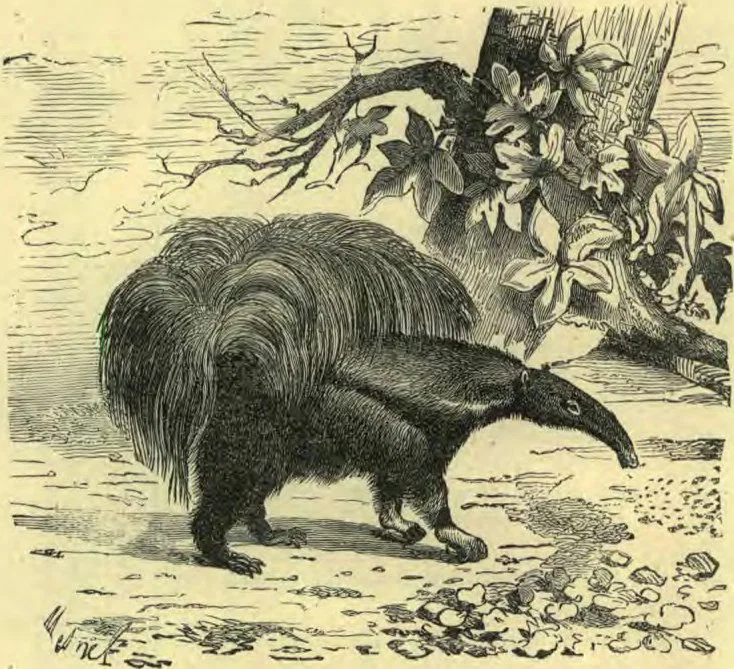
Ants have many strong enemies. One of them, called the Great Ant-eater, is shown in the picture. He lives in South America. He has a long head, but no teeth. His hair is coarse and brown, with some gray on his face. The claws on his fore feet are very long, and when he wants to walk, he doubles them under, just as you would turn your fingers down on the palm of your hand. When he goes to bed, he does not crawl into a hole, but curls up under his great, bushy tail, so that he looks like a bundle of hay thrown down on the ground.—Sel.

PETER PUTOFF.

I know a little boy whose real name is Peter Parsons, but the boys call him Peter Putoff, because he has such a way of putting off both business and pleasure.
He can learn his lessons well, but he is almost always at the bottom of his class, because he has put off learning his task from one hour to another until it is too late. He can walk or run as fast as any boy in town, but if he is sent on an errand, the errand never gets done in season, because he puts off starting from one moment to another; and for the same reason he is almost always late at school, because he can never be made to see that it is drawing near to nine o'clock.
If letters are given him to post, they seldom get in in time for the mail; and if he is to go away by the boat or train, the whole family have to exert themselves to hurry Peter out of the house, lest he defer starting till the hour be past.
He delays in his play as in his work. He puts off reading in the library book until it is time to send it back; he waits to join the game until it is too late; and generally comes up a little behindhand for everything all the week through, and then begins the new week by being too late for church and Sabbath-school. Peter is quite conscious of his own fault, and means to reform sometime, but he puts off the date of the reformation so constantly that manhood and old age will probably overtake this boy, and find him still worthy of the name of Peter Putoff.—Little Sower.
Continue reading: NOW