“THERE is one lawgiver, who is able to save and to destroy.” James 4:12. This is absolute. “For the Lord is our Judge, the Lord is our lawgiver, the Lord is our King; he will save us.” Isa. 33:22. God is the only real lawgiver. He is Lord and King over all the inhabitants of the world, “both low and high, rich and poor together.” He is the lawgiver for princes as well as peasants, for judges as well as common people. To him they all alike owe allegiance, even as a child does to its father; “for we are also his offspring.” Acts 17:28. “The Most High ruleth in the kingdom of men, and giveth it to whomsoever he will.” Dan. 4:25. “Wisdom and might are his;” “He removeth kings, and setteth up kings.” Dan. 2:20, 21. It is decreed that the nation and the kingdom that will not serve him shall perish. Isa. 60:12. Hence the exhortation, “Be wise now therefore, O ye kings: be instructed, ye judges of the earth. Serve the Lord with fear, and rejoice with trembling. Kiss the Son, lest he be angry, and ye perish from the way.” Ps. 2:10–12.
The One Supreme Law.
“Let us hear the conclusion of the whole matter: Fear God, and keep his commandments; for this is the whole duty of man. For God shall bring every work into judgment, with every secret thing, whether it be good, or whether it be evil.” Eccl. 12:13, 14. So the message which goes forth “to peoples, nations, tongues, and kings” (Rev. 10:11), even “to every nation, and kindred, and tongue, and people,” is to “fear God, and give glory to him; for the hour of his judgment is come; and worship him that made heaven, and earth, and the sea, and the fountains of waters.” Rev. 14:6, 7.
God is the supreme lawgiver, because he alone is able to save. Therefore “the law of the Lord is perfect, converting the soul.” Ps. 19:7. That law, which was once spoken by God himself, in tones which shook the earth, is composed of ten precepts.
It was of this law that Jesus said, “It is easier for heaven and earth to pass, than one tittle of the law to fail.” Luke 16:17. He said, “Think not that I came to destroy the law, or the prophets: I came not to destroy, but to fulfill.” Matt. 5:17. The law was within his heart (Ps. 40:8), and he came in the likeness of sinful flesh, in order “that the righteousness of the law might be fulfilled in us.” Rom. 8:4.
This law is summed up in two great commandments, the first of which is, “Thou shalt love the Lord thy God with all thy heart, with all thy soul, and with all thy mind.” And the second is like unto it, namely, “Thou shalt love thy neighbor as thyself.” Matt. 22:37, 39. “Love worketh no ill to his neighbor; therefore love is the fulfilling of the law.” Rom. 13:10. “All things whatsoever ye would that men should do to you, do ye even so to them; for this is the law and the prophets.” Matt. 7:12. Therefore it follows that the man who faithfully keeps the law of God, fulfills every obligation to man. “Love is the fulfilling of the law,” and “love is of God;” therefore he who loves God, must love all men. So to fear God and to keep his commandments is the whole duty of every man. There is nothing that can be required outside of that.
No man can serve two masters. Whatever is contrary to God’s law, even though it be framed into “law,” is lawless and wicked, and must be shunned and ignored by every one who does his duty. There is no danger that this will lead to anarchy; for to love God supremely is the first commandment, and he who does that will necessarily love men.
The Seal of the Law.
“In six days the Lord made heaven and earth, the sea, and all that in them is, and rested the seventh day: wherefore the Lord blessed the Sabbath day, and hallowed it.” Ex. 20:11.
At the close of each day’s work “God saw that it was good.” Each step was perfect as he proceeded in the work of creation. At the close of the sixth day “God saw everything that he had made, and, behold, it was very good.” Gen. 1:31. Creation was then both perfect and complete.
Then God rested from all his works. A perfect dwelling place was prepared for a perfect people. In Heb. 4:1–4 the fact that the perfect rest for the people of God was ready from the foundation of the earth, is proved by the statement that “God did rest on the seventh day from all his works.” The seventh-day Sabbath is therefore the seal of a complete and perfect new creation. Now note carefully what follows:—
1. Salvation from sin means a new creation. “If any man be in Christ, he is a new creature.” 2 Cor. 5:17. “By grace are ye saved through faith; . . . not of works, lest any man should boast. For we are his workmanship, created in Christ Jesus unto good works.” Eph. 2:8–10. The gospel is “the power of God unto salvation,” and the eternal power of God is seen in the things that he has made. Rom. 1:16, 20. Redemption therefore is creation.
2. The Sabbath, being the sign of creation complete and perfect, is the sign of perfect and complete salvation. So God says of his people, “I gave them my Sabbaths, to be a sign between me and them, that they might know that I am the Lord that sanctify them.” Eze. 20:12. The Sabbath of the Lord is the sign and reminder of his power to save.
3. God is the only lawgiver, because he is the only one who can save. “There is one lawgiver, who is able to save and to destroy.” He has a right to the service of men, because he is the Creator, and we are dependent on him both for this present life and for that which is to come. Therefore it follows—
4. That the Sabbath is the seal of God’s power, and of his authority as lawgiver. To despise the Sabbath is to despise God’s authority. To substitute another sabbath in the place of God’s Sabbath is the most bold and glaring defiance of God that could be devised.
The Great Lawbreaker.
There is a being known as Satan, or the adversary, who was once an angel of light in heaven, having the name Lucifer, or light-bearer. The cause of his fall from heaven is thus described: “Thou hast said in thine heart, I will ascend into heaven, I will exalt my throne above the stars of God: I will sit also upon the mount of the congregation, in the sides of the north: I will ascend above the heights of the clouds; I will be like the Most High.” Isa. 14:13, 14.
That which turned him from the light-bearer into the prince of darkness was the exaltation of himself. He set himself forth as greater than God.
Having seduced man from his loyalty to God, Satan became “the god of this world.” He is such because men have turned “every one to his own way;” and to choose our own way in preference to that of God, is to be ruled by Satan. The way of self is the way of Satan. The full development of this satanic spirit among men is thus set forth by the Apostle Paul, in speaking of the coming of Christ: “That day shall come except there come a falling away first, and that man of sin be revealed, the son of perdition; who opposeth and exalteth himself above all that is called God, or that is worshiped; so that he as God sitteth in the temple of God, showing himself that he is God.” 2 Thess. 2:3, 4.
“That man of sin,” is literally, as rendered by Young, “the lawless one.” He is the lawless one because he sets himself against God and his law. So in Dan. 7:25, we have the same lawless one described as one who “shall speak great words against the Most High, and shall wear out the saints of the Most High, and shall think to change times and laws.”
The beast of Revelation 13, also answers to the same description, in that “he opened his mouth in blasphemy against God, to blaspheme his name, and his tabernacle, and them that dwell in heaven; and it was given unto him to make war with the saints and to overcome them.” Verses 6, 7.
That earthly power which completely meets these specifications is the papacy. All men are by nature in opposition to God, and there are many forms of organized opposition to him; but in that vast system, the head of which is the pope of Rome, we find the most complete development of the satanic principle of the exaltation of self that can possibly be found among men.
Of this power it is said in Rev. 13:2, that “the dragon gave him his power, and his seat, and great authority.” Not that the dragon resigned his own power and authority in favor of “the beast,” but that all the power and authority which “the beast”—the papacy—has, is given it by the dragon. But the dragon is “that old serpent, called the Devil and Satan.” Rev. 12:9. Therefore the power of the papacy is the power of the devil; and the pope, who professes to be the vicar of Christ, is, on the contrary, the vicar of Satan.
The Mark of Lawlessness.
The papacy arose through the substitution of the teaching of men for the word of God. The great claim of the papacy to-day is that of infallibility, that it is superior to the Bible, competent to sit in judgment upon it, and to decide what is authoritative and what is not. Now the one thing above all others upon which the papacy depends to show its power and authority, is the substitution of the Sunday for the Sabbath. A few extracts from standard Catholic works are sufficient to show this.
From the “Catholic Christian Instructed,” sixteenth edition, James Duffy, Sons, & Co., Dublin, we quote the following:—
Q. What are the days which the church commands to be kept holy, or observed as days of particular devotion?
A. 1st. The Sunday, or Lord’s day, which we observe by apostolical tradition instead of the Sabbath.
Q. What warrant have you for keeping the Sunday preferably to the ancient Sabbath, which was Saturday?382
A. We have for it the authority of the Catholic Church and apostolic tradition.
Q. Does the Scripture anywhere command the Sunday to be kept for the Sabbath?
A. . . . the Scripture does not in particular mention this change of the Sabbath. . . . In fact the best authority we have for this ancient custom is the testimony of the church. And therefore those who pretend to be such religious observers of the Sunday, whilst they take no notice of other festivals ordained by the same authority, show that they act more by humor than by reason and religion; since Sundays and holidays all stand upon the same foundation, viz., the ordinance of the church.
In the “Faith of Our Fathers,” by Cardinal Gibbons, “twenty-fifth carefully revised and enlarged edition,” we find the following evidence that the Catholic Church exalts itself above the word of God:—
The Scriptures alone do not contain all the truths which a Christian is bound to believe, nor do they explicitly enjoin all the duties which he is obliged to practice. Not to mention other examples, is not every Christian obliged to sanctify Sunday, and to abstain on that day from unnecessary servile work? Is not the observance of this law among the most prominent of our sacred duties? But you may read the Bible from Genesis to Revelation, and you will not find a single line authorizing the sanctification of Sunday. The Scriptures enforce the observance of Saturday, a day which we never sanctify.—Page 111.
Christ declared, in the words of Scripture, that man must live “by every word that proceedeth out of the mouth of God.” The Catholic Church on the contrary, coolly boasts of setting aside the word of God, and thereby proclaims itself antichrist, opposing and exalting itself “above all that is called God, or that is worshiped.”
Again, in a Catholic work entitled, “Abridgment of Christian Doctrine,” we find the following:—
Q. How prove you that the church hath power to command feasts and holy days?
A. By the very act of changing the Sabbath into Sunday, which Protestants allow of.
Exactly in harmony with this Roman Catholic testimony is the following from professed Protestants. Canon Elyton says:—
There is no word, no hint, in the New Testament about abstaining from work on Sunday. No commandment of God bids us do this or not do that on Sunday; we are absolutely free as far as his law goes. The observance of Ash Wednesday or Lent stands on exactly the same footing as the observance of Sunday.—The Ten Commandments.
The late Dr. R. W. Dale said:—
The Sabbath was founded on a specific, divine command. We can plead no such command for the observance of Sunday.
Dr. Isaac Williams, of the Church of England, says:—
We are commanded to keep holy the seventh day; but we do not think it necessary to keep the seventh day holy; for the seventh day is Saturday. It may be said that we keep the first day instead; but then surely this is not the same thing; the first day cannot be the seventh day; and where are we told in Scripture that we are to keep the first day at all? We are commanded to keep the seventh; but we are nowhere commanded to keep the first day.—The Church Catechism, p. 334.
On the next page but one he adds:—
The reason why we keep the first day of the week holy instead of the seventh is for the same reason that we observe many other things, not because the Bible, but because the Church, has enjoined it.
Let it be observed that these statements are almost identical with those quoted from Roman Catholic writers. All agree that the substitution of Sunday for the Sabbath is contrary to Scripture. “The Church” is the sole authority for the change. Now it matters not by what name that church is called; the fact is that the substitution of Sunday for the Sabbath, contrary to the Scriptures, marks it as apostate and identical with “that lawless one,” and the “beast” which opens its mouth in blasphemy against God.
This conclusion, therefore, is as clear as that two and two make four: The substitution of Sunday for the Sabbath of the Lord is the badge of authority of that power which claims to be superior to God, in that it claims to be above his word. Sunday is, therefore, the mark of the beast.
A Warning.
Against the receiving of this mark the Scripture utters the following warning: “If any man worship the beast and his image, and receive his mark in his forehead, or in his hand, the same shall drink of the wine of the wrath of God, which is poured out without mixture into the cup of his indignation; and he shall be tormented with fire and brimstone in the presence of the holy angels, and in the presence of the Lamb.” Rev. 14:9, 10.
Evidently it is not a light thing that the Papacy has done in substituting Sunday for the Sabbath. It strikes directly at the authority of God. In no other way could so bold a claim be made to supremacy above God. It is a denial of His supremacy as the one only Lawgiver.
There are many thousands who have never thought but that in keeping Sunday they were obeying God; it is for the benefit of such that the warning is given, that they may save themselves from the coming danger. God does not punish any except those who disregard His gracious warnings. It is when men persist in following the traditions of men, knowing that they are contrary to God’s word, that they have the mark of the beast so as to be subjects of the threatened punishment.
The World Following the Beast.
The Scripture says that all that dwell on the earth shall worship the beast, except those whose names are in the book of life. It is only necessary for us to take a glance at the so-called “Christian nations” of earth, in every one of which Sunday laws are a prominent feature, to see how nearly universal homage to the Papacy, although often unconscious, has become.
In the position that the civil authorities and even ministers of the church take in regard to the enforcement of Sunday laws, we see the spirit of the Papacy. When the fourth commandment is quoted to a magistrate, so that he can see that the Sunday law is in opposition to it, he will say, “I am here to enforce the laws as they are, whether right or wrong. This is a law of the State, and it must be enforced.” That is to say, “It matters not what God’s law may say; the law of the State is above it.” That is putting the State above God.
A New York minister who has gained a world-wide reputation as a “reformer,” Dr. Parkhurst, of anti-Tammany fame, made a typical utterance a few weeks ago, when he said: “The enforcement of the law, and the wisdom of the law, are distinct.” “I care very little comparatively what law is on the statute books. But I will fight till I die for the enforcement of such laws as are there.” So it is often said that the best way to get rid of a bad law is to enforce it. That is simply to do evil that good may come. But the whole world has a perverted idea of law and duty. Men fancy that they are law-abiding because they will enforce even a bad law, because it is a law of the State, not realizing that to enforce a bad law is sin, a violation of the law of God.
“INTOLERANT OF EVIL.”
By Ellet Joseph Waggoner
BY E. J. WAGGONER.
At the fiftieth annual meeting of the London Y. M. C. A., one of the speakers, the head master of Harrow, said in the course of his address:—
If a Christian would be like Christ, he must be strong and even fierce in character. He must be intolerant of the things that are wrong; he must not suffer them, must not endure them for an instant.
Just think what influence might be exercised by this great meeting if we were all resolved that in public and in private life we will be intolerant, as intolerant as Christ was, of things that are evil, and base, and vile. Talk about public men and public opinion! We are public opinion. It is in our power to say, as Christian men and women, what we deem to be right; and depend upon it if we stick to that which we deem to be right in Christ’s name, there is no power on earth that can stand against us.
Unfortunately that idea is very common. This very statement was highly eulogized by a daily paper that is prominent in the ranks of reform, and most people would read it without thinking of its real tendency, which is the worst sort of persecution. It means that every professed Christian is to make his ideas of right and wrong the standard for everybody else, and then to do the best he can to force others to come to that standard. Of course persons working singly in such a way would accomplish nothing, and would be regarded as nuisances; and so they must unite and agree on certain points, and then by their combined power and influence, compel other people to come to the same standard. There is in human nature enough tendency in that direction, without clergymen teaching it as a Christian duty.
The only way in which a man can rightly be intolerant of evil, is to be intolerant of it in himself. The Christian is represented as a soldier, and the Christian life is a warfare, but not against men. “For though we walk in the flesh, we do not war after the flesh; for the weapons of our warfare are not carnal, but mighty through God to the pulling down of strongholds; casting down imaginations, and every high thing that exalteth itself against the knowledge of God, and bringing into captivity every thought to the obedience of Christ.” 2 Cor. 10: 3-5.
Jesus Christ is the Lamb of God. He was strong, he resisted even unto blood, striving against sin; but by no means could he be called intolerant. Fierceness is not characteristic of a lamb. He was the light of the world, which means that he enlightened the world in respect to righteousness. He “condemned sin in the flesh,” both by his life and by his words; yet he did not presume to condemn men. He said, “If any man hear my words, and believe not, I judge him not; for I came not to judge the world, but to save the world.” John 12: 47.
And so he instructed his disciples: “Behold, I send you forth as lambs among wolves.” Luke 10: 3. It is the wolves, and not the lambs, that are intolerant. Christ’s followers are simply to bear a plain testimony, leaving the Holy Spirit to impress it upon the people, and the Lord himself to deal with those who will not accept it.
This was made very clear by the parable of the wheat and the tares. When the servants of the husbandman told him that tares had appeared in the wheat, and asked if they should root them out, he replied: “Nay; lest while ye gather up the tares, ye root up also the wheat with them. Let both grow together until the harvest; and in the time of the harvest I will say to the reapers, Gather ye together first the tares, and bind them in bundles to burn them; but gather the wheat383into my barn.” Matt. 13: 29, 30. In the same chapter the Saviour explained that “the harvest is the end of the world; and the reapers are the angels.” The end of the world, and the coming of the Lord, is the time when evil is to be rooted out by force. And it is to be done only by the Lord and his angels.
The spirit of intolerance is the spirit of the Papacy. It is a most insidious evil. The intolerant one persuades himself that he is actuated solely by righteous zeal for the Lord, when he is in reality moved only by zeal for his own opinions. He opposes an evil, not so much because it is evil, but because it seems to defy him, or in other words, “It outrages public sentiment.” And he seeks to enforce something that he judges to be right, simply because he judges it to be right, and not because the word of the Lord commands it. If he knew the commandment of the Lord, he would know that it is love, and that force and intolerance is a violation of it.
Because “the servant of the Lord must not strive; but be gentle unto all men, apt to teach, patient, in meekness instructing those that oppose themselves; if God peradventure will give them repentance to the acknowledging of the truth.” 2 Tim. 2: 24, 25.
WE WILL HELP YOU.
By Editor
“How I wish all my friends could read that SENTINEL,” is a sentiment expressed by many of our readers on receiving some special number of the SENTINEL; but as it costs one cent each to mail the SENTINEL, many have, for this reason, used but a limited number of papers in this way. Here are offers which will enable you to send a single issue of the SENTINEL to scores, yes, hundreds of your friends for the first cost of the paper, without the additional postage:—
OFFER No. 1.
Send a list of the names and addresses of your friends, plainly written, and we will send the SENTINEL you name to any number of names for one and a quarter cents each.
OFFER No. 2.
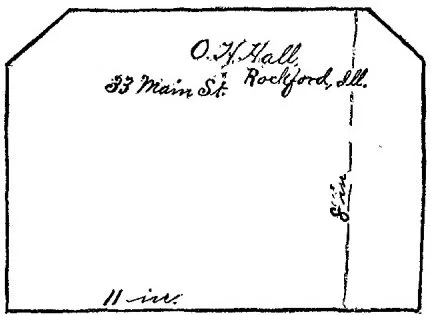
Send us wrappers, shaped and addressed similarly to the following cut, and we will send the SENTINEL you desire to one hundred names for one dollar.
Wrappers of thin manilla paper are the best. Be careful to write the names and addresses plainly, and write them about an inch or an inch and a half from the edge. The wrappers should be about eight by eleven inches; with the corners clipped, as in cut. In mailing the wrappers to us, don’t fold them but roll them.
Try one of these plans on our excellent extra of August 15. Keep these directions for future reference.
THE RIGHTS of the PEOPLE
By Alonzo T. Jones
Or Civil Government and Religion
By Alonzo T. Jones.
An Up-to-Date Pamphlet on the Principles of Religious Liberty.
This book cannot fail to be of great value to all in the study of the series of S. S. Lessons on Religious Liberty for the last three months of 1895. It was not written to go with these lessons, but it is fortunate and timely that it should be published at this time.
“THE RIGHTS OF THE PEOPLE” contains fifteen chapters, the following being a portion of the chapter headings:—
Christianity and the Roman Empire—What is due to God and What to Cæsar—The Powers That Be—How the United State Became a Christian Nation—What is the Nation?—Who Made the Nation?—Religious Right in the United States—Religious Right Invaded—The People’s Right of Appeal—National Precedent on Right of Appeal—Sunday-law Movement in the Fourth Century and Its Parallel in the Nineteenth—Will the People Assert and Maintain Their Rights?—Religious Rights in the States.
In the four appendixes to the book are given the Declaration of Independence—The Constitution of the United States—The Dred Scott Decision, and the “Christian Nation” Decision.
This is a book of permanent value for reference and study and one that all should possess. It contains 384 pages with several illustrations, is issued as No. 32 of the Religious Liberty Library, and is bound in paper covers. Price 40 cents.
A Finer Edition on laid paper is also ready. It is neatly bound in cloth. Price One Dollar.
Address all orders to
PACIFIC PRESS PUB. CO., 43 Bond St., New York; 18 W. Fifth St., Kansas City, Mo.; 12th & Castro Sts., Oakland, Cal.
STORIES FROM THE ACTS OF THE APOSTLES
(Companion volume to “Good Shepherd.”)
A book of 88 pages, with 45 pictures, 22 of which are full-page, representing in a very instructive manner various scenes in the history of Peter, Paul, and others of the Apostles. The stories are arranged with special reference to the little children. Bound in lithographic illuminated covers, postpaid, - - - - - - - 50c
PACIFIC PRESS PUBLISHING CO.,
43 BOND ST., NEW YORK CITY
THE “CYCLONE” STILL WHIRLS!
SWEEPING EVERYTHING CLEAN BEFORE IT.
SEE WHAT THE PEOPLE SAY!
Owatonna, Minn., Nov. 5, 1894.
Messrs. Coon Bros., Battle Creek, Mich.
Gentlemen: I have sold the Cyclone Washer for a year, and it is growing in favor every day. I can say that every machine I have sold, gives entire satisfaction. I find ladies who have not been able to wash for years are now able to wash with the Cyclone with perfect ease.
Yours truly,
Wm. A. Wiggins.
College Place, Wash., Oct. 15, 1894.
Messrs. Coon Bros:
After using the Cyclone Washer for over two years, I believe it to be the best Washing Machine made. I can do a washing in two hours. We have no more blue Mondays, as our washing is on the line before we have time to get blue. I have learned to do without many things these hard times, but must have the Cyclone Washer.
Mattie Bullaford.
The Shepherd King
(Companion volume to “Good Shepherd.”)
A Book of Eighty-eight Pages, With Thirty-seven Pictures,
Many of which are full-page,
Illustrating the most striking events in the life of David.
The whole story is told in a most entertaining manner, and is highly instructive to the young and interesting to the old.
Bound in Lithographic Illuminated Covers, post-paid, 50c.
Address, PACIFIC PRESS PUB. CO., 43 Bond St., New York.
Abiding Sabbath And Lord's Day.
By Alonzo T. Jones
BY ALONZO T. JONES.
A pointed review of the $500 and $1,000 prize essays in support of the Christian Sabbath, so called. Those desiring some $1,000 reasons for keeping the first day of the week, will find them here. 173 pages, 20 cents. Pacific Press, 43 Bond St., New York City.
Waterman's Ideal Fountain Pen
Claims first attention, as it certainly is
The Best Fountain Pen on the Market.
Other makes may be good, but the WATERMAN IS THE BEST. Some points of excellence are:—
The fine quality of the gold pens;
The reliability of its feed, which has stood a ten years' test;
The absence of any portion of the feed on the top of the pen point, whereby it is left untrammeled and acts with all the ease and grace of any first-class gold pen.
Among those who use the Waterman Pen are:—
REV. LYMAN ABBOTT, Editor “Christian Union,” New York. CHAUNCEY M. DEPEW, Pres. N. Y. C. & H. R. R. Co. HON. W. E. GLADSTONE, Hawarden, England. JOHN WANAMAKER, Ex-Postmaster General. And thousands of others whose judgment may safely be trusted, all of whom with one consent pronounce the Waterman
“THE BEST FOUNTAIN PEN.”
Among the many excellent features of this pen, to some of which we call attention, stands one of no mean value, and that is the shape of the holder. There is, in the new style, no prominent collar or shoulder to come in contact with the fingers when writing, but the holder has the pleasing touch of any ordinary good pen holder.
The Waterman makes a most acceptable present to a parent, to a child, to a brother, to a sister, to a friend, to anybody, and will be SENT AT OUR RISK to any address in America on receipt of price.
In ordering state what kind of a pen you like best. Whether stiff or flexible, fine or coarse, etc.
Address, PACIFIC PRESS PUBLISHING CO., 43 Bond Street, New York City.
Law Should Protect Every Man's Right to Observe
The law should protect every man in his right to observe whatever day he wants to; but it should never compel any man to observe any religious institution whatsoever.—Sabbath Recorder.
Enforcing Law Simply Because It Is Law
If it is right to enforce “law” simply because it is “law,” then Torquemada stands justified before the world, for he only enforced the “law” of Spain.
If it is duty to enforce “law” simply because it is “law,” then Torquemada not only stands justified before the world, but he must be awarded the meed of honor, for he only discharged an unpleasant duty!
But it is not duty to enforce “law” simply because it is law. Every man, however humble or however high his station, is bound, first of all, to do justice to his fellow-men; and nothing can free him from this obligation. Any failure to discharge this duty to the law of nature as written in the very nature of man, is either tyranny or cowardice.
The Civic Duties of Christians Examined
WE hear much said at the present time about the “civic duties of Christians.” This is a very misleading phrase. It conveys the idea that that which is civic pertains to that which is Christian; which is not the case. Man as a mere unit of civil society, a mere factor of civil government, is not necessarily a Christian at all. A Christian sustains exactly the same relation to the civil government as does one who is not a Christian; in other words, the profession or non-profession of Christianity or of any religion does not affect a person’s relation to the civil power at all. All persons, whether Christians, atheists, Jews, or pagans, are equally bound to contribute to the support of the civil power which exists for the preservation of their mutual rights. They are equally bound to abide by all just laws. These are their civic duties; and the civic duty of the atheist is the same as that of the Christian.
Opposing Principles, Not Men, in Government Debate
WE oppose principles, not men; false and evil theories of government, not the organizations that hold and advocate them.
Protesting Invasions of Rights Before Legislation Passes
The time to protest against an invasion of our rights is when the principle is attacked upon which they rest, and before actual legislation is passed which would take them from us. The world has ever been too slow upon this point. Human nature is prone to wait and delay until action is felt to be an unavoidable necessity; and by failing to protest when their rights were violated in principle, men have logically forfeited the right to protest when they were invaded by force of law. He who does not protest until he is made actually to suffer from the evil which has invaded his liberty, will find himself placed at great disadvantage and in a very bad light in the eyes of those to whom he would appeal.
Does the Sunday Saloon Law Strengthen the Saloon?
Is not the Sunday saloon-closing law a virtual support to the evil which the saloon represents? Does it really weaken the saloon’s position? If so, why are saloonists in general willing to abide by such a law? Does it not afford them an opportunity to assume more of an appearance of respectability? And is this likely to help toward the saloon’s extinction? Let candid, thinking people seriously consider whether a law which helps the saloon to appear respectable, and virtually justifies its existence and its work upon all but one day in the week, is not doing more to strengthen than to weaken the power of this foe to humanity.
MORE ARRESTS IN ONTARIO.
A LETTER from P. M. Howe, dated Nov. 29, brings news of more arrests of Adventists in the vicinity of Chatham, Ont., for doing work on Sunday. The writer says that on Nov. 28 he was summoned, together with William Simpson, to appear before Justice Watson, of Ridgetown, to answer to the charge of doing worldly labor on the third day of November, “being the Lord’s day,” by working at carpentering and masonry. Thomas Griffith was also arrested for cutting wood on Nov. 10; and A. O. Burrill, the Adventist pastor, is under arrest for assisting in the building of the Adventist church.
When the Adventists began the erection of their church, the opposition party set fire to their lumber, by which about 3,000 feet of it was destroyed. As the work was however continued, they began to watch the Adventists on Sundays, and the above-mentioned arrests are the result. No comment is needed to make plain the animus of the proceeding.
The justice at Chatham refused to take the cases, and the prosecutors, not discouraged, went to the neighboring village of Ridgetown, where they succeeded in getting them set for trial. All four cases will be tried the same day, Dec. 5.
The Sabbath as a Delight in the Lord
THAT the Sabbath is not designed merely for physical rest is shown by the fact that mere physical rest is not Sabbath-keeping. The prophet thus describes true Sabbath-observance: “If thou turn away thy foot from the Sabbath, from doing thy pleasure on my holy day; and call the Sabbath a delight, the holy of the Lord, honorable; and shalt honor him, not doing thine own ways, nor finding thine own pleasure, nor speaking thine own words: then shalt thou delight thyself in the Lord.” To keep the Sabbath is therefore to delight in the Lord; hence only he who delights in the Lord keeps the Sabbath.