The Youth’s Instructor, Vol. 29, No. 16.

SMYRNA

The Youth’s Instructor

Apr 20, 1881

S. D. A. Publishing Association · Battle Creek, Mich. · Apr 20, 1881

SMYRNA

THAT memories cluster around the names of ancient cities of the East, especially those we read of in that dear old book,—the Bible! How eagerly, too, do we grasp for everything that will give us information concerning them. Sometimes, no doubt, most of us have wished that the Bible contained a history of all these places, that we might know more about them. But this could not well be; for when that holy volume was written, the most of these places had no history of importance to the people then living. Such a history would have seemed to them about the same as a narration of the common occurrences of to-day in the villages or towns where we live, would to us—not worth preserving.
And had the trivial occurrences of these days been thought worthy of preservation, they could have found no place in the Bible, as there were so many things pertaining to our future well-being to be recorded, that, had the Bible given only a brief notice of them all, it would have been to us what the Hindoo Shasters are to the people of India—so large that few would own a copy, much less read it through. The most, then, that we can learn of the history of these places must be gleaned from sources outside of the Bible; and the events composing this history become especially interesting to us only as they make up a part of the great history of Christianity. These, as they are handed down to us, not only form connecting links between that time and ours, but connect us by living faith to Him who is the Author of our salvation.
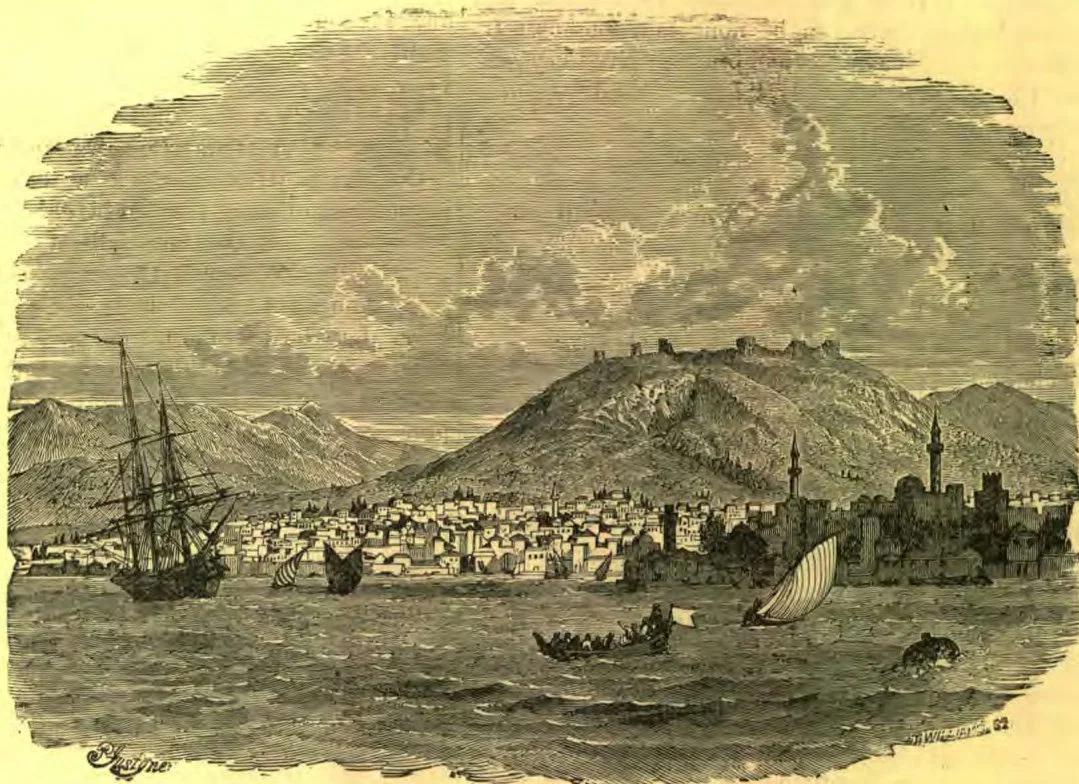
The accompanying cut represents the city of Smyrna, one of the most ancient towns of Asia Minor. It is situated near the mouth of the River Meles, on the shore of a gulf bearing the same name. But little is known of its very early history. It did, however, along with other cities, claim to be the birthplace of Homer, the blind old Grecian poet so well known to classical readers, and who lived about the time of Isaiah the prophet.
We are told that the old city was destroyed by Alyattes, a Lydian king, and lay waste for four hundred years. It was rebuilt by Antigonus, one of the generals of Alexander the Great, and greatly beautified by Lysimachus, and was known as “the lovely—the ornament of Asia” till after the time of Christ. A Christian church was formed there at an early day, and is mentioned by name in the book of Revelation, in the address to the seven churches. (Chapter 2: 8–11.) Tradition also speaks of one Polycarp, who was a disciple of the apostle John, and by him appointed bishop, or elder, of the church in Smyrna. During the persecution of the Christians under Marcus Aurelius, Polycarp suffered martyrdom with most heroic fortitude, in A. D. 169.
The city was destroyed by an earthquake in A. D. 177, but being rebuilt by the Emperor Marcus Aurelius, it once more became a very populous town. On the hill southeast of the city, as shown in the background of the picture, are some remnants of the massive walls, and fragments of the early magnificent buildings. There is also pointed out the site of the stadium, or ancient theater, in which Polycarp is said to have suffered martyrdom.
The city, after passing through various vicissitudes, fell into the hands of the Turks during the Middle Ages, and has remained in their possession ever since. We look forward, however, to a time in the near future, when, with all earthly kingdoms, it will become subject to Him who will be King of kings and Lord of lords.
J. O. CORLISS.

Ancient Britain: Pagan and Christian Rites Blend

ANCIENT BRITAIN. NO. 5.

During the reign of Constantine there was a respite from the terrible slaughter of Christians, but another danger to faith in Christ arose from a different source. At this time a new religion was forming, consisting of a blending together of pagan and Christian rites. This some historians denominate—“A new paganism.”
After Constantine’s time, civil disturbances rapidly followed one another, and warfare with other nations, which broke Rome into many kingdoms. The Goths of German origin, under Alaric, in A. D. 395, commenced their terrible ravages against Italy, even marching to the gates of Rome itself. To withstand the assaults of the Goths, in A. D. 411, the Romans recalled their legions from Britain, intending to return them when their home troubles were passed. This they never did. With their legions they took the strongest and bravest of the Britons as soldiers, leaving this part of their kingdom weak and unprotected.
At this time there came to Britain from a country between the North and Baltic seas—now called Denmark and Prussia—a people then called Saxons. The first that came seemed only intent on plunder. They carried away much gold, silver, food, clothing, and some of the little children as slaves. Their report to their own countrymen concerning the nice things found here, stirred them up to come and conquer the whole country as their own. They came, and with them joined the Angles, their neighbors, and commenced a warfare on the defenseless Britons.
The Saxons and Angles landed between Ramsgate and Dover, in the County of Kent, at a point not ten miles from where Julius Cæsar first planted his standard, more than four centuries before.
Though their fighting men were gone, they joined together to fight against the Saxons and Angles, not wishing to yield their country and the religion of Christ to the rule of those who worshiped idols of stone and wood, and who were as base as their own former idolatry. They appointed one of the bravest among them, Arthur, as their king, and helped him fight the Saxons for a long time. The Saxons and Angles were, however, too strong for them, and at last Arthur was obliged to yield, when he, with his brave knights, went to the north of France into a land which they named Britany.
Two of the Saxon brothers, called Hengest and Horsa, made themselves kings over part of Britain. The Angles gave the name of Angleland to their newly-acquired kingdom. It is now called England, as the Angles were the original Englishmen.
The Saxons treated the Christian Britons very badly because they would not cease to love and serve the true God. They pulled down their churches, and either killed or drove away their ministers. They were very glad to make the Britons build their houses, plow their cornfields, and take care of their sheep, but they would not let them read. They spoiled their schools, and burned their books. They did not know the true God, but bowed to images of men and women made of stone and wood, and were very severe on the Christian Britons because they were not willing to worship their senseless idols.
The most of the Christians fled into the mountains and forests of Wales. Others went, some to Ireland, and others to the highlands and islands of Scotland. Here they joined with the Culdees, the descendants of those who fled from Diocletian’s persecution, in the worship of the true God. Swarming with the Saxon invaders, England was at this time in almost as bad a state as it was under the teachings of the Druids, before the Romans came.
J. N. LOUGHBOROUGH.

SONG OF THE ROOTLETS.

Down in the ground, so busy, Little roots at work; All of them in a hurry, Toiling in the dark. List to their low, deep murmur; While they work, they sing, “Gone are the frosts of winter, Sunshine now of spring.”
“Down in the ground, so busy, Sucking juices up; By-and-by in a hurry, Flowers will push up,— Snowdrop, crocus, and lily, Where the sunshine lies; Tulips flashing so gayly, Brightening to the eyes.
“Hidden away in darkness, Working out of sight; Yet task have we of gladness,— Bringing flowers to light; Down in the ground so busy, Little things are we; But work of ours is mighty, Over plant and tree.
“Lightly, please, tread over us, Do not spurn, despise; Lovingly, please, think of us, Covered from your eyes. Soon, we lift to your wonder Forms of beauty rare; Soon, from our hands, surrender Fragrance to the air.”
Ah, little roots, ye teach me A lesson of the light: Never to fret, be weary, Working out of sight. Patience and courage, ever Singing at my task; For this, O Heavenly Father, Humbly now I ask.
—Child’s World.

The Little Songstress.

A little girl is singing in a small school-room in a large street of Stockholm. She is brushing, and dusting, and singing, for her mother is the mistress, and she helps to keep the school-room in order; and she warbles as she works, like a happy bird in spring-time.
A lady one day happened to ride by in her carriage; the little girl's song reached her ear, and the ease, grace, and earnest sweetness of the voice touched her heart. The lady stopped her carriage, and went to hunt the little songster. Small she indeed was, and shy, and not pretty, but of a pleasing look.
“I must take your daughter to Crælius,” said the lady to the mother—Crælius was a famous music master—“she has a voice that will make her fortune.”
Make her fortune! ah, what a great make that must be, I suppose the child thought, and wondered very much. The lady took her to the music-master, who was delighted with her voice, and he said,—
“I must take her to Count Puche,” a great judge in such matters.
Count Puche looked coldly at her, and gruffly asked what the music-master expected him to do for such a child as that.
“Only hear her sing,” said Crælius.
Count Puche condescended to do that; and the instant she finished, he cried out, well pleased, “She shall have all the advantages of Stockholm Academy.”
So the little girl found favor, and soon her sweet voice charmed all the city. She sang and studied, and studied and sang. She was not yet twelve, and was she not in danger of being spoiled? I suppose her young heart often beat with a proud delight as praises fell like showers upon her. But God took care of her.
One evening she was announced to sing a higher part than she had ever had, and one it had long been her ambition to reach. The house was full, and everybody was looking out for their little favorite. Her time came, but she was mute. She tried, but her silver notes were gone; her master was angry, her friends were filled with surprise and regret, and the poor little songstress, how she dropped her head! Did her voice come back the next day? No, nor the next, nor next. No singing voice, and so her beautiful dream of fame and fortune suddenly faded away. What a disappointment! And yet not a bitter one, for she bore it meekly and patiently, and said, “I will study.” Four years passed away, and I suppose the public quite forgot the little prodigy.
One day another voice was wanted in an insignificant part of a choir, which none of the regular singers were willing to take. Crælius suddenly thought of his poor little scholar. Pleased to be useful and oblige her old master, she consented to appear. While practicing her part, to the surprise of both pupil and teacher, her long-lost voice suddenly returned with all its grace and richness. What a delightful evening was that; all who remembered the little nightingale received her back with glad welcome.
She was now sixteen. What was her name? Jenny Lind. Jenny now wished to go to Paris and study with the best masters of song. In order to raise the means, in company with her father, she gave concerts through Norway and Sweden; and when enough had been thus raised, she left home for that great and wicked city, her parents wishing it were otherwise, yet trusting their young and gifted daughter to God and her own sense of right.
Here a new disappointment met her. Presenting herself to Gracia, a distinguished teacher, he said, on hearing her sing: “My child, you have no voice; do not sing a note for three months, and then come again.”
She neither grumbled at the time or expense, nor was discouraged or disheartened, but quickly went away to study by herself; and at the end of that time came back again to Gracia, whose cheering words now were, “My child, you can begin lessons immediately.” And then she became so very, very famous,—yea, and through those very paths of painstaking, waiting, and self-denial, without which no true excellence can ever be reached.— Golden Threads.

THE NETTLE TREE.

In Australia, the nettle grows to be a tree. It has large, round, furry leaves, and is an evergreen. But though it makes an imposing appearance, the trunk is really nothing but a tube filled with pith. One blow with an ax will cut down a tree of which the trunk is a foot in diameter. The tree is very common, and very carefully avoided. If a leaf is touched, it causes extreme pain, reaching up the arm, and finally making it feel paralyzed, and perfectly useless. A swelling as large as an egg will come under the arm in five minutes; and remain for hours, while the unpleasant sensation lasts for weeks.—Selected.

I AM NEUTRAL.

A young man was asked by a Christian lady, “Are you on the Lord’s side or on the side of the world?” “I am neutral” (on neither side), was the reply, which we pronounce a cowardly one indeed, and one that shows the deceitfulness of the human heart. The young man might strive to deceive himself into the belief that he could serve God and mammon, but Christ declares plainly that it cannot be done. “Choose ye this day whom ye will serve,” is the solemn charge given to us all; and upon our choice eternity is hung.
Let no thinking individual believe that he can be on neither side in this matter. “He that is not for me is against me,” says Christ; and no one who is for him will say, “I am neutral.” It is the worldling and they who are halting between two opinions, who give this cowardly reply. If you consider yourself neutral, then you are serving sin; for one element needed to make a Christian is decision.
“As for me and my house, we will serve the Lord.” There was no neutral ground taken by Joshua, and there can be none taken by us. Be too honest and brave to give the young man’s reply, “I am neutral.”—American Messenger.

Blackening Others Does Not Whiten Oneself

HE who blackens others does not whiten himself.

BEAUTIFUL HANDS.

Such beautiful, beautiful hands! They're neither white nor small; And you, I know, would scarcely think That they were fair at all. I've looked on hands whose form and hue A sculptor's dream might be, Yet are these aged, wrinkled hands More beautiful to me.
Such beautiful, beautiful hands! Though heart were weary and sad, These patient hands kept toiling on, That the children might be glad. I almost weep as, looking back To childhood's distant day, I think how these hands rested not When mine were at their play.
Such beautiful, beautiful hands! They're growing feeble now; For time and pain have left their work On hand and heart and brow. Alas! alas! the nearing time, And the sad, sad day to me, When 'neath the daisies, out of sight, These hands will folded be.
But oh, beyond this shadowy damp, Where all is bright and fair, I know full well these dear old hands Will palms of victory bear. Where crystal streams, through endless years, Flow over golden sands, And where the old grow young again, I'll clasp my mother's hands.

BE RIGHT.

It is quite as important for a man to be right as to think himself right. Sincerity of belief is no substitute for correctness of belief. It is said that the cause of the recent disaster on the Pittsburg, Cincinnati and St. Louis Railroad was the fact that the watch of the conductor of the freight-train was twenty minutes behind time without his knowing it. It had stopped for twenty minutes, and then started again. He supposed it had been running all the time, and he shaped his course accordingly. It seemed by that watch that he had ample time to make the next turnout before the passenger-train was due there; but the watch being wrong, all his calculations were at fault, and there was death and suffering to the passengers on the colliding trains in consequence.
There is a great deal of running by false time in this world. Boys and men shape their course by wrong standards, and run to ruin accordingly. They think that the personal habits or the business practices or the opinions and beliefs of certain men before them are surely correct, and they wreck everything on the track which those men point out as safe beyond a question. They perhaps act conscientiously and do as well as they know how, but that does not make their course a correct one nor preserve them from disaster. It is essential not only that a man should think he is right, but that he should be right. “Take heed, therefore, that the light that is in thee be not darkness,” is an injunction which the best-intentioned man in the world would do well to heed. Take heed that what you think is fair dealing is not dishonesty; that what you think is the safe course is not the way to ruin. Not conscience, but the Bible, is the sure guide of conduct. “There is a way which seemeth right unto a man, but the end thereof are the ways of death.”—S. S. Times.

APRIL'S TEARS.

APRIL'S tears are happy tears. Joy, when the arbutus sweet Creeps about her dancing feet, When the violet appears, When the birds begin to sing, When the grass begins to grow, Makes her lovely eyes o'erflow. April, tender-hearted thing, Bonny daughter of the Spring!

SCENES IN THE LIFE OF CHRIST.

LESSON 15.—THE FIRST DISCIPLES, AND THE MIRACLE AT CANA.

WHEN the Jews sent priests and Levites to John to find out who he was, he said, “I am not the Christ;” “I am the voice of one crying in the wilderness, Make strait the way of the Lord.” And they said, “Why baptizest thou, then?” “John answered them, saying, I baptize with water; but there standeth one among you whom ye know not; he it is, who coming after me is preferred before me, whose shoe’s latchet I am not worthy to unloose.”
Afterward, as John was standing with some of his disciples, he saw Jesus walking, and said, “Behold the Lamb of God.” Then two of John’s disciples followed Jesus. One of them was Andrew, and he called his brother Simon. The next day they went with Jesus on his way to Galilee. Jesus, seeing Philip, said unto him, “Follow me.” And Philip found Nathanael, and said unto him, “We have found him of whom Moses in the law and the prophets did write, Jesus of Nazareth, the son of Joseph.” When Jesus saw Nathanael coming to him, he said, “Behold an Israelite indeed, in whom is no guile.” Nathanael thought it very strange that Jesus should seem to know so much about him when he had never seen him before; but Jesus said, “Before that Philip called thee, when thou wast under the fig-tree, I saw thee.” Now Nathanael, knowing that Jesus could not have seen him by his natural sight, cried out, “Rabbi, thou art the Son of God; thou art the King of Israel! Jesus answered and said unto him, Because I said unto thee, I saw thee under the fig-tree, believest thou? thou shalt see greater things than these.”
Jesus with his five disciples went on from the Sea of Galilee to Nazareth. A little way north of Nazareth was a small town called Cana. “And the third day there was a marriage in Cana of Galilee; and the mother of Jesus was there. And both Jesus was called, and his disciples to the marriage.” But before the marriage-feast was over, the wine gave out; “And when they wanted wine, the mother of Jesus said unto him, They have no wine.” Jesus told her that the time for him to manifest his power had not yet come; but she said unto the servants, “Whatsoever he saith unto you, do it. And there were set there six water-pots of stone, after the manner of the purifying of the Jews, containing two or three firkins apiece. Jesus saith unto them, Fill the water-pots with water. And they filled them up to the brim. And he saith unto them, Draw out now, and bear unto the governor of the feast. And they bare it.”
“When the ruler of the feast had tasted the water that was made wine, and knew not whence it was (but the servants which drew the water knew), the governor of the feast called the bridegroom, and saith unto him, Every man at the beginning doth set forth good wine; and when men have well drunk, then that which is worse; but thou hast kept the good wine until now. This beginning of miracles did Jesus in Cana of Galilee, and manifested forth his glory; and his disciples believed on him.”

QUESTION.

  1. When the Jews sent priests and Levites to John to find out who he was, what did he say? John 1:19, 20.
  2. What reply did he make when they said, “Why baptizest thou, then?” Verses 26, 27.
  3. Afterward, as John with some of his disciples saw Jesus walking, what did he say?
  1. What did two of John’s disciples then do?
  2. Who were they?—One of them was Andrew, and the other is supposed to have been John, the beloved apostle.
  3. Whom did Andrew call?
  4. Whither did they go the next day?
  5. When Jesus saw Philip, what did he say to him?
  6. Whom did Philip call?
  7. What did Philip say to him?
  8. What did Jesus say, as he saw Nathanael coming to him?
  9. What greatly surprised Nathanael?
  10. What did Jesus say about having seen him before?
  11. What did this cause Nathanael to exclaim?
  12. What did Jesus then say?
  13. Where did Jesus and his disciples go when they went on from the Sea of Galilee?
  14. What small town was situated a little way north of Nazareth?
  15. On what occasion was Jesus, with his mother and disciples, called to that place? John 2:1.
  16. How did the company come to be in want of wine?
  17. What did the mother of Jesus say to him?
  18. How did he reply to her?
  19. What did she say to the servants?
  20. Tell how the miracle was performed.
  21. When the wine was brought to the ruler of the feast, did he know how it had been made?
  22. After he had tasted of the wine, what did he say to the bridegroom?

NEW TESTAMENT HISTORY.

LESSON 26.—THE SERMON ON THE MOUNT.

“Ye are the salt of the earth; but if the salt have lost his savor wherewith shall it be salted? it is thenceforth good for nothing, but to be cast out, and to be trodden under foot of men. Ye are the light of the world. A city that is set on an hill cannot be hid. Neither do men light a candle, and put it under a bushel, but on a candlestick; and it giveth light unto all that are in the house. Let your light so shine before men, that they may see your good works, and glorify your Father which is in Heaven.
“Think not that I am come to destroy the law, or the prophets; I am not come to destroy, but to fulfill. For verily, I say unto you, Till heaven and earth pass, one jot or one tittle shall in no wise pass from the law, till all be fulfilled. Whosoever therefore shall break one of these least commandments, and shall teach men so, he shall be called the least in the kingdom of Heaven; but whosoever shall do, and teach them, the same shall be called great in the kingdom of Heaven. For I say unto you, That except your righteousness shall exceed the righteousness of the scribes and Pharisees, ye shall in no case enter into the kingdom of Heaven.
“Ye have heard that it was said by them of old time, Thou shalt not kill; and whosoever shall kill, shall be in danger of the judgment: but I say unto you, That whosoever is angry with his brother without a cause, shall be in danger of the judgment: and whosoever shall say to his brother, Raca, shall be in danger of the council: but whosoever shall say, Thou fool, shall be in danger of hell-fire. Therefore, if thou bring thy gift to the altar, and there rememberest that thy brother hath ought against thee, leave there thy gift before the altar, and go thy way; first be reconciled to thy brother, and then come and offer thy gift. Agree with thine adversary quickly, while thou art in the way with him; lest at any time the adversary deliver thee to the judge, and the judge deliver thee to the officer, and thou be cast into prison. Verily I say unto thee, Thou shalt by no means come out hence, till thou hast paid the uttermost farthing.
“Ye have heard that it was said by them of old time, Thou shalt not commit adultery; but I say unto you, That whosoever looketh on a woman to lust after her, hath committed adultery with her already in his heart. And if thy right eye offend thee, pluck it out, and cast it from thee; for it is profitable for thee that one of thy members should perish, and not that thy whole body should be cast into hell. And if thy right hand offend thee, cut it off, and cast it from thee; for it is profitable for thee that one of thy members should perish, and not that thy whole body should be cast into hell.
“It hath been said, Whosoever shall put away his wife, let him give her a writing of divorcement; but I say unto you, That whosoever shall put away his wife, saving for the cause of fornication, causeth her to commit adultery; and whosoever shall marry her that is divorced, committeth adultery.
“Again, ye have heard that it hath been said by them of old times, Thou shalt not forswear thyself, but shalt perform unto the Lord thine oaths; but I say unto you, Swear not at all: neither by heaven; for it is God’s throne: nor by the earth; for it is his footstool: neither by Jerusalem; for it is the city of the great King: neither shalt thou swear by thy head, because thou canst not make one hair white or black. But let your communication be, Yea, yea; Nay, nay; for whatsoever is more than these cometh of evil.”

QUESTIONS.

  1. To whom is Christ speaking when he says, “Ye are the salt of the earth”? Matt. 5:13.
  2. What does he say of salt that has lost its saving quality?
  3. In what way do the followers of Christ have a saving effect upon others?
  4. In what way could this saving effect be lost?—By their not living up to their profession.
  5. In what sense are Christ’s followers to be regarded as the light of the world?
  6. What precept does Jesus give in regard to shedding this light? Verse 16.
  7. What bearing does this have upon those who spend their lives in monasteries?
  8. Does it allow us wholly to avoid the society of our neighbors?
  9. How does he show the inconsistency of such a course? Verse 15.
  10. What does Jesus say of his mission as connected with the law and the prophets?
  11. How long does he say that every part of the law will continue in force?
  12. What does he say of those who shall break even the least of these commandments, and teach men to do so?
  13. What does he say of those who shall do and teach them?
  14. What does he say of the degree of righteousness indispensable to an entrance into Heaven?
  15. What reference does Jesus make to the sixth commandment?
  16. What does Jesus say of him who shall be angry with his brother without a cause? Verse 22.
  17. What does he say of certain contemptuous expressions?
  18. How does Jesus show that brethren must be reconciled to each other before they can offer acceptable worship? Verses 23, 24.
  19. How does he show that we may sin by cherishing unholy thoughts and desires, as well as by outward acts? Verses 27, 28.
  20. How does he show that anything that leads us into sin should be given up, no matter how dear it may be to us? Verse 29.
  21. How is the same lesson repeated in verse 30?
  22. How does he correct those who think that the marriage-tie can be broken for slight causes? Verses 31, 32.
  23. What reference does Jesus make to the third commandment?
  24. What instruction does he give in verses 34 and 35.
  25. How does he continue it in verse 36?
  26. How does Jesus teach that our language should always be simple and unpretending, and that we should never attempt to strengthen a statement by an oath?

NOTES ON THE LESSON.

“Shall be in danger of the judgment (shall be liable to the judgment). That is, to have the matter brought before a senate, composed of twenty-three magistrates, whose business it was to judge in cases of murder and other crimes. It punished criminals by strangling or beheading. . . .”
“Raca, from the Hebrew rak, to be empty. It signifies a vain, empty, worthless fellow, shallow brains, a term of great contempt. Such expressions were punished among the Gentoos by a heavy fine.”
“The council, the famous council known among the Jews by the name of Sanhedrin. It was composed of seventy-two elders, six chosen out of each tribe. This grand Sanhedrin not only received appeals from the inferior Sanhedrins, or court of twenty-three before mentioned; but could alone take cognizance, in the first instance, of the highest crimes, and alone inflict the punishment of stoning.”
“Thou fool, moreh, probably from the Hebrew marah, to rebel, a rebel against God, apostate from all good. The term implied, among the Jews, the highest enormity, and most aggravated guilt. Among the Gentoos, such an expression was punished by cutting out the tongue and thrusting a hot iron into the mouth of the person who used it.”
“Shall be in danger of hell-fire (shall be liable to the fire of hell). Our Lord probably here alludes to the valley of the son of Hinnom. This place was near Jerusalem, and had formerly been used for those abominable sacrifices, in which the idolatrous Jews had caused their children to pass through the fire to Moloch. . . . From the circumstance of this valley’s having been the scene of those infernal sacrifices, the Jews, in our Saviour’s time, used the word for hell, the place of the damned. . . . It is very probable that our Lord means no more here than this: If a man charge another with apostasy from the Jewish religion, or rebellion against God, and cannot prove his charge, than he is exposed to that punishment (burning alive) which the other must have suffered, if the charge had been substantiated.”
“There are three kinds of offenses here [in these verses], which exceed each other in their degrees of guilt. (1) Anger against a man, accompanied with some injurious act. (2) Contempt, expressed by the opprobrious epithet raca, or shallow brains. (3) Hatred and mortal enmity, expressed by the term moreh, or apostate, where such apostasy could not be proved. Now, proportioned to these three offenses, were three different degrees of punishment, each exceeding the other in its severity, as the offenses exceeded each other in their different degrees of guilt. (1) The judgment, the council of twenty-three, which could inflict the punishment of strangling. (2) The Sanhedrin, or great council, which could inflict the punishment of stoning. (3) The burning alive in the valley of the son of Hinnom. This appears to be the meaning of our Lord. . . . It seems that these different degrees of guilt and the punishment attached to each, had not been properly distinguished among the Jews. Our Lord here calls their attention back to them, and gives them to understand that, in the coming world there are different degrees of punishment prepared for different degrees of vice, and that not only the outward act of iniquity should be judged and punished by the Lord, but that injurious words and evil passions should all meet their just recompense and reward.” —Clarke’s Commentary.

Prayer as the Key of Morning

SOME one has beautifully said, “Let prayer be the key of the morning and the bolt of the evening.”

THE LITTLE ORPHANS.

Recently, while looking for a seat in a crowded train during my travels in Iowa, I passed through a car entirely filled with little boys from three to twelve years of age.
Glancing upon the little upturned faces as I passed, I wondered where so many little ones, seemingly all alone, were bound for.
Their dirty hands and faces and uncombed hair suggested that they might be poor little orphan boys, which I found on inquiry to be indeed the case. They had been gathered from the streets of New York City, by some kind-hearted persons, and after each little one had been provided with a new suit from cap to boots, they were placed in charge of men who were finding homes for them among the farmers of the far West.
A few of these I have since learned found kind friends and pleasant homes, while many though provided with food, clothing and a shelter from storms, yet found no warm friends to sympathize with them.
When the pure, white snow carpets the earth, and old Jack Frost creeps forth upon his freezing mission, how the little hearts of the INSTRUCTOR family ought to be lifted up to God in thankfulness for all the blessings they enjoy;—for father, mother, happy homes, and plenty to eat and wear!
When we offer thanks, we ought to realize that all the blessings of life do truly come from our Heavenly Father, and that to him we owe our life, our all.
How hard we ought to try to obey those dear parents spared us, and show by our every action our appreciation of them.
Dear children, when you are spending pleasant evenings by the warm fireside with loving friends, do not forget the many poor who are so destitute. May God’s blessing rest upon you all, and spare you the sorrow of parting with your dear parents!
MRS. I. J. HANKINS.

NED'S RUDDER.

“AND so you mean to follow the sea?” said old Dr. Williams to Ned.
“Yes. Father says I may sail with ‘The Osprey’ on her next voyage,” answered Ned, with a pleased look.
“And you sail your yacht, meanwhile, to keep your hand in?” said the doctor, looking at the toy he had taken from Ned. “It’s a pretty little craft, and well put together; but it lacks a rudder, Ned.”
“I know that, but it is going to have one all right. You don’t suppose I’d put to sea without a rudder, do you? The yacht is not furnished yet, sir.”
Ned looked at the doctor with a very confident air, as of one who knew quite well what he was about; and the doctor looked back at him with a grave smile:—
“I see you understand what your boat needs, my boy. I wonder if you know as well what your own outfit should be?”
“Well, I guess I do;” and Ned rattled over a list of things that belong to a seaman’s chest. The doctor listened to him attentively.
“There’s a rudder lacking, I’m afraid,” he said, when Ned had finished.
“A rudder! How can you carry a rudder in your kit?”
“What is the use of a rudder?” asked the doctor.
“Why, to steer by, of course.”
“Just so. And a man wants something to steer by as well as a ship. The Bible is a rudder, Ned, and chart and compass besides. It’s an anchor, too, of hope and dependence. They that go down to the sea in ships and see the wonders of the great deep, can the very least of all afford to do without it.”
Ned looked down and blushed a little. “I s’pose I can take a Bible along,” he said rather uneasily.
“I thought I would bring you one,” said the doctor, taking out a neat pocket-Bible. “I’ve put your name in it, and I want you to promise me that you’ll steer by your rudder. The ship that doesn’t mind her helm is in a bad way; but the boy that drifts about here and there, with nothing to shape his course, is in a much worse one. Remember that, Ned.”
It was a word in season, fitly spoken. The boy had heard the same before, but it reached his heart now with a different meaning. He took the doctor’s Bible and gave his promise; kept it, too, in spite of many a sneer and many a temptation. “The Osprey” went on a long voyage. She met storm and disaster, and often, in the face of hardship and danger, Ned’s “rudder” served him well—strengthened his courage, renewed his hope, led him to believe that all would be well, since God was at the helm.
On land or on sea, there is no soul that can keep in the right track without the same blessed guide.—The Little Sower.

Forging Character Through Daily Effort

You cannot dream yourself into a character; you must hammer and forge one for yourself.—Froude.
Continue reading: LITTLE STRINGS