Your ShelfYour Projects

Review and Herald, Vol. 88, No. 20.

The Need of Prayer

Review and Herald

May 18, 1911

Review and Herald Publishing Association · Takoma Park Station, Washington, D. C. · May 18, 1911

The Need of Prayer

Go not, my friend, into the dangerous world without prayer. You kneel down at night to pray, and drowsiness weighs down your eyelids; a hard day's work is a kind of excuse, and you shorten your prayer, and resign yourself softly to repose. The morning breaks, and it may be you rise late, and so your early devotions are not done, or are done with irregular haste. No watching unto prayer! wakefulness once more omitted; and now is that reparable?—We solemnly believe not. There has been that done which can not be undone. You have given up your prayer, and you will suffer for it. Temptation is before you, and you are not ready to meet it. There is a guilty feeling on the soul, and you linger at a distance from God. It is no marvel if that day in which you suffer drowsiness to interfere with prayer, be a day in which you shrink from duty. Moments of prayer intruded on by sloth can not be made up. We may get experience, but we can not get back the rich freshness and strength which were wrapped up in those moments.—Frederick W. Robertson, D. D.

THE JUNE NUMBER OF Life and Health

The June number of Life and Health brings a volume of practical instruction, clothed in simple language, upon such topics as—How to Prevent Tuberculosis—the theme of public interest in all places; The Advantages of Country Life—the moral, physical, and mental influence of fresh air and sunshine; The Evil Effects of Worrying; The Curse of Alcohol; The Increase of Infantile Paralysis; The Care of Children; The Evils of the House-Fly; The Benefits of the Bath; Common-Sense Physical Culture for the Sick; Fruits, Their Use as Foods; Drugs for Emergencies, Not Specifics; Old Age Not Measured by Years, but by the Manner of Life; A Diet for Acute Inflammatory Skin Disease; Mouth Treatment in Health and Sickness; The Influence of Home Upon Character and Health, and many other topics of present public interest to all classes.

All Orders for This Number of Life and Health Should Be Sent Through the Conference Tract Societies
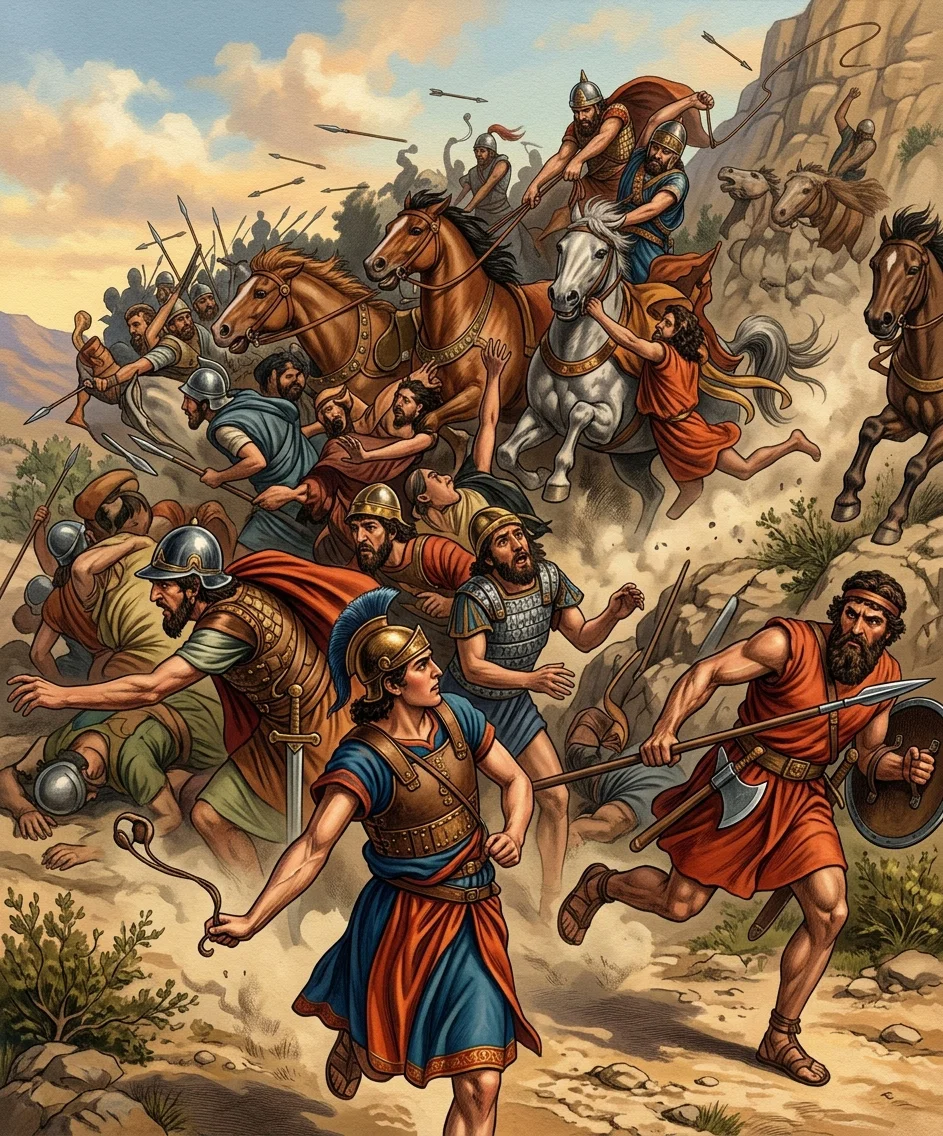
Full Page Illustration from “A Man of Valor”

A Story of Vigor, Action, Courage, and Adventure

No modern tale of romance or adventure surpasses in interest this story of the fortunes of Jonathan, son of the king of Israel. The love of this royal youth for the shepherd lad David, and the marvelous happenings that befall the two, form a narrative no less interesting because true.

“A Man of Valor”

By Arthur W. Spaulding
Its true story of a real boy and of his growth into the same vigorous and valorous manhood to which every real boy aspires to-day. Its description of the intrigues of kings, the clash of opposing armies, and the final triumph of right over might, are most inspiring.
The “Man of Valor” is a book which, once opened and read, becomes a chosen friend. While specially a book for boys, there are few girls who will not read it with intense interest.
For the lessons of practical value which naturally connect themselves with the narrative, it is well worth while for every parent to place this book in the hands of his children.
In Cloth, Handsomely Illustrated, the price is $ .75
Order from your Tract Society or from

Review and Herald Publishing Association

WASHINGTON, D. C.

An Appeal to Our Churches Throughout the United States

Sanitarium, Cal.
DEAR BRETHREN AND SISTERS: I wish to make an appeal to you in behalf of the work in Portland, Maine. The believers in Portland are endeavoring to complete the building of a suitable house of worship; and unless they receive help from their brethren and sisters, they will be greatly embarrassed.
The city of Portland was remarkably blessed by God in the early days of the message. At that time able ministers preached the truth of the soon coming of the Lord, giving a startling warning of the near approach of the end of all things. In halls, in meeting-houses, and in private houses, the mighty power of God was revealed in the messages borne. The light of the Lord shone from one end of the city to the other. Meetings were appointed in various sections of the city, and the genuine work of the Holy Spirit was evidenced. The first and second angels’ messages sounded all through Portland, and the city was greatly moved. Many were converted to the truth of the Lord’s soon coming, and the glory of the Lord was revealed in a remarkable manner.
In the city of Portland the Lord ordained me as his messenger, and here my first labors were given to the cause of present truth. After a period of despair, the blessed Saviour revealed to me his love, and brought joy and happiness to my soul. When I was but a child, the Lord placed upon me a burden for souls. I worked earnestly for the conversion of my playmates, and at times ministers of some of the churches would send for me to bear testimony before their congregations. After the great disappointment, the Lord revealed himself to me in a special manner, and bade me bear his messages to his people.
For years I have cherished a hope that I might once more speak to the people in Portland. This hope was realized at the camp-meeting held in July, 1909, in a favorable place in Portland. Elder S. N. Haskell and several other experienced ministers were present. Day after day the large tent was well filled with earnest people. The Spirit of the Lord came upon me, and gave me power to make appeals to the people.
The last Sunday afternoon every seat in the tent was full; and in order to accommodate all who came, it was necessary to bring all the available chairs from the tents of the campers. We had one of the most solemn meetings that I have attended for years. After a discourse accompanied by the manifest power of the Holy Spirit, nearly the entire congregation arose, pledging themselves to search the Scriptures, and to follow the light of the Word of God. As a result of this camp-meeting and of the efforts that followed, some have taken hold of the truth.
I am now urging that a strong effort be put forth to give the last message of warning to the city of Portland, Maine. Let the third angel’s message be proclaimed from one end of the city to the other.
It is right that there should be a commodious house of worship in the city of Portland. Our brethren there have done well in securing a piece of land favorably situated between the business part of the city and the great park called “The Deerings’ Oaks.” While I was in Portland, I saw the beginning that had been made on their church building,—the first meeting-house to be erected in that city by Seventh-day Adventists. I encouraged the brethren to go ahead with the work of building as rapidly as possible, and promised that I would do what I could to raise means to help in its erection. The building is now erected, but is not finished in the interior. Our people are meeting in the basement.
While not one penny should be expended unnecessarily in the erection of this church building, no second-class work should be done. It is planned to use the basement of the church for church-school purposes. This is right, that provision may be made by which our children can be guarded from the evils that prevail in the public schools. If this plan is carried out, the basement will have to be well finished; and this can not be done without means.
The city of Portland must not now be neglected. This meeting-house should be complete and furnished. Work must be opened in different sections of our cities. The various lines of work should be courageously carried forward by different companies of workers. The grace of God will accompany the effort, and the light of truth will be given in clear, straight lines. This work should go forward without delay.
The Lord has given instruction that the work of uplifting the banner of truth in the Eastern States must now go forward with new power, and that the vigor of healthy, devoted labor shall be given to those cities where the first and second angels’ messages were preached. Portland has been especially pointed out as a place that should be labored for without delay. This city has been especially noticed by the God of Israel; should we not unite our efforts to have there a house of worship that is worthy of the notice of the people? I invite our churches throughout the States to lend a helping hand.
It has been proposed by friends of this enterprise that I make an appeal to our churches throughout the States, asking each church-member to make a donation of ten cents for the erection of this meeting-house in Portland. It was thought that such a small offering would scarcely be felt by the givers, while if all our churches united in giving, a sufficient sum would be raised to enable the believers in Portland to go forward and complete their meeting-house.
Let all the churches, large and small, have a part in the work. Let the children as well as the older members of the Lord’s family have a share in it. Parents can certainly make this small donation; and the children, by practising self-denial and economy, can also have a part. We ask you in the name of the Lord to do what you can. I pray that this may be the beginning of a work that will result in the extension of a knowledge of the truth for this time throughout the State of Maine.
ELLEN G. WHITE.

Facing the Crisis

C. H. EDWARDS
There are certain developments in the world which seem to indicate that at no very distant day the entire Christian church, and especially observers of the seventh day, will be brought face to face with the question of simple faith in the Bible and its statements. For years the Higher Critic has carried on his work of undermining the faith of Christendom in the surety and truthfulness of the Bible.
He has never hesitated a moment to dissect the Sacred Word. He declares that the story of Jonah and the whale is but a myth; that Job never lived; that Daniel never had an existence, and that the writings ascribed to him were simply the impositions of some one who lived at a much later date. The virgin birth of Christ, his miracles, and his bodily resurrection have all been ridiculed and rejected; and to-day comparatively few are found who believe in the supreme, infallible, divine Word of God. Many, even of those who proclaim their allegiance to that Word, at once become apologists for it and admit that they do not believe its scientific statements, when they are met with the assertion that so-called modern science disproves the accuracy of the Bible.
Perhaps the latest attempt to undermine the authority of the Bible has been the effort to discredit and change the ten commandments. This movement has assumed such proportions that it is well worth our time and attention to consider it. For years the Christian world has been preparing for just such an attempt as this. Many who apparently abhor the teachings of the modern critic have been the leaders in preparing the ground and sowing the seed for the great harvest that must surely be reaped. Some time ago there came from the pen of one of the most prominent evangelists of the age, a book whose intent was to discredit and belittle the Sabbath of the fourth commandment. So zealously did he endeavor to repudiate the sayings of God that he actually declared:—
“The one thing we have now settled is that the law written and engraved upon stones, including the Sabbath law, has no claim whatever on the Christian; in fact, is done away. We must stand by this proposition, because the Spirit of God says so in the Word.”
From one end of the country to the other this fearful delusion of antinomianism is being promulgated. Even the preachers of denominations which claim absolute loyalty to the decalogue are adopting this insidious notion that God's holy law has no claims upon a Christian. Thus, from the pulpit and from the press, the entire world is being sown with the seeds of lawlessness; and when the present movement to discredit the authority and authenticity of the decalogue is fully launched, the world will be ready to be swept away in the vortex of antinomianism and destruction.
The Higher Critics of England have decided that it is time for the church to authoritatively declare its opinion on, and its attitude toward, the ten commandments. This month there will be held a convocation of the Church of England at Canterbury; and at that time the Very Rev. William M. Furneaux, dean of Winchester, is to present to the convention a plan for the revision of the law of God. It is declared that this movement has the backing of so many influential clergymen that there is a fair prospect of its receiving favorable consideration.
We are glad to state that not all the clergy are committed to this plan. The following ringing challenge by Prebendery Webb-Peploe, of St. Paul's, London, should cause many to stop and consider the matter carefully before engaging in such an undertaking:—
“Never has a more blasphemous or sacrilegious proposal been made. What are we coming to when mankind presumes to abridge and alter words specifically declared to be those of Jehovah? The substitution of the evangelical summary of the ten commandments in the common service was a retrograde step, but it was nothing so serious in the sight of God as this new proposal. I hold that the whole of the Old Testament was a divine organ. It is not brevity that is aimed at, but a deliberate distortion of the Christian faith.”
What makes the movement so forbidding and so alarming is the reason that is set forth as the basis for the change. Not only has the Christian church been taught the sophistry of antinomianism, but even from the pulpit the statement has been made that the story of creation, as recorded in Genesis, is a myth, pure and simple. The same teaching is found in leading colleges and universities.
Dr. Henry S. Nash, professor of New Testament literature in the Episcopal Theological Seminary at Cambridge, England, says:—
“These commandments are padded with too much theology and worn-out tradition. The movement to shorten, or modify them on the part of the convocation of Canterbury in the Church of England, is really nothing new. The subject has been discussed by scholars of the Bible for some time. We need to put them into portable shape. Everything else is put into a small shape today, and I suppose these commandments must yield to the same tendency. . . . Now about the history of these commandments. We do not believe they were handed to Moses on two tables of stone chiseled out by the Omnipotent. That is to say, We do not believe that God turned sculptor for a time, and handed this prophet two tables of stone with the commandments engraved on them. While they came in their simplest form from the Almighty, we are not compelled to believe that the two tablets of stone came out of heaven, and were handed to Moses. All the evidence is against this. This is merely tradition. Like all traditions, it has fallen to pieces in the light of careful and accurate scholarship.”
After thus decrying the authenticity of the entire law, he takes the commandments separately, and gives his reasons for changing them specifically:—
“Now we see this in the fourth commandment. We do not keep the seventh day holy because God rested on that day. There are many other reasons for keeping one day holy in seven. Sunday is not the Sabbath. The Sabbath is, strictly speaking, Saturday. But this commandment speaks of the Sabbath in such a way that it does not give us the true reason for keeping Sunday. This opens a whole field for controversy. It is not necessary to enter on this. But it indicates that we are not to look at the wording of this commandment literally; for if we do, we shall have no end of trouble. No one believes that this earth was created in six days of twenty-four hours' length. No doubt there are people who still cling to this conception of creation, but geology has something to tell us about this. Its investigations are to be weighed. It may have taken millions of years for this earth to assume its present condition. I think that such a commandment provokes comment in its present form. It is so involved in traditions that we have to explain many of its phrases, whereas a simpler form would answer so much more to our moral teachings.”
Bishop Williams, of the Episcopal district of eastern Michigan, when asked to express his opinion on the subject, said:—
“I don't believe there is any person nowadays who believes the Lord created heaven and earth in six days, and that is my reason for favoring the abridgment of the fourth commandment.”
Prof. F. B. Blodgett, professor of Old Testament literature and interpretation at the General Theological Seminary, New York City, declared:—
“Similarly, under the fourth commandment about keeping holy the Sabbath day, the reason is stated: ‘For in six days the Lord made heaven and earth, the sea, and all that in them is, and rested the seventh day.’ Now today nobody believes that the earth was made in six days,—at least, it is not at all in line with modern science. It would be hard, therefore, to hold, as a reason for keeping the Sabbath, a reason the truth of which one disbelieves. As a matter of fact, we keep the Sabbath for an altogether different reason—not because the Lord made the heavens and the earth in six days, but because of modern humanitarian motives in providing rest for workers.”
From this it can be seen that the movement to abridge the commandments is a logical one from the modern churchman's point of view.
Step by step, closer and still more closely, the world is being brought to the final test of faith. The children of men are coming face to face with the solemn question: Whom shall we believe—God or man? Is it a matter of wonder that the Saviour, seeing this very time, asked, with inexpressible sadness, “When the Son of man cometh, shall he find faith on the earth?”
It is by such teaching that the world is being prepared to reject the Bible and its divine Author. But what is the chaff to the wheat? He that sitteth in the heavens will laugh at man's vain imaginings. His Word is established. By it man will be judged at last. Happy are they who accept that Word now, believe its plain, simple record of creation, and square their lives by God's divine law.
Providence, R. I.

Proclaiming the Truth Under Difficulties

MRS. E. G. WHITE
“Sent forth by the Holy Ghost,” Paul and Barnabas, after their ordination by the brethren in Antioch, “departed unto Seleucia; and from thence they sailed to Cyprus.” Thus the apostles began their first missionary journey.
Cyprus was one of the places to which the believers had fled from Jerusalem because of the persecution following the death of Stephen. It was from Cyprus that certain men had journeyed to Antioch, “preaching the Lord Jesus.” Barnabas himself was “of the country of Cyprus;” and now he and his fellow worker, Paul, accompanied by John Mark, a nephew of Barnabas, visited this island field.
The mother of Mark was a convert to the Christian religion, and her home was an asylum for the disciples. There they were always sure of a welcome and a season of rest. It was during one of these visits of the apostles to his mother’s home, that Mark proposed to Paul and Barnabas that he should accompany them on their missionary tour. He felt the favor of God in his heart, and longed to devote himself entirely to the work of the gospel ministry.
Arriving at Salamis, the apostles “preached the word of God in the synagogues of the Jews. . . . And when they had gone through the isle unto Paphos, they found a certain sorcerer, a false prophet, a Jew, whose name was Barjesus: which was with the deputy of the country, Sergius Paulus, a prudent man; who called for Barnabas and Saul, and desired to hear the word of God. But Elymas the sorcerer (for so is his name by interpretation) withstood them, seeking to turn away the deputy from the faith.”
Not without a struggle does Satan allow the kingdom of God to be advanced in the earth. The forces of evil are engaged in an unceasing warfare against the agencies appointed for the spread of the gospel; and these powers of darkness are specially active at times when the truth is being proclaimed before men of repute and sterling integrity. Thus it was in the days of Paul and Barnabas, when Sergius Paulus, the deputy of Cyprus, was listening to the gospel message. The arch-enemy of souls, working through the sorcerer Elymas, sought by false reports and specious deceptions to prejudice the mind of the deputy against the gospel. The deputy had sent for the apostles, that he might be instructed in the message they had come to bear; and now the forces of evil sought with their baleful suggestions to thwart the purpose of God. Thus does the fallen foe ever work to keep in his ranks men of influence who, if converted, might be of great service to the cause of God.
But none need fear defeat at the hand of the enemy; for it is the privilege of the gospel worker to be endued with power from above sufficient to enable him to withstand every satanic influence. Thus it was with the workers who, during their visit to the isle of Cyprus, were brought into direct conflict with the powers of darkness. Although sorely beset by Satan in the person of Elymas the sorcerer, Paul nevertheless had the courage to rebuke the deceiver. “Filled with the Holy Ghost,” the apostle “set his eyes on him, and said, O full of all subtilty and all mischief, thou child of the devil, thou enemy of all righteousness, wilt thou not cease to pervert the right ways of the Lord? And now, behold, the hand of the Lord is upon thee, and thou shalt be blind, not seeing the sun for a season. And immediately there fell on him a mist and a darkness; and he went about seeking some to lead him by the hand. Then the deputy, when he saw what was done, believed, being astonished at the doctrine of the Lord.”
The sorcerer had closed his eyes to the evidences of gospel truth; therefore the Lord, in righteous anger, caused his natural eyes to be closed, shutting out from him the light of day. This blindness was not permanent, but only for a season, to warn him to repent, and to seek pardon of the God whom he had so grievously offended. The confusion into which this man was brought, with
all his boasted power, made of no effect his subtle arts against the doctrine of Christ. The fact of his being obliged to grope about in blindness, proved to all beholders that the miracles which the apostles had performed, and which Elymas had denounced as being produced by sleight of hand, were in reality wrought by the power of God. The deputy was convinced of the truth of the doctrine taught by the apostles, and embraced the gospel of Christ.
Elymas was not a man of education, yet he was peculiarly fitted to do the work of Satan. Those who preach the truth of God will be obliged to meet the wily foe in many different forms. Sometimes it is in the person of learned, more often of ignorant men, whom Satan has educated to be successful instruments in deceiving souls. It is the duty of the minister of Christ to stand faithfully at his post, in the fear of God and in the power of his might. Thus he may put to confusion the hosts of Satan, and triumph in the name of the Lord.
Paul and his company now continued their journey, going to Perga, in Pamphylia. Their way was toilsome; they encountered hardships and privations, and were beset with dangers on every side. As they advanced, they were compelled to face “perils of waters,” and “perils of robbers.” In the towns and cities through which they passed, they were still surrounded by dangers seen and unseen. But Paul and Barnabas had learned to trust in God’s power to deliver. Their hearts were filled with fervent love for perishing souls. As faithful shepherds in search of the lost sheep, they had no thought of their own ease and convenience. Forgetful of self, they faltered not when weary, hungry, and cold. They had in view but one object,—the salvation of those who had wandered far from the fold of safety.
It was here that Mark was overwhelmed with fear and discouragement, and wavered for a time in his purpose to give himself whole-heartedly to the Lord’s work. He had labored with success under favorable circumstances; but now, upon encountering the opposition and the perils that so often beset the pioneer worker, he failed to endure hardness as a good soldier of the cross. He had yet to learn to face danger and persecution and adversity with a brave heart. Unused to hardships, he was disheartened by the perils and privations of the way. As the apostles advanced, and still greater difficulties were apprehended, Mark was intimidated, and, losing all courage, refused to go farther, and returned to Jerusalem.
This desertion caused Paul to judge Mark unfavorably and severely for a long time. At a future period there was a sharp contention between Paul and Barnabas concerning Mark, who had again decided to devote himself to the work of the ministry. This contention caused Paul and Barnabas to separate, the latter following out his convictions, and taking Mark with him in his work.
At that time, Paul was not inclined to excuse in any degree the weakness of Mark in deserting them and the work upon which they had entered, for the comforts and safety of home; and he urged that one with so little stamina was unprepared for taking up a work requiring patience, self-denial, bravery, devotion, and faith, with a willingness to sacrifice even life if need be.
Barnabas, on the other hand, was inclined to excuse his nephew, because of his inexperience. Barnabas felt anxious that Mark should not abandon the ministry; for he saw in him the qualifications of a useful worker for Christ. In after-years, his solicitude in Mark’s behalf was richly rewarded; for Mark gave himself unreservedly to the Lord and to the work of proclaiming the gospel message in difficult fields. Under the blessing of God, and the wise training of Barnabas, he developed into a valuable worker.
Paul was afterward reconciled to Mark, and received him as a fellow laborer. He also recommended him to the Colossians as one who was a fellow worker “unto the kingdom of God,” and “a comfort unto me.” Again, not long prior to his own death, he spoke of Mark as profitable to him in the ministry.

Trust

STILL will we trust, though earth seem dark and dreary, And the heart faint beneath His chastening rod; Though rough and steep our pathway, worn and weary, Still will we trust in God.
Our eyes see dimly till by faith anointed, And our blind choosing brings us grief and pain; Through him alone, who hath our way appointed, We find our peace again.
Choose for us, God, nor let our weak preferring Cheat our poor souls of good thou hast designed. Choose for us, God; thy wisdom is unerring, And we are fools and blind.
So from our sky the night shall furl her shadows, And day pour gladness through her golden gates; Our rough path lead to flower-enameled meadows, Where joy our coming waits.
Let us press on: in patient self-denial, Accept the hardship, shrink not from the loss: Our guerdon lies beyond the hour of trial, Our crown beyond the cross.
—William Henry Burleigh.

Its Predictive Aspect

Tracings of the Prophetic Gift—No. 2

Its Predictive Aspect

J. O. CORLISS
THE Old Testament prophets were the soul and life of Israel’s activity. Had it not been for their timely and continuous disciplinary warnings, and frequent predictions of ultimate success for the seed of Abraham, probably that people in time would have been merged into the nations by whom they were surrounded. The opportunities for such a result were not wanting. After the removal of the ten tribes to the far East, where they were lost by intermarriage with foreign associates, the tribe of Judah was carried away to Babylon. But they were accompanied thither by a young prophet who, through direct providence, pointed out the rise and fall of nations hostile to God’s truth, yet ever crowned his predictions with the one thought of encouragement that the people of God would finally take the kingdom, which would be universal, and possess it forever and ever. See Dan. 2:44; 7:27; 12:1, 2, 12.
Without doubt these predictions saved the captive Jews from apostasy, as they were intended to do. It was these missives that gave the Jewish nation that hopeful, progressive character, which no other early nation shared. The voice of their prophets gave them a general spirit of tenacious hope and trust that never fully deserted them, even though they were left to mourn their former glory.
Those prophetic warnings, precepts, and consolations were drawn from imagery that covered both the present and extended to the future. Indeed, the very form of the Hebrew verb, in which one tense is used for both past and future, especially adapts it to the peculiarities of prophetic speech. The prophets were represented as watchmen stationed upon a high tower, from which they could see above and beyond the stretch of ordinary human view. So the question was asked of one: “Watchman, what of the night?” The reply was sounded forth: “The morning cometh, and also the night.” Isa. 21:11, 12.
Then, as if some might become restless at the delay of the predicted issue, and so raise doubts as to the genuineness of the augury, the prophet says: “I will stand upon my watch, and set me upon the tower, and I will watch to see what he will say unto me, and what I shall answer when I am reproved,” or “argued with,” as in the margin. Hab. 2:1. The only reply from the Lord is: “Write the vision, and make it plain upon tables, that he may run that readeth it.” Assured, as the prophet was, that the word of the Lord to him could not fail, he would not deign to reply to reproofs or arguments, beyond writing the vision plainly, as he was instructed to do, so that all might read it, then leaving the result with the Lord to look after. But he ventures to assure all who read that the vision will speak for itself at the appointed time for its fulfilment, and will not lie. The only safe advice to be given under the circumstances would therefore be: If the vision appears to tarry, “wait for it; because it will surely come, it will not tarry.”
The very force of positiveness accompanying early prophetic exhortations placed them beyond the necessity of added confirmatory evidence. The words thus uttered attested their authority, without explanation or comment. So certain was the divine instrument of their fulfilment, that the issue was quietly left to be decided by the results. This is well illustrated by the words of Micaiah, who predicted disaster to the king of Judah if he went to battle with wicked Ahab. The prophet was insulted and smitten in the face for his faithful testimony, but he quietly replied: “Thou shalt see on that day when thou shalt go into an inner chamber to hide thyself.” 2 Chron. 18:24. Being then remanded to prison, to be fed on bread and water until the king should peacefully return from war, the prophet answered briefly: “If thou certainly return in peace, then hath not the Lord spoken by me.” Then, as if he would have this last statement remembered by all, he added: “Harken, all ye people.”
One lesson to be drawn from this incident ought not to pass unheeded. It is clear that the early prophets were the source of appeal in matters of perplexity, because the people believed that through them they could and would hear the counsel of Jehovah in pressing extremity. In the case just cited, the prophet was called as usual to settle a point of duty, but because the advice given was not in accord with the judgment of those who sought the counsel, his testimony was rejected, and he was subjected to insult. It was this selfish use of God’s instruments that belittled the prophetic gift among the Jews, and cost them their standing before God.
The fulfilment of prophetic warnings is the strongest proof that the Bible is God’s own guide-book for the world. The “things to come” so positively set forth have revealed an insight into the needs of future generations far beyond human anticipation, even of those living in the age for which the prophecies were written. This makes them a special sign of authority to those who require strong evidence of Scriptural inspiration.
Prophetic references to the future were the ground for consolation to the Jewish church. As the people were sustained in their hours of difficulty from this source, so should the people of God ever be hopeful from the same cause; for it is this which gives the Bible its victorious character, and places its believers above the morose spirit of false religions of every kind. Through prophetic utterances came the hope of an approaching Messiah, who was to be, and who is, the very center of human hope. This was indeed the great climax to which all prophetic expression pointed. When God announced “by the prophets,” a coming Christ, he but spoke of that which in his own good time he is sure to bring to pass.
As has been eloquently stated by Dean Stanley: “To what future of futures, which shall fulfil the yearnings of all that the prophets have desired on earth, it is for us, wherever we are, to look onward, upward, and forward, in the constant expectation of something better than we see or know. Uncertain as to the day and hour and as to the manner of fulfilment, this last of all predictions still, like those of old, builds itself upon the past and present. ‘It doth not yet appear what we shall be: but we know that, when he shall appear, we shall be like him; for we shall see him as he is.’”
Mountain View, Cal.
Continue reading: Obtaining the Victory