The Youth’s Instructor, Vol. 48, No. 36.

A TRIP TO PARIS

The Youth’s Instructor

Sep 13, 1900

Review and Herald Publishing Company · Battle Creek, Mich. · Sep 13, 1900

A TRIP TO PARIS
It was in the summer of 1894 that two Americans, then staying in London, decided to visit the renowned French capital. One of them was a middle-aged professional man, who had traveled considerably in various parts of the world, and was consequently an excellent companion for such a trip. The other man was younger, not yet thirty, and his experience away from home was somewhat limited. He had seen several of the Eastern and Middle States; had visited the world-famed Niagara; and the year before had visited the Columbian Exposition. Besides this he had taken with nature’s kodaks a large number of mental pictures of the beautiful scenes so wonderfully spread out before one making a trip up the Hudson. These experiences, together with the ocean voyage to Queenstown and Liverpool, and the trip to London by rail in the odd, small, side-door, English compartment cars, had fanned into a blaze a long-smoldering fire of longing to see something of the great world in which we live.
Under these conditions these two persons were thoroughly mated, and well prepared to enter heartily into a search for the many interesting things of the strange city, from which to derive instruction and entertainment. With the Latin phrase, multum in parvo, in mind, concerning both time and expense, advantage was taken of a cheap, three-days’ excursion via the London, Chatham, and Dover Railway, leaving England’s metropolis at 8:30 Saturday night. Before the train started, every one seemed to speak English, though occasional traces of a foreign accent were heard, and an abundance of black hair and eyes on the crowded platforms of Holborn Viaduct Station showed that a larger percentage of Norman blood than is usually seen in a London crowd was present. As soon as the train started, however, and even before it had passed over the famous old “King Lud” hotel, situated under the Ludgate Hill bridge of this line, a jabbering of French was heard on all sides. This road is one of the great arteries of traffic and travel between the realms of Her Majesty, the Queen, and her neighbors of the great Continental Republic; and naturally enough, in addition to the number of English passengers “going abroad,” there were a large number of French subjects returning to their homes, who had been quite inconspicuous while mingling with the crowds of London, but who began to be much in evidence as they were thrown into one another’s company, and discovered many with whom they possessed a mutual language.
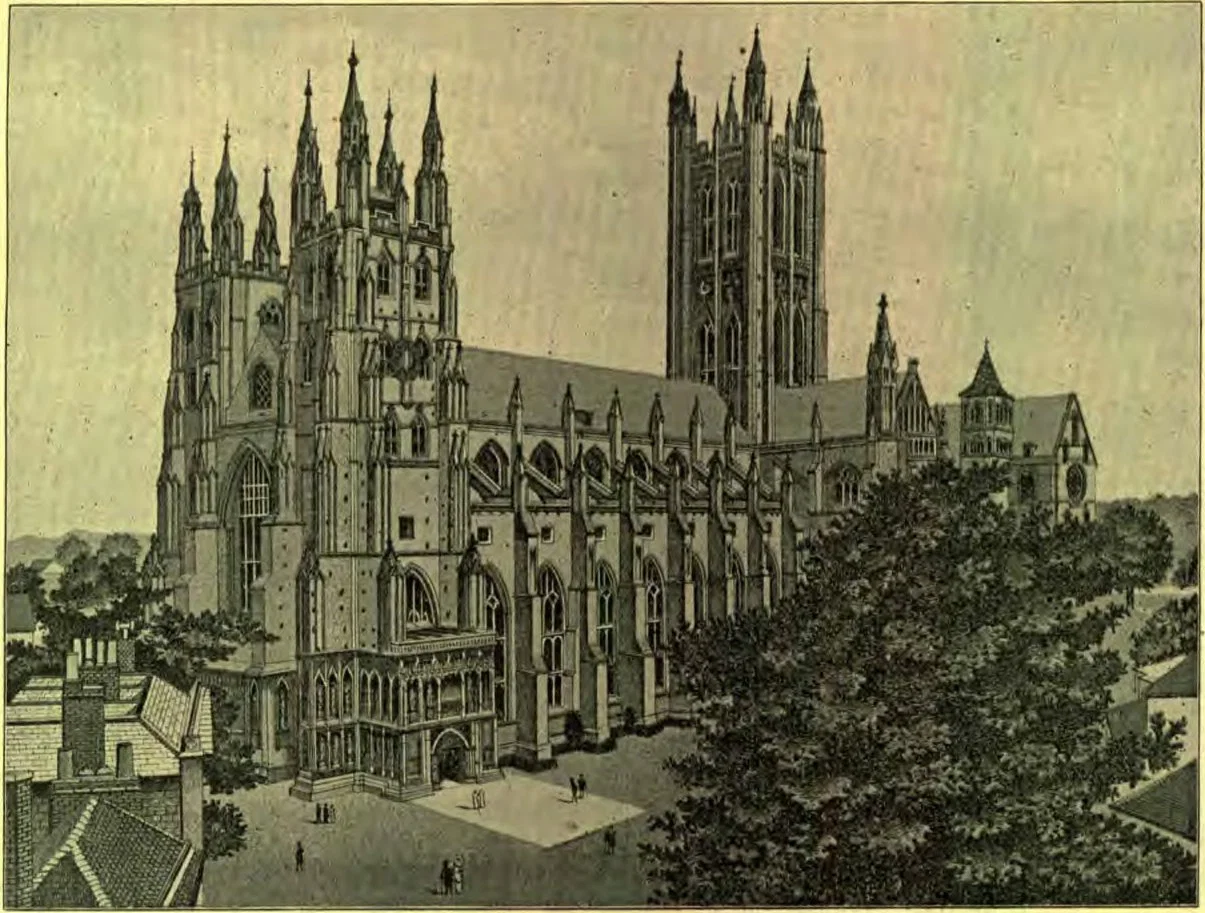
CANTERBURY CATHEDRAL
The ride to Dover lasted about two hours. The route lay through the ancient city of Canterbury, where is situated Canterbury Cathedral, the scene of Thomas à Becket’s murder; but the night was dark, and nothing much could be seen. These English cities are not so brilliantly lighted as are our American towns, or at least they were not at that time. The use of French continued to increase till Dover was reached, when it seemed that nearly every one was using the quick, soft speech of the smooth Latin tongue, in sharp contrast with the prevailing rougher Anglo-Saxon words heard two hours before. Here, after a half-hour’s delay, one of the Calais boats was boarded. The English Channel is rough,—very rough and choppy sometimes,—and these boats are not large, like the great “liners” of the Atlantic service; but a description of this feature of the trip will be omitted till the return journey, for fear that some might by its perusal miss the enjoyment that such a trip really affords.
By the time the shores of France were reached, not only was there much French to be heard in the commands of the custom-house officers, the orders of the railway foremen, and the shouting of the men under them; but English seemed to be a dead language. It will be remembered that only a short time before this date, the anarchist Vaillant had thrown a bomb in the Chamber of Deputies, in Paris, which resulted in the injury of many persons and damaged the auditorium to a considerable extent. This incident caused much excitement all through the nation; and on entering the country all foreigners were carefully scrutinized, and their baggage was subjected to a thorough examination . Although our travelers had only small hand baggage, even this caused considerable delay, especially as neither of them could speak French, and a French official who could speak English was, to their surprise, hard to find. At last the ordeal was over, and they were told to pass out to the train.
It was now two o’clock in the morning. On leaving the station a great railway yard was entered, where there were several trains, but which one to enter they could not tell. After searching some time, a coach was found on which was a card labeled “Paris;” but an attempt to enter it was quickly interrupted by a uniformed official who, up to this effort to help themselves, had seemingly paid no attention to the searchers. No reason was given for their not being allowed to take this train; but from the fact that it was finished better than others, and that it was the first to leave the station, the conclusion was reached that it was for regular passengers only, not for excursionists. After showing their tickets to the brass-buttoned official, the two Americans were turned over to a “guard,” or a “trainman,” as he would be called in England and America; but what appellation is given to him in Calais was not learned. With lantern in hand, he led the way across several tracks to the opposite side of the yard, opened a door, and motioned them to enter a dingy, ill-lighted, uncushioned compartment, in a black car, which can best be compared in outside appearance to a Lehigh Valley coal-car with a roof. For half an hour it had been dawning upon the Yankees that they were not receiving the courteous attention that a lavish use of francs and centimes would have secured, and now they had good reason to regret that the continental portion of their trip was to be as “excursionists.”
After a tedious delay, during which the first-mentioned train pulled out, this train was hauled out of the darkness, and backed up to the station platform. Then the other passengers entered the compartments of the cars, which are similar to those of England, except that they are much heavier, and evidently designed for longer journeys.
A COMPARTMENT CAR
A COMPARTMENT CAR
The section assigned to the two Americans received the addition of three Frenchmen and an Englishman who spoke French. The journey passed without incident worthy of mention till daylight, when other passengers, residents of the rural districts, took the places of some who had reached their journey’s end.
The Americans, now properly designated the foreigners, not being acquainted with the road, and not understanding the language, did not know the exact time they would arrive in Paris; so the younger one took out his timepiece, and pointing to it inquiringly, said to one of the latest occupants, “Paris”? He felt sure that the name would be recognized, and the man would understand that the time when the city would be reached was sought. But no; not a gleam of intelligence passed over the face of the Frenchman. The French-speaking Englishman came to the American’s assistance by informing him that Paris was not so pronounced in France. Said he, “You should say Paree.” On hearing that word the Frenchman became animated at once. Reaching for the watch, he pointed to seven and twelve, thus indicating that the train would reach the city at seven o’clock. He seemed quite pleased to be able to render this service. It was soon learned by the two Americans that what seemed to be a lack of courteousness on the part of the people with whom they were forming an acquaintance was due only to a failure to make themselves understood; and without doubt if those men at the station at Calais had been changing cars in Chicago or New York, the different manners and customs of American railways would have led them to think they were among a race of stupid, ignorant people. So much for a different point of view. That the newcomers in the car were considerate for others was soon proved by the act of a kind-hearted old man with an “Oom Paul” countenance, who made use of his snuff-box, and seeing the elder American eyeing it closely, passed it to him at once.
When the hands of the watch indicated 6:30, there began to be a bustle among the passengers in the little room of the car, especially among the ladies. Hats were adjusted, wraps fastened, children who had been eating were brushed up, and everything showed that the city was near. Soon the familiar outlines of the Eiffel Tower, so often pictured in modern literature, appeared to view through the right window, and the last possible fear that the wrong train might have been taken amid the confusion at Calais was dispelled. The great building in which the train stopped had over the door on the outside, facing the street, a sign reading, “Station du Nord.” By this it was learned that the train had entered and stopped in the north side of the city. A day or two later another station was entered, over the door of which was the word “Ouest,” associated with others now forgotten. The location was responsible for the conjecture that the word meant “West.” H. E. SIMKIN.
(To be continued.)

A SIN-PARDONING SAVIOUR

I

Christ came to this world to reveal the Father, to give to mankind a true knowledge of God. He came to manifest the love of God. Without a knowledge of God, humanity would be eternally lost. Without divine help, men and women would sink lower and lower. Life and power must be imparted by him who made the world.
The promise made in Eden,—the seed of the woman shall bruise the serpent’s head,—was the promise of the Son of God, through whose power alone could the counsel of God be fulfilled and the knowledge of God be imparted.
God made the promise to Abraham, “In thee shall all families of the earth be blessed.” To Abraham was unfolded God’s purpose for the redemption of the race. The Sun of righteousness shone upon him, and his darkness was scattered. Christ declared, “Your father Abraham rejoiced to see my day: and he saw it, and was glad.”
Jacob declared: “The scepter shall not depart from Judah, nor a lawgiver from between his feet, until Shiloh come, and unto him shall the gathering of the people be.”
To Moses God talked face to face, as a man talks with a friend. On him shone the light regarding the Saviour. He said to the people: “The Lord thy God will raise up unto thee a Prophet from the midst of thee, of thy brethren, like unto me; unto him shall ye hearken.”
The sacrifices and offerings told their story of the coming Saviour, who was to be offered up for the sins of the world. They pointed forward to a better service than theirs, when God would be worshiped in spirit and truth and in the beauty of holiness.
In the Jewish service was typified the atonement demanded by the broken law. The victim, a lamb without spot or blemish, represented the world’s Redeemer, who is so holy and so efficient that he can take away the sin of the world.
To David was given the promise that Christ should reign forever and ever, and that of his kingdom there should be no end.
The Hebrews lived in an attitude of expectancy, looking for the promised Messiah. Many died in faith, not having received the promises; but having seen them afar off, they believed and confessed that they were strangers and pilgrims on the earth.
God prepared the way for the coming of his Son by scattering the Old Testament Scriptures among heathen and idolaters. Divine power went with the Word. It carried with it the evidence of its power; for it bore the divine credentials.
Thus the way was prepared for the great Teacher. “But when the fullness of time was come, God sent forth his Son.” Christ came to teach lessons that would echo and re-echo from generation to generation. The teaching of the rabbis consisted of a monotonous repetition of maxims and traditions. Christ spoke with an assurance that impressed his hearers. His whole being was charged with divine love. His heart was filled with sympathy for mental and physical distress, which he met wherever he went. He bore a living testimony that he came not to destroy life, but to save it. By look and word he drew men to himself. Sympathy and love flowed from him to the distressed and suffering. The beauty of his countenance and the loveliness of his character attracted the people. No sooner did they look upon his face, and hear his gracious words, than their hearts were filled with a warm glow of love.
The truth that had been given to patriarchs and prophets Christ rescued from the rubbish, and presented to the people in a way that made it seem like new truth. He also gave them many new truths, spoken on his own authority.
MRS. E. G. WHITE.

COLORS OF SEA-WATER.

THE color of the sea is continually varying. The ocean, seen by reflection, presents a fine, azure-blue, or ultra-marine. Near the shore it becomes of a green, or glaucous, tint, and more or less brilliant, according to circumstances.
There are some days when the ocean assumes a livid aspect, and others when it becomes a very pure green; at other times the green is somber and sad. When the sea is agitated, the green takes a brownish hue. At sunset the surface of the sea is illumined with every tint of purple and emerald. Placed in a vase, sea-water appears perfectly transparent and colorless.
Many local causes influence the colors of marine waters, and give them certain decided and constant shades. A bottom of white sand will communicate a grayish or apple-green color to the water, if not very deep; when the sand is yellow, the green appears more somber; the presence of rocks is often announced by the deep color which the sea takes in their vicinity.
In the Bay of Loango the water appears of a deep-red, because the bottom is there naturally red. It appears white in the Gulf of Guinea, yellow on the coast of Japan, green to the west of the Canaries, and black round the Maldive group of islands. The White and Black Seas appear to have been named after the ice of the one, and the tempests to which the other is subject.
Colored animal or vegetable bodies give to the water a particular tint. Navigators often traverse long patches of green-, red-, white-, or yellow-colored waters, their coloration being consequent on the presence of microscopic crustaceans, medusæ, zoophytes, and marine plants. The vermilion sea on the California coast is probably due to the latter cause.—The Ocean World.

THE CRUCIBLE

The iron is torn away from all it knew, Beaten and broken, biting blow on blow; Weighed in the balance, flung to burning flame. So I, beneath Thy hands; do thou thy will!
Up through the heaving mass the fierce blasts blow; The heat grows sharper, piercing to the core; Shape crumbles down, color drops out in fire. Strength goes; pride goes; self changes; change not thou!
The fire dies out; the molten shape grows cool. Tempered and tried, edged on the whirling stone, Steel for the king’s hand, perfect; iron no more. Myself no more: set thou thy hand to me.
— Mabel Earle.

25—Black Mustard

One of our most common wayside weeds is the Black Mustard. I present a drawing of the whole plant, and a larger one of the flowers and pods. This plant belongs to the family of Crucifera, with the Peppergrass and Bishop's Purse, already described in these articles.
It is not a native of this country, but came to us from Europe. It is often cultivated for its small, dark-brown, pungent seeds, from which the well-known condiment called mustard is made.

26—Hedge Mustard

A far more unsightly weed than the Black Mustard is the Hedge Mustard. It may be found almost anywhere along waysides. The flowers are much smaller, and of a paler yellow. The Hedge Mustard branches about as freely as the Black Mustard, but hardly lifts its thin, curved branches out of the weeds among which it grows. This unsightly weed was formerly used for medicinal purposes.
Brassica Nigra
Brassica Nigra
L. A. REED.

ACTION

Strong is the arm that swings, and throws The light, free ball afar. Up, and still up, in the air it goes, A tiny shooting star; Then, as it seems beyond recall, It wavers, and begins to fall.
Across the field the schoolboys run, With eager, upturned eyes; They push and crowd, but only one Is sure to get the prize (But over near the schoolyard wall A few boys do not try at all).
Boys, press your way, and be alert For opportunity! Don't be content to stand inert, But up — and run — and see. Hurrah for him who wins the prize,— And honor to the boy who tries!
Frank Walcott Hutt.

CONFESSING CHRIST

How swiftly the Ethiopian put on the badge when he found that Jesus was his Saviour and Lord! Some of us might have said to Philip: “I believe that you are right, and that Jesus Christ is the Saviour, but I would rather not acknowledge him publicly, now. There are no Christians that I know of in Ethiopia. The customs are quite unlike yours; I could not commune there; and this is all a good deal of an experiment. When I come to Jerusalem next year, as I hope to, I would like to talk with you again about this matter.” Is this what he said?—No! Seeing some water by the roadside, he said, “See! water! what doth hinder me to be baptized?” There is the loyalty that commits itself absolutely and immediately. How did he know where he would be another year? No one can do anything to-morrow. If I live until to-morrow and do anything, it will have been done to-day; then, if it is right, do it to-day. To-morrow may not come. Fly your flag to-day for Jesus Christ, if you have given yourself to him. You will be stronger to fight a good fight and keep the faith to-morrow, if to-morrow ever becomes to-day.—Malthie D. Babcock, D. D.

We Can Not Have Jesus Without Joy

“WE can not have Jesus, and not have joy.”

ONE OF NATURE'S STOREHOUSES

WOULD you like to go with me this morning to a little house not built with hands? It is a tiny house, painted green, with a beautiful round tower, which reaches so high above it that it is always the first part of the house to catch sight of the rising sun, and the last to which the sunbeams say good-by.
This little storehouse has no counters nor shelves, no glass windows nor clerks; and the queerest part of it all is the strange stock kept here, and the funny little customers that come to the house. The stock is all kept up in this tall, pink tower, stored in cups so small that you and I can not see them with our naked eye. The stock is something that we all like, and good things are always wanted by everybody; thus it happens that the oddest, busiest lot of customers come to this place that you can imagine. They come with noise and bustle; for are they not always in a hurry to get home to their babies, who must have some bread to make them strong?
They come buzzing just like the bees that they are, and creep up to the tower where the sweets are kept, and fill their pockets full (for you know bees have pockets in which to carry bundles). And what kind of money do you suppose they pay for this honey?—Why, gold dust, which they carry all over their wings and bodies.
Thus it is that the bees go shopping, and visit the little storehouses—the clover plants.
— Child Garden.

GOOD THINGS TO LEARN.

LEARN to laugh. A good laugh is better than medicine.
Learn how to tell a story. A well-told story is as welcome as a sunbeam in a sick-room.
Learn to stop croaking. The world is too busy to care for your ills and sorrows. If you can not see any good in this world, keep the bad to yourself.
Learn to hide your aches and pains under a pleasant smile. No one cares whether you have the earache, headache, or rheumatism.
Learn to greet your friends with a smile. They carry too many frowns in their own hearts to be bothered with any of yours.—Epworth Herald.

THE MARCH OF THE GOLDENRODS

THERE'S a torchlight procession aflaunt through the meadows! The van has gone on, and the rear's never seen; It troops o'er the fields in undisciplined order, Each soldier arrayed in uniform green.
I can not distinguish recruit from commander; The order of march lacks the common design: But each, with his torchlight held valiantly upward, Is doing his best to keep up with his line.
They leave me the road and the walk and the pathway. Where I, from my cool, shady seat, watch them pass, While they tramp through ditches and hollows and valleys, And scramble up hillsides and through the tall grass.
The regiment gains in recruits as it marches, And volunteers always “fall in” by the way. Their names are not drafted: one only condition,— That all carry torches by night and by day.
But by and by comes! Then the torches burn faintly— A flash—and a flicker! Their brilliance is sped! And commands from the front, in the distance from nowhere, Send orders to “halt,” for sweet Summer is dead!
Then the soldiers in green halt, and patiently listen For further commands for the troop to disband; But while they are waiting, their enemy, Winter, Approaches, and on them he lays his cold hand.
And they die! and their little lives vanish—oh, whither? But their ghosts remain standing, true pictures of woe, With inverted torches—you often can see them, If you walk through the fields in the season of snow.
— Helen T. Wilder, in The Interior.

ARE YOU A CHRONIC BACKSLIDER?

Do you occasionally yield yourself sufficiently to God so that you secure a definite spiritual uplifting, and then do you afterward drift back even farther than you were before? Have you gone to camp-meetings, or to some revival effort, and enjoyed a real spiritual feast, only to find in a short time after returning home that your soul was as famished as before? Have you not sometimes seriously wondered what would be the final outcome of all this,—whether God would some day suddenly and miraculously lift you above the inclination to backslide; or whether, after all these trials and tribulations, you were eventually to be lost? or have you come to the conclusion that your present Christian experience is about all the satisfaction that can be secured from Christianity in this life, and that the real peace and happiness resulting from following Christ do not begin until one has crossed to the other shore?
Have you tried to root up error from your mind, instead of planting truth there? Have you tried to crowd darkness out of your soul, instead of bringing in light? Have you tried to remove weariness from your spiritual muscles by simply rubbing the aching spots? Or have you learned the sweet lesson of taking that rest which naturally brings refreshing?
Perhaps your experience has been a duplicate of the kind described by Christ in Matt. 12:43, 45, where an unclean spirit had been dislodged from a human soul, and after a time returned, and found the place from which it had been driven out, empty, swept, and garnished,—the very fact that it was left empty being nothing less than an invitation for the evil spirits of jealousy, envy, evil surmisings, doubt, frivolity, gayety, and sentimentalism to return, and take possession to an even greater extent than before. This led Christ to say that the last state of that man was worse than the first. This man had spent more time and energy in getting evil things out than he had in letting the truth in,—that truth which, by its very disinfecting power, would have driven out these undesirable things. “Ye shall know the truth, and the truth shall make you free.” John 8:32.
There is a better experience for us all than to have an empty and naked soul, walking about in a ghostly manner, simply inviting back the devils that have been cast out. For there are truths, which, if accepted, will cure us of chronic backsliding, so that we may become like “a tree planted by the rivers of water, that bringeth forth his fruit in his season; his leaf also shall not wither [backslide]; and whatsoever he doeth [including work for other young people] shall prosper.” Ps. 1:3.
When there is a fragrance about your Christian experience that captivates the hungry souls that come in contact with you, it will be easy for you to recommend the gospel to your associates; for the very flavor of your life will, to use a homely figure of speech, cause their spiritual saliva to flow, and they will be ready to digest whatever truths you have for them. Then your branches will spread; there will be beauty about you, as about the olive-tree, and fragrance, as of Lebanon; and those who dwell under the shadow of your influence will be revived, and grow up as the vine. Hosea 14:5-7. When you begin to feed upon truth that produces that kind of experience, it will be quite natural for you to say, like Ephraim, “What have I to do any more with idols?”
DAVID PAULSON, M. D.

Tricks of Speech

NOTHING is easier to acquire, nothing more difficult to lose, than a trick of speech and manner, and nothing is more universal. If we look around among our friends and acquaintances, we shall find scarcely one who has not his favorite word, his perpetual formula, his automatic action, his unmeaning gesture,—all tricks, caught, probably, when young, and, by not being got rid of then, next to impossible to abolish now.
Who does not know the familiar, “I say,” as the preface to every remark, and the still more familiar, “You know,” as the middle term of every sentence? Who, too, in these later times has not suffered from the infliction of “awful” and “jolly”—mile-stones in the path of speech, interspersed with even uglier and more obtrusive signs of folly and corrupt diction—mile-stones that are forever turning up, showing the successive distances to which good taste and true refinement recede in the race after slang? Then there are the people who perpetuate ejaculations; who say “Goodness!” as a mark of surprise, and “Good gracious!” when surprise is mixed with a trifle of reprobation. Lower in the social scale come “My word!” “Patience!” “Did I ever!” and indifferently in all stations, “You don’t say!” or in a voice of deprecation, “No!” and “Surely not!” To judge by voice and word, these ejaculatory people are always in a state of surprise. They go through the world in unending astonishment, and their appeals to their “goodness,” and that indeterminate quantity called “good gracious,” are incessant.—Selected.

Genius, Fame, and the Good Deed Done for Love

Ah, Genius burns like a blazing star, And Fame has a honeyed urn to fill; But the good deed done for love, not fame, Like the water-cup in the Master's name, Is something more precious still. — Susan Coolidge.

THE GREAT TEST OF CHARACTER

SOMETIMES our best efforts seem to be rewarded only by the faultfindings and criticisms of others; and it often appears that our endeavor to help another is rewarded by falsehood and misrepresentation. To be able, under such circumstances, to bear these things in patience, without murmuring, constitutes one of the greatest tests of a true and noble character.
One writer has said that “the truly noble character will not stoop to resent the false accusations made against it.” To be able patiently to bear mistreatment, as did Joseph; to be willing to be misjudged, as was Daniel; and to be unappreciated, as was Moses, are all essential elements to strength and nobility of character. How can we hope calmly to meet the great crises in life’s experience, when we so easily become ruffled and out of temper when misjudged by our friends, or ill-spoken of by our enemies? “If in the land of peace, wherein thou trustedst, they wearied thee, then how wilt thou do in the swelling of Jordan?”
The youth who to-day is building a character for eternity should be so busied with the work of helping others that he can find no time either to resent or to attempt to explain away the many falsehoods that the enemy may circulate about him. Thus the patience with which we can suffer wrongfully, the fortitude with which we can endure hardship, and the forbearance with which we labor under misrepresentation, constitute, in themselves, not only one of the greatest means of developing character, but also one of the greatest evidences of its strength. At some time in his experience, every Christian will be brought to the place where he must stand alone with God.
W. S. SADLER.

WHICH WOULD YOU BE?

I know a little girl who cries Whenever things perplex her; And oh, the petty cares of life, They do so often vex her! She spends her time from morn to night In dolefully repining, Nor ever looks behind the clouds To see the sun still shining.
I know a little girl who laughs At every grievous trouble, And blows it smilingly away, As if it were a bubble. For her the sky is always blue, And always birds are singing, While all the world is bright and gay, With merry voices ringing.
— Watchman.

PLATINUM

In almost all native gold is found another metal called platinum. This metal is, in reality, a combination of metals; that is, platinum is found in a somewhat rare ore called platinum ore, which also contains palladium, rhodium, iridium, ruthenium, and osmium.
In the sixteenth century, Spanish miners discovered in the gold ore of the Darien mines, grains of a whitish metal somewhat resembling silver, this was used by the Spanish government to adulterate their silver coin, and its exportation was prohibited. Its existence remained, therefore, comparatively unknown until late in the last century, when it was introduced into Europe as a curiosity, under its Spanish name of platina del Pinto (the little silver from the River Pinto). Subsequently the ore has been found in Santo Domingo; in California; on the Rogue River, in Oregon; in Canada; and in Borneo; the richest deposits, however, occurring in the Ural Mountains. For a time the Russian government struck coin of this metal, but its market fluctuations forced its abandonment for this purpose. Since that time the main use to which platinum has been put is in the manufacture of chemical utensils and other articles requiring lightness combined with strength.
Platinum is not changed by the action of air, water, steam, or any ordinary acid. Boiling caustic potash, or soda lye, has no effect upon it; nor can it be fused with any known substance in the absence of air.
In color, platinum, as found, is a pale steel-gray, occurring rarely in any other form than scaly grains or round lumps. The grains are often found cohering, however; and in this form, masses of considerable size and weight are obtained. The Madrid museum has a mass from Condoto weighing twenty-six and one-half ounces; while the Demidoff museum, Russia, has one weighing twenty-one pounds, troy, “lumps” weighing from ten to twenty pounds being often found in the Ural Mountains. These mines produce about seven thousand pounds of platinum yearly; and as this amount is a very large quantity, some idea can be formed of the feathery lightness of the metal.
W. S. CHAPMAN.
Continue reading: BACK IN SCHOOL