The Youth’s Instructor, Vol. 37, No. 51.

THE THRUSH

The Youth’s Instructor

Dec 18, 1889

S. D. A. Publishing Association · Battle Creek, Mich. · Dec 18, 1889

THE THRUSH.

WITH what keen pleasure we welcome the first return of the migratory birds! While the indications of spring seem yet a long way off, we come unexpectedly across some forerunner of the feathered tribe, in a sheltered nook, contentedly pecking the seeds from the weeds the snow has not covered, and telling us in a friendly twitter that spring is on the way. Perhaps days, or even weeks, pass by before we see him again. This time he has others with him. Soon all the birds have returned,— the robins, the blue-birds, the little chittering sparrows,—and the air is full of melody.
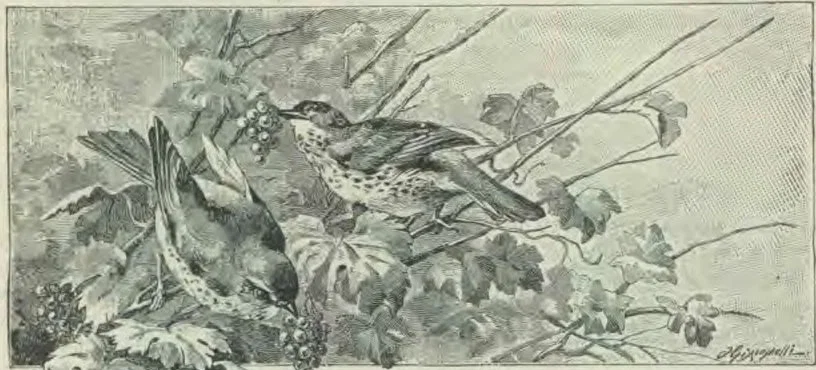
A small grove close by our dwelling is a favorite retreat for those birds who love civilized ways, yet are not so audacious as to build under the very eaves. Chiefest among these feathered tenants is a beautiful thrush, that has been a visitant for several summers. Attracted one morning by an unusually melodious voice among the feathered choir,—a seeming prima-donna among the singers,—two of us provided ourselves with opera-glasses, and sauntered out to get sight of the musician. Guided by the sound, we directed our glasses to the top of a tall oak that stood apart from the other trees. There, on the topmost slender twig, sat a thrush, the morning sunlight falling full on his mottled breast, giving to the reddish brown and fawn tints of his feathers an indescribable richness of color. Bending, quivering in the ecstasy of song, he was all unconscious of the admiring eyes fastened on him, or of the appreciative listeners that drank in the rich melody he showered down.
Suddenly he stopped, cocking his little head this side and that. He had caught sight of the opera-glasses ranged at him. Possibly they were a new kind of shot-gun. He dropped down behind a dead branch, and disappeared. Soon we heard his song in another part of the grove. Then followed a game of hide-and-seek; for each time the thrush discovered that he was observed, he took flight to less conspicuous quarters.
Going by the place later in the day, we observed him hopping up and down among some dead leaves, tussling with a bug or a flat morsel of some kind; for even thrushes feel obliged to pay regard to the cravings of nature.
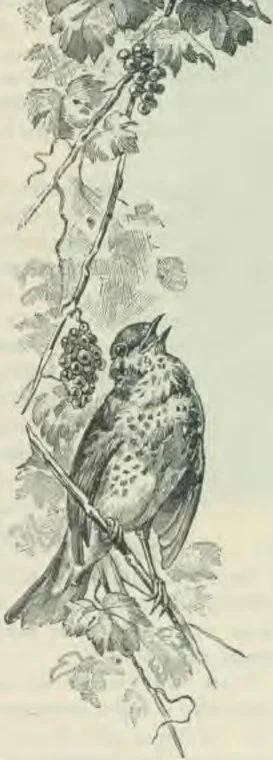
The thrush family embraces some of our most pleasing songsters, the oriole, the cat-bird, the mocking-bird, and the robin finding classification under this head. Prominent among these musicians is the song thrush, which is shown in the engraving on this page. In describing this bird, the Rev. J. G. Wood says:—
“It is plentifully found in most parts of England, and favors us with its vocal efforts throughout a considerable portion of the year. The song of the thrush is peculiarly rich, mellow, and sustained, and is remarkable for the full purity of its intonation and the variety of its notes. The thrush begins to sing as soon as incubation commences, and continues its song from the beginning of spring until the middle of autumn, or even as late as the first of December.”
The nest of the thrush is rather large, and is shaped like a basin. The shell of the nest is composed of roots and mosses, inside which is worked a rather thin but wonderfully compact layer of cow-dung and decayed wood, so strongly kneaded that when dry, it will hold water almost as well as an earthenware vessel. There are usually five eggs, of a beautiful blue, spotted with black. The spots are small, round, and well marked, and are extremely variable in size and number; they are always gathered toward the larger end of the egg.
“The food of the thrush is mostly of an animal character, and consists largely of worms, snails, slugs, and similar creatures. In eating snails it is very dextrous, taking them in its bill, battering them against a stone until the shells are entirely crushed, and then swallowing the enclosed mollusc. “The thrush does not, however, confine itself wholly to this kind of diet, but in the autumn months feeds largely on berries and different fruits, being fond of cherries, and often working great havoc in an orchard or fruit garden. But in spite of its occasional inroads upon the gardens, it deserves the gratitude of the agriculturist on account of its service in destroying the snails and other garden pests, and may well be allowed to take its autumnal toll of a few of the fruits of which it has been such an efficient preserver.”
W. E. L.

STRIKING FOR INDEPENDENCE.

“I am not going to be a slave for anybody. I am tired to death with this everlasting, ‘Dan, do this, and, Dan, do that.’”
“Who wants to make a slave of you, sir? You were simply asked by your mistress to carry a bucket of coal up-stairs,” answered Mr. Reed, eying the boy sharply.
“That is more than I bargained for. You employed me to run errands for the store, and I do not propose to wait on the women-folks, and take care of the baby besides.”
“Very well, I must have a boy who is willing to make himself useful, so you can go at the end of the week,” replied his master, a little stiffly.
So Dan was out of a place again. He had tried several in Easton, and Mr. Reed did not wonder now why his former employers had dismissed him so soon.
“People a’n't going to ride over me, and the sooner they understand that fact the better,” Dan muttered aloud, as he lay tossing on his bed that night. How his mother was to manage without his weekly allowance, he did not know; with half-a-dozen children and an invalid husband to support, she needed all the help he could give. “I’ll go to the city,” he mused. “Yes, go I will, even if I have to foot every step of the road. This little stingy town is no place for a fellow who wants to get on in the world.”
“Let him go,” said his father, when his mother objected to the journey. “A few days in the city without friends will cure him of this spirit of discontent.”
“Have a seat in the cart, Dan,” asked Neighbor Brown after the lad informed him that he was on his way to the station.
“No, thank you, I don’t care about riding, but if you don’t mind, I’ll give you my grip and coat,” answered Dan, as he deposited the load in the wagon. “Just leave them at Grim’s store, and I’ll get them.”
“All right,” said Mr. Brown, cheerfully, “I am glad to be able to give you a lift, be it ever so small. I hope you will succeed in finding a good place.”
“I am not the least uneasy about that,” answered Dan. “I never had any trouble in getting a place.”
“And in losing it, too,” muttered the old gentleman under his breath.
A few minutes later Dan stopped to chat a bit with Jack Frisbee, farmer Green’s bound-boy. The men had gone into the barn with a load of hay, and Jack was busy raking up the grass that had been scattered near the gap.
“Good-by,” called Dan, “I’m off to the city to try my luck. Throw down your rake and come along.”
“I’d like to go first-rate, but I can’t,” answered Jack, coming up to the gate.
“Why can’t you? I would not let a man like old Green stop me. I’d strike for independence, I’m sure,” exclaimed Dan, with a flourish of his hand.
“I’m sure I might get into a worse place, Dan,” said Jack, “besides, in honor I’m bound to stay with Mr. Green until I’m fifteen, and that will be a long time yet.”
“Honor, fiddlesticks! What does he care for you, except to get as much work out of you as possible. Mr. Reed tried to come that game on me, but he found he had gotten hold of the wrong fellow. I believe in standing up for one’s rights, Jack, and I have struck for liberty. If I get you a good place, will you come?”
“If Mr. Green will consent—”
“There it is again! always Mr. Green. I have no patience with such girl-boys, and will waste no more breath,” interrupted Dan haughtily, as he hurried away.
After stepping around awhile, the sign, “Boy Wanted,” caught his eye, in a shop window. In walked Dan, and presented himself to the proprietor.
“Are you acquainted with the city?” asked the gentleman.
“No, sir, that is—not much,” Dan stammered (this was his first visit).
“No good here, then,” was the only reply.
Dan walked out with a great show of dignity. After looking about for some time, he entered another place that had a sign of “Boy Wanted,” tacked up in the window.
“Where was your last place?” was the question this time.
“At Easton, sir.”
“Got a recommendation?”
“No, sir, but I can get one,” was the hesitating reply.
“I can’t spare time to send there for a character. I shall have a score of boys in during the day to choose from. Good day, my lad.”
So passed the rest of that day, and the next, and the next. By this time Dan’s money was all gone, and his independence was beginning to lose its backbone. He was hungry, tired, and sleepy, and without money found it impossible to obtain either board or lodging. At last, worn-out with his wanderings, he crept under a set of old-fashioned steps, and in spite of his forlorn condition, was soon fast asleep.
When he awoke, it was morning, and strange pains in his head and limbs made him think longingly of his good mother, and the cozy, old-fashioned home he had left. He crawled out of his hiding-place, and tried to walk away, but his feet refused to obey his will, and he was obliged to sit down on the sidewalk. Presently a policeman came along, and finding out how ill he really was, called an ambulance, and had poor Dan conveyed to the Howard Hospital. Here he lay for a long time, passing through all the stages of rheumatic fever. When able to walk around once more, he gladly accepted the kind offer of a gentleman to pay his way home. His return cheered the hearts of his father and mother greatly; for they had received no word from him since he started for the city, and feared that some dreadful misfortune had overtaken him. Mr. Reed, hearing of the lesson he had learned, took him back to his old place. He fills it yet, and tries each day to do better work than he performed the day before, and no one is ever annoyed by his constant talk of “striking for independence.” —The Youth’s Evangelist.

THE BIRDS OF HEAVEN.

Hark to Nature's lesson, given By the blessed birds of heaven! Every bush and tufted tree Warbles sweet philosophy; “Mortal, fly from doubt and sorrow; God provideth for the morrow.
“Say, have kings more wholesome fare Than we, poor citizens of air? Barns nor hoarded grain have we, Yet we carol merrily. Mortal, fly from doubt and sorrow; God provideth for the morrow.
One there lives, who, Lord of all, Keeps our feathers lest they fall! Pass we blithely, then, the time, Fearless of the snare and lime, Free from doubt and faithless sorrow: God provideth for the morrow.”
—Bishop Heber.

REFORMED BY A PICTURE.

A STRIKING incident that goes far to prove that good pictures sometimes have more influence than sermons, is told in the Cincinnati Times-Star by Mr. Clark, the manager of Munkacsy’s famous painting, “Christ before Pilate.”
“People sometimes ask,” said Mr. Clark, the manager of the great painting, “whether the exposition of a work of art like this does any good. I can say most emphatically that it does. We had the painting in Hamilton, Canada, last fall, and one day it happened that my wife was alone at the door. A rough, rude man came walking up, evidently a sailor from one of the lake boats. ‘Is Christ here?’ he asked, roughly. Mrs. Clark was so taken aback by the rude, blunt question, that she was speechless for a moment. ‘How much to see Christ?’ he demanded. She told him that the admission fee was a quarter. ‘Well, I guess I’ll have to pay it,’ he growled, and putting down a piece of silver, he brushed past her. He sat down in front of the great picture, and studied it for a moment or two; then, by and by, off came his hat. He studied it a little longer, then, leaning down, he picked up the descriptive catalogue, which he had let fall as he took his seat. He read it over, studied the painting anew, dropping his face into his hands at intervals. And so he stayed there for a full hour. When he came out, there were tears in his eyes, and with a voice full of sobs, he said to Mrs. Clark: ‘Madam, I came here to see Christ because my mother asked me to. I am a rough man, sailing on the lakes, and before I went on this cruise, my mother wanted me to see this picture, and I came in to please her. I never believed in any such thing, but the man who could paint a picture like that, he must have believed in it. There is something in it that makes me believe it, too. Madam, God helping me, I am a changed man from to-day.’—Selected.

THE RAG-PICKERS OF PARIS.

The rag-pickers of any large city are a curious and interesting study, but notably so are those of Paris. They live through collecting the sweepings and refuse thrown out from houses, offices, and stores. All cities have laws compelling the citizens to deposit this rubbish in receptacles on the sidewalks by certain hours, that the “garbage” carts can collect it daily, and carry it off. The rag-pickers overhaul these places, collecting from the refuse every article that has a marketable value.
The city of Paris throws out yearly 300,000 tons of refuse, from which the rag-picker obtains and sells substance, to the value of 25,000,000 francs or nearly $5,000,000. The daily sales average nearly $14,000, but this is shared in by over 40,000 men and women, so that each earns an average of only about one franc, seventy-five centimes, or less than thirty-five cents. A rag-picker working all night can earn only from forty to sixty cents, because two hundred pounds of waste paper is worth but two francs, woolen rags five cents a pound, cotton three cents; and bones rarely over thirty-five cents per hundred weight, while all the pickers are bound, under severe penalties, to deposit, at the nearest police-station, any valuables found. Each has a card or license, with a number, and a corresponding number is attached to his “find,” and share in any reward offered.
The rag-pickers of Paris are, singularly enough, noted for their honesty and industry. A year ago a jeweler of that city lost a fine pearl weighing 125 grains, and valued at $8,000. In a few days a poor woman, a rag-picker, deposited the pearl with the chief of police, having found it in a heap of rubbish, and was handed the reward advertised for its recovery.
Sorting the rubbish has to be done on the return of the pickers home in the morning. Some sell their entire collection to a boss, or trieur (sorter), who does nothing but sort and sell material.
Rag-pickers, as a rule, live to a good old age, and often become well-to-do. A story is told of one by the name of Lion, nicknamed Loup, who died recently at the age of eighty-eight. He had acquired property and a most wonderful collection of curios. A gentleman, a collector of bric-a-brac, became acquainted with Lion, and afterwards they grew attached to each other. He tells the following of the old rag-picker:—
“I used to shake hands with the rag-picker, and stroke the donkey’s nose; for it is well to have friends in every social condition of life.
“The old man’s ‘finds’ were commensurate with the little knowledge possessed in those days by even French people of fashion and the utter ignorance of the middle class respecting the value of certain articles of vertu, which, when damaged or broken, were committed to the rubbish heap at the street door. Often in those heaps were to be found china plates, and dishes, chipped crockery, statuettes that had lost one or more of their limbs, rust-eaten bronzes, old door-locks wherein no key would turn, ornaments that had fallen to the floor and got smashed for want of a saving nail, time-worn Gobelins tapestry, faded miniatures,—in fact, every kind of object that was thought cumbersome and consequently discarded by the treasure-blind.
“My old rag-picker, who had a sharp eye for such wanton waste, first set about selling what he found, but possessed, as he was, of a virtuoso’s instinct, he soon began to lay aside some of the more precious articles, and ere long became well informed on the subject of antiquities, especially those relating to the Middle Ages and the Renaissance.
“I once saw Lion make over to a willing purchaser, in the presence of M. Ridel, the Notary, for a consideration of $300, a half-toothless ivory comb, whereon figured some handsomely-carved salamanders. To judge from the emblems it bore, this article of a lady’s toilet had unmistakably been worn at the court of King Francis the First.”
“One day Lion said to me: ‘We don’t live in a palace, my donkey and I, but if you like to call on us, we shall be glad to see you.’ The donkey seemed to be of one mind with his master.
“There are some invitations which a man cannot readily decline. So, the following day, at about twelve o’clock, the hour at which, under the Second Empire, rag-pickers awoke, I directed my steps toward the Rue de Longchamp, and knocked at the door of a ramshackle tenement. He unbarred the door, and I entered a rather spacious place that answered the twofold purpose of a stable and a bedroom. On one side was a couch, and a litter of straw on the other, for master and donkey were inseparable. Theirs was a friendship which death alone could sever.
“Soon as I made my appearance, the donkey brayed out a lusty ‘Good morning!’ and Lion ushered me up a steep staircase to his first-floor sanctum, which was strewn with what made up his fortune. In one corner was to be seen all sorts of old scrap iron artistically fashioned; on another side were precious articles in crockery, Sèvres biscuit, and porcelain. To the left hung large patches of splendid old Gobelins tapestry, while on the right stood a table with its glittering show of small paintings, miniatures, medals, antique coins, bronzes, and even jewelry.
“I bought of him that day a watch, style Louis XIII., most delicately chased.
“On my expressing astonishment at the sight of so many dainty articles, carefully repaired, Lion showed me his work-table near the window; it was covered with all manner of tools, such as are used by locksmiths, watchmakers, and sculptors. In his spare hours the rag-picker had learned half a dozen trades, in order properly to restore his works of art. He had not yet drawn up a catalogue, because he couldn’t write; but he gave an excellent description of his valuables.” W. S. C.

BENEATH MY ROOF-TREE.

ONE dewy morn, when waking birds Their first low notes were trilling, And perfume from each hawthorn hedge The wandering wind was filling, I saw serene Contentment pass, With step that scarcely swayed the grass,
So wondrous sweet and fair beyond All other friends I thought her, That every day through woodland way And flowery field I sought her, And called and called again her name,— But never answering whisper came.
Then, vexed that she would not reply, I cried in accents fretful, “Contentment, where thou listest, go; Nor will I be regretful; I fain would have thee with me dwell, But, since thou wilt not, fare thee well.”
I sought my cot, where needlecraft, The spinning-wheel’s swift whirring, And housewife cares, gave wings to time, And kept the life-tide stirring; Forgot were whimpling burn and fell, The sunlit mead and dusky dell.
A light footfall: a gentle knock; A snowy kirtle fluttering Within my door; a longed-for voice My name in soft tones uttering; And lo! beneath my own roof-tree The long-sought one stood seeking me.”
—S. S. Times.

A QUESTION ANSWERED.

Eliot Macdonald had been to the post-office. He held in his hand an open letter in which these words were written: “Your actual value in God’s world is what you do.”
Eliot read the words over and over again. They were like a light, revealing to him a new purpose in life. Wishing and dreaming of doing great things is of no use, he thought. I must seek an education to fit myself for some definite work. How can I best do that?
He entered the school-room more quiet and thoughtful than usual. His teacher was talking to a group of boys, and Eliot heard him say,—
“Boys, don’t depend upon your teacher to do your work. Rely upon yourselves. When you go out into the world, you will have no teacher at your side to direct and help you. Begin now. Take hold of the first lesson that comes, and master it. Don’t imagine that it is of little consequence whether you do to-day’s work thoroughly and faithfully or not. Your to-morrows depend upon your to-days, and your future lies folded in your own efforts. Aim to make the most of every faculty you possess, and to reach the highest possible manhood, then you will be fitted for whatever work God has waiting for you to do.”
Eliot felt that his question was answered.—Sabbath Visitor.

OUT IN THE STORM.

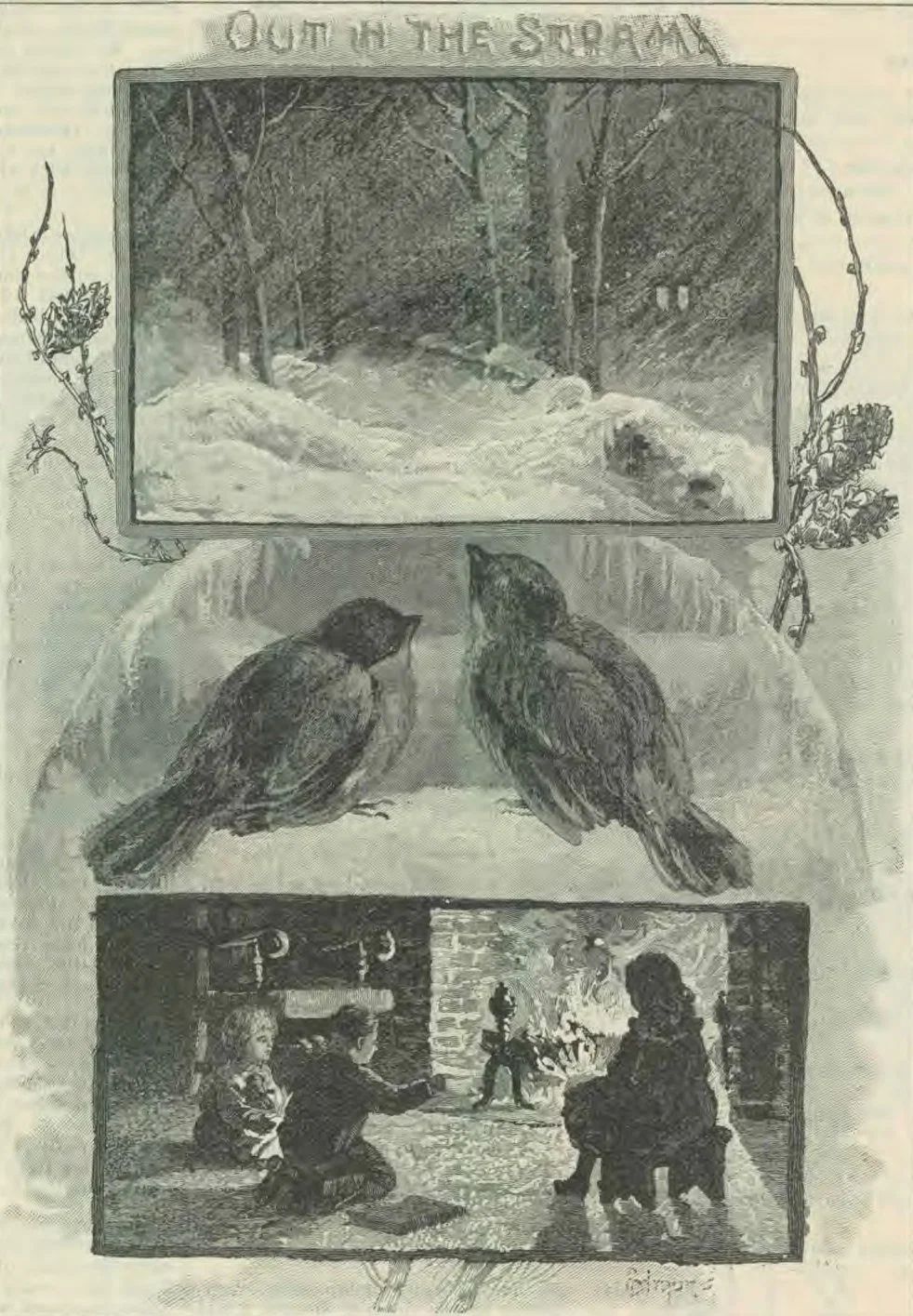
SHRILL shriek the winter winds, And through the hemlocks sigh; Swift, in a wild and merry dance, The snow-flakes whirl across the sky. The trees with icy boughs Stand crackling in the gale; Low from his kennel, snug and warm, Echoes old Carlo’s mournful wail.
OUT IN THE STORM
OUT IN THE STORM
Heap high the blazing grate, And fill the house with cheer; In cosy circle clustered round, No storms we happy children fear, Though the loud whistling blasts O’er land and ocean roam, We laugh and sing without a care, Safe in our own dear sheltering home.
But listen! “Tap, tap, tap,” Upon the window-pane. You roguish wind, we love you not; Pray fly away, nor come again!
Ah, look! A tiny beak! A shrewd and sparkling eye! “’Tis Master Snow-bird’s plaintive chirp: ‘Feed me, kind friends, nor let me die!’” Hasten! the choicest crumbs Pour on the window-sill.
Welcome, lone wanderers in the gale: Come, snow-birds all, and take your fill.
He darts away in fright; Quick, close the sash, and wait! See, he returns on fluttering wing, And, joyful, calls his gentle mate.
How sweet, amid the storm, Their twitterings of delight! And, while we watch their eager joy How our own hearts grow warm and light!
Only two mites of birds, Two specks on the gray sky; Yet not one pang nor joy they feel, Escapes the heavenly Father’s eye.
—Our Little Ones.

FIGHTING FOR JESUS.

A SERMON FOR THE NURSERY.
The children had the whooping-cough: Hugh and Alice and Jenny and the twins. You can imagine what a racket they made; for when Alice left off coughing, Hugh or Jenny were sure to be just beginning, and the twins coughed, as they did everything else, both together. Of course they could not go to church and that was how Aunt Ruth happened to think of preaching them a sermon. The rest of the family went to hear the minister, and Aunt Ruth arranged her congregation on the sofa, and gave them some lumps of sugar with cough medicine dropped on them. Hugh and Alice liked the medicine, and the twins would have swallowed any kind of dose for the sake of a lump of sugar. Then Aunt Ruth began.
“My text is a very short one. It has only four words, and it is about fighting.”
“I know,” said Alice, looking at the boys: “Thou shalt not fight.”
“H’m,” said Hugh, “that’s no text.”
“The congregation mustn’t interrupt,” said Aunt Ruth. “My text is about fighting, and it is this: Fight the good fight. You may all say it with me. If I were a minister, I should always have my people repeat the text.” They all repeated it together, and Aunt Ruth went on—
“The first thing I want to say about my text is this: There is a fight going on in this world; not just a battle that comes to an end because one side or the other is beaten, but a regular war, that goes on and on, day after day, and year after year, and never really comes to an end. It is a fight between all the good and all the bad,—a fight between everything that is true and pure and noble and lovely, and everything that is untrue and impure and dishonorable and unlovely.”
“The second thing is: Everybody is wanted for it. “In most wars this is not so. If the old men come, and say, ‘We want to join the army, take us,’ they tell them, ‘Oh, no! you are too old; we want only strong men.’ And if the women or the girls should say, ‘We want to join the army, take us,’ they would say, ‘Oh, no! you are only women; you cannot fight; we must have strong men.’ And if the boys say, ‘Take us,’ they tell them, ‘Oh, no! you are too young; only strong men can fight.’ But in this fight everybody is wanted,—young and old, weak and strong, and, most of all, the children.”
“The third thing is: Everybody is in it.”
“No one can stand on one side, and say, ‘I am not going to join either army;’ for every one is enrolled on one side or the other, and helping either the good or the bad to win. Satan does not wait till we come and say: ‘Put me down on your side; I am going to fight in your army.’ No, indeed, most people never say that; but Satan finds them standing idle, or waiting to make up their minds, or trying to please themselves, and he says: ‘Put them down in my army; every one that is not fighting me, counts one on my side.’”
“The boy that wouldn’t swear himself, counts on the wrong side if he goes with those that do swear, or stays to listen to profane and wicked words. The girl who would not tell a lie herself counts one on the wrong side if she only laughs at those who do. Satan says: ‘Every one that is not against me is on my side,’ and Jesus Christ says: ‘Every one that is not with me is against me.’”
“The next thing is, that on both sides they have recruiting-offices and camps of instruction. You know that when men are first gathered into an army, they do not know how to be soldiers. They have to learn to obey orders, and to be always ready and watchful, and vigilant, and how to use their weapons, and to bear all sorts of hardships like brave soldiers. So they put them into camps of instruction, and there they are drilled and taught.”
“Satan has his camps of instruction on the street corners, and in the saloons, and at the theaters, and in all places where his crafty officers can get hold of foolish people and teach them his ways.”
“And Jesus Christ, the great Captain of the other army, has his camps, too,—in the homes, and the churches, and the Sabbath-schools, where children are taught how to march, and stand guard, and use their weapons.”
“What do they fight with, auntie?” asked Hugh. “The Book of Instructions tells all about that; you learned it not long ago, Alice.”
“Oh, yes! I remember. ‘Wherefore take unto you the whole armor of God, that ye may be able to withstand in the evil day, and having done all, to stand. Stand, therefore, having your loins girt about with truth, and having on the breastplate of righteousness, and your feet shod with the preparation of the gospel of peace: above all, taking the shield of faith, wherewith ye shall be able to quench all the fiery darts of the wicked, and take the helmet of salvation, and the sword of the Spirit, which is the word of God.’”
“Thank you, Alice; that was exactly right; and then it says we are to pray always, and to watch with all perseverance. But I was going to tell you one thing more about this fight. All the soldiers in Christ’s army fight under the very eye of their leader, and he is always at hand to see their brave deeds, and send them help when they need it. You know it sometimes happens in battles, that a soldier, or a company of soldiers, will be surrounded by the enemy, and find themselves in great danger, with no way to send for reinforcements, and are cut to pieces before any help can get to them. But in this fight, Christ’s soldiers have only to say: ‘Lord, be thou my helper,’ and the commander answers: ‘Fear not, for I am with thee: I will deliver thee.’”
“Another thing is that every faithful soldier is sure of promotion, whether he does little or much, if he only obeys orders, and does his best. In other armies, thousands of brave men die and are never heard of, or go away maimed and crippled and poor, while the great officers get all the glory. But Christ rewards every one of his soldiers, and gives them all crowns and honors. He says, only ‘Fight the good fight,’ and promises that, ‘He that overcometh shall inherit all things.’”
“I am going to fight in that army,” said Jenny.
“So am I,” said Hugh; “only it sounds nice to talk about, but I never could quite see what a fellow was to fight.”
“I think my sermon needs an application,” said Aunt Ruth, “because that is the trouble with all of us; we are expecting to meet some terrible enemy, and have an out-and-out fight with him. Now I can tell you, children, some of the ways you will have to fight. Some of these cold mornings, when the rising-bell breaks right into the middle of a nice dream, and the bed feels so warm and soft, you’ll hardly suspect that you have a chance for fighting by jumping bravely up and obeying orders. And some morning when everything goes wrong, and your hair is all tangles, and your shoe-strings get into hard knots, and you have something for breakfast that you don’t like at all, you may never think you have a chance for very brave fighting by just calling on your Captain for help, and being pleasant and patient in spite of all.”
“And when you have hard lessons to learn that you don’t feel very much interest in, and can’t really see the use of, you may not think that if you try to shirk them, instead of faithfully doing your best, you have lost a chance for a good fight.”
“And when you are tempted to break a rule of school, or play some funny trick, or take a mean advantage in a game, or cheat a little in play, or neglect work that you ought to do, or say a teasing thing to make some one else angry, or say an unkind thing, or repeat an evil story, or tell an untruth,—you may not think it,—but these are all battles to be fought and won in the name of Jesus, and he is just as ready to help us win them as he was to help Paul or Stephen.”
Hugh and Alice and Jenny looked very thoughtful, but the twins began to wriggle about, and Lenny, who sat next the end, had been slyly dangling a string over the old cat’s head for some time. So Aunt Ruth closed her sermon, and dismissed the congregation; but Alice leaned upon her shoulder to whisper:—
“Auntie, if a girl tried not to be so careless about tearing her clothes, and leaving things out of place, would that be fighting?”
“Certainly it would,” said auntie.
“And would Jesus help us about such things as that?”
“Indeed, he will, my darling.”
“Then I know one way for me to fight,” said Alice, kissing her auntie.—Emily Huntington Miller.
Continue reading: THE WORLD—A CATECHISM