The Youth’s Instructor, Vol. 37, No. 41.

A SINGLE STITCH

The Youth’s Instructor

Oct 9, 1889

S. D. A. Publishing Association · Battle Creek, Mich. · Oct 9, 1889

A SINGLE STITCH.

ONE stitch dropped as the weaver drove His nimble shuttle to and fro. In and out, beneath, above, Till the pattern seemed to bud and grow, As if the fairies had helping been. And the one stitch dropped pulled the next stitch out.
And a weak place grew in the fabric's web; And the perfect pattern was marred for aye By the one small stitch that was dropped that day.
One small life in God's great plan; How futile it seems as the ages roll, Do what it may, or strive how it can, To alter the sweep of the infinite whole! A single stitch in an endless web, A drop in the ocean's flow and ebb! But the pattern is rent where the stitch is lost, Or marred where the tangled threads have crossed; And each life that fails of the true intent Mars the perfect plan that is Master meant.
—Selected.

TROPICAL VEGETATION.

It is but a small portion of the land surface of the earth that is wholly destitute of vegetation. Except in extreme altitudes, or in those places where there is insufficient moisture to sustain plant life, vegetation appears in some form. Dr. Kane, the celebrated Arctic explorer, made the statement that “as far as man has reached to the north, vegetation, when fostered by a sheltered situation and the refraction of solar heat from the rocks, has everywhere been found to rise to a considerable altitude above the level of the sea; and should there be land at the North Pole, there is every reason to believe there would be animal and plant life.”
Vegetation, scanty and feeble in the cold regions of the north, is of short duration. It gradually improves as the temperate zones are approached, where the rays of the sun, falling more directly upon the surface of the earth, produce a great number and variety of plants.
But it is the perpendicular rays of an equatorial sun falling upon the moist grounds of the tropics, that clothes Nature in her richest dress. Humboldt says that “tropical trees are endowed with richer juices, ornamented with a fresher green, and decked with larger and more lustrous leaves than those of the more northerly regions. Trees nearly twice as large as our oaks, there glow with blossoms large and magnificent as our lilies.”
He mentions a flower that grows upon the Magdalena River, in South America, that measures four feet in circumference, which the children sometimes wear as a helmet in their play; and another flower, in the Indian Archipelago, that measures four feet in diameter, and weighs fourteen pounds.
It is estimated that of the 200,000 known plants, the greater part of the species belong to the torrid zone. And no one can guess how many times this might be multiplied could the vast, unexplored tropical fields be searched. It is within the tropics that the wonderful baobab tree is found; also the beautiful and stately banyan tree, each one of which forms a grove by itself. The Bo-tree, too, is here, and is probably the oldest tree in the world. It is said to have been planted two hundred and eighty-eight years before Christ.
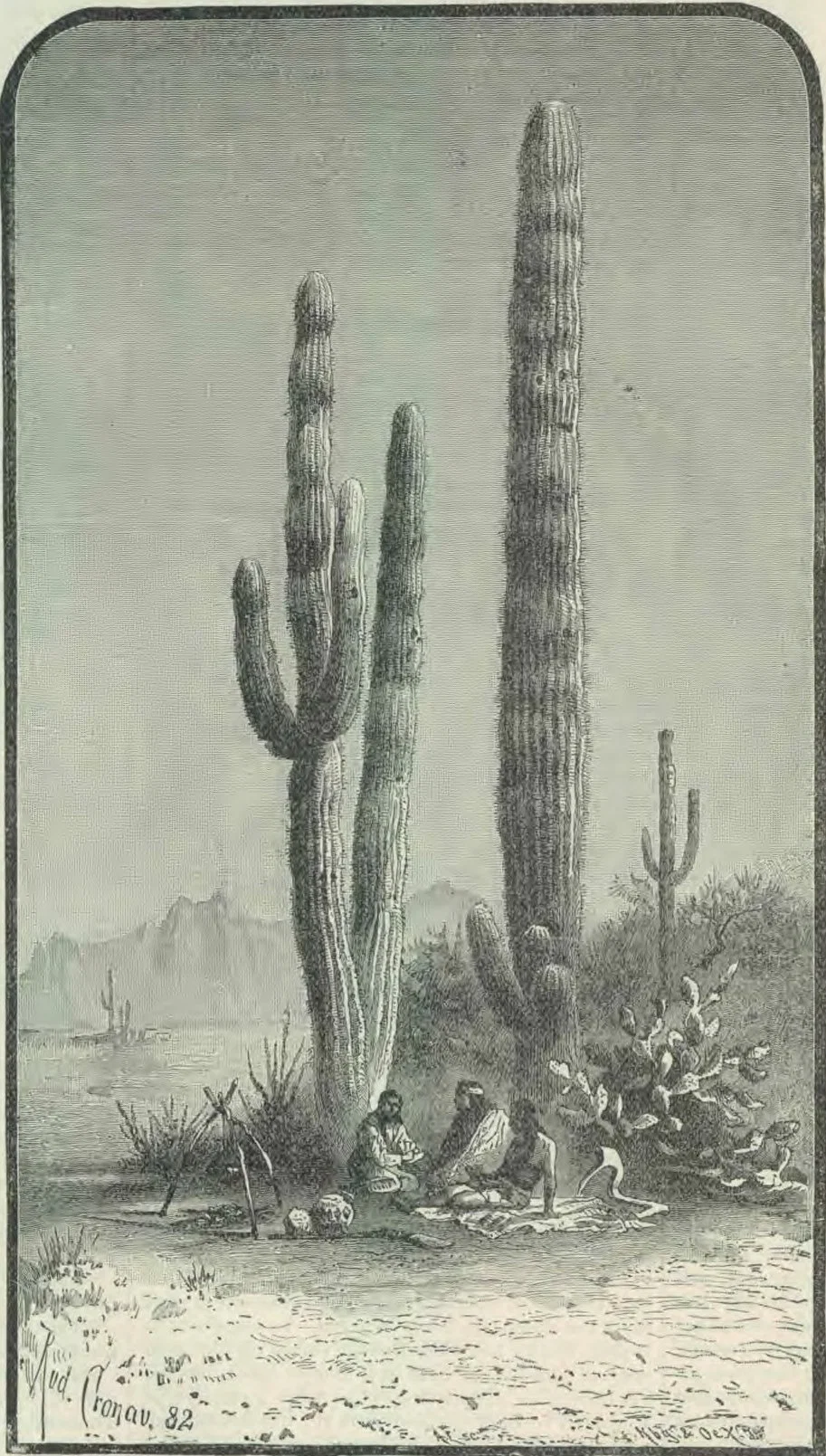
I might mention many other interesting specimens of tropical vegetation; but there is one family of plants that differs from most others, in this particular,—that it grows only in hot, stony, or rocky places. Our picture represents some species of this plant. Linnaeus gave it the name of cactus, from the fact that the ancient Greeks gave this name to some prickly plant. But modern botanists have redivided and renamed the family, so to speak, according to differences in the flower tube,—those with long-tube flowers forming one division, and those with short-tube flowers the other. These are again divided and subdivided according to certain characteristics peculiar to each species, thus forming a great variety of species.
The cacti are plants having the central part woody, around which are overlaid thick masses of cellular tissue; that is, made up of very small cells that connect with each other. The outside skin is tough and leathery, which enables the plant to retain its juice and to thrive on the rocks and barren places of tropical countries.
The cacti grow in various forms, and of different sizes, and are generally covered with bunches of hair and thorns instead of leaves. The tufts of hair show where the flowering buds originate, although but few of these develop.
This family belongs almost entirely to the New World, and thriving, as it does, where scarcely anything else will grow, it seems as if it were a provision of nature for the support of men and animals who inhabit this region of country; for the fruit, as a general thing, is not only good for food, but is agreeable to the taste. Some of the Opuntia cactuses have become very generally distributed over some portions of Europe, particularly upon the shores of the Mediterranean and among the volcanoes of Italy.
In the accompanying engraving may be seen interesting members of the cacti family. One species is the Torch cactus, which sometimes grows to the hight of fifty or sixty feet, having a diameter of from one to two feet. It is generally branchless; but sometimes stems shoot out at the sides at right angles with the plant, from whence they curve and grow upward, parallel with the main stem. It is said they have the appearance of telegraph poles. The stems of the Torch cactus have from ten to twenty ribs, as may be seen in the picture. The natives preserve the fruit, which, when ripe, makes an excellent article of food. To gather it, they make use of a forked stick fastened to a long pole. This family of cactuses, Cereus, is common in hot-houses, where, of course, the plants do not attain to such hight as in their original soil.
Opuntia, the Indian Fig-tree, or Prickly Pear cactus, may also be seen in the engraving. It comprises some 150 species, which differ very much from any other of the groups. These are thick, fleshy shrubs. The farmer makes use of them largely in fencing his gardens. It is upon one species of this shrub that the cochineal insect is raised. Plantations are established for the purpose, and they often contain as many as 500,000 plants. Mexico is the native country of this insect, but our greatest supply is brought from New Grenada, S. A., and the Canary Islands. Some of the opuntias are esteemed very highly for their fruit.
The Hedgehog cactus is also a native of Mexico and South America. It comprises some 200 species, one of which produces plants that sometimes weigh a ton, and measure nine feet in height and three feet in diameter. Upward of 50,000 buds and spines sometimes appear among the ridges of one plant. These spines are used by the Mexicans as tooth-picks.
One nearly related to the Torch cactus is the Old Man cactus. It forms a small group of tallish stems, on which, with the tufts of spines, grow hair-like bodies. These hairs, though coarse, somewhat resemble an old man's beard.
The cacti prefer the driest situation, fully exposed to the burning rays of a tropical sun. Here they thrive, and the several groups form a very interesting subject to investigate. M. J. C.

THE RECORDS.

Ten o’clock. Millie Brooks, tired and sleepy, put her French grammar on the pile of school books.
“I have studied till I don’t know anything,” she said to her mother, kissing her good night. “But I feel dimly that I shall be very wise to-morrow morning.”
“I see by your last monthly report that your record was almost perfect,” smiled Mr. Brooks. “So you must be ‘wise’ by the time you get to school.”
“It will be perfect this month,” Millie replied, proudly. “You shall be proud of your daughter, papa, on examination day; but I’m glad I don’t have to recite now; I should fail completely. Good night,” and she ran upstairs.
“Was I ever so tired before?” she yawned, as she lighted her gas. “But it is worth while. Papa will be so glad to see a perfect record this month. Oh, I am too tired to read in that to-night,” she added, as the new rays of light fell on her little red Bible. “I shouldn’t understand a word if I tried. But, oh, I didn’t yesterday; no, nor the day before, and Sabbath I only learned my Sabbath-school lesson. I wish I could remember it in the daytime; but then I have so little time I wonder I don’t forget to eat.”
She stretched out her hand towards it, but drew back without taking up the sacred Book.
“I am too tired,” she said again. “To-morrow I will read in it for certain. I will try and make the time for it, and I won’t forget it.”
But the morrow was another busy day, filled with earthly duties, pleasures, and studies. Not one thought did she give to the study of the Book which was to guide her to eternal life.
Millie’s school report for that week was perfect. The record kept showed not one failure. She knew her lessons by heart as well as by rote. Her superior mind thoroughly absorbed every detail. What she studied became her own. No wonder that for her was foretold a brilliant future. But if there is a record kept by the great Teacher, who loves to watch those who diligently study his Word, every day of that week was written upon that record failure,—a failure where most she needed perfection by the study. Not one word of his Book had she made her own; she had gathered nothing from its treasures to strengthen her for her daily conflict with sin. The fire of Christian love was slowly burning out in her heart for lack of this most needful fuel.
She did not so much as stretch out her hand towards the little red Book to-night; she was weary, and did not see it; but her lessons were all learned. The algebraic problems were correctly worked, and she could not only repeat every page of history, but give you her ideas upon it. Latin Cæsar was at her tongue’s end in such perfect English that you would have thought she was reading from the English text. French verbs, regular and irregular, were firmly fixed in her mind, and the French story was translated as easily as the Latin Cæsar. But not one gentle precept was instilled into her heart; she had ceased to follow the life of him in whose footsteps she must walk; and the charity which was not puffed up, which was never vain, and sought not her own glory, was unlearned.
So the month went on, bringing every day a perfect record in school; and almost every day a failure was noted by the great Teacher, who has given us a book of lessons for life, and who watches faithfully over his scholars below.
“I have not missed once this month, papa,” Millie said at dinner one day. “Just think of it! Will you not be proud of that record when it comes in? Sarah Gillette tried at first to keep up with me; but when I found what she was trying to do, I studied with renewed vigor, and she really gave up in despair. The girls feel they cannot keep up with me. So many of them failed yesterday in chemical experiments that Miss Sheffield said some very cutting things to them. ‘There’s Millie Brooks, the youngest in the class,’ she added, ‘who never fails.’ That was worth all my hard study and weariness.”
But was it worth the neglect of her Bible? Yet there was time for both. It was only that her heart was so filled with earthly ambition that it crowded out all love for holier study or ambition to stand nearest Him. While she was standing at the head of her class, proud of her own abilities, she was also growing puffed up and vainglorious. So, as time passed on, her mind grew richer in worldly lore, but her heart was barren and untaught. Her daily walk showed the stunted growth of her soul, and where humility and love should have flourished, grew the rank weeds of ill-temper and pride.
It was not that Millie never looked into her Bible. She often took it up, and sometimes even read a chapter; but it was merely as a duty, and she never dipped below the surface, or made one blessed truth her own. She never studied it, praying God to bless his message to her. She never sought for a message; she only performed a task.
Examination day came and passed, and it was Millie Brooks, who, standing at the head of her class, took the prize; and it was Millie Brooks, who, not having the shield of faith, the helmet of salvation, the sword of the Spirit, which is the word of God, was weak in the Lord, losing the “prize of the high calling of God in Christ Jesus.”—Child’s Paper.

A VISIT TO THE MENAGERIE.

I WANT to tell you of a few curiosities that I saw at the Central Park Menagerie last week. The park commissioners have recently added to their collection, and among the new-comers are a pair of hippopotami from the River Nile. As we stood looking at them, visions of palm trees, and pyramids raising their giant forms above the Egyptian sands, rose before my mind, and of the Arabs and camels coursing swiftly over the great desert.
These animals are sometimes called river horses, but why, I fail to see. The hippopotamus more nearly resembles a great seven hundred pound hog than it does a horse, except in its food. Its skin is pink-tinted, coarse, and almost hairless. It has a square, heavy face, about two feet long and fully a foot wide, with dull, sleepy eyes, and a monstrous mouth. It lives both in and out of the water.
When we saw them, one was standing on the wide stone border of the tank, eating hay, and the other lay asleep in the warm sunshine near him, with his head resting on the iron rail that inclosed the tank. Every little while it would open its eyes, and squeal just like a pig. It seemed to want people to notice it; for when they laughed and turned toward it, it would contentedly close its eyes, and appear to go to sleep again.
A handsome black leopard is a new inmate of that department of wild animals. He looks like a sleek black cat about six times enlarged. In the shade he is plain black; but when the sun shines on him, he is covered with lovely spots of a blacker black, like velvet upon silk. His fur looked so thick and soft that I wanted to bury my fingers in it; but I could not help wondering what the leopard would be doing while I was gratifying my wish. There is no danger, however, that any one will try such an experiment; for a stout railing keeps every one four feet away from all the cages.
In a glass case six feet high are the snakes. There is a tank of water in this case, and in the middle of the case, two posts, like small tree-trunks with limbs, for the snakes to climb upon when they feel so disposed. In one corner, boa constrictors, moccasins, and some smaller snakes were coiled in a knot, with only their heads up and alert. One rattle-snake was asleep on a limb; and another was going toward the tree. His head was raised, and his small eyes, like black beads, were fixed on us, while his tongue played in and out of his mouth with lightning-like rapidity; his rattles, about seven in number, stood straight up from the floor, as he slowly glided along. In his case, as in most of the others, safe “distance lent enchantment to the view.”
In the elephant house, a notable addition has been made. Adam Forepaugh has presented his largest elephant to the menagerie. It weighs ten thousand pounds, and cost Mr. Forepaugh ten thousand dollars. This elephant is certainly a king of his species; for he towers up to a height of ten feet or more, and has large ivory tusks more than three feet long. Yet with all his majestic bearing, he does not disdain holding out his trunk for two peanuts, or a bit of cake or candy, which his admiring child friends are always glad to give him.
I would like to tell you of the cute little black bear cub we saw, and of the baby seal and its mother, but I am afraid the editor will frown if I take any more space.
Mrs. L. E. Orton.

IF WE HAD BUT A DAY.

We should fill the hours with sweetest things, If we had but a day; We should drink alone at the purest streams In our upward way.
We should love with a lifetime’s love in an hour, If the hours were few; We should rest, not for dreams, but for fresher power To be and to do.
—Selected.

MENDING WITH PINS.

“Oh, that's nothing,” said a young woman; “I'll put a pin in. I can't stop to mend it now.”
It was a hole in her pocket that Helen Russell mended that morning with a pin. Several days passed, and she forgot the circumstance.
“Pinning it up” was one of Helen's favorite makeshifts.
“I hate to mend,” she would say, “and, after all, pins will do. They have to do, anyway.”
Even holes in her stockings were caught together in this fashion, and a button off her glove was replaced by the same shiftless expedient. It was not that she lacked time to use needle and thread, but simply that she had fallen into a lazy habit.
Helen Russell was a school-teacher, and a few days after pinning up the hole in her pocket, she went to the office of the town treasurer, and drew sixty dollars, her earnings for ten weeks' teaching. She put the money into her purse, and the purse into her pocket.
Then she made a few calls, and went to the post-office. As she was descending the steps of the post-office, she caught her foot in the trimming of her skirt, which had ripped, and had been fastened with a pin; she tripped, and fell heavily on to the stones.
Her wrist was broken by the fall. A pin, which fastened her glove in default of a button, was plunged into the palm of her hand and inflicted a painful wound.
She was taken home in a carriage, and her injuries were dressed. A few hours afterward she thought of her money, and felt in her pocket for her purse. It was gone. The pins which had repaired the hole in the pocket were likewise gone; so there was no doubt as to the way in which the purse had disappeared.
Searching and advertising proved of no avail. She had saved a few stitches at the expense of ten weeks' wages, a broken wrist, and sundry painful bruises.
“'Twas all my own fault,” she said, penitently; “I'll never mend with pins again.”—Youth's Companion.

ENOUGH TO POISON A PARISH.

A Romish priest accosted the daughter of an ex-papist, and wanted to know why she didn’t attend catechism-class any longer. She replied that her father had forbidden her to enter his church any more, whereupon the priest tried to instill rebellion and disobedience into her young mind, by saying that she should obey him, not her father.
But she replied: “We are taught in the Bible to honor our father and our mother.”
“You have no business to read the Bible,” said the priest.
“But, sir, our Saviour told us to search the Scriptures.”
“That was only to the Jews,” said the priest, “and not to children; and you don’t understand it.”
But the little girl, who knew the Bible better than did the priest, told him what St. Paul said to Timothy,—“that from a child he knew the Scriptures.”
“Oh,” said his reverence, “Timothy was then being trained to be a bishop, and was taught by the authorities of the church.”
But the little girl wasn’t to be baffled by his false logic and gross perversion of truth; for she told him that Timothy’s mother and grandmother did the blessed work.
Then the priest turned away, saying that “she knew enough of the Bible to poison a whole parish.”
—Selected.

THE SINGING LESSON.

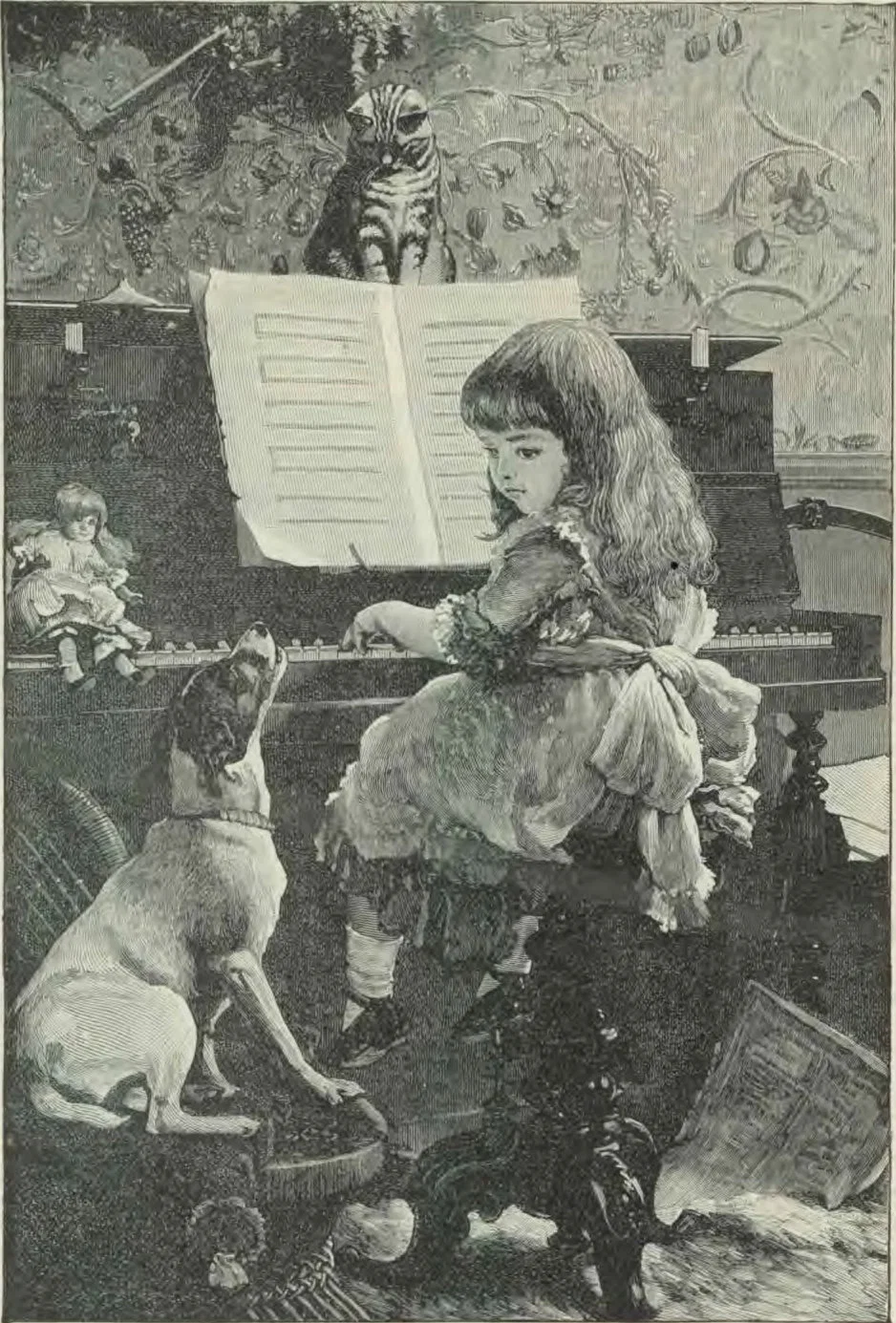
NOW, Donald, I'm ready. One, two, three, four,—steady! Be sure that you get the tone. We'll sing the song over Of poor doggie Rover, Who had not so much as a bone.
Now: "Old Mother Hubbard, She went to the cupboard—" O Donald! you've lost the key; Now listen a minute, Until I begin it, And keep your eye fixed upon me.
Stop, puss, you are trying To send my sheet flying. But this is no time for play; Come, fold your paws—please do! I've no time to tease you; I'm giving a lesson to-day."
Now: "Old Mother Hubbard, She went to the cupboard, To get poor doggie a bone." One, two, that is splendid, Three, four, it is ended, And sung without flattening a tone. —S. S. Advocate.

THE MOTHER-HELPERS.

One afternoon Mary thrust her pretty blonde head out of the door of her room, and called, “I want all, every one of the small Joneses, up in my room. So come, John, Robbie, Katie, Susie, and the twins.”
There was a sound of lively feet on the stairs; then, “Well, here we are, young lady. What’s wanted of us now?” said John, the oldest and spokesman.
Rob added: “Fire away if it is some good news; but if it’s bad, why, I think I will go outdoors.” And he began a restless tramping up and down the room.
“Now do sit down, all of you, and I will call the meeting to order. I just overheard Dr. Archer tell father that mother was not looking well,—a fact I have noticed myself, by the way,—and that he thought she was feeling quite poorly, and father ought to take, or send, her away on a trip somewhere; for she needed a change. Father said he didn’t see how he could possibly afford it. ‘Then,’ said Dr. Archer, ‘just take care of and save her all you can.’ So then I thought I would tell you all, and we would form ourselves into a society for helping mother.”
“But we help her now, Mary,” said Susie, “and I am afraid she wouldn’t let us do any more than we are doing.”
“We needn’t let her know we are trying to help her, but just go to work and do all we can, and do it cheerfully and pleasantly.”
“Do you all agree? What say you?”
They all shouted, “Aye, aye.”
“Very well; we will call ourselves ‘Mother’s Helpers,’ and our motto, ‘I’ll try.’ Meeting’s adjourned.”
They began right away; and next morning, when Mrs. Jones went down-stairs to get the breakfast, she found that John and Rob had brought in all the wood and water, the fire was made, the tea-kettle boiling, and all without having to call either boy. She stepped into the dining-room, and the table was set, ready for breakfast, and Susie was just fixing a bouquet by her mother’s plate as a finishing touch. The mother passed on to the sitting-room, where she found Mary had swept the room nicely, and was dusting and arranging with Katie’s help. The twins came down-stairs with their clothes all on, and went to Susie to have them fastened. Mrs. Jones smiled to herself. She saw through the secret right away, but being a wise little mother, she kept quiet about it, and went around distributing kisses and thanks to all her little helpers.
After breakfast she said: “Now, my small people, I invite the crowd to a ‘pea-pod picnic’ in the back-yard, under the old elm-tree, at eleven o’clock to-day.”
“What is that?” asked Ella and Eddie, the little twins, in one breath.
“You will see, my dears.”
When the time arrived, the children were all on hand, and so was Mrs. Jones, with a large pan of peas. They all went to work to see who could shell the fastest, and while they worked, mother told them a nice story.
Susie didn’t come out ahead in the race, because she and Katie were always stopping to count the peas in the pods, to find a pod with the lucky number “nine” in it.
Mary was the one that won the race, and she was most loudly cheered. After the peas were shelled, Mrs. Jones pulled out from hiding a basket of cherries, with the remark, “People always eat at a picnic, so help yourselves, little helpers.”
The children didn’t get tired of their “helping society,” but kept it up all summer; and at their weekly meeting they had very good reports, and thought up new and better ways of helping mother.—Selected.

STINGY DAVEY.

DAVEY was a very pretty little boy. He had light, curly hair, dark blue eyes, and rosy cheeks. He was very stingy. He did not like to share anything with his little brothers and sisters. One day he went into the kitchen, where his mother was at work, and saw on the table a saucer of jelly.
“Can I have that jelly?” asked Davey.
“Mrs. White sent it to me,” said Davey’s mother. “She had company for dinner, and made this jelly very nice. But I don’t care for it; so you may have it if you won’t be stingy with it.”
Davey took the saucer of jelly, and went out into the yard; but he did not call his little brothers and sisters to help him eat it.
“If I divide with them, there won’t be a spoonful apiece,” he thought. “It is better for one to have enough than for each to have just a little.”
So he ran to the barn, and climbed up to the loft, where he was sure no one would think of looking for him.
Just as he began to eat the jelly, he heard his sister Fannie calling him. But he did not answer her. He kept very still.
“They always want some of everything I have,” he said to himself. “If I have just a ginger-snap, they think I ought to give them each a piece.”
When the jelly was all eaten, and he had scraped the saucer clean, Davey went into the barnyard, and played with the little white calf, and hunted for eggs in the shed where the cows were. He was ashamed to go into the house; for he knew he had been very stingy about the jelly.
“O Davey!” said Fannie, running into the barn-yard, “where have you been so long? We looked everywhere for you.”
“What did you want?” asked Davey, thinking that of course his sister would say she had wanted him to share the jelly with her.
“Mother gave us a party,” said Fannie. “We had all the doll’s dishes set out on a little table under the big tree by the porch; and we had strawberries and cake and raisins. Just as we sat down to eat, Mrs. White saw us from her window, and she sent over a big bowl of ice cream, and some jelly left from her dinner. We had a splendid time. You ought to have been with us.”
Poor Davey! How mean he felt! And he was well punished for eating his jelly alone.—Selected.

TOMMY'S TROUBLES.

ALWAYS and forever getting into trouble of one sort or another was poor Tommy. He had a talent for climbing, and for tumbling, and for bumping his head, and for hurting his feet and coming to grief generally.
On this Friday evening he sat on the side of his little bed, “one shoe off and one shoe on,” and thought sorrowfully about the day; it had been an unlucky one.
In the first place he had broken grandma’s spectacles; then he had lost mother’s scissors, the pair that she always “cut out” with; and his new summer pants were not cut out. Then he had tumbled from the hay-mow, bumping his nose and breaking one tooth; but the last thing was to get himself caught by a hook in the barn, where he could not get loose unless he swung off without regard to the box by which he had climbed up, and in this case he would be likely to drop several feet on to a hard floor. Tommy did not like that, so he hung where he was.
“I might yell,” he said to himself, “but nobody would hear me; they are all too far away. I might hang here until they come to feed the horse; but I can’t; that will be hours, and I’m getting pretty dizzy now.”
The baby trotted out to the barn door, and said “da! da!” and a few other words that she understood better than others did; baby could walk better than talk. Tommy looked at her, and said, “O baby, I wish you had sense.” Then he hung still.
At last he heard his mother’s voice in the yard, a long way off. Then, oh, how Tommy yelled! His voice seemed to pierce right through the mother’s ears. She fairly flew over the ground to the barn.
In a twinkling the step-ladder was brought and arranged, and mother climbed up and unwound his sleeve from the hook, and she and Tommy came down. Someway, he doesn’t know how, he twisted his foot, and to-night it aches. But Tommy isn’t thinking of his foot; he is thinking of the troubles he has, and the mischief he has done, and how impossible it seems to do any better.
“Praying don’t do any good,” he said disconsolately to his mother. “I pray to be a good boy every day, and I ain’t never a good boy—so there!”
“Tommy,” said his mother, “why didn’t you call on baby to help you to-day? Didn’t you want to get down?”
“Course!” said Tommy, “but what was the use? I knew she couldn’t help me. Such a tiny thing as she is never could get up the step-ladder to the hook I was hanging on.”
“And what made you call me?”
“’Cause I wanted to get down right straight off; and I knew you could help, and I knew you would help me; so I yelled.”
“Well, Tommy, if you remember that of God,—that he can and will; and if you truly want help, and will call to him, he is just as sure—oh, surer than I can be. Because, you know, Tommy, you are liable to get into places where mother can’t reach; but God can reach everywhere. Remember that, my boy.”—Sel.

LETTER TO THE HEBREWS.

LESSON 4.—HEBREWS 2:9-16.
1. For whom did Christ die? Heb. 2:9.
2. Will all be saved for whom he died? 2 Peter 2:1; John 3:16; 5:40.
3. Were the sufferings of Christ necessary to our redemption? Heb. 2:10, 17.
4. Wherein did it “become” God to have Christ suffer? See note.
5. Did the Son of God need to be made perfect in character? Heb. 4:15; 7:26.
6. Was he lacking either in power or glory? Heb. 1:2, 3; John 17:5.
7. In what sense could Jesus be made perfect through sufferings? See note.
8. How is he the Captain of our salvation? Ans.—He is our Commander, Leader, going before us through all our obedience, trials, temptations, and sufferings.
9. How is it that the sanctifier and sanctified are all of one? Ans.—God is the Father of all, and they are united in one. See John 17:21.
10. Who are the brethren of Christ? Matt. 12:50.
11. Notwithstanding his greatness and glory, what condescension does Christ show? Heb. 2:11.
12. Of whom will he be ashamed? Mark 8:38.
13. What nature did he assume? Heb. 2:16, 17.
14. Why did he assume our nature? Ib.; Heb. 2:14, 17.
15. Whom will he destroy through his death? Verse 14; Rom. 16:20.
16. How and by whom was death introduced into the world? Rom. 5:12; 1 John 3:8.
17. What did Christ come to bring? John 3:17; 10:10; 1 John 5:11.
18. Can death, then, be the friend of man? 1 Cor. 15:26; Jer. 31:15–17.
19. What effect does the fear of death have on man? Heb. 2:15.
20. By whom alone can this fear and bondage be removed? Ib.; Rom. 8:14.

NOTES.

It became the Father to make his Son perfect through suffering. The attributes of God, both love and justice, required that a worthy sacrifice should be offered for man’s redemption. Rom. 3:25, 26, shows that the sacrifice of Christ was necessary that God might be just, maintain the integrity of his government and law, and yet justify penitent sinners. In this view it was indeed fitting, or becoming, in the Father to provide such a sacrifice as the sufferings and death of his Son. In no other way could God’s justice be honored; in no other way could sin be removed. Heb. 9:22.
In what sense was he made perfect through suffering? To some the idea may seem to be a great mystery, but it contains the richness of the gospel; not only in purchasing us by his blood, but in partaking of our trials, temptations, and afflictions, he is brought near to our consciousness. Thus there is a unity insured which could not be without his suffering.
Were a man of immense wealth, who had never known suffering and care, to approach the poor and wretched and endeavor to offer them consolation, his words would be but sounds of mockery in their ears. But suppose one who had been immensely wealthy, and had resigned all, had become poor for the sake of the poor, had taken their severest sufferings upon himself, and even died that they might have life, then the poor hungry souls would hang upon his words with comfort and delight. Every tear that he shed would fall like a balm. There would be a union of hearts, for they would know his heart; they would understand and appreciate the strength of his sympathy, the depth of his love. Such a Saviour has the Father given to us, and the Scriptures assure us that he can be touched with the feeling of our infirmities, because of the temptations and agony through which he has passed. Had he never suffered, he could never be all that the weary heart longs for; but by his sufferings he can satisfy every longing heart, because by his own experience he is able to enter the secret chambers of human woe. Thus it is easy to see that his perfect adaptation to our every want is through his sufferings. Thanks be to God for such a Saviour!
Will the object of the death of Christ be accomplished? Will he destroy Satan? Most expositors pass this idea by, as though this were a work too great to be accomplished, or which the Saviour had no desire or thought of accomplishing. It seems to be taken for granted that Satan has, by some means, gained a right to eternal life. We cannot imagine that the existence of Satan, or of any moral evil, can be a desirable thing in the universe of God. The Lord did not originate sin, he never created an evil being. Angels and men were all created upright, but they fell, and have become desperately wicked. Now it appears reasonable and just, yes, necessary, that God should place intelligent creatures on probation, and permit them to form their characters as they should choose, for there could be no character at all without choice; and he reserves all to the decisions of the Judgment. But we could not vindicate the government of God if he had originated sin, and planted moral evil in the hearts of his creatures. And it would likewise disparage his character and government, if, after sin had intruded itself into his fair creation, and marred it with its hateful work, he would perpetuate it, and give it an eternal abiding-place in his dominions. Said the Saviour, “Every plant, which my heavenly Father hath not planted, shall be rooted up.” Matt. 15:13. It is a cheering thought that the universe of God will be restored to its sinless, happy state, in which it was created. See Rev. 5:13.
The idea that Christ laid not hold of angels, or partook not of their nature, brings up the question of representation in the fall and recovery of man. Adam’s sin involved his whole posterity in ruin. He stood as their representative, and the gifts of God to him were intended for all his race. See Gen. 1:28; Ps. 115:16. But as none of Adam’s posterity represented a race, none of them could involve his posterity by his action. And therefore none of them has sinned after the similitude of Adam’s transgression. See the argument on representation in the fall and recovery, in Rom. 5:11–21.
Continue reading: EACH HAS A GIFT