The Youth’s Instructor, Vol. 36, No. 40.

THE QUEST
Earlier text: THE USE OF SIMPLE LANGUAGE IN TEACHING

VIRGINIA SABBATH-SCHOOL ASSOCIATION.

The fifth annual session of this Association was held at Woodstock, in connection with the camp-meeting, July 31 to August 7, 1888.
FIRST MEETING, AT 5 P. M., AUG. 2.—The President, T. H. Painter, was in the chair. The minutes of the last session were read and approved. The President spoke of the progress of Sabbath-school work in the State the past year. Interesting remarks were made by others. By vote, the Chair was authorized to appoint the usual committees.
Adjourned to call of Chair.
SECOND MEETING, AT 6 P. M., AUG. 7.—Previous to this meeting, the Chair had appointed the usual committees, which were as follows: On Resolutions, C. Eldridge, R. T. Fultz, P. Painter; on Nominations, A. C. Neff, R. D. Hottel, E. W. Farnsworth. The Committee on Nominations not being ready to report, the Committee on Resolutions presented the following:—
Resolved, That the President of this Association attend each quarterly meeting once a year, and work in the special interest of our Sabbath-schools.
As there are only four schools in the State, it was thought best that the President should visit each school once a year, and work up the interest in that way. This resolution was unanimously adopted. The Committee on Nominations presented the following report: For President, T. H. Painter; Vice-President, M. G. Huffman; Secretary and Treasurer, Katie M. Neff; Executive Committee, T. H. Painter, M. G. Huffman, C. V. Woods. The nominees were elected to their respective offices.

TREASURER'S REPORT.

Cash on hand at beginning of year, $12.33 Received during year, 12.69 Total, $25.02 Cash paid out, $14.42 Balance on hand, $10.60
Adjourned sine die.
T. H. PAINTER, Pres.
AMY A. NEFF, Sec.

PROCEEDINGS OF THE MAINE S. S. ASSOCIATION.

THIS Association convened on the camp-ground at Bangor, Sept. 4-11, 1888.
FIRST MEETING, SEPT. 4, AT 4:30 P. M.—President in the chair. The Secretary being absent, W. J. Dunscomb was chosen secretary pro tem. On motion, the reading of the minutes of the last yearly session was omitted.
The Chair was empowered to appoint the usual committees on Nominations and Resolutions, which were as follows: On Nominations, D. B. Skidgill, I. S. Ricker, Wm. Morton; on Resolutions, R. S. Webber, G. W. Howard, S. H. Linscott.
SECOND MEETING, SEPT. 5, AT 5 P. M.—The report of the previous meeting was read and approved, also that of the session of 1887.
The Nominating Committee then presented the following report: For President, S. J. Hersum, Belgrade; Secretary, Ida Grant, Hartland; Executive Committee, R. S. Webber, G. W. Howard. The report was adopted by considering each name separately.
The Committee on Resolutions presented the following:—
Whereas, The Sabbath-school has become a great power in the hand of God to impress upon the hearts of parents and children the truths of the third angel's message, therefore,—
Resolved, That we make every effort in our power to make our Sabbath-schools a success.
Whereas, We believe that many will be brought into the truth by an earnest study of the word of God; and,—
Whereas, The Sabbath-school is devoted particularly to the study of the Bible; therefore,—
Resolved, That it is our duty to make great efforts to establish new Sabbath-schools among our people.
These resolutions were considered separately and adopted.
Meeting adjourned sine die.
S. J. HERSUM, Pres.
W. J. DUNSCOMB, Sec. pro tem.

To State Secretaries: New Directory and Cash Memoranda Book

☞ To State Secretaries.—It may be well to state that the new book for “State Directory and Cash Memoranda,” can be made to cover four years instead of two, as mentioned in the last WORKER, by using the two pages opposite for the record of one school. Many prefer this plan. Let this most excellent book be adopted by each State secretary.

Questions Answered.

1. Has the superintendent authority to conduct the Sabbath-school according to a plan of his own, and at the close of his term to appoint a committee to nominate officers for the ensuing quarter, when a majority of the members present are opposed to such an arrangement?
The superintendent should continually seek the counsel of the adult members of the school, and endeavor to conduct the school in accordance with their judgment and the prescribed methods recommended by the State and International S. S. Associations. The manner of selecting the nominating committee should be decided by vote of the school. If the school authorize the superintendent to appoint such committee, he may do so; otherwise the members of that committee should be selected by vote of the school.
2. Is it the place of the retiring superintendent to appoint teachers for the children's classes for the ensuing quarter?
The natural supposition is that all appointments made by a superintendent are valid only during the quarter for which and in which they are made. It is recommended, however, that teachers continue to act until others are appointed to fill their places. It is the prerogative of a superintendent to make changes in teachers whenever in his judgment they are needed.
3. Should the secretary make orders for supplies without the co-operation of the superintendent?
He should not. The officers of a school should consult together regarding the purchase of supplies, and act harmoniously. If, however, any one member be selected as the purchasing agent for the school, and authorized to act upon his own judgment, the case is different.
4. Is it the superintendent's privilege to know of the financial condition of the school?
It is not only his privilege, but his duty as well.
5. Should teachers of the children's classes be required to purchase their own lesson books, or should they be supplied by the school?
They should be supplied by the school, unless teachers desire to purchase them.
6. Is it proper to take up a special collection on the Sabbath for the purpose of paying off a debt, or to make a special purchase of supplies?
We think not. Such a proceeding partakes too much of commercial transactions to be consistent Sabbath work.

THE THIRD ANGEL'S MESSAGE.

LESSON 16.—THE FINAL CONTEST AND THE VICTORY.

1. Who will be the National Reform king?
2. Who alone will refuse to acknowledge him as Christ?
3. What do the National Reformers say will be done with all such? Ans.—“The day is coming when all professed Christians who deny the kingship of Christ over the nations, together with their infidel confederates, will, at Christ’s command, be slain before his face, because they will not have him to reign over them.”—Secretary M. A. Gault, in Christian Statesman, January 14, 1886.
4. What did the prophecy say they would do? Rev. 13:15.
5. What then will those be doing? Rev. 14:12.
6. What then will be the work of the great false christ? Mark 13:22.
7. What have we found to be the one part of the commandments of God, above all others, that distinguishes those who obey the third angel’s message? Ans.—The keeping of the Sabbath of the Lord!
8. What will be done by the great false christ to seduce them from this? Ans.—“In his assumed character of Christ, he claims to have changed the Sabbath to Sunday, and commands all to hallow the day which he has blessed.”—Great Controversy, Vol. 4, p. 442.
9. What crowning wonder will be wrought to confirm this? Rev. 13:13.
10. What answer may be made by all? Ans.—The seventh day is the Sabbath even though heaven itself comes down. Matt. 24:35; Luke 16:17.
11. When they yet refuse to receive the mark of the beast and to worship his image, what then will be done? Ans.—“A decree will finally be issued, denouncing them as deserving of the severest punishment, and giving the people liberty, after a certain time, to put them to death.”—Id., p. 445.
12. Are any put to death when the time expires? Ans.—No. See note.
13. Where are they next seen? Rev. 15:2.
14. What song do they sing? Verse 3.
15. Can anybody else learn that song? Rev. 14:3.
16. What was the song of Moses? Ans.—The song of victory that they sang when God gave deliverance from Pharaoh’s oppression.
17. What, then, will be the song of these? Ans.—The song of their deliverance.
18. Deliverance from what? Ans.—From Satan’s oppression through the power of the beast and his image.
19. What was one main cause of Pharaoh’s oppressing Israel? Ans.—The keeping of the Sabbath. Ex. 5:5.
20. What will be the cause of the wrath of Satan, and the tyranny of the beast and his image, upon those who obey the third angel’s message? Ans.—The keeping of the Sabbath.
21. Then why is it that only these will be able to sing the song of Moses? Ans.—Because only these, of all the world, will have been delivered from such bitter oppression.
22. What will these have received that they might be saved? Ans.—“The love of the truth.”
23. What will be their shield in the time of the seven last plagues? Ps. 91:4.
24. When they approach the glittering gates of the glorious city of God, what will be said? Isa. 26:2.
25. What else is a part of their song? Rev. 15:3, last part.
26. As none others can learn this song, what would this show? Ans.—That these are counted worthy to receive such views of the works and the justice of God, as none others can.
27. How do they obtain these views? Rev. 14:4, last part.
28. Where and with whom shall they dwell? Rev. 7:15–17.

NOTE.

QUESTION 11.—“As the time appointed in the decree against God’s people comes, the inhabitants of the earth unite to destroy the disturbers of their peace. In one night they determine to strike the decisive blow that shall forever silence the voice of the reprover. The waiting ones, in their solitary retreats, are still pleading for divine protection. In every quarter, companies of armed men, urged on by hosts of evil angels, are preparing for the work of death. With shouts of triumph, with jeers and imprecations, they are about to rush upon their prey.
“But lo, a dense blackness, deeper than the darkness of the night, falls upon the earth. Then a rainbow, shining with the glory from the throne of God, spans the heavens, and seems to encircle each praying company. The angry multitudes are suddenly arrested. Their mocking cries die away. The objects of their murderous rage are forgotten. With fearful forebodings they gaze upon the symbol of God’s covenant, and long to be shielded from its overpowering brightness.
“The wicked look with terror and amazement upon the scene, while the righteous behold with solemn joy the tokens of their deliverance. Everything in nature seems turned out of its course. The streams cease to flow. Dark, heavy clouds come up, and clash against each other. In the midst of the angry heavens is one clear space of indescribable glory, whence comes the voice of God like the sound of many waters, saying, ‘It is done.’”
“That voice shakes the heavens and the earth. There is a mighty earthquake. The firmament appears to open and shut. The glory from the throne of God seems flashing through. The mountains shake like a reed in the wind, and ragged rocks are scattered on every side. There is a roar as of a coming tempest. The sea is lashed into fury. There is heard the shriek of the hurricane, like the voice of demons upon a mission of destruction. The whole earth heaves and swells like the waves of the sea. Its surface is breaking up. Its very foundations seem to be giving way. Mountain chains are sinking. Inhabited islands disappear with their living freight. The seaports that have become like Sodom for wickedness are swallowed up by the angry waters. Great hailstones, every one ‘about the weight of a talent,’ are doing their work of destruction. The proudest cities of the earth are laid low. The costly palaces, upon which the world’s great men have lavished their wealth, in order to glorify themselves, are crumbling to ruin before their eyes. Prison walls are rent asunder, and God’s people who have been held in bondage for their faith, are set free.”—Great Controversy, Vol. 4, chap. 35.

THE SCENT OF DOGS.

Our sense of smell is hardly keen enough to enable us to understand how it is possible for the dog to do all he can do with his nose. We cannot, for instance, distinguish by the smell a rabbit's foot from a piece of bark, which it seems most to resemble—probably because the bark is the strongest-smelling substance with which the foot usually comes in contact.
But not so with the hound, or even with many common cur-dogs. Not only will they recognize the scent of the foot itself, but, hours after the rabbit has passed along, they can follow him unerringly by the scent of the spots where he touched his light feet to the ground. What proportion of the odor of the foot can there be left upon a spot where it has merely rested for an instant? And yet a dog with a good nose first will find an invisible track, and then will determine, by sniffing for a few yards back and forth, which way the animal passed. Then he will follow all the windings and doublings which the animal has made, either in searching for food, or after he is “up,” in escaping his pursuers.
If this be wonderful, what is to be said of a dog's never confusing the track of one rabbit with that of another? After a dog has once seen that a rabbit is dead, he will never notice its track again, but will set off upon some other track, which often is much fainter than that of the one just killed, though the two may cross each other and be intermingled in innumerable places. The bloodhound, which is the keenest-scented of all dogs, can follow his master or his victim, no matter how many others may tread in the same path.
We can hardly believe that these things are done solely through the sense of smell; but that is the best that science can make of it as yet.
There are many other facts which demonstrate the power of the dog's scent. I once knew a hound which would never eat bread, and yet was quite fond of raised biscuit, the same thing in every respect, save that it contained a little shortening. One might take in one hand a piece of bread half the size of a pea, and in the other the same amount of biscuit, and the hound would smell of both, and never make a mistake in selecting the biscuit.
The power of scent of even the keener-nosed common dogs, such as the bull-dog, can be tested by fastening a bit of meat to a string, and dragging it about the yard when the dog does not see you, hiding it at the end of the trail, and then afterward putting him on the search for it where you started. If he has a good nose, he will go over the same path you took, and find the meat. Leave no string on the meat, however, as it might injure him to swallow the string.
All hounds save the greyhound run entirely by scent. When they come upon the faint scent of a track, they will work along it until it grows fresher, and then begin to bay or “give tongue.” There is always a correspondence between the baying and the trail. An experienced hunter can tell by the baying not only where the dog is, but, by the frequency and confidence of the sound, how fresh the trail is—that is, how close upon his game the dog is. All hunted animals have a way of doubling, or running in circles. Hence, if a hunter observes by the baying that his dog is going away from him, he waits patiently, sometimes for minutes, sometimes for hours, until the circle is made, and he hears the dog approaching. Then he is on the alert for a shot, for the game is probably not many rods in advance of the dog.
A hound is seldom lost. His nose is his compass. Whenever he pleases, he can take up his master's track and find him, or he can retrace his own steps homeward.
Dogs do not seem to enjoy those odors that please us. A dog will turn away disappointed and indifferent from the finest of perfumes. Except the scent of those things which he would like to eat, I have never found anything that seemed to delight a dog's sense of smell.—September St. Nicholas.

GLASS BEADS AND BARTER.

Marco Polo is said to have been the first who urged the Venetians to make beads for the African market, and to have pointed out to them the proper routes by which their goods could be spread over the country. The trade seems to have been a very thriving one ever since.
Burckhardt, who traveled in Nubia in 1814, says that every district has its own particular kind of bead, which is not in fashion in the neighboring districts. At Shendy, glass beads have not the same currency that they have in Abyssinia and Darfour, though they are seen in the market. The white glass beads of Bohemia are most liked at Darfour. He calculated that four or five hundred chests of Venetian beads, weighing ten hundred weight each, were sold at Cairo annually. At Djedda he describes some dozen varieties of Venetian beads prepared for the inland market, each packet arranged with its sample bead outside, and each known by its special name, as the renowned King's Saddle, Hassan Beg, and so on.
Modern travelers see the same practice in Arab shops of to-day. Burckhardt describes one particular sort of bead called “reysh,” imported from Surat, in India, which he thinks were colored agates. These formed the principal article of exchange for slaves at Djedda. These beads were worth fifteen dollars a thousand, which would purchase at Kordofan six female slaves; and as the beads were easily transported, the trade must have been very profitable. He describes the chiefs adorning themselves with amber and coral, but says the Venetians sent false coral into the market.
The Venetian beads were made, doubtless intentionally, as much as possible like the ancient ones so dear to Africans; but they seem to have been unable to make the mosaic beads—an art rediscovered in more modern times. It is these ancient mosaic beads which command such high prices at Ashantee. After the late war, officers of the British army described the desire of even civilized people to purchase the ugly beads brought from Coomassie, which they valued more than coral of the same weight, doubtless from a lingering half belief in the charm supposed to belong to them.—Selected.

PLANTING TREES BY ARTILLERY.

The S. S. Classmate gives a novel but successful way of planting fruit trees, as related by Mr. James Nasmyth in his biography. It is as follows:—
“The Duke of Athole consulted my father as to the improvements which he desired to make in his woodland scenery near Dunkeld. The duke was desirous that a rocky crag, called Craigybarns, should be planted with trees to relieve the grim barrenness of its appearance. But it was impossible for any man to climb the crag in order to set seeds or plants in the clefts of the rocks. A happy idea struck my father. Having observed in front of the castle a pair of small cannon, used for firing salutes, it occurred to him to turn them to account. His object was to deposit the seeds of the various trees in the soil in the clefts of the crags. A tinsmith in the village was ordered to make a number of canisters with covers. The canisters were filled with all sorts of suitable tree seeds. A cannon was loaded, and the canisters were fired up against the high face of the rock. They burst and scattered the seed in all directions. Some years after, when my father revisited the place, he was delighted to find that his scheme of planting by artillery had proved completely successful, for the trees were flourishing luxuriantly in all the recesses of the cliff.”

A WHALE WITH A RECORD.

A LETTER from Captain Chase, of the American whaling ship Niger, now on a cruise in the South Seas, says that after an exciting chase they captured a fourteen-ton sperm whale off the East Cape, N. Z. In cutting up the fish, the head of an old-fashioned harpoon, of the make of thirty-five years ago, was found imbedded in the blubber. A large lump had formed around the iron, which was in a good state of preservation, the projecting part showing the action of the water. It must have been in the whale twenty years or more. The marks on the harpoon showed it to have been manufactured in London in 1857.

Iceland's Public Funds Kept in Double-Locked Chest

The public funds in Iceland are kept in a large iron chest secured by a double lock having two keys. The chest is kept in the governor's house; and whenever opened to receive or pay out money, both keys must be procured from the governor and treasurer.

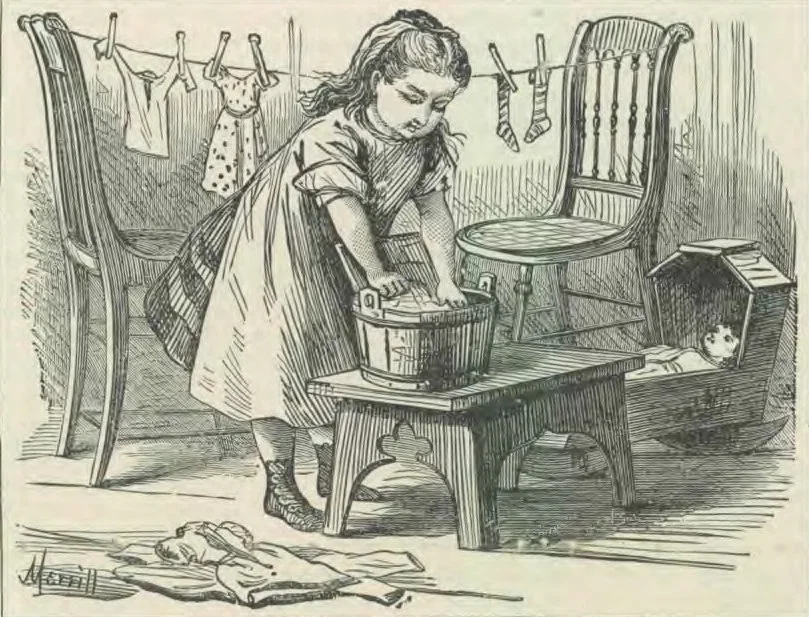
A SONG FROM THE SUDS.

QUEEN of my tub, I merrily sing, While the white foam rises high; And sturdily wash and rinse and wring, And fasten the clothes to dry; Then out in the free, fresh air they swing, Under the sunny sky.
I wish we could wash from our hearts and souls The stains of the week away; And let water and air by their magic make Ourselves as pure as they; Then on the earth there would be indeed A glorious washing-day!
Along the path of a useful life, Will heart's-ease ever bloom; The busy mind has no time to think Of sorrow or care or gloom; And anxious thoughts may be swept away As we bravely wield a broom.
I am glad a task to me is given, To labor at day by day; For it brings me health and strength and hope, And I cheerfully learn to say,— “Head, you may think, Heart, you may feel, But, Hand, you shall work alway!” —Louisa Alcott.

WHY DOLLY DIDN'T GO.

At last everything was ready. The lunch-basket was packed with the daintiest lunch that mamma could think of—boned chicken, and little thin sandwiches, and tarts, and chocolate cake, and three big oranges.
Dolly stood in the doorway, fresh and sweet in her new cambric, and her pretty lace-trimmed hat. Mamma knotted the blue sash in a wonderful bow on one side. Then she tied the silver quarter that was to pay for Dolly's ride, in the corner of a handkerchief, and fastened it to Dolly's belt, for the little girl was apt to lose things.
“Now mind, Dolly,” said mamma, “don't lose your money, and remember your things when you come home. And Dolly,” mamma spoke very softly then, “if God has anything he wants you to do to-day, don't fail him, will you, dear?”
“No, I'll be all ready,” said Dolly, with her eyes very bright, and her cheeks very red.
Then mamma kissed her, and off she started down the road.
Dolly was very happy that morning. There was to be a picnic down by Shelley's pond, four miles away, and all the little boys and girls in the Bigelow school, who could afford the money to pay for the ride, were going. They were to meet at the school-house, and have the long ride in big teams, and there were to be boat rides, and swings, and a dinner, and the ride home in the cool of the day. Dolly had thought about it for a whole week almost all the time.
“Mamma talks funny, sometimes,” said Dolly to herself, as she tripped along. “I don't believe God'll want me to do anything to-day, 'cept to have a good time.”
Dolly came to the covered bridge that crossed the river. She stopped, as she always liked to do, to peep out for a moment through the great timbers of the sides, and down into the black, roaring depths below. Just as she reached the other end, and was passing out of the bridge, she heard a faint sob. Dolly looked everywhere, and at last, down by the very edge of the river, half buried in the cool, green ferns and tall flags, she found Bessie Stone, crying as if her heart would break.
“Why!” said Dolly. “What is the matter, Bessie?”
Dolly could see that she had started for the picnic. She had a lunch-basket beside her, and her school dress and pink sun-bonnet had been freshly washed and ironed. “Come, Bessie,” said Dolly, creeping down to her, and trying to take her hands away from her face. “I heard the teams coming when I was on the bridge. We'll miss them if we don't hurry.” At that Bessie cried harder than ever, and wrung her hands.
“Oh, dear, dear! I can't go. I can't go. I lost my money down through the bridge, and now I'll have to stay at home.”
“Run home and get some more,” suggested Dolly.
“Mamma can't give me any, because she's poor. I picked up chips for Mrs. Bean and earned this. I never went to a picnic in all my life, and I wanted so much to go to this.” And the tears came faster and faster.
“Dear! dear!” said Dolly, “never been to a picnic?”
“No,” said Bessie, “and I worked four weeks to earn the money. I had it in my hand, and I stopped to tie up my shoe on the bridge, and laid the money down, and it fell through.”
“I'm so sorry,” said Dolly.
They were not far from the school-house. They could hear the gay chatter of the boys and girls as they came together, and then the loud rumble of the teams, as they drove up. Bessie gathered up her sun-bonnet and basket, and then, with a very sad face, started to go home.
Did somebody whisper to Dolly, that she jumped up so suddenly? There wasn't a live creature in sight except an old frog, who had come up on the shore to hear what all the noise was about. But Dolly very distinctly heard these words in her heart: “If God has anything he wants you to do to-day, don't fail him, will you, dear?”
Another moment and Dolly went hurrying back over the bridge, and caught Bessie and crowded the precious handkerchief that had the money in it into her hand. “Here's my money,” she said. “Now go quick, Bessie, or you'll be late.” She was a little afraid she might change her mind, if there was any delay.
Bessie's eyes opened wide. “Why, what'll you do?” she said.
“Oh! I don't care about picnics; that is, not very much,” answered Dolly bravely.
Bessie refused at first; but she was very small, and she wanted so much to go. Dolly urged her very hard, and at last she took it.
“We'll exchange lunch-baskets,” said Dolly. She had noticed that Bessie's basket had altogether too lean a look for a basket that was going to a picnic.
So they exchanged, and Bessie ran on up the hill, urged on by Dolly's cry of “Hurry now, Bessie!” behind her.
It was baking day at Mamma Carr's. She was just holding up a little cranberry roll that was to go into Dolly's dinner pail the next day, when the door suddenly burst open, and Dolly herself came rushing in.
“Dear! dear!” said mamma. “Why, Dolly, what is the matter? Did you lose your money?”
“No; I gave it to Bessie Stone. She lost her's, through the bridge, and she has never been to a picnic in her life, never.”
Mamma dropped the turnover onto the molding-board, and all floury as she was, she sat right down and took Dolly in her arms, and gave her a hug.
“Why, Dolly Carr!” she said, “I'd rather my little girl should do a thing like that than have her made a queen.”
“And sit on a throne and wear a crown?”
“Yes,” said mamma. “And, Dolly, I think God has put a crown away to keep for you this very day.” So Dolly was comforted.
They opened Bessie's lunch-basket. I am sure you never could have guessed what was the lunch that poor little Bessie was to carry to the picnic. It was just two dry crackers and a piece of codfish. “I'm so glad I thought to exchange,” said Dolly.
Mamma gave up her baking, and devoted herself to her little daughter all day. They had dinner out under the old elm, and then they went out into the woods after wild flowers. And the little girl was full of sunshine all day long.
“Somehow,” she said to her mother, “I keep growing gladder and gladder all the time.”
Bessie stopped on her way home to exchange lunch-baskets. “I never had such a good time in all my life,” she said to Dolly, “and I'll never forget it in you, Dolly Carr, never.”
“It has been the happiest day I ever had,” said Dolly, when she was snugly tucked in bed that night.
“And I know why,” said mamma. “Do you?”—New York Observer.

Letter Budget.

This Budget brings letters from six little girls, and please notice how far apart they live;—one is in California, one in Texas, one in Michigan, one across the great Atlantic Ocean, and one in each of the States of Indiana and Ohio. We sincerely hope they are getting all ready to be gathered into one place by and by, under the banner of the Prince of Peace.
Bessie Noble, of Hamilton Co., Ind., writes: “I am eleven years old. I go to day school and to Sabbath-school. I love to read the Letter Budget. I wish I knew all the little boys and girls who write for it. I have three sisters and three brothers. We live about a mile from the church, but we go every Sabbath. I study in Book No. 3. In day school I am in the fifth reader. I want to meet you all around the throne of God.”
Ada Berry, of Lake Co., Cal., says: “I am ten years old. I have two sisters and a brother, and the family all keep the Sabbath but father. I like the Instructor very much. We live seven miles from town. I have a pet chicken, and when I sell it, I am going to give the money to the church at Calistoga. There are no Sabbath-keepers here but our family. We cannot go to day school. I help my mother work. I am trying to be a good girl.”
We have a letter from Collin Co., Texas, written by Pearl Haggard. It reads: “I am a little girl, and will be four years old in July. As I am too small to write, mamma will write for me. I go to Sabbath-school with papa and mamma and little baby brother, when it is not too muddy. I learn my lessons in Book No. 1. Mamma teaches them to me. I get papa to read the letters in the Budget to me at night. I want to be a good girl, and meet you all in the new earth.”
Lena Turner, of Ashtabula Co., Ohio, says: “I am the only little girl in town that is trying to keep the Lord’s Sabbath. I have a little sister. She is not two years old yet. I guess she will keep it with grandma, mamma, and myself. I am seven years old. I go to school, but stay out one day each week, because it keeps on the Sabbath. I got mamma to write a letter for me last winter, but I have never seen it in print. I have tried to get other subscribers to the Instructor, but have not been able to yet.”
Lottie Durland sends a letter to the Budget over the “big water.” She writes: “I do not think you have had a letter from this place, so I thought I would write one. I am a little girl nine years old. We have Sabbath-school at our house. My papa is a minister. We came here from America. We have been in England nearly five years. I would like to go back very much. I have a brother and sister. My sister is thirteen years old. I am trying to be a good girl, so as to meet you in the new earth.”
Minnie Hobson, writing from Clare Co., Mich., says: “I am a girl nine years old. I live with my parents. I don’t go to Sabbath-school now because there is none. I think it will begin this summer. When I go, I study in Book No. 1. My niece and youngest brother study in Book No. 2. I have two brothers, but no sisters. We all keep the Sabbath but my oldest brother. Ma thinks I would better stay home from day school the rest of this term, because I study too hard. My niece has no mother. She lives with us. Her father is in Canada. I am trying to be a good girl.”

You have reached the end of this edition.

The Youth’s Instructor · Oct 3, 1888