Your ShelfYour Projects

Review and Herald, Vol. 64, No. 11.

IN WHAT SHALL WE GLORY?
Earlier text: NEW YORK

Chicago, Rock Island and Pacific.

Depot, corner Van Buren and Sherman streets. Ticket offices, 104 Clark St., Palmer House, & Grand Pacific.
TRAINS. LEAVE. ARRIVE.
Davenport Express 9:10 a m 5:40 p m
Council Bluffs Fast Express *12:05 p m *2:00 p m
Kansas City and Leavenworth Express *12:05 p m *2:20 p m
St. Joseph and Atchison Express *12:05 p m *2:20 p m
Minneapolis and St. Paul Express *1:00 p m *2:00 p m
Peoria Express †1:00 p m *2:20 p m
Peru Accommodation †4:45 p m †10:00 a m
Council Bluffs Night Express *10:30 p m *6:50 a m
Kansas City and Leavenworth Night Express †11:00 p m 6:25 a m
St. Joseph and Atchison Night Express †11:00 p m 6:25 a m
Peoria Night Express †11:00 p m 6:25 a m
Minneapolis and St. Paul Fast Express †10:30 p m 6:50 a m
Daily. Daily except Sundays. Daily except Mondays. Daily except Saturdays.

CHICAGO, BURLINGTON & QUINCY R. R.

Union Passenger Station and Ticket Office, Canal St., between Madison and Adams.
LEAVE. TRAINS TO AND FROM CHICAGO. ARRIVE.
a 8.45 a.m. Galesburg, Ottawa, and Streator Express b 6.50 p.m.
b 11.00 a.m. St. Paul, Dubuque, & Sioux City Express b 2.50 p.m.
b 11.50 a.m. Council Bluffs, Cedar Rapids, and Watertown Passenger b 2.15 p.m.
a 12.30 p.m. Denver and Omaha Fast Express a 2.00 p.m.
a 12.30 p.m. Kansas City and Mexico Express a 2.00 p.m.
a 12.30 p.m. St. Joseph, Atchison, & Topeka Express a 2.00 a.m.
b 4.45 p.m. Mendota & Ottawa Express b 10.30 a.m.
b 4.45 p.m. Rockford & Rochelle Express b 10.50 a.m.
b 4.45 p.m. Amboy, Rock Falls, and Sterling Express b 10.50 a.m.
c 10.00 p.m. St. Paul & Sioux City Express h 6.35 a.m.
a 10.00 p.m. Dubuque & Forreston Express a 6.35 a.m.
a 10.30 p.m. St. Joseph, Omaha, Denver, & California Express a 6.55 a.m.
a 10.30 p.m. Des Moines Express a 6.55 a.m.
a 10.30 p.m. Texas Express d 5.45 a.m.
a 10.30 p.m. Kansas City Night Express c 5.45 a.m.
a Daily. b Daily except Sunday. c Daily except Saturday. d Daily except Monday.
St. Paul, Dubuque, and Sioux City trains leave and arrive at Central Depot, foot of Lake street.
PERCIVAL LOWELL, Gen. Pass. Agt.

Obituary Notices.

“Blessed are the dead which die in the Lord from henceforth.”—Rev. 14:13.
MINIER.—Earnest Harvey, son of Bro. and Sr. Jesse Minier, of Ligonier, Ind., died of diphtheria, March 4, 1887, aged 6 years, 2 months, and 13 days. Earnest was a bright boy, beyond his age in intelligence. He was always ahead in his Sabbath-school duties, and would admonish his parents if they neglected religious duties at home. He was the pet of all who knew him, and others besides parents mourn his death. Funeral services were held in the church, Sunday, March 6, and words of condolence were spoken by the writer, from Jer. 31:16. J. P. Henderson.
DWIRE.—Died of consumption, at the home of his parents, near Severy, Greenwood Co., Kan., Jan. 2, 1887, William J., son of William and Maria Dwire. William J. Dwire was born in Marion county, Iowa, and came to Kansas when ten years of age. He was converted and joined the Methodist Church at the age of fifteen, and at the age of twenty he became an Adventist and joined the Severy church. He died at the age of twenty-one, in hope of eternal life. He had been baptized by the writer, who spoke words of comfort at the funeral services. J. W. Bagby.
NICHOLS.—Died of malarial fever, Oct. 18, 1886, at Battle Creek, Mich., Anna Nichols, wife of John S. Nichols and daughter of Mr. and Mrs. Morris Rees, aged 20 years, 3 months, and 16 days. Anna’s faith in the Lord and his soon coming were strong; and while we miss her so much, we mourn not as those who have no hope; for we believe that she will come forth in the morning of the first resurrection, clothed with immortality and eternal life. Funeral services were held in the Tabernacle, Sabbath afternoon. Words of comfort were spoken by Eld. U. Smith. J. S. Nichols.
GREENE.—Died at the homestead near Shannock, R. I., Feb. 10, 1887, Mrs. Hannah Greene, relict of the late Jason P. Greene, aged 74 years, 9 months, and 26 days. Her last illness was short, having been taken with an acute chill about a week before her death, followed by paralysis. Sr. Greene was a Sabbath-keeper, and in the later years of her life came to believe in the reward to be bestowed upon the righteous at the second coming of Christ. We trust she will be among those who will have a part in the first resurrection, and enjoy a home in the earth made new. The funeral was held Sabbath day, Feb. 12, at the house, Eld. Joseph Sullivan, of the Greene Hill Seventh-day Adventist church, officiating, who spoke encouragingly from Job 14:14, “If a man die, shall he live again?” E. A. Stillman.
SMITH.—Graham Smith died at Richmond Centre, Ohio, Feb. 28, 1887, aged 44 years and 4 months. For nearly seven years he had been a cripple and a great sufferer with rheumatism. In August, 1881, Eld. O. F. Guilford and the writer held a series of meetings in a tent at Richmond Centre, and Bro. Smith (although a cripple) attended nearly every meeting. He gave his heart to Christ, and with great joy accepted the truths of the last message, recorded in Rev. 14:6–12. His religious life and sense of moral duty are well illustrated in his baptism. The weather was cold and the ground covered with snow when he saw it his duty to go forward in this ordinance. Although many remonstrated with him for fear that it might occasion his death, at his request we carried him in our arms, and buried him in the watery grave. He had been as helpless as an infant for nearly two years. He bore his extreme suffering without a murmur, and uttered words of life, courage, and faith till the last. Bro. Smith often thanked God for afflictions, which had been a means to lead him to accept the truth. He felt that his work was done, and that the blessing of Rev. 14:13 was his to share. He leaves a dear wife and two children, parents, brothers, and sisters, and a large circle of friends to mourn his loss. Words of comfort were spoken by the writer, from Matt. 1:9, to a large congregation of sympathizing friends, March 2. R. A. Underwood.

CHOICE JUVENILE BOOKS.

Sabbath Readings for the Home Circle. In four volumes, containing moral and religious reading for the household; carefully selected and compiled for the use of Sabbath Schools and family libraries. No better books for children in the market.
Each 60 cts. Entire set, put up in neat box, $2.50.
Sunshine at Home. A bright, sparkling book for the family circle, brimful of good sense, and perfectly free from “trash.” 112 quarto pages, highly embellished.
Price, $1.50.
Golden Grain Series. A choice collection of instructive stories suited to the wants of children from eight to 16 years and older, illustrated and beautifully bound in three volumes.
The Hard Way, 160 pp.; The School boy’s Dinner, 160 pp.; Grumbling Tommy, 160 pp. Each, 30 cts.
The Child’s Poems. Containing Little Will, and other stories, teaching beautiful lessons of temperance and virtue. Bound in cloth, and richly embossed in gold and black.
128 pp. 25 cts.
Golden Grains. In Ten Pamphlets, 32 pages each.
320 pp. 50 cts.
The Sunshine Series. Stories for little ones, in Ten Small Books, adapted to children from the ages of four to ten years.
In glazed paper covers, 320 pp. 50 cts.
Any book in this list sent post-paid on receipt of price.
Address, REVIEW & HERALD, Battle Creek, Mich.

Sabbath School Helps.

Bible Lessons for Little Ones. No. 1, flexible cover, 15 cts. No. 2, flexible cloth, 20 cts. Bible Lessons for Children. No. 3, 4 (with map), 5, 6, and 7, 25 cts. each.
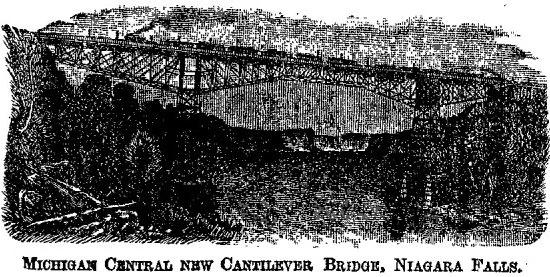
Michigan Central New Cantilever Bridge, Niagara Falls.

MICHIGAN CENTRAL RAILROAD.

GOING EAST STATIONS GOING WEST
Mail Day Exp. N. Y. Exp. Atlantic Exp. Night Exp. Pacific Exp. Evening Exp. Day Exp. Chicago Exp. Mail
p.m. p.m. p.m. a.m. a.m. Arr. / Dep. p.m. a.m. a.m. a.m. a.m.
6.00 6.45 10.45 6.00 7.30 Detroit 9.15 8.00 9.10 1.30 7.00
4.33 5.30 9.45 5.45 6.08 Ann Arbor 10.38 9.12 10.25 2.32 8.16
3.15 4.23 8.49 3.15 4.50 Jackson 12.03 10.52 11.35 3.32 9.35
2.00 3.10 7.54 1.58 3.43 Marshall 1.04 11.47 12.50 4.22 10.38
1.12 2.27 7.33 1.30 3.20 Battle Creek 1.56 12.12 1.12 4.40 11.03
12.17 1.50 6.58 12.33 2.35 Kalamazoo 2.35 1.20 1.50 5.15 11.52
10.38 12.15 5.49 11.13 12.55 Niles 4.18 3.09 3.22 6.35 1.40
9.18 11.11 4.55 10.18 11.27 Mich. City 5.40 4.32 4.35 7.32 2.58
6.50 9.00 3.10 8.15 9.10 Chicago 8.05 7.00 6.40 9.30 5.45
a.m. a.m. p.m. p.m. p.m. a.m. a.m. p.m. p.m. p.m.
Gr. Rap. & Kal. Ex. leaves Kalamazoo 6.45 a. m., Bat. Creek 7.31, Marshall 7.57, Jackson 9.15, Ann Arbor 10.25, arr. Detroit 11.45 a. m. Returning, leaves Detroit 4.00 p. m., Ann Arbor 5.30, Jackson 7.10, Marshall 8.20, Battle Creek 8.52, Kalamazoo 9.45.
All trains run by Nineteenth Meridian, or Central Standard Time. Day Express, Grand Rapids and Detroit Express, and Grand Rapids and Kalamazoo Express daily except Sunday. Pacific, Evening, and Chicago Expresses west, and Atlantic, New York and Night Expresses east, daily.
Nov. 14, 1886. G. W. RUGGLES, Gen. Pass. Agt., Chicago.

RUM OR TEMPERANCE—WHICH?

On the fourth of next month, the people of Michigan will have the opportunity of saying by vote whether or not they wish the constitution of this State to be so amended as to prohibit the manufacture and sale of intoxicating liquors within the boundaries of Michigan.
Eld. Butler has already spoken on this subject, and speaks again in this number. Read carefully what he says, and then act accordingly. Every Seventh-day Adventist is by grace, if not by nature, a prohibitionist. It has pleased God to give us quite a numerical strength in this State, and every ounce of that strength should be exerted toward wiping out the foul blot of the liquor traffic from our borders.
We look with pleasure and pride upon the noble achievements of Maine, Kansas, and Iowa in the direction of prohibition, and rejoice in the good and manifest results that have followed that action. Shall Michigan come short in the good work? We most earnestly trust not. It seems to us that if any of our people fail to do what they can by acting themselves, and inducing as many others as possible to act, in favor of this amendment, it will be not merely a mistake, a neglect, and an inconsistency on our part, but a positive sin of much deeper dye, the place for repentance of which it may be hard to find. Do not throw away such an opportunity to strike a blow for the right. We hope to hear a good report from every S. D. Adventist in Michigan on this question.

SPANISH HONDURAS.

Just as we go to press, a dispatch comes to us from Eld. T. H. Gibbs, reading as follows:— “Oteri, Feb. 23, 1887: I arrived safely at Rivaton Island, Spanish Honduras, to-day. Pleasant trip. Health and courage good. I earnestly desire the prayers of my brethren for wisdom to introduce the truth concerning these last days, in this strange land.”

WHAT ARE YOU DOING TO CIRCULATE THE NEW HOLLAND PAPER?

This excellent sixteen-page paper, the Bible Reader, has been out a few weeks, and is being highly commended where it has been seen and read. In the few places where it has been canvassed for, it has met quite a ready sale, and the people seem to like it much. We have no doubt of the excellence of the paper, and are sure it meets a long-felt want. We do not fear but that it will have in time a large circulation, but we feel anxious to see it introduced at once in all places where there are those who speak the Holland language. We fear many of our American Sabbath-keepers do not take the interest they should in its circulation. Our brethren and sisters should make an effort to introduce it immediately wherever there are any of this tongue. Send to the REVIEW Office for specimen copies, and go out among your neighbors, and show them this beautiful and interesting paper. Its very appearance will impress the people favorably. Let all Conference and T. and M. officers look after this, in their fields of labor.
O. I. B.

A TENT AND CAMP-MEETING FUND IN MICHIGAN.

The Conference committee and other leading brethren in the State have long felt that a tent and camp-meeting fund of at least $5,000 ought to be raised. Many Conferences have considered such a fund indispensable, and have had one from which to draw all expenses for tents and camp-meetings, and have always endeavored to keep it replenished. When a Conference has once adopted the plan of having such a fund, they will never be inclined to go back to the hand-to-mouth arrangement of getting along without one.
It is unpleasant, indeed, at the close of a camp-meeting, to have always to take up a collection to pay the expenses, or else take the means from the Conference funds. Conferences which have no such fund generally make a practice of taking money from the Conference fund, raised by the tithing to pay for tents, etc. We consider this practice utterly indefensible. We know of no more moral right to appropriate the tithing—which the Bible expressly indicates is to be used to sustain those who labor in the cause of God—for buying tents, building meeting-houses, or sustaining camp-meetings, than to thus use other funds which are given for an entirely different purpose. What should we think of taking the means raised to sustain the foreign missions, and buying tents with it? We should never dream of doing it. Why, then, take the tithing? We consider it all wrong. Besides, the tithing is needed, all of it, to sustain the constantly-increasing corps of workers, and must not be perverted to other purposes. To do so will hinder the work in many ways.
The Conference committee therefore urge the directors in each district of the State to bring this matter before each church, and obtain pledges and means immediately to create this $5,000 fund. We shall need several tents this spring, to be ready for the summer campaign, and have no thought of using the Conference funds to buy them. We ask our people to contribute for this important purpose, and thus place the work on the proper basis.
GEO. I. BUTLER, Pres. Mich. Conf.

KENTUCKY, ATTENTION!

Bro. H. Rupert, secretary of the tract society, has resigned, and Sr. Elsie Scott, of Cecilian, Hardin Co., Ky., has accepted the position in his place. All business with the Kentucky Tract Society should hereafter be sent to her address.
J. H. Cook, Pres. Ky. T. and M. Soc.

NOTICE!

Eld. I. H. Evans, who was formerly a minister of the Kentucky Conference, but is now of Michigan, has sent in his resignation as a member of the Conference Committee, and Eld. Robert Garrett, of Rio, Hart Co., has been appointed by the other members of the committee to fill said vacancy.
J. H. Cook. S. Osborn. } Ky. Conf. Com.

THE VOTE FOR PROHIBITION.

As the time approaches for the very important question of prohibition in Michigan to be decided at the polls, early in April, we feel anxious that our people shall all previously take in the importance of this subject, and do their duty in expressing their opinion in a legal way on this great moral question. S. D. Adventists, as a class, are not politicians, and it is rare that the great majority of them get much stirred in any purely political contest, however excited the mass of their fellow-citizens may become. Unless there is some moral question plainly involved in an election, very few of them attend it. We are glad of this, for in the scramble for the spoils—which is the principal object discernible in most political contests in these days—we do not see how a Christian can desire any part. But we consider the prohibition of the liquor traffic a great moral question. Our world, groaning under the curse, filled with iniquity, pain, and death, is not a place of unmixed joy by any means. But the sorrow growing out of the sale of intoxicating drink adds vastly to its wretchedness. Crime of every description is largely increased by it. Widows and orphans abound because of its blighting curse. Prisons are filled with blear-eyed, degraded victims of its ever-flowing poisonous stream, and our public system of justice and government is taxed to the utmost, adding greatly to our burdens. By it myriads go down to eternal perdition, who might be saved but for its degrading, ruinous effects. It is one of the most surprising, astonishing things in this world that a traffic so terrible in its effects should not have been utterly prohibited long ago by every civilized country on the globe. It destroys more people than war, pestilence, and famine combined. A large portion of the suffering and poverty of our world is directly traceable to it; and yet, because of the cravings of perverted appetite, this monster, Alcohol, is permitted to tear and destroy more than all the wild beasts of the jungle, and the robbers and pirates of land and sea; and but little effort is made to hinder it. And sensible, (talented men even favor its continued sale, and tell us that for a few paltry dollars paid into the public treasury, it should be licensed by the Government, thus freely to continue its work of death, filling our prisons, making wretched widows and orphans, and filling hundreds of thousands of graves every year.
It is not often that the people have a fair and square opportunity to express an opinion at the ballot-box, upon the question of prolonging this traffic or destroying it. Occasionally such a privilege is granted by the law making power. We know not whether the question has ever in the past come squarely before the people of Michigan for decision. It has in Maine, Kansas, and Iowa, where from personal knowledge and observation, we know that prohibition has proved a great blessing. There is far less drunkenness and crime in those States than before. In many places the jails are nearly empty. A drunken man in the public streets is rarely seen. The sale of liquor as a beverage is driven into the dens and secret haunts of vice, away from public view, so that the young are not tempted by it as when it was allowed to be sold openly. Its sale becomes a matter of reproach, so that those who deal in it lose their respectability. So it should be. It should be branded as a crime, and driven from respectable business and society. We hope from the depths of our heart that Michigan will place itself in the fair catalogue of States which brand liquor-selling as something wicked and abominable, and protect their citizens from the effects of this terrible curse.
We cannot see how any Seventh-day Adventist who has any regard for the law of God or the good of humanity, can be indifferent when the vote is taken for or against prohibition. We greatly desire that every one of them shall cast a vote for prohibition. We feel they will commit a great mistake, yea, a great sin, if they fail to express an opinion on such a subject. There are sins of omission as well as of commission. There are times when indifference is criminal. When we can do good and do it not, we are guilty. We want every Sabbath-keeper to cast a vote for closing out the liquor traffic. We urge them to be ready to a man, and we believe that the many Sabbath-keepers of Michigan will stand up and speak out when this vote is taken. We should be truly sorry to have our people less interested than others on such a question as this, when a vote is to be cast. Let every one of our people do his duty.
G. I. B.

You have reached the end of this edition.

Review and Herald · Mar 15, 1887