The Youth’s Instructor, Vol. 35, No. 13.

THE SOUTH WIND

The Youth’s Instructor

Mar 30, 1887

S. D. A. Publishing Association · Battle Creek, Mich. · Mar 30, 1887

THE SOUTH WIND

For the INSTRUCTOR.

THE SOUTH WIND.

BY L. D. SANTEE.
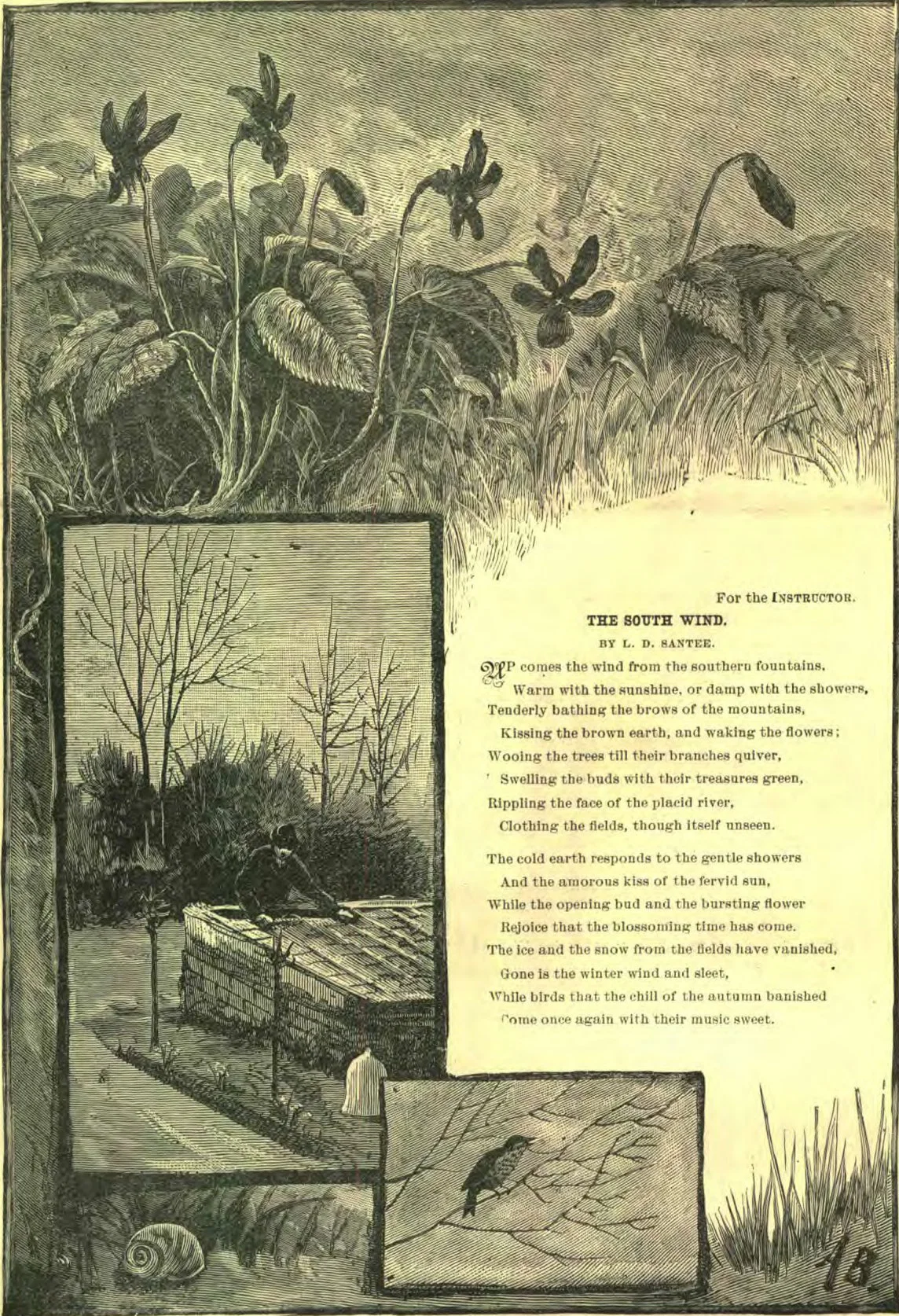
Up comes the wind from the southern fountains, Warm with the sunshine, or damp with the showers, Tenderly bathing the brows of the mountains, Kissing the brown earth, and waking the flowers; Wooing the trees till their branches quiver, Swelling the buds with their treasures green, Rippling the face of the placid river, Clothing the fields, though itself unseen.
The cold earth responds to the gentle showers And the amorous kiss of the fervid sun, While the opening bud and the bursting flower Rejoice that the blossoming time has come. The ice and the snow from the fields have vanished, Gone is the winter wind and sleet, While birds that the chill of the autumn banished Come once again with their music sweet.
Violets fair, in warm, sunny places, Look up to heaven with eyes of blue, Pure and sweet as angel faces, And eyes all tearful with heaven's dew.
Naked trees, by the south wind shaken, Rouse from their slumbers long and deep, To the warmth and the joy of spring awaken, While the thrill of life through their branches sweep.
The south wind soft to the opening flowers Whispers his love notes, low and sweet; His music is heard in the sweet spring showers, And he presses the seas with his tireless feet.
On every side where the winter cumbered, The brown, bare earth with its robe of snow, The germs that low in the earth had slumbered Have wakened in beauty to bud and blow.

CONTENTMENT

ETHEL CHALMERS was darning a three-cornered hole in her school dress. It was work she particularly disliked, but it was not to be neglected on that account. Her dresses had such a habit of catching on nails and fences and branches of trees, coming home with slits and torn places in them, that her mother had said she really could not spare the time to mend them all. Besides, she said, she didn’t like to see her daughter’s accomplishments all run in the same line. She thought a little girl who was able to climb to the top of the highest apple tree in the orchard, and to cross rail fences as quickly as a boy, should also know how to put in a patch neatly, and to darn a zig-zag tear. So, frequently a portion of Ethel’s time was spent in making repairs.
“I wish,” she said, as she laid the ragged edges together, and basted a bit of the cloth underneath, “I wish I didn’t have to darn my dresses; that I could just get a new one when one is torn. I’m tired of being poor—no, we’re not poor, but half and half. But I wish we were rich; then I’d have a pair of ponies like May Sterner’s; she drove past a little while ago. They are the sweetest things you ever saw, mamma; they come to her whenever she calls them, and she can do just what she likes with them. Their names are Dandy and Daisy. I think I’d be perfectly happy if they belonged to me.”
Just then Ethel’s two brothers, who had been playing in the yard, stopped near the window, disputing about which should be the horse and which the driver in their next game. Their words could easily be heard in the sitting-room, and Mrs. Chalmers, looking at Ethel with a smile, said, “There are your ponies.”
Ethel opened the window, and said, “Boys, wouldn’t you like to make a team, and let me drive?” The boys were delighted, and forgot that each had been wanting to drive; in a moment Ethel had on her hat and was by their side.
“I was just wishing I had a pair of ponies, and here they are!” Then, while the little steeds pranced and jumped, she harnessed them, giving them many pats and soothing words to quiet them. Then when all was ready, they had a fine frolic up and down the walks, till Ethel at last said she must go in and finish her dress. But first she arranged that Joe should be the driver while they went a certain distance, and then Dick, so that there should be no unfairness.
When, with glowing cheeks, she took up her work again, her mother said, “Would you be willing to exchange ponies with May? If she could take Joe and Dick, and you Dandy and Daisy, would you be ‘perfectly happy’?”
“No, indeed,” said Ethel, “I wouldn’t do that for anything! I wouldn’t give up the boys for fifty ponies.”
“When you find yourself wishing for something you cannot have,” her mother said, “it is a good plan to think of some good thing you do have. And you may be sure you have all that is needful for you. Even if you had more, there would always be something more that you could not have, and you would not be any more likely to be happy than you are with what you have. Any one who can say, with Paul, ‘I have learned, in whatsoever state I am, therewith to be content,’ is sure to be happy. If we would only stop to think that God could have placed us in any condition, and chose this as the one in which we can best serve and enjoy him, it ought not to be hard to be content.”
“I hadn’t thought of it just that way. It ought to make me contented. There! isn’t that a nice darn? By the time it is pressed, you can hardly see it.”
“It is very well done. I am growing proud of your mending, and although you do dislike it now, you will probably live to be thankful that you had to learn to do such work. Now you have earned a good play; run and enjoy it, only do try not to tear your dress.”
—Youth’s Evangelist.

PURE AND MANLY.

GEN. ROBERT E. LEE was a thoughtful boy, for his mother had taught him to practice self-denial and self-control, and to be economical in expending money. His father's death, when the boy was but eleven years of age, made him a “little man.” He did the marketing, managed out-door affairs, and looked after the comfort of his invalid mother. As soon as school had closed for the noon recess, he rushed away from the frolicksome boys, and hurried home to arrange for his mother's daily ride. Young as he was, he carried her to the carriage, arranged the cushions, and seating himself by her side, tried to entertain her, gravely reminding her that the ride would fail to benefit her unless she was cheerful.
“Robert is both a son and a daughter to me,” the mother used to say.
He was the most methodical of managers, and the neatest of housekeepers. Unlike many boys, he did not think it beneath him to attend to details, or to do little things with as much carefulness as if they were large. While studying conic sections, he drew the diagrams on a slate. Though he knew the one he was drawing would be rubbed out to make room for another, he drew it with as much accuracy and neatness as if it were to be engraved.
After his return from the Mexican War, his wife on opening his trunk found in it every article of clothing he had taken with him, and a bottle of brandy, which had been put in for medicinal use, unopened.
He never drank brandy or whisky, and rarely a glass of wine, and he never used tobacco. To apprehend the meaning of this fact, and its illustration of the lad's powerful self-control, one must recall the rollicking life and drinking customs of Virginia during Gen. Lee's boyhood and youth.
During a school vacation, he was a guest in a country house, where the host, a fascinating gentleman of culture, lived a gay, wild life. Young Robert, who had been trained to self-control and self-denial, was shocked. He made no comment on what he saw, but he refused to join in the revels.
The unspoken rebuke brought to his bedside, the night before his departure, the penitent host. The youth's abstinence had shamed him, and he, a man of the world, came to confess to his youthful guest sorrow for the wild life he was leading.
Earnestly he warned him to beware of acquiring drinking habits, and urged him to persist in his temperate course of life. On leaving him, the host promised he would try to reform.
He entered West Point at the age of eighteen, graduated second in his class, and, during the four years of cadet life, did not receive a demerit mark for any breach of rules or neglect of duty. He avoided tobacco and intoxicating liquors, never uttered a word to which a woman might not have listened, and never did a deed which his mother could not have approved.
Lads who think it effeminate to be good, and manly to be bad, are asked to harmonize their notions with the pure, noble boyhood of Gen. Robert E. Lee.—Youth's Companion.

ATTENTION

“Genius,” said Helvetius, “is nothing but a continued attention.”
Sir William Hamilton also calls genius only “the higher capacity of attention.”
Wedgeworth entertained the opinion that the great differences in intellect which are found in men depend more upon the cultivation of the habit of attention than upon any great disparity in their natural powers.
The word “attention” signifies an alertness, an expectancy, a readiness for what may come next, a reaching out after whatever is at hand.
The first military command is, “Attention!” and not until this order has been obeyed is the soldier ready for the rest. The teacher directs his pupils to attend to their lessons, and the preacher seeks the attention of his hearers. The opening words of Mark Antony in his celebrated oration on Caesar, “Friends, Romans, countrymen, lend me your ears!” were but an appeal for attention.
By the exercise of attention, the mind is directed toward and fastened upon the matter in hand, whether this has reference to the observation of outward objects or to reflection and other processes of the mind itself.
The familiar story of “Eyes and No Eyes” well illustrates the difference in the amount of knowledge gained by two persons in going over the same road. But here the real difficulty was, as it usually is, not that the eyes did not see, but that the mind did not attend, and consequently did not appreciate and remember that which was seen and heard.
In general, it is a very true saying that we see just what we are looking for—that is, only what the attention is fixed upon. As Thoreau expresses it, “There is just as much beauty in the landscape as we are prepared to appreciate, and not a grain more.”
Let a farmer make a journey, and he will notice the farms and farm-houses, the crops, the cattle, the roads, fences, and bridges. The artist sees the beautiful in sky and cloud and landscape, and the picturesque in hill and dale and winding river. The botanist sees every leaf and tree and flower; and the geologist notes every rock and glacier scratch and stratum of earth. The difference between them is in the matter of attention.
The American Indian, with senses so acute that he can find his way through the trackless forest by the minute appearances of the trees, or follow his enemies over the pathless prairie by the marks of their footsteps, and tell with accuracy, by means of signs invisible to untrained eyes, their numbers, their progress, their haltings, and their occupations, shows the effect of attention when applied to observation. The scholar, the philosopher, or the logician, so thoroughly absorbed in a train of reasoning as to be utterly oblivious to the outside world, illustrates the results of the same faculty when directed to the mental processes.
Every man who has won success by the exercise of his mental faculties has possessed the power of attention. On the other hand, habits of listlessness and inattention are among the most harmful which can be indulged.
They leave an individual at the mercy of his surroundings, subject to a thousand distractions, and able to fix his mind upon nothing permanently.—Golden Days.

THE HARDSHIPS OF THE PILGRIMS.

One bleak December day, two hundred and sixty-six years ago, a ship sailed along the New England coast, and dropped anchor in Cape Cod Bay. She carried a precious freight of one hundred pilgrim passengers, who had left England and persecution behind, to found a colony in a new country, where they could worship God according to the dictates of their own conscience. They were derisively called Puritans, because they abandoned the rites and traditions of the Church of England, and sought to follow the “pure word of God.” They left civilization, and many of them forsook luxurious homes and surroundings, that we, their descendants, might have religious freedom and happiness. For us they willingly braved the perils and hardships of a life in the wilderness.
In the next few years their numbers were augmented by the arrival of other ship-loads of Puritans; but all had the same experience in toil and anxiety. Their houses were rudely built of logs, with loop-holes for windows. Delicate women learned to handle the hoe and the gun, that in case of necessity they could take the father’s place at the head of the household. Neighbors were widely separated, and often the only means of communication in time of deep snows were the huge tin horn or the musket.
For days and even weeks their only food was corn meal, moistened with water, and baked before the fireplace; for stoves were an unknown luxury.
They lived in constant fear of the Indians, who were hostile to them. They built a heavy fort of logs, with holes for the gun-barrels; and when an alarm of an Indian attack was given, the settlers, with their families, made all haste to the block-house for safety; and woe to the luckless ones who failed to reach it in time. Their lost ones were scalped and killed immediately; or, what was far worse, were taken into the forest, and tortured in every conceivable way that savage minds could devise, till death relieved their agony. When sickness and death thinned their ranks, they made as little parade as possible at the funerals, and the graves were leveled and planted with corn, that their watchful foe might not detect how weak their defense was becoming.
They had no carriages, but rode to church on horseback, the women on the same horse behind the men. The trusty musket was slung across the saddle, and set upright in the aisle at the end of the pew. It is said that this is the origin of the custom of men’s occupying the outer end of the pew at church.
Bears, wolves, and panthers frequently ventured into the settlement at night, and sniffed around the doors and cracks between the logs of the house, or attacked the farm-yards and carried off the bleating calves and sheep. The children were not allowed to play out of sight, for fear of wild beasts or Indians.
All these hardships the Pilgrims endured patiently, and we do not learn that they ever regretted the sacrifice of comfort for the sake of principle.
And cannot we who are pilgrims to “a better country, that is, a heavenly,” be faithful to conscience for the short time remaining? We know that the earth made new will be the final inheritance of the saints. No need of toil and waiting to prepare a dwelling, for all beauty and perfection will be there. “The wilderness and solitary place shall be glad, and the desert shall blossom as the rose.” The inhabitant shall never say, “I am sick,” and sorrow and sighing shall flee away. L. E. ORTON.

WAITING

WHEN sudden temptation doth strongly assail thee, Then pause and reflect, ere forever too late; When noble resolves are beginning to fail thee, It is wisdom, indeed, to consider and wait.
But when conscience is urging to duty, whatever The duty may be, either trifling or great, Delay not a moment, and hesitate never— In all that is right it is sinful to wait.
—Sel.

TRUE POLITENESS.

The question was once asked of a certain person, “What is politeness?” and the answer which was made was excellent: “It is benevolence in little things.”
If that be so, then it is a quality which cannot be taught by the graceful dancing-master. One may learn to bow, and smile, and flatter, and say “Thank you” and “If you please” on all possible occasions, and yet not be truly polite. There must be a kind heart which links itself to other hearts by unseen yet powerful ties of sympathy.
Two boys pass an old woman's apple-stand as a passing cart happens to knock away the prop, and the apples roll in all directions. One boy exclaims, “Too bad, aunty,” and the other runs and picks the apples up for the old lady. Which of the two is truly polite?
Abound in sympathy. Do not burst into a loud laugh when a comrade gets an ugly fall on the ice, but run and help him up. If you had fallen, you would not like to be laughed at. Do not make fun of a comrade who, in ignorance, mispronounces a word. If you correct at all, correct in a kindly way. Carry a kind heart wherever you go, and let it send a pleasant sunbeam to your face.
It costs not much to be polite, and he who has the art will find his happiness increased thereby. He will be a welcome guest, and will make friends all through the journey of life, and will keep them too. If he lends a helping hand to others, he will find a helping hand stretched out to him. If even some are rude, be courteous in return, and learn not to return evil for evil, but that nobler lesson of good for evil, whereby in time evil may be overcome.—S. S. Classmate.

TWO BLIND MEN.

THERE were once in Rome two blind men, one of whom cried in the streets of the city, “He is helped whom God helps;” the other, on the contrary, cried, “He is helped whom the emperor helps.” This they did every day, and the emperor heard it so often that he had a loaf of bread baked and filled with gold pieces.
This gold-filled loaf he sent to the blind man who appealed to the emperor’s help. When he felt the heavy weight of the bread, he sold it to the other beggar as soon as he met him. The blind man who bought the bread carried it home. When he had broken it and found the gold, he thanked God, and from that day ceased to beg. But the other continuing to beg through the city, the emperor summoned him to his presence and asked him, “What hast thou done with the loaf that I lately sent you?”
“I sold it to my friend because it was heavy and did not seem well risen.”
Then the emperor said, “Truly he whom God helps is helped indeed,” and turned the blind man from him. —From the German.

Liquor Sales Aboard the Steamer Etruria

Two Philadelphia gentlemen were exchanging experiences of ocean-travel recently. One asked the other how much money he supposed had been paid over the saloon-bar of the Etruria during the last trip for single drinks to be swallowed at the bar. “I should think that $600 would be a good sum to be taken for the few days that the Etruria was out,” was the reply. “You never guessed wider of the mark,” returned his friend; “fully $3,000 were taken in, according to the company’s books.”

ANCIENT RUINS OF CEYLON.

In the Indian Ocean, between fifty and sixty miles directly south of Hindoostan, lies the island of Ceylon. This island has long been famous for its remarkable ruins of ancient cities, lakes, etc., some of them on a scale so magnificent as to give evidence of former prosperity and an immense population of intelligent and enterprising inhabitants. It is a tropical country, as you know, its agricultural resources depending upon a good water supply. It has had the reputation of being a remarkably fertile island, and in times of greatest prosperity received the name of “Paradise of the East;” but if one can rely upon the testimony of those who have spent some years there, a portion of the time engaged in agricultural pursuits, it is proved beyond question that only by resorting to the best system of irrigation and the free use of manure could it deserve the title. Coffee, cinnamon, and the cocoa-nut thrive in its light soil. Rice is the chief article of food with the natives, but as the rains are insufficient for its cultivation, they succeed in growing it only in proportion as they irrigate and enrich the land.
The extensive ruins of first-class water works which exist in every part of the island are proof that no pains were spared formerly to make it the rich territory that it is claimed it was. And what grander resources could one wish, or, in fact, need for an Eden than the mountain reservoirs of Ceylon? Sir Samuel W. Baker, who spent eight years in traversing the island, says:—
“The greater portion of the highland district may be compared to one vast mountain; hill piled upon hill, and peak rising over peak; ravines of immense depth forming innumerable conduits for the mountain torrents. Then at a certain high elevation the heavings of the land appear to have rested, and gentle undulations, diversified by plains and forests, extend some thirty miles. From these comparatively level tracts and swampy plains the rivers of Ceylon derive their source, and the three loftiest peaks of mountains take their base: Pedrotallagalla, rising from the Newera Ellia Plain, ‘Totapalla’ and Kirigalapotta from the Horton Plains, seven thousand feet above the sea.”
Their system of irrigation cost them a great deal of labor. Natural lakes were few, and so artificial lakes were formed by damming the natural outlets of the mountain streams, walls of masonry forming the basin for the water. One such lake was surrounded by a wall twelve miles long and one hundred feet thick. Speaking of the amount of labor bestowed in conveying the water over the country, Mr. Baker says:—
“For many miles the water is conducted from the mountains through dense forests, across ravines, round the steep sides of opposing hills, now leaping into a lower valley into a reservoir, from which it is again led through this arduous country until it at length reaches the land which it is destined to render fertile. In those days rivers were diverted from their natural channels; opposing hills were cut through, and the waters thus were led into another valley to join a stream flowing in its natural bed, whose course, eventually obstructed by a dam, poured its accumulated waters into canals which branched to various localities. Not a river in those times flowed in vain. The hill-sides were terraced out in beautiful cultivation, which are now waving with wild vegetation and rank lemon grass. The remaining traces of stone walls point out the ancient boundaries far above the secluded valleys now in cultivation. But the nation has vanished, and with it the industry and perseverance of the era.”
No doubt the query arises in the mind of the reader, What became of the vast population that formerly had possession of nearly every portion of this island? for it is said that “even in the uninhabited and chilly regions, up to an elevation of seven thousand feet, the hand of man is so distinctly traced that the keen observer can read with tolerable certainty the existence of a nation long since passed away.” “There are native paths from village to village [now in ruins] across the mountains, which, although in appearance no more than deer-runs, have existed for many centuries, and are used by the natives even to this day.”
Perhaps the following paragraphs by Mr. Baker will give a faint clue to the mystery of this nation’s disappearance. He says:—
“The very existence of the population depended upon the supply of water, and that supply was obtained from the neighborhood of Newera Ellia. Therefore, a king in possession of Newera Ellia had the most complete command over his subjects; he could either give or withhold the supply of water at his pleasure, by allowing its free exit or by altering its course.
“Thus, during rebellion, he could starve his people into submission, or lay waste the land in time of foreign invasion. I have seen in an impregnable position the traces of an ancient fort, evidently erected to defend the pass to the main water-course from the low country. In time of war or intestine commotion, the water may have been cut off from the low country, and the exterminating effects of famine may have laid the whole land desolate.” “The power of such a weapon of annihilation as the command of the waters may easily be conceived.”

THE MINISTRATION OF ANGELS.

LESSON 11.—AT THE END OF THE WORLD THEY GATHER THE SAINTS AND DESTROY THE WICKED.

1. When Christ comes the second time, who will come with him? Matt. 16:27.
2. How many of the angels will come with the Saviour? Matt. 25:31.
3. What can you say of the glory which will be manifested on this occasion? Matt. 24:30, last part.
4. Whom will the angels gather at that time? Verse 31.
5. From whence will they gather them? Same verse.
6. By whom will the saints be carried to their reward? Matt. 24:31.
7. How, then, will the saints “be caught up” to meet the Lord? 1 Thess. 4:17.
8. Who rejoiced when these saints were converted? Luke 15:10.
9. Who watched over them all through life? Ps. 91:11.
10. Then will not these angels rejoice with Jesus and the saints when the work is finished and Satan is defeated? Rev. 18:20.
11. After the resurrection, whom will the saints be like? Luke 20:36.
12. What will these saints and angels then constitute? Eph. 3:15.
13. At the end of the world, who will gather out the wicked? Matt. 13:40, 41.
14. What will they do with them? Verse 42.
15. How was this same work represented to John? Rev. 14:17.
16. Who has power over fire? Verse 18, first part.
17. What did he command to be done? Verse 18.
18. What was the result? Verse 19.
19. Where are the wicked finally cast? Rev. 20:15.
20. What intelligent creatures will then be left alive?
—Holy angels and redeemed saints.
21. How does John describe their condition then? Rev. 5:13.

THE TEACHER'S INFLUENCE.

There should be an earnest, prayerful preparation of the lesson. A teacher must not only have the love of God in his heart, but he must make a practical manifestation of his love by a careful preparation of the lesson. He should not only study it to know it himself, but he must have a plan and an aim. Let him study to make an earnest application of it to his class.
Be able to have such an influence upon your class as to impress their hearts with the spiritual truths of the lesson. Draw them out to take part in the exercises. Secure their co-work and sympathy. To do this the teacher’s own life must first be centered in God. Every Sabbath-school teacher exerts an influence upon his scholars. That this influence may be toward purity and prayerfulness, a hopeful Christian faith, and grateful love to God, the heart of the teacher himself must be thoroughly consecrated to the Master and to his work. To have and to use this influence, is the duty of every teacher.—The Standard.

THE WANDERING SHEEP.

PERHAPS you have one scholar who is troublesome. Sometimes you get tired of this scholar. Sometimes you are discouraged. Sometimes you are indignant.
Did you ever think of that parable of the lost sheep? The ninety and nine were left. A hireling, perhaps, had charge of them. But the shepherd could trust no one else to seek the poor, wandering, imperiled, lost one. The lost one was nearest the heart of the shepherd. The wayward sinner is most anxiously regarded by the Good Shepherd.
Would you be like your Master? Would you be a true shepherd? Then let your heart cherish most the wandering one. Let him be ever present in your prayers, and always uppermost in your thoughts. Remember: The lost sheep is nearest the Shepherd's heart!— Selected.

The Sculptor Who Lost His Skill

A SCULPTOR of growing skill and fame was complimented one day upon the graceful manner in which he handled his chisel; whereupon he began to give attention to the graceful handling of his chisel, and his skill and fame came to an end.

HOLY STONES.

FORMS of worship are the outgrowth of a natural tendency of the mind. Before the savage has been taught to recognize the one God, he throws all the fear and veneration belonging to his nature into the worship of some inanimate object. The Dakotas, one of our Indian tribes, deify the boulders that are scattered over the prairies where they dwell. One of these stones, known as “Eyah Shah,” or Red Rock, and lying near St. Paul, Minnesota, is thus described in the Popular Science Monthly:—
“When a Dakota was in perplexity or distress, he would clear a spot from grass or brush, roll a boulder upon it, streak it with paint, deck it with feathers and flowers, and then pray to it for needed help.
“Usually when a stone had thus served its purpose, it was no longer regarded as a sacred object, and might be disposed of in any way that suited the savage; but the peculiarity of the sacrificial stone now described is that from year to year, and from one generation to another, it was a shrine to which pilgrimages were made, and where offerings were laid.
“Notwithstanding the significance of its name, the stone is not naturally red, but is merely a hard specimen of granite. It is also called ‘Wankan,’ or ‘a mystery.’
“Immediately before starting on a hunting expedition, the clan claiming this altar would visit Eyah Shah, leave an offering of gaily painted feathers, a duck, or haunch of venison, and after a few simple ceremonies, go on their way. Twice a year, however, the clan would meet more formally, in order to paint the stone, which they did with vermilion, or occasionally with the blood of their enemies, saved for the purpose.
“When this ornamentation was finished, they would trim the boulder with feathers, flowers, and other ornaments, and dance about it before sunrise, with chants and prayers for successes from the mysterious spirit of the rock.
“The north end of the rock is ornamented by a design representing the sun, a rudely drawn face surrounded by fifteen rays.”—Exchange.

STRENGTH OF INSECTS.

As an illustration of the remarkable strength of insects, a celebrated naturalist gives the following anecdote of a beetle, which we clip from the S. S. Classmate:—
“This insect has just astonished me by a proof of its vast strength of body. When it was first brought to me, having no box at hand, I was at a loss where to put it until I could kill it; but a quart bottle full of milk being on the table, I clapped the beetle, for the present, under that, the hollow at the bottom allowing him to stand upright. Presently, to my surprise, the bottle began to move slowly, and glide along the smooth table, propelled by the muscular power of the imprisoned insect, and continued for some time to perambulate the surface, to the astonishment of all who witnessed it. The weight of the bottle and its contents could not have been less than three and a half pounds, while that of the beetle was about half an ounce, so that it moved a weight 112 times exceeding its own. A better notion than figures can convey will be obtained of this feat by supposing a lad of fifteen to be imprisoned under the great bell of St. Paul’s, weighing 12,000 pounds, and to move it to and fro upon a smooth pavement by pushing within.”
The editor of the Classmate remarks that “if a man were as strong in proportion to size and weight as this beetle, or as many of our ordinary insects, he might easily pick up a pair of horses and march off with one under each arm. What feeble creatures we are, when we come to think of it!”

PAPER MAKING.

In Tonquin, paper is manufactured from the dried bark of the paper tree, which is worth about two cents a pound. The material is reduced to a fine pulp in mortars, and mixed with a certain quantity of water, so as to form a clear paste. This is sized with an infusion made from the shavings of another tree called the “gumao.” The paper is made by women with delicate bamboo screens, which they dip into the paste, drawing out a thin sheet of paper and depositing it on a board. These sheets are put into a press to extract the moisture, and are dried by placing them upon a hot masonry wall. Each woman makes one thousand sheets per day, the thickness of the paper depending upon the consistency of the paste.

EXPENSIVE FIRES.

The Parsees have had three large and thirty-three smaller fire temples in Bombay, India, and they have just instituted another. They use 1,001 pieces of fuel of sixteen different kinds to obtain the sacred fire which is thenceforward fed with sandal-wood. The process of getting this fire, with attendant ceremonies, costs about $12,000.

AN ANGEL APPEARS TO GIDEON.

ONE time after the Israelites had been greatly oppressed by the Midianites, the Lord pitied them, and sent Gideon, a mighty man of valor, to deliver them. Gideon was threshing wheat near an oak tree, when an angel of the Lord appeared unto him. Judges 6:12.
Gideon was very much discouraged. He thought that the Lord did not care for them any more, because they had been left to suffer so; but this was not the case. The angel told him that the Lord would be with them if they would go and fight their enemies. But Gideon wanted to know what proof he could have that the Lord would help them. So the angel gave him good instruction what to do. Then Gideon went and prepared his guest a dinner; for he supposed all the time that he was only a man. The angel would not eat it, but told him to spread it out on the top of a big stone.
This Gideon did; and now the Bible says: “The angel of the Lord put forth the end of his staff that was in his hand, and touched the flesh and the unleavened cakes; and there arose up fire out of the rock, and consumed the flesh and the unleavened cakes. Then the angel of the Lord departed out of his sight.” Judges 6:21. When Gideon saw this, he perceived for the first time that this person was an angel, and he was greatly frightened, fearing that he should die. Here, you see, is another case where a man talked with an angel a long time and supposed all the while he was only a man. So it may be now that we may often talk with those whom we suppose to be men, and it may be on some occasions that they are angels sent from heaven.
There is another interesting account of how an angel appeared to a woman and talked with her, while she supposed all the time that it was only a man. That woman was the mother of Samson. She was alone at home one day while her husband was gone, and an angel of the Lord appeared unto her. Judges 13:3. He talked with her quite a while. She asked the angel who he was and where he came from; but he would not tell her.
When her husband came home, she told him all about it. “A man of God came to me,” she said; and then she went on and told him what the man had said to her. They were a good deal puzzled about this, but could not understand it. Then they prayed to God that they might see the man again. “And God hearkened unto the voice of Manoah, and the man of God came again unto the woman as she sat in the field.” This time, the woman, as soon as she saw him, ran and called her husband. Then they both talked with the angel quite a while, but they supposed all the time that it was a man.
Then Manoah and his wife proposed to get dinner for the man. He told them he would not eat anything if they did. They were very anxious to learn his name, and they asked him again about it. But the angel would not tell them, because if he had, they would readily have known that he was an angel. So they prepared a sacrifice to the Lord, as was the custom in those times. They built a fire and laid the sacrifice on the fire to burn. The Bible says: “When the flame went up toward heaven from off the altar, that the angel of the Lord ascended in the flame of the altar, and Manoah and his wife looked on it, and fell on their faces to the ground; but the angel of the Lord did no more appear to Manoah and his wife. Then Manoah knew that he was an angel of the Lord.”
This good man and his wife were now greatly frightened. They were afraid they should die, because they had seen an angel of God, had been so near to him, and had talked with him. By this you can see that angels can go right into fire and it does not hurt them, and that they can go off right up to heaven, and do other wonderful things. No doubt angels often now come to earth as they did in those days. If they are seen at all, they are thought to be men, the same as the parents of Samson thought this angel was a man.
D. M. CANRIGHT.

POLITE TO GOD.

“Hush!” whispered a little girl to her classmates who were laughing during prayer, “we should be polite to God.” Dear children, do you ever think how wickedly rude it is to laugh and whisper in your class, or while the superintendent is engaged in prayer? Be careful how you laugh during God’s service, lest some time he laugh at you and “mock when your fear cometh.”
Continue reading: Letter Budget