America has at last a real queen, with jeweled crown and scepter, and all the other appurtenances of royalty. A new royal dynasty has been launched into being, the head of which is to be known as “Queen of the Holland Dames of the New Netherlands.” With much pomp and glitter, the coronation ceremonies were conducted on the evening of the 9th inst., in the grand ball room of the Waldorf-Astoria Hotel. Miss Lavinia Van Westervelt Dempsey is the name which has hitherto designated the new monarch.
The proceedings attending the coronation were very interesting, and were meant to be impressive. “Her Majesty” was seated upon a gilded throne, over which was a canopy of ermine. Upon the upholstery of the throne was embroidered the coat of arms of Holland. Surrounding the queen were Sir Knights and noble dames and ladies of honor, and numerous pages waited in attendance to bear the trains of the royal dresses. Some of the Sir Knights wore costumes said to be fac-similes of those worn in the time of William the Conqueror; and others were dressed to represent the court of Louis XVI. of France. One of the ladies of honor was dressed like Mary Queen of Scots, and displayed a veil and prayer book which she affirmed once belonged to the wife of Oliver Cromwell. As regards uniformity of style, the court costumes were a failure; but much allowance must be made for slight discrepancies in conducting such an undertaking as that of founding a royal dynasty upon American soil; besides, they all represented royalty, and that was the important point.
So now we have a real American royalty; and American heiresses need no longer be sent abroad to acquire a royal title; for in the natural order of things there must be in this new dynasty real American princes and princesses, dukes, marquises, counts and what not, and it will only remain for title-loving Americans with money to purchase their titles from the home market which will be available from this time forward. Of course, the highest order of “high society” in America will be the new royalty; and the “four hundred” must now step down into second place.
There is a serious significance in all this, however much one may be impressed with its absurdity. As a straw showing the direction of the wind, it joins with other things to show the existence and growth of a sentiment among wealthy and prominent Americans which is directly the opposite of that under the inspiration of which this republic was established. It is one of many indications that with the rise of the money power, there has arisen in this country a sentiment which is contrary to the Declaration of Independence and to the principles of free government, and which must be reckoned with as a dangerous foe of American liberty.
There is quite a sentiment prevailing in this country, if we may judge from newspaper statements, in support of the idea that temperance does not mean total abstinence from what is bad, but that it consists in a moderate use of such things; the use of them in so moderate a way as not to exhibit their harmful properties. For example, true temperance as regards the use of intoxicants consists, according to this idea, in drinking them to an extent that will be just short of getting drunk. An individual who writes upon the subject, and in so doing no doubt voices the sentiments of others, says this: “When we are admonished to be temperate in all things, even in language, I presume it was never intended that we should abstain from talking; and so in our ‘meats and drinks.’ Pray relieve the mind of one accustomed to drink wine at table who has heretofore believed that there was virtue in temperance, and still thinks there is but little in prohibition.”
It is true there is such a thing as intemperate speech; but speech is not inherently harmful, and intemperate speech does not mean much speech, but improper speech. Intoxicants are harmful in and of themselves. The harmful property is in the smallest amount of them, no less truly than in the larger quantities; if this were not so, no harm could result from using them freely. It is a fact that moderate drinking does directly lead to “over-indulgence” and drunkenness; no one ever begins the use of intoxicants otherwise than “moderately.” Must we then conclude that temperance leads to intemperance? The proposition is absurd. No; if “moderate” drinking were true temperance, it would never lead to drunkenness. The moderate use of the things which are proper in eating and drinking, never leads an individual to a dishonored grave. This so called “moderation” is a delusion and a snare. If people would be really temperate in life, they would never care for the “moderate” use of intoxicants. A taste for such things is a sure evidence that the seeds of intemperance are in the system, only waiting the opportunity to develop and do their deadly work.
It is the same with indulgence in any other form of evil. The carnal heart continually longs to indulge in105those things which are hurtful to body and soul; but it aims to do this only “moderately.” And in this it now has, all too frequently, the countenance and aid of the church. As noticed in our last issue, the pastor of an Episcopal church in Jersey City has started a class in dancing, in the church gymnasium; and the success of the innovation shows how ready the young people are to avail themselves of the opportunity to indulge in a form of worldliness under the auspices of the church. Under the auspices of the church, the indulgence will of course be very “moderate,” and therefore an exhibition of true temperance. Will it? What do you think?
Here is what one individual thinks—Mr. Eben Bumstead, of Boston, Mass.—who has sent us a leaflet called out by this Jersey City incident. He says:— “Dear Sir:—The prominence which has lately been given to the announcement that a Jersey City pastor intends to form a ‘Bible-class dancing school,’ would seem to make this an opportune time for speaking in no uncertain tones—cost what it may—in order to warn your people everywhere of the dangers which they do not now see, of the modern waltz, which the dancing masters at their recent convention in this city condemned as ‘obnoxious,’ and which the Christian Herald, of Sept. 22, 1897, says ‘has proved the road to ruin to countless thousands.’”
In this circular is given the testimony of Mr. T. A. Faulkner, ex-dancing master, ex-champion dancer, and ex-president of Dancing Masters’ Association of the Pacific Coast. In this he says on the point of “moderation” in this indulgence: “I only wish that certain parents who think they are restricting their children to ‘parlor dancing at home only,’ could have been with me the night of May 30th, 1892, and have seen as I did, their girls, some of them but twelve or fourteen years of age, dancing in a public saloon, where so much beer had been spilt on the floor that the women had to hold their dresses to keep them from getting soiled and wet as they danced. This is usually the result of teaching the child to dance and then to restrict it to home dancing. If they once become fascinated with it they must and will, by some means, fair or foul, have more of it than their homes afford. The safe side is the best side. Keep them from taking the first step to ruin, and they can never take the last.”
True temperance consists in abstaining from taking the first step to ruin.
And it is very significant that such charges of worldliness can be laid at the door of the church at the very time when the church is trying to get control of the state, to run the affairs of civil government according to the laws of Christian morality. The church should remember the proverb, “Physician, heal thyself.”
A Striking Incident from South America.
THERE is no quarter of the globe that furnishes richer mines for securing practical examples of the workings of a united church and state than South America. We have published within the last year quite a number of personal experiences, written by the actors themselves. In a contemporary, we find the account of a seller of religious books in Chile, where there is supposed to be religious liberty. It seems that it was his first experience, as he was evidently not aware that Catholic holidays in that country are quite rigidly observed. He came to one town where he had some books to deliver, and all the places of business being closed, he could do little or nothing, so he went to another town, and with practically the same results. While waiting in the public square for a train, a priest came out of the main church of the town with his procession of saints, when all the men took off their hats. There were fully a thousand present, and he alone kept on his hat. On the opposite side of the street the priest in his four-cornered cap came along and motioned for him to take off his hat. No attention was paid to this, and he was then commanded to either remove his hat or leave the square. What happened after this we will let him tell in his own language. He says:—
“I asked him what authority he had in Chile to give such a command, as there is religious liberty in this country. He threatened to call the police. I said, ‘Very well, if you have authority to do so.’ He left his monos (saints) in the street, and went to look for a policeman; and the crowd left his procession to see me.
“While I was waiting, I asked the people what authority the priest had, as I did not believe in his santos or his church. Finally the priest came back with the policeman, and commanded him to take me to jail. I again asked if one had to take off his hat in the public square. The policeman said I must come with him, and talk to the chief of police, which I did. While on the way, I gave a tract to the policeman, and convinced him that the priest was wrong. Half a square before we reached the prison, several persons came rushing up behind, and asked the policeman to let me go. One of these brushed my back with his hand, as on leaning against a tree while waiting in the square for the priest, my coat had become soiled. I asked them to come along and see what the chief would say.
“On reaching the prison the policeman said, ‘I come with this man by order of Señor Cura, because of his making a scandal in not taking off his hat.’ The chief said, ‘Go.’ I did not care to go at once, so he asked me in, and I showed my book to him and others, and gave him some tracts, then turned to the public square again, where the priest was. A little before reaching it a well-dressed man came almost on a run, and we met on the corner. He was astonished, and asked if I was not the man who had been sent to jail.
“‘Yes,’ was my reply.
“He said, ‘If I only had power, you would go to jail.’
“I then asked him if he was a Christian, and if Christ ever sent any one to jail. He went away somewhat ashamed. On reaching the ‘plaza,’ or square, the people106spied me, and pointed me out to others. Because of my ‘offense’ many had become my friends, and perhaps more had become my enemies. After talking awhile to some, as the priest was entering the church with his crowd, I gave away some tracts, and left for the station to take the train for San Felipe.
“When I had entered the train one young man began brushing the dust off my back to show his affection. I felt thankful to the Lord for this victory. Being my first visit to the town, I arrived without friends or enemies; but on leaving, all were either friends or enemies.”
Is the Bible Equal to It?
By Lewis C. Sheafe
BY LEWIS C. SHEAFE.
Just now the preachers of this city are having a spasm of “higher criticism.” They are jubilant over the so-called discoveries, and lament that they have been so simple-minded as to believe in the past, that the Bible is the very word of God, and that the Lord meant just what he said. Now, they say, we can treat the Bible as literature, and in their wisdom it is not safe for one not well versed in the languages to attempt to do much with the Bible.
Such language reminds one of what was said by the papists after Luther’s triumph at Leipsic; they said in substance, We too accept the Scriptures, we even put them above Augustine and the Councils. But who can interpret them? Can peasants and women, or even merchants and nobles? The Bible, though inspired, is full of difficulties; there are contradictory texts. It is a sealed book except to the learned; only the church can reconcile its difficulties. We can accept nothing which is not endorsed by popes and councils. No matter how plain the Scriptures seem to be, on certain disputed points only the authority of the church can enlighten and instruct us. Moreover, since the Scriptures are to be interpreted only by priests, it is not a safe book for the people. We, the priests, will keep it out of their hands. They will get notions from it fatal to our authority; they will become fanatics; they will in their conceit defy us.
Then Luther rose, more powerful, more eloquent, more majestic than before; he rose superior to himself. What! said he; keep the light of life from the people? take away their guide to heaven; keep them in ignorance of what is most precious and most exalting? deprive them of the blessed consolations which sustain the soul in trial and in death? deny the most palpable truths because your dignitaries put on them a construction to bolster up their power? What an abomination! What peril to the souls of men!
Then Luther grasped that great idea of the Reformation, which was “The right of private judgment,” or “Religious liberty.” He said, Let the Scriptures be put into the hands of everybody; let every one interpret them for himself, according to the light he has from the guiding Spirit. Let spiritual liberty be revived, as in apostolic days. Then only will the people be emancipated from the middle ages, and arise in their power and majesty, obey the voice of enlightened conscience, and be true to their convictions. Then will they obey God rather than man, and defy all sorts of persecutions and martyrdom, having a serene faith in those blessed promises which the Gospel unfolds.
That same enemy of religious liberty is abroad again. Let us beware. Don’t put the scholarship of men above the wisdom of God, for God has hid these things from the wise and prudent and revealed them unto babes. The doubts and denials of scriptural facts, by the so-called higher critics, have gotten men into the fog, and to-day men and women are skeptical as to the existence of God, the moral government of the world, the truth of Christianity, and the reality of the supernatural. Now the way out of this fog is by a living faith in the living Word of God. Give it a prayerful study. It has light yet to reveal for these times. It is equal to these times, for it is Spirit and life.
Louisville, Ky.
Superabundant Legislation.
N. Y. “Christian Advocate.”
PRESIDENT WHITAKER, of the New York State Bar Association, said recently that from 1777 to 1897 the Legislature of New York had passed and ordered printed 101,000 pages of statutes, and that in the years 1887 to 1892 a volume of 600 pages was published each year; from 1892 to 1897 two volumes of 1,000 pages each were issued each year, with the exception of two years, when the output was three volumes each year. This is a vast amount of legislation even for so important a state as New York, and there can be no doubt that much of it is never enforced, and probably some of it is absolutely unnecessary. Perhaps if the Legislature met biennially, and the term of the session was limited, this evil of unessential legislation might be mitigated. As it is now, the Legislature sits for about four months each year, and produces about 1,000 pages of statutes. President Whitaker says: “A very large portion of the time of the Legislature is spent in passing special and personal laws, in which the people as a whole have very little, if any, direct interest. And it is not infrequent that laws are passed in direct opposition to the real interests of the general public. In fact, people are beginning to look upon legislative sessions as a menace, rather than a solace.”
What the World Needs: More Love Than Legislation
WHAT the world needs is not more legislation, but more love.
Discussing Principles Versus Personalities in Controversy
On the side of truth men care only to discuss principles; on that of error they prefer to descend to personalities.
Studies in French History. -9.
By Mrs. L. D. Avery-Stuttle
“WHEN the poor Jews could no longer be found to torment and persecute,” begun Professor Carman, “the next Wednesday afternoon, the tide turned toward some heretics at Orleans. Among these was an old man, who had once been confessor of Queen Constance. But he had become in some way convinced of the errors of the Romish church, and had severed his connection from it. This made the queen so angry that as he was passing by, she struck him so violent a blow with her staff that his eye was dashed out.”
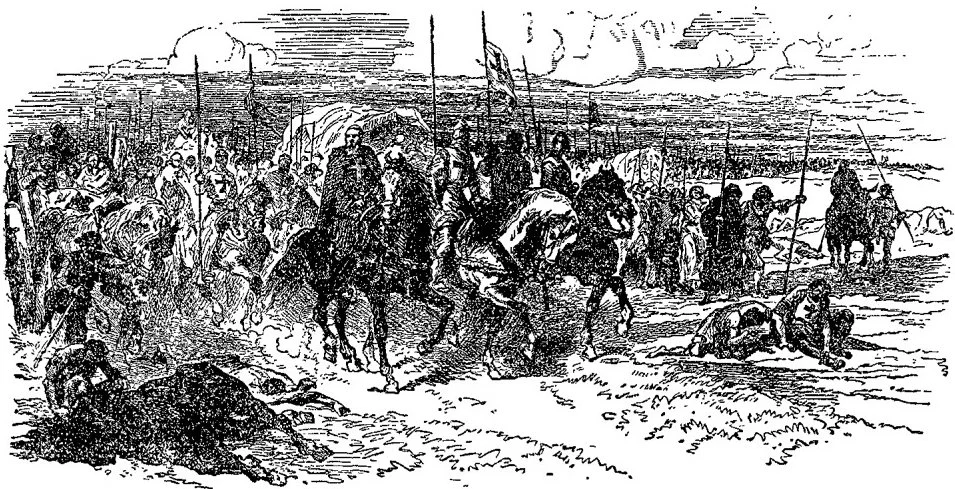
CRUSADERS ON THEIR WAY TO PALESTINE.
“She must have been an extremely pleasant tempered woman,” exclaimed Jack Smith, indignantly, “and deserved to have songs written about her.”
“About the year 1031 there was a dreadful famine which lasted for three years. I think I have never read of anything so horrible ever being done as during this frightful time. History tells us that human flesh was very often eaten, and even that the frenzied people would rob the graveyards, and devour the buried corpses. It was not safe for children to be left alone, lest some fiend, made frantic by the pangs of hunger, should kill them to sustain his own life. The wolves and other wild animals were as hungry as the people, and grew so bold as often to attack them; and the famished people were so weak from hunger that they could hardly defend themselves.”
“O, wasn’t it so dreadful!” exclaimed Florence Ray. “How long before there was a change?”
“In the fourth year the crops again grew, so that there was an abundance of food. And now, while everybody’s heart was soft and tender with gratitude, the Catholic Church made a law, called the ‘Peace of God,’ forbidding the taking of human life, in war or in any other way.”
“Well, seems to me that was a pretty good thing,” said Charlie White.
“Yes, but while the people depended upon their own unaided efforts they could not keep the sixth commandment or any other. The natural heart is full of hatred and murder, and these people soon became as lawless and wicked as ever. Then another law was tried, called the ‘Truce of God.’ From Wednesday eve till the next Monday morning, the law forbade murdering anyone upon any pretext whatever; so that during this period each week, human life was comparatively secure.”
“Then I suppose if any one had any killing to do, he must do it between Wednesday and Monday,” chimed in Harry Ray.
“I should have thought they would have called the other days ‘butchering days,’” remarked Will Barnaby, shuddering.
“Yes; but even this restriction was better than nothing. This was the condition of things in the eleventh century,—about 1034.
“How long did King Robert the Pious reign?” asked Rob Billings, pencil in hand.
“Thirty-five years, and was succeeded by Henry the First, his son, and Philip the First, his grandson. Henry reigned twenty-nine years, but his reign seemed to be quite uneventful. Philip had a long reign of forty-eight years. The historian does not give Philip I. a very good name, I am sorry to say; but kind and just rulers are always the exception, not the rule.
“While Philip was on the throne of France there was a wonderful warlike movement undertaken to rescue or recover Jerusalem from the hand of the Turks, called the Crusades.”
“I remember of reading that Philip the First was awfully lazy, and lazy folks are generally cowards; so I should have thought he would have objected to exposing himself enough to lead his army,” said Edna Phillips.
“Your idea is quite correct, Edna,” said the professor, “quite correct; for Philip did not offer to head his army, and so when the Christian troops returned victoriously, he did not claim, nor did he get a bit of the glory.
“Along toward the last of his reign he pretended to feel so sorry for his sins that he ordered his people not to bury him with the preceding kings of France in St. Denis Cathedral.
“The lives of the nobles were wicked and profligate in108the extreme. If any man wished to live without honest toil, he would take a horde of his retainers, or people under him, and placing himself at their head, would plunder and rob any one who chanced not to be able to offer resistance.”
“It doesn’t seem as if France or any other kingdom could endure such a lawless way of living very long,” said Florence Ray.
“Well, there was a better time at hand for the miserable people, and well it was that this was so. When Philip I. died, his son Louis VI., called the Wide-awake, when he was young, but known better as ‘The Fat,’ reigned after him. Louis immediately began by attempting to control the lawless nobles. He was cunning enough to call the common people and the church to his aid, because they were all of one mind in wanting to rid the country of these lawless villains. At last they succeeded, though they did some hard fighting. But although the king became so fleshy that he could hardly seat himself upon his horse, he did not give up hard work.”
“Benjamin Franklin said, ‘If you want a thing done, do it yourself,’ and Louis did it; though he had of course never heard of either Franklin or his saying; nor did he believe in putting off till to-morrow what ought to be done to-day. His minister’s name was Suger, and he was a wise and sensible man. He was of great value both to Louis VI. and to his son Louis VII., who succeeded him, and whose reign of forty-three years begun in 1108.”
“Now perhaps this study has been as long as you can profitably take in for this time; but I would like to ask if there are any in our class who would like to give up these studies.”
For an answer the professor received a perfect chorus of “No, no; we want to continue them; we wouldn’t give them up for anything.”
MRS. L. D. AVERY-STUTTLE.
To the Juvenile Readers of the “American Sentinel.”
By F. C. Gilbert
Dear Friends:—Doubtless all of you are more than gratified with the Young People’s Department of this periodical, which has been created especially for the youthful readers of the paper. Personally, I am of the conviction that this addition is very timely, and will be of great value to all who interest themselves in it. Perhaps some may think the subject of religious liberty is not essential for young people, nor of vital importance enough for them to become interested in. But of all the people who should be especially awake to these living principles, with a keen sense of their value, the young ought to be the first and most active. There are many reasons which demonstrate this to be a fact; a greater number than can be written in this short epistle.
It is a fact with which nearly all of you are familiar that, during the past three years, a continuous patriotic wave, so-called, has been sweeping over this country, and it seems constantly to rise with each setting sun. One very remarkable thing about this movement is that its strength lies in the concentrated forces of several millions of the best young people of this country. Never perhaps in the history of the country, the times of ’76 and ’61 excepted, has the air been so full of patriotism as at the present, and its density becomes more and more apparent. One writer, recently speaking of this movement, said, “There can be no question about the penalty that may be incurred by neglecting the present golden opportunity to make patriotism universal and fervid, North, South, East, and West. Miss this God-given opening of to-day, and the fortunate conjunction may never return.”
God is certainly granting golden opportunities at the present time to rightly understand the true meaning of civil and religious liberty, that all may know the correct relations which exist between God and Cæsar; between the church and state; between God and the individual; between individuals and society; and much, yes, everything, depends upon a correct understanding of these relations. Never has a truth come to the world without the devil was bound to defeat it if possible; either by directly opposing it, or else by counterfeiting. So these eternal principles of civil and religious liberty which to-day are commanding the attention of almost the whole world, and promise, in the near future, to become the living issue, are either misrepresented, falsely colored, or misconstrued by the force of evil, in order that their true meaning shall not be apparent to all.
As one of the outgrowths of this popular patriotic wave there has been thrown ashore this so called “Christian Citizenship” organization. It has gathered under its influence nearly five millions of people, the very cream of the land, and imbued them with an enthusiasm worthy of the most noble cause the world has ever known. As we are all well aware, the whole foundation of this great movement is built upon a false hypothesis; hence will not stand when the great contest between righteousness and error will be waged. It being built upon a sandy foundation, the rivers of truth will inundate the whole structure. Then how important it is that every young person educate himself that he may correctly understand these eternal principles,—that he build upon a solid foundation, even upon the Rock of Eternal Truth, in order that he be not carried away with “the refuge of lies,” which are to come to nought.
Yet more: it is not only necessary that each one understands these principles for himself, but he also has a duty to perform in telling his neighbor the true intent of the principles of civil and religious liberty. Millions to-day are anxiously waiting to learn the truth of these things; and as ye have freely received, freely give.
But some may ask, “Who is my neighbor?” He who needs the assistance most, independent of caste, color, condition, or position. When we consider the millions of persons in these various organizations, working with such a zeal and earnestness for what they believe to be109the upbuilding of Christ’s kingdom upon earth, yet misguided because of erroneous principles, how necessary it is for every person who loves God, and to whom has been given the privilege of knowing these eternal truths, especially among the young people, to become thoroughly acquainted with these facts themselves, and then coöperate with the divine One, that many of these earnest but misguided persons may know the truth as it is in Jesus, and turn their feet in the path of truth and rectitude.
It is the mission of this department of the SENTINEL to educate the youth upon this line. The call of God to-day is, “Educate, Educate, Educate.” By so doing each one will not only save his own soul, but will have many sheaves to be gathered in the garner at the great day of the Lord.
Yours for religious liberty,
F. C. GILBERT.
“He Shall Think To Change . . . Laws.”
By F. B.
“Our last talk brought out the fact that the papal power has warred against—well, let me see if you can tell me, Charlie?”
“Against the Most High God and against the saints of the Most High.”
“What was he next to war against?”
Charlie turned to the prophecy and read from Dan. 7:25, “He shall think to change times and laws.”
“Whose times and laws, Charlie?”
“The times and laws of the Most High.”
“Yes. We all know that it is customary for nations to change their laws; for men to change each other’s laws; but what kind of wisdom would men need to change the laws of the Most High?”
“The wisdom of the Most High,” said Charlie.
“Has any finite being ever had the wisdom of the Most High?”
“N—no,” said Charlie, slowly. “Jesus was the Son of God,—God in the flesh.”
“We will speak of his attitude to the law of God a little later. What does Paul call the pope?”
“The man of sin,” said Charlie.
“And in our past talks we have learned that the pope’s only an exponent of self; that each one of us, unchanged by divine grace, will war against God and his saints.”
“Let us see what the pope has said in regard to changing God’s law. Hand me the books on the sofa.”
Mrs. Ross read: “The pope’s will stands for reason. He can dispense above the law, and of wrong make right by correcting and changing laws.”—Pope Nicholas, Dist. 96.
“This paragraph is from the decretals of the popes.”
“But, mama, suppose the pope did think to do away with God’s law and the precepts of Christ, what difference would it make? He couldn’t really do such a thing. Right, you know, is right, because it is right, and because God is. To undo God’s law, that is the very expression of right, would be to put God out of existence.”
“Yes, Charlie. But who is behind the papal horn?”
“Satan.”
“And Satan is manifested in self, and self would kill and obliterate any thing or body that would hinder its exaltation. While no one can undo right, or dethrone God, yet self thinks to do it. The Catholic version reads, ‘He shall think himself able to change times and the law.’”
“Do you suppose that the pope actually thinks he is able to do that?”
“Certainly. But he is not the only one who thinks so. Whole nations have thought to do so, and as nations are only individuals in mass, individuals have thought to do so. You may turn to Rom. 8:7, and read.”
Charlie read, “‘The carnal mind is enmity against God; for it is not subject to the law of God, neither indeed can be’”
“Dear me,” said Charlie; “Is it impossible for any of us to keep God’s law?”
“Impossible, unless we experience a change of heart, or mind. Paul also says, ‘We have the mind of Christ.’ Jesus told Nicodemus that in order to understand the things of God he ‘must be born from above,’ All have carnal minds who have not the mind of Christ, and the works of the flesh appear. Self controls the life, and the fruits of the Spirit are not seen.” F. B.
For Sale Cheap.
By William Ward Simpson
I HAVE a limited number of copies of the old edition of “Thoughts on Daniel,” which formerly sold for $1 25. As long as they last, I will sell them, postpaid, for 50 cents a copy. Will make an acceptable present. Address William Ward Simpson, Battle Creek, Mich.
TO OUR PATRONS:
By Editor
Write names plainly.
Remit by P. O. Money Order, or Express Order, or by Bank Draft on New York. Personal checks are not desired.
Make all Orders and Drafts payable to Pacific Press Publishing Co., not to the editor or any other individual.
We will receive Postage Stamps in small quantities and any kind of good money. Defaced coins will not be taken. If paper money or coin is sent, register the letter.
NUT BUTTER MILLS.
By Joseph Lambert
Something new. Designed especially for converting nuts into butter for table and culinary purposes. Valuable recipes for the use of nuts. Shelled and unshelled nuts of all kinds at reasonable prices. Send for descriptive circular and price list.
JOSEPH LAMBERT,Battle Creek, Mich.
The Gospel Primer.
A Book for the Children.
Contains 160 pages of matter, which will interest the old as well as the young. There are thirty-three full-page illustrations, which, in themselves, teach many gospel truths.
PRICE - - - - .25
Address this Office.
A Greek-English Lexicon TO The New Testament.
Revised and Enlarged by
Thomas Sheldon Green, M. A.
WITH A PREFACE BY
H. L. Hastings,
Editor of the Christian, Boston, Mass.
AND A SUPPLEMENT BY
J. H. Thayer, D. D., Litt. D.
Professor of New-Testament Criticism and Interpretation in the Divinity School of Harvard University.
Containing additional Words and Forms to be found in one or another of the Greek Texts in current use, especially those of Lachmann, Tischendorf, Tregelles, Westcott, and Hort, and the Revisers of 1881.
“The best thing of the kind for the money.”
PAPER BINDING, Postpaid, 35c.
Address,
Pacific Press Publishing Co.,
39 Bond Street, New York City.
TRADE MARK REGISTERED
BARLEY CRYSTALS
New Diuretic, Invigorating Pure Cereal. Endorsed by physicians in cases of weak and irritable Digestive Organs, and Kidney Trouble. Emollient, attractive, palatable. Unsurpassed in the whole range of cereals.
PAMPHLET AND COOKING SAMPLE FREE.
Unrivalled in American Beverage. Ask Dealers, or Write to Farwell & Rhines, Watertown, N. Y., U.S.A.
The Simplicity Vaporizer: A Nose, Throat, and Lung Instrument
By S. W. Armor
SIMPLICITY VAPORIZER.
A New Instrument which has no Equal at the price as a Means of Applying Medicaments to the Nose, Throat, and Lungs.
The Simplicity Vaporizer
Has the following advantages over all others:—
Simplicity and Durability at a Moderate Price.
It is Easily Cleaned and cannot get out of order.
No Metal or Glass Tubes. These are made of Hard Rubber.
All Parts can be replaced at a small cost.
The Simplicity Vaporizer is indispensable in the successful treatment of Colds, Bronchitis, Nasal and Throat Catarrh, diseases of the Ears, Etc.
Price of VAPORIZER with enough Medicine for 100 treatments, $1.25
Agents Wanted.
S. W. ARMOR,
39 Bond Street, NEW YORK.
SEND FOR LIST OF EXCELLENT BOOKS
slightly damaged, offered at half price.
Address, PACIFIC PRESS PUBLISHING CO., 39 Bond St., New York.
Steps to Christ.
In twelve chapters are presented in a simple and beautiful manner the steps by which a sinner may be made complete in Christ. It contains a wealth of counsel and encouragement for those who are laboring with the difficulties that beset a growing experience.
Price (Fleming Revell edition) - - .75
A NEW TRACT CATALOGUE.
_“Descriptive Catalogue of the Bible Students’, Apples of Gold, and Religious Liberty Libraries”_ is the title of this 36 page catalogue.
It gives a pithy description of each tract and pamphlet in the above Libraries, together with their size and price. It will greatly assist the reader to select such numbers as he may desire to read and circulate; and may be obtained FREE by addressing the Pacific Press Publishing Company, Oakland, Cal.; 39 Bond St., New York City, N.Y.; 18 W. 5th St., Kansas City, Mo.; or Review and Herald, Battle Creek, Mich.; Atlanta, Ga.