A Pure Linen Test.—In order to determine whether your handkerchief is made of pure linen, draw it over your moistened finger. If it is linen, it will show the moisture at once; if cotton, hardly a trace of dampness will be seen.
Frederick the Great’s Permission.—It is related that two officers of Frederick the Great, of Prussia, once asked his permission to fight a duel. This was granted; but “when they met on the dueling ground next morning, they found there a gallows erected, and a corporal’s guard stationed; and, inquiring the meaning, were told that his majesty had ordered that whoever survived the duel should be immediately hung.” The duel did not take place.
One Chicago Building’s Mail.—Something of an idea of the enormous amount of business transacted daily within the walls of one of Chicago’s huge skyscrapers may be gleaned from the following statement: “The smallest postal district in the world is under the roof of the Monadnock building at Jackson, Dearborn, and Van Buren streets, in Chicago. The building alone comprises a separate and distinct district in itself. At the same time the volume of business there is the largest of all the sub-stations, or even districts, in the city, save that of the board of trade station. In this immense seventeen-storied structure, which covers the small ground area of four hundred feet long by seventy feet wide, almost six thousand persons occupy the twelve hundred rooms. The carriers’ schedule in the building provides six deliveries every day except Sunday; and in these six deliveries the carriers distribute, on an average, twenty-five thousand pieces of mail daily in the great office structure.” And remember, this is but one of the many great buildings of the kind found in Chicago.
A Word to Would-be Writers.—One of the most clever and successful writers in New York City has left on record the following words of caution to those who imagine the field of literature an easy one to till: “Theoretically, it seems so easy, by means of pencil and paper, available to any one, to write undying words, and to tell stories that shall move the world, and which shall cause the name of the writer to go thundering down the ages, and be numbered among the immortal band. The road seems royal; and with visions of Benjamin Franklin entering Philadelphia with a loaf under each arm, many literary aspirants have entered New York, from time to time, with manuscripts carefully written on one side of the paper, and folded (not rolled), neatly bestowed in their pockets, presently to find, only too quickly, that the most cherished illusions will fade, and that the world is, after all, very cold and unfeeling. . . . When all is said, it finally remains true that the same energy that is signified by, and required for, literary success on the part of the aspirant, applied in other directions, will yield fruit, some sixty and some a hundredfold better.” Of course there are a few distinguished writers who are able to command almost any price for their literary wares. As an illustration, for only the serial rights of his latest story, Mr. Rudyard Kipling received the encouraging sum of twenty-five thousand dollars. His royalties upon this same story in book form, after it has run through one of the great magazines, will be additional profit. On the other hand there are hundreds, perhaps it would not be too much to say there are thousands, of literary workers who are poorly paid, scantily clothed, illy housed, and often only half-fed. AUGUSTIN J. BOURDEAU.
LITTLE FEET AND LITTLE HANDS
LITTLE feet may find the pathway
Leading upward unto God;
Little hands may help to scatter
Seeds of precious truth abroad.
— Selected.
THE CAT THAT OTHERS FED
A True Story
IN a certain town in California there lives a very lazy cat. There are three other cats in the family to which he belongs, and they are all very smart. Perhaps that is the reason Tom is so lazy—he thinks the other cats catch birds and gophers enough for four. While Graybeard, Dinah, and Snowball are off hunting, Tom lies asleep in the sun; but when they come back with a nice fat gopher or a tender blue jay, Tom is very wide-awake at once, and claims his share of the feast with as much assurance as if he always did his share of the work.
The other cats no doubt feel the unfairness of this, but either because they are too good-natured to deny him this privilege, or because Tom is so much bigger than any of them that they are a little afraid of him, they never seem to dispute his claims.
But although Tom succeeds in his schemes for living without working, his laziness is punished in a very queer and unexpected way. The blue jays, which are often caught by the industrious cats, have found that Tom is too lazy to catch them, no matter how near they come; so, instead of being afraid of him, as they are of the other cats, they seem to despise him because he is not worth being afraid of, and their treatment of him is very amusing.
Whenever they spy him near the orchard, where they come to get the fruit, they will fly to him and flutter around him, screaming and pecking at him until they have driven him off.
“Ho, you lazy thing!” they seem to be saying, “do you call yourself a cat? You are of no more account than a rabbit. Why don’t you catch us?” and poor Tom has not even spirit enough to face them and frighten them away, but runs to find some one of the other cats; for well he knows that the jays will not dare come anywhere near them.
Sometimes when Tom takes refuge in the110house, the jays will actually follow him in through the open door, and keep up their teasing and tormenting, while he hides under tables or chairs until some one comes in to drive them away, when he walks off with dignity.—Youth’s Companion.
WORKING AND SHIRKING
By Aunt Betty
The twins, Rob and Roy, were cleaning the back yard, and Grandfather Downs was watching them from the porch.
“Now, Rob,” said Roy, “that box needs to be put over here, in this corner. I’ll mark the place to put it, with a stick, while you bring it over.”
Rob tugged and pulled at the box, while Roy looked on, offering suggestions and criticisms freely. At last the box was settled to his satisfaction, and the cleaning went merrily on.
“You go on raking, Rob,” said Roy, after a few minutes. “I’m going to lay off the yard in strips for us.” So Roy spent fifteen minutes in laying off the yard, while Rob raked steadily on.
“O Rob! mama said these bricks must be piled over by the back gate. Let us play you’re the Israelites, and I’m the Egyptian taskmaster. I’ll get my toy whip, and drive you while you carry them. You must take big loads, just like the Israelites in the pictures.”
“Boys,” called Grandfather from the porch, “come and rest here in the shade a little while;” and the two boys scampered up the steps, and sat down beside him. Grandfather laid a hand on each young head, and looked lovingly at them, as Jacob must have looked on Ephraim and Manasseh.
“When I was a boy,” said Grandfather, in the “story-telling voice” that the boys loved to hear, “I lived on a farm in a new country. We lacked many of the conveniences which you have now. The nearest town was twenty-five miles away. There were no sawmills nor lumber-yards near us, and our houses were built of logs, roofed and floored with boards split from cedar. Everything was homemade.
“When a settler built a new house, it was a great day. All the men in the neighborhood were invited to the ‘raising;’ and their wives, sisters, and daughters came to help with the cooking, and take part in the merrymaking in the evening.”
“In our neighborhood there was a man named Silas Jenkins; and he was always the last man chosen in making out a crew for a ‘raising.’ He was strong, genial, and good-natured, and there seemed no good reason for so slighting him—at least not until you had seen him at the work. Then you would soon find out why he was never invited unless the crew was very short. When the men all had the great log in their arms, or on their shoulders, holding their breath to lift, Silas, though he appeared to lift, always had breath to shout, ‘Heave her up! H-e-a-v-e her up!’”
Grandfather’s story came to a sudden end, as his stories generally did. Rob looked inquiringly up at him, but Roy hung his head.
“Come, Rob,” said he, “I’ll carry bricks for a while now, and you can be taskmaster.”
And after the bricks were moved, Grandfather smiled to see that Roy’s rake was as busy as Rob’s.
AUNT BETTY.
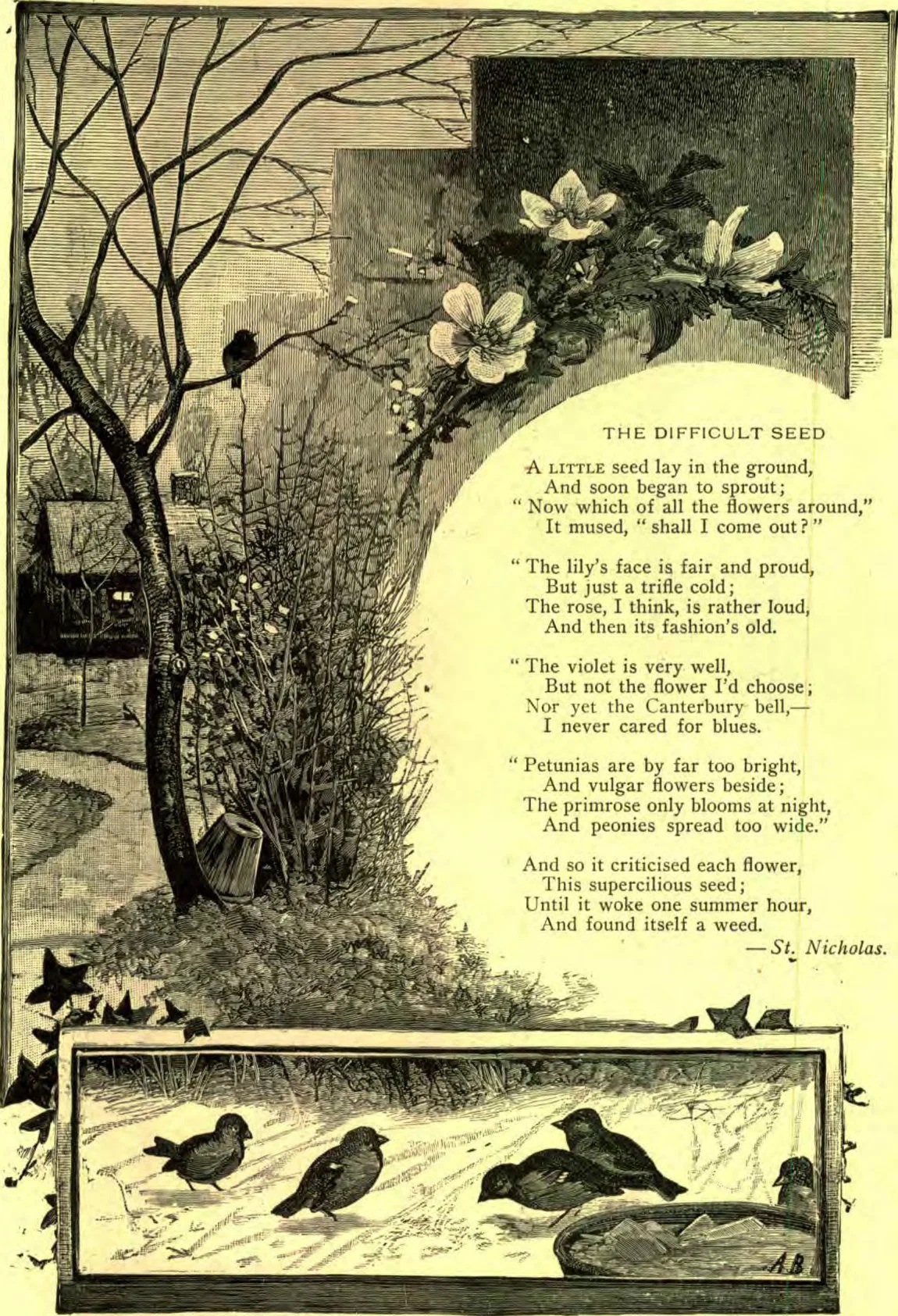
THE DIFFICULT SEED
A little seed lay in the ground,
And soon began to sprout;
“Now which of all the flowers around,”
It mused, “shall I come out?”
“The lily’s face is fair and proud,
But just a trifle cold;
The rose, I think, is rather loud,
And then its fashion’s old.
“The violet is very well,
But not the flower I’d choose;
Nor yet the Canterbury bell,—
I never cared for blues.
“Petunias are by far too bright,
And vulgar flowers beside;
The primrose only blooms at night,
And peonies spread too wide.”
And so it criticised each flower,
This supercilious seed;
Until it woke one summer hour,
And found itself a weed.
— St. Nicholas.
Our Picnic
By Addie Guthrie
Seattle, Wash.
Dear Youth’s Instructor: One bright day last summer I received an invitation to attend a picnic at West Seattle, just across the bay. At eight o’clock some of us were at the landing, but as usually happens, some were late. We therefore had the pleasure of seeing the old Seattle Ferry, looking like a huge washtub, sail off without us. While waiting for its return, we saw some squaws very gaily dressed, and others hardly dressed at all, spearing food out of a garbage barrel.
At last the steamer returned, and this time we went aboard and had a pleasant ride across the bay. We walked quite a ways before we found a place suitable for the lunch to be spread. Here we left our baskets, and ran off to find some shells. After hunting for some time we began to think of the good things in our baskets, and soon went back to where the older ones of our party had our lunch spread on the grass. Oh, how we did enjoy it! But we were careful not to eat too much, because we were in such a hurry to go in wading. Of course we had to wait a while after eating, but the time came at last when we all put on our bathing suits, and bravely waded in. Then the fun began. We splashed and played in the water, and each had a turn in getting ducked. The day was not half long enough. But there was no help for it; the sun was getting low, so we had to scramble to see who would get dressed first. We were just in time to catch the last boat. And thus ended a very pleasant day.
Addie Guthrie (9 years old).111
It is pleasant to know that our Heavenly Father loves to have his children have happy times together. And he wants them to be happy in such innocent ways that his own good Spirit can go with them to bless and protect them all the time. If this is not so, there is something lacking that nothing else can supply. Your letter is beautifully written, Addie.
APRIL FIELD STUDY
(April 7–13)
Introduction.—The articles for special study in the April Magazine are: “The Gospel in the Malay Archipelago,” “The Religions of India,” “In the Zenanas.”
William Milne.—The history of this man, though brief, is full of good deeds for the people he loved, and to whom he gave his life, and is indeed worthy of imitation. He was one of the pioneer missionaries to Java, laboring there in the early part of the nineteenth century. Converted at the age of sixteen, at twenty he decided to become a foreign missionary, although five years after this were spent in securing a support for his mother and sisters. His early opportunities for education were meager. When he was twenty-seven years old, he sailed for China, but found that, with the exception of Canton, this country was closed to the foreign missionary. Leaving his wife with friends, he spent six months in Canton engaged in the study of the language, and the next eight months in a tour through Java and other points in the Indian Archipelago, distributing among Chinese residents copies of the New Testament, and a few tracts, which had been translated into the Chinese. At the end of this time he rejoined his wife, giving further time to the study of the language, while he held meetings in his home for foreign residents and sailors. As preaching was still prohibited in China, it was decided that he should labor for the Chinese in Malacca. He immediately went to Penang, opened a missionary day-school, and later an Anglo-Chinese college, and began publishing a monthly and a quarterly paper in the Chinese.
Besides looking after this work in all its details, we are told that from this time—1815—until the close of his life, his main work was the preparation of religious literature in the Chinese language. He aided in the work of translating the Bible into Chinese, the books of Deuteronomy and onward to Job being translated by himself. He prepared a commentary on the Epistle to the Ephesians, and wrote several religious books and tracts, all acceptable to the Chinese. He had great skill and readiness in the use of the language, and, in addition to all his literary labors, performed much evangelistic work. His first convert became the first ordained Chinese evangelist, and was in the service of the London Missionary Society for many years.
At the age of thirty-seven Dr. Milne died, having spent only ten years in missionary labor. His wife having been laid to rest three years before, four little children were left. An interesting fact in the history of these children is that seventeen years after the death of his father one of the sons returned to China as a missionary.
Brahmanism and Hinduism.—These terms, though sometimes used interchangeably, are not synonymous. Brahmanism may be defined; Hinduism can not. Brahmanism is, properly, an early stage in the development of the faith of the Hindus. It dates back to the migration of the Aryans into India. Its sacred books are the Vedas, written probably between 1500 and 1000 B. C., with numerous commentaries and supplements. It is said that the longest life would not suffice for the perusal of these works. Brahmanism originally included a belief in the Supreme Being. The descent to polytheism was by easy stages, when, instead of glorifying the Creator, they worshiped and served the creature. More than three hundred and thirty million divinities grace the Hindu pantheon, chiefly forces and phenomena of nature.
The result of this religion is a race of men whose lowest appetites and loftiest aspirations, whose grossest impurities and most heroic virtues, are alike consecrated by the presence of the gods. The distinguishing feature of this religion is caste; and the ultimate aim is not salvation from sin and death, but eventually deliverance from life itself, by being merged into Brahm, as a drop of water is swallowed up in the sea.
This, then, is the foundation of Hinduism. But Hinduism has adopted whatever was pleasing in Buddhism, Mohammedanism, and even Christianity, until to define Hinduism is impossible. To illustrate the gathering-in, or growing, process of this religion, it has been compared to an old building, which through a long period has been patched, and repaired, and enlarged by additions, until every original aspect has disappeared; and the result is an entire hamlet rather than a single structure. Again, it has been compared to a great banyan tree, covering and including all the superstitions and philosophies that have been known to the Indo-Aryan race.
Condition of Women.—The condition of women in India is an old story, and yet the situation remains largely as it was fifty years ago. While their condition has been somewhat ameliorated by the work of the missionaries, yet the large majority are still in a bondage which only the gospel message can break. The story of Hannah, as written in the book of Samuel, is true of every Hindu wife who has not been blessed with a son. Daughters are seldom prayed for, nor is their advent welcomed. Though other reasons of a secular nature are sometimes given, it is doubtless the religious one—that a son is able to perform successfully the funeral rites of his parents and ancestors—that has the greatest influence. When a son is born, there is great rejoicing in the family, and friends come with their congratulations; but on the birth of a daughter there are no sounds indicative of gladness in the house, and if friends call to see the father, it is to offer consolation.
The only religious training and education of the girl, until that gradually introduced by the missionary, has been with the one object in view—that of securing a husband. But when this is attained, it is very rarely that the saddest part of her life does not begin. She is the property of her husband; all her duties are related to him. If he is removed out of her life, she is a stray and ownerless animal.
Through the English, the suttee (the burning of the widow upon the funeral pyre of her husband) has been abolished; but, instead, the time of her suffering has only been lengthened, until many prefer death to a life of continued misery. Besides all the physical suffering that is entailed upon her, the Indian woman who loves her husband is taught that owing to some sin in a previous birth, she is now called to suffer all the pains incident to her position as a widow. All the relief that has come has been the result of the entrance of the gospel. Much remains to be done. The hopeless condition of our sisters in India should appeal to every young woman who knows the love of God. The transformations that have been made are marvelous. We may share in this glorious work.
What Bird Is This?
By M. J. Rockwell
ROARING BRANCH, PA.
DEAR YOUTH'S INSTRUCTOR: I am very much interested in the Bird Lore department of our paper, as well as all the rest of it. I am pleased that we are going to have a Boys' and Girls' column. I live in the north-central part of Pennsylvania, among the mountains. There are plenty of the charming little Chickadees here, uttering their cheerful call all the year round. While working in the woods, my father has had them come and sit on his finger, and eat crumbs from his hand.
While walking along in the woods one day, I heard a clinky, metallic sound, which at first I thought came from a hatchet, but which proved to be made by a bird. I could not see the hidden woodsman until within ten or twelve feet of him, when I was startled by his sudden flight. I concluded that the sound produced by the bird was a chirp, but as it was made only when the bird was alighted, it may have been caused by his pecking at the wood. It was with some difficulty that I obtained a sight of this bird. In size it was slightly larger than the pretty snowbird—longer, and of more slender and delicate build. Its plumage was brilliant, being of blue above, shaded to white beneath. When flying, it showed one white tail-feather and two blue ones. I shall be glad if any of the INSTRUCTOR readers can tell me the name of my winter visitor, and how the sound I heard is produced by the bird.
M. J. ROCKWELL.
We are glad to know that the bird studies in the INSTRUCTOR are awakening so deep an interest in this subject among our readers, and that many, like the writer of this pleasant letter, are observing the birds for themselves. Perhaps some of our older bird students will be able to identify this bird for our young correspondent.
Writing Briefly for the Youth Letters Department
By Editor
To say as much as possible in the fewest words that will tell the story well—that is one of the things to think about when writing for this department. As the letters come in, it will be necessary, in order to keep the department within bounds, and still to make it as interesting as possible, to give the terse, boiled-down, bright letters first choice. And the others will have to be shortened. Now there is no one who likes to have some one else “condense” what he has written. Therefore, see to this yourselves, boys and girls; and it will be pleasanter for us all.
SELF-PRONOUNCING S.S. Teachers’ Reference Bible
By Editor
Contains the Celebrated Teachers’ Helps, comprising nearly 400 pages. Also a complete series of fifteen new maps.
DESCRIPTION
IMPERIAL SEAL BINDING, TUCK EDGES, known as “DIVINITY CIRCUIT,” ROUNDED CORNERS, FULL RED UNDER GILT EDGES.
We offer this Bible, postpaid, for only six new yearly subscriptions at 75 cents; or twelve new six months’ subscriptions at 40 cents.
We will also send it, postpaid, with the INSTRUCTOR one year for $2.25. For 20 cents extra we will stamp your name in gold upon the cover. Address—
THE YOUTH’S INSTRUCTOR,
Battle Creek, Mich.
Easy Steps — In the — Bible Story
By Adelaide Bee Cooper
By Adelaide Bee Cooper, Editor of the
Youth’s Instructor
Introduction by Elder S. N. Haskell,
Contains the Bible stories from Creation to the Giving of the Law. It is the first of a series of books for children, to cover the entire Bible narrative. The second Book of the series is now in preparation.
The early Bible stories never lose their beauty, freshness, and charm. They bring new inspiration to those advanced in years, and are read with pleasure and eager delight by youth and children. The principles revealed in the lives of the early Bible characters will, if instilled into the minds of the young, make an indelible impression for good, that neither time nor later associations can erase. Mothers, read them to your children.
2. What does the Lord tell us to do concerning our High Priest? Heb. 3:1; note 1.
3. By whom was Jesus called to be High Priest? Heb. 5:10.
4. In what way was he appointed? Heb. 7:21; note 2.
5. At what time did the priesthood of Jesus begin? Note 3.
6. After what order, or kind, was Jesus made priest? Heb. 6:20; note 4.
7. Why was he not appointed High Priest after the order of Aaron? Heb. 7:17, 19; note 5.
8. What was the work of a high priest? What therefore must be the work of Jesus? Heb. 8:3.
9. What is the offering of our High Priest? Heb. 9:14; note 6.
10. How long will he continue to serve? Heb. 7:24; note 7.
11. Because his priesthood is not to be changed, what is Jesus able to do? V. 25; note 8.
12. What does God ask us to remember if we are tempted and overcome? 1 John 2:1.
NOTES
1. There is nothing which we should study more earnestly than the work of Jesus, our High Priest. The Lord asks us to “consider.” He would have us not only read about Jesus, but meditate, and think, and study. If we do not do as we are bidden, it will be impossible for us to overcome; for we shall be so ignorant of the work of Jesus that we will not know how to pray aright, and thus will not receive answers to our prayers. Let us begin now, if we have not already done so, to form the habit of thinking about Jesus, our High Priest, when we are about our play and our work, when we go out and come in, when we rise up and sit down. The thought that Jesus is praying for us in heaven, will be a power to keep us in the pure and good way.
2. Jesus was made priest by his Father; and as we learned last week, he was glad to take up the work of saving his lost, sinful people. But God was just as glad as his Son; for “God so loved the world, that he gave his only begotten Son.” It was God who swore that his Son should be priest forever, and he will never repent. The Lord saw the end from the beginning, and he has been and is glad every day that Jesus has been made high priest. The Father and his Son will never be discouraged about the work, though sometimes it appears to us that our hearts are too bad to be saved. And if God will never repent nor change his mind about us, we have every reason to be of good courage.
3. Jesus began his work as high priest after his work on earth was all finished. On the cross he said, “It is finished.” He had done all that God had given him to do to fit himself for his work in heaven. After his resurrection, he ascended to his Father; and from that day until now he has been seated at the Lord’s right hand, praying and working for man.
4. Jesus was made priest “after the order of Melchisedec.” The history of Melchisedec is given in Gen. 14:18-20. Melchisedec was a very good man, and therefore a very great man, a priest, one who was acquainted with God. In the Bible he is spoken of as the “King of righteousness.” Heb. 7:2. He was also called “King of peace.” He was a priest who understood God’s forgiveness, how God makes men righteous, and he taught others the way of righteousness and peace. This is the work, also, of Jesus. Jesus is our righteousness and peace. He is our priest-king, the true King of righteousness and peace, and is therefore called a priest “after the order of Melchisedec.”
5. Jesus could not possibly have been a priest after the order of Aaron; for the sons of Aaron, the Levites, did their work on earth, while Jesus does his in heaven. They offered sacrifices which could not take away sin, while our High Priest offers that which actually takes away sin.
6. The offering of Jesus is himself. Heb. 7:27 (last part). On the cross he gave up his life. He shed his blood as an offering for the world. He did it once for all. And now he pleads the merit of that blood for all who put their trust in him. Whenever one of his children comes to him in prayer, Jesus stretches forth his hands, and asks his Father to remember the blood shed on Calvary.
7. When Jesus was on earth, preparing for his work in heaven, he was a prophet. It was of Jesus that Moses spoke when he said to the Israelites, “The Lord thy God will raise up unto thee a Prophet . . . like unto me.” Deut. 18:15. When Jesus died on the cross, his work as prophet ended, and soon he began his priestly work. He will continue to work as priest, and to plead for sinners, until the last sinner who desires to be saved is saved; then he will lay aside his priestly garments, and put on the robes of the King. His work as priest will close when probation closes.
8. It is truly wonderful that Jesus is able to save to the uttermost. And the reason is that he never ceases to be priest. He might be both willing and able to save; but if his life were too short, he would still be unable to save his people. But he lives forever. His years do not fail. He, our great High Priest, is the same yesterday, to-day, and forever. “He ever liveth to make intercession.” O, let us trust him! May our prayer be that he will take us to-day, and wash away all our sins in the fountain of his own precious blood.
WILL BEAR READING MORE THAN ONCE
That best of all Bible books for children—“Easy Steps in the Bible Story”—gains the unqualified approval of the children themselves; and that is the best possible testimony in its favor. They are glad to read it more than once. And the book will bear reading more than once: that is its strength.—Elder A. T. Jones, in Review and Herald, Jan. 8, 1901.
OAKLAND, CAL., Jan. 17, 1901.
REVIEW AND HERALD PUB. CO., BATTLE CREEK, MICH.
Gentlemen: I am pleased with the author's success in briefly touching the salient points in the long period covered by “Easy Steps in the Bible Story,” and connecting them in such a way as to lead the minds of the little folks along with increasing interest. I hope thousands of children will be provided with this book.
ELDER A. G. DANIELLS.
The book contains 160 pages, table of contents, and list of illustrations. Our artist has prepared 150 beautiful pen-drawings, illustrating the text of the book. It also contains many full-page illustrations. Beautiful cover design. Two styles of binding.
PAPER COVERS, - 25 CENTS
CLOTH, - - 50 CENTS
Order of your Tract Society; the Review and Herald Pub. Co., Battle Creek, Mich., or the Pacific Press Pub. Co., Oakland, Cal.
GRAND TRUNK R'Y. SYSTEM.
Taking Effect Dec. 16, 1900.
Trains leave Battle Creek.
WEST-BOUND.
No. 9, Mail and Express, to Chicago .......................... 12.15 P. M.
No. 1, Chicago Express, to Chicago ........................... 8.30 A. M.
No. 3, Lehigh Valley Express, to Chicago ..................... 3.50 P. M.
No. 5, International Express ................................. 2.17 A. M.
No. 75, Mixed, to South Bend ................................. 8.30 A. M.
Nos. 9 and 75, daily, except Sunday.
Nos. 1, 3, and 5, daily.
EAST-BOUND.
No. 8, Mail and Express, East and Detroit .................... 3.45 P. M.
No. 4, Lehigh Express, East and Canada ....................... 8.22 P. M.
No. 6, Atlantic Express, East and Detroit .................... 2.10 A. M.
No. 2, Express, East and Detroit ............................. 6.50 A. M.
No. 74, Mixed (starts from Nichols yard) ..................... 7.15 A. M.
Nos. 8 and 74, daily, except Sunday.
Nos. 4, 6 and 2, daily.
W. C. CUNLIFFE, Agent,
BATTLE CREEK.
Light for the Christian Walking in Darkness
DID you ever watch a passenger-train speeding through the country at night? Far away from the glare of the electric lights, which make of night but a dimmer day in the cities, uphill and down, through valley and field and wood it rolls swiftly and safely on its way. In the dark?—No, but through the dark. For far before it shine the brilliant rays of the headlight, showing the track plainly to the skilled engineer. Since it can not have a lighted path, it lights its own way.
In a certain sense the Christian is like that—he must often go through very dark and dangerous places; but the blessed part of it is that he need never “grope in the dark without a light;” for the word of God is a lamp to his feet, and a light to his path; he has put on “the armor of light,” and is led by him who is the Light of the world. In confidence and trust, therefore, he can walk into the darkness; for the light goes with him, and the way is made plain and bright before him.
AMERICAN POETRY
If one were asked to name the American poets, or to guess at their number, it is quite probable that he would come far short of the facts. For there are represented in the collection of American poets owned by the Brown University more than five thousand volumes—the largest collection of its kind in the world. The library is known as the Harris Library, and was bequeathed to the university in 1884 by Senator Anthony.
“As an illustration of the value of some individual books in this library, it may be said that Mr. Harris paid one hundred and twenty-five dollars for an edition of the poems of Anne Bradstreet, the earliest poet of New England, who came over in 1630. Among other valuable first editions in the collection are Longfellow’s ‘Evangeline,’ copies of which have sold for seventy-five dollars, and Whittier’s ‘Moll Pitcher,’ which has brought one hundred dollars. The library is very complete in song-books, college and fraternity song-books, masonic song-books, temperance song-books, and song-books of negro minstrels, slavery, and the Rebellion.
“Albert Gorton Greene, the original collector of this library, graduated from Brown in 1820, was a judge of the municipal court, and became an enthusiastic bibliophile. When he died in 1868, his collection of Americana, consisting of one thousand volumes, came into the possession of Caleb Fiske Harris, who had a great love for books, and bought in every quarter of the globe with little consideration of price. He died in 1881. Senator Anthony purchased that part of his library relating to American poetry, and added to it his own fine collection. From him the library passed to the university.
“This collection, rich as it was, has been made more valuable by the addition of books procured at the sale of the private library of Thomas J. McKee, of New York,—such books as were not to be found in the Harris list.”
It is said that while Mr. Harris was making this collection, he received the following from William Cullen Bryant: “Your work has amazed me by showing what multitudes of persons on our side of the Atlantic have wasted their time in writing verses in our language.” To which an exchange adds: “It is now possible to estimate American poetry literally by the mile, with the conviction that much of it is better for measuring than for reading purposes.”
FOR EVERY DAY OF THE WEEK
Sunday:
Merit, no matter under what skin found, is, in the long run, recognized and rewarded.—
Booker T. Washington.
Monday:
“Lost! lost! a treasure rare,
Beautiful beyond compare;
It ran away, no word was said,
While I was yawning in my bed.
To bring it back no one has power,—
This treasure was a morning hour.”
Tuesday:
Our deeds have an inescapable reflex influence; what we do helps to make us what we are.—P. S. Moxom, D. D.
Wednesday:
If there’s a cross for thee, thou wilt come to it in the right time. Then take it up, and carry it as a good man should. But don’t go out of thy way to find a cross,—that’s as bad as going out of it to escape one.—Amelia E. Barr.
Thursday:
Mirth is like a flash of lightning that breaks through a gloom of clouds and glitters for a moment. Cheerfulness keeps up a kind of daylight in the mind, and fills it with a steady and perpetual serenity.—Addison.
Friday:
Be noble—that is more than wealth:
Do right—that’s more than place:
Then in the spirit there is health,
And gladness in the face;
Then thou art with thyself at one,
And, no man hating, fearest none.
—George Macdonald.
Sabbath:
“Let us therefore come boldly unto the throne of grace, that we may obtain mercy, and find grace to help in time of need.” Heb. 4:16.