A KNOWLEDGE of what this Government will become when its legislators surrender fully to the demands of the clergy, and its laws are modeled after (their ideas of) the will of God, is not dependent upon theory or logic. It is furnished us by the plain testimony of historical facts.
There is nothing new under the sun,—not even the “National Reform” theory of government. Indeed, that theory is older than the theory expressed in our national Constitution, and has been many times put upon trial. History is full of instruction upon this point; but her lessons are never sufficiently learned by the generality of mankind. This is why history—evil history—so persistently repeats itself.
We have not to go back very far into the past to find the information sought. Nor are we obliged to turn to Roman Catholic lands. Indeed, those most active in National Reform work are the descendants of the old Scottish Covenanters, and it is the Scottish Covenanter theory of government which they are seeking to establish in this country. That theory was once well established in Scotland, and very interesting to enlightened people in this age is the record of the proceedings under it. That record may be found in “Buckle’s History of Civilization.” First, however, by way of introduction, we quote the following from the “Encyclopedia Britannica,” article, “Presbyterianism”:—
For the spiritual tyranny which they [the Covenanters] introduced, the reader should refer to Mr. Buckle’s famous chapter; or, if he thinks those statements to be partial or exaggerated, to original records, such as those of the Presbyteries of St. Andrews and Cupar. The arrogance of the ministers’ pretensions and the readiness with which these pretensions were granted, the appalling conceptions of the Deity which were introduced, and the absence of all contrary expression of opinion, the intrusions on the domain of the magistrate, the vexatious interference in every detail of family and commercial life, and the patience with which it was borne, are to an English reader alike amazing. “We acknowledge,” said they, “that according to the latitude of the Word of God (which is our theme) we are allowed to treat in an ecclesiastical way of greatest and smallest, from the king’s throne that should be established in righteousness, to the merchant’s balance that should be used in faithfulness.” The liberality of the interpretation given to this can only be judged of after minute reading.
Turning now to “Buckle’s famous chapter” (chapter V. of his “History of Civilization”), we find the following (the notes, in brackets, being from Buckle’s foot-notes in proof of his statements):—
“According to the Presbyterian polity, which reached its height in the seventeenth century, the clergyman of the parish selected a certain number of laymen on whom he could depend, and who, under the name of elders, were his councillors, or rather the ministers of his authority. They, when assembled together, formed what was called the Kirk-Session, and this little court, which enforced the decisions uttered in the pulpit, was so supported by the superstitious reverence of the people, that it was far more powerful than any civil tribunal. By its aid, the minister became supreme. For, whoever presumed to disobey him was excommunicated, was deprived of his property, and was believed to have incurred the penalty of eternal perdition.”
“The clergy interfered with every man’s private concerns, ordered how he should govern his family, and often took upon themselves the personal control of his household. [Clarendon, under the year 1640, emphatically says, ‘The preacher reprehended the husband, governed the wife, chastised the children, and insulted over the servants, in the houses of the greatest men.’—Note 26.] Their minions, the elders, were everywhere; for each parish was divided into several quarters, and to each quarter one of these officials was allotted, in order that he might take special notice of what was done in his own district. Besides this, spies were appointed, so that nothing could escape their supervision.”
Sunday observance was enforced in a manner which, to even the strictest National Reformer, would have been unexceptionable:—
“Not only the streets, but even private houses, were searched, and ransacked, to see if any one was absent from church while the minister was preaching.” [In 1652, the Kirk Session of Glasgow “brot boyes and servants before them, for breaking the sabbath and other faults. They had clandestine censors, and gave money to some for this end.” And by the Kirk-Session, Presbytery, and Synod of Aberdeen, it was “thocht expedient that ane baillie with tua of the session pas throw the towne everie sabboth-day, and nott [note] sic as they find absent fra the sermones ather afoir or efter none [either before or after noon]; and for that effect that they pas and sersche sic houss as they think maist meet, and pas athort the streittis.” “Ganging throw the towne on the ordinar preiching days in the weik, als weill as on the sabboth-day to cause the people to resort to the sermones.” “The session allowis the searchers to go into houses and apprehend absents from the Kirk.”]—Notes 28, 29.
The preacher was exalted to a position which, in the public mind, must have been but little short of the place of deity:—
“To him [the minister], all must listen, and him all must obey. Without the consent of his tribunal, no person might engage himself either as a domestic servant, or as a field laborer. If any one incurred the displeasure of the clergy, they did not scruple to summon his servants and force them to state whatever they know respecting him, and whatever they had seen done in his house. [In 1652, Sir Alexander Irvine indignantly writes, that the Presbytery of Aberdeen, ‘when they had tried many wayes, bot in vaine, to mak probable this their vaine imaginatione, they, at lenthe, when all other meanes failed thame, by ane unparallelled barbaritie, enforced my serwandis to reveall upon oathes what they sawe, hard, or knew done within my house, beyond which no Turkische inquisitione could pase.’—Note 31.] To speak disrespectfully of a preacher was a grievous offense; to differ from him was a heresy; even to pass him in the streets without saluting him, was punished as a crime. His very name was regarded as sacred, and not to be taken in vain. And that it might be properly protected, and held in due honor, an assembly of the church, in 1642, forbade it to be used in any public paper unless the consent of the holy man had been previously obtained.”
The “law and order” leagues, city vigilance leagues, and “societies for the prevention of crime,” were very numerous:—
“The arbitrary and irresponsible tribunals, which now sprung up all over Scotland, united the executive authority with the legislative, and exercised both functions at the same time. Declaring that certain acts ought not to be committed, they took the law into their own hands, and punished those who had committed them. According to the principles of this new jurisprudence, of which the clergy were the authors, it became a sin for any Scotchman to travel in a Catholic country. It was a sin for any Scotch innkeeper to admit a Catholic into his inn. It was a sin for any Scotch town to hold a market either on Saturday or on Monday, because both days were near Sunday. It was a sin for a Scotchwoman to wait at a tavern; it was a sin for her to live alone; it was also a sin for her to live with unmarried sisters. It was a sin to go from one town to another on Sunday, however pressing the business might be. It was a sin to visit your friend on Sunday. On that day horse exercise was sinful; so was walking in the fields or in the meadows, or in the streets, or enjoying the fine weather by sitting at the door of your own house. To go to sleep on Sunday, before the duties of the day were over, was also sinful, and deserved church censure.”61[The records of the Kirk-Session of Aberdeen, in 1656, have this entry: “Cite has-bell Balfourt, servant to William Gordone, tallyeor, being found sleeping at the Lochel side on the Lord’s day in tyme of sermon.”—Note 186.]
At the “Kirk,” the prayers averaged nearly two hours in length, and the “sermones” about three hours and a half; yet it was a great sin even for the children to become tired before they were ended:—
“Halyburton, addressing the young people of his congregation, says: ‘Have not you been glad when the Lord’s day was over, or at least, when the preaching was done that ye might get your liberty? Has it not been a burden to you, to sit so long in the church? Well, this is a great sin.’”—Note 186.
“Heresy,” or “pretended liberty of conscience,” was the crime of crimes, and to be punished accordingly:—
[“Rutherford’s Free Disputation against Pretended Liberty of Conscience” says: “We hold that toleration of all religions is not farre from blasphemy.” “If wolves be permitted to teach what is right in their own erroneous conscience, and there be no magistrate to put them to shame, Judges 18:7, and no king to punish them, then godliness and all that concerns the first table of the law must be marred.” “Wilde and atheistical liberty of conscience.”—Notes 199, 200.]
“They taught that it was a sin to tolerate his [the heretic’s] notions at all, and that the proper course was to visit him with sharp and immediate punishment. Going yet further, they broke the domestic ties, and set parents against their offspring. They taught the father to smite the unbelieving child and to slay his own boy sooner than to allow him to propagate error. [“A third benefit (which is a branch of the former), is zeal in the godly against false teachers, who shall be so tender of the truth and glory of God and the safety of the church (all which are endangered by error), that it shall overcome natural affection in them; so that parents shall not spare their own children, being seducers, but shall either by an heroick act (such as was in Phineas, Num. 25:8), themselves judge him worthy to die, and give sentence, and execute it, or cause him to be punished, by bringing him to the magistrate. . . . The toleration of a false religion in doctrine or worship, and the exemption of the erroneous from civil punishment, is no more lawful under the New Testament than it was under the Old.”—Hutcheson’s Exposition on the Minor Prophets, the Prophecie of Zachariah—Note 201.]
“As if this were not enough, they tried to extirpate another affection, even more sacred and more devoted still. They laid their rude and merciless hands on the holiest passion of which our nature is capable, the love of a mother for her son. Into that sanctuary, they dared to intrude; into that they thrust their gaunt and ungentle forms. If a mother held opinions of which they disapproved they did not scruple to invade her household, take away her children, and forbid her to hold communication with them. Or if, perchance, her son had incurred their displeasure, they were not satisfied with forcible separation, but they labored to corrupt her heart, and harden it against her child, so that she might be privy to the act. In one of these cases mentioned in the records of the church of Glasgow, the Kirk-Session of that town summoned before them a woman, merely because she had received into her own house her own son, after the clergy had excommunicated him. So effectually did they work upon her mind, that they induced her to promise, not only that she would shut her door against the child, but that she would aid in bringing him to punishment. She had sinned in loving him; she had sinned, even, in giving him shelter; but, says the record, ‘she promised not to do it again, and to tell the magistrates when he comes next to her.’”
“She promised not to do it again. She promised to forget him whom she had borne of her womb and suckled at her breast. She promised to forget her boy, who had ofttimes crept to her knees, and had slept in her bosom, and whose tender frame she had watched over and nursed. . . . To hear of such things is enough to make one’s blood surge again, and raise a tempest in our inmost nature. But to have seen them, to have lived in the midst of them, and yet not to have rebelled against them, is to us utterly inconceivable, and proves in how complete a thraldom the Scotch were held, and how thoroughly their minds, as well as their bodies, were enslaved.”
“What more need I say? What further evidence need I bring to elucidate the real character of one of the most detestable tyrannies ever seen on the earth? When the Scotch Kirk was at the height of its power, we may search history in vain for any institution which can compete with it, except the Spanish Inquisition. Between these two there is a close and intimate analogy. Both were intolerant, both were cruel, both made war upon the finest parts of human nature, and both destroyed every vestige of religious freedom.”
It may be said, of course, that all this was back in the seventeenth century, when men were narrow and bigoted in their ideas, and intolerant in matters of religion. Yes, that was the seventeenth century, when men were bigoted and self-opinionated and revengeful, and hated others who differed from them, and lusted for power in both civil and spiritual affairs; and this is the nineteenth century, when human nature is exactly the same that it was then. To-day men are narrow-minded, bigoted, full of prejudices and passions, and as eager to obtain power and to use it for any purpose they may see fit, as they ever were in the past. Let the “National Reform” party succeed—let there be a resurrection of the Scottish Covenanter theory of government in this land, and there will be a chapter in our national history parallel to that in Scotland’s history to which we have referred.
We present no arraignment of clergymen, as such; we ourselves believe and preach the gospel of salvation through Christ. If we did not, the AMERICAN SENTINEL would not be published. But there are clergymen and clergymen—some who are eager to get control of civil affairs in order that they may be conducted on a “Christian” basis, and others who see that compulsion in religious matters is contrary to the gospel, and ruinous to both the Church and the State. The clergymen who would assume control of civil affairs if they could, are not to be trusted. And, sad to say, they are a numerous and growing company in our fair land, and are able to marshal a mighty host of adherents.
The proper administration of civil affairs for the preservation of peace and order, is through the regularly-constituted and authorized officials of the government, and not through the clergy, or through “Law and Order” leagues, “City Vigilance” leagues, Epworth leagues, “Christian Endeavor” leagues, societies for the “Prevention of Crime,” or anything else of the sort. If the regularly-constituted officials of the government are not trustworthy, let others be appointed in their place; if they are not sufficiently numerous, let the number be increased. But let religion be kept out of politics, and to all those of whatever profession who would seize upon the civil power in the interests of a religious theory of government, let it be emphatically said, “Hands off.”
DIVINE RIGHT.
It is the divine right of every man to believe or not believe, to be religious or not religious, as he shall choose for himself. God himself, in Jesus Christ, has said: “If any man hear my words, and believe not, I judge him not; for I came not to judge the world, but to save the world. He that rejecteth me, and receiveth not my words, hath one that judgeth him; the word that I have spoken, the same shall judge him in the last day.” John 12:47, 48. Thus the God of heaven, the Author of Christianity, has left every soul free to believe or not believe, to receive or reject, his words, as the man may choose for himself. And when any man chooses not to believe, and chooses to reject his word, the Lord does not condemn him.
Whoever, therefore, would presume to exercise jurisdiction over the religious belief or observances of any man, or would compel any man to conform to the precepts of any religion, or to comply with the ceremonies of any religious body, or would condemn any man for not so complying, does in that thing put himself above Jesus Christ, and, indeed, above God, for he exercises a prerogative which God himself refuses to exercise.
The word of God is the word of life. To whomsoever that word comes, whosoever heareth it, to him in that word there comes life from God—eternal life. Then he who rejects that word rejects life. He who rejects life does in that very thing choose death. And he who chooses death by the rejection of life does in that pass judgment of death upon himself. And so it stands written, “It was necessary that the word of God should first have been spoken to you; but seeing ye put it from you, and judge yourselves unworthy of everlasting life,” etc. Acts 13:46. Thus it is that God judges no man for rejecting his word; and this is how it is that that word shall judge men in the last day. “In that day” that word of life will stand there as the witness to all that eternal life came to all, but was rejected, and nothing but death remains. And when the death is received, each one receives simply what he has chosen, and in that the God of love does not condemn, but is sorry instead.
Now to the Christian church is committed this word of life as she is sent into the world. She is to “preach the word.” To her it is written, “Do all things without murmurings and disputings; that ye may be blameless and harmless, the sons of God, without rebuke, in the midst of a crooked and perverse nation, among whom ye shine as lights in the world; holding forth the word of life.” Phil. 2:14-16. Thus the true Church is in the world “in Christ’s stead.” (2 Cor. 5:20), to hold forth, to bring to men, the word of life. In so doing she judges no one, she condemns no one, she sets at naught no one, for she “is subject unto Christ” in everything (Eph. 5:24), and he ever says, “If any man hear my words, and believe not, I judge [condemn] him not.”
In this word Christ also establishes the divine right of every man, at his own free choice, to dissent from, and to disregard in every way, any doctrine, dogma, ordinance, rite, or institution of any church on earth. And no man can ever rightly be molested or disquieted in any way whatever in the free exercise of this divine right.
A Subtle Subterfuge.
Professedly this right has always been recognized by both Catholicism and the different sects of Protestantism, but in nearly every instance the profession of recognition of the right has been only a pretense; for, while professing to recognize the right in one way, in another way, and by a sheer subterfuge, it has been denied and attempt made to sweep it entirely away. This subterfuge is for the church to get her dogmas or institutions recognized in the law, and then demand obedience to the law, throwing upon the dissenter the odium of “lawlessness and disrespect for the constituted authorities,” while she poses as the champion of “law and order,” the “conservator of the State, and the stay of society”!
Of all the hypocritical pretenses that were ever employed, this is perhaps the subtlest, and is certainly the meanest. It flourished throughout the Middle Ages, when anything and everything that the Church could invent was thus forced upon the people. Its slimy trail can be traced throughout the history of the “Protestant” sects, in thus forcing upon the people such peculiar institutions as were characteristic of the sect that could obtain62control of the law. And now it is made to flourish again, by all the sects together, in thus forcing upon the people the one thing in which they are all agreed, and in which they have obtained control of the law, the observance of Sunday, “the Christian sabbath,” supported by such auxiliary organizations, such wheels within wheels, as the National Reform Association, the American Sabbath Union, the “Law and Order Leagues,” the “Civic Federations,” W. C. T. U., Y. M. C. A., Y. P. S. C. E., and so on through the rest of the alphabet.
Sunday, not only according to their own showing, but by every other fair showing that can be made, is a religious institution, a church institution, only. This they all know as well as they know anything. And yet every one of these organizations, principal or auxiliary, is working constantly to get this church institution fixed, and more firmly fixed, in the law, with penalties attached that are more worthy of barbarism than of civilization; and then, when anybody objects to it, they all cry out that “it is not a question of religion; it is simply a question of law. We are not asking any religious observance; all that we ask is respect for law”!!
The Christian, Protestant, and American answer to all this is that neither the Sunday institution nor any other religious or ecclesiastical institution, has any right to a place in the law. And even when it is put into the law, this does not take away the right of dissent. The divine right of dissent from religious or ecclesiastical institutions abides ever the same, whether the institution is out of the law or in the law. And when the institution is fixed in the law, the right of dissent then extends to that law. The subterfuge cannot destroy the right.
The Courts Indorse the Subterfuge.
From the church organizations the courts have caught up this cry. And, though acknowledging that the Sunday institution is religious; that it is enacted and enforced at the will of the church; and that the logic of it is the union of Church and State; yet they insist that, as it is in the law, and the law is for the public good, no right of dissent can be recognized, but the dissenter “may be made to suffer for his defiance by persecutions, if you call them so, on the part of the great majority.”
This argument is as old as is the contest for the right of the free exercise of religious belief. It was the very position occupied by Rome when the disciples of Christ were sent into the world to preach religious freedom to all mankind. Religious observances were enforced by the law. The Christians asserted and maintained the right to dissent from all such observances, and, in fact, from every one of the religious observances of Rome, and to believe religiously for themselves, though in so doing they totally disregard the laws, which, on the part of the Roman State, were held to be beneficial to the population. Then, as now, it was held that, though religious belief was the foundation of the custom, yet this was no objection to it, because it had become a part of the legal system of the government and was enforced by the State for its own good. But Christianity then refused to recognize any validity in any such argument, and so it does now.
A CRITICISM OF THE MASSACHUSETTS SABBATH PROTECTIVE LEAGUE.
By George B. Wheeler
[[George B. Wheeler in the Boston Herald, Feb. 4.]]
To the Editor of the Herald:
THE claim that was made at the annual meeting of the New England Sabbath Protective League in Music Hall Sunday, January 26, that its sole object was to secure a day of rest for the working man through legislation, that the character of the league was wholly humanitarian, and that it was in no wise its purpose to enforce a religious observance of the day, is certainly open to criticism, in view of the character of the legislation sought and the statements made in the Defender, the official organ of the league.
They insist on legislation compelling every one to desist from both labor and amusements, except works of necessity and charity, upon the particular day that they believe to be sacred. Now, if it is simply and wholly to secure a day of rest for the workman, without any regard for the religious observance of the day, why do they insist on taking away his natural right to engage in labor or amusements at any time that will best suit his convenience, providing it is not near enough to a church and of a character to disturb the worship?
It is a well-known fact that a large proportion of the wage-earners in our large towns and cities are closely confined during the week, with little or no exercise, and that nothing could be better for them physically than the exercise that would come from many kinds of labor that they might engage in or in many of the healthful amusements and sports, like base-ball, that are now prohibited, on the ground that they infringe upon the sacred character of the day.
Now the fact is that labor and amusements of this kind upon the Lord’s day would be to this large class of workmen rest, physically and mentally, and to those who are indifferent to the sacred character of the day morally beneficial, for “Satan finds some mischief still for idle hands to do,” which is as true of Sunday as any other day of the week.
If the league fear oppression for the workingmen by their being compelled to work seven days in the week, a simple law obliging every individual, firm or corporation, to give every employé a day of rest after six days of consecutive labor would certainly accomplish all they claim. Why is the present bill to prohibit delivery of ice from wagons on Sunday urged by the Sabbath League before the State Legislature if not on account of the sacred character of the day? If it was simply a day of rest they wanted to secure for the ice-men, why not ask for legislation securing for ice-men a day of rest, and leave the day optional with them?
That it is the religious observance of the Lord’s day, by cessation from both labor and amusements, that is the object of the New England Sabbath League is evident to every reader of the Defender, its official organ. In the declarations of principles it is said: “The New England Sabbath Protective League is formed for the purpose of defending the sabbath against the persistent encroachments upon its sacredness by business and pleasure.” The word “defending” certainly implies something beside moral suasion.
Another statement that is strongly emphasized is: “These decisions render it clear that no work will be considered by the court a work of necessity and charity, and, therefore, be permitted under existing statutes, which merely prevents the loss of property, the loss of money or gain, or an additional employment of labor.” The evident meaning is that the loss of property, of money or gain is not to stand in the way of the sacred character of the day.
Again: “Should the Legislature of Massachusetts pass a law abolishing our civil rest day, and proclaim it a holiday or a work day, the religious sentiment and conscience of the State would rise in an overwhelming tide of righteous indignation and protest.” If it is neither a holiday nor work day, it means a sacred day, and that would be the reason for the rise of righteous indignation and protest. “Who, that has any regard for the sanctity of the day, will say that there is justification for the 5:45 scheduled Sunday passenger trains?” “If the railroad corporations of this State, with their numerous freight and passenger trains, do not desecrate the day, then no individual or corporation can profane the day.”
Many other quotations like the foregoing might be given to show that it is the preservation of the religious character of the day that is the object of the New England Sabbath Protective League; indeed, its name indicates that, and not simply to provide a rest day for workman.
Can anything be more unpatriotic and un-American than for part of the community who believe in the sacred character of a particular day to try to enforce their views of it by law upon others who think differently?
BETTER LOOK AT HOME.
“It appears,” remarks the Mail and Express, “that Ahlwardt, the German demagogue who came over here a month or two ago to start a fanatical and brutal agitation against the Hebrews, is still in this country—very still indeed. The misguided bigot appears to have had the sense to take out an injunction against his mouth to restrain it from making any further trouble for him.” This is all very well aside from its rather virulent tone. But simply because this German agitator has not found the Americans ripe for an anti-Jewish crusade, it will not do to conclude that there is here no spirit of bigotry or intolerance. The Mail and Express itself has a record as the organ of the American Sabbath Union, which proves that intolerance is not confined to foreign lands.
CHURCH AND STATE.
THIS subject is ably discussed in “Religious Liberty Library,” No. 36 Extra, by Rev. Geo. R. Kulp, pastor of the M. E. church, Battle Creek, Mich. The subject under discussion is the pope’s encyclical to the people of this country. Mr. Kulp not only does justice to the designs of the Papacy upon this country, but he denounces in no uncertain terms as persecution the prosecution of Protestants by “Protestants” for Sunday work. It is a valuable tract.
Order of the Pacific Press Pub. Co., 39 Bond Street, New York, N. Y.
A BIBLE FOR EVERYBODY.
By Editor
We propose to make it possible for each and everyone to be the possessor of
A FIRST-CLASS HIGH-GRADE BIBLE.
The book we offer is what is known as the
NEW INTERNATIONAL SELF-PRONOUNCING REFERENCE TEACHERS' BIBLE,
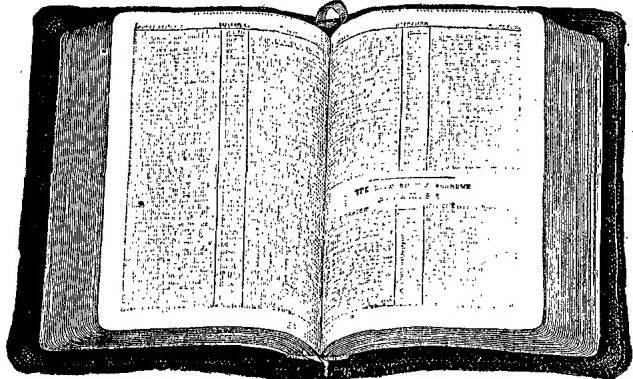
Minion type (see specimen page), bound in extra Morocco leather, divinity circuit, extra grained leather lining to edge, round corners, red under gold edges, silk sewed, silk headband, silk marker, binding of the best quality.
REGULAR PRICE, $4.00
REGULAR PRICE, $4.00
OUR PREMIUM BIBLE
CLOSED.
WITH SENTINEL, ONE YEAR $3.00
With this book reading is made easy. No more stumbling over the hard words. All proper names are divided into syllables, and the accent and diacritical marks render their accurate pronunciation a simple matter. With a little study of the Key to Pronunciation to be found in every copy of this Bible, the reader loses all fear of the long, hard names of Scripture, and pronounces them with ease.
As is indicated by the name, this is a teachers' Bible. It contains seventeen maps, thirty-six illustrations and diagrams, copious helps of the latest revision, Word Book (concordance), and numerous other features, many of which are not found in any other Bible.
It is only by special arrangement with the publishers of this Bible that we are able to make this
UNPRECEDENTED OFFER.
Remember, the price of this Bible is $4.00. ANYONE SENDING US $3.00 AND THE NAME OF A NEW SUBSCRIBER WILL RECEIVE THIS BIBLE POSTPAID.The BIBLE may be sent to one address, the SENTINEL to another.
Or WE WILL GIVE ONE OF THESE SUPERB BIBLES for seven new names at the regular subscription price, $7.00.
For 25 cents extra we will mark on the Bible in gold letters any name desired.
Address all orders to AMERICAN SENTINEL,
39 Bond Street, New York City.
Barber Sunday-Law Decision and Religious Legislation
COMMENTING on the Barber Sunday-law decision in the Appellate Court of this State, the New York Observer, of February 13, says: “The sabbath-loving portion of the community will welcome this decision. The outward and public observance of the sabbath is a matter concerning which the State has something to say, and is likely to be so regarded for some time to come.” As the reader will observe, this language is in harmony with what is said of this decision on page 60, viz., that it gives legal support to a religious institution—the Sunday-sabbath—and affords satisfaction to believers in that institution, contrary to the wishes and belief of other classes of the people. It plainly justifies the SENTINEL’s frequent references to Sunday laws as religious legislation. There is no institution more thoroughly religious in its nature than the Sabbath.
National Reform Lists Sabbatarians Among Enemies of Amendment
THE Christian Reformer calls attention to resolutions passed at the recent National Free Thought Congress against the so-called “Christian” amendment, and intimates that all Christians who do not indorse the amendment are allies to the infidels. This is not at all strange since such tactics are quite characteristic of the “Reform” movement. In a convention held in this city in 1873, Jonathan Edwards, D. D., then prominent in National Reform councils, in classifying those whom he considered enemies to the National Reform cause, said:—
The atheist is a man who denies the being of God and future life. To him mind and matter are the same; and time is the be-all and end-all of consciousness and of character.
The deist admits God, but denies that he has any such control over human affairs as we call providence, or that he ever manifests himself and his will in a revelation.
The Jew admits God, providence, and revelation, but rejects the entire scheme of gospel redemption by Jesus Christ as sheer imagination, or—worse—sheer imposture.
The Seventh-day Baptists believe in God and Christianity, and are conjoined with the other members of this class by the accident of differing with the mass of Christians upon the question of what precise day of the week shall be observed as holy.
These all are, for the occasion, and as far as our Amendment is concerned, one class. They use the same arguments and the same tactics against us. They must be counted together, which we very much regret, but which we cannot help. The first-named is the leader in the discontent and the outcry—the atheist, to whom nothing is higher or more sacred than man, and nothing survives the tomb. It is his class. Its labors are almost wholly in his interest; its success would be almost wholly his triumph. The rest are adjuncts to him in this contest. They must be named from him; they must be treated as for this question, one party.
The truth is, however, that nobody is so far from infidelity and atheism as the man who recognizes the existence of inalienable rights; who believes that in matters of religion God is supreme, and that every man should be left free to render to God that service which the Creator requires of every man. “For he that cometh to God must believe that he is, and that he is a rewarder of them that diligently seek him;” and he who worships God “must worship him in spirit and in truth,” not by compulsion.
Primarily, infidelity means unfaithfulness, and who is so unfaithful as those who deny the power of God, and who show their lack of faith in God by appealing to civil authority for the accomplishment of those things which God has reserved in his own power?
Sunday Afternoon Concerts Suppressed in Pittsburg
SUNDAY-AFTERNOON concerts have recently been suppressed in Pittsburg, Pennsylvania.
Mrs. Cleveland and the Woman's Sabbath Alliance
It is stated that Mrs. Cleveland is a member of the Woman’s Sabbath Alliance of the District of Columbia, the organization referred to in our Washington correspondence last week, having for one of its objects the securing of a Sunday law for the district.
Sunday Opening of London Museums and Institutions
A RECENT Associated Press dispatch from London, says: “An interesting step towards the Sunday opening of museums and other public institutions in England is the decision of the Corporation of London to open the next Guildhall picture exhibition on Sunday.”
The Sunday-Closing Crusade Reaches Brooklyn
THE Sunday-closing crusade, so vigorously pushed for some months past in this city, has reached Brooklyn. At present it is confined chiefly to saloons. It will doubtless, however, soon be extended to bake-shops and other equally harmless and even necessary things.
Rev. Hiscox Denounces Sunday Law Persecution
By Editor
REV. E. T. HISCOX, D. D., of Mount Vernon, this State, had a ringing article recently in the Christian Index, denouncing, as religious persecution the prosecution of Seventh-day Adventists and Seventh-day Baptists for Sunday labor. We will print it next week. It ought to have a wide circulation among Baptists.
Christian Statesman Reports National Reform Activity in 1895
THE Christian Statesman reports for the closing months of 1895, fifty National Reform meetings; scores of sermons; two conventions; and the dissemination of a large amount of literature. The editor of the Statesman challenges any organization to show any greater amount of work accomplished with the same expenditure of means.
Clerical Civil Government
By Editor
WE trust that no one will hesitate to read the article, “Clerical Civil Government,” on page 60, because of its length. It fairly bristles with facts most pertinent just now, in view of the persistent assault of the National Reformers, so-called, upon our American system of government. Read it, and ask your friends to do the same.