Your ShelfYour Projects

Review and Herald, Vol. 75, No. 46.

THE KING IN HIS BEAUTY

Review and Herald

Nov 15, 1898

Seventh-day Adventist Publishing Association · Battle Creek, Mich. · Nov 15, 1898

THE KING IN HIS BEAUTY.

R. F. COTTRELL.
The King in his beauty is coming, erelong; Prepare ye, prepare ye to meet him, To share in his glory, and sing the new song;— Who, who, will thus joyously greet him? Then wake thee, and haste to arise; Already the day-star is beaming; Let slumber depart from thine eyes,— No time now for indolent dreaming. O get ready The King in his beauty to see!
He comes not an infant in Bethlehem born, He comes not to lie in a manger; He comes not again to be treated with scorn, He comes not a shelterless stranger; He comes not to Gethsemane, To weep and sweat blood in the garden; He comes not to die on the tree, To purchase for rebels a pardon. O no! Glory, Bright glory, environs him now!
With chariots celestial behold him descend, With glory ineffable beaming; And all the blest angels around him attend, In heaven’s bright panoply gleaming. The trumpet of God sounds, Arise! The dead now awake from their slumber, And straightway mount up to the skies,— A multitude no man can number. Shouts of Glory! And Victory! now fill the air.
And now, safely standing upon the glass sea, They form the triumphal procession, To celebrate duly the grand jubilee Of captives now freed from oppression. Then lift up your heads, O ye gates! The King in his glory will enter; His army, victorious, awaits Fair Zion’s redeemed to present her. Ope, ye portals! The King in his glory comes in!
Earth’s captives, now rescued, will sorrow no more, Nor hunger nor thirst shall annoy them; No pain shall afflict them, their sufferings are o’er, No sickness nor death shall destroy them: But freed from mortality’s woes, Eternity opens before them; Its pleasures are never to close, God’s glory forever beams o’er them. Glory! glory! The King in his beauty is there!

CHRIST'S ATTITUDE TOWARD THE LAW.

MRS. E. G. WHITE.
The great plan of redemption was laid before the foundation of the world. Christ did not stand alone in this wondrous undertaking for the ransom of man. In the councils of heaven, before the world was created, the Father and the Son covenanted together that if man proved disloyal to God, Christ, one with the Father, would take the place of the transgressor, and suffer the penalty of justice that must fall upon him. “God so loved the world, that he gave his only begotten Son, that whosoever believeth in him should not perish, but have everlasting life.” What a price was this for heaven to pay to ransom the transgressor of the law of Jehovah!
Christ did not come to change the Sabbath of the fourth commandment; he did not come to weaken or set aside the law of God in one particular: he came to express in his own person the love of God, and to vindicate every precept of the holy law. Instead of abrogating the law to meet man in his fallen condition, Christ maintained its sacred dignity.
The Lord does not save sinners by abrogating his law, the foundation of his government in heaven and earth. God is a judge, the guardian of justice. The transgression of his law in a single instance, in the smallest particular, is sin. God can not dispense with his law, he can not do away with its smallest item, in order to pardon sin. The justice, the moral excellence, of the law must be maintained and vindicated before the heavenly universe. And that holy law could not be maintained at any smaller price than the death of the Son of God.
Christ bore sin in man's behalf, that the sinner might have another trial, with all its opportunities and advantages. “Whosoever committeth sin,” says John, “transgresseth also the law: for sin is the transgression of the law. And ye know that he was manifested to take away our sins; and in him is no sin. Whosoever abideth in him sinneth not: whosoever sinneth hath not seen him, neither known him.”
When Christ gave the sermon on the mount, the Pharisees were present, watching every word. The Saviour read their hearts; he knew that they were bracing themselves to resist light. Their prejudice against him was strengthening. They were saying in their hearts, “He is doing away the law. We will have no such teaching.” But while they were bottling up their wrath, there fell on their startled ears the answer to their unspoken thought: “Think not that I am come to destroy the law, or the prophets: I am not come to destroy, but to fulfil. For verily I say unto you, Till heaven and earth pass, one jot or one tittle shall in no wise pass from the law, till all be fulfilled. Whosoever therefore shall break one of these least commandments, and shall teach men so, he shall be called the least in the kingdom of heaven; but whosoever shall do and teach them, the same shall be called great in the kingdom of heaven.”
This is the judgment pronounced in the kingdom of heaven. Some have thought that the commandment-breaker will be there, but will occupy the lowest place. This is a mistake. Sinners will never enter the abode of bliss. The commandment-breaker, and all who unite with him in teaching that it makes no difference whether men break or observe the divine law, will by the universe of heaven be called least among the human agencies. For not only have they been disloyal themselves, but they have taught others to break the law of God. Christ pronounces judgment upon those who claim to have a knowledge of the law, but who, by precept and example, lead souls into confusion and darkness. They are teaching for doctrines the commandments of men, and making void the law of God through their traditions. “For I say unto you [my disciples], That except your righteousness shall exceed the righteousness of the scribes and Pharisees, ye shall in no case enter into the kingdom of heaven.”
“Till heaven and earth pass, one jot or one tittle shall in no wise pass from the law, till all be fulfilled.” As long as heaven and earth remain, not one jot nor tittle shall pass from the law. As long as the canopy of heaven is above our heads, and the earth beneath our feet, there should be no argument nor controversy over this question. Until the heavens and the earth remove, you may be sure that the law of Jehovah will hold its exalted place.
“Then cometh Jesus from Galilee to Jordan unto John, to be baptized of him. But John forbade him, saying, I have need to be baptized of thee, and comest thou to me? And Jesus answering said unto him, Suffer it to be so now: for thus it becometh us to fulfil all righteousness.” In “fulfilling” all righteousness, Christ did not bring all righteousness to an end. He fulfilled all the requirements of God in repentance, faith, and baptism, the steps of grace in genuine conversion. He did this as an example, that we should follow in his steps. In his humanity, Christ filled up the measure of the law's requirements. And this he did as an example to us. He was the head of humanity, its substitute and surety. Human beings, by uniting their weakness to the strength of his divine nature, may become partakers of his character.
Satan will use every subtle argument to deceive men and women as he did in Eden to deceive Adam and Eve. “Yea, hath God said, Ye shall not eat of every tree of the garden?” Satan said to Eve. “And the woman said unto the serpent, We may eat of the fruit of the tree of the garden: but of the fruit of the tree which is in the midst of the garden, God hath said, Ye shall not eat of it, neither shall ye touch it, lest ye die. And the serpent said unto the woman, Ye shall not surely die: for God doth know that in the day ye eat thereof, then your eyes shall be opened, and ye shall be as gods, knowing good and evil.”
Adam and Eve both ate of the fruit, and obtained a knowledge which, had they obeyed God, they would never have had,—an experience in disobedience and disloyalty to God,—the knowledge that they were naked. The garment of innocence, a covering from God, which surrounded them, departed; and they supplied the place of this heavenly garment by sewing together fig-leaves for aprons.
This is the covering that the transgressors of the law of God have used since the days of Adam and Eve's disobedience. They have sewed together fig-leaves to cover their nakedness, caused by transgression. The fig-leaves represent the arguments used to cover disobedience. When the Lord calls the attention of men and women to the truth, the making of fig-leaves into aprons will be begun, to hide the nakedness of the soul. But the nakedness of the sinner is not covered. All the arguments pieced together by all who have interested themselves in this flimsy work will come to naught.
The Lord Jesus Christ has prepared a covering, the robe of his own righteousness, that he will put on every repenting, believing soul who by faith will receive it. Said John, “Behold the Lamb of God, which taketh away the sin of the world.” Sin is the transgression of the law; but Christ died to make it possible for every man to have his sins taken away. A fig-leaf apron will never cover our nakedness. Sin must be taken away, the garment of Christ's righteousness must cover the transgressor of God's law. Then when the Lord looks upon the believing sinner, he sees, not the fig-leaves covering him, but his own robe of righteousness, which is perfect obedience to the law of Jehovah.
Christ came to give an example of the perfect conformity to the law of God required of all, from Adam, the first man, down to the last man who shall live on the earth. He declared that his mission was not to destroy the law, but to fulfil it in perfect and entire obedience. In this way he magnified the law, and made it honorable. In his life he revealed its spiritual nature. In the sight of heavenly beings, of worlds unfallen, and of a disobedient, unthankful, unholy world, he fulfilled the far-reaching principles of the law. He came to demonstrate the fact that humanity, allied by living faith to divinity, can keep all the commandments of God. He came to make plain the immutable character of the law, to declare that disobedience and transgression can never be rewarded with eternal life. He came as a man to humanity, that humanity might touch humanity, while divinity laid hold upon the throne of God. But in no case did he come to lessen the obligation of men to be perfectly obedient. He did not destroy the validity of the Old Testament Scriptures. He fulfilled that which was predicted by God himself. He came, not to set men free from that law, but to open a way whereby they might obey that law, and teach others to do the same.

THE CHRISTIAN INCARNATION.

This idea of incarnation is the central doctrine of all Paul's teaching. It is his remedy for sin, his basis of hope for the past and the future. As God was in Christ, so Christ, by the Holy Spirit, will be in his people, changing their hearts, transforming their lives, and making them fit for the very presence of God.
How far-reaching this idea is, may be realized by a little consideration. If God is present in any soul, there must be power. No temptation can successfully assail the citadel where he is. There must also be power for service. The man in whom God dwells must be irresistible when he takes his place in the army of Christ's followers. There will also be peace in the soul when God is there. The lower nature will be subject to the higher, rebellion will cease, and the rule of God will be supreme. No more struggles, no more self-reproach, no more internal strife, but a sweet peace, which comes from being in accord with our Maker.
There will also be progress. The whole idea of sanctification is not revealed at conversion. As the conscience becomes more active, more tender, more quick-sighted, the process of sanctification goes deeper. It is not sufficient to refrain from sins of action and word; sins of thought become odious. Sinful desires must not be held in check; they must be cast out. The memory has to be purged, imagination has to be purified. With Christ in the heart, the whole nature is gradually brought under his sway until it is attuned to his spirit. We become, not so much his followers as his very impersonations. Our words and acts are his; and as he was, so are we in this world.
How is it that this delightful conception is not realized in every Christian? A hint of the reason is given by Paul in 1 Cor. 3: 16–23. The temple of God is holy. But the temple may be defiled; the beneficent power may be resisted; there may be a lack of docility. A leaning to our own way, a dependence on our own powers, a hungering for old gratifications, may thwart God's will in us; for it is very gentle, and will force no man into the way of life. To get the full benefit of his presence, there must be not only submission, but cheerful acquiescence and a working together with him for our own salvation. This is the secret of success or failure.—Signs of the Times.

LIGHT AND THE GOODNESS OF GOD.

L. A. REED.
LET me summarize what was said in my last article. White light is emitted by ignited solid matter; while burning gas, though the gas may have been derived from a solid, gives but little light. In order for light to emanate, the solid must burn as a solid, and be heated white-hot, for at least a moment before it is turned into gas and consumed. The flame of pure hydrogen gives very little light, because there are no solid particles in it. From the wax, tallow, or paraffin, a gas, composed of hydrogen and carbon, is formed by the heat of the burning wick; the hydrogen, in this composite gas unites with the oxygen of the air a trifle sooner than does the carbon; the carbon has so strong a tendency to return to its solid form that the instant it is released by the hydrogen, it is left in the flame in the form of fine charcoal dust. This dust, being heated white-hot in the flame, gives forth the light.
God himself is operating in the candle flame. The Creator himself is there at work, producing the beneficent result. He makes the candle shine for the evil and for the good. “Of course,” says one, “it could not be otherwise: the candle is as willing to shine for the unjust as for the just.” But, my friend, there is no “of course” about it; it could be otherwise. It is true that the candle cares not for whom it shines; but the candle is only the instrument, the servant, which God uses; and God could make the candle shine for one and not for another. But he makes it shine for the evil and for the good, even as he “maketh the sun to rise on the evil and on the good, and sendeth rain on the just and on the unjust.” All this is as God wills it, and it is ever what he wills it, and it is never anything but that which he wills it.
Some have an idea that the candle is a machine of some sort, set going once and for all, and that it continues to run with this inherent energy with which it was originally endowed. But the candle does nothing; God does it all. In the candle are manifested the power and intelligent presence of God himself. “Many, [are you one of them?] teach that matter possesses vital power, . . . that certain properties are imparted to matter, and it is then left to act through its own inherent energy. . . . This is false science, and is not sustained by the word of God. Nature is the servant of her Creator. . . . There is in nature the continual working of the Father and the Son. . . . His energy is still exerted in upholding the objects of his creation. It is not because the mechanism that has once been set in motion continues to act by its own inherent energy.”
“Those who dwell on the laws of matter and the laws of nature, in following their own limited, finite understanding, lose sight of, if they do not deny, the continual and direct agency of God.” Do you deny the continual agency of God in the work of the candle flame? do you deny or lose sight of his direct agency in that work? or do you see and ever keep in mind that God is the continual and direct agent in it all? “There is, with many, a marked distinction between natural and supernatural. The natural is ascribed to ordinary causes, unconnected with the interference of God. . . . Matter is supposed to be placed in certain relations, and left to act from fixed laws; . . . nature is [supposed to be] endowed with certain properties, and placed subject to laws, and left to itself to obey these laws, and perform the work originally commanded. This is false science; there is nothing in the word of God to sustain it. . . . They [the laws] are not self-working.”
“God is perpetually at work in nature. She is his servant, directed as he pleases. Nature in her work testifies of the intelligent presence and active agency of a Being who moves in all his works according to his will.”—Special Testimony, published in Daily Bulletin, Lincoln, Neb., Feb. 18, 1897.
Then it is not forces inherent in oxygen, hydrogen, and carbon which give us the light of the candle; but it is God, the God perpetually at work in nature, who works in the candle flame. And in this work going on in the flame, God is simply using these elements as his servants. The fire in its work, even as the other operations of nature, “testifies of the intelligent presence and active agency of a Being who moves . . . according to his will.”
God himself adjusts the attractive forces operating between the different elements, so that the hydrogen and the oxygen unite a fraction of a second before the carbon. If the Creator should give the oxygen and the carbon a slightly greater affinity for each other than they have at present, the carbon would be burned when first turned into gas; that is, the carbon and the hydrogen would burn simultaneously, and the flame would be slightly luminous, because there would be no charcoal dust left for an instant in the flame to radiate light. But on the other hand, if oxygen had less affinity for carbon than it has at present, the carbon dust would collect in the flame faster than it could be burned, and would escape in clouds of black soot.
During a period of time so short that it is entirely imperceptible to our unaided senses, the solid particles of charcoal are set free, are heated white-hot, and radiate, perhaps, but one wave of light; the next instant they, too, “rush into combination with the great fire element, and not a particle is left to dim the transparency of the air. The smallest variation in either force would destroy the adjustment by which this result is produced, and our lamps and candles would cease to give their light.” But these forces never vary from age to age, because back of the force is the unchangeable God. The candle gives its light to-day, just as it gave it ages ago, not because it is subject to mechanical contrivance, but because with the Creator, whose work it is, there “is no variableness, neither shadow of turning.”
Yes, God makes the candle shine for the evil and for the good; he makes the sun rise on the evil and on the good, and sends rain on the just and on the unjust. If you are a sinner, this goodness of his should lead you to repentance. Or if you claim to be already a child of his, it should lead you to “love your enemies, bless them that curse you, do good to them that hate you, and pray for them which despitefully use you, and persecute you; that ye may be the children of your Father which is in heaven: for he maketh his sun to rise on the evil and on the good, and sendeth rain on the just and on the unjust.” Thus the goodness of God revealed in nature, in sun and rain, in grass and flowers, yea, in the candle flame, should lead us to repentance.
But we must see God’s goodness there before it can so lead us.

A CYCLONE IN NEW YORK STATE.

Scientific American.
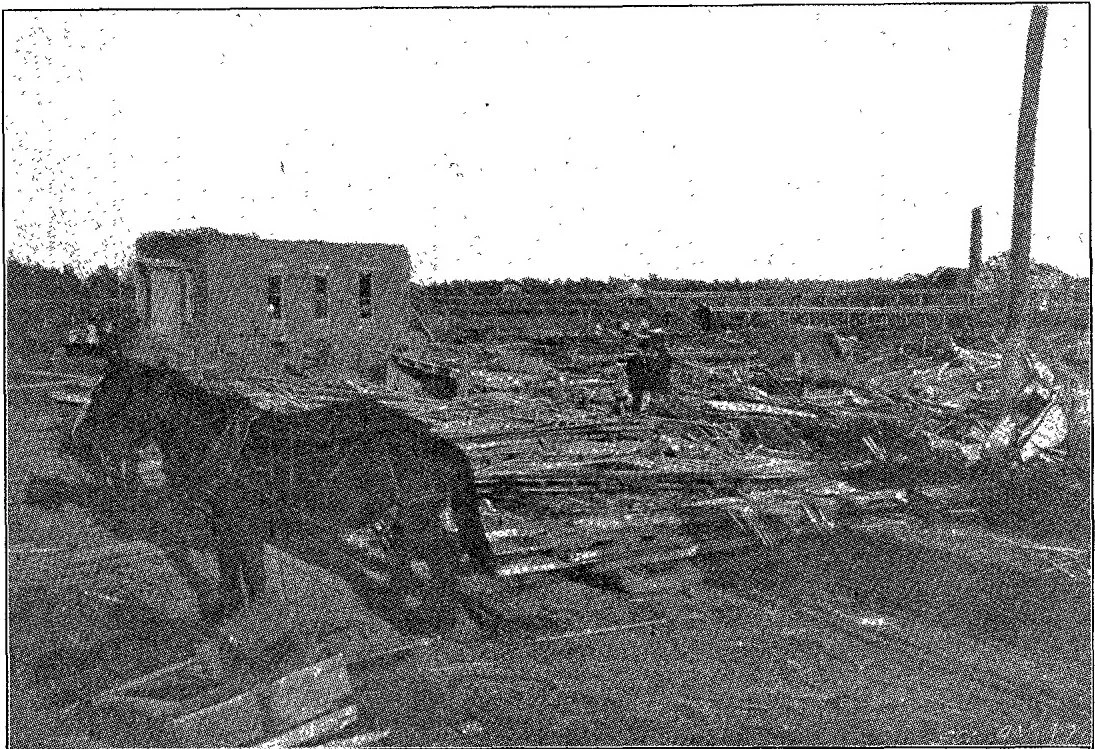
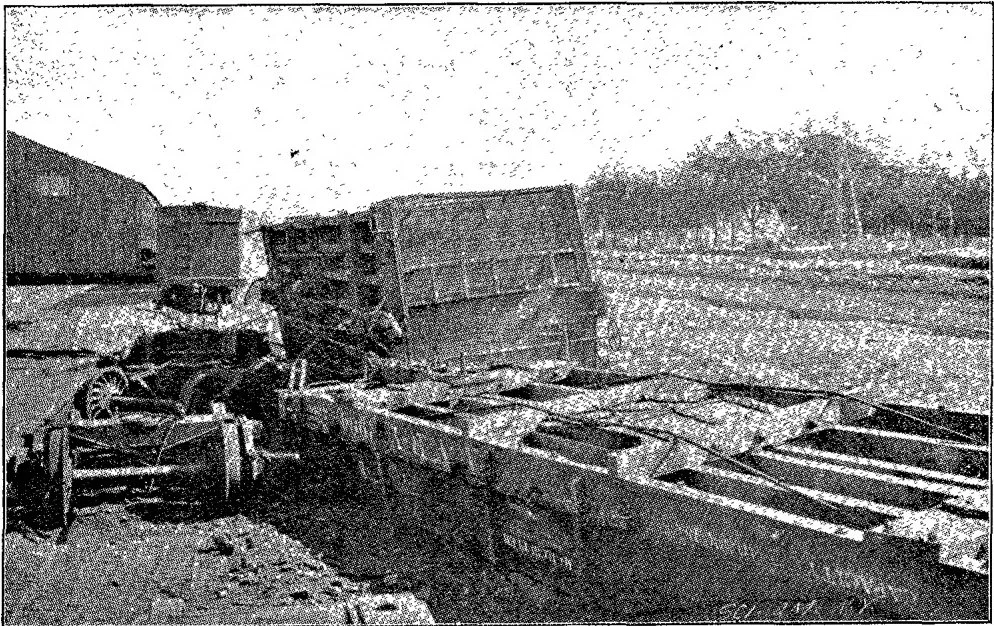
A cyclone is a horror that we are apt to consider indigenous to the West, as far as this country is concerned. Fortunately, in the East we rarely suffer from such manifestations of the power of wind; but on September 26 a funnel-shaped cloud appeared out of Lake Ontario a little before 4 P. M., and gathering force as it came from the lake, swept over the Niagara peninsula from northwest to southeast. Running parallel to the Welland Canal, it cut a swath fully three hundred feet wide from lake to lake, and did an incredible amount of damage, killing five people and injuring many others. The section of country involved includes Tonawanda, in New York State, and Merritton, in Ontario, Canada, where the damage was the greatest. In Tonawanda the tornado demolished houses, uprooted trees, overturned freight-cars, and swept a clean path several hundred feet wide for a distance of ten miles. Our engraving shows some of the wrecked freight-cars at Tonawanda, showing how box- and coal-cars were wrenched from their trucks and thrown off. Tonawanda is the great center of the lumber industry, and the damage to the lightly constructed wooden buildings was naturally considerable. Thousands of feet of pine were swept into the river. After passing over Tonawanda, the tornado took a southeasterly course, and visited small towns farther on. While crossing from Grand Island to the main shore, the tornado formed a waterspout fifty feet high in Niagara River. As it swept east, it destroyed buildings right and left; thousands of telegraph-poles were demolished.
As already stated, Merritton was the greatest sufferer by the cyclone. It is a manufacturing town, one and one-half miles from St. Catharines, Canada, on the Welland Canal. There are two large paper-mills and a cotton-mill there. The two buildings of the Lincoln paper-mill were destroyed. The roof was picked up, the walls were smashed in, and the heavy machinery went tumbling through the floor. Eighty employees were at work, and it was a miracle that only one person was killed. Over $150,000 worth of damage was done to the two buildings of the paper-mill. The ward schoolhouse, containing seventy-five pupils, was overthrown; one girl was killed, and a score were badly injured. Twenty children were injured in another schoolhouse. “Orange Hall,” the local home of the Orangemen, was razed to the ground.
By permission of the “Scientific American.” THE WORK OF THE CYCLONE AT MERRITTON, CANADA.
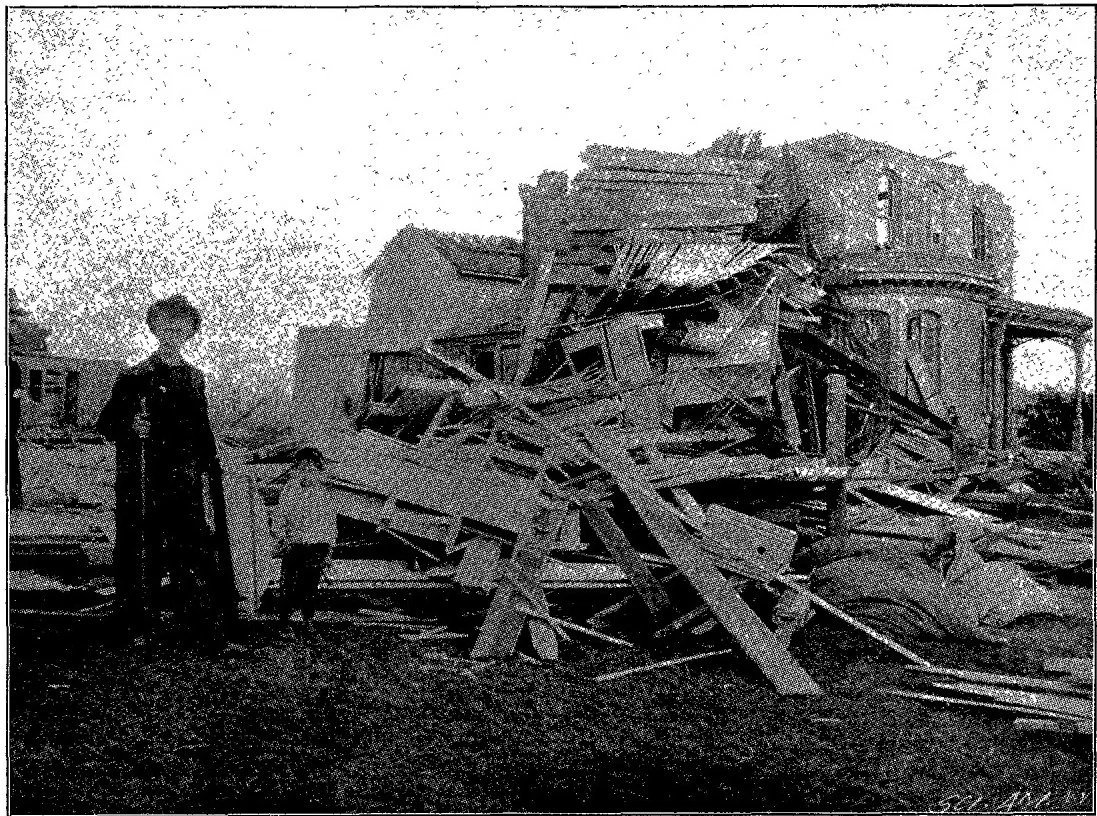
Our engraving shows the terrible destruction of the cyclone. In front are the ruins of Orange Hall, the schoolhouse where the child was killed is in the background to the left, and the chimney of the Lincoln paper-mill is shown to the right. In the picture of the house of John Gardner is shown the cyclone’s power, which in a moment turned a substantial house into kindling-wood, and also wrecked a brick house.
The Presbyterian church was completely destroyed. The spire of the Episcopal church was torn down, and the power-house of the Acetylene Gas Company was also wrecked. In all, twenty buildings at Merritton were destroyed, and it is thought the loss will be fully $225,000.
The cloud took a zigzag course through the town near the paper-mill, where there were several cars loaded with paper. They were tossed into the mill-race, and the air was filled with flying paper. Some bits were picked up five miles from Merritton. At Grantham the storm played several tricks. One house was blown down, and a red-hot stove was picked up and carried across the road. A baker’s wagon at Merritton was picked up, and the boy driving it was carried sixty feet and deposited in the street. St. Catharines also suffered greatly. The cyclone lasted but five minutes at Merritton, and its approach was watched by many of the townspeople.
By permission of the “Scientific American.”
HOUSE COMPLETELY WRECKED BY THE CYCLONE AT MERRITTON, CANADA.
By permission of the “Scientific American.” HOUSE COMPLETELY WRECKED BY THE CYCLONE AT MERRITTON, CANADA.
Outside the tornado belt, the sun was shining brightly. A cyclone of this nature has never before been known in this region. The cloud, its appearance, and its method of working, as well as the devastation that it wrought, are all identical with the cyclone of the West.

“SPIRITUALISM EXPOSED.”

A. S. WRIGHT.
(Battle Creek, Mich.)
“WONDERFUL exposures” of Spiritualism are exciting some interest in this city at present; and while we do not at all impugn the motives of those making the exposures, the important question comes to us, What will be the effect of such a work?
We know that Spiritualism is altogether deceptive. But we know that while in many instances its deceptions are carried on by means within the natural powers of man, it also presents phenomena that are altogether beyond human control, and hence can not be explained on any such basis. We know this by the word of God, without studying its workings. And we know, further, by that prophetic Word, that the time is now ripe for this crowning deception to display greater power than it has yet shown.
Then what can be the effect, upon those who are ignorant of its character, of teaching that Spiritualism is only a first-class sleight-of-hand performance?—Plainly, it can not fail to make them want to see it for themselves. For a well-conducted sleight-of-hand performance will draw and entertain the most intelligent people in any community. And to those unacquainted with, or unmindful of, the word of God, this investigation means deception just as surely as “seeing is believing” to the man who has not faith.
God warned man faithfully against investigating the power of evil when he said of that fateful tree of which Spiritualism is a poisonous leaf: “In the day that thou eatest thereof thou shalt surely die.” But the arch-deceiver said: “‘Ye shall not surely die.’ God is afraid you will know as much as he knows. Investigate.” Eve investigated. The result of her researches ought to be enough for us.
God’s word is truth. That which rests upon a denial of a plain statement of his word is a lie, and needs no investigation by the man who believes God. Let us, in the name of the Lord, warn men not to investigate Spiritualism in any other way than in the word of God.

Washington Morse's Recollections of the Advent Movement

FROM AN AGED PIONEER.
The following is from our aged brother, Washington Morse, who had a thrilling experience in the Advent movement of 1844, and was one of the first to accept the advanced light of the third message respecting the cleansing of the sanctuary and associated truths:—
“As we drew near the 22d day of October, 1898, I was made happy in calling to mind the scenes that took place fifty-four years ago, at the ending of the prophetic period when the investigative judgment began in heaven; and still further back, even to 1833, when Elder Wm. Miller gave his first lectures. In 1834 I had the privilege of hearing him give two courses of lectures, one in Brookfield, and the other in Braintree, Vt. In 1840 Elder J. V. Himes issued the first paper, called the Signs of the Times, concerning the second coming of Christ. From this time on, the message, ‘Fear God, and give glory to him,’ greatly increased in power. In July, 1840, Brethren Himes and Miller came to Rochester, N. Y. There they preached that we were in the little while between the second and third woes. Brother Miller said that that was the Scriptural and safe ground to occupy.
“Pen can not describe the trying scenes through which we passed from that time until March, 1850. Elder Joseph Bates came to my house, in Corinth, Vt., and brought us the light on the third angel’s message. At that time I, with my family, began to observe the Bible Sabbath. In the spring of 1852 a Conference of Seventh-day Adventists was held at Jesse Thompson’s, twelve miles from Saratoga Springs, N. Y., to consider the feasibility of having a hand-press of our own on which to print the REVIEW AND HERALD, with other matter. I, with about seventy-five others, was present. Six hundred dollars was raised to purchase and equip an office, and it was voted to establish it at Rochester, N. Y. The first number of Vol. III was issued from the newly equipped office, May 6, 1852.
“When I was last in Battle Creek, I had the pleasure of seeing the old press that was purchased for beginning the work in Rochester. It stands in one of the composing-rooms of the spacious office there, and is in daily use as a proof-press. Proofs of each page of the Review, also of other papers, are taken on it before the ‘forms’ are printed on the large presses in the press-room below.
“As I stood looking at that old press, many long-forgotten memories were revived. I remember the words of Elder White when it was decided to purchase it. He said, ‘I think this press will last us until our work is done.’ We then thought that that printing outfit would be sufficient to carry on the printing business until the end of time. Now we can see that our view of the magnitude of the work was very circumscribed. I suppose that in all our publishing houses in different parts of the world there are fifty presses now in use, many of which have from sixty- to seventy-fold greater capacity than the one first purchased. Marvelous things have been accomplished in the forty-six years since that time.
“Now here we are at the fifty-fourth anniversary of the ending of all the prophetic periods; and in Dan. 12: 13 a blessing is pronounced upon those who wait, and come to the end of the thirteen hundred and thirty-five days. This period began A. D. 508 and ended in 1843; and the blessing has reference to the increase of knowledge, and marks the full beginning of a work which is to continue unbroken till the Lord comes. The three messages of Rev. 14: 6-12 constitute this work. These messages are inseparable, and all together form the last threefold message. The essential work of these messages is told in plain language; it is a warning of the judgment hour, the fall of Babylon, and the worship of the beast and his image. Now, how can any one receive the fulness of the blessing pronounced under this light without understanding the messages in their fullest extent? The thing which the angels desire to look into is the unfolding of God’s word since the time of the blessing promised in 1843.”
FREIGHT-CARS WRECKED BY THE CYCLONE AT TONAWANDA, N. Y.

NO MORE CHURCH TRIALS.

C. J. HERMAN.
(Antigo, Wis.)
When every member of the church becomes a worker for the salvation of souls, there will be no church trials; for the brethren will fight sin instead of sinners. They will use the weapons which “are not carnal, but mighty through God to the pulling down of strongholds; casting down imaginations, and every high thing that exalteth itself against the knowledge of God, and bringing into captivity every thought to the obedience of Christ.” 2 Cor. 10:4, 5.
Christ’s servants do not fight sinners; for Jesus says, “My kingdom is not of this world: if my kingdom were of this world, then would my servants fight.” John 18:36. In Eph. 6:12 we read: “For we wrestle not against flesh and blood [or sinners], but against principalities, against powers, against the rulers of the darkness of this world, against spiritual wickedness [or wicked spirits] in high places.” The feet of God’s soldiers are to be shod with the preparation of the gospel of peace. “How beautiful upon the mountains are the feet of him that bringeth good tidings, that publisheth peace; that bringeth good tidings of good, that publisheth salvation; that saith unto Zion, Thy God reigneth!” Isa. 52:7.
Where God reigns, there is peace. Sin has made this world full of woe and trouble; for this cause came Jesus into this world to bring tidings of peace. When the angels heralded the Saviour’s presence in the world, they proclaimed, “Glory to God in the highest, and on earth peace, good will toward men.” Luke 2:14. God sent Jesus to bring tidings of peace to sinners. He says, “Peace be unto you.” We are to bring this message to sinners, even to those who are trying to harm us; for, said Jesus, “As my Father hath sent me, even so send I you.” John 20:21. These words make our mission to the world very plain; we are not to sit idle, but are to bring the message of peace to those in trouble.
What a privilege to carry the message of pardon to the transgressors of God’s holy law, to point them to him who will give them power to become the sons of God! We all need this power to keep us out of trouble, and to insure peace of soul. “O that thou hadst hearkened to my commandments! then had thy peace been as a river, and thy righteousness as the waves of the sea;” “great peace have they which love thy law: and nothing shall offend them.”
To receive Jesus is to receive this peace; for he gives to sinners the power to become the sons of God. “If any man serve me, let him follow me; and where I am, there shall also my servant be.” We are all to engage in the work in which Jesus was engaged when he was on this earth; and that means to live as he lived, to talk as he talked, and to walk as he walked.
“Peace be unto you.”
To carry this message by might or by power is to use carnal weapons, which would be fighting sinners instead of sin. The Lord says, “Not by might, nor by power, but by my Spirit, saith the Lord of hosts.”

Secret Prayer Is Most Apt to Be Genuine

“SECRET prayer is most apt to be genuine.”
Continue reading: GOOD FORM