The Youth’s Instructor, Vol. 66, No. 25.

Miscellaneous News Items on Science and Affairs

The Youth’s Instructor

Jun 18, 1918

Review and Herald Publishing Assn. · Takoma Park Station, Washington, D. C. · Jun 18, 1918

Miscellaneous News Items on Science and Affairs

In the single State of New York fifty-five thousand long-unclaimed bank accounts are reported.
It is reported that England has saved 300,000 tons of coal and France $10,000,000 worth by “saving daylight.”
On May 15, the first aerial delivery of New York mail in the city of Washington, D. C., was made, after a flight of three hours and five minutes.
During 1917 approximately 7,000,000 men, 500,000 animals, 200,000 vehicles, and 9,500,000 tons of stores were conveyed from England to the various fronts.
If all the locomotives employed on United States railroads were placed on four parallel tracks, they would form a line three hundred eighty-five miles in length.
Walking in a thunder storm under an umbrella with the modern metal rod is now said to be about the most dangerous of practices, since the metal is an almost certain conductor of electricity.
Columbus discovered the hammock as well as America. In San Salvador he found the natives sleeping in what they called hamacs, and Columbus bought several and so introduced the hammock.
Switzerland is considering the feasibility of adopting the twenty-four-hour clock which has already been tried in several European countries. This system does away with any confusion of A. M. and P. M.
Senator Kenyon, of Iowa, introduced a resolution under which all obligations of France to the United States for moneys borrowed or funds advanced since the beginning of this war, including interest, would be canceled.
Governor Whitman signed a bill requiring boys between sixteen and nineteen years of age to attend drill and perform military duties. Compliance with the requirements of the new law entitles the youth to a certificate, without which he cannot attend public or private school or obtain employment.
The smallest church in the world stands on the roof of the St. Lawrence Hospital in New York City. It will hold just forty persons, and in four long steps one can cover the distance from the entrance to the altar. It was built for the convenience of patients in the hospital and of the hospital employees.
The first ambulance for wounded soldiers was introduced on the battlefield by Larret, a French surgeon, in 1792. The British Army did not use them until 1857, after the Crimean War, and Congress did not establish a uniform system of ambulance service in the United States until March 11, 1864, when the Civil War was nearly three quarters over.
Dr. B. J. Cigrand, writing in the New York Times, says that the historical painting, “Washington Crossing the Delaware,” which is the work of Emmanuel Leutze, a German-born American citizen, was actually painted on the banks of the Rhine, and that Germans posed for the leading figures. While in Germany some years ago, he says, he visited Leutze’s old homestead at Düsseldorf. The keeper of the place informed him that Leutze came there in 1841 and shortly afterward began the painting, sitting by the Rhine for many days, studying its flow and making an outline of its banks.
The first of the big American hospital trains has been used on the French front with entire success. It is a khaki-colored train of sixteen cars made in England, equipped with an operating-room, a pharmacy, a kitchen, and ten ward cars. The cars are 57 feet long, made of steel, vestibulated, steam heated, and electric lighted. They are painted in khaki-green, with “U. S.” in red letters in the center of Maltese crosses on red background at the ends.
Shoes made of tough, coarse fibers of esparto grass are still worn in Iberia and in some parts of Portugal. They are the best wearing shoes known, one pair having the record of outwearing a dozen pairs of the hide variety. They half-sole themselves, that is, they pick up tiny pebbles in the meshes of the sole fiber, and when one pebble is worn out, another takes its place. It is not uncommon for one pair of these shoes to wear many years.
The following figures, compiled by the State Department and published in the Nation’s Business, indicate the increase in the cost of living over 1916: Italy ................................................ 65 per cent Spain ................................................ 25 “ Greece ............................................... 250 “ Switzerland .......................................... 97 “ Sweden ............................................... 225 “ Denmark .............................................. 70 “ France ............................................... 57 “ Holland .............................................. 60 “
Miss Hendrica Van der Flier, of Holland, visited Washington recently, and presented to Mrs. Wilson, the President’s wife, a gold ring which Belgian children had sent to her as a gift. Miss Van der Flier is in America for the purpose of raising a fund of $1,000,000 with which to build a garden village near Antwerp to shelter Belgian widows and orphans.
Anthracite culm mixed with about twenty per cent of soft coal makes a good smokeless fuel.

The Genesis of a Quotation

THE expression, “God tempers the wind to the shorn lamb,” occurs in “A Sentimental Journey Through France and Italy,” by Laurence Sterne, who died in 1768. Nearly two hundred years earlier Henri Estienne had written, “Dieu mesure le froid à la brebis tondue,” (God tempers the cold to the shorn sheep). It would seem that Sterne simply borrowed from Estienne. George Herbert, who died in 1632, may also have been indebted to Estienne for the same thought, which, however, he varied a little more than did Sterne. Herbert wrote: “To a close-shorn sheep, God gives wind by measure.”
C. P. BOLLMAN.

Courage

Because I hold it sinful to despond, And will not let the bitterness of life Blind me with burning tears, but look beyond Its tumult and its strife;
Because I lift my head above the mist Where the sun shines and the broad breezes blow, By every ray and every raindrop kissed That God's love doth bestow,
Think you I find no bitterness at all, No burdens to be borne like Christian's pack? Think you there are no ready tears to fall, Because I keep them back?
Why should I hug life's ills with cold reserve, To curse myself and all who love me? Nay! A thousand times more good than I deserve God gives me every day.
And in each one of these rebellious tears, Kept bravely back, he makes a rainbow shine. Grateful I take his slightest gift, no fears Nor any doubts are mine.
Dark skies must clear, and when the clouds are past, One golden day redeems a weary year; Patient I listen, sure that sweet at last Will sound his voice of cheer.
Then vex me not with chiding, let me be; I must be glad and grateful to the end. I grudge you not your cold and darkness — me The powers of light befriend. —Celia Thaxter.

Ways to Win

W. E. HOWELL
EVERY boy likes to win out in what he undertakes, and so does every girl. It is born in the blood of every normal young person to want something more than he has, to be something more than he is, and to do something more than he is doing. This is a heaven-born instinct, and if given proper direction will bear fruit in the life to the honor of its possessor and to the honor of his Creator.
One burning desire in the heart of every normal boy and girl is to obtain a good education. Never in the world's history have external circumstances combined to emphasize this desire and to magnify the need of special training as they do at the present time. No young man or woman who does not stir himself to do his very best, may hope to realize many of the laudable aims of life in these times of great opportunity.
There is no greater opportunity in the world than that of having some responsible part in the Great Advent Movement that is to finish the last work this world will ever see done. Positions of worldly honor and gain pale into insignificance in comparison with becoming a coworker with Christ and a joint heir in the great reward of eternal life just before us. The things of time are not a drop in the bucket compared with the things of eternity.

But How?

“How am I to get the education I long for?” is the question many young people are asking themselves and their neighbors. There are so many ways that it is impossible to mention all of them, but a few of the principal ones are suggested here. The youth who is really ambitious for an education will put it this way:
1. I will settle it that I am going to school, whether I see any present way of getting there or not.
2. If I cannot find a way, I will set about at once to make one.
3. I will be in dead earnest and perfectly honest in whatever way I find or make to get to school and to get through school.
4. If I don’t see just now the way I prefer, I will take advantage of the way that lies next to me.
5. I will dedicate myself and my plans to God, and keep both constantly before him.

What Are Some of These Ways?

1. I will canvass if I can learn how—and I know I can learn how, because hundreds of other boys and girls have done so. This seems to me the best way, because I am both helping to win other souls to God, and I am winning my own way through school.
2. Until I have opportunity to learn how to canvass, I will work faithfully by the day, or the hour, or the piece, at the first and most paying thing I can find—and I can find something, because every boy and girl has who went about it in earnest.
3. During my spare hours evenings and rainy days, I will study shorthand with all my might, with a teacher if I can find one, but otherwise alone, and I will try hard to get access to the use of a typewriter. I think these will help me to win my way along. I have heard that several of our denominational leaders today got their education through stenographic work.
4. The first chance I get, I will learn to keep books. My mother tells me of a neighbor’s son who took a course in bookkeeping the first year he went away from home to school, and supported himself in school the next two years by helping to keep the college books.
5. I think I will finish that nurses’ course I started last winter. I heard one of our educators say not long ago that every one of our forty boarding schools ought to have a physician or a nurse on the school staff, to look after the health of the students and the community, and to teach the students first aid and simple treatments. This is both a paying and a gospel occupation. Besides that, I understand it is one of the best qualifications for service in the mission field when one is through school.
6. I will arm myself with a lawn mower, a sharp sickle, and a rake, and do lawns at twenty-five cents to one dollar apiece in the autumn and the spring. For the winter I will arm myself with a snow shovel, and keep up my wholesome outdoor exercise while earning my way as I go.
7. I will learn how to fire a furnace economically, so as to deliver a uniform heat, and make a contract to serve a certain number of houses through the cold weather. This will give me spare time to study in a warm place between firings, and will keep my courage aglow by meeting my bills as they come due.
8. My mother says that I can cook many dishes as well as she can. During my spare hours I will study up on the latest principles of good cookery, and I see no reason why I should not assist in this delicate and wholesome art at the academy. I heard a W. C. T. U. leader say the other day that one of the highest accomplishments of the true woman is to be a first-class cook; that there is more real education in it than in the study of algebra and the piano.
9. It seems to me that Dorcas, the garment maker, must have been one of the most honorable women of New Testament times. She had the love and esteem of her neighbors, and Peter was moved to restore her to life that she might continue to accomplish her deeds of love. Why may I not develop the skill with a needle that I have often been told I possess, and turn this to good account on my education?
10. Printing is one of the greatest and most useful of modern arts. It is one of the chief ways of giving the gospel to the world. It educates both the hand and the mind; and while giving a practical experience that will be of great value in the mission field, it will help save my purse from the aching void.
In short, there are so many WAYS to WIN that I shall not delay another day in setting out for my goal—the very best education I can get in a Christian school.

Courage in the Lord

OFTEN we are hard pressed by the enemy, and sometimes we give way to discouragement. It is hard at such times to realize that the sun is shining behind the clouds. Concerning this state of mind the servant of the Lord says:
“Hope and courage are essential to perfect service in the work of God. These are the fruit of faith. Despondency is sinful and unreasonable. God is able and willing to more abundantly bestow upon his servants the strength they need for test and trial. The plans of the enemy may seem to be well laid and firmly established, but God can overthrow the strongest of these. And this he does in his own time and way, when he sees that the faith has been sufficiently tested.”
“All afflictions and trials that befall us here are permitted to work out his purposes of love toward us, that we might be partakers of his holiness, and thus become participants in the fulness of joy which is found in his presence.”
“He who is imbued with the Spirit of Christ abides in Christ. Whatever comes to him comes from the Saviour, who surrounds him with his presence. Nothing can touch him except by the Lord’s permission.”
What real comfort these words bring to the heart of the trusting believer! Then why should we be discouraged?
“God would never send you the darkness, If he thought you could bear the light; But you would not cling to his guiding hand If the way were always bright; And you would not care to walk by faith Could you always walk by sight.
“’Tis true he has many an anguish For the sorrowful heart to bear, And many a cruel thorn crown For your tired head to wear; He knows how few would reach heaven at all If pain did not guide them there.
“So he sends you blinding darkness, And the furnace of sevenfold heat; ’Tis the only way, believe me, To keep you close to his feet; For ’tis always so easy to wander When our lives are glad and sweet.
“Then nestle your hand in your Father’s, And sing, if you can, as you go; Your song may cheer some one behind you Whose courage is sinking low; And— well, if your lips do quiver, He will love you the better so.”
C. J. TOLF.

At First and Now

WHEN the war began, the people of the country were invited, even by governmental agencies, to express their interest in the soldier boys by inviting them to their homes to meals, to social entertainments, and to spend their leave. The people responded quickly and generously to this invitation. This well-meant hospitality is now regarded by the officers of the army as not only unnecessary under present conditions, but absolutely detrimental to the efficiency of the service. They therefore present the following points to the public as the result of their observation:
“FIRST: That the entertainment of the men in service in private homes has resulted to the detriment of the men instead of to their benefit. The men have been overfed, the camp officers say; they have been kept up too late; and it takes from twelve to twenty-four hours for the men to become readjusted to the sterner camp life upon their return after their entertainment in homes of comfort and plenty. Where they have been kept overnight, the men return to camp or yard long after the fixed early hour the next morning, and give as an excuse that they were allowed to oversleep, they missed their train, breakfast was unavoidably late, and so on. In other words, the plan has not worked out satisfactorily.
“SECOND: That the sending of sweets and edibles of all sorts to the men in service has been disadvantageous to the health of the men. The camp officers claim that the excellent and well-balanced meals provided are all-sufficient for the men, and that where they desire ‘extras’ they can be bought at the canteens at moderate prices.
“THIRD: That as over ninety per cent of the social functions provided for the men outside of the camps have taken the form of dances, kept up until ‘all hours,’ the physical vitality of the men is impaired and they show the results in their work.
“FOURTH: That the sending of unnecessary ‘comforts’ by overanxious mothers and wives has become a serious matter in the camps, where the men have no use or room for them; that while at the first rush the necessary needs and comforts were not all provided, they are now, and any further contributions from home find no place.
“FIFTH: That the writing of doleful letters by mothers and wives has had a seriously depressing effect on the men; that they rebel at the practice themselves, and cannot understand why the folks back home fail to comprehend that they are well cared for and contented — most of the men being better cared for and far healthier, in reality, than in their civilian lives.
“SIXTH: That the ‘godmother’ idea of women writing to boys whom they do not know and whom their fancy pictures as being lonely — which is not true — should absolutely cease, in order to stop revealed graft and deception.”
These official conclusions become an appeal to the public to lessen their efforts to provide physical comforts, delicacies, and entertainments for the soldiers; still there are ways open to all to render material aid to the comfort and well-being of the men in army service. These are:
The writing of cheery, helpful letters by members of the soldier’s family and by his personal friends; the sending of current magazines and good books; the giving of work and money to the Red Cross work; and helping your community, if you live in a center adjacent to camps, cantonments, and naval bases, to provide suitable and wholesome accommodations for the men when on leave.

A Story from India

One day while making my way as best I could through the crowded reception-room at the recent General Conference, I was accosted by a brother, who said: “I have a story that I want to tell to some of our publishing men when they have time to listen.” I replied, “I am ready to listen now.” The brother was one of our missionaries from India, and what he told me was substantially as follows:
“One day in Calcutta I received a letter from a gentleman living about fifteen miles down the Hoogly River, at a place called Fort Gloster. In the letter he stated that he and his wife were Christians, but not members of any church. He said that two years previous to this a canvasser had come to their place and had sold them Volumes 1 to 3 of the ‘Helping Hand’ series (Millennial Dawn books), and he was much interested in the subject of the millennium, and requested me to bring to him or send one of our colporteurs with Volumes 4 and 5 of the same series, as he wanted to continue the study further. I could not understand how he connected Millennial Dawnism with Seventh-day Adventism.”
“I laid the letter on my desk and kept it there for several days, and the thing kept bothering me, so a few days later I filled my bag with a number of our books and went down to visit the gentleman. I reached there about noon, and found him at home for his noon hour. We had a very interesting talk. I was careful in bringing up the subject. I was trying to find out how he connected us with those books. Finally I had to come out plainly and ask, and he told me that the canvasser from whom he purchased the books said he was a Seventh-day Adventist.”
“I had heard of this same canvasser before in India, where he had made the same claims, selling these Millennial Dawn books as Seventh-day Adventist literature. I told this man that we did not publish those books, nor did we hold the views contained in them. Then he said, ‘If you do not hold to these views, what is your position on the subject of the millennium and the coming of the Lord?’”
“My time was limited and it was nearly time for him to go to work, but I said, ‘I have several books with me that will explain all these points.’ I opened my bag and showed him ‘The Great Controversy.’ He was very much interested in it, and said, ‘I will take that book.’ I showed him ‘Daniel and the Revelation,’ giving him a brief explanation of the contents of the book. I also had a copy of ‘Heralds of the Morning,’ and told him that it dealt with the coming of the Lord. He took a copy of both books. He also purchased ‘Here and Hereafter’ and ‘Steps to Christ,’ and I gave him a large number of tracts that I had with me. Altogether I sold him about twelve dollars’ worth of books, and before leaving I promised to keep in touch with him by correspondence.
“Later on I visited him again. We had a pleasant visit and also a good Bible study. Then he and his wife came to Calcutta to visit us in our home, and we had another good Bible study. Our acquaintance developed into friendship, and we visited back and forth quite freely. His wife is now a baptized member of our church. The gentleman has paid tithe quite regularly ever since then, and is himself very deeply interested in our truths, and I hope and fully expect that some day he will take his stand definitely with us.”
This experience shows how even a deception practiced by the enemy of God’s truth resulted in bringing an honest seeker and his family to the light. It also illustrates the effectiveness of our good books when used by our ministers in connection with their work.
W. W. EASTMAN.

Soul-Winning by the Use of Literature

I TAKE it that you recognize the fact that literature is a very important factor in soul-winning. The same ministry of holy angels attends the printed page that attends the work of the minister. Therefore, as we give out a tract, a pamphlet, a book, a magazine, or any other paper, angels of God follow it up, the Holy Spirit follows it up. But it must be distributed in the spirit in which it was written. I think a mistake has been made in the past by putting a commercial slant to the work of distributing literature. I want to endeavor to lead your minds away from that idea, and remind you that literature affords an opportunity to introduce a religious subject. It is an entering wedge for personal work.
Our young people and our children ought to be acquainted with the contents of the paper, book, or magazine they use, and realize its value in personal work. Show them how to use the paper in their personal interviews. It will teach them how to talk on soul-winning subjects. As they learn sentences in the book, or read paragraphs here and there, they will soon be using the thoughts of the book unconsciously. They will imbibe the spirit of the book. It will teach them how to do soul-winning work. Surely our literature is a great blessing to those who distribute it, to say nothing of its influence after it leaves their hands. Its usefulness as an introduction by which they may have access to people, is invaluable.
W. W. EASTMAN.
I AM a believer in personal work, but I think it is absolutely essential that God do something for our hearts before we can hope to do anything in a successful way for other hearts. I am thinking of the experience of the young man out of whom the Lord cast the legion of devils, as recorded in Luke 8. That young man desired to return with the Master, and got into the boat fully intending to cross the lake; but the Master observed him and requested him to go ashore. The young man entreated to be permitted to go along, but the Master said, “No; I am obliged to go, but I want to leave you for a witness. I want you to return to your own house and show what great things God has done for you.” And the Word says that the young man returned and published throughout the city the great things God had done for him, and the result is shown in that while the people came together and invited the Master to leave their shore, it was not long until they welcomed the Master back. On his return, the Word says, the whole country was at the water’s edge to meet him. I suppose all were ready and anxious to hear words from the lips of the Master.
Our literature is excellent ammunition for the personal worker. We have soul-winning literature of all sizes, from the small tract up to the magazine and book; and I believe we ought to be armed for the warfare. However, one would hardly feel like passing out tracts until he had read them himself, and the reading of them will be of great benefit to the worker. I do not think we can overestimate the educational value of our literature,— the spiritual uplift that it will bring into the heart of every person who reads it with a sincere desire to know the way more perfectly. And it is when we read it ourselves, and get the spirit of it, that we feel like passing it on.
See to it that the literature you pass out to your friends and neighbors comes to them through consecrated hands and with earnest prayers. Somehow the people look at the reading matter you give them in the light of what they see beaming in your own countenance. The Christian man or woman handling our literature is often to that literature what the front page, with its various colors and figures, is to a magazine. When the people read it, they will be impressed with its truths accordingly as they recognize the truths reflected in the face of the one who offered it to them. Truly, I do not know of any agency more useful in soul-winning than our literature properly used.
But while we labor, we must keep in mind the practical suggestions made this afternoon. I believe our lives, the warm handshake, the kindly interest, will count more in winning souls to a knowledge of this great truth than the arguments in the literature itself. And so we want to bear in mind all the time that there is no agency so effective in soul-winning as a sanctified life; and when the heart is sanctified with the grace of God, we can take our literature as an introductory agency to help in the great work we are endeavoring to do.
Nor do we want to be overconfident, and think that, because of the value of our literature, all we need to do is to take an armful and leave it, and that will do the work. You may take all the books we publish to your neighbors, and if you fail to live what they teach, those friends may never learn the truth. But on the other hand, you may take just one pamphlet or one book, and if you live consistently yourself, it may be sufficient to bring them into the truth.
F. W. PAAP.

Sowing

“Be not deceived; God is not mocked: for whatsoever a man soweth, that shall he also reap.” Gal. 6:7.
WHAT kind of seed are we sowing In this great field of life? Are we planting deeds of kindness, Or scattering words of strife?
Every seed that we sow will be fruitful, Not one will languish and die; They will be as balm for healing, Or wound like arrows that fly.
Our record the angels are keeping; Where will we stand in that day, When in the final judgment We reap what we’re sowing today? MRS. GRACE E. BRUCE.

Climbing Mt. Hood

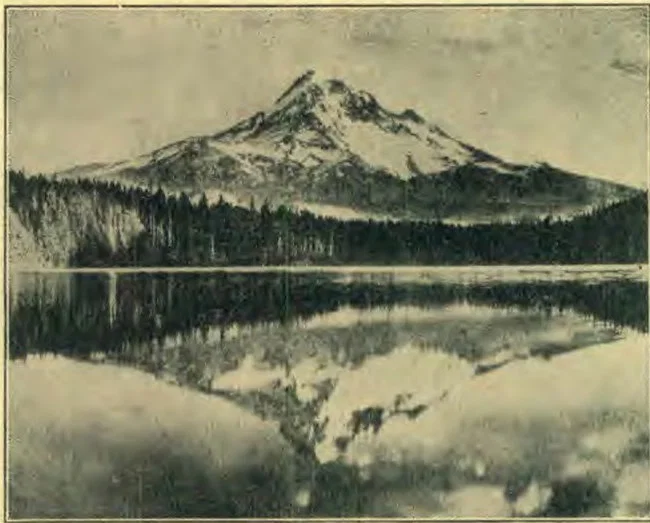
MT. HOOD is one of the most visited snow peaks of America. Its glistening summit is a constant challenge to the sight-seeing stranger, and an invitation to the native Westerner, for mountain climbing is a fascinating pastime. In a recent issue of Sunset, Hamilton M. Laing describes the start from Government Camp, after a night spent in the open, and his experiences on the ascent and descent of this skyscraper of Oregon. We give an excerpt of his story for the edification of the uninitiated:
“We were off at 2:45 A. M., and toiled up the wood path through the scattered timber. There were six of us, including Hans, the guide. Two parties from Portland had beaten us on the start; a yell or halloo ahead anon broke the mountain quiet; a flash glinted here and there, though the moonlight was so strong that our guide did not light the lantern he carried.
“The first flowers were bidding good morning as we emerged from the timber; then the sky grew yellow; Sol peeped over a ridge; it was morning. Flowers appeared all about us. We had left the tall lupine and the Mariposa lilies and squaw grass down in the timber; but here were beds of phlox, white and pink, fuzzy spraguea, short-stemmed purple asters, and masses of frost-tinted polygonum lying like orange and crimson rugs upon the ash-gray hills.
“The other parties toiled up the snow ahead of us; a far yell or yodel came drifting back with a strange hollowness in the morning air. Then just before we took to the snow fields, Hans mounted a small rock and said, ‘Now I will give them a call,’—with a trifle of emphasis on the ‘I,’—took in a barrelful or less of mountain air, threw up his head, and let go. I can no more describe that yodeling melody or its effect on me than I can paint a sunset. I know it sent the prickles running strangely up and down my spine, as music has done but rarely. I had heard this musical juggling before, but I had never heard Swiss Hans yodel in the mountains. It was the proper setting. He gave half a dozen calls, each seemingly better than the last.
MT. HOOD, OREGON, FROM LOST LAKE
“I was charmed; I would learn to yodel or I should know why! During the next hour I myself awakened a whole legion of slumbering echoes. Unheeding the agony in the faces of my comrades—we wore grease paint and amber goggles anyway—and the smiles of the Swiss, I yo-o-o-odel-odeled till I was hoarse. . . . But when I had ended with a throatful of frogs, Hans eased me down with the solemn assurance that it had to be ‘borned in you.’ I understood then that I had been ‘borned’ without it.
“Then we tackled the snow fields, . . . and as we toiled toward Crater Rock the going became stiffer. The haul up the wire cable hand over hand brought extra fatigue, and the ascent was covered in short drives. The climb begins to be more real here; the breath comes fast; the heart hammers and pounds; the senses grow dizzy in this light ether, and it needs no guide’s warning at such times to hold the climber back. Our trouble now was in getting ahead. . . .
“It is fine to be a greenhorn and get impressions new and first hand. . . . Even in this barrenness there were living things. Grasshoppers, beetles, and moths, mostly dead and long in cold storage, but a few alive, were observed on the snow. Some large buzzing fly that none of us could capture followed us noisily at times. Several butterflies were seen flitting around the sun-warmed rocks; and later as we rested at Crater Rock an able-bodied daddy longlegs was found walking at his grandfather gait over the rocks! It is easy enough to account for the presence of the migrant birds, but the live grasshopper on the snow and the vegetarian spider miles beyond the last sprig of vegetation, were puzzlers.
“The southern ascent of Hood—and mountaineers say that it is a very easy peak to climb; a good one for beginners—passes up through the throat of a great volcano that long ago poured out its material to build the mountain. The southern side of the mountain is missing, . . . but part of the rim remains. This is the sharp tip that pleases the eye of the thousands who see it from the valleys. Crater Rock is the mound in the heart of the old crater left by the last throes of the dying volcano. It is a wild spot. Steam and sulphurous vapor issue from holes here and there. The air is laden with a smell that suggests an interrelation of laboratory, naughty student, and hydrogen sulphide.
“After we had rested at Crater Rock and eaten chocolate and stiffened our knees with a sandwich each from the hamper Hans carried on his broad shoulders, we journeyed upward and along the hog-back or snow ridge toward the crevasse. Small bits of rock chased each other down the white slope in such close succession that they seemed alive.
“Then the thing happened that Hans had warned us might befall ‘if we were not careful.’ Friend J—— said that he felt horrible; to look at him was to believe him. Our guide and comforter explained that many climbers got sick, that mountain sickness was a twin brother of seasickness, a harmless ailment but dreadfully unpopular. Friend J—— just wanted to lie there in the snow and die. He besought us to leave him; and indicated brokenly that when he could get his stomach back to its old moorings he would start downward. It is plainly useless to argue with a man when he has mountain sickness, so we waited till he felt better and said he would try to make the summit. And he did.
“The last hour brought the toughest work of all. At the edge of the ascent we came to the crevasse. A ladder and rope were across the gap, but Hans went ahead and fixed everything securely. A new snow had recently fallen, and the light was dazzling. To remove the amber glasses for a few moments meant eyestrain; to expose the skin unprotected for any considerable time meant sunburn almost as severe as a scald. Hence the grease paint.
“The last thousand feet was the hardest pull of all, much of it being hand over hand on the ropes. A few feet at each drive was quite enough. Up, up, another heave or two, with rests between, and it was over. To climb such a mountain is not an achievement, but it is gloriously good fun. It was now exactly noon. We were on the summit on the edge of this old crater rim, 11,225 feet on high, the loftiest spot in Oregon.
“As for the view itself from this mountain top, words are cheap and impotent. It is easy to tell that the sun shone from a sky that held not a vestige of cloud; that the glaciers rolled away far below to divide into their respective canyons and feed a dozen rivers in the green timber; that we could look into the famous Hood River Valley and out upon the mighty Columbia; or even turn about and sweep the swelling blue Cascades 7,000 feet below us, ridge on ridge lying in a maze of blue overcuttings and fading off into the mellow haze that intermingled earth and air; that the very world seemed spread out below us, and we saw it now as the eagle sees it; that the white mountain gods of the West lay off in the distance: St. Helena, Adams, mighty Rainier, with their glistening heads high over the haze that mantled the valleys; easy, but all this does not tell what I felt.
“We rested a little time while Hans flashed a mirror signal to the watchers at Government Camp, and then we set off downward. Hans knew the short cuts, and led off down the slopes like a wild torpedo. The climber is supposed to play himself on the return, and our guide showed us how. With alpenstock for rudder and drag or brake trailing behind, you sit down or lie down and toboggan. You may slide, roll sidewise, or end over end, but you always get down. It makes no difference whether you are under twenty or over fifty and the father of a family; in four seconds you go down a slope that on the upward journey took an hour of siege. No one would have guessed now by looking at Friend J—— as he delightedly bored the snow out of his ears, that scant three hours ago he had voiced a wish to die.
“By 4 P. M. we were back at Government Camp. I bivouacked at a little mountain stream several rods up the trail from the hotel, and had the night with the moon and the glistening ghost mountain, with thrushes for comrades and the chattering water for a lullaby when I dozed; and in the bright morning, after breakfast and a visit from the mountain jays and chickadees, I set off on the back trail and spent a whole golden day on it, as though time in these mountains was simply made to waste.”

Force Cannot Build Anything Lasting

THE more I study the world the more I am convinced of the inability of force to create anything durable. Alexander, Cæsar, Charlemagne, and I myself have founded empires; but upon what did these creations of our genius depend? They depended upon force. Jesus Christ founded his empire upon love, and to this very day millions would die for him.—Napoleon.

Simple Duty Hath No Place for Fear

SIMPLE duty hath no place for fear.— Whittier.

Helpful and Interesting Books

HOW Boys and Girls Can Earn Money," by C. C. Bowsfield. $1 net; by mail, $1.10.
“Graded Exercises in Punctuation and Use of Capitals.” 25 cents.
“In Nature’s Haunts with Youthful Minds.” 75 cents.
“Character Lessons in American Biography.” 75 cents.
“Stickeen,” a dog classic, by John Muir. 60 cents, cloth; 25 cents, paper.
“Fifty-two Story Talks to Boys and Girls,” by Rev. Howard J. Chidley, is an instructive book for children. 75 cents.
“Take It” is a book filled with short suggestions for making the most of life. $1.
Order from your tract society, or the Review and Herald, Takoma Park, Washington, D. C.
Continue reading: Why King George Doesn't Give His Palaces to the Red Cross