The Youth’s Instructor, Vol. 34, No. 7.

IN THE TEMPLE
Earlier text: IN THE TEMPLE

FATHER WATCHED ALL NIGHT.

LITTLE Ella and her father were once traveling together, and in order to reach their home, it was necessary for them to travel all night.
When it became too dark for them to look out of the windows, and the lamps were lighted inside, the father laid aside his little girl’s hat, and spreading out cloaks and shawls, said, “Now we will rest.” But a little, troubled face peered out upon the strange scene, a mist was gathering in those blue eyes, and the cheery tone of voice changed to a very plaintive one, as she asked,—
“Father, how can we go to bed here?”
“This is your bed, darling,” he said, drawing her to his heart, “and a warm one you will always find it.” And then he tucked her in so carefully, that, in place of what had been a little girl, there seemed only a great bundle of shawls. But every now and then there was a movement inside the bundle, and a voice would say, “O father, I am afraid to go to sleep here!” Then the father reminded her that he was taking care of her, and would do so all night. So at last, soothed by this assurance, and worn out by unwonted fatigue, she fell asleep. When she opened her eyes again, after what seemed to her only a few moments, the sun was shining brightly. The train stopped, and there, just in sight, was her own dear home. She could even see her mother standing in the open door, with arms outstretched to welcome back her loved ones. Their first meeting was too full of joy for many words to be spoken; but after those close embraces and warm kisses were over, the mother asked,—
“And so my little girl has been traveling all night! Did she find it a long and weary time?”
“Oh, no, mother, not at all; I had such a good sleep, and father watched over me all night! Only think of it! All night, mother, he watched over me! At first I was afraid to go to sleep in that strange place; but he told me to lean against him, and shut my eyes and rest easily, for he would stay awake and take care of me. So I crept up close to him, and before I knew it, I was really and truly sound asleep.”
Then the mother told her child of the other good Father who watches over each of his children, not only one night, but every night of their lives. And though grown to womanhood now, Ella still remembers them, and never lies down to sleep without the glad feeling, “My Father will be awake to watch over me.” And her first thoughts on waking to the beauties of the morning light are of the dear Father in heaven, whose loving care has made her rest so safe and pleasant to her.—Children’s Record.

SAIDA'S SANCTUARY SHEKELS.

Away down in Mexico, where the sunshine is hotter and brighter than we ever saw it, where the big red cactus grows and blooms out-of-doors, and no snow ever falls, live two little girls named Saida and Ethel.
They are not brown-skinned and black-browed, like the Mexicans; for these little maidens were born way up among New England hills, and have only recently followed their father to this southern land, where he has a government appointment.
And they still keep their places in a missionary mite society among their old friends in the North, sending their mites back once a year to swell the golden stream that presently rolls down to Mexico again, to support a girls' school there, in which the Bible truth is taught.
They are very little girls, you must know, too little, their mamma thought, to earn any money themselves; so she always gave them their silver quarters for the society. But one day, while Saida was reading a Sabbath-school paper which grandma sent her every week, she came across this sentence in a talk to children: “The Jews, you know, were not allowed to pay just any money for the temple tribute, they could not bring Greek or Roman coins; but their offering must be the silver half-shekel set apart for the purpose, bearing the sacred legend, ‘Jerusalem the holy.’ Little people, how is it with your offerings? If papa or mamma gave them to you from their purses, they are not sanctuary shekels; if you only gave what you could spare without missing, they were not sanctuary shekels; no, if you would bring true offerings into God's temple, there must be on your silver pieces (though only seen by his eyes) pictures of some work you have done, or some self-denial you have made, for him.”
This little sermon put a new thought into Saida's heart; and she and Ethel talked it over and over, swaying backward and forward in the great hammock under the trees. Then the next thing was to talk it over with mamma.
Now these little girls went a long, long distance to school every day, an English school; papa said it was too long for them to walk, so he gave them a silver bit every morning to ride to school (for street cars run now even in that Mexican city), and another bit for their ride home in the afternoon. Saida's plan, and Ethel's, was to save that second bit of silver every day by walking home, instead of riding.
The way was, as I said, very long; sometimes it seemed to their tired little feet as if it had no end. And the sun was very hot, and the school-books made their arms ache.
But oh, how happy and pleased they were, when the money was all earned, and mamma sent their mites back to the treasurer of their society at home!
If you had looked at these silver pieces, you would have seen only a crowned head and some Spanish words; but God and the angels saw on one side of them the sweet picture of two little girls bravely bearing weariness and heat for him, and on the other, “Of a truth I say unto you that these have cast in more than they all.”—Elizabeth P. Allan.

NOT YOUR OWN, BUT CHRIST'S.

DEAR little one, to whom do you belong, besides to dear mamma and those about you whom you love so much? You belong to the blessed Saviour, who bought us with his own precious blood. You know that the blood in our bodies is our life. If the blood were lost, we could not live a moment. So when our dear Saviour gave his blood for us, he gave his very life. And why did he give his life—why did he leave his happy home in heaven to come and die for us? Because he loved us so much that he wanted us to be happy forever in heaven with him.
Satan tempts us so as to make us wicked like himself; but Jesus bought us for himself with his own precious blood; and he will keep us from sin and Satan, if we ask him.
Well, if we are not our own, but belong to Jesus, we must use every part of our body for him. We cannot do for him as Mary and Martha did; but for others we can do acts of kindness, and give little words of love, because we love Jesus, and so it will all be for him.
Did you ever think that your little hands could do something for Jesus, by working for others; and your little feet, by running readily on some message for one you love; and your tongue, by speaking kindly and gently, even when others speak unkindly to you? Your thoughts also you can, by his help, keep pure and good for him. Whatever we do for Jesus, whose eye is always upon us, he will see and love. How sweet it is to think that we belong to such a loving Saviour!—S. S. Times.

THE SNOWFALL.

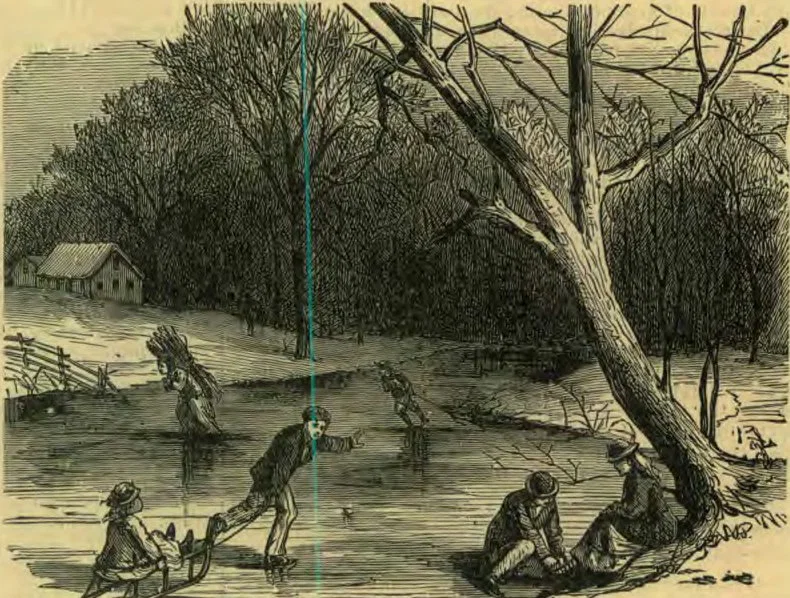
Old Winter comes forth in his robe of white, He sends the sweet flowers far out of sight, He robs the trees of their green leaves quite, And freezes the pond and river; He has spoiled the butterfly’s pretty vest, And ordered the birds not to build their nest, And banished the frog to a four months’ rest, And makes all the children shiver.
Yet he does some good with his icy tread; For he keeps the corn-seeds warm in their bed, He dries up the damp which the rain has spread, And renders the air more healthy.
He taught the boys to slide, and he flung Rich Christmas gifts o’er the old and young, And when cries for food from the poor were wrung, He opened the purse of the wealthy.
We like the Spring, with its fine fresh air; We like the Summer, with flowers so fair; We like the fruits we in Autumn share; And we like, too, old Winter’s greeting; His touch is cold, but his heart is warm; So, though he brings to us snow and storm, We look with a smile on his well-known form, And ours is a gladsome meeting. —Selected.

Kindness as a Means of Grace

Kind looks, kind words, kind acts, and warm handshakes—these are secondary means of grace when men are in trouble, and are fighting their unseen battles.

Letter Budget.

JOHN C. YATES, of Greenwood Co., Kan., writes: “As I have never written for the INSTRUCTOR, and take much interest in the letters, I thought I would let you see my name in the Budget. I am a little boy ten years old. I live in sunny Kansas. We had nice weather a good while when the INSTRUCTOR was talking of snow and winter. The first snow here fell December 6, and was very light. I go to day school, and study third reader, spelling, arithmetic, writing, and language. We have forty-five scholars. I attend Sabbath-school with my parents, and two sisters, one of whom is fifteen, and the other seven, years of age. There are thirteen members in our Sabbath-school. I study Book No. 2. I want to be a good boy, and have a home in the new earth.”
Since John’s letter was written, two months ago, it may be that old Winter has left his snowy blanket more than once in Kansas; for he has been stealthily creeping here and there, even into territory where it has been thought he had no right to enter. But most of the boys rather enjoy some ice and snow.
HERE we have a letter from little LYNN TOZER, who says: “I live in Grand Rapids, Mich. I have two sisters and one little brother. We all keep the Sabbath with my mamma. We do not have any meetings or Sabbath-school here now except what my mamma has at home for us. I go to day school right across the street; and it makes it real nice this cold weather. I have a kittie that looks just like a tiger. I have had her most three years. I am always glad to get the INSTRUCTOR. My aunt sends it to me. After I read my papers, I give them to the little boys about here. I have never seen a little letter from here, and so I thought I would write one. I hope this will be printed. I am eight years old.”
Lynn’s letter was written all by himself, in a very plain hand, with every word spelled correctly. We always print such bright, intelligent letters; and we have many such, as you see in the Budget from week to week.
BERTIE I. VAN HORN writes from Eaton Co., Mich. He says: “This is the second time that I have written for the INSTRUCTOR. I go to day school, and am in the fourth grade. We learn texts of Scripture every week, and repeat the Lord’s prayer every morning in concert. I paid tithes on what grew in my garden last summer, and last Christmas I paid one dollar to the European missions. I go to Sabbath-school and learn lessons in Book No. 4. I was baptized last fall, on my eleventh birthday. I want to be a good boy and keep God’s commandments. I like my INSTRUCTOR very much, and think the Budget is very interesting.”
Thanks for your letter, Bertie. The Budget is becoming more interesting because the letter writers are trying to make it so, by writing something all like to read. Boys and girls who are cultivating the gifts of speech, hearing, and seeing, which God has given them, and who are trying to lead pure and useful lives, will have something good for the Budget. Don’t you find it so?
JENNIE M. SMITH writes from California. She says: “As I never wrote a letter for the Budget, I thought I would write one. I go to Sabbath-school every Sabbath, and study in Book No. 4. We have a nice Sabbath-school. We came to Healdsburg last April. I have been perfect in my Sabbath-school lessons ever since I came. My sister Maud and I attend the college. Sister is ten, and I will soon be twelve. My studies are Bible, language, reading, geography, arithmetic, spelling, and writing. We went to the Coast last summer, and camped on the beach four days. We had a nice time gathering shells, chasing the waves, and watching the ships pass. It was so nice to watch the waves dash up against the rocks. We saw the fishermen go out in small boats at sea to catch fish. We would think the waves would drown them, but soon we would see them come up again. Once when the fishermen went out, they returned with a small shark in their net. We enjoyed ourselves so well that papa says we will go again next summer if nothing happens. Last winter we lived in Kansas. Maud and I went to school two months, and had to wade in snow. It is much nicer here, for instead of snow, we have green grass and flowers. We had nice times Christmas at the College. We had singing and speaking, and considerable money was given to the foreign missions. I am trying to be a good girl, so as to meet you all in heaven.”
You have written a very entertaining letter, Jennie. Your stay on the beach was an enjoyable affair. “They that go down to the sea in ships, . . . these see the works of the Lord, and his wonders in the deep,” as those do not who remain quietly on the land. But some of the wonders of the mighty deep may be seen even on the Coast. You are fortunate to have such good school advantages.

The Reformation in Denmark.

The work of the Reformation affected Denmark at an early period, and resulted in establishing Protestantism in this country. Many travelers told of the work in Germany.
Among certain young men who went to Germany to improve their education, was a nobleman named Peter Lille, who heard Luther in Wittenberg. He embraced the new faith, and on his return preached the gospel with much zeal, pointing out the necessity of a reformation in the church. He found some willing hearers.
Christian II. reigned at this time. He was a very cruel king, and entertained great hatred towards the nobility and clergy, because they curtailed his power. But he was a great friend of the lower classes, and tried in various ways to help them. In the beginning of his reign the papal legate, Arcimbold, sold letters of indulgence in Denmark. The king tried to get this man on his side; but he deceived him, and united with enemies in Sweden, whereupon the king took away from him all the money he had obtained by his miserable trade.
Christian II. favored the work of Luther, and persuaded his uncle, elector Frederick of Saxony, to send a Lutheran preacher to Copenhagen. This preacher did but little, however, because he did not understand the language.
On account of his cruelty and violence, the king had to flee from Denmark. He sought refuge with elector Frederick, and heard Luther preach in the castle Schweinitz near Wittenberg. The sermon impressed him favorably; and he said that he never in all his life had heard the gospel preached like that; that he would never forget this sermon; and that he hereafter, by the help of God, would suffer everything with more patience. But like many others, he became a hearer and not a doer of the word. Not long after this he became reconciled to the pope, because he thought that in no other way he could regain his kingdom. But he was defeated, and afterwards died in prison. He caused the New Testament to be translated, and printed in Danish, contributing thus far to the spread of the gospel, although selfish ambition no doubt was his sole motive.
Hans Tausen did most of all to spread the Reformation in Denmark. His parents were simple farmers, living on Fyn. He was educated in the cloister of Autorskow; and being a very promising youth, he was permitted to travel in foreign countries at the expense of the cloister. He was drawn to Wittenberg by the rumors he heard of Luther, and was soon convinced of the truthfulness of the doctrines which the great reformer preached. But the prior soon called him back, and he was confined in the cloister. The next year, however, he was sent to Viborg, and obtained permission to preach. His sermon made a deep impression upon the citizens, and they protected him against the Catholic clergy.
Meanwhile Frederick I. had ascended the throne of Denmark. He favored the doctrine of Luther, and protected the Reformers. He made Hans Tausen his chaplain.
The new doctrine found adherents and defenders in several cities, especially in Malmö. Here two unlearned citizens preached the gospel with great eloquence, and the learned Frantz Vormordson soon helped them. From Leipzig, foreign merchants brought the New Testament in Danish in great numbers into the kingdom; and it was in vain that the bishops denounced this as a dangerous book.
King Frederick called a diet in Odense in 1527, where he declared that he would protect the Catholic bishops as far as it could be done in harmony with the word of God, but that he had decided that the Lutherans should have full liberty of faith and conscience, and equal rights with the Catholics.
Thus the Reformation gained strength year by year. Christian Pedersen published a new and better translation of the New Testament, which was a great help to the cause. Tausen was now called to Copenhagen, and soon won over most of the citizens to the new religion. Thus the people were gained at large, and in the course of ten years Denmark became Protestant.
When the diet of Augsburg convened in Germany, the Catholic party in Denmark made a new effort to regain their sinking influence, but in vain. A diet was called at Copenhagen to examine the new doctrine, that it might be condemned; but the Protestants showed great firmness. They presented forty-three articles of faith to the king and his ministers, and aroused the people by vehement sermons. The king again declared that he would protect both parties.
This result strengthened the Protestants, and their doctrine soon became prominent in all the cities. Yet this was not brought about without much disturbance in many places, where the Protestants used violence against the clergy and the church edifices. The monks especially suffered much persecution, and were often harassed until they left their cloisters. The noblemen also did all in their power to get away as much property as possible from the church.
The condition of the people in these days was such that they needed to be enlightened. Murder and violence were often committed, and drunkenness prevailed to a horrible extent among all classes, rich and poor.
Great superstition prevailed. Relics of saints were looked upon as possessing miraculous power, and sorcery and witchcraft were practiced. In the city of Ribe alone, no less than twelve women were condemned to be burned as witches in the years 1573 to 1652. They also believed in mermen and mermaids, fairies, hobgoblins, dwarfs, and mountain-nymphs.
Thus we see there was great need of light among these so-called Christians, and that their religion was not far removed from the heathenism that had prevailed seven hundred years before this time.
Christian III. had now ascended the throne. He called a diet in Copenhagen, A. D. 1536. Here it was decided that the Catholic religion should be forever abolished, and the evangelical doctrine should be the established religion in Denmark. Luther’s friend, Bugenhagen, professor in Wittenberg, was called to arrange the religious affairs. This was done without any opposition on the part of the people. But in Iceland (which belonged to Denmark) the Reformation found much opposition. After a long contest it was established in Iceland in the middle of the sixteenth century, after the Catholic bishop, John Arsen, was beheaded with his two sons.
Thus Protestantism was established by political parties, the cunning policy of statesmen, the voice of diets, and the shedding of blood,—a very different manner, indeed, from the way in which Christ and his apostles established Christianity, and consequently a very different religion. Is it any wonder that there is great need of a new reformation?
Much intolerance was frequently manifested. John Dascy, a Polish nobleman who had been much persecuted in England on account of his religion, sought refuge in Denmark. His faith differed only in a very few points from the Lutheran, yet he and his followers were banished from Denmark, in the midst of a very severe winter, with their sick women and little children.
Niles Hemmingsen, professor of the university of Copenhagen, and one of the most learned theologians of his time, was accused for agreeing with the Reformed in the doctrine of the Lord’s Supper. He was at last deposed from his office. The first cause of this was, that he opposed the Concordiaformel, a book containing a full explanation of the faith, by Luther and Melancthon. Yet this book was finally rejected in Denmark; and the king, going to the opposite extreme, ordered that every priest who possessed this book should lose his office, and every book-seller who sold it should forfeit life and property. The king then published some articles of faith. Every stranger, who wished to settle in the country, had to accept and swear to these articles, or leave the country in three days; and those who afterwards rejected the articles, were punished with death and loss of property.
At present the religion in Denmark is generally distinguished by infidelity and worldliness. We find much less interest in religion manifested here than in Sweden and Norway. Grundtvigianism have arisen in the present century, and nearly half of the priests in the state church favor their views. They exalt the church far above the Bible, which they say is but a dead letter, favor greatly the epicurean doctrine, and believe in conversion after death.
Among dissenters the Baptists and Methodists have the greatest influence. The doctrine of the former has come into Denmark from Germany, the latter from America.
J. G. MATTESON.
Copenhagen, Denmark.

IN THE TEMPLE.

It was spring-time in the beautiful land of Palestine. The warm breeze that fanned the cheek of the dusty wayfarer, the green grass and gay wild flowers springing at his feet, and the songsters pouring out their praises from the tree tops o'er his head, all proclaimed the advent of the happy season. From the secluded village of Nazareth, shut in among the hills of Galilee, a small company might be seen journeying to the southward. Among them is a humble carpenter, called Joseph, and his wife Mary, with their son, a lad of twelve, whose thoughtful brow shows wisdom far beyond his years. For awhile their way lies through the rich and fertile plain of Esdraelon, verdant with fields of waving grain. Soon they pass the mountains of Carmel, no doubt near the very place where, long years before, fire had come down from heaven in answer to the prophet’s prayer.
By degrees the mountains grow lower and more rounded as they reach the hill country of Samaria. Here the road makes a sudden turn, and enters a short valley. To the north rises a mountain, bleak and barren; on the other side rises another, less rugged, and covered with living green. The one is Ebal, and the other Gerizim. As the wayfarers pass this place, they no doubt recall the time when Joshua assembled in this valley all the tribes of Israel, and rehearsed in the ears of the people the blessings and the curses written in the law of Moses.
As they follow the road southward, winding among rocky hills and wild defiles, or past peaceful villages, their number is increased by other bands of pilgrims wending their way to Jerusalem to attend the Passover. At last they reach an eminence, and there bursts upon their view the holy city. From afar they can behold the temple glittering in the sunlight, and can see the smoke of its offerings forever rising to the heavens. All the houses are crowded with pilgrims who have come to attend this yearly feast; and the white tents of those who camp without the city gleam everywhere among the clustering vines and olives that clothe the hill-sides.
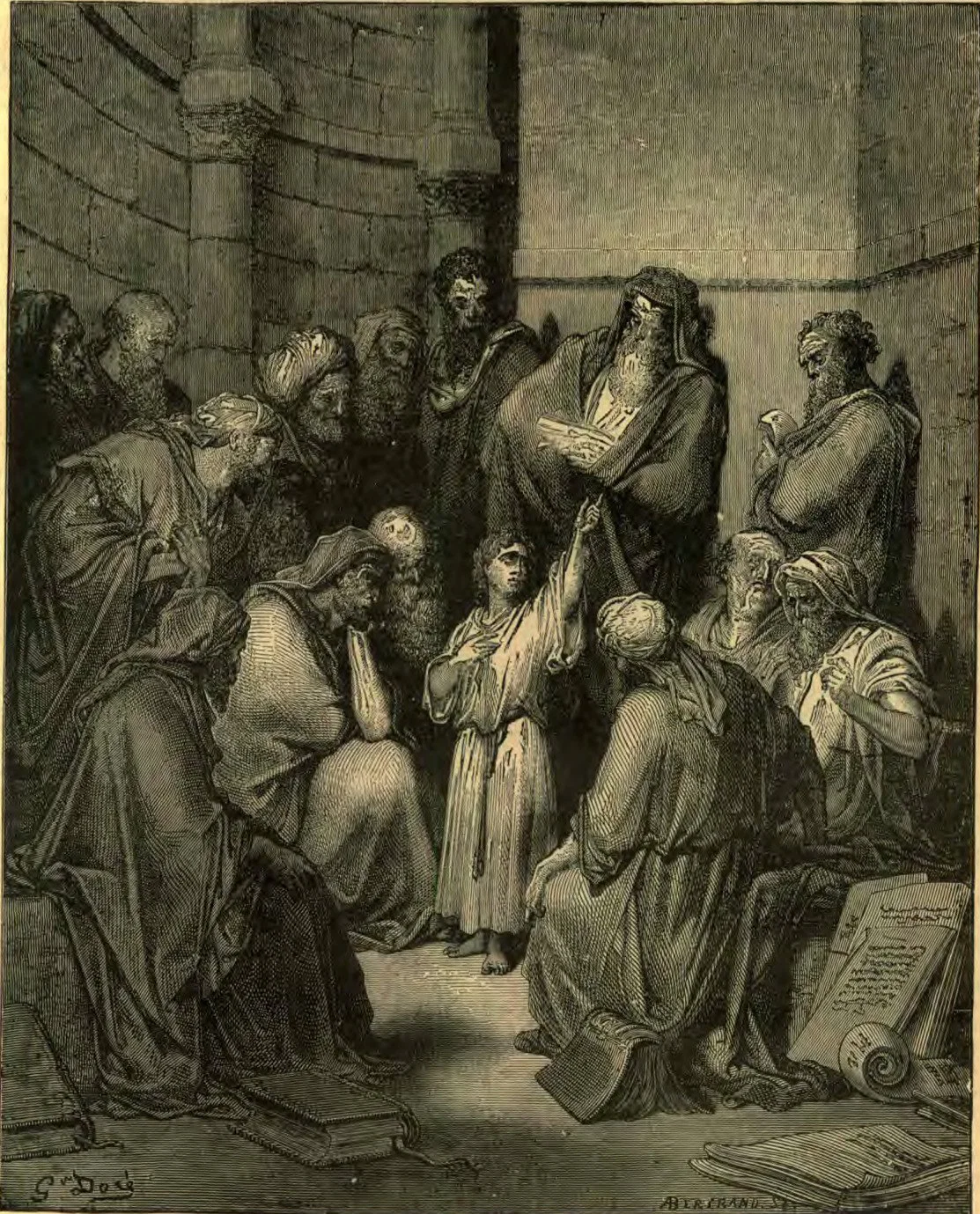
For eight days the solemn feast is celebrated according to the law of Moses; and then the people return to their homes. Joseph and Mary must meet many kinsfolk and acquaintances at this yearly reunion, and their return journey is no doubt enlivened with pleasant discourse with their friends. So absorbed are they in their talk that for a whole day they journey homeward, not once noticing that the child Jesus is not by their side. Then, conscience-smitten for their carelessness and inattention, they make diligent search among their company for the missing one. What anguish must have filled Mary’s heart as night closed in, and her son could not be found! Diligently they search among the crooked streets of Jerusalem. At last they draw near the temple, and now they hear his voice. They find him in the midst of the learned doctors of the law, both hearing them and asking them questions; and the wise men are “astonished at his understanding and his answers.” Then said Mary unto him, “Why hast thou thus dealt with us? behold, thy father and I have sought thee sorrowing.” And he said unto them, “How is it that ye sought me? wist ye not that I must be about my Father’s business?” “And he went down with them, and came to Nazareth, and was subject unto them: but his mother kept all these sayings in her heart.”
As it was with Joseph and Mary, so may it be with us now. They, through carelessness, lost the Saviour of the world; so we, through negligence, may lose him from our hearts, and it will require many days of sorrowful searching ere we find his love again. W. E. L.

THE BOOK OF NATURE.

We scarce could doubt our Father's power, Though his great goodness were untold In the Sacred Record made for us By the prophet bards of old.
We must have felt his watchfulness About us everywhere, Though we had not learned in the Holy Word, How he keeps us in his care.
I almost think we should know his love, And dream of his pardoning grace, If we never had read how the Saviour came To die for a sinful race.
For the sweetest parables of truth In our daily pathway lie; And we read without interpreter The writing on the sky.
The ravens, fed when they clamor, teach The human heart to trust; And the rain of goodness speaks, as it falls On the just and the unjust.
The sunshine drops like a leaf of gold, From the book of light above; And the lily's missal is written full Of the words of a Father's love.
So, when we turn from the sacred page Where the holy record lies, And its gracious plans and promises Are hidden from our eyes,
One open volume still is ours, To read and understand; And its living characters are writ By our Father's loving hand!
—Phoebe Cary.

STORIES ABOUT LINCOLN.

I WANT to tell you more about Mr. Lincoln, first, because I think it will interest you; and secondly, because I hope it will encourage you to live a brave, honest life like his.
As I told you, he was very poor when a boy, and even when a man grown. A friend urged him to study law; but Mr. Lincoln told him he had no books nor money to buy them. So that friend loaned him books. Lincoln took them home, and studied day and night. “He went day after day, for weeks, and sat under an oak tree on a hill near New Salem, Ind., and read, moving around to keep in the shade, as the sun moved. He was so absorbed that people said he was crazy,” and he often passed his friends without knowing them. This is the kind of work that brings success.
When first elected to the legislature, Lincoln was so poor he had to walk to the capitol, a distance of one hundred miles. He had very large feet. On one occasion he complained of being cold. His companions told him it was no wonder, as there was so much of him on the ground. He enjoyed the joke.
In order to learn grammar, Lincoln had to borrow a book and study it alone, and that after he was a man too. When he had not money enough to dress decently, he would buy papers and books, and read them intently. Some boys and girls think more of fine clothes than they do of an education. Such persons never amount to much.
One man says that the first time he saw Lincoln, he was lying in a trundle bed covered with books and papers, rocking a cradle with his foot. That was just like him—studying and yet helping a mother quiet her child. It shows the good heart he had,—another good example for boys to follow.
One touching incident illustrates the goodness of his heart. While yet young and poor, he won a case for which he received five hundred dollars. He was overjoyed. It was the largest sum he had ever possessed. He laid it before him, and counted it over and over. What do you suppose he did with it? Bought himself a fine suit of clothes? went to the theater? got a gold watch or a rifle?—Oh, no. He just took the whole of it, and bought a home for his old step-mother, and gave it to her. That was a noble deed. Such a man was worthy to be president.
One of the most beautiful traits of Mr. Lincoln was his regard for his poor relatives. When he became a great man, he did not shun them; but whenever it was possible, he went and stayed with them. He assumed no superiority to them. He often helped them with money and in other ways. Frequently he left his companions at the hotel after a hard day’s work, and spent the evening with those old companions of his humble days. On one occasion, when urged not to go, he said, “Why, aunt’s heart would be broken if I should leave town without calling upon her;” yet he had to walk a long way to make the call. How we admire such conduct!
Little Abe was a good temperance boy, just as all boys ought to be. When he became a man, he did not give up his principles. When he was nominated for president, a company of great men called on him to tell him of it. On such occasions it was expected that they would be treated to liquor, and that he would drink with them. He spoke to them about this, and said he would furnish something to drink. Soon the girl brought in a pitcher and glasses. Mr. Lincoln arose, and gravely said, “Gentlemen, we must pledge our mutual healths in the most healthful beverage which God has given to man. It is the only beverage I have ever used or allowed in my family, and I cannot conscientiously depart from it on the present occasion; it is pure Adam’s ale from the spring;” and then he drank his glass of cold water.
This is the way all should do, have good principles and stick to them always and everywhere. Now children, who of you will try to be like Mr. Lincoln in these good ways? If we try, we may succeed.
D. M. CANRIGHT.

THE TWO MEN OF COLOGNE.

[Republished by request.]
A LONG time ago, there lived, in Cologne, Otto von Hiller and Rupert van Tone, And Otto wrote fables, But Rupert made tables— “The very best tables that ever were known!” So said every sensible frau of Cologne.
“Friend Rupert,” said Otto von Hiller one day, “Come, tell me the wonderful reason, I pray, Why men call you clever, When really you never Professed to have very much learning, you know, And I—well, in truth, I’ve enough for a show.
“I’m master of Latin, I’m famous in Greek, Both French and Italian I fluently speak; I could talk by the year Of our nation’s career; Yet, some one has said—to his shame be it known— That I am the stupidest man in Cologne!”
Said Rupert van Tone: “If you’ll promise to try it, I’ll tell you a secret,—I’ve learned to keep quiet.” “But I’ve so much to say!”— “’Twon’t spoil in a day; Who lets his tongue run like a vibrating lever Stands very small chance of being called clever.”
But he’d “so much to say,” this Otto von Hiller: ’Twas now to the judge, and now to the miller; He’d appear without warning, And stay all the morning, Till his hearers would sigh as he left, “What a drone! He is truly the stupidest man in Cologne.”
But Rupert van Tone worked on at his trade; He listened and thought, but his words he well weighed, Till at threescore and twenty He’d money in plenty; And through summer and winter his mansion was known As the home of the cleverest man in Cologne. —Emma C. Dowd.

GIVING

A few years ago a lady was employed by the City Mission Society in New York as a Bible-reader. She had a husband wasting with consumption, and two helpless children depending upon her for bread. She received twenty-five dollars a month from the society for her work, and this was her only source of income.
She was a person of strong faith in God, and really believed that he cares for his children with more than a father's love and care; so, though her income was small, counted in dollars and cents, it was actually very large, for she had the riches of heaven at her disposal.
She went to her church one Sabbath morning. Her purse had run very low, but the monthly salary was due the following Thursday, and she knew it was always promptly paid. On this morning there was a call for money. The dear old church had long been in debt, and now hearts were moved to clear away the burden. It was clearly a call to give to the Lord, and our friend was startled to find in her heart a strong desire to give a month's salary!
“Why, how can you do that?” said Prudence and Common Sense. “Your husband and children will starve.”
“God will take care of them,” said this Christian believer.
“But that is absurd!” said Reason. “You have no right to make others suffer, even if you are willing to suffer yourself.”
For a moment she was shaken; but a little voice whispered, “The prompting to give is of the Lord; heed it.” And she took the paper and put down her name for twenty-five dollars. Then her heart misgave her again, and many times during the days that followed was she called to fight over again “the fight of faith.”
On Thursday she went to draw her monthly due—the money that was the Lord’s; and as she entered the room, one of the officers met her with a smiling face, to say that a lady had placed three hundred dollars in her hands to divide among the Bible-readers, “and I am going to give you twenty-five dollars of it,” she said.
This officer knew nothing of the need of the hour, nor did the lady who gave the generous aid know why she was led to give it at this very time; but our friend knew, and she went away praising God that he had given her this test of his willingness to give all to his children who will freely give all to him.—S. S. Classmate.

The Gift of a Lovely Thought

If instead of a gem, or even a flower, we would cast the gift of a lovely thought into the heart of a friend, that would be giving as the angels must give.
Continue reading: IMPORTANT BIBLE SUBJECTS