The Youth’s Instructor, Vol. 34, No. 7.

IN THE TEMPLE
Earlier text: FATHER WATCHED ALL NIGHT

IMPORTANT BIBLE SUBJECTS.

LESSON 9.—THE DATE OF THE 2300 DAYS.

1. Into what portions does the angel divide the seventy weeks? Dan. 9:25, 27.
2. What was to mark the beginning of this period of 490 years? Verse 25, first part.
3. How does the angel mention this commandment?—As something well known to Daniel.
4. What means had Daniel of knowing that such a commandment was to be given? Verse 2.
5. Where do we find the promise that the captivity of the Jews should last but seventy years? Jer. 29:10.
6. When did this captivity begin?—606 B. C. (See Dan. 1, margin.)
7. At what date, then, would the seventy years terminate?
8. In what year did Daniel make the prayer recorded in the ninth chapter of his prophecy?—B. C. 538. (See margin.)
9. What seems to have been the burden of his prayer? Verses 17, 18.
10. What does he seem to fear?—That on account of the unfaithfulness of the people, the Lord would defer the fulfillment of his promise. Verse 19.
11. Why does not the angel tell Daniel when the commandment to restore and build Jerusalem shall go forth?—Because the time had already been fixed in the prophecy of Jeremiah.
12. For what purpose does he seem to have mentioned the commandment?—Merely as a starting point, or date, of the seventy weeks and the 2300 days.
13. What incidental assurance does the angel give with reference to the restoration of Jerusalem?—“The streets shall be built again, and the wall, even in troublous times.” Verse 25.
14. What more important subject does the angel at once open up before the mind of Daniel?—He shows him when the promised Messiah shall begin his ministry upon the earth, and how long it shall continue.
15. How was the promise of Isaiah 44:28 fulfilled? Ezra 1:1-3.
16. In what respect did this decree fail to meet all the requirements of the one spoken of in Dan. 9:25? (See note.)
17. How did the Jews take advantage of the decree issued by Cyrus? Ezra 2:1, 64, 65.
18. How were the Jews interrupted in the work of rebuilding the temple? Read Ezra 6.
19. How were they enabled to resume that work? Read Ezra 5 and 6:1-12.
20. For what did this decree make no provision?
21. How did Artaxerxes Longimanus make the command complete? Ezra 7.
22. What part of this decree made special provision for the restoration of Jewish laws and customs? Verses 25, 26.
23. How may the commandment in Dan. 9:25 be regarded?—As a triple commandment.
24. How is it described in Ezra 6:14?
25. What does this prove?
26. When was this commandment made complete?—B. C. 457. See Ezra 7, margin.

NOTE.

THE commandment to restore and build Jerusalem,—The commandment issued by Cyrus, gave the Jews permission to return to Jerusalem and rebuild the temple. But the commandment mentioned in Daniel 9:25 includes the building not only of the temple, but of the city. It also embraces a work of restoration, which must have reference to the re-establishment of Jewish laws and customs,—the restoration of the civil government. About fifty thousand Jews, by the permission of Cyrus, journeyed from Babylon to Jerusalem, and began work on the temple. About fourteen years later they were obliged to cease building, on account of the fierce opposition of their enemies; but in B. C. 519 Darius Hystaspes issued a decree which afforded them protection and assistance. This decree, however, made no provision for the restoration of the Jewish laws.
At length, in B. C. 457, Artaxerxes Longimanus issued a decree granting Ezra full power to complete the work of restoring and building Jerusalem.
In Ezra 6:14, this commandment is mentioned first as the commandment of the God of Israel, and then as the commandment of Cyrus, Darius, and Artaxerxes. This proves that it took all three decrees to fully constitute the one commandment of the God of Israel,—the commandment which the angel mentioned to Daniel.

SOMETHING ABOUT ICEBERGS.

ONE of the greatest perils of the Atlantic Ocean is the icebergs, which float southward, sometimes as far as New York. It is difficult to discern them on a dark night, and frequently a vessel comes suddenly upon one, and is dashed to pieces without any warning. The larger part of the iceberg is under water, so that the danger is much greater than would seem to one who did not understand this. An iceberg that appears 100 feet above the water, will have about 700 feet below the water to balance it. “Their great size proves how great are the frozen rivers, in the polar lands, from which they are broken off as the frigid tide reaches the sea.” One of vast proportion was described by an eye-witness as follows:—
“In the early part of last May an immense berg anchored near the eastern limit of the Grand Bank, where the water, by measurement, was shown to be over five hundred feet deep.
“When first observed, the crystal mountain towered two hundred feet above the sea at the highest point, and was nearly half a mile long; and, although the summer had been unusually warm in those storm-swept localities, at the end of August this mass of flinty ice was still nearly half that magnitude.
“At that time the gradually melting berg had become hollow in its center, through which a clear river ran for nearly its entire length, finally plunging into the ocean as a most beautiful cataract.
“Along either side, numerous lesser torrents leaped from overhanging crags, or rushed down steep declivities, and continually agitated surrounding waters. The spray from these rapidly-descending streams produced a thin, silvery mist, through which the berg’s many strange domes, pinnacles, and spires appeared of nearly double their actual dimensions.
“For several hours during the mornings and evenings of clear days the refraction of sunbeams in this gauzy vapor produced a magnificent rainbow, whose colors were surprisingly vivid and well defined. Throughout a radius of many miles about this enormous refrigerator the air was always very cold and moist.
“Cold gales, attended by such visitors from the far North, usually all too plenty in the Gulf of St. Lawrence and about the shores of Cape Breton, blowing over Nova Scotia, New England, and even the Middle and Southern States, very likely in a great measure explain why our Atlantic coast has a lower mean temperature than any other region on earth so near the equator.”

NOTICE

SHORTLY after our last papers went to press, we received intelligence that the publishing house containing the lithograph plates of the chart of prophetic dates was burned, and the plates destroyed. Hence the General S. S. Association will not be able to supply the charts as advertised in INSTRUCTOR No. 5.

Seize the Moment: Begin Boldly and Finish

ARE you in earnest? Seize this very minute! What you can do, or dream you can, begin it. Boldness has genius, power, and magic in it. Only engage, and then the mind grows heated— Begin, and then the work will be completed.

CLIMATIC CURIOSITIES.

How many of our readers can point out Alaska on the map,—that distant peninsula which was ceded to the United States by Russia in 1867? Among those who have visited that country since that time was Lieut. F. Schwatka, who commanded the Alaska Exploring Expedition which left Portland, Oregon, in 1883. In a recent work, he narrates the story of their travels in a very entertaining manner, giving many interesting incidents of the journey and of what they saw of the country, the people, etc., not the least interesting of which are the following observations on some peculiarities of the climate in certain localities. He writes:—
“It is almost impossible to perceive how heavily laden with tropical moisture the atmosphere is in this supposed sub-arctic colony of ours. It oozes up around your feet as you walk, and drips from overhead like an April mist, and nothing is exempt from it. Even the Indians’ tall, dead ‘totem-poles’ of hemlock or spruce, which would make fine kindling wood anywhere else, bear huge clumps of dripping moss and foliage on their tops, at heights varying from ten to thirty feet above the ground. An occasional stray seed of a Sitka spruce may get caught in this elevated tangle, and make its home there just as well as if it were on the ground. It sprouts, and as its branches run up in the air, the roots crawl down the ‘totem-pole’ until the ground is reached, when they bury themselves in it, and send up fresh sustenance to the trunk and limbs, which until then have been living a parasitic sort of life off the decayed moss. Imagine a city boy tossing a walnut from a fourth-story window, and its lodging on top of a telegraph pole, there sprouting next spring, and in the course of a couple of years extending its roots down the pole, insinuating themselves in the crevices and splitting it open, then piercing the pavement; the tree continuing to grow for years, until the boy, as a man, can reach from his window and pick walnuts every fall,—and the idea seems incredible; and yet the equivalent occurs quite often in the south-eastern portion of our distant colony.
“Nor is all this marshy softness confined to the levels or almost level slopes, as one would imagine from one’s experience at home; but it extends up the steepest places, where the climbing would be hard enough without this added obstacle. In precipitous slopes where the foot tears out a great swath of moist moss, it may reveal underneath a slippery shingle or shale, where nothing but a bird could find a footing in its present condition. There is wonderful preservative power in all these conditions, for nothing seems to rot in the ground, and the accumulated timber of ages, standing and fallen, stumps, limbs, trunks, ‘criss-cross and tumble-tangled,’ as the children say, forms a bewildering mass which, covered and intertwined as it is with a compact entanglement of underbrush and moss, makes the ascent of the steep hill-sides a formidable undertaking.”

MAKING GLOBES.

The Times of Troy, N. Y., furnishes some interesting facts in addition to what has already been published about globe-making. We give them as follows:—
“It is a fact not known, perhaps, by many readers, that Troy is one of the largest and best producers of school and library globes in the country. The manufacture was begun in this city in 1852. At first only a ball five inches in diameter was made, but a 10-inch terrestrial globe was soon added. The list of sizes was rapidly increased. The balls are made in Boston, but the appendages are supplied, and the globes mounted and shipped in this city, where are owned the plates from which the maps are printed. Globe-making is a skillful and delicate process. The maps are printed in small sections on English drawing paper, and these segments must be so nicely put upon the hollow ball of papier mache that there shall not be the slightest break in the alignment of letters or the continuity of lines when the smooth and painted surface is complete. Three months are required to construct one of these worlds in miniature, from the time the ball is begun until it rests in its frame or sits aloft upon a brass, bronze, or nickle standard. It must be so trimmed and mounted that it will have no disinclination to change its inclination in the frame, and will hang so truly in space that it will halt in its revolution at any time when so commanded, and remain motionless, as if its center of gravity were in truth equally distant from all points upon its circumference. If the globe refuse to rest with any other country than America on top, the maker will be deemed more patriotic than skillful. The sizes manufactured range from three to thirty inches in diameter, and from $2 to $223 in price, and are mounted in forty different styles. The constantly increasing demand for these portable orbs is very forcibly shown by the fact that the shipments from this city last year were fifty per cent larger than during the preceding year.”

BEDS AND BEDSTEADS OF OLDEN TIMES.

It is said that in the time of Queen Elizabeth and reigns just preceding, the beds were made of straw or leaves, simply stuffed into bags and placed upon tables or benches, sometimes in a recess before which curtains were hung. A writer in the S. S. Classmate says of the bedsteads of that time:—
“The ‘four-poster,’ or great standing bed, was common, although very different from that in use to-day. The idea is supposed to have come from Austria, but its direct importation was probably from France, where sumptuous carved oak bedsteads were already well known. These were commonly paneled down to the floor, and contained drawers, chests, and presses, over which the sleeper virtually held guard.
“Richard III. possessed one of this kind, of which the following story is told: ‘On the twenty-first of August, 1485, he arrived at Leicester, some of his retinue having preceded him with the running wardrobe, which included a ponderous four-post bedstead with a double bottom of boards, including a military chest. All this was erected in a chamber of the Boar’s Head. Richard slept on it that night, his last on earth, for next day he was defeated and slain on Bosworth Field. The bed was stripped of its hangings and finery, but the bedstead was left with mine host, and became a kind of show at the Blue Boar. In the reign of Elizabeth the house was kept by a man named Clark, whose wife, one day while shaking or making the bed, saw a gold coin roll on to the floor. This led to an investigation, when it was found that the double bottom concealed a very large sum of gold, partly coined by Richard, and partly of an earlier date. It was, in fact, Richard’s treasury, and at the pass to which he had then come, might be said to be the very last of it. The amount is not named.’
“There were two forms of bedsteads in use in those days,—the standing bed and truckle bed, which latter was a low-framed bedstead, plain to the last degree, mounted on casters, and capable of being put under the former; indeed, it was not merely often put away there, but sometimes occupied by an inferior. My lady’s maid not unfrequently slept on the floor beside the bedstead of her mistress. An old ballad speaks of the chaplain who had to
‘lie upon the truckle bed, Whilst his young master lieth o’er his head.’
The posts, head-boards, and canopies of the Elizabethan bedstead were curiously wrought, and carved in oak and other woods, gilt and painted. They were often adorned with mottoes.
The bed-hangings were of the most sumptuous kind; bedsteads with their fittings were enumerated specially in bequests. Thus the ‘Fair Maid of Kent’ left her will in the following terms: ‘To my dear son, the king (Richard II.), my new bed of red velvet, embroidered with ostrich feathers of silver, and heads of leopards of gold, with boughs issuing out of their mouths; to my dear son, Thomas, Earl of Kent, my bed of red camak, paied with red, and rays of gold.’ Satins, silks, furs, and tapestry were largely employed. Stow speaks of a counterpane worth 1,000 marks, and yet it may have covered a straw sack or mattress.”

A SHELL MOUND.

A CORRESPONDENT of the St. Nicholas, writing from Peru, Florida, says that while with a party on a holiday excursion on the shore of Tampa Bay, they visited a shell mound which was about thirty feet high and a quarter of a mile long, and composed entirely of shells. There are several trees on the island, and it is covered with salvia, a perennial plant which is prized as a hot-house flower. The beautiful scarlet salvia you may have seen, as the plant thrives nicely in Northern gardens during the summer months.

THE POWER OF PERFUMES.

No power has yet been conceived to enable the human eye to see one of the atoms of musk, yet the organs of smell have the sensitiveness to detect them. Their smallness cannot even be imagined, and the same grain of musk undergoes absolutely no diminution in weight. A single drop of the oil of thyme, ground down with a piece of sugar and a little alcohol, will communicate its odor to twenty-five gallons of water. Haller kept for forty years papers perfumed with one grain of ambergris. After this time the odor was strong as ever.

THE FIRST STEAM VESSELS.

GOLDEN DAYS is responsible for the following:—
“The first attempt to propel vessels by steam power was made at Barcelona, Spain, by Blasco de Garay, in 1542, and various attempts were made during the sixteenth, seventeenth, and eighteenth centuries; but it was not until 1787 that successful steamboats were built. Fitch running a boat on the Delaware in that year; Symington, the “first practical steamboat,” the Charlotte Dundas, in 1801; and Fulton, the Clermont, which was the first to regularly engage in traffic, in 1807.”

NOT YOUR OWN, BUT CHRIST’S.

Dear little one, to whom do you belong, besides to dear mamma and those about you whom you love so much? You belong to the blessed Saviour, who bought us with his own precious blood. You know that the blood in our bodies is our life. If the blood were lost, we could not live a moment. So when our dear Saviour gave his blood for us, he gave his very life. And why did he give his life—why did he leave his happy home in heaven to come and die for us? Because he loved us so much that he wanted us to be happy forever in heaven with him.
Satan tempts us so as to make us wicked like himself; but Jesus bought us for himself with his own precious blood; and he will keep us from sin and Satan, if we ask him.
Well, if we are not our own, but belong to Jesus, we must use every part of our body for him. We cannot do for him as Mary and Martha did; but for others we can do acts of kindness, and give little words of love, because we love Jesus, and so it will all be for him.
Did you ever think that your little hands could do something for Jesus, by working for others; and your little feet, by running readily on some message for one you love; and your tongue, by speaking kindly and gently, even when others speak unkindly to you? Your thoughts also you can, by his help, keep pure and good for him. Whatever we do for Jesus, whose eye is always upon us, he will see and love. How sweet it is to think that we belong to such a loving Saviour!—S. S. Times.

FATHER WATCHED ALL NIGHT.

LITTLE Ella and her father were once traveling together, and in order to reach their home, it was necessary for them to travel all night.
When it became too dark for them to look out of the windows, and the lamps were lighted inside, the father laid aside his little girl's hat, and spreading out cloaks and shawls, said, “Now we will rest.” But a little, troubled face peered out upon the strange scene, a mist was gathering in those blue eyes, and the cheery tone of voice changed to a very plaintive one, as she asked,—
“Father, how can we go to bed here?”
“This is your bed, darling,” he said, drawing her to his heart, “and a warm one you will always find it.” And then he tucked her in so carefully, that, in place of what had been a little girl, there seemed only a great bundle of shawls. But every now and then there was a movement inside the bundle, and a voice would say, “O father, I am afraid to go to sleep here!” Then the father reminded her that he was taking care of her, and would do so all night. So at last, soothed by this assurance, and worn out by unwonted fatigue, she fell asleep. When she opened her eyes again, after what seemed to her only a few moments, the sun was shining brightly. The train stopped, and there, just in sight, was her own dear home. She could even see her mother standing in the open door, with arms outstretched to welcome back her loved ones. Their first meeting was too full of joy for many words to be spoken; but after those close embraces and warm kisses were over, the mother asked,—
“And so my little girl has been traveling all night! Did she find it a long and weary time?”
“Oh, no, mother, not at all; I had such a good sleep, and father watched over me all night! Only think of it! All night, mother, he watched over me! At first I was afraid to go to sleep in that strange place; but he told me to lean against him, and shut my eyes and rest easily, for he would stay awake and take care of me. So I crept up close to him, and before I knew it, I was really and truly sound asleep.”
Then the mother told her child of the other good Father who watches over each of his children, not only one night, but every night of their lives. And though grown to womanhood now, Ella still remembers them, and never lies down to sleep without the glad feeling, “My Father will be awake to watch over me.” And her first thoughts on waking to the beauties of the morning light are of the dear Father in heaven, whose loving care has made her rest so safe and pleasant to her.—Children's Record.

SAIDA'S SANCTUARY SHEKELS.

Away down in Mexico, where the sunshine is hotter and brighter than we ever saw it, where the big red cactus grows and blooms out-of-doors, and no snow ever falls, live two little girls named Saida and Ethel.
They are not brown-skinned and black-browed, like the Mexicans; for these little maidens were born way up among New England hills, and have only recently followed their father to this southern land, where he has a government appointment.
And they still keep their places in a missionary mite society among their old friends in the North, sending their mites back once a year to swell the golden stream that presently rolls down to Mexico again, to support a girls' school there, in which the Bible truth is taught.
They are very little girls, you must know, too little, their mamma thought, to earn any money themselves; so she always gave them their silver quarters for the society. But one day, while Saida was reading a Sabbath-school paper which grandma sent her every week, she came across this sentence in a talk to children: “The Jews, you know, were not allowed to pay just any money for the temple tribute, they could not bring Greek or Roman coins; but their offering must be the silver half-shekel set apart for the purpose, bearing the sacred legend, ‘Jerusalem the holy.’ Little people, how is it with your offerings? If papa or mamma gave them to you from their purses, they are not sanctuary shekels; if you only gave what you could spare without missing, they were not sanctuary shekels; no, if you would bring true offerings into God’s temple, there must be on your silver pieces (though only seen by his eyes) pictures of some work you have done, or some self-denial you have made, for him.”
This little sermon put a new thought into Saida’s heart; and she and Ethel talked it over and over, swaying backward and forward in the great hammock under the trees. Then the next thing was to talk it over with mamma.
Now these little girls went a long, long distance to school every day, an English school; papa said it was too long for them to walk, so he gave them a silver bit every morning to ride to school (for street cars run now even in that Mexican city), and another bit for their ride home in the afternoon. Saida’s plan, and Ethel’s, was to save that second bit of silver every day by walking home, instead of riding.
The way was, as I said, very long; sometimes it seemed to their tired little feet as if it had no end. And the sun was very hot, and the school-books made their arms ache.
But oh, how happy and pleased they were, when the money was all earned, and mamma sent their mites back to the treasurer of their society at home!
If you had looked at these silver pieces, you would have seen only a crowned head and some Spanish words; but God and the angels saw on one side of them the sweet picture of two little girls bravely bearing weariness and heat for him, and on the other, “Of a truth I say unto you that these have cast in more than they all.”—Elizabeth P. Allan.

THE SNOWFALL.

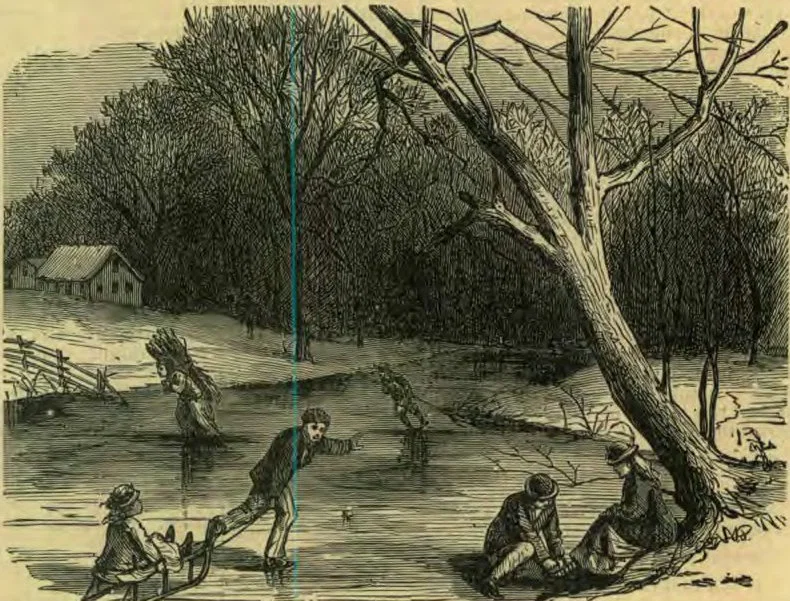
OLD Winter comes forth in his robe of white, He sends the sweet flowers far out of sight. He robs the trees of their green leaves quite, And freezes the pond and river; He has spoiled the butterfly's pretty vest, And ordered the birds not to build their nest, And banished the frog to a four months' rest, And makes all the children shiver.
Yet he does some good with his icy tread; For he keeps the corn-seeds warm in their bed, He dries up the damp which the rain has spread, And renders the air more healthy. He taught the boys to slide, and he flung Rich Christmas gifts o'er the old and young, And when cries for food from the poor were wrung, He opened the purse of the wealthy.
We like the Spring, with its fine fresh air; We like the Summer, with flowers so fair; We like the fruits we in Autumn share; And we like, too, old Winter's greeting: His touch is cold, but his heart is warm; So, though he brings to us snow and storm, We look with a smile on his well-known form, And ours is a gladsome meeting.
—Selected.

Kindness as a Means of Grace

KIND looks, kind words, kind acts, and warm handshakes—these are secondary means of grace when men are in trouble, and are fighting their unseen battles.

Letter Budget.

John C. Yates, of Greenwood Co., Kan., writes: “As I have never written for the INSTRUCTOR, and take much interest in the letters, I thought I would let you see my name in the Budget. I am a little boy ten years old. I live in sunny Kansas. We had nice weather a good while when the INSTRUCTOR was talking of snow and winter. The first snow here fell December 6, and was very light. I go to day school, and study third reader, spelling, arithmetic, writing, and language. We have forty-five scholars. I attend Sabbath-school with my parents, and two sisters, one of whom is fifteen, and the other seven, years of age. There are thirteen members in our Sabbath-school. I study Book No. 2. I want to be a good boy, and have a home in the new earth.”
Since John’s letter was written, two months ago, it may be that old Winter has left his snowy blanket more than once in Kansas; for he has been stealthily creeping here and there, even into territory where it has been thought he had no right to enter. But most of the boys rather enjoy some ice and snow.
Here we have a letter from little Lynn Tozer, who says: “I live in Grand Rapids, Mich. I have two sisters and one little brother. We all keep the Sabbath with my mamma. We do not have any meetings or Sabbath-school here now except what my mamma has at home for us. I go to day school right across the street; and it makes it real nice this cold weather. I have a kittie that looks just like a tiger. I have had her most three years. I am always glad to get the INSTRUCTOR. My aunt sends it to me. After I read my papers, I give them to the little boys about here. I have never seen a little letter from here, and so I thought I would write one. I hope this will be printed. I am eight years old.”
Lynn’s letter was written all by himself, in a very plain hand, with every word spelled correctly. We always print such bright, intelligent letters; and we have many such, as you see in the Budget from week to week.
Bertie I. Van Horn writes from Eaton Co., Mich. He says: “This is the second time that I have written for the INSTRUCTOR. I go to day school, and am in the fourth grade. We learn texts of Scripture every week, and repeat the Lord’s prayer every morning in concert. I paid tithes on what grew in my garden last summer, and last Christmas I paid one dollar to the European missions. I go to Sabbath-school and learn lessons in Book No. 4. I was baptized last fall, on my eleventh birthday. I want to be a good boy and keep God’s commandments. I like my INSTRUCTOR very much, and think the Budget is very interesting.”
Thanks for your letter, Bertie. The Budget is becoming more interesting because the letter writers are trying to make it so, by writing something all like to read. Boys and girls who are cultivating the gifts of speech, hearing, and seeing, which God has given them, and who are trying to lead pure and useful lives, will have something good for the Budget. Don’t you find it so?
Jennie M. Smith writes from California. She says: “As I never wrote a letter for the Budget, I thought I would write one. I go to Sabbath-school every Sabbath, and study in Book No. 4. We have a nice Sabbath-school. We came to Healdsburg last April. I have been perfect in my Sabbath-school lessons ever since I came. My sister Maud and I attend the college. Sister is ten, and I will soon be twelve. My studies are Bible, language, reading, geography, arithmetic, spelling, and writing. We went to the Coast last summer, and camped on the beach four days. We had a nice time gathering shells, chasing the waves, and watching the ships pass. It was so nice to watch the waves dash up against the rocks. We saw the fishermen go out in small boats at sea to catch fish. We would think the waves would drown them, but soon we would see them come up again. Once when the fishermen went out, they returned with a small shark in their net. We enjoyed ourselves so well that papa says we will go again next summer if nothing happens. Last winter we lived in Kansas. Maud and I went to school two months, and had to wade in snow. It is much nicer here, for instead of snow, we have green grass and flowers. We had nice times Christmas at the College. We had singing and speaking, and considerable money was given to the foreign missions. I am trying to be a good girl, so as to meet you all in heaven.”
You have written a very entertaining letter, Jennie. Your stay on the beach was an enjoyable affair. “They that go down to the sea in ships, . . . these see the works of the Lord, and his wonders in the deep,” as those do not who remain quietly on the land. But some of the wonders of the mighty deep may be seen even on the Coast. You are fortunate to have such good school advantages.

You have reached the end of this edition.

The Youth’s Instructor · Feb 17, 1886