Your ShelfYour Projects

Review and Herald, Vol. 85, No. 20.

The Plodder's Petition
Earlier text: The Central American Conference

Our Girls' School in Korea

Korea

SOONAN.—Our school opened December 9. Our girls’ school is small, but we enjoy much of God’s blessing while studying together. I have six students at present. For a while there were eight; but the husband of one, and the mother-in-law of another, would not permit them to continue to attend.
Children are married between the ages of twelve and fifteen. It is said that one can not find a girl fifteen years old who is not married. After she is married, she has to live in the house of her mother-in-law, and is nothing more than a slave.
One meets with many interesting experiences each day. From the first I tried to impress upon the students that all should be modestly dressed, washed, with hair combed, before entering the schoolroom. One morning, however, when I was speaking to the smaller girls, one of my oldest students (aged twenty-nine) said that I should not require the younger girls to be washed, and have the hair combed every day; for that was difficult to do. She also said: “Since I attend school, I comb my hair every day; but I do it in the evening, and wash my face in the morning.” A few days later she came, and said: “Teacher, please excuse me. I had no time to wash my face this morning.”
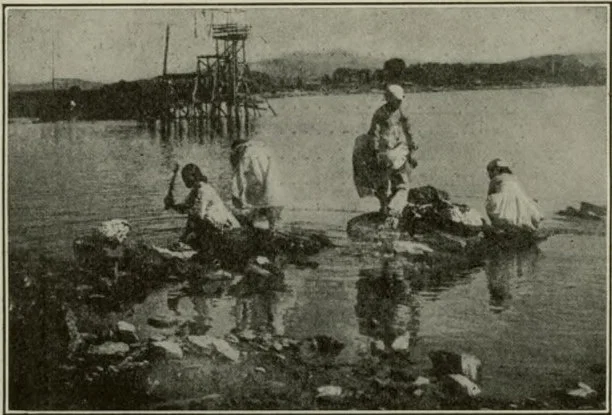
NATIVE LAUNDRY, KOREA
I teach Bible, arithmetic, physiology, and geography. My language teacher also gives the girls lessons in reading and writing. We find few women who can read, and many are not allowed to learn, even if they wish to do so. It depends often upon the mothers-in-law, whether or not they will be allowed to learn. Their husbands, also, will tell them that their work is to cook and sew, etc. According to the custom here, it is a shame for a man to work. The women have to labor in the fields, usually with their babies tied on their backs. They must also do all their own spinning and weaving for the clothing they need.
But these dear sisters feel very thankful when they hear how our Saviour came to die for them. Even in homes where the men are professedly Christians, the women seem to be kept under the impression that they can not be saved, if they have families to take care of. I have come in contact with quite a number who told me that they had always been taught that they could not be saved. With tears in their eyes, they began to thank me for telling them that Jesus came to die for them, and that they can receive help in all their trials each day, by going to him in their need.
It is surprising how quickly they learn. If we give them an opportunity, I believe they will put to shame many of us who have been in favorable surroundings all our lives.
I hope that very soon an experienced teacher for the girls will be able to come. I had had no experience in school work before coming here, and I have to learn each day along with the students. The three oldest have come with the intention of preparing for service. They are very promising young women. I love these people, and only hope that soon more workers will come to this field, to help give the last warning message to them. I am well, and of good courage, and trusting for help in Him who has promised to be with us always.
MIMI SCHARFFENBERG.

G. W. ANGLEBARGER

Colorado

DENVER.—Since last September seventy-eight persons have been added to the church. The Lord has wonderfully blessed our church in its efforts. We have placed many tracts in the homes of the people, and we are now planning to put out another tract on the temperance question, as this subject is agitating the minds of the people as never before in this city. We are planning to hold about fifty cottage meetings in the city. The way is opening up in a remarkable manner for the message, and we see many indications that the Lord is leading, and impressing souls with the importance of this truth.

G. W. ANGLEBARGER

Field Notes and Gleanings

AT the time of a recent visit of Brother Eugene Leland to the church on the Indian Reserve near Brantford, Ontario, two new members were received into the church, the ordinances were celebrated, and the elder of the church was ordained.
FROM Prescott, Ariz., Brother I. P. Dillon writes that nine adults have taken their stand for the truth, and there are still others greatly interested. This result is due largely to the meetings held by Brother F. W. Wheeler and himself in a school-house in the suburbs of the city.
BROTHER B. L. DIFFENBACHER writes: “Since coming to Colorado a few weeks ago, God has greatly blessed me in my labors for him. Sabbath, April 11, I buried eight dear souls with their Lord in baptism. Six of these were from Eaton, where I held meetings for four weeks. These were all taken into the church, and one sister was received subject to baptism.”
OF the work at Union City, Mich., Brother John E. Hanson writes: “Four have been added to the roll of membership since our arrival, making twenty in all, and there are more who will join soon. Twenty-nine were present at our last Sabbath service. We are holding services and Bible readings nearly every day, and more often twice a day, with good results. The Lord has greatly blessed the labors of Sister Cleora Green, and I believe that we shall see many more precious souls gathered in as the result of the faithful work done here.”

Early Experiences in the Publishing Work—No. 2

In a former article we left Mrs. Bates in a sad state of mind, because she had just learned that their last money had been expended; and Brother Bates was at his desk full of faith and courage, preparing the manuscript for the first Sabbath tract published by a Seventh-day Adventist. As he sat writing, and Mrs. Bates was in her room mourning, the impression came to him, as strongly as if spoken in an audible voice, “Go to the post-office; there is a letter there for you.” He said to himself, “I do not know who would write me,” and attempted to go on with his writing; but the impression came again, stronger still, “Go to the post-office; there is a letter for you.” So he obeyed the impression, laid aside his pen, and went to the post-office. Sure enough, there was a letter addressed to him; but the postage on it was not paid. In those days prepayment of postage was optional with the sender of a letter; but the receiver in that case must pay the postage before receiving the letter from the postmaster. So here Brother Bates was humbled again; for he must tell the postmaster, with whom he was well acquainted, that he had no money with which to pay the postage. The postmaster, however, urged him to take the letter and pay when he got the money. “No,” said Brother Bates, “I am not going to cause you to disobey orders, for you have no right to let the letter go until the postage has been paid; but it is my impression that there is money in that letter. You break the seal, and open the letter. If there is money in it, take the postage out of the money. If there is no money, I will not receive nor read the letter until the postage is paid.”
Accordingly, the postmaster broke the seal and opened the letter, when out came a bright ten-dollar bill. While the change was being counted out for Brother Bates, he read the letter. It was from a stranger, who had heard of his work, and who was so strongly impressed that he was in need of money that in hurrying off the same, he probably forgot to pay the postage on the letter.
Our tender-hearted Brother Bates had by no means forgotten the weeping wife at home, and his first move was to send some consolation there. He went at once to a provision store to secure commodities for the table. Let it be remembered that in 1845-46 ten dollars would buy more than twice as much for family use as a like amount will now purchase. He got a whole barrel of flour for four dollars. He ordered potatoes, sugar, and other supplies, and said to a drayman, “Load this on your truck, and deliver the goods on the front porch at such a street and number. Probably the woman will tell you that the goods do not belong there; but pay no attention to that. You unload the goods just as I have told you.”
“Yes, captain,” said the drayman, “I will do just as you have ordered.”
Then Brother Bates went to see a printer, and said, “I am going to write a book, and wish you simply to set the type, and print the sheets. I can fold and stitch the pages myself. I wish you to furnish me proofs of the galleys, which I will read. I expect to have money, and will pay you as fast as I receive it. I will not take the one thousand printed sheets until you are fully paid. Will you take the job on such terms?” “Yes,” responded Mr. Lindsay, the printer, “and you may bring on your copy as fast as you please.”
Then Brother Bates secured his writing-paper, and goose quills for pens; for we had neither gold nor steel pens at that time. While thus employed, he gave ample time for the grocer’s supplies to reach his home.
When he passed down the street to his home, Brother Bates saw that the goods were on the front porch; but he went into the back door of his house, and seated himself at his desk to resume his writing as if oblivious to anything that had occurred. Just then Mrs. Bates came to him, and said, “Joseph, just look out there on the front porch!” He, apparently unconcerned, arose and said, “What is the matter?” “Why,” said she, “a little while ago a drayman came here, and unloaded that barrel of flour, and all that stuff on the front porch. I told him he had surely made a mistake, for it did not belong here, and that we had no money with which to buy such things. I tried to get him to take it away, but he persisted that this was the exact number where it was to be left. And he left it all, and drove off.”
“Well,” said Brother Bates, “I guess it’s all right.” “But,” said Mrs. Bates, “where in the world did it come from?” “The Lord sent it,” was Brother Bates’s calm reply. “Yes,” said Mrs. Bates, “that’s what you always say, the Lord sent it.” “Well,” said Brother Bates, taking the letter out of his pocket and handing it to his wife, “you read that letter, and you will learn where it came from.” She read the letter, and in a flood of penitential tears retired to her room for another hour of weeping, far different, however, from the first. In that hour of confession of her lack of faith, and trust in God, she was enabled to make a new consecration to God, and take a firmer hold of that faith manifested through her husband, whom God was thrusting out as a pioneer of the third angel’s message to the world. The experience of that day not only gave fresh courage to Brother Bates in the work upon which he had entered; but better fitted her to stand as a faithful helper, without murmuring, in the conflicts through which he might be called to pass. So wrought the Lord in leading this apostle of the message through some of the “narrows” connected with the early development of this cause.
J. N. LOUGHBOROUGH.

Canvassers’ Summary for March, 1908

Agents Hours Orders Value
Atlantic Union Conference
Central New England 17 1103 268 $1,048.20
Southern New England 1 81 9 23.00
Maine 3 32 9 25.15
Vermont 6 144 61 130.00
Western New York 18 780 407 624.25
Greater New York 13 592 269 759.75
New York 8 308 107 327.55
Totals 66 3040 1130 2,937.90
Columbia Union Conference
Ohio 13 958 448 797.40
West Virginia 9 840 245 502.35
Chesapeake 5 336 342 447.10
East Pennsylvania 8 440 157 336.65
West Pennsylvania 4 22 32 139.90
Virginia 10 300 190 260.65
New Jersey 3 ... 32 80.10
Totals 52 2896 1446 2,564.15
Lake Union Conference
Southern Illinois 5 74 22 59.55
Northern Illinois 3 178 77 181.50
North Michigan 9 740 162 441.70
West Michigan 1 9 1 2.50
Indiana 4 376 77 243.15
Wisconsin 11 349 33 110.70
Totals 33 1726 372 1,039.10
Southern Union Conference
Alabama 5 103 60 106.50
Kentucky 1 37 24 29.75
Louisiana 9 666 209 489.25
Mississippi 3 165 99 151.00
Tennessee 10 537 425 789.75
Totals 28 1508 817 1,566.25
Southeastern Union Conference
Cumberland 5 289 175 240.50
Florida 3 99 13 54.15
Georgia 13 601 246 404.70
North Carolina 8 377 283 338.20
South Carolina 9 704 649 736.60
Totals 38 2070 1366 1,774.15
Central Union Conference
Colorado 8 399 90 310.70
Kansas (two months) 19 1049 286 1,002.00
Nebraska 5 301 104 428.35
Wyoming 2 ... 23 73.75
Totals 34 1749 503 1,814.80
Southwestern Union Conference
Arkansas 7 39 11 37.00
Oklahoma 12 485 124 374.40
Texas 8 662 253 859.80
Totals 27 1186 388 1,271.20
North Pacific Union Conference
Upper Columbia 2 246 115 296.00
Southern Idaho 3 178 104 529.95
Western Oregon 2 172 50 241.95
Western Washington 3 210 99 260.30
Montana 3 50 71 213.85
Totals 13 856 439 1,542.05
Northern Union Conference
Iowa 8 648 141 310.75
Pacific Union Conference
California 12 ... 400 996.05
So. California 6 ... ... 99.90
Totals 18 ... 400 1,095.95
Australasian Union Conference .. 3206 1221 4,634.25
South African Union Conference .. 1176 121 653.00
Canadian Union Conference 3 150 91 166.75
British Union Conference 63 3974 1831 2,583.00
German Union Conference 257 ... ... 7,494.56
Mexican Mission (two months) 4 ... ... 216.00
South American Union Conference .. ... ... 592.49
Scandinavian Union Conference 64 7626 5746 4,133.74

General Summary

Atlantic Union      66   3040   1130   2,937.90 Columbia Union     52   2896   1446   2,564.15 Lake Union       33   1726   372    1,039.10 Southern Union     28   1508   817    1,566.25 Southeastern Union   38   2070   1366   1,774.15 Central Union      34   1749   503    1,814.80 Southwestern Union   27   1186   388    1,271.20 North Pacific Union   13   856   439    1,542.05 Northern Union     8   648   141    310.75 Pacific Union      18   ...   400    1,095.95 Australasian Union   ...  3206   1221   4,634.25 South African Union  ...  1171   121    653.00 Canadian Union     3   150   91    166.75 British Union      63   3974   1831   2,583.00 German Union      257  ...   ...    7,494.56 Mexican Union (two months) 4  ...   ...    216.00 South American Union  ...  ...   ...    592.49 Scandinavian Union   64   7626   5746   4,133.74 Grand Totals      708  31,806  16,012  $36,390.09

The Publishing Work

Conducted under the auspices of the General Conference Publishing Department.
C. H. JONES - - - - Chairman
E. R. PALMER - - - - Secretary
H. H. HALL - - - Assistant Secretary

Book Delivering in Georgia

I HAVE been asked many times what per cent of our orders we could deliver in Georgia. For the benefit of those who may be interested, I will give the actual records of two experienced canvassers who began work about Nov. 10, 1907, and stopped March 2, 1908.
One worked 380 hours, taking 155 orders for “Coming King,” and 538 for “Best Stories;” total value of orders, $473.35. He delivered 111 copies of “Coming King” and 310 of “Bible Stories,” and 4 Bibles; total value of deliveries, $282.10. This was at the rate of about thirty-seven cents an hour, or $3.70 for a day of ten hours profit to the canvasser.
The other worked 701 hours, taking 301 orders for “Coming King,” and about 657 for “Best Stories;” total value, $711.65. He delivered 222 copies of “Coming King;” 488 of “Best Stories;” 2 of “Daniel and the Revelation;” 3 of “New Testament Primer;” and 2 Bibles; total value of books delivered, $567.85. This makes a profit of about forty cents an hour, or $4 for a day of ten hours.
These are the actual records, as shown on the State agent’s books. So you may figure all you wish, and compare this with other records made in other places at the same time,—during the financial panic,—and see how they compare. This work was done in Columbus, Ga.
We have many cities which are just as good territory, and one hundred forty-six counties, many of them excellent territory. If you want good territory, let us know.
A. L. MANOUS, Field Agent.
602 Capital Ave., Atlanta, Ga.

The Easiest Excuse: Persuading Oneself Out of Duty

“ONE of the easiest things for some people to do is to persuade themselves that it is not their duty to do anything.”

Christian Liberty

Reports, Notes, and Comments Pertaining to the Current History of the Rights of Conscience

Conducted by the Religious Liberty Bureau
K. C. RUSSELL, Chairman
W. A. COLCORD, Secretary

The Sunday Law Cases at Kansas City

I WILL report concerning the status of the cases now well known as the Theatrical Sunday law cases of Kansas City, in which it is sought to show that the selling of tickets and ushering of people to their seats, etc., on Sunday, is “labor” within the meaning of the statute, and to restrain it. The cases, as all know, were first brought to national view by the sweeping decision of Judge W. H. Wallace in January, in which he stated that ministers and judges were united in the work of protecting the Sabbath from desecration; and the wholesale indictments—two thousand and over—which followed. As all must see, the chief question in the minds of public citizens has been, “What is, and what is not, permissible on Sunday? What constitutes ‘labor’ on the Christian Sabbath according to an act of assembly?” whereas it ought to be, “Should Sunday as a religious institution be protected at all by civil law?”
Feeling that Judge Wallace was prejudiced against them, and unfair in his decisions, the theater managers secured a writ of mandamus from the supreme court, practically compelling Judge Wallace to transfer the numerous cases to Judge Porterfield's court, the second division of the criminal court. In the first case tried, conviction failed on account of disagreement of the jury. The second trial resulted in conviction of the defendant, and a nominal fine of one dollar. Then came a caustic censure of Judge Porterfield's court and jury by Judge Wallace, upon failure to convict in the first case. This was resented by Judge Porterfield in his court. A surprising result has been reached in this peculiar way. The courts, at variance upon contested points, have evidently turned the legal scales in favor of the defendants. Finding that the evidence in three thousand cases was wholly insufficient, County Prosecutor Kimball, on April 20 in Judge Porterfield's court in the brief space of five minutes, dismissed three thousand cases, and cleared the docket to April 3.
This is not the end of the crusade, however, though it strongly indicates a final collapse. This week the grand jury will indict other theater folks who worked in the playhouses last Sunday, but none of these will be tried until after Saturday, when an argument for and against a new trial in the case of the only theater manager found guilty, will be heard. In the meantime the reports of the theater cases are occupying prominent columns in the journals of Kansas City, and the public is thinking upon the right and wrong of the question. It is to be hoped that the questions of civil and religious rights may yet work into and claim the attention of those engaged in this crusade for Sunday enforcement.
JOHN S. WIGHTMAN.

Current Mention

— On May 4 the Senate ratified a treaty for “more accurately defining and marking the international boundary-line between the United States and the Dominion of Canada.” The convention was signed April 11 by Secretary Root and Hon. James Bryce, ambassador from Great Britain.
— As a sequel of the street-car strike in Chester, Pa., the children of one of the schools are on strike because two of the teachers rode on the street-car manned by strikebreakers. As a climax the mothers of the children demanded of the school board that these teachers resign. The parents were promised that the teachers would apologize to the children, and also publish an apology in the local newspapers.
— The centenary of the organization of the Roman Catholic Diocese of New York was celebrated the last days of April. Cardinal Logue, who participated in the ceremonies, said of the parade of 30,000 Catholic laymen on May 2: “I never saw such an impressive gathering in all my life, and I never expect again to witness such a demonstration of loyalty to the Catholic faith. I have seen processions in various Catholic countries, at Rome and elsewhere, but nothing to equal this.”
— The retail and wholesale prices now being charged for meats of all kind are the highest recorded in seven years, being an increase of from two to seven cents a pound over the prices of one year ago. There seems to be a difference of opinion as to the cause, some attributing it to the so-called beef trust, while others believe it to be due to a scarcity of cattle. Public protest against these high prices has taken the form of refusal to buy. As a result it is reported that the sales within the last month have fallen off fifty per cent in Chicago and other large cities.
— The action of Austria in breaking away from the concert of the powers in regard to Turkey by her railroad proposals has caused other nations to push forward their claims. Italy demanded that she be allowed to establish post-offices in six principal cities of the Turkish empire, the same as other nations; and when her request was refused by the porte, on the ground that those of other nations were permitted by sufferance rather than by treaty, prepared a fleet to be despatched to Asia Minor. On receiving the news of the proposed demonstration, the porte met all the demands, conceding not only the right to independent post-offices, but also the purchase of land in Turkish territory, and coast navigation and commerce. France is in conflict with the Turkish government regarding coal-mines at Ereğli, in Asia Minor, in which a French company is interested to the extent of $15,000,000. The owners refuse to give up the concession to the Turkish government, which wishes to regain control, until the porte furnishes proof of his ability to provide funds for the purchase. France will make no further Turkish loans until the matter is settled, and the French embassy has notified the porte that France will require an indemnity of $2,500 for every day that settlement is deferred, in addition to $2,800,000 for losses already incurred by the company through the disturbances.
— In order further to pursue her study of the Yoga philosophy, a mystic cult imported from India, the wife of President W. E. Stone, of Purdue (Ind.) University, has withdrawn from the world, her husband, and her family. One bit of the philosophy runs, “So long as one is tied or attached to any particular person or thing, so that his happiness seems dependent thereon, he is the slave of that person or thing.” President Stone will likely be obliged to give up his work on account of impaired health because of his wife’s course, but hopes that mother-love will ultimately predominate, and she will return to her boys.
— The turbulent tribes on the north-west frontier of India have been giving trouble to the British, and the moderate means taken to suppress them seem to have been unsuccessful. On May 1 a large body of Afghan troops, numbering from 13,000 to 20,000, crossed the border, and made an attack upon the blockhouses that guard the Afghan end of Khyber Pass. This attack was repulsed by the British troops, but from all appearances the ameer of Afghanistan must have known of the preparation for this raid, which was made by militia levies commanded by Afghan officers. A few weeks ago the ameer refused to sign the Anglo-Russian agreement, which states that Afghanistan is within the British sphere of influence. While the British are thus occupied on the frontier, the disaffected party among the natives of India shows a tendency to adopt more violent measures. A bomb explosion at Muzaffarpur in Bengal led to the discovery of an extensive plot centering in Calcutta. There the police unearthed much seditious literature and a large number of bombs and cartridges, evidently prepared for an attack upon the British authorities.
— Since the attempt to assassinate President Cabrera of Guatemala some weeks ago, he has adopted tyrannical measures, and is reported to have put to death hundreds of persons. General Vasquez, former president of Honduras, is reported to have planned a revolution against the present Honduran government, and is believed to have the support of Cabrera. Honduran troops have been massed on the Guatemalan border. A special envoy sent from Honduras to Guatemala was obliged to take refuge in the Mexican legation, and the Mexican government has refused demands to surrender him, fearing the man will be shot. Mexican troops were reported to be massed on the Guatemalan frontier, and the government at Washington has been asked by Guatemala to demand an explanation of Mexico. Mexico denies the presence of any troops except the regular frontier guard. Secretary Root has addressed a note to the Guatemalan government urging that every Central American government be represented at the opening of the Central American Court of Justice, which is soon to assemble in the city of Cartago, Costa Rica. If Cabrera should decline to send representatives, the government of the United States and Mexico would be forced to consider measures to compel him to do so.

Resolutions Relating to Religious Liberty Work and Temperance

THE following resolutions were adopted by the General Conference Committee Council, recently held in Washington, D. C.:—
Whereas, the forces which are seeking to secure Sunday legislation throughout the country are rapidly molding public sentiment in favor of such legislation; and,—
Whereas, In order to meet this growing evil, our people should be thoroughly organized; therefore,—
Resolved, That we recommend that our union and local conferences so perfect their organization for religious liberty work in their respective territories that during the coming year every citizen within the limits of each conference may in some way be warned of the coming crisis.
Whereas, There is great need of qualified workers to engage in the religious liberty work; therefore,—
Resolved, That we recommend that instruction upon the principles of religious liberty be given in all our schools, and that suitable persons be selected by our union and local conferences to assist in carrying on aggressive religious liberty work in the States and at Washington, D. C., whenever campaigns are being conducted for Sunday enforcement, for the experience and education they would receive from such work.
Whereas, Experience has demonstrated that the holding of institutes and like assemblies is an excellent method of educating our workers and people concerning different phases of the truth; therefore,—
Resolved, That we recommend the holding of religious liberty institutes, councils, and conventions in our local and union conferences, as far as practical arrangements can be made for conducting them.
Whereas, Much may be accomplished in enlightening the people upon the principles of religious liberty and the great issues involved in religious legislation through the dissemination of literature; therefore,—
Resolved, That we urge upon our people everywhere throughout the United States and Canada that they give as wide a circulation as possible to our magazine Liberty and our religious liberty tracts and leaflets.
Whereas, The liquor traffic is a great social evil, a menace to the home, the city, the state, and the nation; and,—
Whereas, There is a great movement in this country to stay the tide of this iniquitous traffic; therefore,—
Resolved, That we put forth every consistent and laudable effort in opposing the liquor traffic by our example, our pen, our voice, and our vote.

Religious Liberty Address Delivered at Minneapolis

AN address on religious liberty was recently delivered at Minneapolis, Minn., by Henry W. Rose, who attempted to answer the question, “What do these things mean?” The speaker quoted the statement of Rev. H. W. Fraser, of Vancouver, B. C., who said that “dearth of other attractions forced the people to go to churches on the sabbath [Sunday],” and said that “the obvious underlying motive of this Sunday agitation was to compel people, willy-nilly, to go to church.”

The Kobe Sanitarium

DURING the last year the Lord has blessed in the work to a greater degree than we had dared to hope. Many times the way has seemed to be hedged up with difficulties, and at times it has seemed as if the work must be closed up here. However, the trials and difficulties have caused us to seek God more earnestly, and we have not been disappointed; for he has helped us.
When my wife and I first came here, there was one patient, as the institution had been without a physician for some time. But the patients soon began to come in, and from that time to this we have more than paid expenses. At present, the institution is crowded, and during the last week we have had to refuse admittance to three patients because of lack of room.
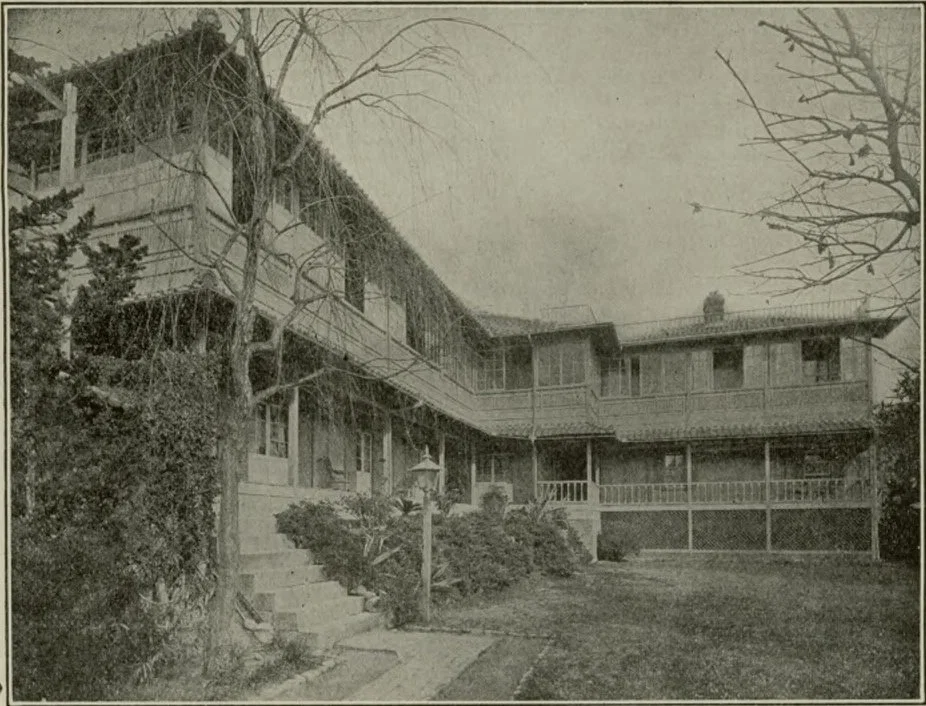
THE KOBE SANITARIUM
THE KOBE SANITARIUM
From the very first, the Lord has sent us patients as fast as we have been able to take care of them. After we were well settled here, I received notice that I must pass the regular examination in order to practise in Japan. If I continued to practise before I had passed this examination, they informed me that I would be arrested and fined. As the law then read, it would take nearly two years before I would receive my certificate, as I would have to take three examinations several months apart. This would mean the closing up of our medical work here. For a time there seemed to be no other alternative, but finally a high official took hold of the matter for us, and after a great deal of patient effort the ordinance was changed so that foreigners would be allowed to take all the examinations at one time. Then I took the examinations, my papers were examined as soon as I had written them, and I was given my certificate.
It seemed providential that before I received my certificate, very few local patients came. However, after this they began to come in quite fast, so that now many of the townspeople are our patients. We have religious services every day, and many of the patients ask why we keep the Sabbath, etc. Thus we have had the opportunity to present the truth. The majority of our patients are missionaries from Japan, Korea, and China, and it is hard to estimate the good that the seed sown here will do. From time to time we have had a large portion of all the missionaries here in Japan at our sanitarium, and many missionaries, from other parts of the Orient. We hold services with them every day, and I am sure that these prayer-meetings bring us all nearer together, and nearer to God.
In the last year we have bought and paid for new equipment valued at one thousand dollars (gold), added five hundred dollars to our bank account out of our earnings, and paid part of our small debt. So we feel that the Lord has blessed us in a temporal way also.
Our sanitarium workers are few, and for a long time we had to work very hard; but now that Miss Dehn has come to help us, the work will be easier for all. The greatest problem that we now have to deal with is the language. It is essential that we learn the language, but it is very difficult most of the time to get much opportunity to study while engaged in the sanitarium work.
We are hoping soon to secure a larger and better equipped institution in the country. This institution will be for both Japanese and foreigners, and we are also planning to have a training-school in connection with it. This will enable us to give our native young people a training in health principles and in simple treatments, and evangelistic work as well. The work surely is great, and as we lay the foundation for a larger and broader work, we need your prayers that we may keep close to God, and be guided by him in all our plans for the future.
W. C. DUNSCOMBE, M. D.

Medical Missionary Department

Conducted by the Medical Department of the General Conference
W. A. GEORGE, M. D., - - - Chairman
W. A. RUBLE, M. D., - - - Secretary

Medical Missionary Call from the Swiss Field and Korea

Findings

An urgent call was made at the late General Conference Committee Council from the Swiss field for a French-speaking physician to prepare for medical missionary work in that field. Who will be the man?
Dr. Riley Russell, who will be graduated from the George Washington University this spring, has been invited by the General Conference Committee to go to Korea to labor as a medical missionary.
In sending his regrets from the Nashville Sanitarium, that he could not attend the late General Conference Council in Takoma Park, D. C., Dr. W. A. George says: “Our work here seems to be well on the way to being self-supporting, and I do not want to do anything that is likely to hinder it in any way. Several physicians are sending us patients from Nashville and other places, and I must be here to take care of them, or they will not be satisfied.”
The Secretary of the Medical Department urgently repeats his request that medical missionary workers in the field should render their assistance both to this department of the REVIEW and to the similar department in Life and Health, by reporting such experiences as will be a benefit to the readers of these journals. General interest in this department of the work will be greatly stimulated by information concerning the medical missionary work which is actually being done.
Brother Sam. Koenigmacher and wife have lately gone from the St. Helena Sanitarium to Nyassaland to assist in the work in that field. Mr. Koenigmacher has for a number of years acted as head nurse in the St. Helena Sanitarium. His presence and that of his wife will be much missed in the work at St. Helena, but as Dr. Rand writes, they are always willing to give up even their best help to go to the regions beyond to help in carrying the message. The St. Helena Sanitarium has lately sent Miss Dehn to Kobe, Japan, to answer a call for a nurse in that field. St. Helena is approaching the record made last year by the Boulder Sanitarium, in furnishing workers for foreign fields. All our sanitariums should vie with one another in this matter, because there is so much need of consecrated nurses in these dark parts of the world.
Dr. R. M. Clarke has been transferred from the Knowlton, Quebec, Sanitarium, where he has been laboring for a number of months, to the Moline Sanitarium. It has seemed best to transfer the medical missionary work that has been done at Knowlton, to the city of Quebec as soon as arrangements can be made in that city for treatment rooms. The institution has been prospered under Dr. Clarke’s supervision, but on account of the stringent medical requirements in the Province of Quebec, it is not possible for an American graduate in medicine to become registered in that province. What work we do there must be done by nurses until we can find a man who has both a medical degree and a literary degree from a French or English University. Dr. Clarke spent a few days in Washington on his way to Moline, where he will be located for some time to come.
Continue reading: Greater New York Conference