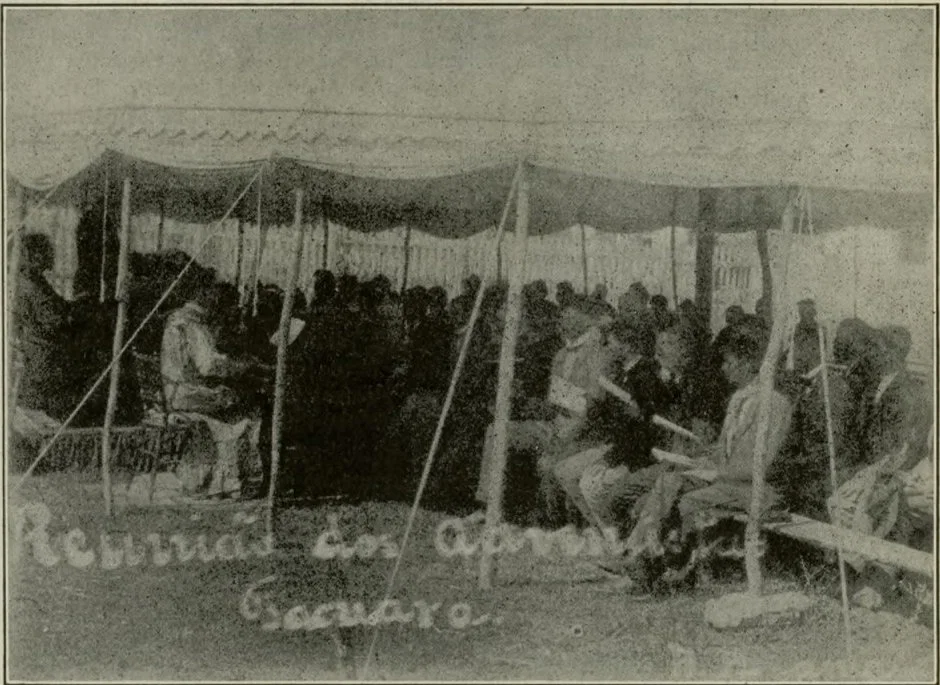
ACCORDING to appointment this meeting convened at Coxen Hole, Ruatan, Bay Islands, March 5-15. A lovely cocoanut grove was secured for the camp-ground. A beautiful stream of water ran through the grounds, emptying into the sea not far away. This was the first representative gathering of our people ever held in this field. Some fears were entertained regarding the attendance; but in this we were happily surprised, for on the opening day nearly all who were coming were on hand. The attendance of our own people was about one hundred fifty, while many not of our faith were present throughout the meeting.
We were glad to see Elder W. A. Spicer present the first day. Elder U. Bender, president of the West Indian Union, was unable to reach us. He had come as far as New Orleans, but was unable to get a boat from there. In a land of railroads, such as the United States, there is no fear of being late at a camp-meeting; but here it is different. Those who come to the islands must come by sail-boat; and of course if the wind fails when one is on his way to a meeting, he is likely to be belated; however, we were very fortunate this year.
The spiritual atmosphere of the meeting was excellent, and many hearts were subdued by the Spirit of God. A regular camp-meeting program was carried out, although it threw considerable work on our small force of laborers, Elder Spicer and the writer being the only ministers in attendance. A book tent, grocery tent, and dining tent were operated with good success.
After due consideration and discussion, this mission field was organized into a conference, its territory to consist of Spanish Honduras, Bay Islands, British Honduras, Guatemala, and Salvador, with a population of three million five hundred thousand. Of this number perhaps fifty thousand speak English; most of the rest speak Spanish. It can be easily seen that we have a great work before us.
It has been eighteen years since the truth first came to this country. There has been a steady advance all this time; but when the field was organized into a conference, the brethren and sisters took new courage. When the motion to organize a conference was acted upon, the congregation arose, and sang, with renewed zeal, “Praise God from Whom All Blessings Flow.” While the enemy is causing some to believe and teach that organization is a step toward the papacy, God’s people are made to rejoice that the Lord continues to organize his work and workers throughout the whole world, that they may go up as one man against the strongholds of the enemy.
As we met each morning at nine o’clock in conference session, and discussed the work we have before us, our brethren obtained a new view of what it means to be a Seventh-day Adventist. An unwarned world, with the troubles of the last days upon us, is something for us to think about. In this field as in all mission fields we feel that our great need at present is more workers. But we have the assurance that the Lord of the harvest is watching, and will supply the workers in time.
We have a strong force of young people who will be able to bear burdens after receiving some training. But we have as yet no regular training-school. Sister Ida Shirley has a normal class in Bonacca, and we trust that this will be a help to us in this direction for a time at least.
The officers elected for the coming year were as follows: President, E. L. Cardey; Secretary and Treasurer, Mrs. Ethel T. Nowlen; Sabbath-school Secretary and Secretary of the Young People’s work, Ida I. Shirley; assistant, Miss Alma Osgood; Educational Secretary, J. G. Smalley. Conference Committee: E. L. Cardey, C. A. Nowlen, C. E. Morgan, David Haylock, C. Jones. The committee on licenses and credentials13submitted the following report: Ministerial credentials, E. L. Cardey; missionary credentials, J. G. Smalley, C. E. Morgan, F. E. Carey, C. A. Nowlen, Ida I. Shirley, Ethel T. Nowlen, John J. Woods. The following are some of the resolutions passed:—
“Resolved, That the new Central American Conference send greetings to our brethren of the West Indian Union Conference and to our brethren in all the world, assuring them that we will join heartily with them in hastening the message to the world, that the work may be quickly finished.”
“Whereas, The General Conference Committee has kindly responded to our call for a representative of that body to join with us in this meeting; therefore,—
“Resolved, That we heartily thank them for the timely help thus rendered.”
Many important decisions were reached relative to pushing the work into the unentered parts of our territory. It was decided that immediate steps be taken to open work in the unentered republic of Guatemala. As we talked of advancing into these dark, unentered countries, courage and good cheer filled every heart, and a reconsecration to service was made. If our present plans carry, we shall have entered Guatemala by the time this report reaches the readers of the REVIEW.
Elder Spicer’s words of counsel and instruction will long be remembered by the believers who attended the meeting, and will have a lasting effect upon our work.
Now and then, I have noticed, the cry is raised by some one, “Why do the leading brethren make such long journeys to attend a meeting?” To such we would say, Could you be in a foreign field, separated from the counsel and advice of experienced workers, and see the good effect a visit of a General Conference worker has upon our brethren in foreign lands, the question would be forever settled why such long trips, involving expense, seasickness, and other hardships and discomforts, are undertaken.
A good interest was awakened in the town, and each night from six hundred to seven hundred persons were in attendance. The meetings were continued one week after the camp-meeting closed. Some have already accepted the truth, while many others are convinced of what they should do. We trust many will decide aright. A lot and material have been donated for a church building, and already work has been begun on it. Brother J. G. Smalley will look after the interests there. Before the camp broke up, it was decided that our next meeting should be held in Belize, British Honduras, in the spring of 1909, the Lord willing.
The last Sabbath of the meeting was a day of consecration, when nearly all renewed their covenant with God, while some made a start for the first time. On Sunday a large concourse of people gathered on the sea-shore to witness the burial of eight new converts in baptism.
The brethren returned to their home churches full of courage and faith in the final success and triumph of the third angel’s message, and determined to work as never before to make it a success. Brethren in the home land, pray for the success of the cause in this new conference, remembering that finishing the work here as elsewhere means the hastening of our Lord’s coming to take home his faithful and tried servants.
Belize, British Honduras, C. A.
The First Tent-Meeting in Brazil
By John Lipke
JOHN LIPKE
WE have experienced the truth of 2 Chron. 20:20. The desire to see the work of God in Rio Grande do Sul prosper as never before led us to study the Testimonies in regard to methods of work. We found that the holding of camp- or tent-meetings would bring the desired results.
BRAZIL'S NEW TENT, WITH MEETING IN PROGRESS
Convinced, we began to work to get a large meeting tent. Circular letters were sent out to our churches, laying the matter before them. Our people saw light in the plan, and began to send in contributions and pledges, and by the end of the year we had more than one thousand milreis on hand.
The question came up, “Shall we order the tent from the States, or shall we make it ourselves?” For two reasons we decided to make it ourselves: first, because it would take a long time to get one from the States, and thus we would lose much precious time; second, it would cost us more money by so doing. During a Bible institute which was held in the month of January, we started on this work, and in less than a month it was finished. This was no small task to undertake, because none of us had ever done such work. Trusting in divine help, we went forward, and were not disappointed. The Lord gave the needed wisdom. How happy we were when we could dedicate the tent to the Lord’s service! Soon after completing it, we shipped it, with six small tents, to Taquara, where we wanted to hold a local meeting. We pitched them, and fitted them up inside as well as possible. With two hundred milreis which one brother let us have, we bought an organ.
February 12 we began our meeting. Our brethren—half of them Germans, half Brazilians—had come in good numbers. The men lived in tents, and the women in a neighboring house. Meals were served according to the European plan, in this house.
We had visited the mayor and other officials, and the editor of the county paper, and our brethren had distributed invitation cards. The first night our tent was filled to overflowing. People stood around outside. And as the tent was near the street, many stood there, and listened attentively. Good singing made the services interesting, drew the people, and made hearts soft, ready to receive the divine seed. We thanked God when we saw with what power his servants proclaimed the message. We know God was in the camp. He touched hearts by his Spirit. A large audience was present when a lecture on the temperance question was given. The best people of the town attended our services. A great stir was made in the whole county. Before the meeting, we had visited the editor of one of the journals at the capital. He received a report which we furnished, and thus our name and work will be published by this paper all through Rio Grande do Sul.
The conference has closed. All the laborers and the people say: “This was the best conference we ever attended.” Why?—Because the Lord fulfilled his promise, “Believe his prophets, so shall ye prosper.” Before we began, some doubted; they had never seen a meeting carried on in that manner. But at the close everybody saw that it is good to follow the directions given by the spirit14of prophecy, because then success is sure.
Three laborers remained to follow up the interest. We hope that the Lord will give them many souls. More than ever before, we desire to follow the directions of his Spirit.
Rio Grande do Sul, Brazil.
St. Thomas, Danish West Indies
By H. C. J. Walleker
H. C. J. WALLEKER
We have now been located here about eight months, and are thankful to our Heavenly Father for the many blessings bestowed upon us since coming to this place. Some have accepted the message, and are rejoicing in the new-found light. Others are now preparing for baptism. We have much opposition to meet from the ministers of other denominations, but we find that as they work hard against us, it only helps to make the truth shine brighter.
English is the prevailing language, but so poorly spoken that when we first arrived, we could hardly understand the common people. We are, however, now becoming accustomed to their manner of speaking. The official language is Danish, but only a few of the natives can understand it. In St. Croix, Danish is more generally used. Some books have been sold there, but the truth has never been proclaimed in a public effort. We hope soon to go there, and hold tent-meetings. The General Conference has given us fifty dollars for a tent, to add to the money raised for this purpose at the Western Washington camp-meeting at Kent last year, although we have not yet received this. We see the great need of such a tent, as many of these islands are still waiting for God’s law. We are anxious to begin the proclamation of the truth in some of these places where it has never been heard, but must first have a tent.
We are working on the new addition to our church, which, when finished, will be a great help to our work here. Money comes in very slowly. If only the believers in the United States could know by personal experience the condition that the workers in foreign fields have to meet, how gladly would they give of their means to finish the work. The Spirit of God will direct hearts where to send their money. It is well to have it pass through the regular channels, however, so that the local conference can get the credit for it. I know if money is sent to the General Conference, and it is plainly stated where it is to go, that it will reach the field for which it is intended. Brethren, let us not be afraid to put our money into the cause; for the time is fast coming when it will be useless to us, and also too late to be of any use in saving souls.
The people all through the West Indies are poor, and can do very little themselves toward building churches and schools; but we must have buildings of our own for the work here. No suitable buildings or halls for church or school work can be rented, so we must build. Material is very high in these islands, as it must all come from America or England. The cheapest rough lumber is forty-five dollars a thousand feet, and it is very poor at that. The average wage is thirty-three cents a day, while in most cases one must pay as much or more than in the States for food and clothing, so the people have very little to give.
When we arrived here, we found the brethren had a church building, but far too small for our Sunday-night meetings. Then the school question came up, and we found the law required children to attend the public school on the Sabbath, so we at once decided that we must have a school of our own, but we must first have a building. We knew that it would cost no less than four hundred dollars to get what we needed. I have raised one hundred dollars here, and a little less than twenty-five dollars has been sent from the States.
We have prospects of soon having a teacher to open our school, and we know it will be a great help in carrying the truth to the people. We expect a good class of students, and look for large results from this work. The Lord has impressed an experienced teacher to come to us, and we praise him for this. Our church-schools are an important factor in our work, both in the home land and in foreign fields. The Catholics have been awake to the importance of this work for a long time, and in most places we find them ahead of us. The best school here is conducted by them, and many Protestants must send to them for want of something better. I am glad that our people have begun to wake up to the importance of this work.
H. J. JEWELL
By H. J. Jewell
India
H. J. JEWELL
At present I am as busy as I have been since I left America two years ago. They have been short years, but O, so full of experience and blessings. My burden at times has seemed more than I could bear; but God has sustained me. Never for a moment have I regretted giving up all to come to India, and I rejoice to-day for the privilege of working in this needy field. There is an attraction in martial music and war songs that draws a man into war; and even though he is timid, he soon learns to fight. It is just so with God’s soldiers. When Jehovah’s music fills your soul, and the call comes, and you get into the fight against evil, you wonder why you never got to the battle-field on the frontier before.
Just to let you know how I spend my time, I will say that I help in the treatment rooms; have the outside canvassing for patients, also some correspondence in connection with this; attend several cottage meetings a week; have Sabbath-school work; also, I am managing the business of the Health Food Company; and as the work is all done by coolies, except for one European woman, who oversees things, it means considerable. I must go about to purchase the raw materials from native merchants, who beat me in the price if they can. All this, with posting up many bills, keeps me busy.
In no place have I found such great need for help, such utter helplessness, as in India. There are many missionaries, and dozens teaching different beliefs, and we find thousands of native Christians; but how much of the truth of God have they? It is a common saying among English people here that the native Christians are not very much to be relied upon; and they will employ a Hindu in preference to a Christian. But when they get hold of the third angel’s message, they are loyal even unto death.
The clothes worn here are just the same as in America, except in summer, when we wear light clothes and topies, a light helmet made of the pith of the sola plant. The natives wear a dhotee, a piece of cloth about fifteen feet long and one yard wide, which is wrapped in folds something like trousers. They have also a large shawl, or robe, which is drawn about the body; this costume is finished with a turban, a piece of cloth about one yard wide and from ten to fifteen feet in length, which is wound about the head. You see all these in the old family Bible pictures. Of course the coolies and poorer men wear only a small cloth about the loins. Out in the jungle, some do not have even that.
The staple articles of food with all Indians are rice and dahl, the latter a small lentil, combined with fruit and vegetables. The natives are all fond of peppers and “hot” foods. Almost all food is “hot” when it is cold. The chief fruits are plantains, guavas, mangoes, custard-apples, pineapples, apples, peaches, grapes, and pears. Plantains, which are small bananas, can be bought any day of the year for a few pice (about two cents) a dozen. Lemons and oranges are cheap, the former costing about one cent and a half a dozen when at their best. We have plenty of rice, corn, beans, peas, all kinds of garden truck, and all kinds of nuts. There is food in abundance. House rent is high in the large cities, but in small towns a good bungalow costs from two to twenty rupees a month.
By careful study and close application, one can get a fairly good working knowledge of the language in about two years. I can understand Hindustani fairly well.
Those coming to India will find true friends here, who will give them a hearty welcome. India is not a jungle filled with wild men and reptiles. Though I have traveled about ten thousand miles of roads and trails, I have seen only one snake since I came, and it was dead. Our lady canvassers—and there are about twelve of them—travel thousands of miles, and have remarkable success. But a soldier on the battle-field can not describe his experiences as they really are. You must be there to know them yourself. May some one come over and join our band, and help us in this work.
Calcutta.
The Saskatchewan Mission Field
By H. S. Shaw
LAST summer we centered our entire force of laborers in the tent work in Regina, and it seemed at first that all we could do was fruitless. Finally, after a long, hard struggle with wind and weather, along with other more serious difficulties, we took down the tents, and changed our plans of labor. Elder A. C. Gilbert went to Moose Jaw, and began labor with literature, from which effort we now have hope of seeing fruit. Elder Paul Curtis had to look after the book work, so he could not enter into another public effort. Elder Christian Sulzle was asked to continue with literature in Regina, from house to house among the German people. Elder F. H. Conway was also asked to work with literature among the English in Regina, and Brother B. C. Haak was called to teach in the Manitoba school.
A few days before the German tent was taken down, three men came to Elder Sulzle's tent one night, after the evening service had closed, and asked that they might have a visit together about some points of our faith. They came thus “by night” because the rulers of their church strictly forbad any of its members attending the meetings of any other denomination. They asked many questions, and the meeting continued till nearly two o'clock in the morning, when they departed making no comments, only saying they had enjoyed the study very much. Meanwhile another of their members—not daring to go in, for fear the church would find it out—listened outside in the shadow of the tent. This happened just before the series of German tent-meetings closed, and as far as we could see, there was nothing further in the matter which seemed to us of any particular consequence; so, on account of bad weather and lack of interest, the tent was taken down.
Things looked gloomy and uncertain at this point, but we felt that if possible some work should be started in Regina, and that somehow, at some time, something would come about to shed light on the situation. A few weeks later these men came to Elder Sulzle's home, and invited him to visit them. He did so, and began regular studies with them on some of the points of the third angel's message. Others of their church began to study with them, and after investigating for a few months, four or five men and their wives began keeping the Sabbath; among these were the three men who came to the tent at night. When they had become so interested in the Sabbath study, they each wrote a letter to the leaders of their church in Austria, asking their opinion about the matter, and their fatherly advice as to what they should do, now that they had learned of the true Sabbath, and could no longer look upon Sunday as a sacred day. These brethren had come from Austria with others, some of them being Servians, others Rumanians, and still others Slavonians, and were leaders of their church in this city.
When their letters were received in Austria, a conference was immediately called, and two days were spent in discussing the matter. A decision was finally reached. It was that these Regina brethren must drop these old Jewish ideas, or they must discontinue their leadership of the church, and be disfellowshipped from its communion. As no Scriptural authority was given for the statements made, these brethren only felt more settled that they were right. They felt that they had reached a crisis in their lives, and were determined to be loyal to God.
They then addressed carefully written letters to the leaders of their denomination in North America, explaining the condition of things to them. But these had already received letters from the council in Austria, instructing them to deal with those brethren in Regina who had departed from the faith of the church into Judaism. These leaders then called a conference of the three churches in Saskatchewan, and at this conference the Sabbath-keepers were excluded from the church.
This has caused a stir among that people. Some are investigating, to learn for themselves why it is that these hitherto faithful men and women have taken such a firm stand for the seventh-day Sabbath. Already in a church some miles distant, a number of persons have begun to keep the Sabbath, so that in both places there are now more than twenty faithful Sabbath-keepers, and others are on the point of deciding to obey. These Sabbath-keepers are all grown people, and in this number their children are not counted. There are still others who have begun to keep the Sabbath this year in other parts of the province.
We feel that we have great reason to thank the Lord for his guiding providence, and by his grace we are trying to follow the opening interests springing up in different parts of this field. Our courage was never better than now, and we are happy with the thought of being connected with the people whose God is the Lord.
H. S. SHAW.
A. P. HEACOCK
By A. P. Heacock
Arkansas
LITTLE ROCK.—The church in this place for which we asked help through the REVIEW some weeks ago is now completed. All are highly pleased with it, and are thankful to God that he provided a way by which we have been enabled to have a settled place of worship. We would also express our thanks to those who have contributed means to help us in building. We have occupied the new church two Sabbaths. As we could not formally dedicate it on account of indebtedness, we sought to dedicate anew our lives to God’s service, which means even more to us, and we trust is acceptable to God. We hope that brighter days are before the Little Rock church and the Arkansas Conference. Two united with the church last Sabbath, subject to baptism. Others who expect to unite soon, are keeping the Sabbath.
We are now greatly in need of another smaller building on the same ground, to be used for church-school purposes. If there are families who have children to educate, and who desire to come to this field to live, the writer will gladly correspond with them. Our school would be outside the city limits, so such families could live in the country if they desired.
We also hope to have a school permanently established in the country near Hot Springs next fall. Loyally living in harmony with the principles of the third angel’s message is the best of missionary work in the South.
A. P. HEACOCK
West Indies
By F. G. Lane; Mrs. F. G. Lane
ANTIGUA.— One year ago we had no thought that we would soon be in the West Indies. But we are here, and we believe the Lord guided us this way. We have had many precious experiences, which have been a great help to us. We count the sacrifice but little compared with the many blessings received, knowing that the Lord made an infinitely greater sacrifice for us.
Since coming here, we have seen twenty-four persons baptized, taking a firm stand for the commandments of God and the faith of Jesus. Two others have been taken into the church subject to baptism, and we expect to baptize six or seven more during the coming16quarter. These take their stand in the face of bitter opposition, such as has never been experienced in the States, at least not in Michigan. Some lose their work, which is a far more serious matter here than in the States; others are driven from home; and others are unmercifully beaten by members of their own families.
All through our work we have met with very bitter opposition by the ministers, who publicly denounce the Adventists as a set of heretics, a curse to the island, that ought not to be tolerated. Nevertheless we have been received kindly by the people, and the Lord has opened their hearts to receive the truth. Scores are now holding back from taking a full stand only through lack of faith, and courage to meet the persecution that would be sure to follow.
We expect soon to open the work in a small island about forty miles distant, where the message has never yet been taken.
We solicit your most earnest prayers in behalf of the work and workers in this part of the field.
Mr. and Mrs. F. G. Lane.
South Africa
By J. F. Olmstead
CAPE TOWN.—We are in the midst of our week of prayer here in South Africa, and already the Lord’s Spirit has been at work in a most convincing way. Here in the college our fondest hopes are being realized. Some of the boys and girls who have given us the most trouble and anxiety are now just as earnest to do right. From time to time in our early morning meeting, the Lord’s presence has been felt; this was especially true this morning. After reading part of the chapter on “Faith and Prayer,” from the book “Education,” we pleaded earnestly that all who had been discouraged, and especially those who had never made a full surrender to the Lord, give themselves to him. While we sang the first stanza of “Lift Him Up,” one student arose and stood weeping, then another, and another, until every one stood weeping, feeling the sense of condemnation and guilt; then all joined in singing, “Nearer, My God, to Thee.” It was indeed a most solemn hour, and one that I shall not soon forget. As I saw their repentance and sorrow, I was compelled to weep with them; for my interest is centered in my students, and their eternal gain is ever before me.
Some of these, who have renewed their allegiance to God, have come to us from other churches; some have been reclaimed from the enemy, who had discouraged them in God’s service, and caused them to fall by the way; but now we praise the Lord for his goodness, and for his wonderful works to the children of men. Truly the Lord is so good, and treats us so much better than we deserve, that words fail to express our appreciation of all the blessings that are ours to enjoy.
J. F. OLMSTEAD, Principal.
Somabula Mission
By W. C. Walston
WE are well, and enjoying many blessings for which we feel very thankful. No sickness or plague has come near our doors. Our school is full at present, and all the students seem to be making good progress in their studies.
We have started an out-school about twelve miles from the mission, and two of our native teachers are conducting the school, and have a fair attendance.
Our teachers and older boys at the mission go out every Sabbath afternoon, and hold services at several kraals near here; and on these occasions we have, at times, over three hundred natives who listen to the message. Several of our large family are awaiting baptism.
Our mealie fields, we are told by the patrol police, who visit us every few weeks, are the best in this part of the country. They will soon be ready to harvest, and we expect a good crop. We have not been able to get into town with our oxen for about two years, because of the cattle disease, so could not haul our grain to market. But two17weeks ago I went to Gwelo, and as there is but little disease now among the cattle, I was able to obtain a permit to drive our oxen in, also sold our grain, and we are now moving it as rapidly as possible.
We feel that the Lord remembers his work here, and we praise him for his goodness in so many ways. We often wonder how the message is to go to all these people in this dark part of the world. Truly the harvest is great, and the laborers are few. We shall be glad to welcome any who have a burden for this work, to help us carry the truth to the people who are waiting for it.
W. C. WALSTON.
Atlantic Union Conference
By I. H. Evans
Received on the $150,000 Fund up to May 5, 1908
Atlantic Union Conference
Central New England …… $2,775.18
Greater New York …… 1,505.46
Maine …… 852.89
New York …… 2,326.50
Southern New England …… 1,210.50
Vermont …… 1,344.74
Western New York …… 2,073.09
Total …… 12,088.36
Chesapeake …… 688.58
Eastern Pennsylvania …… 2,549.51
New Jersey …… 1,202.45
Ohio …… 6,302.43
Virginia …… 1,034.77
West Pennsylvania …… 1,976.56
West Virginia …… 558.86
Total …… 14,313.16
District of Columbia
Washington churches …… 1,384.54
Lake Union Conference
East Michigan …… 3,158.46
Indiana …… 5,248.02
North Michigan …… 1,705.22
Northern Illinois …… 2,913.36
Southern Illinois …… 1,457.71
West Michigan …… 8,733.70
Wisconsin …… 5,044.25
Total …… 28,260.72
North Pacific Union Conference
Montana …… 745.44
Upper Columbia …… 3,036.43
Western Washington …… 3,349.38
Idaho …… 1,033.65
Western Oregon …… 2,988.65
Hawaii …… 21.05
Alaska …… 20.00
Total …… 11,194.60
Southern Union Conference
Conference not specified …… 97.41
South Carolina …… 268.09
Alabama …… 623.14
Tennessee River …… 1,405.31
Florida …… 951.48
North Carolina …… 954.75
Cumberland …… 1,360.99
Louisiana …… 572.54
Mississippi …… 413.08
Georgia …… 457.97
Total …… 7,104.76
Northern Union Conference
Iowa …… 7,777.58
Minnesota …… 5,752.78
South Dakota …… 2,666.47
North Dakota …… 2,134.93
Conference not specified …… 73.82
Total …… 18,405.58
Pacific Union Conference
Southern California …… 4,584.90
Arizona …… 466.79
California-Nevada …… 10,249.03
Utah …… 440.58
Total …… 15,741.30
Southwestern Union Conference
Not specified …… 22.82
Arkansas …… 938.93
Oklahoma …… 4,029.74
Texas …… 2,543.90
Total …… 7,535.39
Western Canadian Union Conference
Alberta …… 1,211.35
British Columbia …… 224.50
Manitoba …… 349.76
Saskatchewan Mission Field …… 59.60
Total …… 1,845.21
Unknown
Unknown …… 161.70
Foreign
Algeria …… 13.33
Australia …… 178.71
Bermuda …… 36.00
China …… 165.60
South Africa …… 439.02
Jamaica …… 66.01
Yukon Territory …… 20.00
England …… 281.55
West Africa …… 50.00
Mexico …… 65.97
Costa Rica …… 6.25
India …… 418.25
South America …… 76.43
Switzerland …… 9.69
Panama …… 27.11
Nicaragua …… 9.00
Central American Mission …… 26.00
Trinidad …… 28.69
Norway …… 25.00
Japan …… 12.50
Hayti …… 5.00
Egypt …… 51.55
Palestine …… 2.00
Tobago, W. I. …… 1.22
Cuba …… 8.00
Hungary …… 3.00
Tahiti …… 14.88
France …… 6.80
Philippine Islands …… 1.00
Samoa …… 8.00
Barbados …… 5.00
Portugal …… 6.00
Straits Settlements …… 10.08
Pitcairn Island …… 20.00
New Zealand …… 1.52
Fiji …… 4.87
St. Kitts …… 7.51
Ireland …… 1.21
Russia …… 5.00
Denmark …… 14.59
Santa Domingo …… 2.50
Total …… 2,134.84
Grand Total …… $138,740.78
I. H. EVANS, Treasurer.
Norfolk Island
By Harry Mitchell
WE send along our word of cheer to the readers of the REVIEW. We are all well, and of good courage in the Lord. While we can not report a very great interest among those not of our faith, we are glad that our own people are being helped. It seems hard for the people of these islands to break away from old habits and customs, and we need much patience in dealing with them. We find that we must first train the minds of the people before we can expect them to grasp the truth for these last days. This is our work at present. We have a class of adults taking lessons, and I am pleased to say that they are making rapid progress. We hope soon to be able to send out some workers from here to other islands.
We shall be glad to receive any back numbers of the Signs of the Times, the Youth's Instructor, Bible Training School, etc., as we can use them to good advantage. The people are very poor, and really unable to purchase reading-matter, so everything we do for them must be free. No doubt many at home will be glad to help us. Remember this island and people in your prayers. This island has had a remarkable and terrible history, yet now nearly all its people go to church, and we hope to see many of them saved. To this end we labor, remembering the promise, “Ye shall reap if ye faint not.”
Address all papers, post-paid, to Norfolk Island, South Pacific Ocean.
HARRY MITCHELL.
Missionary Work and Openings in Ecuador
By Thos. H. Davis
Ecuador
AMBATO.—While busily engaged in teaching, I have found some time to do a little missionary work in the way of distributing our literature. This has stirred up the priests. One has said from the pulpit that we are trying to corrupt the young people. His sermon seemed only to cause more inquiries on the part of those interested, and they are asking for more reading-matter. A young man from the coast, who is here for his health, has begun distributing some of our reading-matter; and though his relatives, where he is staying, try to make it disagreeable for him, he keeps on asking for more literature for his friends. I pray the Lord to open his eyes fully to the truth. While out distributing literature, I met a prominent young man from Cuenca, the third city of Ecuador, which has the name of being the most fanatical in the country. This young man desires to take subscriptions for our Spanish paper, Las Señales de los Tiempos, and I have encouraged him to do this.
Several have written asking about the openings for English teachers, and I would say that nearly all the colleges I have inquired about are anxious for American teachers. As they can not get any, they take any native who understands a few words of English. So there is an urgent need of some good teachers to act as self-supporting missionaries.
The bubonic plague has at last got into Guayaquil, and there are ten new cases a day. The authorities of the interior are having the towns cleaned up, and are paying two cents each for rats. While the plague is taking its victims, on the one hand, on the other the people are learning to be cleanly. The Guayaquil and Quito Railroad Company have distributed a very timely circular, which states that the plague propagates rapidly among people who are uncleanly, and also advises the extermination of rats, flies, hogs, and guinea-pigs.
Since the plague has arrived in Guayaquil, I often think of an expression in the Testimonies, which says what we could do, and do not, in time of peace, we shall have to do in time of trouble. We must wake up and do more before more troubles come.