The Youth’s Instructor, Vol. 28, No. 3.

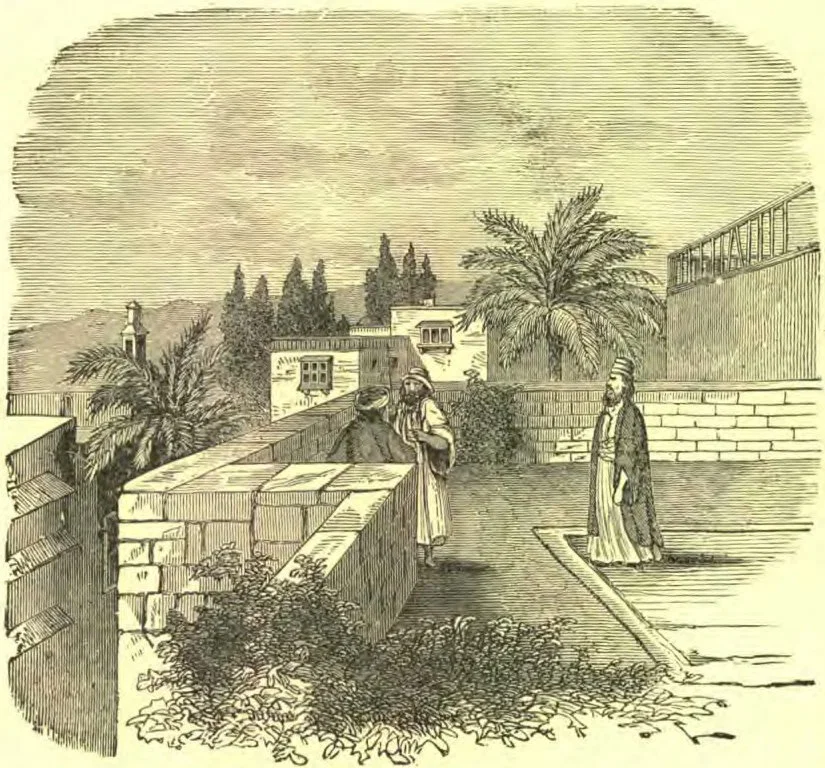
A SYRIAN FAMILY ON THE HOUSETOP

The Youth’s Instructor

Jan 14, 1880

S. D. A. Publishing Association · Battle Creek, Mich. · Jan 14, 1880

A SYRIAN FAMILY ON THE HOUSETOP.

If you were to call upon your little friends in Syria on a warm summer evening, you would not find them in the parlor, or sitting upon the piazza, but on the roof of the house. Dr. Jessup, who has lived there a great many years, thus describes such a family gathering:—
“An American family on the housetop would be a strange sight; but it is not a strange sight in the East. The roofs of the houses are flat, and play an important part in the domestic history of the family. In the mild climate of Syria and Palestine, the housetop is the resort at evening; and in the hot summer months, here their beds are spread, covered by a booth, or awning; and the whole family sleep in the open air to avoid the heat, and escape from the fleas.
“Here the Turkish rug is spread, and the family take their evening meal. Flowerpots stand on the wall, as the Orientals are excessively fond of flower-culture, prizing above all others the rose, the jasmine, the pink, and tuberose.
“A housetop has a parapet around, according to the Mosaic injunction. This precaution is too often neglected, and I have sometimes heard of boys falling backward from the roofs while flying their kites. In many of the cities and towns, the houses are built close together, even covering the streets which pass beneath them like tunnels; so that the roofs of the houses form one continuous surface. In the villages the streets are so narrow, and the roof-beams project so far over the streets, that one can readily run from one end of the town to the other on the roofs. When our Lord said, ‘Let him that is on the housetop not come down,’ he meant let those who are on the housetop in time of attack upon the city not try to come down into the city, but jump across from roof to roof to the end of the town, and then escape into the country.
“Town-meetings are held on the housetops, proclamations are made on the housetops, and olives, figs, and grapes are here spread out to dry. Before the wheat is ground, it is washed and spread on the housetop, and the children watch it while drying to keep away the sparrows. Here the washed clothes are hung out; and here the women of the households meet and lean over the parapets, either to see what is passing in the street, or to talk with the neighbors. The Mohammedans pray on the housetops, turning their faces toward Mecca.
“In the cities the roofs are made of cement, and in the mountain villages, of earth a foot thick. Sometimes bonfires are built on the housetops; and watchmen often watch the village vineyards in fruit-time, sitting in booths on the highest housetops in the village.
“An Oriental housetop is a great convenience; but, alas! these flat roofs too often leak, and sometimes, when covered with earth, and soaked with rain, they fall in, and bury the whole family alive in the ruins.”—Christian Weekly.

A MOTHER'S GIFT.—A BIBLE.

REMEMBER, love, who gave thee this, When other days shall come; When she who had thy earliest kiss Sleeps in her narrow home; Remember, ’t was a mother gave The gift to one she’d die to save.
That mother sought a pledge of love, The holiest for her son; And from the gifts of God above, She chose a goodly one; She chose for her beloved boy The source of life and light and joy;
And bade him keep the gift, that when The parting hour should come, They might have hope to meet again In an eternal home. She said his faith in that would be Sweet incense to her memory.
And should the scoffer in his pride Laugh that fond faith to scorn, And bid him cast the pledge aside That he from youth had borne, She bade him pause, and ask his breast If he or she had loved him best.
A parent’s blessing on her son Goes with this holy thing; The love that would retain the one Must to the other cling. Remember, ’t is no idle toy,— A MOTHER’S GIFT; remember, boy.

ALWAYS SPEAK THE TRUTH.

VISITING a friend's school the other day, I noticed upon the walls of the room some excellent mottoes, one of which I have placed at the head of this article. Doubtless some, I hope many, of the readers of the INSTRUCTOR have made this motto their own; and I doubt not all will agree with me that it is a good one. But I fancy I hear some of them say, “Yes, it is a good motto, and I do almost always speak the truth.” This is not enough; our motto says “always.” Now it is very easy for any one to tell the truth generally, when there is no temptation to do otherwise; but to speak it every time, no matter whether by so doing self is condemned or justified, whether punishment or reward is the result, requires principle and courage.
For the boy or girl who never, by word, look, or act, tells an untruth, there are in store a prosperous future, and a useful position in society; while those who indulge in telling that which is untrue, even occasionally, be the temptation what it may, will disgrace themselves, dishonor their parents, and incur the displeasure of God, who has said, “He that telleth lies shall not tarry in my sight.” Open your Bibles and read Rev. 21:8, and notice the company in which such will at last be found, and what their fate will be. Can it be that any of the dear readers of the INSTRUCTOR will meet a doom so fearful!
The story of Ananias and Sapphira is familiar to most of you. We may learn from this how heinous in the sight of God is the sin of lying. It is not probable that this was their first departure. Could we know their history, very likely we should learn that this wicked habit was formed in childhood. The sin of lying is no less offensive in the sight of God now than then; and judgment, though perhaps less speedy, will surely follow every similar transgression that remains unrepented of.
Many a man who has ended his days at the scaffold or in prison, began his terrible career of crime with a slight offense, to conceal which a falsehood was told. Doubtless bitter remorse of conscience was suffered at first; and oh, how much of sin, and suffering, and disgrace might have been saved had that one wrong step been retraced! But the downward road once entered, the voice of conscience is smothered; one step leads to another; conscience reproves less and less, until fear of detection is the only restraint from crime, and this not being a sufficient safeguard against temptation, the fatal deed is at last committed, and repentance comes too late.
If any who read this have taken this first step, or even gone farther in the dangerous road, oh, be entreated to face right about, and let no hope of gain, no fear of loss, nor the pride of a wicked heart, induce you to listen for a moment to the voice of the tempter. Seek God for help, and in the strength which he will give you, strive for victory. Dare to be true. And when the pearly gates of the city of God shall be opened, and the righteous nation “which keepeth the truth” shall be permitted to enter, among them may there be found a happy company of noble boys and girls who have made it a rule to “always speak the truth.”
J. Q. FOY.

SCRAPS FROM HISTORY.

THE CALL OF ABRAHAM.

ABRAHAM, the father of the Jewish nation, was born at “Ur of the Chaldees.” In early life, he was associated with those who worshiped false gods, his father Terah being an idolater. Joshua 24:2.
Abraham was the only one in his time who truly worshiped the Lord. In Genesis 18:19, we read that he would “command his children and his household after him, to keep the way of the Lord, to do justice and judgment.” For this reason, God chose him to preserve his name in the earth.
In order to preserve Abraham and his posterity from idolatry, God called him away from his native country, and he dwelt in the land of Canaan, or Palestine, a country in south-western Asia, bordering on the Mediterranean Sea.
The descendants of Abraham at last became a great nation, and made Jerusalem the capital of their kingdom. For many years they preserved the worship of God in its purity, year after year continuing the sacrificial offerings. In order that these services might be carried on in a proper manner, the children of Israel, during the days of Moses, built a sanctuary in which to offer their sacrifices. The tribe of Levi was chosen from among the twelve tribes to care for this sanctuary; and priests were chosen from the family of Aaron to conduct the services in it.
The sanctuary was first erected in the wilderness, as the children of Israel were traveling from the land of Egypt to the land of Canaan. When they reached Canaan, the sanctuary was pitched at Shiloh. But because Israel departed from God, he forsook the sanctuary, and for many years they were without a sanctuary. But Solomon, during his reign, built that grand temple of which you read in the book of Kings; and in this the sacrificial offerings were carried on several hundred years.
Israel received many laws from God to govern them; and for this reason their government has sometimes been called a theocracy, or a government of God, the divine mind or will being made known through the high priest. S. H. LANE.

KINDNESS

KINDNESS cheers the broken-hearted, Makes the sick and weary smile; Loving words full oft the sadness From earth’s sorrowing ones beguile.
“Though we may not strew bright flowers All along life’s darksome way, The bestowal of one daisy, May make happy hearts to-day.”
“The word kindness comes from the word kinned; that is, one of the same kin or race.” This word, then, reminds us of the fact that all men are brethren. Should not all that are of the same kindred be kind? Yes, certainly; for kind words and bright smiles make happy hearts.
It is natural for man to desire sympathy. A kind word is refreshing dew to the drooping spirit. It is a balm to the wounded heart. Then let us make our pathway fragrant with deeds of kindness; make it to bud and blossom with generosity and love.
Not long since, I read a little incident in the life of the Duke of Wellington, which shows something of his character. It was during his last sickness that a servant offered him a saucer containing a little tea, asking him if he would have it. The Duke replied, “Yes, if you please.” These were his last words. How much kindness and courtesy is expressed in them! He who had commanded the greatest armies in Europe, and had long used the tone of authority, did not despise or overlook the small courtesies of life.
These little things, the little kindnesses of life, make up the great whole. The little stream that has its source in some hidden spring far away in the cleft of a retired rock, may seem like a very little thing, yet it goes trickling and gurgling along, accumulating force and power, until it finally becomes the propelling agent of some mighty factory where thousands of looms give employment to as many hands. So a little word spoken in kindness may be a seed dropped into some heart that may finally result in the conversion of a hundred souls.
The wind is unseen, but it cools the brow of the fevered one, sweetens the summer atmosphere, and ripples the surface of the lake into spangles of beauty. So kindness of heart, though invisible to the material eye, makes its presence felt, and from its effects upon surrounding things, we are assured of its existence.
Out upon the street, the graceful figure of a lady stooped to make happy the heart of a little child of forlorn appearance, by placing in the tiny hand a bonbon. A simple act of love, but kindness of heart must have prompted it.
It is a duty that we owe to ourselves and to those around us to cultivate this plant of kindness in the heart. Every act of love makes it grow, and these acts performed daily, will soon fill the heart with love and kindness. And although our lives may have in them no great deeds, we may by little acts merit the approbation of the Master, and in the great day of reckoning hear him say, They have done what they could. V. A. M.

THE ICEBERG.

An iceberg drifting in the polar seas Braces its cold and bold and glistening front Against the sharpness of the Arctic blasts; But when it idly floats by southern shores, Where milder sunshine wakes the praise of spring, Warm airs embrace the rugged stranger round, And melt away its angles with their breath; The tepid waves caress it, and the light Nestles among its many crevices, Till it relents, and in a vail of mist Withdrawing, sinks, and weeps itself away Upon the bosom of the summer sea. And so, when argument, reproach, and force Are spent in vain, the hard heart yields to love.

LESSONS FOR CHILDREN.

LESSON LV.—SOLOMON FORSAKES GOD.

THE Lord had said that none of his people should marry any of the people of the nations around them; for if they did, they would be led to worship the false gods that those nations worshiped. But Solomon loved many strange women, and married wives who had been brought up to worship idols. Now when Solomon grew old, his wives turned his heart away from the Lord, and got him to worship the gods which they served.
It was very wicked for Solomon to worship other gods; for the Lord had appeared to him twice, and charged him again and again not to do so. The Lord then told Solomon that his kingdom would be taken away from him, and given to another; yet not till after Solomon was dead, because of the faithfulness of David, his father.
The Lord also raised up enemies to trouble Solomon. Among these was Jeroboam, a mighty man of valor, whom Solomon had made ruler over the house of Joseph.
One day Jeroboam went out of Jerusalem, wearing a new garment, and the prophet Ahijah met him in a field by the way. Then the prophet caught hold of the new garment which Jeroboam had on, and tore it into twelve pieces. “And he said to Jeroboam, Take thee ten pieces: for thus saith the Lord, the God of Israel, Behold, I will rend the kingdom out of the hand of Solomon, and will give ten tribes to thee: . . . . Howbeit I will not take the whole kingdom out of his hand: but I will make him prince all the days of his life for David my servant’s sake, whom I chose, because he kept my commandments and my statutes: but I will take the kingdom out of his son’s hand, and will give it unto thee, even ten tribes. And unto his son will I give one tribe, that David my servant may have a light alway before me in Jerusalem, the city which I have chosen me to put my name there.”
The Lord also said to Jeroboam, “If thou wilt hearken unto all that I command thee, . . . . I will be with thee.”
“Solomon sought therefore to kill Jeroboam. And Jeroboam arose and fled into Egypt, unto Shishak king of Egypt, and was in Egypt until the death of Solomon. . . . . . . . . . . . . . . . . . . . . . . . . . And the time that Solomon reigned in Jerusalem over all Israel was forty years. And Solomon slept with his fathers, and was buried in the city of David, his father: and Rehoboam his son reigned in his stead.”

QUESTIONS.

1. What had the Lord said to his people about marrying those that belonged to other nations? 1 Kings 11:2.
2. Why were they not to marry them?
3. How did Solomon disobey the Lord in this?
4. What bad influence did these women have upon him?
5. Why was it especially wicked for Solomon to do this? Verses 9, 10.
6. What did the Lord tell Solomon about his kingdom?
7. Why was his kingdom to be taken away?
8. Why was it not to be taken away in the days of Solomon?
9. In what other ways did the Lord trouble the king? Verses 14, 23–26.
10. What mighty man was among these enemies?
11. How had Solomon honored him?
12. What did the prophet Ahijah do when he found Jeroboam in the way, clad with a new garment?
13. How did the prophet explain the meaning of what he had done?
14. When was Jeroboam to begin to reign over ten tribes?
15. Why was one tribe to be left to Solomon’s son?
16. How did the Lord encourage Jeroboam to be obedient to his commandments?
17. How did Solomon treat Jeroboam when he knew what the prophet had said to him?
18. How did Jeroboam escape?
19. How long did Solomon reign in Jerusalem?
20. Where was he buried?
21. Who reigned in his stead?

BIBLE LESSONS FOR YOUTH.

LESSON LXXXI.—JEHOSHAPHAT.

  1. In what one thing did Jehoshaphat act foolishly? 2 Chron. 18.
  2. While at the court of Ahab, what was he persuaded to do?
  3. What did the prophet of the Lord foretell?
  4. Whose counsel did Ahab and Jehoshaphat follow?
  5. What was the result?
  6. What reproof did Jehoshaphat receive while on his return to Jerusalem? Chap. 19.
  7. How did he employ himself after his return?
  8. Repeat the charge given by him to the judges whom he appointed. Verses 6, 7.
  9. Who came out to battle against Jehoshaphat after this? Chap. 20:1.
  10. What did Jehoshaphat set himself to do?
  11. What did he proclaim?
  12. Describe the gathering of the people at Jerusalem.
  13. On whom did Jehoshaphat call?
  14. What did he recount?
  15. For what did he plead?
  16. Upon whom did the Spirit of the Lord then come?
  17. With what words did he encourage them?
  18. What did he say about the battle?
  19. What were they to do instead of fighting?
  20. What did Jehoshaphat and the people do when they heard these words?
  21. Where did they go next morning?
  22. What did Jehoshaphat say to the people?
  23. What did he appoint from among the people?
  24. What were these singers to do?
  25. What words were they to utter?
  26. What did the Lord do for them when they began to sing and to praise?
  27. How were their enemies destroyed?
  28. What did the men of Judah behold as they looked toward the great multitude?
  29. What spoil was taken, and how much?
  30. How did Jehoshaphat still further suffer from joining with evil men? 2 Kings 3.
  31. How were these kings and their armies saved from perishing?
  32. Describe the miracle, and the destruction of the Moabites.

SYNOPSIS.

In one thing, Jehoshaphat acted foolishly. He was on intimate terms with Ahab, and went to Samaria to feast with that idolatrous king in his own palace. While there, he was persuaded to join with Ahab in an expedition to take Ramoth-Gilead from the Syrians. A prophet of the Lord foretold the fatal consequences of the expedition, but Ahab and Jehoshaphat followed the counsel of the prophets of Baal, and met a dreadful defeat, in which Ahab lost his life, and Jehoshaphat barely escaped.
On his return to Jerusalem, Jehoshaphat was met and reproved by the prophet Jehu, who said, “Shouldst thou help the ungodly, and love them that hate the Lord?”
After this, Jehoshaphat went in person throughout his kingdom, instructing the people, and setting judges over them. It would be well if all in authority would heed the charge which he gave to the judges. He said, “Take heed what ye do; for ye judge not for man, but for the Lord . . . Wherefore now let the fear of the Lord be upon you; take heed and do it; for there is no iniquity in the Lord our God, nor respect of persons, nor taking of gifts.”
“It came to pass after this also, that the children of Moab, and the children of Ammon, and with them other besides the Ammonites, came against Jehoshaphat to battle. . . . And Jehoshaphat feared, and set himself to seek the Lord, and proclaimed a fast throughout all Judah. And Judah gathered themselves together, to ask help of the Lord; even out of all the cities of Judah they came to seek the Lord.”
Then Jehoshaphat called upon the Lord, recounting past mercies and promises, and pleading for deliverance from his enemies. The Spirit of the Lord then came upon Jahaziel, and he said, “Thus saith the Lord unto you, Be not afraid nor dismayed by reason of this great multitude; for the battle is not yours, but God’s. . . . Ye shall not need to fight in this battle; set yourselves, stand ye still, and see the salvation of the Lord with you. . . .” And Jehoshaphat bowed his head with his face to the ground; and all Judah and the inhabitants of Jerusalem fell before the Lord, worshiping the Lord.”
“And they rose early in the morning, and went forth into the wilderness of Tekoa; and as they went forth, Jehoshaphat stood and said, Hear me, O Judah, and ye inhabitants of Jerusalem, believe in the Lord your God, so shall ye be established; believe his prophets, so shall ye prosper. And when he had consulted with the people, he appointed singers unto the Lord, and that should praise the beauty of holiness, as they went out before the army, and to say, Praise the Lord: for his mercy endureth forever.”
“And when they began to sing and to praise, the Lord set ambushments against the children of Ammon, Moab, and Mount Seir, which were come against Judah; and they were smitten. For the children of Ammon and Moab stood up against the inhabitants of Mount Seir, utterly to slay and destroy them; and when they had made an end of the inhabitants of Seir, every one helped to destroy another. And when Judah came toward the watch-tower in the wilderness, they looked unto the multitude, and, behold, they were dead bodies fallen to the earth, and none escaped. And when Jehoshaphat and his people came to take away the spoil of them, they found among them in abundance both riches with the dead bodies, and precious jewels, which they stripped off for themselves, more than they could carry away; and they were three days in gathering of the spoil, it was so much.”
Notwithstanding Jehoshaphat’s sad experience with Ahab and Ahaziah, he consented to join with Jehoram and the king of Edom in an expedition against the Moabites. These three kings and their armies were on the point of perishing for want of water, when the Lord delivered them by the hand of the prophet Elisha. The record of this noted miracle may be found in the third chapter of 2 Kings.

The Secret of Success

A gentleman in Scotland thought he would try his hand at fishing. Provided with the best of tackle, he toiled all day, but caught nothing. Toward evening he spied a ragged little urchin, with tackle of the most primitive order, land fish with marvelous rapidity. He went to him and asked him the secret of his success, receiving for reply: “The fish’ll not catch, sir, as lang as ye dinna keep yeself oot o’sicht.” Fishers of men need not wonder at their want of success if they do not keep themselves out of sight.

The Three-Handed Race and Sabbath-School Tardiness

Gough says that in his travels he has met with a three-handed race,—people that have a right hand, a left hand, and—a little behind hand. And yet, three-handed though they be, they are the most untidy people in the world to have around, especially in Sabbath-school. “Late—late—so late”—not once, but always. No one ever knew them to be on time.

A SERMON ON LIGHT.

Oh, we had a splendid sermon to-day about lights,” said Lucy.
“What kind of lights?” Andrew asked.
Before Lucy had time to reply, Jimmy interrupted with, “I guess I know. Wasn’t it about Drummond-lights? That is the biggest light in the world. If I were going to preach about lights, of course it would be about the biggest.”
“Drummond-lights were mentioned, but only mentioned among the many kinds of light.”
“Then I don’t believe that it was a very good sermon,” said Jimmy.
“Yes, it was a very good sermon. The text was, ‘Let your light so shine before men, that they may see your good works and glorify your Father which is in Heaven.’”
“Well, doesn’t that mean to let a very bright light shine before men?”
“If we can; but supposing we are only small men and women, or even children, do you think that we should refuse to shine, because we cannot give as much light as the largest?”
“I’m sure I don’t,” said Mary. “I should think a little light was better than none.”
“Certainly,” replied Lucy, “and so a good part of the sermon was about rush-lights.”
“Rush-lights? What are they?”
“They are the cheapest kind of a candle. Mrs. Middleton told me about them once. She came from England, and the poor people in some parts of England make these rush candles, because they can afford no others.”
“But what are they?”
“Be patient, and I will tell you. Do you know what a bulrush is?”
“Yes, it grows in water.”
“Well, these poor people gather the bulrushes, and take off the bark, except a narrow strip on each side to hold up the soft white pith that’s going to be the wick of the candle. Then they dip it in tallow, and let it cool, and then dip it again, and cool it until it won’t bear any more; and then the candle is ready to light.”
“But what a little bit of a wick that must be for a candle.”
“Yes; and this little bit of a candle gives very little light. But it is better than no light in a cottage. A rush-light in a room keeps it from being all dark, and the poor people move it about from place to place in the room, to see what they want to see most.”
“Why, it is like a little star, isn’t it?”
“Yes; and think what a blessing it is to these poor people, who would be all in the dark without it.”
“But what has that to do with a sermon?”
“Don’t you see? We children, and a good many grown people in this world, are only little rush-lights. We can’t do great deeds, but we can all do little ones. A smile, a pleasant word, a kind act, are each a little light sent out into the darkness.”
“We might any of us do as much as that, to let our light shine,” said Andrew. “Do you think, Lucy, that it is by such little things that we can glorify the Father in Heaven?”
“Yes, certainly. That was what our minister told us to-day. Christ said, ‘Herein is my Father glorified, that ye bear much fruit.’”
“But if we children are, every hour of our lives, pleasant, and smiling, and kind, it doesn’t seem to me that we shall make much impression on the darkness. We are such little lights.”
“So is the rush-light a little light; but it does its work in the place where it is set, and means as much there as the star does in the night sky. No one star could make the night beautiful; but the many together, each shining in its place, and doing the very best that it can, make all the heaven glorious, and the earth glad for their light. So the many kind acts, or loving smiles, or tender words of the many little children may make beauty and joy everywhere, and the Father in Heaven be truly glorified. Let us all then do our very best to be as fair rush-lights as we can, and all the dark will be lightened.”—Myrtle.

PAPER BARRELS.

It is claimed that the new paper flour barrels are not only cheaper, but more tight and durable, as well as lighter, than those of ordinary construction. By an improved method of manufacture, these barrels are composed of paper pulp, which is run into a mold made in the shape of one-half of a barrel cut lengthwise. The pulp is subjected to a powerful hydraulic pressure, and when reduced to the required thickness, the ends of the halves are cut off; the pieces are then placed in a steam-dryer, the sides trimmed evenly, and the substance thoroughly dried. It comes from the dryer ready to be made into barrels. Three heavy wooden hoops are fastened together, and slid into grooves cut in the paper halves, which have an average thickness of three-sixteenths of an inch. The ends of the barrel are made of paper of a similar thickness, constructed on the same principle as the sides. The barrels are manufactured entirely by machinery, and the halves are cut so true that two pieces of the same size will readily fit together.—Chicago Paper.

WHAT IS A PEA-NUT?

The pea-nut is the fruit of a plant which grows to the height of about fifteen inches, being very much like the field pea with yellow flowers. They are known in England as the ground-nut, for the reason that the branches, after flowering, bend down till they touch the ground, into which they work themselves. Upon these branches grow the pods that contain the nuts. When the nuts are ripe, the plant dies. It is then pulled up, and the nuts which adhere to the twigs are collected. The pods usually contain two nuts, sometimes only one, and very rarely three. Ground-nuts are grown in light, sandy soils in most tropical countries, and have long been used in Africa, India, Brazil, and other places, as food. The best are raised on the banks of the river Gambia, where they are extensively grown in large fields. They yield large quantities of oil; and for thirty years they have been grown in Africa as an article of commerce, and are now largely exported for crushing. The oil differs in quality and price according to the care with which it is refined. That made in London is accounted equal to fine olive-oil. In France the oil is principally used in the manufacture of soap. It is also used in the woolen manufacture, in lamps, and for lubricating heavy machinery, for which it is said to be especially well fitted.

ENVELOPES

It is difficult to say just when envelopes came into general use in this country. Machines for making them were not patented until 1844, and they were not sold to any extent until two or three years later. As late as 1850 a large number of letters from village post-offices were in the old style, sealed with wafers, and a blank space on the last page of the sheet for the last directions. We have seen one stray letter of this sort within a year.—Christ. Weekly.

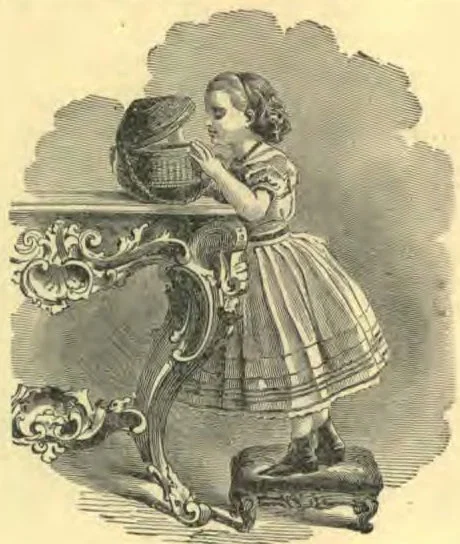
CURIOSITY

I WONDER what's in the basket?” “I think I'll reach up and ask it With my two hands on the cover, And my two eyes peeping over.”

You have reached the end of this edition.

The Youth’s Instructor · Jan 14, 1880