The Youth’s Instructor, Vol. 29, No. 5.

HEROD’S TEMPLE

The Youth’s Instructor

Feb 2, 1881

S. D. A. Publishing Association · Battle Creek, Mich. · Feb 2, 1881

HEROD’S TEMPLE.
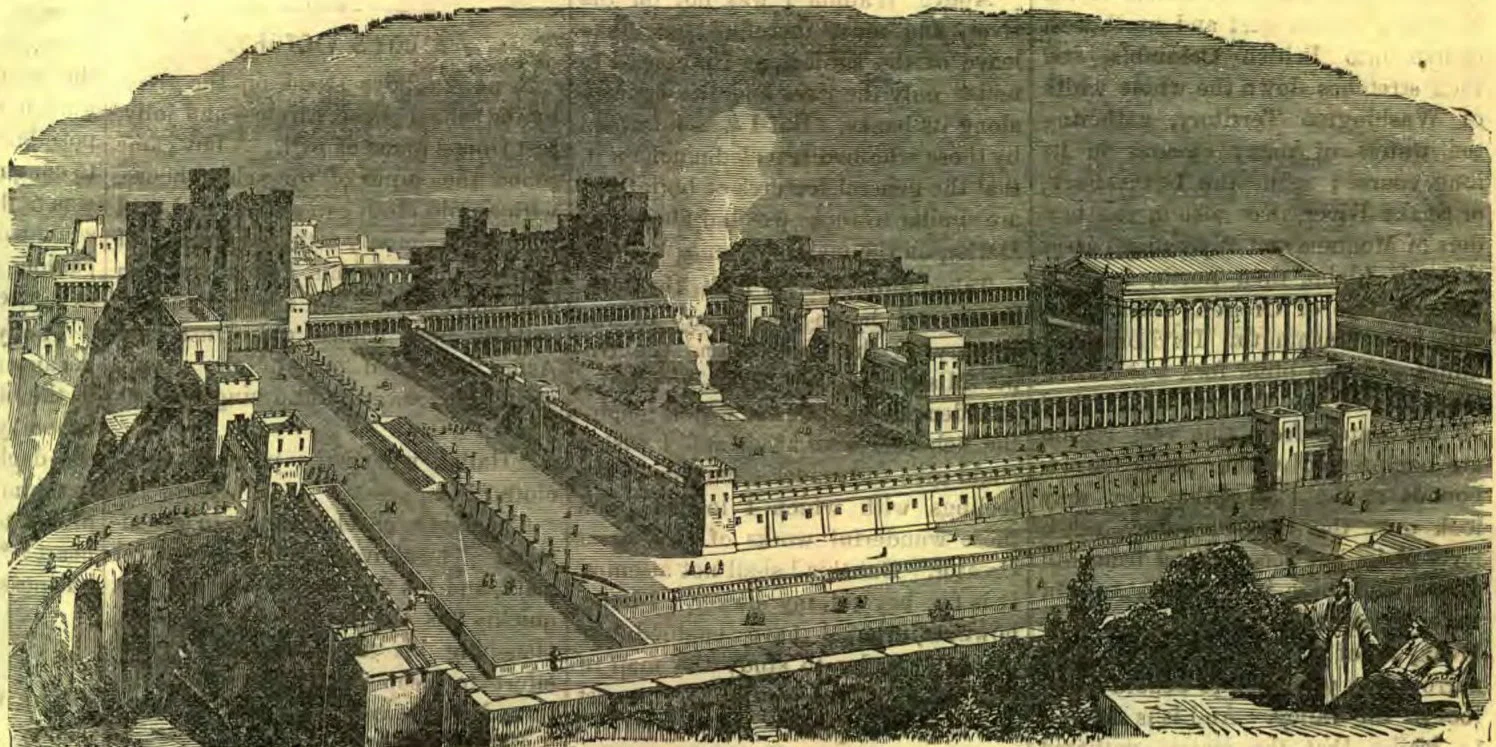
In the south-eastern part of Jerusalem stood, many centuries ago, the temple represented in the picture. It was built on the top of Mount Moriah. Tradition says that this is the same mountain whereon the patriarch Abraham, obeying the divine command, proceeded to offer up his only son as a burnt sacrifice. Here, too, that renowned warrior, king David, built an altar to the Lord, and confessed his sins. This mighty king was he who first had it “in his mind to build a house unto the name of the Lord.” But by the command of God, the work was reserved for his son Solomon; for David “had been a man of war, and had shed blood.”
The temple of Solomon, was very beautiful. It was built after the same plan as the tabernacle, only on a larger scale. The most holy place, or oracle, was twenty cubits every way, while the outer apartment was forty cubits long and twenty wide. A minute description of the building itself may be found in 1 Kings 6 and in 2 Chron. 2: 3.
In order to obtain an area sufficiently broad, four massive walls were built up from the bottom of the mountain, and the space between the walls and the mountain itself was partly occupied by extensive vaults, and partly filled by the immense quantities of earth and rock obtained in bringing the summit of the mountain down nearly to a level with the top of the walls. These walls, in some places several hundred feet high, were built of stones of enormous size. The top of the mountain, as one might look down upon it from Mount Olivet, is all that is seen in the picture.
On this flat surface were three courts, one rising above another in the form of terraces, as you may see; and on the highest of these stood the temple itself. This edifice was destroyed by the Chaldeans, and afterward rebuilt by Zerubbabel. Some five hundred years later, and a little before the birth of Christ, it was rebuilt, enlarged, and beautified by Herod the Great. His plan was very nearly the same as that followed by Solomon.
HEROD'S TEMPLE.
HEROD'S TEMPLE.
Next to the outer wall was a court, called the court of the Gentiles. On three sides it had a double row of porches, and on the south side a triple row. The roofs of these porches were of carved cedar, supported by columns of marble, and marble of various colors formed the floor.
Next within and above the court of the Gentiles was the inner court. This had two inclosures. The outer one was inclosed by a wall three cubits high, having at regular intervals pillars on which were engraved inscriptions in Greek and Latin, forbidding any stranger to enter, on pain of death. Between this and the second wall was an open space ten cubits wide. The second inclosure of the inner court was surrounded by a wall forty cubits high on the outside, but only twenty-five on the inside, the interior platform being raised fifteen cubits. This inclosure was divided into two parts; that extending across the east end was called the court of the women; and the remainder, the court of the Israelites. Between the gates of this court were porches, smaller but not less beautiful than those in the court of the Gentiles.
Inside of this, and separated from it only by a low wall, was the court of the priests. In the midst of this court stood the temple. Only priests were allowed to enter this sacred inclosure, and even when Herod was repairing this place, none but the priests had anything to do with the rebuilding of the temple itself. The gates leading from the courts to the temple corresponded well with the magnificence of the buildings and the massive grandeur of the walls.
This grand structure was plundered, burned, and demolished by the Romans under Titus. Thus the Saviour’s words were fulfilled, when he said to his disciples: “Verily I say unto you, There shall not be left one stone upon another, that shall not be thrown down.”
At the present there stands upon the supposed site of the temple an imposing structure known as the Mosque of Omar, or Dome of the Rock. Under the dome of this octagonal mosque is a large stone, which tradition says is “the place where Abraham offered up Isaac, the threshing-floor of Araunah the Jebusite, and the site of the holy of holies in Solomon’s temple.”
WINNIE LOUGHBOROUGH.

COLUMBIA RIVER. (CONCLUDED.)

Above and near the Cascades is a wonderful curiosity. The river spreads over a shallow place on which there are stumps of trees, evidently of fir, which shows that the land has been depressed, perhaps by a slide, as fir does not grow on wet bottoms. At the ordinary stage of the river these stumps are seen, being wood above the water, and petrified, or turned to stone, under the water. Of course I could not examine these, passing on the boat, but had to trust to information received. I was told that the State Geologist of Oregon says it is the only place in the world where such a curious combination of wood and stone is found.
Above the Cascades we embark on another boat which conveys us another fifty miles to the Dalles. This is, perhaps, the most beautiful part of the river. The rocky hills are high, and so peculiar in formation that they present an endless variety of interesting shapes to the eye. Sometimes they are perpendicular from the water’s edge, and sometimes so pointed as to present a succession of turrets, reminding one of extensive ruins of castles and fortresses.
Arriving at the Dalles, we find a pleasant village, and here we take another railroad fifteen miles in length. From this point my disappointment in the river was continuous. We always form some idea of a country when we hear or read of it, and my ideas of this part of the country were as far as possible from the truth. The Dalles are even narrower than the Cascades, the river running between banks of rock perpendicular on both sides; sometimes in one channel, sometimes dividing around rocks into two or more channels, and yet in banks mostly perpendicular. Toward the head of the Dalles are rapids or falls of ten to fifteen feet.
From the description of its rocky passes, I supposed the river was here shut in by the mountains as at the Cascades. The hills back from the river, though high, do not present the same mountainous appearance, but resemble the rocky bluffs of a prairie country,—there being no timber of any consequence in sight. Often, as we ride through the narrow valley in which the river lies, though the track is considerably elevated, the river is entirely lost to sight in its deep and narrow bed. If the reader will look on the map, he will see that the Clarke Fork, or Columbia River, rises in Montana near the head waters of the Missouri, takes a west and north-west course into British Columbia, and then stretches down the whole width of Washington Territory, gathering the waters of many streams in its long course; while the Lewis Fork, or Snake River, rises also in the borders of Montana and Wyoming, passes through Idaho, then north, forming the east line of Oregon, takes a circuit into Washington Territory, and unites with the other fork a short distance above the Oregon line. And all the waters from this vast region are compressed within such narrow bounds at the Dalles that you may look over the treeless valley, not a level plain, but scooped out from hill to hill, and there is no appearance of water presented. There is no wide break, as of a river-bed, but it is so narrow that you seem to behold every foot of the valley. And it is difficult to realize that the waters gathered from many mountains in the noble Columbia lie unseen almost at your feet.
Above the Dalles the river scenery does not resume any of the appearance with which we have become so familiar below. There is no more timber in sight. The banks vary in height, being sometimes bold and rocky, and again low enough to give a view of the plain far back; but the steamer plows its way from sunrise to sunset, and no trees are to be seen except a few along the bank.
The land immediately along the river is mostly worthless, if not from natural sterility, from the impossibility to get water upon it. Occasionally small strips of bottom-land are found and settled upon, but these are rare. Umatilla and Wallula are the only river villages between the Dalles and the eastern boundary of Washington, and these make a better show on the map than any other way. They are set down in the desert, where it is not possible to raise anything, and of course they look dreary and forsaken. They are little villages, made necessary by the want of trade, the farming country commencing fifteen twenty, and sometimes thirty miles from the river. This makes it hard for the farmer, as he has to team from fifteen to thirty miles over a sandy, barren or alkali desert to get his produce to the river where it is shipped to market.
Wallula is in Washington, near the line, at the mouth of Walla Walla River. Here old Fort Walla Walla was built by the Fur Company in 1820; it was an adobe, or mud fort, and part of it is yet standing. The United States fort of the same name is about thirty miles from the river, near Walla Walla City.
In justice to the country, I must say there is an excellent wheat-raising country back of this desert-lining to the river; but these two difficulties are much against the settlers; that of getting their produce to the river, and the difficult navigation of the river. Near the foot of the Blue Mountains there is a strip which is well adapted to fruit. And wherever the streams are available for irrigation, fruit is easily raised.
Above Wallula I was not on the river, and must therefore now take leave of the subject, as I proposed to notice only the river and the country along its banks. But I was informed by those who had traveled much on it, that the general features of both forks are similar to those we find above the Dalles, on the main stream.
Taken altogether, it lacks the loveliness and home-like beauty of the scenery on the Hudson and the Upper Mississippi, but there is often a grandeur and nobleness which inspire the beholder with awe; and I wish I could give the reader some idea of the feelings with which I looked upon these wonderful works of the great Creator. But this I shall not attempt. It is far beyond my power. I hope, however, that I have enabled the youthful reader to study the map of that country with additional interest and to greater profit.
J. H. WAGGONER.

Invention of the Pendulum Clock in 1639

PENDULUM clocks were invented in 1639.

A BOY'S VICTORY.

A dozen boys stood on the green by the school-house, careless and jolly, just from a game of ball. A boy came round the corner of the school-house, with an old cloth cap on his head, and wearing a loosely-fitting garment of coarse cloth. In his hands were an iron stove-shovel and a hod of ashes.
“Oh, here comes old Dust and Ashes,” shouted one of the group, springing forward and giving the coat a jerk.
“Hallo! what's the price of sack-cloth?”
The boy's cheek flushed in an instant. The shovel rang on the gravel walk, and his fingers clutched; but as quickly his cheeks paled again, and, clenching his teeth, as with a great effort to keep back something, he turned a little and muttered the word “Mother!”
“Ho! ho!” shouted the other. “The baby's sick, and wants to see his mother.”
The boy in the coarse frock turned away, and rapidly disappeared behind an old barn; then, breaking into a run, he fled swiftly down the path to the maple woods, his faithful Hunter bounding and racing through the grass by his side.
Most graciously stood the maples, all russet and crimson and yellow, bathed in the yellow haze of the still October afternoon. In among their shadows he sprang, his feet rustling the already fallen leaves, and flinging himself in a little hollow, he buried his face in his hands. Poor Hunter stood by, wondering why his young master, any more than himself, could possibly think of anything but birds and squirrels at such a time. Then the boy, seizing his only playmate in his arms, cried:—
“Oh, nobody loves me, nobody in the world loves me but you, Hunter! Oh, mother, mother, why did you die?”
And the sobs came fast and thick, and the tears flowed like rain. Long did the motherless boy wail and cry, till, from very weariness, he could weep no longer. Tears brought relief, and the holy quiet of the grand old woods filled him with solemn and holy thoughts,—thoughts of his dead mother.
Only one year ago she had died, and he remembered his agony and loneliness, and the year of toil as the ward of a cruel uncle. He remembered his eagerness to go to school, his trying to pay his way by working about the school-room, and the unfeeling gibes and jeers his humble station and coarse clothing had earned him. Again the angry, rebellious thoughts came up, as his eye fell on his coarse coat, and the quivering sobs returned; but with them came the words of that mother, and how her poor fingers had toiled to make that coat, the best she could give him. Though coarse its texture, every thread was hallowed by a mother's love. He took from his vest pocket the well-worn Bible, her Bible, and read the precious promise to the widow and orphan again and again. New and strange thoughts came to him, and there, in the grand old forest, with the autumn sunset shimmering the golden maple leaves, was a new purpose born in his soul. He had begun to conquer himself. Henceforth there was no hesitation for him. Body and soul he devoted himself to God. Companions might jeer, but Jesus reigned in his heart.
The years rolled on, and the boy became a man, but the purpose formed in the old maple grove burned in his bosom yet; and now his feet tread the decks of an India steamer, bearing him swiftly to the chosen scenes of his toil, for these words are in his heart: “I must be about my Master's business.”—Selected.

THE TRUE GUIDE.

You who are just going out into the world, answer me one question to-day. Whom have you taken as your guide through life?
Perhaps your secret thought has been, “I need none to guide me. I can take care of myself. I am a man now, and can face the world alone.” How little you know of life, if this has been your thought. Stop before it is too late, and consider what lies before you. This life is a long and dangerous journey for those who desire to find the heavenly home at the end of it. The wisest and best of us reach that goal travel-stained and weary—“through great tribulation.” Those who set out alone never get there at all; for the narrow road to God is hard to keep, and self-will and carelessness lead many astray. Only He who is the Truth can show us the right path, and hold up our goings therein, that our feet may not stumble.—Selected.

THE PRICE PAID.

The Chinese are exceedingly mercenary. They will do almost anything for money. They have no notion of any man's taking a course which does not tend to profit. “One of our new converts,” says a missionary, “recently held the following dialogue with a neighbor who attempted to catechize him on the subject:—
“How much did those foreigners give you to join their church? twenty dollars?”
“More than that.”
“A hundred dollars?”
“More than that.”
“A thousand dollars?”
“More than that.”
“How much, pray?”
“More than the value of the weight of this mountain in silver and gold.”
“In the name of Buddha! what?” cried his astonished interrogator.
“This precious book,” said the Christian, holding up his Bible, “which tells me of God, and Christ, and Calvary, salvation, and everlasting life in Heaven.”

What Comes From the Heart Goes to the Heart

What comes from the heart goes to the heart.

WORK

ANYWHERE, everywhere, something to do! Something for me, and something for you! Work for the hand and work for the head, Work for the winning of daily bread.
Never a day dawns but brings its own task; What, only for me and for you is to ask; Some are chosen to sweep, and others to spin; Some to sow, some to reap, while some gather in.
Some must build ships, and some guide the helm, Some fashion our garments, and some rule the realm; Some fell the forests, some the fields till, Some paint and some carve, some grind at the mill.
Some must buy and some sell, some traverse the sea, Some God's preachers and judges and singers must be. Let each to his task-work list for the call— Christ worked, and the Father works high over all!
Some work in the shadow, some in the sun; Some in joy, some in pain; but the Master is one, Calling all to their tasks, portioning each his reward, As he ceases his toil at the word of his Lord.
Work while the day lasts, work with a will; Soon will the night come, when all will be still; Sweet will it be, at the set of the sun, To hear from the Master the welcome “Well done.” —Selected.

FROM NAZARETH TO EGYPT.

Though Nazareth of Galilee was the home of Joseph and Mary, yet in obedience to the decree of the Roman emperor that every one should go to his native city to have his name enrolled, they went to Bethlehem; and here Jesus was born, according to the prophecy, made so many years before, that the Saviour of the world should be born in Bethlehem of Judea.
The journey from Nazareth to Bethlehem was then a very pleasant one; and it is easy to imagine the route that Joseph and Mary would take. In that country things are so little changed by the passing of years, that the very roads have, in most cases, remained the same as they were eighteen hundred years ago. By their way of traveling in those days, the journey must have occupied three or four days.
Passing down the little valley of Nazareth, they would cross the rich plain of Esdraelon,—not then, as now, left untilled and almost unpeopled, but covered with cities and villages, full of life and activity. Leaving on the left the rounded heights of Mount Tabor and the villages of Nain and Endor, up among the hills, they would be likely to take the road directly south to Jezreel, which was situated on a gentle swell of the plain of Esdraelon. This had been a favorite residence of Ahab, king of Israel.
They would pass through a landscape varied by orchards, vineyards, gardens, and fields; for every available spot was cultivated, even to the very tops of the hills. The mountains of Gilboa, where Saul and Jonathan were slain, lay just east of Jezreel, as they went on; and then came Engannim (the modern Jenin), with its remarkable fountain, on the edge of the hill-country of Samaria. Dothan, with its rich pastures, where Joseph, the son of Jacob, had found his brethren with their flocks so many ages before, would soon be seen on their right; and before long, their winding road, rising and falling among continuous hills, would bring them to Samaria itself, then just rebuilt by Herod the Great.
Sychar, in the valley of Shechem, would come next in their way, as they journeyed down this beautiful valley. Here would likely be a resting-place, perhaps by the well of their father Jacob, by which, in after years, Jesus sat and talked with the woman of Samaria, teaching to all mankind that grand lesson of human equality, and uttering those sublime words which can never grow old: “God is a spirit, and they that worship him must worship him in spirit and in truth.”
From this place they would take the great road leading southward into Judea,—by Shiloh, where Hannah came to pray before the Lord, when the tabernacle was there; and on past Gilgal, where her son sat to judge Israel. The road led on by Bethel, where, of old, Jacob had slept on his pillow of stone; and at last they would come to Jerusalem, the Holy City; and here we may imagine they would rest awhile, perhaps over night, before going on to the end of their journey. It was to Bethlehem that Joseph and Mary were coming, the town of Ruth and Boaz, and the early home of king David, from whom Joseph and Mary were descended. The village lay about six miles south of Jerusalem, a little to the east of the main road to Hebron.
As they approached the little town from Jerusalem, they would pass, during the last mile, that place sacred to Jewish memory, where the light of Jacob’s life went out, when his loved Rachel died and was buried “in the way to Ephrath which is Bethlehem.” It being a time when so many were coming home to Bethlehem, the inns were crowded so full that the weary travelers were obliged to put up with very humble accommodations. Just how long they stayed in Bethlehem we do not know; but here Jesus passed the first two or three months of his earthly life, and here the wise men from the East visited him.
Finally, to escape the wrath of Herod, Joseph took the young child and his mother and fled into Egypt, where they were beyond the control of Herod; and there they remained until those that sought the young child’s life were dead. Just how long this was, no one knows certainly. There are different opinions in regard to the length of time they remained in Egypt; but it is generally supposed to have been somewhere about six months—perhaps longer. The kindness of Alexander the Great and the Ptolemies to the Jews had caused great numbers of them to settle in Egypt, so Joseph and Mary would be likely to find there those of their own nation, who would gladly welcome them.
But Egypt was not the place where the child Jesus was to grow up, so when they heard that Herod was dead, Joseph and Mary returned to Nazareth. But fearing the cruel Archelaus, the son of Herod, they did not pass through Judea, but “turned aside” and went into Galilee, probably journeying along the coast, through the level country of the Philistines and across the fertile plain of Sharon. Here they would be stopped by the Carmel range; but near Megiddo was a pass through the mountains,—the same which the good king Josiah had, at the cost of his own life, so bravely defended against Pharaoh-necho, king of Egypt, who was passing through the country on his way to fight against the king of Assyria. Through this defile the travelers might pass, and go on, without farther hindrance, to their own city, Nazareth. E. B.

LESSONS ON NEW-TESTAMENT HISTORY.

LESSON 15.—JESUS REJECTED AT NAZARETH.

From the time of the first miracle at Cana to that of the second must have been more than half a year; for the passover was held in April, and the visit of our Lord to Sychar seems to have been in the early part of December. It appears that the disciples whom Christ had called soon after his temptation accompanied him to the passover, attended his preaching in Judea, and remained with him until his return to Cana. Then they seem to have gone to their former occupation, while Christ, for a short time, returned to Nazareth to await a more favorable opportunity for the prosecution of his work.
“And he came to Nazareth, where he had been brought up; and, as his custom was, he went into the synagogue on the Sabbath-day, and stood up for to read. And there was delivered unto him the book of the prophet Esaias. And when he had opened the book, he found the place where it was written, The Spirit of the Lord is upon me, because he hath anointed me to preach the gospel to the poor; he hath sent me to heal the broken-hearted, to preach deliverance to the captives, and recovering of sight to the blind, to set at liberty them that are bruised, to preach the acceptable year of the Lord. And he closed the book, and he gave it again to the minister, and sat down. And the eyes of all them that were in the synagogue were fastened on him.
“And he began to say unto them, This day is this scripture fulfilled in your ears. And all bare him witness, and wondered at the gracious words which proceeded out of his mouth. And they said, Is not this Joseph’s son? And he said unto them, Ye will surely say unto me this proverb, Physician, heal thyself; whatsoever we have heard done in Capernaum, do also here in thy country. And he said, Verily I say unto you, No prophet is accepted in his own country. But I tell you of a truth, many widows were in Israel in the days of Elias, when the heaven was shut up three years and six months, when great famine was throughout all the land: but unto none of them was Elias sent save unto Sarepta, a city of Sidon, unto a woman that was a widow. And many lepers were in Israel in the time of Eliseus the prophet; and none of them were cleansed, save Naaman the Syrian. And all they in the synagogue, when they heard these things, were filled with wrath, and rose up and thrust him out of the city, and led him unto the brow of the hill, (whereon their city was built,) that they might cast him down headlong. But he, passing through the midst of them, went his way.”
“And leaving Nazareth, he came and dwelt in Capernaum, which is upon the sea-coast, in the borders of Zabulon and Naphthalim, that it might be fulfilled which was spoken by Esaias the prophet, saying, The land of Zabulon and the land of Nephthalim, by the way of the sea, beyond Jordan, Galilee of the Gentiles. The people which sat in darkness, saw great light; and to them which sat in the region of the shadow of death, light is sprung up.”

QUESTIONS.

  1. How long must it have been from the time of our Saviour’s first miracle at Cana to the healing of the nobleman’s son at the same place?
  2. How had our Lord been occupied during that time?
  3. By whom had he been accompanied?
  4. What did he do after performing his second miracle at Cana?
  5. How were his disciples occupied while their Lord thus retired to the home of his childhood?
  6. What did he do on the Sabbath day?
  7. What was given him to read?
  8. Repeat the words that he read.
  1. After reading these words, what did he do?
  2. How did the people regard him?
  3. What did he then say?
  4. How did the people receive these words?
  5. What did they say?
  6. What did he anticipate they would ask him to do?
  7. What did he say about a prophet’s honor?
  8. To what incident did he refer in the life of Elijah?
  9. Relate the story of this famine, the preservation of the prophet’s life, and the miracle performed for the poor widow. 1 Kings 17.
  10. What did Jesus say about Elisha’s healing Naaman?
  11. Tell the story of this miracle. 2 Kings 5.
  12. How were the people affected by his words?
  13. What did they do?
  14. How did he escape the cruel death which they meant to inflict upon him?
  15. Where did he next take up his abode?
  16. What scripture was thus fulfilled?

Correction to Lesson 10 Paragraph Wording

CORRECTION.—In Lesson 10, last paragraph, “New Testament History,” half-brother should read half-uncle.

WE CAN WAIT TO KNOW.

We should be very glad to understand now the influence which we are exerting, and be able to tell the breadth of our circle of blessing, and to see the results which our toil will reach. But we see through a glass darkly. The dark spots on our glass may be just over the places of the field of vision, where the best results will be produced. Men have been known to toil to the end of life in misapprehension of that which eventuated in the highest joy.
We are told of a sculptor who worked long at the marble, and then asked the opinion of Angelo, who turned from the beautiful work with the words, “It lacks but one thing.” The artist was troubled at this defect, but did not know Angelo’s meaning until, as he was about to die, he called for the great critic, and asked the meaning of his criticism but to be delighted with the response: “I meant that to be a perfect man, the statue lacked but one thing—speech.” We may imagine that many a Sabbath-school worker will by-and-by emerge from the clouds of doubt that hang about his toil, to walk into the light of the knowledge of a great work done and approved by the Master.

SCENES IN THE LIFE OF CHRIST.

LESSON 2.—THE PROPHETS.

We will now go back, and notice some of the good men sent by the Lord to instruct his people. The most noted of these was Moses, who led Israel out of Egypt; but Samuel, the last of the judges, was also a prophet. In answer to his prayer the Lord sent thunder and lightning to drive back the Philistine host.
The prophet Elijah flourished in the time of wicked Ahab, and Elisha in the time of Jehoram. Both these men did many wonderful things; and Elijah, like Enoch, was taken to Heaven without seeing death.
Isaiah and Hosea prophesied in the latter part of the kingdom of Israel; Jeremiah, Zephaniah, and Habakkuk, near the close of the kingdom of Judah; and Ezekiel, about the same time, to the Israelites that had been carried into captivity.
During the seventy years, the Lord revealed wonderful things to Daniel in Babylon. Here, too, he preserved the three worthies in the furnace of fire, and Daniel in the lions’ den.
After the return of the Jews from captivity, and while they were building the temple, the people were instructed and encouraged by the prophets Haggai and Zechariah. Sixty years after the temple was completed, a good priest by the name of Ezra went up from Babylon to Jerusalem to teach the people, and bring them back to all the customs and usages required by the law of their God. A few years later, Nehemiah, another good man, went up to assist Ezra, and to build the wall of Jerusalem. Both these men were sent from the court of Ahasuerus, the husband of Esther.
A little later still, the prophet Malachi reproved the sins of both priests and people. He was the last of the Old-Testament writers, and prophesied of John the Baptist, who was to proclaim the coming of the Messiah. The Bible gives no account of what took place during the 400 years between Malachi and the time of Christ, but from common history we learn that for about 80 years of that time they remained under the control of the Persians, and were afterward ruled by Alexander the Great 10 years, by the Ptolemies of Egypt 119 years, and by the Syrians about 41 years. Then for a hundred years they were independent under the Maccabees, when they fell under the control of the Romans. It was by the Roman emperor that Herod the Great was made king. This Herod ruled the country when Christ was born.

QUESTIONS.

  1. Who was the last of the judges?
  2. What other office did he fill?
  3. Tell some of his miracles.
  4. What prophets flourished in the time of Ahab and Jehoram?
  5. Tell some of their miracles.
  6. Who prophesied during the latter part of the kingdom of Israel?
  7. Who prophesied near the close of the kingdom of Judah?
  8. To whom did Ezekiel proclaim the word of the Lord?
  9. To whom did the Lord make wonderful revelations during the captivity?
  10. What prophets encouraged the people while they were building the temple?
  11. What good man came to instruct the people about 60 years after the temple was completed?
  12. What other good man was sent from Babylon during the time of Queen Esther?
  13. Who was the last of the Old Testament writers?
  14. What did he do?
  15. Of whom did he prophesy?
  16. Where do we have to go for the record of the events of the 400 years between Malachi and Christ?
  17. Who ruled the country when Christ was born?
  18. By whom was he made king?

HOW GUNPOWDER IS MADE.

How do you think you would like to live, fearing every moment to be blown up, not daring to speak loud, or to jar anything, for fear of starting an explosion that would send you in an instant into eternity?
You don’t think it would be very pleasant? Well, it isn’t, yet hundreds of men live in just that state—work, receive pay, and live year after year in the very sight of death, as it were—all that the world may have gunpowder. You can easily guess that those men go about quietly, and never laugh.
You know that gunpowder is very dangerous in a gun or near a fire, but perhaps you don’t know that it is equally dangerous all through the process of making. A powder-mill is a fearful place to visit, and strangers are very seldom allowed to go into one. They are built far from any town, in the woods, and each branch of the work is done in a separate building. These houses are quite a distance from each other, so that if one is blown up, it will not destroy the rest. Then the lower parts of the building are made very strong, while the roofs are very lightly set on, so that if it explodes, only the roof will suffer. But, in spite of every care, sometimes a whole settlement of these powder-mills will go off almost in an instant, and every vestige of the toil of years will be swept away in a few seconds.
But, though you feel like holding your breath to look at it, it is really a very interesting process. Gunpowder is made, perhaps you know, of charcoal, saltpetre, and brimstone. Each of these articles is prepared in a house by itself, but the house where they are mixed is the first terrible one. In this building is an immense millstone, rolling round and round in an iron bed; and under this stone are put the three fearful ingredients of gunpowder. There they are thoroughly mixed and ground together. This is a very dangerous operation, because if the stone comes in contact with its iron bed, it is very apt to strike fire, and the merest suspicion of a spark would set off the whole. The materials are spread three or four inches thick in the bed; the wheel, which goes by water-power, is started, and every man leaves the place. The door is shut, and the machinery left to do its terrible work alone. When it has run long enough, the mill is stopped, and the men come back. This operation leaves the powder in hard lumps or cakes.
The next house is where the cakes are broken into grains, and, of course, is quite as dangerous as the last one. But the men can not go away from this; they are obliged to attend to it every moment, and you may be sure no laugh or joke is ever heard within its walls. Every one who goes in has to take off his boots and put on rubbers, because one grain of the dangerous powder, crushed by the boot, would explode the whole in an instant.
The floor of this house is covered with leather, and is made perfectly black by the dust of the gunpowder. It contains a set of sieves, each one smaller than the last, through which the powder is sifted; and an immense laboring mill, where it is ground up, while men shovel it in with wooden shovels. The machinery makes a great deal of noise, but the men are silent, as in the other houses. The reckless crashing of the machinery seems even to give greater horror, and one is very glad to get out of that house.
The stoving-house is the next on the list, and there the gunpowder is heated on wooden trays. It is very hot, and no workmen stay there. From there it goes to the packing-house, and is put up in barrels, kegs, and canisters.
Safely through all these houses, it goes at last to the store-house. One feels like drawing a long breath to see the fearful stuff safely packed away, out of the hands of men, in this curious house.
In none of these powder-houses is any light ever allowed, except sunlight. The wages are good, the day’s work is short, ending always at three or four o’clock. But the men have a serious look that reminds one every moment of the danger, and makes him glad to get away.— American Sportsman.

A BRAVE BOY.

It was a stormy evening in January. It had been very cold all day, but toward night it grew warmer, clouds came up rapidly from the northeast, and now it was snowing. Freddie Johnson, a bright, chubby little fellow of six years, was sitting by the fire, looking at the pictures in the last Nursery, when his father said, “Come, Freddie, I am going to write a letter which I wish you to take to the post-office for me. Run and put on your coat and hat. The letter will be ready as soon as you are.”
“All right,” said Freddie, who was accustomed to obey without asking questions,—a rare trait in a little boy.
Now the post-office was half a mile distant, and Freddie had never been there alone, though he had often gone with his father; but he was a courageous little fellow, and very proud of doing errands for “papa,” so he did as he was bidden, and with his mamma’s help was soon muffled up to his chin in overcoat and scarf; and when he came back for the letter, looked as if he could defy any storm.
“Here, little Dutchman,” said papa, “you see I have wrapped this letter up in paper so that it will not get wet. Now when you get to the office, take the paper off, and drop the letter into the box. Don’t stop anywhere, but come directly back.”
“Yes, sir,” said Freddie; and then he whispered, “Papa, do you believe I shall see any dogs?”
“No, dear,” Mr. Johnson replied, “the dogs have all gone to bed, I guess. Now good-bye.”
Freddie started off bravely. It was a very dark night, and he could only see a little way ahead, but on he trudged, wading through the deep snow, trying to whistle, as his Uncle Charlie did.
“Halloo, sir, where are you going?” said a man who met him on the way down.
“Post-office,” said Freddie.
“Aren’t you afraid you’ll get lost?” asked the man in surprise.
“No, sir,” said Freddie stoutly, as he passed on; “papa sent me.”
He found the post-office without difficulty, dropped the letter into the box, and started for home. But we must go back a little in our story.
As soon as Freddie had left the house, his father hastily put on his overcoat and hat, and hurried after him. Walking on the opposite side of the street, and a little behind, he followed Freddie, keeping his eye on him all the way, to see that no harm came to his little boy. When they had nearly reached home, Mr. Johnson hurried ahead, and was calmly reading his paper when Freddie came in, looking more like a snow-man he had built in the yard than like Freddie Johnson. Then what a greeting the little hero received! How his mamma and his aunties crowded around to help him off with his wraps, shake off the snow, and kiss his bright rosy cheeks! How his eyes sparkled with delight when his papa called him his “brave little boy,” and told him he must hurry and grow up, for he needed in his store just such a clerk as Freddie would make! But it was now bed-time, and with a “good night” all round, Freddie went up stairs, and was soon sleeping soundly.
Now, children, this is a true story, and to me it has a beautiful lesson. Just as Freddie’s father followed him all the way, ready to help if any danger should threaten him, so our Father in Heaven watches us wherever we go, and whatever we do, and although we cannot see him, we may be sure that he will never let any real harm come to us.—Selected.
Continue reading: THE CUNNING FOX