We wish a few earnest words with you. We are not given to sensationalism, but we want you to look at matters just as they are, and then help us to save what can be rescued from a sinking craft. The immortal Lincoln once said in the dark days of slavery, “These are bad times, and seem out of joint.” This was true then, but it is doubly so now. Society is rotten to the core; politics is the very essence of corruption; murder and rapine stalk like giants through the land; the rich are growing richer and the poor poorer. Only a short time ago thirty thousand employés of the sweat shops of this city marched passed the SENTINEL office, having struck against the oppression and tyranny exercised over them, and now well nigh a quarter of a million coal miners of the country are arrayed against the greed and injustice of soulless corporations. An unrest has taken possession of the toiling masses that amounts to frenzy; their minds are filled with dreams of rebellion bordering on anarchy. Statesmen look into the future with deep forebodings. Men’s hearts are literally failing them for fear, and the anxious inquiry on all sides is, “What shall the end be”?
The religious world is fast imbibing the idea that the solution for this intricate problem—the panacea for the gigantic evils that confront us, is to be found in a recognition of God by legal enactment as the ruler of the nation. The devil never invented a greater deception. But nevertheless plans are being laid, stakes set and lines drawn to accomplish this very thing.
Now, as never before, an opportunity is presented to tell the people what all these things mean, and the only avenue of escape from the inevitable ruin that will follow. This can be done in no better way than by inducing them to become readers of the AMERICAN SENTINEL. Will you help us to place the paper in their hands?
Now, for the purpose of introducing the SENTINEL more generally among those not now readers of it, we have determined to make the following unprecedented offer: Any such person can have the paper sent to his address until January 1st next, for only twenty-five cents. This is but little more than the cost of the white paper on which it is printed, and it is made in the hope that every member of the SENTINEL family will lay his plans to send us at least one new subscriber under this special offer, for it is our experience that these short-time subscribers invariably become regular readers. Here is an opportunity to do real missionary work in a worthy cause rarely offered.
Of the future of the SENTINEL, just a word. It will endeavor to keep fully abreast with the times, and keenly alive to its mission. It will deal fearlessly and faithfully with every question within its province. It has in contemplation several substantial improvements, among them being a department called “Religious Liberty for Young People,” which can hardly fail to interest hundreds of our young people who have heretofore paid little attention to the subject.
Can we not count on our friends everywhere for a long pull, a strong pull and a pull altogether for at least five thousand new subscriptions by September 1st?
Charity the Key to Liberty.
By C. W. Keniston
BY C. W. KENISTON.
God is love.
True love, forgetful of self, seeks to bless others, and is therefore unselfishness.
Unselfishness is an attribute of God’s character.
Instead of seeking to gain happiness and pleasure for self, he uses his almighty power in distributing these things to his creatures.
But these gifts can only be received into an unselfish heart; so one of the conditions for the reception of God’s gifts is unselfishness, or a willingness that others should be favored instead of self.
God’s happiness and joy are infinite because his almighty power is exerted in the diffusion of good to his children. Our joy will be great in proportion as we also work for the good of those around us; and while thus working our power for so doing will increase and grow continually, bringing an ever-increasing return of the very things dispensed. This is the pursuit of happiness. The chance to follow this pursuit is the broadest kind of liberty, the true province of life.
God’s law is the law of liberty, because the keeping of its precepts calls out the trait of unselfishness in the doer, thus opening the gate of liberty to him. Nothing but unselfish love, to God first, and then to man, can be the keeping of this law; so there must be a likeness to the character of God in the one who would keep his law before it can be kept by that one. This is wherein God writes his law in the heart. It is this unselfishness planted in the heart that moves men to the voluntary worship of God by keeping his commandments. Without it they cannot serve him nor keep his law.
This power of service is the gift of God; and the voluntary submission and desire which make it possible for457us to be recipients of this power are the first steps toward the possible practice of unselfishness and the enjoyment of liberty. This kind of service is true religion, and such as have this kind will practice it regardless of all obstacles and hardships. So the brave and loyal servants of God and his law are not the servants of compulsion, but of volition. God knew all this, and his wisdom compels not, but says, “Whosoever will, let him come.” He leaves us free to serve him or not to serve him, as we choose.
Now, if God has left this power of choice with us individually, then no man or combination of men, no government or combination of the same, can have any right to interfere in any way with any one, no matter how great or how humble, in the practice of religion in the way he sees it, or in the non-practice of any. The civil law is for the regulation of civil affairs only, and may compel men while they remain among their fellows to be civil in their outward acts; but not to be religious either inwardly or outwardly.
Thomas Jefferson saw these points when he said in the Declaration of Independence that “All men are created equal; that they are endowed by their Creator with certain inalienable rights; that among these are life, liberty and the pursuit of happiness.” He held that governments are instituted among men to protect them in the enjoyment of their rights, not to take them away; and this protection is what the United States Constitution was intended to impart, in that clause known as the First Amendment, which declares that “Congress shall make no law respecting an establishment of religion or prohibiting the free exercise thereof.”
Let each and every citizen and lawmaker, as well as all Christians, zealously cherish these rights. And, reader, consider, if your neighbor differs from you in his religious practice, he is no more different from you than are you from him; and if God in infinite wisdom has left us all at liberty to choose our own service and the manner of it according to conviction, then we ought also freely to grant the same to our fellowmen. In so doing the blessings of liberty may be gathered in rich measure; for as has been shown, the reward of unselfishness is liberty.
A Warm Friend Renews Subscription to the Sentinel
A WARM friend of the SENTINEL at Vancouver, B.C., writes: “Please find enclosed my subscription for the coming year. The SENTINEL is, in my opinion, the best paper of its kind published in the known world to-day. I cannot do without it, nor should any thinking man.”
Sunday Laws from a Youth’s Standpoint.
By J. F. Ballenger
BY J. F. BALLENGER.
Charlie—Do you really think, George, that Sunday laws are wrong?
George—Yes; I know that they are wrong.
Charlie—What makes you think so?
George—Well, I will tell you. Somebody sent father some papers called the AMERICAN SENTINEL, and I read them, and I tell you, Charlie, I got more out of them on religious liberty than I ever knew before; and father says he has, too.
Charlie—What do you mean by religious liberty? I don’t know that I just understand what that means.
George—Why, that means that the Government should not make laws to try to compel men to be religious or to keep Sunday, but to leave every one free to worship God according to the dictates of his own conscience.
Charlie—Oh yes, I see; it means the same as the First Amendment to the Constitution, where it says “Congress shall make no laws respecting an establishment of religion, or prohibiting the free exercise thereof.” We had that in our lesson on “civil government” in school just a few days ago.
George—That’s it, exactly, Charlie; Sundays laws are contrary to the Constitution and take away our religious liberty; and the paper I spoke of shows that Sunday laws are not only contrary to the Constitution, but also contrary to the words of Christ, for you know he says, “Render unto Cæsar the things that are Cæsar’s, and unto God the things that are God’s.” The things of Cæsar means the government of the State, and the things of God, the government of God. To keep a day as a Sabbath holy unto God is something that belongs alone to God, and the State should have nothing to do with it.
Charlie—Would it not be wrong for me to work on Sunday?
George—If you believed that Sunday is the day that God commands you to rest on and then you should go right on and work on that day, you would be sinning against God, and you would have to give an account to Him alone and to no one else. But suppose you believed that the seventh day or Saturday is the Sabbath and kept it, as many good people do, and as the commandment plainly tells us to do, and then went quietly about your work on the first day of the week, wherein would you harm any one else? Could not everybody else go to meeting or stay at home or do as they liked just the same as though you were sitting in the house or at church, or just as they do on other days of the week.
Charlie—Why, yes, I should think so. But would I not be casting a bad influence if I should work on Sunday?
George—No; not if you believed that the seventh day458and not the first day is the Sabbath. Suppose you honestly believed that the seventh day or Saturday is the Sabbath, and that you ought to keep it, and that God commanded you to work six days, and then you would keep Sunday because you were afraid or ashamed to work on that day; what kind of an influence would that be? Would that not be a bad influence rather than to go on and work on the first day as God commands you, and as He himself did? and would not the State be exerting a worse influence in compelling you to keep Sunday contrary to your religious convictions than you would were you to act according to your convictions.
Charlie—I believe it would, and I am almost convinced that Sunday laws are wrong and Sunday-keeping, too. Are you going to keep Saturday, George?
George—If I ever make a profession of religion and join a church I will keep the seventh day. I could not do otherwise, as the commandment is just as plain as words can make it.
Charlie—I wish you would bring those papers over and let me read them; I want to post up on this question.
George—I will be glad to do so, for I know you will be interested. But I suppose we will have to go, or we will be late to school. I want to see you and have another talk with you on this subject.
Charlie—All right; come over to our house next Sunday and bring your Bible and those papers, and we will study up on this question.
George—If nothing happens I will. Good day.
Mr. McAll's Gospel Mission in Paris
WHEN Mr. McAll, the founder of the McAll mission in Paris, went to that city, he knew but two French words,—“God,” and “love.” The prevailing religion was against him, the power of the State was not in his favor; yet by the power expressed in those two words he established his gospel mission and was highly successful in rescuing souls from the slavery of sin. He was encouraged to undertake his seemingly difficult task by these words, addressed to him one day by a stranger: “Sir, I have something important to tell you. You are now in a quarter inhabited by workmen. We all have left a religion of superstition and tyranny; if some one came to teach us a religion of liberty and sincerity; many of us would be ready to listen.”
“The truth shall make you free.”
The Ohio Baseball Sunday Law Decision.
THE decision of Judge Ong, in the Common Pleas Court at Cleveland, Ohio, July 9, in the case of the State of Ohio vs. John Powell, representing the Cleveland baseball club, adds one more chapter to the fund of legal literature respecting the validity of Sunday laws. The substance of Judge Ong’s ruling (which we take from the Cleveland Recorder, of July 10), is as follows;—
“It will be observed that Section 7032A provides that ‘whoever on the first day of the week, commonly called Sunday, participates in or exhibits to the public with or without charge for admittance, in any building, room, ground, garden or other place in this State, any baseball playing, he or she shall, on complaint made within twenty days thereafter, be fined in any sum not exceeding $100, or be confined in the county jail not exceeding six months, or both, at the discretion of the court.’ It is perfectly apparent to the mind of the court, and we think it must be to every one learned in the law, that such a statute must and does rest for its validity on one of two predicates, to wit: it must either be unlawful or an offense to play or exhibit baseball on Sunday because it is Sunday, or it must rest, in order to be an offense, upon the fact that it is an immoral game or exhibition falling clearly within the police power or regulation, and therefore, a crime and a violation of its provision punishable as therein provided.
“Can the statute, then, be upheld, and is it a constitutional act as resting upon the predicate that it is unlawful and a crime to play baseball on Monday, or any other day of the week. If it rests upon the fact or is made a crime because it is played on Sunday, then it is clearly in conflict with the constitution and cannot be upheld, because the doctrine is well settled, and especially in Ohio, that all statutes which inhibit common labor,—statutes that refer to ‘the first day of the week, commonly called Sunday,’ are not enacted or enforced to compel the observance of that day as a day of religious worship, but as a day set apart by the statutes of Ohio as a day of rest.”
“No statute could be upheld under our constitution for one moment that required the people of the State of Ohio to attend any kind or any form of religious service on Sunday or any other day of the week. Such an act would be clearly in violation of the spirit and language of the organic law of the State, but no more so than would be a statute which undertakes to make the omission or commission of an act a crime because it is done or omitted to be done on the first day of the week.”
“Again, if the power did exist to enact the statute under consideration and inhibit the exhibition or playing of baseball upon Sunday, then it would be clearly void because it makes no exception in behalf of that class of people who conscientiously observe the seventh day of the week as Sabbath. The Supreme Court of Ohio have two or three times very distinctly declared that a statute providing for the observing of the first day of the week, as a day of rest, is void and unconstitutional unless it contains a provision exempting those who conscientiously observe the seventh day of the week as Sunday for the operation of the statute.”
“Whether the legislature of Ohio may or may not enact and place upon the statute books a section that would be constitutional and valid as inhibiting the playing of baseball on the first day of the week, we are not called upon to say; but clear it is to the mind of the court that as the statute now exists, enacted and grouped among a lot of immoral games, such as gambling, sale of intoxicating liquors, etc., the provision therein referring to the game of baseball is unconstitutional and void.”
This decision, while its practical effect is against Sunday legislation, still comes far short of what might have been stated with perfect truthfulness, upon the subject. The judge discriminates between rest and religious worship, two things which are distinct from each other in all ordinary cases, but which blend in one when we come to the matter of the observance of the Sabbath. Hence his argument at this point is defective. But this is purely a matter of religious belief—a truth which rests wholly upon a scriptural basis; and it serves here to illustrate the fact that a Sunday law must, in its very nature, involve a religious controversy.
The court which is called to pass upon the validity of a Sunday law cannot avoid coming in contact with a religious question; namely, whether the mere act of resting on Sunday is or is not an act of religious worship. And this is a question which no lawyer or judge, as such, is competent to answer. It is answered by revelation, and by that alone.459
Hence a Sabbath law is, in its very nature, a thing which has no business outside the province of religion, and therefore no proper place upon any of the statute books of civil government.
The “Calf Path” Reviewed.
By Henrietta Reams
BY MRS. HENRIETTA REAMS.
THE CALF PATH.
One day through the primeval wood,
A calf walked home, as good calves should,
But made a trail, all bent askew—
A crooked trail, as all calves do.
Since then two hundred years have fled,
And I infer the calf is dead;
But still he left behind his trail,
And thereby hangs my moral tale.
The trail was taken up next day
By a lone dog that passed that way;
And then a wise bell-wether sheep,
Pursued the trail o’er vale and steep,
And drew the flock behind him too,
As good bell-wethers always do.
And from that day, o’er hill and glade,
Through those old woods a path was made,
And many men wound in and out
And dodged and turned and bent about,
And uttered words of righteous wrath
Because ’twas such a crooked path;
But still they followed—do not laugh,
The first migration of that calf;
And through this winding wood-way stalked,
Because he wobbled as he walked.
This forest path became a lane
That bent and turned and turned again.
This crooked lane became a road
Where many a poor horse with his load
Toiled on beneath the burning sun,
And traveled some three miles in one;
And thus a century and a half
They trod the footsteps of that calf.
The years passed on in swiftness fleet;
The road became a village street,
And this, before men were aware,
A city’s crowded thoroughfare.
And soon the central street was this
Of a renowned metropolis;
And men two centuries and a half
Trod in the footsteps of that calf;
Each day a hundred thousand rout
Followed the zigzag calf about,
And o’er his crooked journey went
The traffic of a continent;
A hundred thousand men were led
By one calf near three centuries dead;
They followed still his crooked way
And lost a hundred miles a day,
For thus such reverence is lent
To well-established precedent.
A moral lesson this might teach
Were I ordained and called to preach,
For men are prone to go it blind
Along the calf paths of the mind,
And work away from sun to sun
To do what other men have done;
They follow in the beaten track
And out and in and forth and back,
And still their devious course pursue
To keep the path the others do.
But how the wise old wood-gods laugh,
Who saw the first primeval calf!
Ah! many things this tale might teach
But I am not ordained to preach.
—Sam W. Foss.
This parable of the “calf path” is a telling and truthful one, and worthy of more serious thought than the humorous spirit of the poem is likely to inspire.
It has ever been the policy of the Deceiver to make a jest of the vital issues of life, and, by holding up a ludicrous phase of truth, banish all serious reflections and convictions.
Nevertheless, there is illustrated in this satire a law of nature as fatal to faith in God as our fallen nature and the author of the first “crooked path” can make it.
THE “CALF PATHS” OF THE MIND.
There is a well-known psychological fact known as the law of habit, which may be simply stated thus—
Every time we think, feel or act in a certain direction, there is created by that thought, feeling or action a tendency to think, feel or act in the same direction again. Every time we think, feel or act over that line it becomes easier to do so, until eventually, that which at first required an effort, we do mechanically without any effort of the will or intelligence.
The first thought or feeling cut out a channel or groove, as it were, which becomes the “trail,” to use the figure, of all our future thoughts and feelings on that subject, until some new conviction cuts out a new channel and alters the course of our thought path; and even then our thoughts and actions often involuntarily take the old path from sheer force of habit.
This is, in brief, the key-note to all established human custom, law, usage, tradition and philosophy.
THE “CALF PATHS” OF TRADITION.
Away back at the fountain heads and springs of the human race, the ancestral fathers, heroes, and leaders of the several races set for generations to come the customs, usages and traditions which have constituted the peculiar characteristics of that race, nation, tribe, clan or family, from time immemorial.
Whatever were their peculiar conceptions of propriety, hospitality, civility, utility or devotion, they passed from being confirmed personal habits to family customs and usage, and ultimately became the written or unwritten laws of etiquette, government and religion of the tribe, clan or nation. However much they may have become expanded, modified or embellished, or degenerated in their460development, the original concept remains, time-honored and revered, because of its antiquity and family, tribal or national associations.
So natural is the tendency in the human family to follow in the wake of established precedent. So by the influence of earliest associations and by the power of confirmed habit do the tides of human thought, feeling and belief flow on in the old traditionary ruts, enlarging, deepening, broadening, accumulating influence, prestige and power, as they flow down the ages.
Now and then a reformer, moved by the abuses and corruptions of the traditional path, and fired with zeal and eloquence for a new theory, cuts out a new channel of thought and becomes a founder of a new system, sect or government.
He, the “father” of that thought, wins “children” to his idea, and they in turn bequeath it to their children, who grow up in the path of that thought, system or creed, and so it is inherited from generation to generation, and winning new adherents from the old traditional path, it grows into a broad and beaten thoroughfare of intellectual life.
THE CROOKEDNESS OF HUMAN CONCEPTS.
That it is impossible for the path of human tradition to be anything but a “crooked” one is clearly set forth in the Scriptures of truth:—
“If any man think that he knoweth anything, he knoweth nothing yet as he ought to know.” 1 Cor. 8:2.
“The Lord knoweth the thoughts of the wise that they are vain.” 1 Cor. 3:20. Again, the Word says:—
“Let no man deceive himself. If any man among you seemeth to be wise in this world, let him become a fool, that he may be wise. For the wisdom of this world is foolishness with God. For it is written, He taketh the wise in their own craftiness.” 1 Cor. 3:18, 19.
And again in 1 Cor. 1:19, 20: “For it is written, I will destroy the wisdom of the wise, and I will bring to nothing the understanding of the prudent. Where is the wise? where is the scribe? where is the disputer of this world? Hath not God made foolish the wisdom of this world?”
In 1 Cor. 2:6, 7, 8. the apostle declares, “Howbeit we speak wisdom among them that are perfect: yet not the wisdom of this world, nor of the princes of this world, that come to nought: But we speak the wisdom of God in a mystery, even the hidden wisdom, which God ordained before the world unto our glory. Which none of the princes of this world knew: for had they known it they would not have crucified the Lord of glory.”
“Beware lest any man spoil you through philosophy and vain deceit, after the tradition of men, after the rudiments of the world, and not after Christ.” “Which all are to perish with the using, after the commandments and doctrines of men.” Col. 2:8, 22.
How terrible was Christ’s rebuke to the hypocrite Jews because they had “made the commandments of God of none effect” by their traditions! and he declared unto them, “But in vain do ye worship me, teaching for doctrines the commandments of men.” Matt. 15:1-9.
From the precedent of Eve’s error down to this present day, all history witnesses to the Lord’s testimony that this is “a crooked and perverse generation” (Deut. 32:5; Ps. 125:5; Phil. 2:15).
Since, then, it is impossible for us with our natural powers and inclinations to form true right concepts (Prov. 20:24; 21:2; 16:9, 25); since “the world by wisdom have not known God;” since all ’osophies and ’isms of men are “in vain” to teach us the way of truth and right, and without it we shall perish; to whom, then, shall we look for truth and righteousness and life? Where is the source, the fountain-head, of truth and life (for they are inseparable) that we may “seek” and “find” right concepts, true judgments and understanding, by which we may “make straight paths for our feet?”
“For with thee is the fountain of life; in thy light shall we see light.” Ps. 36:9.
“In whom (Christ) are hid all the treasures of wisdom and knowledge.” “For in him dwelleth all the fulness of the godhead bodily.” Col. 2:3, 9.
Here, then, is the Source of all true wisdom, and knowledge, and life; and without Him we “shall not see life.” John 3:35, 36. But how is He revealed to us?
Jesus has answered that too. “For it is written, Man shall not live by bread alone, but by every word of God.” Luke 4:4. “The words that I speak unto you, they are spirit and they are life.” John 6:63. Paul admonishes the Colossians, “Let the word of Christ dwell in you richly in all wisdom.” Col. 3:16.
David testified by the Spirit of God, “Thy word is true from the beginning, and every one of thy righteous judgments endureth forever.” “Therefore I esteem all things to be right; and I hate every false way.” Ps. 119: 160, 128.
“The Word of God is quick and powerful, and sharper than any two edged sword, piercing even to the dividing assunder of soul and spirit, and of the joints and the marrow, and is a discerner of the thoughts and intents of the heart.” Heb. 4:12.
Ah, when the Word of God comes into our soul it breaks down all partition walls of “caste” and “set,” and ploughs straight through the elegantly-paved thoroughfares of false etiquette, false creed, false sophistries and philosophies of men; for it is “no respecter of persons,” titles, nor traditions, though they be hoary with age, and can number their worshipers by millions. It cuts straight through the crookedness of our old accustomed channels of thought, and it seems verily like the “dividing asunder of soul and spirit,” “joints and marrow,” to surrender to that Word our life-long habits of thought and action; to step out of the beaten path of custom, and walk alone with God in the “straight and narrow way461that leadeth unto life.” But “blessed is he that is not offended in me,” saith the Lord. Let the surgical Word do its blessed work. It is written of its mission, “I wound to heal.”
It has ever been the merciful endeavor of the gospel to straighten every crooked path (Isa. 40:4), as it is the settled and malignant purpose of the Prince of Error to make crooked the straight path of the just by all “the deceivableness of unrighteousness” of which he is the master magician.
Methodist Pastor Urges Strike Against Sabbath Work
The pastor of the South Street Methodist Church, of Brockton, Mass., Rev. O. W. Scott, in a recent Sunday discourse, advocated a “strike” of railroad men and electric men who were “compelled to work on the sabbath.” He said he believed that such a strike would succeed, because of the moral and material help which would be contributed to it.
There are signs which point to a closer union of the Sunday and laboring men’s movements, by which a great impetus will be given to the former.
Labor Seeks Eight-Hour Day as Sunday Law Alternative
WHILE the church forces are working to have a general Sunday rest law accepted as a panacea for the ills of the laboring men, the latter are bent on settling the labor problem by a shortening of the working day. According to an outline of their plan given in the July Christian Endeavorer, their aim is to secure an eight-hour day of work, to begin with May 1, 1898. By this means they hope to secure work for the unemployed, two millions of whom could, it is said, be accommodated by this reduction of the working hours. Also “better work,” by a reduction of the strain of ten hours’ labor, and an “opportunity for social, intellectual, and spiritual culture.”
These are precisely the things which a general Sunday law is professedly designed to secure. Whether the church forces will win over the federations of labor to their proposition or not, remains to be seen.
Good Citizens' League Purposes and Constitution
BESIDES the “Christian Citizenship League,” there is in the political reform field the “Good Citizens’ League,” which is now fairly launched, with headquarters at Washington, D. C. The purposes of this league are defined in Article II. of its Constitution, as follows:—
“1. To unite for efficient and concerted action, and for mutual encouragement, all friends of good government. 2. To promote the study and practice of citizen duty from the standpoint of the Bible and good morals. 3. To agitate the question of purity in politics, to the end that its members, together with all other good citizens, shall be active, in attending the primaries and conventions of the parties, thereby securing the nomination for public office of ‘able men, such as fear God, men of truth, hating unjust gain.’ 4. To foster truth, and the diffusion of knowledge concerning the principles of American institutions among all the people, the alleviation of suffering, the uplifting of humanity, and as far as possible, the abatement of poverty. 5. The social intercourse and improvement of the members.”
• The president of the league is Hon. S. E. Nicholson, of Indiana.
Private Immorality as a Threat to the Nation
We have a foe to our national prosperity in private immorality. Intemperance that debauches the individual will ruin the nation. The strength of a republic is found in the character of its citizens. If anything is treason that saps the nation's life-blood, that weakens her defenses, then that is treason which robs her citizens of strength of body, clearness of brain and pureness of morals. We need a body of patriotic citizens who are brave enough to be true to themselves.—Pastor First M. E. Church, Salt Lake City.
Announcement of Ringgold's Next News, Notes and Comments
By Editor
WE hope to be able in our next issue to present again the customary contribution from the pen of Jas. T. Ringgold, under the head of “News, Notes and Comments.”
The Faithful Bride and the Fallen Woman
By Editor
WE begin next week a series of five very instructive articles, by A. F. Ballenger, under the title, “The Faithful Bride and the Fallen Woman.”
The Best Time to Begin Is Today
THE best time to begin in the work of advancing the cause of human freedom, is To-day.
TO OUR PATRONS:
By Editor
Write names plainly.
Remit by P. O. Money Order, or Express Order, or by Bank Draft on New York. Personal checks are not desired.
Make all Orders and Drafts payable to Pacific Press Publishing Co., not to the editor or any other individual.
We will receive Postage Stamps in small quantities and any kind of good money. Defaced coins will not be taken. If paper money or coin is sent, register the letter.
THE WHIRL of the CYCLONE CONTINUES.
The people are looking for a perfect washing machine. It is found only in the Cyclone, and it is so easy to demonstrate the fact to intending purchasers that agents for it are reaping a rich harvest. Write for terms and territory to Coon Bros., 18-20 Hanover St., Battle Creek, Mich.
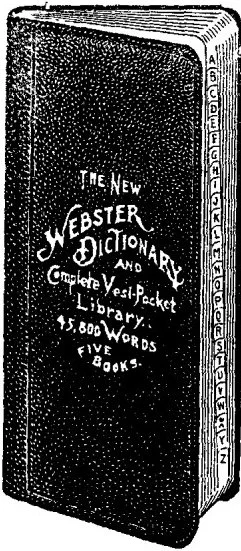
The New Webster Dictionary and Complete Vest Pocket Library
“I am surprised,” Says PROF. E. A. SHELDON, President of the State Normal School, Oswego, N.Y., “that so much that is valuable for one to know is brought into so small a compass and sold at so small a price.”
THE NEW Webster Dictionary AND Complete Vest. Pocket Library
is full of happy surprises. It successfully combines a Dictionary of 45,800 words; a complete Parliamentary Manual; Literary Guide, etc. Positively the only pocket dictionary giving the full pronunciation of words.
Over 300,000 copies sold.
“I shall give this book a place in my vest pocket, a place that no other book thus far has had.”—C. C. Gaines, Pres. of Eastman Business College.
192 Pages, 5⅝ x 2⅝ in., Weight, 2 ounces.
Should be owned by every Student, Business Man, and Person of Intelligence.
Cloth, 25 cents; Morocco, 50 cents; Extra Quality with Three Years’ Calendar, Perpetual Memorandum, and Safety Postage-Stamp Holder, 60 cents.
Contains ninety-six pages, with twenty full-page illustrations. The work takes up Christ's great prophecy of his own second coming, and the signs of the times are clearly pointed out in relation to that greatest of all events.
JUST THE BOOK FOR THE TIMES.
Interesting, Timely, and Instructive.
Price, attractive board cover, .25
PACIFIC PRESS PUBLISHING CO.,
39 Bond st., New York City.
AGENTS' OUTFIT FREE. No Capital NEEDED.
Weekly sales pay big money. We make a high grade BICYCLE as low as $24.00. Fully guaranteed. Shipped anywhere on approval, direct from our factory. ALPINE CYCLE CO., Dept. 68, Cincinnati, O.
The Gospel Primer.
A Book for the Children.
Contains 160 pages of matter, which will interest the old as well as the young. There are thirty-three full-page illustrations, which, in themselves, teach many gospel truths.