On the morning of November 29, Brethren Krum and Jespersson and I went by train from Jerusalem to Jaffa to counsel with Brother Hörner about the mission there. I was glad to find the sea so quiet that I could leave that afternoon for Port Said, Egypt. Elder Krum had to remain a few days to catch the boat for the north, and then it became so stormy that the vessel had to leave for Beirut, before it could finish taking on cargo, and return to Jaffa again. It requires but one night to go from Jaffa to Port Said.
As we entered the canal at Port Said, the quarantine officers came out, and all the dirty clothes and blankets in the baggage had first to undergo a process of disinfection, but the superficial manner in which this was conducted is shown by the fact that only one of my two blankets was taken. Naturally, we had to pay a fee for the disinfection. As we entered Port Said, we could see that things were managed by an altogether different government. As our readers may know, Egypt is now an English protectorate. Although there is a force of but twelve thousand soldiers here, yet they are able to rule this country with its twenty millions of people. The English lord is the real ruler, and not the Egyptian khedive. They have a fine harbor at Port Said, and the city is well kept. Here I again found well-dressed policemen, and any one may read the daily news, there being freedom of the press.
The train leaving Port Said in the evening followed up the canal to Ismailia, a distance of fifty miles on the narrow gauge road, and then one here takes the broad gauge to Cairo, ninety-three miles distant, traversing a part of the Goshen of the Bible.
On my arrival in Cairo, I was glad to meet Brethren Passebois and Awada and our two Armenian brethren. I was at once conducted to the health home, where we carry on a vegetarian restaurant, which is situated in the center of the city, only a few minutes’ walk from the post office. In the basement is the depository of the British and Foreign Bible Society. We have the second story. At the earnest solicitation of some German merchants residing in the city, who promised speedily to secure sufficient boarders to keep the institution going, Brother Passebois opened this vegetarian home, and I was glad to see fifteen young men from all parts of the German empire, enjoying our well-supplied and richly spread table. Three of these room in the house, and so the mission prospers financially. This work really opened the way for us to have a good place for Bible readings right in the very heart of the city.
Cairo has a population of about six hundred thousand, among whom are thirty-five thousand Europeans. For the most part, the population is made up of Egypto-Arabians (townspeople), Fellah settlers, Berbers, Copts, Turks, and Jews, as well as a sprinkling of negroes, and Northern Africans, Bedouins, Syrians, Persians, Indians, and other Oriental peoples. Cairo is by far the largest city in all Africa. It has some nice streets and buildings. One of its peculiarities is its bazaars, located in narrow lanes, and generally shaded by an awning to keep out the sun. These shops are about six feet wide, and open toward the street. Some of the artisans do most skillful work with the most primitive tools. I noticed that the turners, for instance, can use their feet and toes as nimbly as they can use their hands and fingers.
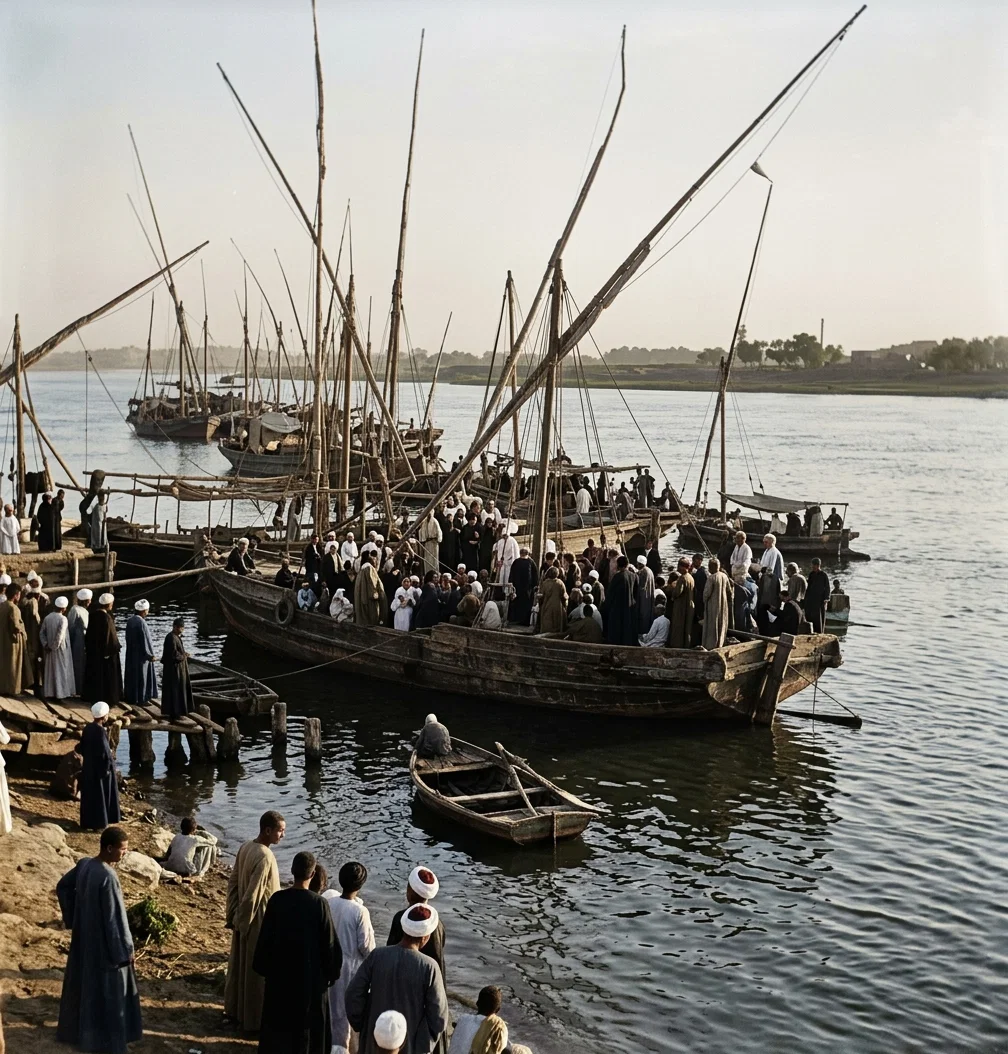
ASSEMBLED FOR BAPTISM
While in Cairo, we had meetings almost every night, speaking in English, which was translated into Armenian by one brother, and into Arabic by another. Twelve Armenian Sabbath keepers, and Elder Awada and his wife (Copts), who had been working for the American Presbyterian mission for eleven years, were present, and he translated into the Arabic. Sabbath, December 13, was an excellent day for us. During the preceding week, I had been holding meetings with the candidates, preparing them for baptism. Sabbath we filled a tram (as there were thirty of us), and went to the River Nile, where we had secured one of the small sailboats that ply to and fro on the river, to be used as dressing rooms in connection with the preparations preceding the service. It was a beautiful day, and I baptized twelve. One aged brother who had kept the Sabbath, and paid his tithe faithfully for two years, but was not able to leave off the disgusting tobacco habit, wept bitterly as he saw them, one by one, going down into the watery grave, while he himself was left behind. And, the solemn ceremony being over, he stepped up to me, and said that, by the help of the Lord, he would gain the victory over the filthy weed, and a few weeks later Brother Passebois baptized him also. We organized a church in Cairo, with Brother Passebois as elder.
While at Cairo, we went out one day to visit the pyramids, those mighty sepulchers of the ancient kings. I also paid a visit to the mosque Gami’a el-Azhar, which was converted into a university in A. D. 988. The sanctuary, with its nine aisles, now forms the upper hall of instruction, and has one hundred and forty marble columns, and covers an area of thirty-six thousand square yards. The subsidiary buildings are divided into separate chambers for the use of the natives from a particular country or province of Egypt. Most of the students are natives of Egypt. At the last census, the mosque was accommodating 6,923 students. Before the English occupied the country, there were sometimes as many as 7,700 students in attendance. The pupils sit crosslegged on the ground, in little groups around their teachers. A great part of their task is to learn the Koran by heart; and while thus engaged, they continually swing their bodies to and fro,—a most peculiar sight,—and as they do this, they repeat certain portions of the Koran. Most of these students go forth as fanatic missionaries to Africa and Asia.
As the home of Elder Awada was at Luxor, four hundred and eighteen miles south of Cairo, he was anxious that we should go there to see the country, and visit several interested persons. The railroad kindly granted us half-fare permits, a concession which we had not enjoyed since we left the United States. All the way, one could see the entire width of Egypt, composed of only the Nile Valley, from twelve to thirty-one miles wide, flanked on either side with high hills, beyond which stretches the sandy desert, and from which the fine sand continually drifts into the valley, even penetrating the closed apartments of the cars. All along the road we could see the people, busy irrigating the country, a basket filled with water being swung on a rope between two laborers. The density of the population of the Nile Valley is indeed wonderful. If one takes only the arable area into account, it has a population of seven hundred and fifty per square mile, a density unequaled by any other country.
Leaving Cairo at night, we reached Assiut very early in the morning. This15city, with a population of forty-two thousand, is the capital of Upper Egypt. It is also the chief station of the American Presbyterians, who have quite a school here.
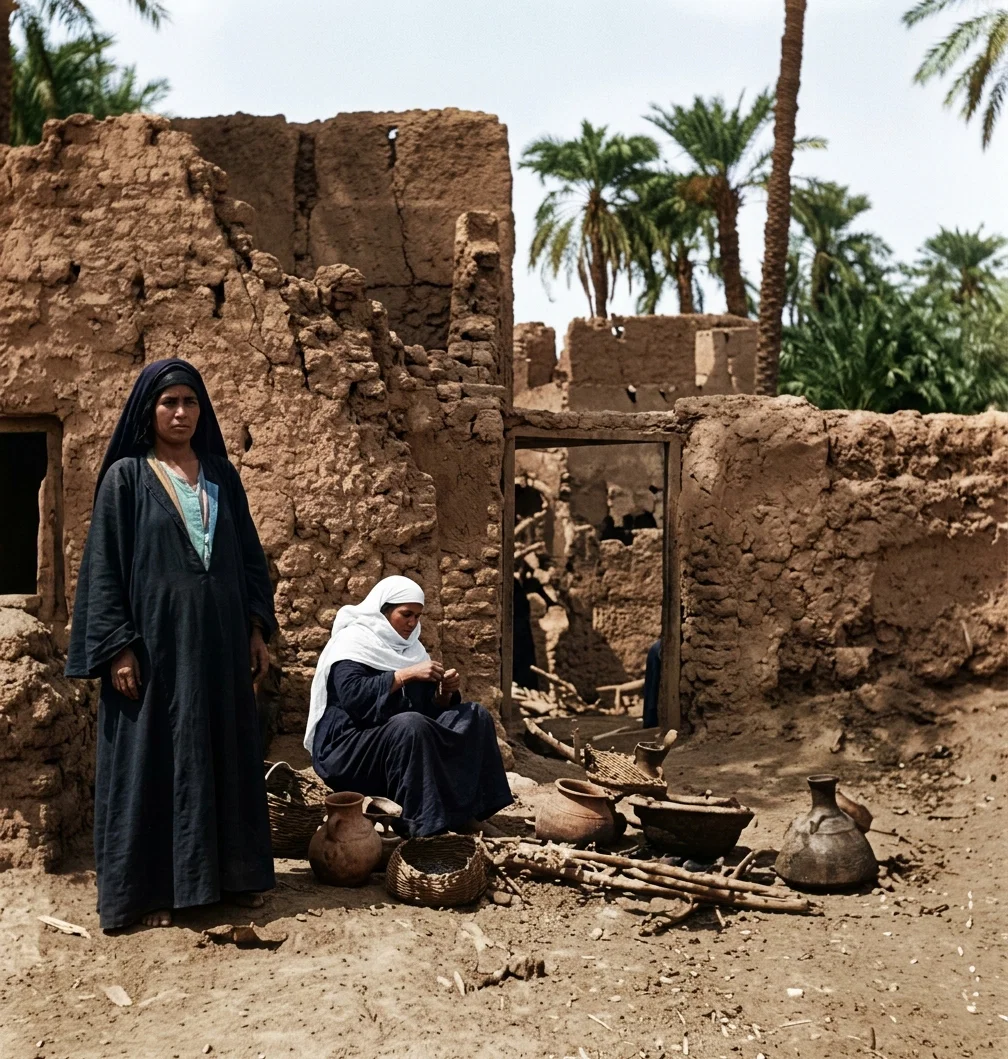
EGYPTIAN VILLAGE WOMEN
We next went to El ’Matia, a small village in which Elder Awada’s brother lived. At this place we saw something of Egyptian village life. One thing peculiar is the large pigeon houses in which huge flocks of pigeons are kept, simply for the sake of their droppings, which is the only manure used in the fields, as the dung of the cattle is dried and used as fuel. But inasmuch as the pigeons consume really more than they produce, they are a loss rather than a gain to their owners.
It being Sunday morning, a number of friends soon called to greet the strangers, and they began to inquire with reference to our belief. Here we went to a Coptic church, quite a large building, the only furniture being mats placed on the floor, on which we all had to squat down. As we were obliged to rise to greet every stranger as he entered, the process became somewhat like a gymnastic exercise. One other peculiarity I noticed was that there was not a female visible in the church. About a fourth of the place was fenced off for the women, from behind which they could peep out through small holes. We talked a while to those assembled, but their service was rather formal in its nature. They partook of the Lord’s supper. One gentleman came quite a ways to meet us, and we had a long and interesting conversation with him.
In order to catch the fast train in the evening, we put our things on a camel, some of the brethren also riding on the animal, while we preferred to return to Assiut on foot. Elder Awada had told us that there was a postmaster a hundred miles south, at Farshut, who was anxious to see us; but as our time was limited, we hardly saw our way clear to stop there. Being tired, as we had had but little sleep the night before, we reached Farshut before we were aware of it, and were awakened by hearing some one knocking at the car window. When we opened the window, a gentleman told us to hurry out, and stop there. But upon offering objections, we learned to our astonishment that our baggage had been taken from the train already, so we had to follow.
Farshut is a town of about fifteen thousand inhabitants, and the postmaster told us that there was not even one physician in the whole place. He took us to his house, and not until morning were we able to retire, he asked so many questions, and was so deeply interested. Before retiring, we sought the Lord together, and in his prayer he promised to give himself fully to the Lord’s service. Although we had supper and breakfast in the house, and were lodged there, and met the gentleman of the house, his children, and his servants, yet one person we did not see—his wife. Even in a Christian family like this, the women are secluded from the men. The only way to reach them is for the missionary’s wife to accompany him. The Orient surely presents a great field for the labors of the Bible woman.
Next day we proceeded to Luxor, so noted for the ancient temples lying on both sides of the Nile,—Luxor and Karnak being on the right side and Thebes on the left. When we reached Luxor, we found the town and the station with flags and banners flying, and decorated in the finest style. The khedive had paid a visit to Khartum in the Sudan, and was expected back the next day on a steamer stopping at Luxor. As we were anxious to see some of the ruins of these noted temples, especially of Thebes, we arranged to go across the Nile that night. As Elder Awada had been pastor of the church at Luxor for many years, the elder of the company at Thebes, across the Nile, came over in the evening to see us. Being well acquainted with the country, they secured a boat which took us across the river by moonlight.
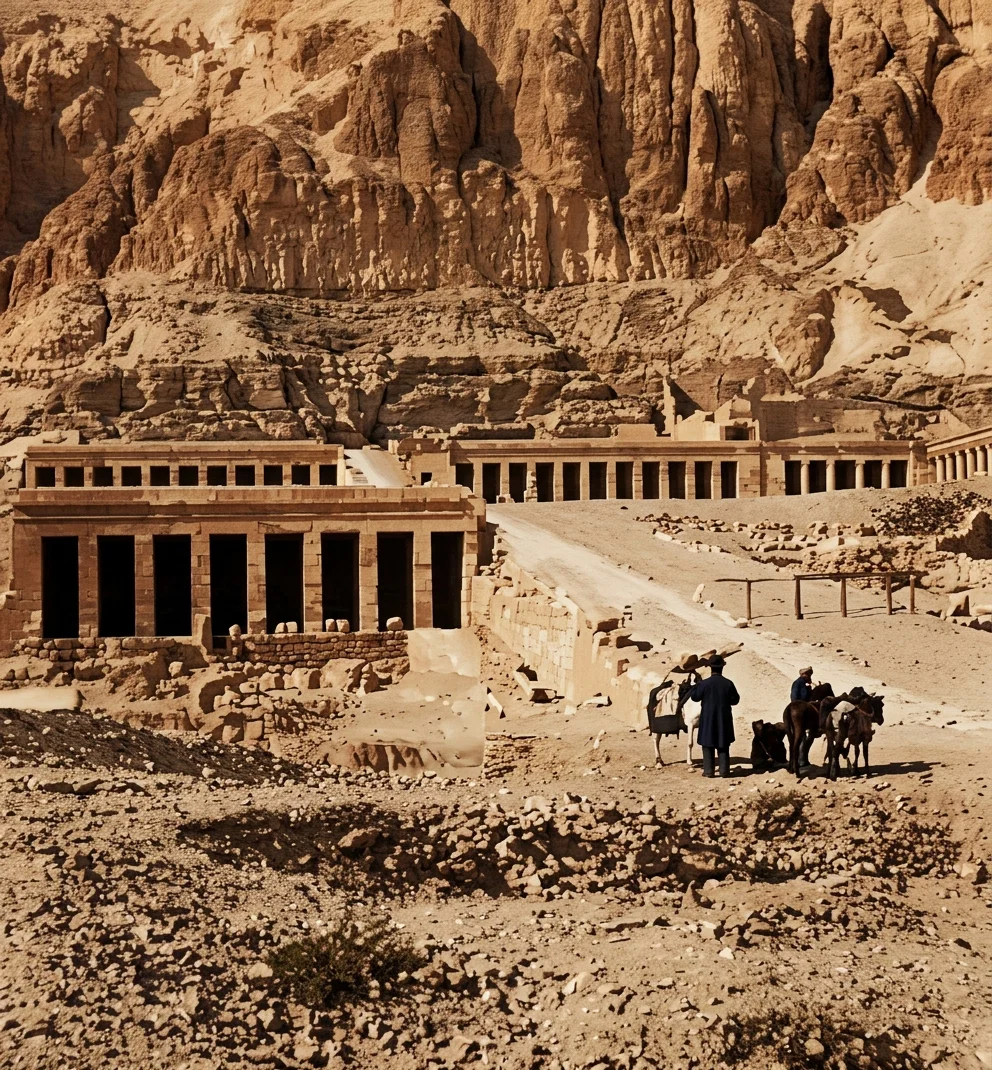
Thebes, the city of the dead, contains a number of temples, some of which date as far back as the time of Moses. They are most wonderful buildings, some of them being five hundred feet long and one hundred and fifty feet wide, all covered with hieroglyphics, and drawings picturing the life of the people of that time. One peculiar thing I noticed everywhere was that on nearly every pillar or column was a picture of the sun. In fact, all the pictures I could see testified to sun worship. The temple of Der el-Bahri, called Zoserzoru, or The Most Splendid of All, by the Egyptians, especially attracted my attention. From the picture, the reader may obtain some idea of the greatness of this temple, which is erected in the rocks, giving it a wonderful background. It occupies three terraces, one above the other. Some of the chambers have been wonderfully preserved. It is only a few years since the structure has been fully unearthed from the sands with which it was buried. Here I saw an altar dedicated to the sun, in an excellent state of preservation. Everywhere on the walls one may see pictures referring to sun worship. In the Ramesseum lie the remains of the colossus of Rameses II, the highest statue in Egypt, the total height of which was fifty-seven feet, with an aggregate weight of over two million pounds. We did not have sufficient time to visit the tombs of the kings and queens in the mountains near by. On our way back, we passed the two colossi of Memnon, each about sixty feet in height. They were formerly adorned with crowns. The size of these statues may be better conceived if we state that the middle finger on each one is about four and one-half feet long.
THE TEMPLE OF DER EL-BAHRI
We also visited Karnak, a little to the north of Luxor. Before one reaches these wonderful temples, he must pass a large avenue of sphinxes. The ruins of these splendid temples at Karnak are immense. Excavations are still being carried on, and new treasures are being constantly unearthed. Here I saw, engraved in stone, the history of the Bible. The triumphal monument of Sheshonk I, the Shishak of the Bible, commemorates the victory won by Shishak over Rehoboam, son of Solomon, king of Judah. “The large form of Ammon, wearing the double crown, appears to the left, grasping in his right hand the sword of victory, and in his left cords binding five rows of captives taken in Palestine.” The Bible passages referred to are161 Kings 14: 25, 26; 2 Chron. 12: 2, 4, 9. One may here find single halls of sufficient size to inclose some of our largest churches.
But we will not stop too long on these wonderful ruins of Thebes, with its hundred gates of old. Its splendor is gone. And we are glad that the temples of the idolatrous worship of the sun, as mighty as they were, are now but a heap of ruins. But brighter than all their former glory, is the Sun of Righteousness, who is again to enlighten darkened Egypt with the bright rays of the everlasting gospel.
As we had to leave that night for Cairo, we missed the arrival of the khedive, but we saw not only thousands assembled here from different portions of Egypt, but quite a number of Sudanese carrying on their wild dances.
Upon our return to Cairo, Elder Awada was ordained to the ministry. He is our first minister in the Arabic, and we hope the Lord may bless his labors to the salvation of many souls.
From Cairo we were accompanied by Brother Passebois to Alexandria, crossing the rich delta of the Nile. Alexandria is a beautiful city of about three hundred thousand inhabitants. It contains a large number of Italians. Its founder was Alexander the Great. Two faithful Armenian brethren have come from Constantinople to labor here. We had several Bible studies at their home, and celebrated the Lord’s supper.
The evening of the 24th I sailed from Alexandria on the Austrian Lloyd steamer “Bohemia.” But as the plague was still raging in Egypt, I had to undergo a careful examination at the hands of the physician before leaving. The following evening we came in sight of Crete, where Paul stopped on his journey to Rome, and the next day we saw the mountains of Greece and the Ionian Isles. There are millions in these countries without a laborer, and they need to be warned. As we entered the Adriatic, the weather became more stormy. And after three days and a half on the journey, the climate suddenly changed from the hot sun of Egypt to the icy air of the Alps. Arriving at Triest, we were all carefully examined by the doctor, and each was obliged to tell him where he was going. Twenty-four hours on the cars took me through the southern portion of Austria, where the German language is quite largely used. Whole provinces there, with a million or more of inhabitants, have not yet seen one of our ministers. Reaching Vienna, the police were still on the lookout for me, being notified by telegram that a man was coming from Egypt, and after they saw that I was well, they let me pass quietly by. I was glad indeed to reach home, after an absence of three and one-half months, having traveled thousands of miles by land and sea, in three different continents. Surely the Lord is good, and to be praised for his protecting care in granting us the privilege of carrying the gospel of the soon-coming Saviour, to the ends of the world.
Our Training School (Colored) at Huntsville, Ala.
By George I. Butler
It has been my privilege this spring to pay two visits to Huntsville, Ala.,—the first, from March 28 to April 3; the second, from April 25–28. These were seasons of interest and profit to the cause in this place, where our largest colored school is located. Doubtless it is well known to many of our people that about six years ago a farm of three hundred and sixty acres was purchased within four miles of the flourishing city of Huntsville, Ala., at a cost of eighteen dollars an acre, or $6,480 in all, for the purpose of establishing upon it a training school for our colored believers, to fit promising young colored people of both sexes to labor successfully for their own people in the cause we all love.
This farm, with its old Southern mansion, once a place of great interest to the surrounding country, where such celebrities as President Jackson had paid visits, in the vicissitudes of the last forty years had greatly run down. So has many a famous Southern homestead since the blight of war so reduced its owner's means that no other result was possible. The farm is a place of great natural beauty, with its gigantic oak trees surrounding and overshadowing what remains of the old mansion. There could not well be a more suitable location for such a school. Just about far enough away from the thriving city to escape its evil influences and pleasures, here in quiet retirement amid the beauties of nature, the pupils can learn of God and his works, attain mental discipline and instruction, have the benefit of physical labor, and learn the processes of nature's growth, and thus be well fitted for life and its duties.
The property was sadly run down when it came into our hands. It is said that scarce a rod of fence sufficient to restrain stock was left on the place. Much of the land was grown up to brush and small trees. There was little if any fruit on the place. The buildings were sadly out of repair. Indeed, it was much like starting anew in many ways. Brother S. M. Jacobs, one of Iowa's most respected members, was chosen to take charge. He and his devoted wife, with the children's help, have labored there hard and faithfully to bring order out of chaos and improve the place, and put the buildings in repair. The place is now all under fence, or largely so, the brush cleared off and grubbed out, until the place has become an object lesson to city and surrounding country. Fruit trees—peaches, pears, plums, etc.—are now growing luxuriantly, and large crops of produce fill the commodious barn erected on the place. Fine stock graze on the green herbage, and everything wears the appearance of thrift and comfort. The farm has more than doubled in value in the last six years. Last year the produce and sales paid all the living expenses, and about four hundred dollars over; this year the same, with about seven hundred dollars excess. This result has been most gratifying. It simply speaks of the energy and good sense and economy of its management. Very many visitors come to look over the premises to learn of the processes employed to bring about these results. The land was run down so that it was difficult to raise a paying crop. But by deep plowing, etc., the soil has been brought up till it now produces bountifully.
Another feature is very gratifying; that is, the change of feeling of the whole community in regard to our work there. It can easily be understood that the advent into a typical Southern locality of Seventh-day Adventists, with their unpopular doctrines, handicapped also with a negro school to develop, would not be apt to strike the ordinary Southern white17man as a very desirable acquisition. Evidences of this feeling were from time to time apparent. But honesty, kindness, friendliness, industry, improvement, and an accommodating spirit, courtesy to all, will gradually win their way to the confidence of the community. And after six years it is evident to the most casual observer that Brother Jacobs and the institution have the good will and confidence of the best people of the community. The business men ever show him the most entire confidence and esteem. Leading men often drive out to the farm, and accept the hospitality of those present. The result is most encouraging to all concerned.
For some time past the training school has numbered about fifty, under the charge of Elder B. E. Nicola as principal, with several teachers as assistants. Already several have gone forth from the school as teachers, Bible workers, etc. Others will do so within a few weeks, when this year's school shall close.
The care, responsibility, and watchfulness required in properly looking after so large a family of young colored people for six years, had worn heavily upon Brother and Sister Jacobs. Her health especially has been greatly affected by it. Her friends have been anxious lest her valuable life should be forfeited unless she is soon relieved. She has done a faithful, noble work, and has the esteem of all who are acquainted with her ardent labors. Brother Jacobs himself has felt for months that he was in danger of a serious breakdown if he continued much longer to bear the burden. He handed in his resignation last January, and begged to be relieved. But it was so difficult to find the proper persons to succeed them as superintendent and matron, that their request was not granted at that time. The school board, of which I was chairman, at our meeting about March 1 were forced to confront the issue of making a change in the management. The names of many had been considered; but the positions were difficult to fill, requiring certain gifts not very plentiful. The board, of which two members were colored,—Elder Sheafe and Brother Brandon, the latter living near the training school,—carefully considered all questions relating to the policy, management, and discipline of the school, and its past work. There had been some feeling with our colored brethren in the past because they were not made better acquainted with the management of the school, which, of course, was not to be wondered at under the circumstances. Several days were profitably spent in a careful study of all the facts accessible. We earnestly desired that our colored brethren on the board should be made perfectly familiar with all our aims and plans, that all suspicions might be allayed, and a clear understanding of all matters reached. This result was secured, satisfaction was expressed, and the statement was made that they were better prepared to recommend the school among their people, and induce the young people among them to patronize it. These remarks were highly appreciated by our white brethren present.
After several days of careful study of the situation, the resignation of Brother and Sister Jacobs was accepted. The final conclusion of the board was to call Brother C. H. Rogers to the position of superintendent, and his sister, Mrs. Estella R. Graham, to that of matron. These were well known to several of the council present as earnest, devoted believers, persons of experience in the Lord's work, though of no experience in the kind of work to which they were called. As both were absent, it took two or three weeks to bring them together to our training school. It was my privilege to be present with them at Huntsville, April 25–28, and to introduce them to their new calling. They were very pleasantly and heartily received, and entered upon their duties as I left the place. I had the privilege of speaking to the school, which I found in good condition, everything having passed off very pleasantly since our previous visit.
Brother and Sister Jacobs did everything possible to make the entrance of the new superintendent and matron upon their work pleasant. They have since gone to Graysville, Tenn., where their son will have an opportunity to enjoy the benefit of our excellent school. There were many pleasant circumstances connected with their departure. The students very plainly manifested their high regard for them when they left. As I was to take the train at 3 A. M. on my way to Atlanta, Brother and Sister Jacobs, who were going across the country to Graysville with a horse and buggy, started early to take me four miles to the station. Not desiring to awaken all the students at that early hour, they endeavored to keep the time of our departure (about 1 A. M.) from being known. As we were quietly getting ready to go off as privately as possible, all at once the bell began to ring, and most of the students came out to bid us good-by. This sudden surprise quite touched the hearts of Brother and Sister Jacobs, and all the rest of us as well. As we drove away, the sweet sound of that beautiful hymn, “God Be with You till We Meet Again,” rang out on the night air. Many of our colored pupils have sweet, melodious voices, and know how to use them. Our emotions were deeply touched, and we could but say, God bless our colored training school. May it prosper, and do a vast amount of good. Its prosperity lies very near my heart. It needs the means and the prayers of all our people to make it what it should be.
GEO. I. BUTLER.
Nebraska Conference Sells Christ's Object Lessons
By Geo. M. Brown
Nebraska
We are all busy in this conference, and are having a precious experience. At our State meeting held at College View, April 15-17, plans were laid for an immediate advance in selling “Christ’s Object Lessons.”
Learning that ten thousand books remained to be sold by this conference, we unanimously decided that we would sell them before we began our tent work. The workers were divided among the seven districts in the conference, and all went to work with a will. Every church that has had the matter presented to them, have taken their quota of books, and more than half of the entire ten thousand books which we had to dispose of have now been ordered, and most of them are in the hands of the churches. The money is beginning to come in, and we expect that this good work will continue until every book is sold, which we hope to see accomplished by the first of July.
One brother writes, “I had remarkable success in selling the six copies of ‘Christ’s Object Lessons.’ Those who bought are among the leading men of this State.” This brother, his wife, and her sister have already sold twenty-four books.
The wife of Governor Savage ordered a copy. She said it was an excellent book, and thought she would want three or four copies.
Space will not permit us to relate the success that has rewarded our efforts, or the many interesting experiences which come to those engaged in the work. Never has anything so stirred all our people and set them to work as has this movement to sell “Christ’s Object Lessons.”
Over one hundred students of Union College spent part of one week in the work, and sold, on an average, about two and one half books each. Special permission was obtained from the authorities of Lincoln for the students to engage in this work without securing the customary license. This illustrates the wonderful way in which the Lord is going before us in this work.
We expect soon to be able to join with our sister conferences in singing the jubilee song of freedom from the debt which has been so long crippling our college.
GEO. M. BROWN.
Report from New York City
By Stephen N. Haskell
The work in this city, as in other portions of the world, is onward. The Scandinavians have united their interests in obtaining a church building. This has been a source of great blessing to them. They now have the first meeting house owned by our people in Greater New York. There is a good interest among them, and several are expecting baptism at no distant date.
The providence of God in an especial manner has been over the German interest. Meetings have been held in the city proper, and a few have accepted the Sabbath. Among them is one sister who has been an active laborer in the cause of Christ. In Brooklyn a meeting house has been secured for a small sum, and the interest there is increasing. Several have been baptized. Arrangements are being made to hold a tent meeting this coming season. With nearly one half as many Germans as there are inhabitants18in the State of Michigan, we have one minister and a single helper.
Elder Warren has labored in Brooklyn among the English, thus carrying on the work begun by the missionary efforts of our brethren and sisters in that place. A goodly number have been baptized, and still there is a good interest. There is also an interest among the colored people, as meetings are being held with them. Dr. Bryant, Brother George King, and several workers have taken a house together, and thus formed a center for the Brooklyn work.
The meetings held in Carnegie Lyceum by Elder Franke have been of unusual interest. From the beginning the attendance has been good. On several occasions some had to go away because they could not obtain seats. It is a popular hall, and the religious interest is good. The Lord has blessed Brother Franke's labors. He has reached a class of hearers that would not have been reached by any other means.
The meetings at the Metropolitan Lyceum on Fifty-ninth Street have continued through the winter. The congregations Sunday evenings have been principally those not of our faith. Several have been baptized, and during the last few months about twenty-five have decided to keep the Sabbath, and a large number are now on the point of deciding. There have been two baptisms during the last two weeks, and we expect another soon. This is a result of the house-to-house work and the Sunday night meetings.
The mission on Sixty-second Street, where the use of rooms has been given us, has been blessed of God. A number have accepted the truth, and several have been baptized.
Our mission work has been largely educational. There are nineteen in our family at present. The majority of these are beginners, having never been connected with the cause in any special way. A few of the workers are experienced in Bible work and nursing. These are from different parts of the country,—one from Florida, and others from the West. We have held two cooking classes; one was held in the early part of the winter, and the other has just closed. The attendance was good, and quite a number not of our faith became interested. The New York Tribune frequently sent a reporter, and published favorable reports.
These classes have been held in the lyceum on Fifty-ninth Street. A school giving instruction in the principles of hygiene has been held among the Scandinavians by our Scandinavian nurse, and we expect soon to open a school of health in the Metropolitan Lyceum. An experienced teacher in this department of the work has come from the West. The nurses we have with us have more than they can do. We have calls for cottage meetings on the health question until we are tired of saying we cannot attend them. Truly God has gone before us in the health work.
Dr. Geisel's stay with us was a great help in every respect, especially in the health and temperance work. We are anxiously looking for her return. It being necessary for her to leave in the midst of the cooking class, Mrs. Haskell, in addition to her other responsibilities, gave the lectures, and Sister Jones, from the South Lancaster Sanitarium, taught the cooking classes.
God has prospered us financially since coming to this city. It would require too much space to give particulars. The expense of the lyceum during the cold weather was about thirty-five dollars a week, including the printing of notices of health and religious work; but we could not have held Sabbath and Sunday night meetings, cooking classes, and general gatherings without the control of it seven days in the week. The total expense of the lyceum from the beginning to March 31 has been $486.47. This has been wholly met by voluntary offerings for that purpose alone. The conference workers who were with us from January 1 to March 31 received $744.16. This does not include Brethren Warren and Utechman, my wife and myself. The tithe of those organized into a church since we came here, together with donations and the profits on book sales, has paid these workers. Our house-rent, when we first came here, was sixty dollars a month; and as our family increased, we were obliged to hire extra rooms until it ran up to one hundred and fifteen dollars a month. All of this has been met. Many items might be mentioned to show God's care over his work here, for all of which we praise his name.
S. N. HASKELL.
M. W. LEWIS
By M. W. Lewis
Michigan
MENOMINEE.— Since our State meeting we have been making a special effort to sell “Christ’s Object Lessons” in this city; but we have had to contend with many difficulties. The foreign population being largely Catholic has made it rather difficult to sell books. The mild winter in the Upper Peninsula made less demand for labor, which caused a shortage on timber at the mills in this city. This resulted in closing down some of the mills, throwing many out of employment. Business was affected generally, the book work not excepted. But we hope that this embarrassment will be partly relieved by street work in the near future. We could not get the sufficient amount of help from the churches under my charge, for several reasons: the church at Wilson being French and Belgian, and in a French-Catholic neighborhood, but little could be done. The Stephenson church was so situated that the members could not take hold of the work as they would like to have done, some working out by the month, others putting in their crops. A few, however, are doing what they can for the sale of the book, and all seem willing to do all they can.
We are not discouraged, the Lord has been helping us in the work. All together have sold seventy books, and to the Lord be all the praise. The Lord moved upon three men here in the city to take twenty-six books. They are sending them to their friends and relatives. One of the three men also ordered a club of the Signs of the Times, which amounted to three dollars and a half. The total amount paid by these three men is thirty-six dollars. We have faith to believe that by the help of the Lord we will sell our quota.
We have organized a Sabbath school in this city, with fifteen members. A few have begun to observe the Sabbath of the fourth commandment. Others are interested. We believe that, by the help of the Lord, a company will be brought out here to hold up the light of the third angel’s message. Please remember the work and workers at the throne of grace.