The Youth’s Instructor, Vol. 35, No. 30.

CALIFORNIA BIG TREES

The Youth’s Instructor

Jul 27, 1887

S. D. A. Publishing Association · Battle Creek, Mich. · Jul 27, 1887

CALIFORNIA BIG TREES.
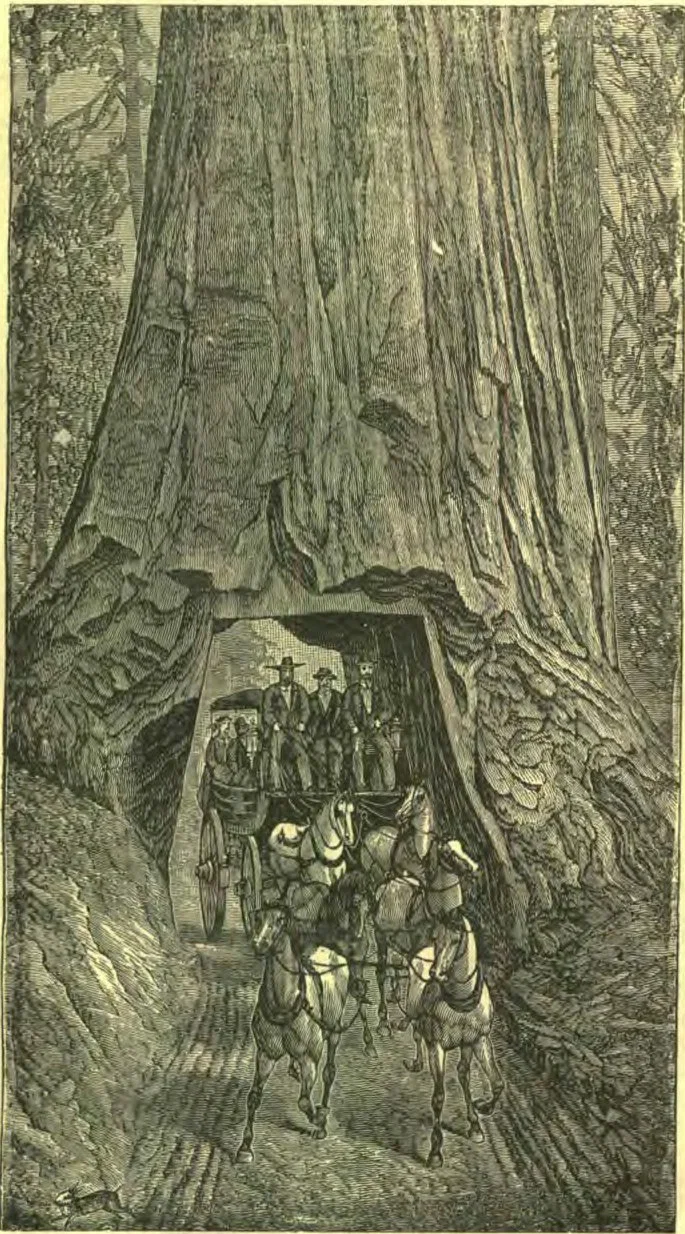
It has been said that Californians are wont to do everything on a large scale. And it seems quite natural that it should be so. Nature planned everything on a large scale in California, and her enterprising people are only filling up the picture according to the outline presented to them. If other countries claim as beautiful scenery, as delightful climate, as lofty mountains, as extensive plains, she surely stands unrivaled in having the grandest valleys, the highest falls, and the largest trees in the world.
At the Centennial Exhibition in Philadelphia, in 1876, there was set up a section of a big tree which appeared so enormous that many queried whether it was genuine, or whether it was put together of sections of many trees for the occasion. In January 1877, in company with a friend who was on the ground when they were cutting down the “Centennial Big Tree,” I visited the spot where it stood. After an enjoyable camp in the frosty air at the foot of the mountain, we ascended some 5,000 or 6,000 feet in a wagon. We camped twice in the mountains before we reached the Big Tree grove. The wagon road leads to lumber mills which are far up the mountain. Leaving this road, we proceeded on horseback over a trail, sometimes steep, but not difficult.
As we neared the redwood grove, the timber increased in size, especially the sugar pines, which were large in diameter, and very tall. At first we found the redwoods scattering, and of only medium size, and the great height of the pines rendered it difficult to form, by comparison, a just estimate of the height of the redwoods. As we neared the summit, we found them more numerous and larger, ranging from eighteen to twenty-five and even thirty feet in diameter. I made it a point to visit the stump of the tree which was exhibited at Philadelphia.
The tree was cut low to the ground, and a recent fire had destroyed the bark, and so marred the edges of the stump that it was not easy to determine its exact size. But from points clearly defined, I made ten steps on its surface, in a direct line across its center. Now let a man of medium size draw lines ten steps in length across a common center, and around the extreme points draw a rough circle, and you will have quite a correct diagram of that stump. My companion said that the bark was thirty-two inches thick when the tree was cut. That would increase the diameter of the stump fully five feet. But a difference of five feet in the diameter of a tree of that size appears inconsiderable to the eye.
To cut the tree in two after it was fallen, it was necessary to have a wide space in which to work. Accordingly two men commenced work on the top of the log, about eight feet apart, or far enough to cut out a length of fence posts; and as they cut in with saws and axes, they split out the length between them, and thus let themselves down until the tree was cut off. The section taken to the Centennial Exhibition was sixteen feet in length; the interior was split out, the outer shell only being taken. Of course it had to be split into many pieces, for no known means of transportation could take it in a few pieces. From the inside of this lower section, and from the length taken out in cutting off the log, the projector of the enterprise obtained two thousand fence posts! How many fence posts, railroad ties, or palings had been made from the tree I could not ascertain. About one hundred feet had been worked up when I was there.
It is difficult to form any just idea of the size of these trees in the midst of such surroundings. Every thing appears to be immense, and the eye, especially of the transient visitor, or one not acquainted with such scenes, fails to make a correct comparison. To realize their size, you must mount upon a tree as it lies upon the ground. A log sixteen feet in diameter does not appear to be very large there; but if you stand upon the top of one, as I did, it appears to be monstrous. And then you can but faintly realize the enormous size of one thirty feet in diameter.
Take this for an illustration. Look at a two-story house, the posts of which may be eighteen or twenty feet in length. Then imagine a log lying on the ground beside it, the top of which is even with the ridge of the house. You are almost startled at the thought. But this is not drawing upon the imagination at all. It is a fair representation of a fact. Such a log would hide any ordinary two-story house from sight...
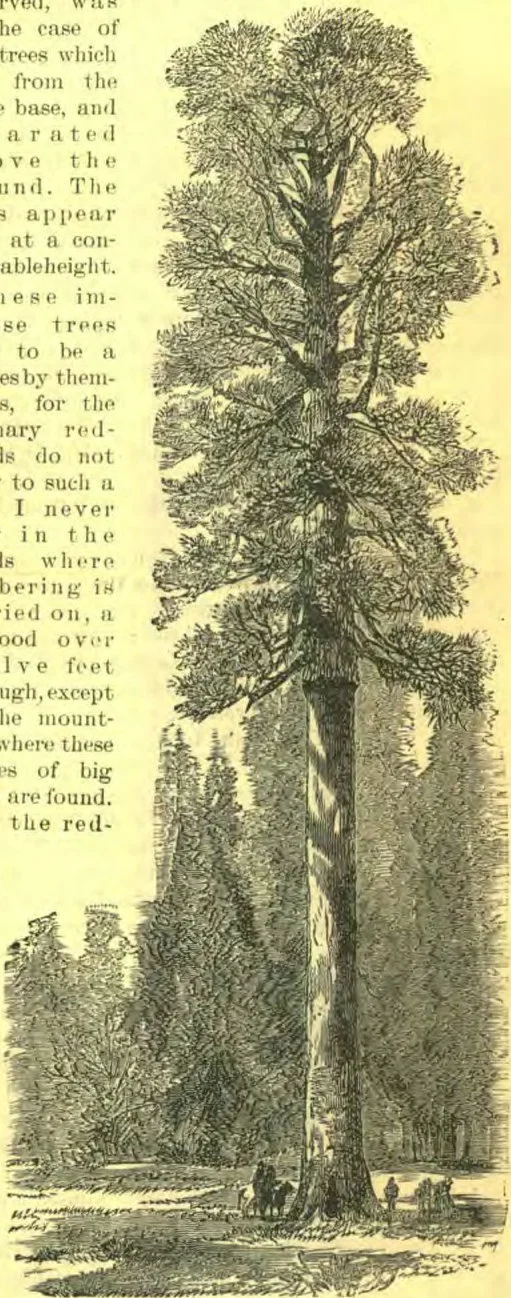
The beauty of these trees cannot possibly be imagined by any one who has not seen them. They ascend with a perfect taper, with as much regularity and symmetry as the most skillfully constructed monument. They present very little of the variety of form found in other trees, but are uniform in their stateliness and grandeur, as if they realized the necessity of a true perpendicular for such immense bodies. The only divergence from a perpendicular that I observed, was in the case of two trees which rose from the same base, and separated above the ground. The limbs appear only at a considerable height.
These immense trees seem to be a species by themselves, for the ordinary redwoods do not grow to such a size. I never saw in the woods where lumbering is carried on, a redwood over twelve feet through, except on the mountains where these groves of big trees are found. But the redwoods are all beautiful trees. A visitor to California once said that she should never be satisfied with any collection of curiosities that she could take home with her, because she could not take a redwood tree.—J. H. Waggoner, in Chips and Sticks.

A DAUGHTER WORTH HAVING.

Two gentlemen, friends who had been parted for years, met in a crowded city street. The one who lived in the city was on his way to meet a pressing business engagement. After a few expressions of delight, he said:—
“Well, I’m off. I’m sorry, but it can’t be helped. I will look for you to-morrow at dinner. Remember, two o’clock, sharp. I want you to see my wife and child.”
“Only one child?” asked the other.
“Only one,” came the answer tenderly, “a daughter. But she’s a darling.”
And then they parted, the stranger in the city getting into a street car bound for the park.
After a block or two, a group of five girls entered the car; they all evidently belonged to families of wealth; they conversed well. Each carried a very elaborately decorated lunch basket; each was well dressed. They, too, were going to the park for a picnic. They seemed happy and amiable until the car again stopped, this time letting in a pale-faced girl of about eleven and a sick boy of four. These children were shabbily dressed, and on their faces were looks of distress. They, too, were on their way to the park. The gentleman thought so; so did the group of girls, for he heard one of them say, with a look of disdain:—
“I suppose those ragmuffins are on an excursion, too.”
“I shouldn’t want to leave home if I had to look like that. Would you?” This to another girl.
“No, indeed! But there is no accounting for tastes. I think there ought to be a special line of cars for the lower classes.”
All this was spoken in a low tone, but the gentleman heard it. Had the child too? He glanced at the pale face and saw tears. He was angry.
Just then the exclamation—“Why, there is Nettie! Wonder where she is going?”—caused him to look out upon the corner, where a sweet-faced young girl stood beckoning to the car driver. When she entered the car, she was warmly greeted by the five, and they made room for her beside them. They were very profuse in exclamations and questions.
“Where are you going?” asked one.
“Oh, what lovely flowers! Who are they for?” said another.
“I’m on my way to Belle Clark’s. She is sick, you know, and the flowers are for her.”
She answered both questions at once, and then, glancing toward the door of the car, saw the pale girl looking wistfully at her. She smiled at the child, a tender look beaming from her beautiful eyes, and then, forgetting that she wore a handsome velvet skirt and costly jacket, and that her shapely hands were covered with well-fitted gloves, she left her seat and crossed over to the little ones. She laid one hand on the boy’s thin cheeks, as she asked of his sister:—
“The little boy is sick, is he not? And he is your brother, I am sure.”
It seemed hard for the girl to answer, but finally she said:—
“Yes, miss; he is sick. Freddie never has been well. He is my brother. We’re goin’ to the park to see if ’twon’t make Freddie better.”
“I am glad you are going,” the young girl replied, in a low voice meant for no one’s ears except those of the child. “I think it will do him good; it is lovely there, with the spring flowers all in bloom. But where is your lunch? You ought to have a lunch after so long a ride.”
Over the little girl’s face came a flush.
“Yes, miss; we ought to for Freddie’s sake; but, you see, we didn’t have any lunch to bring. Tim—he’s our brother—he saved these pennies so as Freddie could ride to the park and back. I guess, mebbe, Freddie’ll forget about being hungry when he gets to the park.”
There were tears in the lovely girl’s eyes as she listened; and very soon she asked the girl where they lived, and wrote the address down in a tablet, which she took from a bag on her arm.
After riding a few blocks, she left the car, but she had not left the little ones comfortless. Half the bouquet of violets and hyacinths was clasped in the sister’s hand, while the sick boy, with radiant face, held in his hand a package, from which he helped himself now and then, saying to his sister, in a jubilant whisper:—
“She said we could eat ’em all—every one—when we get to the park. What made her so sweet and good to us?”
And the little girl whispered back:—
“It’s ’cause she’s beautiful as well as her clothes.” The gentleman heard her whisper.
When the park was reached, the five girls hurried out. Then the gentleman lifted the little boy in his arms and carried him out of the car, across the road, and into the green park, the sister, with a heart full of gratitude, following. He paid for a nice ride for them in the goat carriage; he treated them to a nice lunch at the park restaurant.
At two o’clock sharp the next day, the two gentlemen, as agreed, met again.
“This is my wife,” the host said, proudly, introducing a comely lady, “and this,” as a young lady of fifteen entered the parlor, “is my daughter.”
“Ah!” said the guest, as he extended his hand in cordial greeting, “this is the dear girl whom I saw yesterday in the street car. I don’t wonder you called her a darling. She is a darling, and no mistake, God bless her.” And then he told his friend what he had seen and heard in the horse-car.—Selected.

HONEY BEES.

Every one respects the bees,—those industrious little workers who supply our tables with honey that has a taste of the dew and sunshine of by-gone summers in it. The home-life of these insects remained a mystery until about a hundred years ago, when Francis Huber, a blind naturalist, discovered many interesting things about them. As he was greatly interested in the subject, he invented a hive, and had it placed against his window pane where he might, with the help of his wife, study their habits in the privacy of their hive. As bees will not work in the light, he had a movable slide placed over his window, and this his wife could remove a little while at a time without much disturbance to the inmates.
The bee, he found, has pockets enough to delight a tailor. It has six in its abdomen for wax, one for pollen, and a pocket, or stomach-bag, for honey. Each bee has its own duties, and attends strictly to them, never meddling with its neighbor’s business. Like the ants they use their antennae for communication with each other and in guiding the affairs of the hive.
When they swarm and go into a new hive, some of them walk carefully around inspecting their new quarters. If they find any cracks, they fly off to cherry or horse-chestnut trees for gum to fill them up, so that no intruding insect can gain an entrance. Then, from their wax pockets, some of the bees begin to spread ribbons of wax on the roof of the hive until there is a large lump hanging from it. Then another set of workers come, and with their heads bore holes in the lump, turning round and round and gnawing it until it becomes smooth as glass. Sometimes as many as twenty bees take turns at one cell until it is of perfect shape. These are the nursing bees, who take care of the young bees after the eggs are laid in these cells.
Every swarm has a queen or mother bee. She is larger than the rest, having a long slender body and short wings. All the bees show her great honor, guarding her and waiting upon her. The working bees only have stings and bags of venom.
On each flight the bee visits but one species of flowers before going back to the hive, so as to have only one kind of honey in her bag, or stomach. This is not thought to be the stomach proper, as no process of digestion has been found in the honey. It is probably only a convenient receptacle to store it in on her homeward flight. Some of the honey cells are left open for present use, and some are immediately sealed for winter food.
Some of the community are placed on guard as policemen, or sentinels, to keep out moths, snails, and ants. There is a honey moth that will even defy the stings of bees, if it can get inside the hive to lay its eggs so that its young may feed upon the honey stored there. These sentinel bees have no other duty than to guard the hive from intruders.
If an insect escapes guard and reaches the inside, it is quickly stung to death. If its body is too large to be removed, they cover it with a slimy substance which hardens and prevents decay or any unhealthy odor. Bees are marvels of neatness and good order. It is said that bees soon know their friends. They judge that those who do not fear them do not mean to harm them.
They know how intimately fresh air is connected with good health. When the heat of the hive becomes too great, and the air grows impure, a number of bees set to work to ventilate it. As there are no windows, and only one door, they exercise some ingenuity in doing this. Many of them stand close to the door, with their heads facing it, and wave their wings rapidly to and fro in unison, thus producing a current of air; while behind them all over the hive stand other bees with their heads toward the inner part, repeating the same operation with their wings, and so the fresh air is circulated through all the passages.
If bees do not find the flowers they love, they will fly miles in search of their favorite sweets; and when they start for home, no matter how far away they may be, they make no crooked paths, but fly in a straight “bee-line” for their hive and their store-house.
L. E. ORTON.

BEFORE AND AFTER THE RAIN.

We knew it would rain, for all the morn, A spirit on slender ropes of mist Was lowering its golden buckets down Into the vapory amethyst Of marshes and swamps and dismal fens,— Scooping the dew that lay in the flowers, Dipping the jewels out of the sea, To sprinkle them over the land in showers.
We knew it would rain, for the poplars showed The white of their leaves, the amber grain Shrunk in the wind,—and the lightning now Is tangled in tremulous skeins of rain!
The rain has ceased, and in my room The sunshine pours an airy flood; And on the church's dizzy vane The ancient cross is bathed in blood.
From out the dripping ivy-leaves, Antiquely carven, gray and high, A dormer, facing westward, looks Upon the village like an eye;
And now it glimmers in the sun, A square of gold, a disk, a speck: And in the belfry sits a dove With purple ripples on her neck.
—Thos. Bailey Aldrich.

MODES OF PUNISHMENT IN CHINA.

In the large towns one sometimes sees a poor wretch on his knees, condemned to carry the cangue. This is an enormous block of wood with a hole in the middle, through which the head of the culprit is passed. As the entire weight of the block presses upon the shoulders, the torture, after a few hours, becomes terrible. On the cangue are pasted strips of paper, upon which are written, in large letters, the crime perpetrated, and the sentence. This and strokes with the bamboo are the most ordinary modes of punishment.
The strokes of the bamboo vary in number and force, ranging from a few up to a hundred, sometimes applied with the large, at other times with the small, end of the cane. Most always when over sixty strokes are given, the sentence provides for branding and perpetual banishment. Capital offenses are punished with strangulation, or decapitation, or by death from the awful torture called the “slow and painful death.” In this case the cruel wretch who acts as executioner thrusts his hand into a covered basket containing an assortment of knives, each one labelled with the name of a limb or other muscular part of the body. Drawing one at random, he cuts off the part that is indicated on the knife, removing a muscle, a limb, or a bone, as deftly as a surgeon. One knife is labeled “the heart,” and the relatives frequently bribe the executioner to seize this one quickly, and put an end to the victim’s agony.
Great criminals are frequently inhumanly tortured. Strong ropes are fastened both to the feet and hands, and carried over pulleys on a roof beam, in the court of justice. The poor wretch is then drawn up so that his body forms a bow. Five or six executioners take positions around, some with rattan rods, others with leathern lashes. Before the trial ends, the flesh of the victim is torn in shreds, the blows ceasing only after a full confession is made. Yet frequently this is only the beginning of torture. The Chinese have some remarkable remedies which the judges often order applied after a punishment of this kind, and in a few hours the prisoners can be brought again into court, revived and strengthened, and able to be tortured worse than at first, and yet survive.
There is a class of robber pirates in China called houan-kouen. These men glory in defying the laws, and committing crimes. Their great pride is to give and inflict wounds without flinching, and to kill others with calmness, never fearing death themselves. Sometimes these men will appear before a magistrate, confessing all their crimes, and demanding to be condemned, yet when the court is convened, and according to Chinese law the open confession is necessary, they will deny all simply out of bravado, in order to be tortured, and this they endure with the utmost stoicism. Frequently efforts will be made to force the robber to reveal the names and hiding places of his comrades. If he refuses, torture is inflicted twice a day for several days. Each time he is brought into the court and swung up on the ropes, he is asked to confess. If he refuses, the magistrate selects from the pile on the table before him a rattan, and throws it to the executioners. On the stick are marked a certain number of blows, each executioner dealing twice the number marked, so that the aggregate, when several executioners take part, is something frightful.
The ingenuity of man to torture his fellow-creatures has been exhausted by the Chinese. In no other country are such cruelties practiced. W. S. C.

The Bible as Christian's Chart and Guide

The Bible embodies all that a Christian can need. It is his only chart through this tempestuous life; in trouble, it is his consolation; in doubt, his monitor; in difficulty, his guide; amid the darkness of death, and while descending into the shadowy valley, it is the day-star that illumines his path, makes his eye bright with hope, and cheers his soul with the prospect of immortal life.

A WONDERFUL CLOCK.

A short time since, the writer visited the “Liverpool Free Public Museum.” In a corner of one of the rooms stood a most magnificent and extraordinary clock, which attracts the attention of a great many people. Thinking a description of it worthy of a place in the “Scrap Book” of the INSTRUCTOR, I send a verbatim copy of the one on exhibition with the clock. It reads as follows:—
“The world is indebted for this wonderful production of ingenuity, perseverance, and mechanical skill, to Jacob Lovelace, born in the city of Exeter, who ended his days in great poverty in that city, aged 60 years, having been 34 years in completing it. This beautiful specimen of mechanism is inclosed in an elegant cabinet 10 feet high, 5 feet wide [about 3½ feet from back to face], and weighing half a ton. Ornamented with oriental figures, and finely executed paintings, bordered with richly gilded carved fretwork. The movements are: 1. A moving panorama descriptive of day and night. Day is beautifully represented by Apollo in his car drawn by four spirited coursers, accompanied by the 12 hours. And Diana in her car drawn by stags, attended by the 12 hours, represents Night. 2. Two gilt figures in Roman costume, who turn their heads, and salute with their swords as the panorama revolves, and also move in the same manner while the bells are ringing. 3. A perpetual almanac, showing the day of the month on a semi-circular plate, the index returning to the first day of every month on the close of each month, without alteration even in leap years, regulated only once in every 130 years. 4. A circle, the index of which shows the day of the week with its appropriate planet. 5. A perpetual almanac showing the day of the month, weekly, and the equation of time. 6. A circle showing the leap year, the index revolving only once in four years. 7. A time-piece that strikes the hours, and chimes the quarters, on the face of which the whole of the 24 hours (12 day and 12 night) are shown and regulated. Within this circle [this circle is in the center of the cabinet] the sun is seen in its course with the time of rising and setting, by a horizon receding or advancing as the days lengthen or shorten. Under this is seen the moon showing her different quarters, phases, age, etc. 8. Two female figures, one on each side of the dial plate, representing Fame and Terpsichore, who move in time when the organ plays. 9. A movement regulating the clock as a repeater, to strike, or to be silent. 10. Saturn, the god of time, who beats in movement while the organ plays. 11. A circle on the face of which show the names of eight celebrated tunes played by the organ in the interior of the cabinet every four hours. 12. A belfry with six ringers who ring in merry peal ad libitum. The interior of this cabinet is ornamented with beautiful paintings representing some of the principal ancient buildings of the city of Exeter. 13. Connected with the organ there is a bird organ which plays when required.
“This wonderful piece of mechanism was perfectly cleaned and repaired by W. Frost of Exeter, a self-taught artist.”
R. S. ANTHONY.

SANCTIFICATION

LESSON 4.—HOW IT EVIDENCES ITSELF.

1. In what condition is man in his fallen state represented to be? Eph. 2:12, last clause.
2. How generally is this true of men under the power of sin? Rom. 3:11, 12, 19.
3. What is the cry of the soul when fully aroused to a sense of its condition by the word and Spirit of God? Rom. 7:24; Acts 2:37, last clause.
4. What was the answer to this question? V. 38.
5. How fully may the condemnation of sin be removed? Rom. 8:1; Isa. 1:18.
6. To what class is a special promise made in this connection? Isa. 1:19.
7. Why did God send his “Son in the likeness of sinful flesh, and for sin, condemn sin in the flesh”? Rom. 8:4.
8. What is said of those who are led by the Spirit of God? Rom. 8:14.
9. What words of comfort do we find in John to the brethren? 1 John 3:2.
10. What special preparation of heart is needed to be ready to meet the Lord? Zeph. 2:1-3.
11. Will the day of the Lord come upon his people as a thief? 1 Thess. 5:4, 5.
12. What injunctions are here given? Verses 6, 8.
13. How are those who will stand with the Lamb upon Mount Zion (Rev. 14:1) spoken of? Rev. 14:5.
14. Are we to expect sanctification without obedience? 1 Pet. 1:2.
15. What does true holiness teach us? Tit. 2:12, 13.
16. How does the apostle pray with reference to this subject? Heb. 13:21.
17. Should we look for this work to be accomplished at once? 1 Pet. 5:10.

WEARINESS AND DUTY.

Let each discouraged Christian remember that if, weary in well-doing, he should surrender now, all past toil goes for nothing. It is always the last desperate push in a moral conflict which ends the battle. Apollyon was not pierced even by the sword of the Spirit or the weapon all-prayer until Christian was fairly on his knees, wounded in his head, hand and foot.
Remember, that if you give up now, you offer an entire victory to the adversary. The Devil watches for just such outbreaks of despondency. Demoralized soldiers are better to him than new recruits: for they keep saying in self-justification to more sanguine and better-hearted people, “Oh! that has been tried once: I attempted that meeting, I had that class awhile, I started in that district, I had my trial of that boy: and it was all a failure!” What could Satan do more himself? Say over slowly now to yourself those words of the gentle but brave apostle John: “Look to yourselves, that we lose not those things which we have wrought, but that we receive a full reward.”
Remember, likewise, the effect of surrenders upon the conscience and will of one’s self. Giving up a religious duty always stumbles and weakens our experience. When a man begins to step backward, he may expect soon to find himself sliding or slipping backward without the necessity of lifting his feet to go on purpose, for it is the purpose which is bearing him with it to the rear. Great defeats come from little defections, and masterly victories are gained often by simply one man’s standing steady. So with one’s own decisions; every vacillation is sure to undermine resolve; every honest determination holds one firm to his faith, and gives promise for the future stability.
Remember that if you grow weary and retreat, you part company with Christ your Saviour, Paul the grand old apostle, and all the Christian heroes whose names are on the roll-call of the sainted dead. There was but one motto for the martyrs and confessors of old; they were determined, “having done all, to stand.” There is no success for any one who will not choose the same, and live up to it. “Unstable as water, thou shalt not excel,” was Reuben’s history, and should be our warning.
Remember that the moment you grow weary in well-doing and lay down your work, you become a fresh care to the faithful whom you desert. When a Christian ceases to be a burden-bearer, he becomes a burden. The pastor is troubled about you; the superintendent is worried; your children wonder over you.
Let us learn that faithful followers of Jesus Christ must sturdily resist the temptation of weariness, and keep steadily on in their well-doing.—S. S. Times.

THE BUILDER.

Ah, me, the step, how short a one, Between the doing and the done! How near the barque may come to land, Yet cast her cargo on the sand! Oh, give me strength, and give me mind, To finish what my hands may find; That none may say, in future days, “This man could hew, but could not raise.”

"KING LONDON."

The above is the title Frank R. Stockton gives this great English city, in a series of articles published in the St. Nicholas; and it needs but a few extracts from his papers to verify his assertion,—that “London is the largest and richest civilized city in the world.” He says:—
“During a stay in England, we shall discover, if we pay attention to what people say and do, that Great Britain is divided into two grand divisions: one is London, and the other is the rest of the kingdom. When any one in England says he is going to town, we may know that he is going to London. If he intended to visit any other of the great cities, he would mention Manchester, Liverpool, Birmingham, or whatever its name might be. Town life means London life, and the other cities, no matter how large and important they are, are considered provincial, and a little countrified.”
“If any one were to undertake to walk one way only through all the streets of London, he would be obliged to go a distance of two thousand six hundred miles, or as far as it is across the American continent from New York to San Francisco. This will give an idea of what would have to be done in order to see even the greater part of London.”
“In our approach to this city, as well as in our rambles through its streets, we shall not be struck so much by its splendid and imposing appearance as by its immensity. Go where we may, there seems to be no end to the town. It is fourteen miles one way, and eight miles the other, and contains a population of nearly four million people, which is greater, indeed, than that of Switzerland or the kingdoms of Denmark and Greece combined. We are told on good authority that there are more Scotchmen in London than in Edinburgh, more Irishmen than in Dublin, and more Jews than in Palestine, with foreigners from all parts of the world, including a great number of Americans. Yet there are so many Englishmen in London, that one is not likely to notice the presence of these people of other nations.”
“This vast body of citizens, some so rich that they never can count their money, and some so poor that they never have any to count, eat every year four hundred thousand oxen, one and a half million sheep, eight million chickens and game birds, not to speak of calves, hogs, and different kinds of fish. They consume five hundred million oysters, which, although it seems like a large number, would only give, if equally divided among all the people, one oyster every third day to each person. There are three hundred thousand servants in London, enough people to make a large city; but as this gives only one servant to each dozen citizens, it is quite evident that a great many of the people must wait on themselves. Things are very unequally divided in London; and I have no doubt that instead of there being one servant to twelve persons, some of the rich lords and ladies have twelve servants apiece.”

INSCRIPTIONS AND STUDY OF CHINESE.

All China is one vast library. Nowhere can you find such an institution as a public library, yet everywhere one can find something to read. Inscriptions, sentences, and moral precepts are found in every conceivable place. The fronts of the courts of justice, the pagodas, the public monuments, the shop signs, the doors of the houses, the walls of rooms, halls,—all are full of fine extracts and quotations from popular authors. All articles of use, like cups, vases, fans, etc., have poetic inscriptions upon them. A Chinese, in order to be entertained with a literary treat, has simply to take a walk through the streets of a town, with his head elevated, and read as he strolls leisurely along.
The study of Chinese was formerly thought to be an almost impossible task to a foreigner; but there are now a number of superior scholars in that language, many of whom have a more thorough knowledge of it than the Chinese savants. It is more difficult to become proficient in the spoken language than it is to master the written signs. A Chinese school is a rare curiosity, or rather, bedlam. In order that the scholars may acquire a good pronunciation, the master repeats a certain number of characters to each pupil. All then return to their places, chanting their lesson as they go, and continuing the monotonous chant, rocking themselves back and forth, until they think they have their lesson perfect. Each one chants at the top of his voice, without any care for, or reference to, his neighbors. The uproar, therefore, in a large school is terrific. When a scholar masters his daily task, he presents his book to the teacher, turns his back to him, and repeats his lesson. This is called pegchou, “turning the back on the book,” that is, saying the lesson. W. S. C.

THE VOICE OF BIRDS.

That starlings and ravens can talk is a well known fact. The mocking bird is a perfect plagiarist in the feathered world; he imitates almost all songsters, even the nightingale. Parrots are able to make a noise like that produced by a saw, the sound of a cork drawn from a bottle, and other noises still more peculiar. The kingfisher can reproduce most accurately the cackling of hens, the barking of dogs, the quacking of ducks, and the bleating of sheep.
Birds as well as mankind are apt to be vain of their voices, and try to excel one another. Especially is this the case with nightingales. In a hedge inhabited by them one may often observe that their voices increase two, aye, threefold in strength, and sometimes some of these birds are found with their throats torn—they have simply sung themselves to death.
The stork in Africa, it is said, is dumb, and his clappering is but the sharpening of scythes. This sound is supposed to be specially pleasing to the stork because on freshly cut meadows he always finds food in plenty, and therefore it is suggested that he imitates this noise as suggestive of a rich dinner. All of these birds show great fondness for and are said to be capable of imitating the human voice, if one were only to take sufficient pains in training them. And more than this, they can repeat entire words like the parrot.
Not only in music have birds been the model followed by man, but also that peculiar and entertaining art, ventriloquism, has been copied from them. Just as many of them sing out boldly and fill the air with their melodies, others form their sounds without opening their bills. The pigeon is a well-known instance of this; its cooing can be distinctly heard, although it does not open its bill; the call is formed internally in the throat and chest, and is only rendered audible by resonance. Similar ways may be observed in many birds and other animals. The clear loud call of the cuckoo, according to Nicolardot, is only the resonance of a note formed in the bird. The whirring of the snipe, which betrays the approach of the bird to the hunter, is an act of ventriloquism. The frog also is said not to open his mouth in croaking, but to create his far-reaching sounds by the rolling of air in his intestines.—Chicago News.
Continue reading: THAT BLESSED BOY