Your ShelfYour Projects

Signs of the Times, Vol. 22, No. 16.

God in Nature

Signs of the Times

Apr 16, 1896

Pacific Press Publishing Company · Oakland, California · Apr 16, 1896

God in Nature

“Consider the Lilies.”—These are the words of our Lord in Luke 12:27. We do not understand that he meant that the lily alone of all the flowers should be considered, any more than the raven alone of all the birds (verse 24); but one in each class was taken as a type of all others, and why not the lily among flowers and the raven among birds?
God in Nature.—God reveals himself not alone in his word or his church, or in marvelous miracles of power or grace, but in all nature. “The heavens declare the glory of God; and the firmament showeth his handiwork. Day unto day uttereth speech, and night unto night showeth knowledge. There is no speech nor language, where their voice is not heard.” And yet, while contemplating the wonderful glories of the sky by night or by day, we may say with the old Idumean emir, “Lo, these are parts of his ways; but how little a portion is heard of him!” God is revealed in all creation.
“It Was Very Good.”—Such was this earth and all upon it when it came from the hand of the Creator. The All-wise One in the contemplation of his work was refreshed, delighted, and gave his children the Sabbath as its memorial. (Ex. 31:17; Eze. 20:12.) All bore the stamp of the Creator. Upon everything was his character written. With vision undimmed by sin or tears or age, man could read on mountain and plain, on hill and valley, on river and lake, on sea and sky, on grass and tree and fern and flower, “God is love.” Every voice declared the glad truth. Every image mirrored forth some one of his excellences. Heaven and earth sang his praise.
Blinded by Sin.—But sin came, and the moral vision of man was dimmed, inanimate nature became subject to vanity, the beneficent laws of the Creator were perverted, and God’s image was marred, and his message of love was mingled with the groans and curses of woe and wrath. Man could no longer read God in nature, and angels and prophets were sent with more frequent message and miracle. Types and ceremonies shadowed forth the fearful results of sin and the love and power of a mighty Redeemer. The clearer, fuller revelations of the written word and the living law in Christ Jesus became necessary to the failing moral vision, and now, clear as God’s revelation is, man, rejecting the aid of the Spirit, abides in darkness where it is light, and imagines light where darkness reigns.
Light and Healing in Christ.—But there is light and healing in Christ. He came to open the eyes of the blind, to heal the defective vision. To the spiritually blind who will come to him, he will give the anointing which will enable them to see, even as he anointed the eyes of the physically blind when on earth. (See Rev. 3:16, 17; John 9:6, 7.) The heavenly anointed eyes can see light in God’s light. They know that Christ is the light of the world; that his word is a lamp and a light to our path; that his prophecies are a light in a dark place; and, knowing these things, they know that it is by this light of Christ that the moral worth of other things is discerned. An eye single to God’s glory lets in God’s light, and thus in him are they “children of light.”
Reading by This Light.—By this light is their moral vision healed. In this light they see new beauties never seen before. They gaze into the heavens, and there they read God’s glory in the marshaled hosts of shining orbs. They look upon the earth, and, marred as it is by sin, they see God’s goodness written there. The words of Christ take on new meaning, “Consider the lilies, how they grow.”
Consider the Lilies.—They are little things and frail, and comparatively unimportant, yet God’s power is manifest in them, that we may learn how it may be manifest in us. Consider the lilies; they may teach us precious lessons. Their Beauty.—But God gave their beauty; he clothed them, so that Solomon in all his glory was not arrayed so gloriously. And yet the seed from which the beautiful flowers sprang fell into the common dirt, was watered by common rain, warmed by common sun, fanned by common winds; yet it grew a lovely lily, telling the wonderful story of God’s love and power. So God can and longs to take us from among the common things of this sin-cursed earth, implant within us the incorruptible seed, make us new creatures, and clothe us with his own royal robes of beauty. A prayer which Inspiration teaches us is, “Let the beauty of the Lord our God be upon us,” and if it be offered in simple faith, the result will be, “I will greatly rejoice in the Lord, my soul shall be joyful in my God; for he hath clothed me with the garments of salvation, he hath covered me with the robe of righteousness, as a bridegroom decketh himself with ornaments, and as a bride adorneth herself with her jewels.” So Christ longs that his beauty of character shall be upon us. He clothes the lilies; “shall he not much more clothe you, O ye of little faith?”
“Consider the Lilies;” Their Purity.—Look at the pond lily, with its waxen white petals, with its broad, beautiful leaves of living green spread out upon the surface of the water. How beautiful is the flower! How many have endangered their lives to pluck “just one”! And yet how ignoble are its surroundings. Its roots are deep down in the oozy mire, where swarm a million impurities. The water in which it floats is sometimes indescribably foul. When agitated, noisome vapors fill the air with their unwholesome presence. But the lily is white and pure. Its life is from God. The divine alchemy transmutes the base and vile into living beauty. The power of God’s word, which gave the lily its existence, brings from out the foul water and fouler mire the pure white flower. When the storm disturbs the filthy pool, the foul water washes over the face of the flower, but leaves it unstained, pure and radiant, a witness to the power and love and wisdom of God.
“Grow as the Lily.”—So God promises concerning a faithful, obedient child. Hosea 14:5. Feed upon “the sincere milk of the word, that ye may grow thereby.” 1 Peter 2:2. The Christian is born again by receiving that word. He is cleansed by applying that word. He grows by feeding upon its blessed, life-giving truths. He may not know how this can be, any more than he knows how God brings lilies out of foul pools; but that does not matter. Let him feed upon God, and “he shall grow as the lily.” In the place where God has put him, there may be unwonted corruption, vile influences may exist on every side, but if he feeds on the word, if heart and mind and soul are open toward God, longing after God, as the flower does the light, he will grow Godward day by day. He may be vexed and pained at the evil around him; it may be so prevalent as to lead him to almost identify himself with it, but if he feeds upon the Living Bread, if he drinks from the Fountain of Life, he will grow. Neither the foul waters of sin nor the turbulent waters of strife will defile or uproot him. He has the life of Him who “is able even to subdue all things unto Himself.” But if of choice we drink in the immoral miasmas of our surroundings, we can not be pure. Satan fell in heaven; Enoch, and Noah, and Elijah stood when all around was corrupted. Wherever God bids us go, if we follow his biddings, whether in licentious Sodom or the city of the Great King, he will keep us. Let heart and mind be open toward him. God cares for you, reader, more than the flowers; will you not trust him? “Consider the lilies.”

TWO IDEAS OF “FAITH.”

Which Is Your Idea?

Faith, according to the word of God, is a matter of individual exercise. It is believing with all the heart; it is choosing and receiving Christ; it is yielding unreservedly to God, to obey, to suffer if need be, to wait. It is like the trolley which makes connection between the car and the living wire overhead. The power is in God’s word, and faith in the believer appropriates that power. A congregation of such believers, according to simple Bible rules, forms a church or congregation of God.
But Roman Catholics make faith synonymous with a creed or “articles of faith.” This is emphasized anew by Archbishop Riordan, in a sermon on “The Church and the Scriptures,” preached in Metropolitan Hall, San Francisco, February 14, and reported in the Chronicle of that city of February 15. He says:—
At St. Peter’s first sermon 3,000 of his hearers are moved by grace and receive the faith.
What he means by “the faith” is thus stated in the same sermon previously:—
It is therefore evident that the faith, or “body of doctrine” given by our Lord to the world was to be preserved to the end of time.
And to know what this teaching is, he tells us:—
In the Catholic system we come to the knowledge of our Lord’s teachings, not directly through the Bible, but directly through the church, which interprets the Bible.
In the Catholic system the power which interprets those principles and applies them is the authority of the church, residing in her divinely appointed ministers, and not each individual of the Christian society.

Error Breeds Error.

The one error concerning faith has led to the other, the custodian of faith. As faith is the “body of doctrine,” it must be held, controlled, and interpreted by a select body of men. The soul may not come directly to Christ in his word, even as the poor leper, or the little child, came to him in person; he must first break the cordon of the austere and selfish disciples, who, as of old, arrogate to themselves the sole right to guard the body and graces of Christ. See Mark 10:13, 14; John 12:3–7; Luke 9:51–56.
This leads to the further error that the applications of this “body of doctrine” are not by personal faith on the part of the believer, but that they are applied by the visible church; that without the church the truths of the Bible are dead.
The following excerpts from the same sermon will clearly prove this:—
The letter of the Gospel is by itself dead, and can give no life unless made to live in the great society called the church. The Bible is no doubt the word of God, the book by excellence guarded by the Catholic Church. . . . In it are contained all the principles whose spirit must be embodied in the character of every man who lays claim to high moral character, and in the constitution of every country which makes any pretension to progress and civilization.
But far beyond the dead letter of the Bible is the mighty power of the living church of Christ, in which and through which the truths of Scripture receive their significance and application. This is the power which in every age has brought men to the knowledge of the Christian law, which has regenerated the world morally and politically, and has made civilization coterminous with Christianity. Not the dead words of the Gospel placed in the hands of the people, but their meaning and spirit acting through the church, manifesting themselves in her sacraments, in her liturgy, breathing in her prayers, and speaking through those who, in the name and authority of the divine Founder of Christian religion, were commissioned to carry the truths of salvation to every creature, even to the end of time.
Much more might be quoted, but this is sufficient to show that, according to the doctrine of the Catholic Church, faith means the “body of doctrine,” or the creed; that this faith is held not by individuals, but by the body or society called the church; that the individual can not come to God’s word direct for instruction, comfort, strength, and life, but must obtain it through the church; that the individual can not make application of the truths of the Gospel, but that these applications must be made by the church; and that, without the church, the Bible, the Gospel, the words of Christ, are dead.
This makes the word of God dependent on the church, and not the church on the word. And this is expressly stated by the archbishop, who says, in speaking of the work of the apostles:—
Before half of the first century the faith of Christ is carried to all the people of the civilized world. This work was accomplished without the aid of Scriptures.

What the Word Says.

The truth of this will be seen to be wanting by every one conversant with the New Testament Scriptures. Says Jesus: “Search the Scriptures, for you think in them you have life everlasting; and the same are they that give testimony of me.” John 5:39. (Scripture quotations are from the Douay version throughout this article.) Even Christ himself did not teach without the aid of the Scriptures: “And beginning at Moses, and all the prophets, he expounded to them in all the Scriptures the things that were concerning him.” Luke 24:27.
That the apostles and inspired teachers preached the word of the Scriptures, see Peter’s sermon on the day of Pentecost (Acts 2), in the temple (Acts 3:22–25; 4:11), Stephen’s sermon in Acts 7, Paul’s in Acts 13. It is said that the early disciples “went about preaching the word” (Acts 8:4), “preaching the word of the Lord” (verse 25), “the gentiles also had received the word of God” (Acts 11:1), “preached the word of God in the synagogue of the Jews” (Acts 13:5), “three Sabbath days he reasoned with them out of the Scriptures” (Acts 17:2), and the Bereans are called by inspiration “more noble” than others, because they “received the word with all eagerness, daily searching the Scriptures, whether these things were so” (Acts 17:11). A multitude of other passages in both Acts and the Epistles teach the same thing, that the apostles depended upon and taught the word, the Scriptures.
“Preach the word” (2 Tim. 4:2) is the injunction to Timothy, the minister of Christ. And the word he was to preach was “the Holy Scriptures, which can instruct thee to salvation, by the faith which is in Christ Jesus. All Scripture, inspired of God, is profitable to teach, to reprove, to correct, to instruct in justice; that the man of God may be perfect, furnished to every good work.” 2 Tim. 3:15, 16.
The apostle Peter teaches the same thing: “Being born again, not of corruptible seed, but of incorruptible, by the word of God, that liveth and abideth forever. For all flesh [in church or state] is as grass; and all the glory thereof as the flower of grass. The grass is withered, and the flower thereof is fallen away. But the word of the Lord endureth forever. And this is the word which by the Gospel is preached unto you.” The words in Italics are so printed in the Catholic version, and are quoted from Isaiah 40; and Peter tells us that this is the very word, the Old Testament Scriptures, which by the Gospel is preached unto you. His preaching, therefore, was founded on the Scriptures, as was Paul’s.

Personal Faith.

The reception of that word was not by any faith which the church held or bestowed, but by the personal faith of the individuals who received it, and who grow by feeding upon that same word. “Purifying their hearts by faith.” Acts 15:9. “I commend you to God and the word of his grace, who is able to build you up.” Acts 20:32. “When you received from us the word of the learning of God, you received it not as the word of men, but (as it is indeed) the word of God, who worketh in you that have believed.” 1 Thess. 2:13.
Everywhere in the Scriptures it is the word of God, and personal faith, the faith based on that word, the faith which dwelt in Jesus Christ. “It is the word that is living and effectual” (Heb. 4:12), that is “Spirit and life” (John 6:63), that by faith renews and regenerates the church. The church in individuals receives life from the word, and so becomes the body of Christ, not the word receiving life from the church. If the church receives the word, lives the word, she becomes indeed the body of the living Christ, a living epistle of Christ; but if she fails to do this, she will be utterly rejected, as were the Jews of old. The real test of God’s true children is not by a continuous fleshly line, not by a successive priesthood, not by outward forms and sacraments and liturgies. The Jews thought it was; Jesus declared them to be the children of the devil. John 8:44. The real test of being children of Abraham was the faith, producing the works, of Abraham. John 8:39. God was not dependent on them; he could by his mighty living word make children to Abraham of dead stones—just what all men are, and every church is, without the vivifying power of God’s word received by personal faith.
“The head of every man is Christ” (1 Cor. 11:3), whether pope or priest or layman. Come direct to him. Believe his word; it is for you, whosoever you are. The church of Christ may aid you; your brethren may help you; God’s teachers may instruct you; but if the word avails you aught, it will not be because of others’ faith, but your own personal faith in Christ as a personal Saviour, full, glorious, complete, without any intermediaries. He is “not far from every one of us.” Acts 17:27.

UNION WITH CHRIST.

The seventh chapter of Romans is really all contained in the sixth. He who understands the sixth chapter will have no difficulty with the seventh. Let us, therefore, before beginning with the seventh chapter, recall briefly the points brought out in the last few lessons.
By Christ’s obedience we are made righteous. This is because his life is now given to us, and he lives in us. The obedience of Christ which saves us is his present obedience in us. And the obedience is to the law.
This union with Christ we get by being crucified with him. In that death the body of sin is destroyed, that henceforth we should not serve sin, or, in other words, that we should no more transgress the law. So closely are we identified with sin, it being our very life, that it can not be destroyed without our dying. But in Christ there is no sin, so that while we have a resurrection with him, sin remains dead. So, being raised with him, we live with him, a thing that was formerly impossible on account of sin; sin can not dwell with him.

A Striking Illustration.

“Know ye not, brethren (for I speak to them that know the law), how that the law hath dominion over a man as long as he liveth? For the woman which hath an husband is bound by the law to her husband so long as he liveth; but if the husband be dead, she is loosed from the law of her husband. So then if, while her husband liveth, she be married to another man, she shall be called an adulteress; but if her husband be dead, she is free from that law; so that she is no adulteress, tho she be married to another man. Wherefore, my brethren, ye also are become dead to the law by the body of Christ; that ye should be married to another, even to him who is raised from the dead, that we should bring forth fruit unto God. For when we were in the flesh, the motions of sins, which were by the law, did work in our members to bring forth fruit unto death. But now we are delivered from the law, that being dead wherein we were held; that we should serve in newness of spirit and not in the oldness of the letter. What shall we say then? Is the law sin? God forbid. Nay, I had not known sin, but by the law, for I had not known lust, except the law had said, Thou shalt not covet.” Rom. 7:1–7.

Questioning the Text.

To whom does the apostle speak in this chapter?
“I speak to them that know the law.”
What are such expected to know about the law?
“That the law hath dominion over a man as long as he liveth.”
What illustration of this is given?
“The woman which hath an husband is bound by the law to her husband so long as he liveth.”
What takes place when the husband dies?
“If the husband be dead, she is loosed from the law of her husband.”
If while her husband was alive she should be married to another man, what would the law call her?
“An adulteress.”
But what if her husband be dead?
“She is no adulteress, tho she be married to another man.”
Why not?
“She is free from that law.”
What personal application is made of this illustration?
“Wherefore, my brethren, ye also are become dead to the law.”
By what means?
“By the body of Christ.”
For what purpose?
“That ye should be married to another.”
To what other?
“Even to him who is raised from the dead.”
To what end?
“That we should bring forth fruit unto God.”
What fruit was brought forth when we were in the flesh?
“Fruit unto death.”
What was it that produced this fruit unto death?
“The motions of sins” “did work in our members to bring forth fruit unto death.”
What gave them that power?
“The law.”
But now what has taken place, since we are married to him that is raised from the dead?
“But now we are delivered from the law.”
How is it that we can be married to another, and still be free before the law?
“That being dead wherein we were held.”
What is the difference in the service now and then?
“That we should serve in newness of spirit, and not in the oldness of the letter.”
What shall we say then? Is the law sin?
“God forbid.” Far from it.
What proves that?
“I had not known sin, but by the law.”
What special commandment revealed the greatness of sin?
“I had not known lust, except the law had said, Thou shalt not covet.”
The Illustration.—It is a very simple one, and one which every one can understand. The law of God says of man and woman, “They two shall be one flesh.” It is adultery for either one to be married to another while the other is living. The law will not sanction such a union. For reasons that will appear later, the illustration cites only the case of a woman leaving her husband. The law unites them. That law holds the woman to the man as long as he lives. If while her husband lives she shall be united to another man, she will find herself under the condemnation of the law. But if her husband dies, she may be united to another, and be perfectly free from any condemnation. She is then “free from the law,” altho the law has not changed in one particular. Least of all has it been abolished; for the same law that bound her to the first husband, and which condemned her for uniting with another in his lifetime, now unites her to another, and binds her to him as closely as it did to the first. If we hold to this simple illustration, we shall have no difficulty with what follows.
The Application.—As in the illustration there are four subjects,—the law, the woman, the first husband, and the second husband,—so also in the application. We are represented as the woman. This is clear from the statement that we are “married to another, even to him who is raised from the dead,” which is Christ. He therefore is the second husband. The first husband is indicated in verse 5: “When we were in the flesh, the motions of sins, which were by the law, did work in our members to bring forth fruit unto death.” Death is the fruit of sin. The first husband, therefore, was the flesh, or “the body of sin.”
“Dead to the Law.”—This is the expression that troubles so many. There is nothing troublesome in it, if we but keep in mind the illustration, and the nature of the parties to this transaction. Why are we dead to the law?—In order that we might be married to another. But how is it that we become dead in order to be married to another? In the illustration it is the first husband that dies before the woman may be married to another. Even so it is here, as we shall see.
“One Flesh.”—The law of marriage is that the two parties to it “shall be one flesh.” How is it in this case?—The first husband is the flesh, the body of sin. Well, we were truly one flesh with that. We were by nature perfectly united to sin. It was our life. It controlled us. Whatever sin devised, that we did. We might have done it unwillingly at times, but we did it, nevertheless. Sin reigned in our mortal bodies, so that we obeyed it in the lusts thereof. Whatever sin wished, was law to us. We were one flesh.
Seeking a Divorce.—There comes a time in the experience of men when they wish to be free from sin. It is when we see something of the beauty of holiness. With some people the desire is only occasional; with others it is more constant. Whether they recognize the fact or not, it is Christ appealing to them to forsake sin, and be joined to him, to live with him. And so they endeavor to effect a separation. But sin will not consent. In spite of all that we can do, it still clings to us. We are one flesh, and it is a union for life, since it is a union of our life to sin. There is no divorce in that marriage.
Freedom in Death.—There is no hope of effecting a separation from sin by any ordinary means. No matter how much we may desire to be united to Christ, it can not be done while we are joined to sin; for the law will not sanction such a union, and Christ will not enter into any union that is not lawful. If we could only get sin to die, we should be free, but it will not die. There is only one way for us to be freed from the hateful union, and that is for us to die. If we wish freedom so much that we are willing to be crucified, then it may be done. In death the separation is effected; for it is by the body of Christ that we become dead. We are crucified with him. The body of sin is also crucified. But while the body of sin is destroyed, we have a resurrection in Christ. The same thing that frees us from the first husband, unites us to the second.
A New Creature.—Now we see how it is that we are dead to the law. We died in Christ, and were raised in him. But “if any man be in Christ, he is a new creature; old things are passed away; behold, all things are become new. And all things are of God.” 2 Cor. 5:17, 18. Now we may be united to Christ, and the law will witness to the union, and sanction it. For not only is the first husband dead, but we also died, so that, altho alive, we are not the same creature that we were before. “I am crucified with Christ; nevertheless I live; yet not I, but Christ liveth in me.” Gal. 2:20. We are one. The same law that formerly declared us to be sinners now binds us to Christ.
A Different Service.—Now that the union with Christ has been effected, we serve in newness of spirit, and not in the oldness of the letter. In marriage, the woman is to be subject to the husband. So when we were united to sin, we were in all things subject to sin. For a time it was willing service; but when we saw the Lord, and were drawn to him, the service became irksome. We tried to keep God’s law, but were bound, and could not. But now we are set free. Sin no longer restrains us, and our service is freedom. We gladly render to Christ all the service that the law requires of us. We render this service because of the perfect union between us. His life is ours, since we were raised only by the power of his life. Therefore our obedience is simply his loyalty and faithfulness in us.
Sin by the Law.—The apostle says that when we were in the flesh, “the motions of sins, which were by the law, did work in our members to bring forth fruit unto death.” What shall we say then? Is the law sin? Far from it. The law is righteousness. But it is only by the law that sin is known. “Sin is not imputed when there is no law.” “The sting of death is sin; and the strength of sin is the law.” 1 Cor. 15:56. “Sin is the transgression of the law.” So there can be no sin but by the law. But the law is not sin; for if it were, it would not reprove sin. To convince of sin is the work of the Spirit of God, and not of Satan. He would make us believe that sin is right.
“Thou Shalt Not Covet.”—It once seemed very strange that the apostle should have quoted only this one commandment as the one that convicted him of sin. But the reason is plain. It was because this one includes every other. We learn (Col. 3:5) that covetousness is idolatry. Thus the law ends just where it begins. It is a complete circle, including every duty of every person in the universe. “I had not known lust,” or unlawful desire, “except the law had said, Thou shalt not covet.” Now lust is the beginning of every sin. “When lust hath conceived, it bringeth forth sin.” James 1:15. And sin is the transgression of the law. But the tenth commandment is that one which forbids lust or unlawful desire. Therefore, if it is perfectly kept, all the others must be; and if it is not kept, no part of the law is kept. So we see that in quoting the tenth commandment as that which convinced him of sin, the apostle really included the whole law.
Living with Him.—Before leaving this lesson we must call attention to the force of the eighth verse of chapter 6: “Now if we be dead with Christ, we believe that we shall also live with him.” We can see how apt this is when we know that it is our death with Christ that frees us from the union with the monster sin, and unites us in marriage to Christ. People get married in order to live together. So we become united to Christ in order that we may live with him here and in the world to come. If we would live with him in the world to come, we must live with him in this world.
E. J. W.

WONDERFUL FAITH.

The Thief on the Cross.
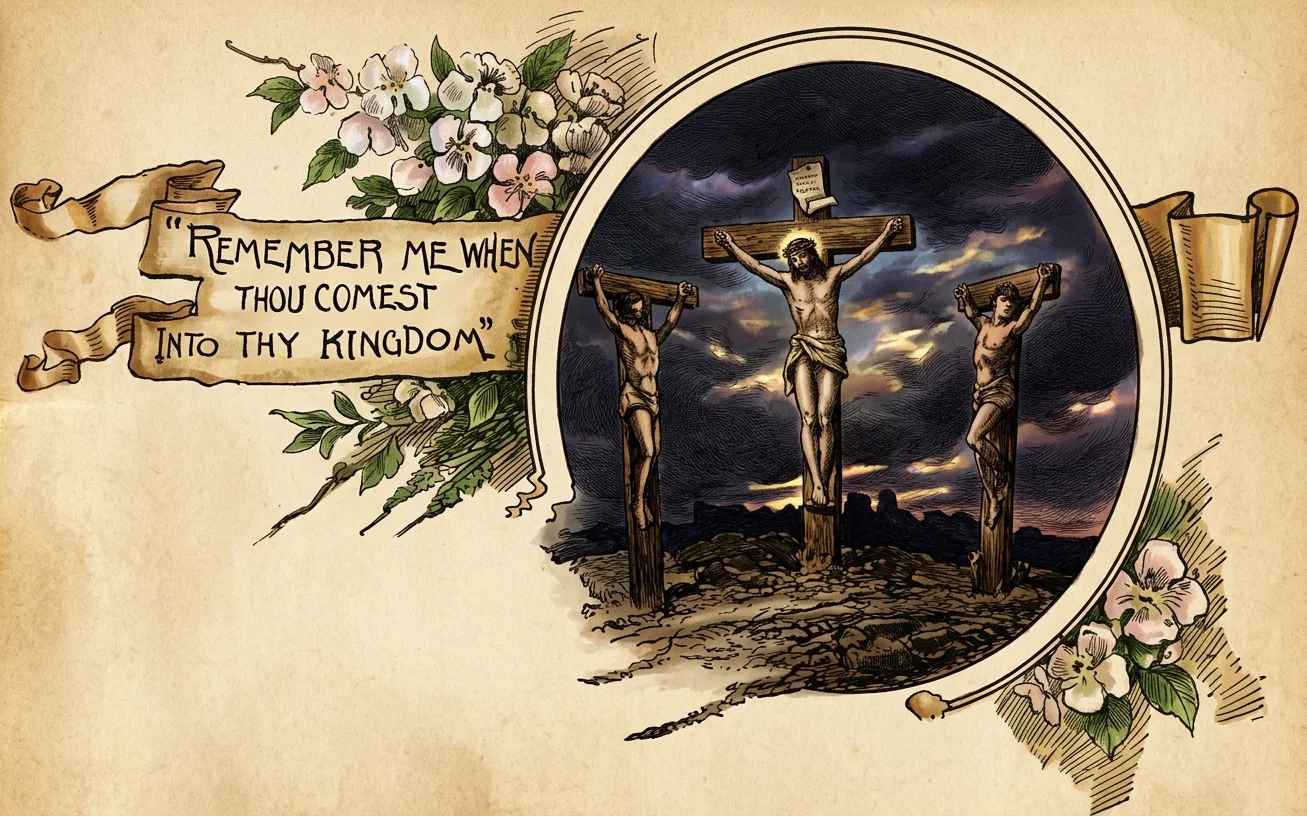
THERE is, perhaps, no example of more wonderful faith, taking into consideration the surroundings, than that of one of the malefactors who was crucified by the side of Jesus Christ. Beside him was a Man, remarkable then only in his sweet dignity, his patience, his unruffled temper, his unselfishness. He sought no self-justification; he committed his case to God.
And yet his disciples had forsaken him. Many who had shouted his praise were now anathematizing him. His own nation, especially the highest and most noted religious teachers among them, had condemned him to die. Even God seemed to forsake him, and the heavens overhead gathered blackness.
Yet, amid all this, while Jew and gentile cursed and reviled the Man of Calvary, the heart of the dying criminal was strangely stirred. He was probably a Jew. He may have heard Christ preach in some of the great outdoor assemblies. He certainly had ideas in the right direction concerning the kingdom of the Messiah. Jesus had taught that his kingdom was not near, that it was like “a certain nobleman [who] went into a far country to receive for himself a kingdom, and to return.” See Luke 19:11–13. Daniel had taught that that kingdom was to be given in the end of the ages of the probationary period, in close connection with the judgment. See Dan. 7:13, 14, 26, 27. Messiah was to go away for awhile to the Father, and to come again into his kingdom, and why might not this Jesus be the Messiah of Daniel (chapter 9), the Suffering One of Isaiah (chapter 53)? And as the Spirit of God brought home the great, glad truth to his heart, he saw in the dying One the world's Redeemer, the Prince of Life; and, while he gave mild rebuke to his copartner in crime, from heart and lips there rose the simple, earnest prayer of faith to the Sufferer beside him: “Lord, remember me when thou comest into thy kingdom.” Luke 23:42. When thou shalt come again to raise the dead (1 Thess. 4:16, 17), to reward thine own (Matt. 16:27), to take thy throne (Matt. 25:31), in the earth made new (Revelation 21, 22), in the Paradise of God, then, “Lord, remember me.” All this is implied in the thief’s request. Wonderful faith in that hour of darkness! Sweet words to the ear of the Redeemer! And wonderful was our Lord’s reply. Leave the common punctuation of the text, and read Christ’s answer according to facts of context and other scriptures: “Verily I say unto thee this day, Shalt thou be with me in Paradise,” or, as it might as truly be rendered, “Thou shalt be with me in Paradise.” So reads the Emphatic Diaglott. The interlinear literal rendering of the Greek reads, leaving out punctuation, of which the original Scriptures knew nothing, “Indeed I say to thee to-day with me shalt thou be in the Paradise.”
Notice the force of the expression, “I say unto thee to-day;” “I say . . . to-day,” yes, to-day, when my own nation have rejected me and condemned me; to-day, when one of my own disciples has betrayed me, and another has denied me, and others have forsaken me; to-day, when even heaven seems leagued with earth against me; to-day, when seemingly I have no power to help a single soul in any way—even to-day, as you have faith to ask, so I have grace to promise, as I will have power to fulfill, “Thou shalt be with me in Paradise” when I come into my kingdom. The Lord’s answer was in harmony with the thief’s request.
But Paradise is where God dwells, where his throne is, as we learn by a comparison of Rev. 2:7 and 22:1, 2. That glorious city, and garden of delights, and throne will form a part of Christ’s kingdom in the earth made new, as we may learn from chapter 21. But they are now in heaven, in the presence of God.
“But did not Christ mean that he and the thief would be in Paradise on that day that he spoke the words?” asks one. No, he could not have meant this, for Paradise is where God dwells, and three days after this Christ declares that “I am not yet ascended to my Father.” John 20:17. He, therefore, did not mean that the thief would be with him in Paradise that day; for Jesus did not go then; nor did the thief probably die, as by the method of crucifixion the victim often lived several days, and near the close of the day, when the thieves were taken from the cross, their legs were broken, to prevent escape and hasten death. The promise of Christ, therefore, pertained to that day; its fulfillment, to the time when he came into his kingdom.
Wonderful faith! Wonderful answer at a wonderful time! But the same Saviour lives to-day, and, tho to grief-blinded, despair-darkened eyes he may seem to be dying, he lives in all the fullness of God, and will hear every prayer of faith. We may pray the same prayer, with the same assurance.
“When Thou comest in Thy kingdom, Sinful tho my heart may be, Like the penitent thief, I pray Thee, Jesus, Lord, remember me.”
Continue reading: Question Corner