The Youth’s Instructor, Vol. 28, No. 22.

Jessie’s Help

The Youth’s Instructor

May 26, 1880

S. D. A. Publishing Association · Battle Creek, Mich. · May 26, 1880

Jessie’s Help.

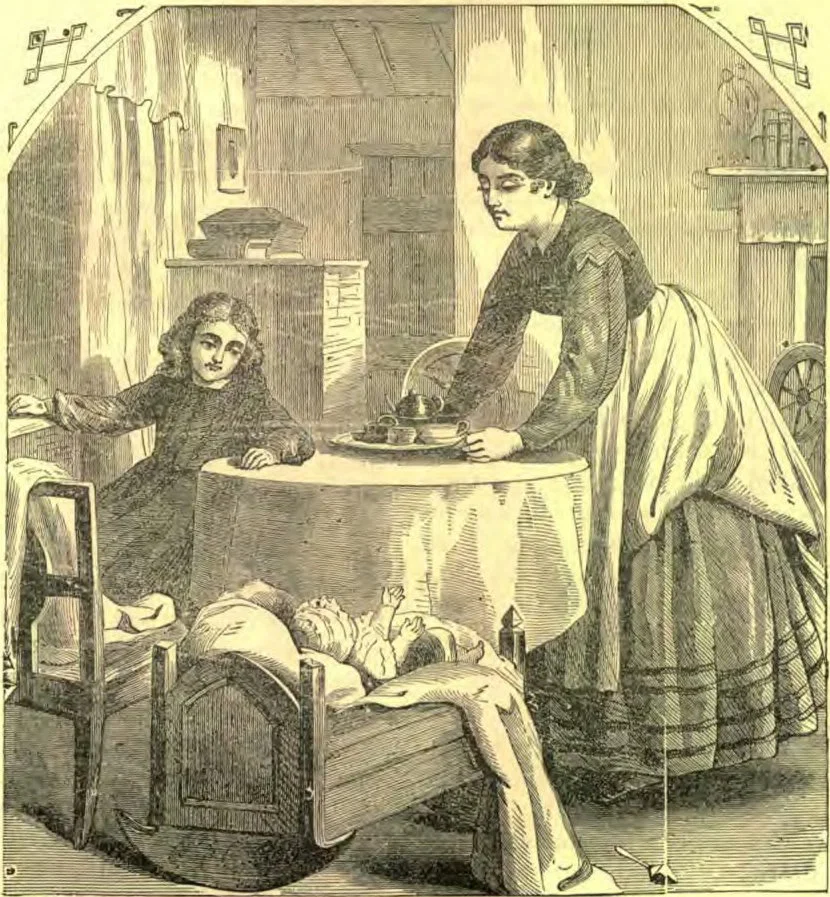
HELP Aunt Mary? Certainly she would! Every curl of Jessie’s bright head bobbed an eager assent to the proposition. With Ann away, that large house to look after, and a baby to take care of, Aunt Mary’s hands surely must be full; and Jessie hurried every step of the way from her own home to her aunt’s.
“I thought you might like to spend the day with me, dear; and as I am alone, you could help me by amusing baby,” said Aunt Mary as the little girl entered.
“I should think I could!” answered Jessie, decidedly, feeling womanly and experienced enough just then to take charge of baby, Aunt Mary, and the whole establishment. “I’ll do anything you want done.”
But Aunt Mary did not make any great demands. She only wanted some one to keep little Willie quiet while she went to the kitchen for an hour or two; so she took baby out of the cradle, where he was laughing and playing, baby fashion, and established him on the floor with plenty of toys about him, and then left the two children to themselves.
Willie enjoyed “bo-peep” and block-houses, and was quite ready to laugh and play; but Jessie soon tired of it. It seemed a very commonplace ending of the great plans of usefulness with which she had come—just a frolic with a baby! Any little girl could do that, and she had meant to be uncommonly helpful. She grew more dissatisfied as she thought of it, and was wishing for something more to do, when her glance fell upon the bookcase. That was the very thing. She had heard Aunt Mary say, only a few days before, that the books needed re-arranging and the magazines to be neatly piled up on their proper shelf.
She could do that, she decided, and how surprised and pleased Aunt Mary would be!
Pushing a chair to the shelves, she placed a footstool upon it, and clambering up began her work at once. But the baby did not like being left alone, and soon expressed his opinion in a fretful cry. He had tossed his playthings out of reach, and missed his companion to pick them up. Jessie descended and restored his treasures, but the same thing happened again and again, and as she grew more interested in her grand project she grew more impatient at each interruption.
“Oh dear! Willie, you don’t give me any peace!” she exclaimed petulantly, lifting him into a high chair and pushing it near a window.
The change pleased him for a few minutes, but she was scarcely busy with the books again before he began to move about uneasily and fret at being left alone. Jessie grew hurried and vexed. If he hindered her so, she could not finish the bookcase before Aunt Mary came, she said to herself. Babies were dreadfully troublesome. He might be good just for a little while; any way, she would not leave the books again until she had to. But suddenly a crash and scream startled her, and she sprang to the floor to find that Willie’s uneasy struggles had overturned his chair and given him a sad fall. Jessie hastily raised him and placed him in his cradle, beginning to rock and sing most vigorously—poor frightened little nurse!—in her efforts to soothe him. In a moment, however, his loud cry sank to a pitiful wail, the little lips paled and the baby-face grew deathly white.
“O auntie, he’s killed!” shrieked Jessie as Aunt Mary, alarmed by the noise, hastened in.
The mother took him in her arms, bore him to the open air and bathed the bruised head, and slowly the color came back to his cheeks and the blue eyes opened again. He had only grown faint and sick from the shock and pain of the fall, and, soothed and caressed into quiet, he presently fell asleep.
Aunt Mary uttered not a single word of blame concerning the accident, and tried her best to make the day pleasant; yet there was a sore spot in Jessie’s heart as well as on baby’s head when night came.
“’Cause it was just like that lesson about King Saul we had in our class,” she said to herself as she walked homeward—“how he wasn’t satisfied to do just the thing he was told, but wanted to do some great thing besides, and so did the wrong thing. And that verse about ‘Obedience is better than sacrifice’—I didn’t know what it meant, but I’m ’most sure I’ve found out all about it now.”—Kate Hamilton.

BABY'S ASLEEP.

BABY has gone to the land of dreams; Hush, or you'll wake him! How still it seems!
Carefully shut the bedroom door, Carefully step on the creaking floor. See how sweet he looks, as he lies With fringed lids closing his dark brown eyes, One pink palm pressing the rounded cheek, And the red lips parted, as if to speak.
There lie his shoes on the kitchen floor, That all day long they have pattered o'er, Chubby and battered, and short and wide, With knotted lacings but half untied, Bearing the print of each tiny toe— Dear little shoes! I love them so, For the sake of the baby boy, you know, Who was wearing them but an hour ago.
Yonder, in the low rocking-chair, Is a broken plaything—he left it there, And there in the corner beside the door, Lies a motley heap of many more,— Jack-knife, picture-book, whistle, ball, Tailless monkey, and headless doll, And new bright pennies, his special joy, By father hoarded to please the boy.
There on the wall hangs the dress he wore, Scarlet flannel, and nothing more; But the wearer gives it a nameless charm, For the sleeves are creased by his dimpled arm; And even the short and wrinkled skirt, Stained with jelly and streaked with dirt, I can look at now without annoy, For it speaks to me of my sleeping boy.
Dear little feet that are now so still, Will ye ever walk in the paths of ill? Rosebud lips, will ye ever part, Bringing grief to a mother's heart? Keep, O Father, that baby brow Ever as pure from stain as now; Lead him through life by thy guiding hand, Safely up to the better land.

The Atlantic Coast: Boston and Its Early History

THE ATLANTIC COAST.—NO. 1.

Having to spend a few days in Boston and vicinity before crossing the Atlantic Ocean, we will gather a few items of interest for our INSTRUCTOR friends. The Indian name for this place was Shawmut. The earliest white settlers called it Trimountaine, because the land comprised three high hills, afterward called Copps, Beacon, and Fort. The highest of the three, Beacon, had itself three sharp peaks. The colonists of Charlestown bought this land of William Blackstone in 1630. He was the first settler there, and had been the sole inhabitant. On the 17th of September, 1630, the Colonists’ Court at Charlestown ordered that Trimountaine be called Boston, in memory of Boston in Old England, from whence many of the colonists had come. In ten years from that time twenty thousand persons had come over from Old England to the Massachusetts colony. In 1674 there were fifteen hundred families in Boston alone, while the reckoning of 1878 gives Boston a population of 385,000 souls.
In the first year of the settlement of Boston, a vessel was built and launched there which was said to be the first vessel constructed in America. In 1704, April 24, the Boston News Letter appeared, which was the first newspaper ever published on the American continent.
In 1706, in a house that stood near the head of Milk Street, on the spot now covered by the office of the Boston Post, Benjamin Franklin was born. He is said to have been “the first great New England journalist, afterward a philosopher, statesman, and diplomatist.” He once worked at the printing business in an office on Little Wild Street, London, Old England. He says of himself, at that time, that he “lived healthfully on £12 a year, and worked cheerfully on water gruel.” He did that hardest work of an old-fashioned printer, press-work on a hand-press. He says the other printers had five pints of porter a day. Franklin rose to fame and wealth. His fellow-workmen, who could afford to drink, worked on in poverty to the end of their days.
The settlers of the Massachusetts colony had more or less trouble with the Indians, although they strove to be at peace with them. The Indians, in trying to pronounce the word English, or rather the French word for English, Anglais, gave it the sound of yang-kee, from which circumstance the New Englanders have obtained the title of “Yankees.”
These early colonists had some curious laws. In 1646 a law was passed making public flogging the penalty for kissing a woman in the streets. There is a record of the rigid execution of this law as late as in the year 1764. The captain of a British man-of-war cruising up the coast returned to Boston on Sunday. His wife met him in the street and kissed him, and for this crime he was publicly flogged. While these colonists were so exact in many small matters, the crime of slavery was tolerated and protected. In 1763, out of a population of 241,000 in Massachusetts, 5,200 were slaves. Connecticut, with 145,000 inhabitants, had 4,500 slaves; and the little State of Rhode Island, with only 40,000 inhabitants, had 4,600 slaves.
That spirit of liberty which abolished slavery in New England and finally in the United States, was kindled more and more by oppression. Their tea, and other articles, were heavily taxed by the mother country; but in 1773, when a cargo of tea with heavy duties upon it came into Boston, about thirty young men, painted and disguised as Indians, went to Griffins (now Liverpool) wharf, broke open and poured into the sea the whole cargo of tea,—340 chests. In 1774 an act was passed closing Boston Harbor, and in February another ship-load of tea was poured into the sea. In New York City, on the 19th of March, another load of tea met the same fate.
These things culminated in the Massachusetts House of Representatives, sitting at Salem, June 17, 1774, passing a resolution that the American provinces should meet in a General Congress at Philadelphia, September 1, 1774; and ere the labors of that Congress were finally closed,—July 4, 1776,—the Declaration of Independence of the United States was signed.
J. N. Loughborough.

A VISIT TO SOUTHERN CALIFORNIA.

DURING the past week we have been attending a very interesting camp-meeting in Southern California. The meeting was appointed for only one week, but owing to the interest it will continue a few days longer. Most of our journey from Oakland here was through the San Joaquin Valley, a long, sandy plain, extending some three hundred miles north and south. The camp-ground is located in the southern part of this valley, but in a tract of country which is well watered and very fertile. In the distance on one side of the camp rise the mountains of the Coast Range, while on the other in full view lie the snow-capped Sierras. The tents are pitched in an open field without trees, but are surrounded with fine fields of alfalfa, or California clover. This kind of clover strikes its roots so deep into the earth (sometimes four feet) that it seldom ever dies out, and three or four crops can be cut year after year without new seed being sown.
This season a sufficient amount of rain has fallen to make fine crops all through the valley; but usually farmers have to irrigate their land in order to raise anything. In sections where the soil is sandy, a small stream will water a field of several acres just by soaking through it. In other sections the land has to be overflowed several times in the course of a season. The water for irrigating purposes in this vicinity comes from King's River. It is bought and sold by the foot, and is measured by raising or lowering a gate placed in the ditch where it enters each farm.
The people of this section all seem interested in the progress of the truth, even to the children. On first-day, two little twin brothers, seven years old, took the INSTRUCTOR and the nice premium book which goes with it to new subscribers, and soon returned with one dollar and fifty cents from two new subscribers. Two other brothers, aged six and seven, the same day obtained five new subscribers. Only think, children, if all of you would do as well as these little boys how many more would read our paper the coming year than have in the past; and then, too, how nice it would be to be doing missionary work as well as the older ones.
But space forbids our writing more now. Perhaps at some future time we may have more to say about things in California.
M. K. W.
Lemoore Camp-ground, April 30, 1880.

LESSONS FOR CHILDREN.

LESSON LXXIV.—IRON MADE TO SWIM.

Naaman was so thankful for being healed of his leprosy that he wanted to make Elisha many costly presents, but Elisha would not take any of them. He wanted Naaman to understand that it was God that had healed him. Naaman did promise not to worship idols any more; for he was now convinced that the God of Israel was the only true God.
Now Gehazi, Elisha’s servant, thought that his master had done very foolishly in not taking the presents. So, when Naaman had started on his journey home, Gehazi ran after him, and said unto him, “My master hath sent me, saying, Behold, even now there be come to me from Mount Ephraim two young men of the sons of the prophets: give them, I pray thee, a talent of silver, and two changes of garments.” But Naaman gave him two talents of silver instead of one. Two talents are as much as three thousand dollars.
When Gehazi got home, he hid the silver and the garments; and when Elisha asked him where he had been, he said that he had not been anywhere. But the Lord had showed Elisha all that Gehazi had done, and Elisha told Gehazi that Naaman’s leprosy should come upon him. And he went out from Elisha’s presence a leper, “white as snow.”
Now there were so many of the sons of the prophets that there was not room for them in the house where they lived, so they said to Elisha, “Let us go, we pray thee, unto Jordan, and take thence every man a beam, and let us make us a place there, where we may dwell.” Elisha gave his consent, and at their request went with them. When they came to Jordan, they cut down wood, and as one was chopping down a tree, the ax head came off the handle and fell into the water, and he cried, and said, “Alas, master, for it was borrowed.”
“And the man of God said, Where fell it? And he showed him the place. And he cut down a stick, and cast it in thither; and the iron did swim. Therefore said he, Take it up to thee. And he put out his hand, and took it.”

QUESTIONS.

  1. How did Naaman want to show his gratitude for being healed? 2 Kings 5:15.
  2. Did Elisha take any of his presents?
  3. What did he want Naaman to understand?
  4. What did Naaman promise?
  5. Who was Gehazi?
  6. What did he think of Elisha’s wisdom in refusing the presents?
  7. What did he do?
  8. What did he say to Naaman when he overtook him?
  9. What did Naaman give him?
  10. How much money was that?
  11. What did Gehazi do with these presents?
  12. What did he say when Elisha asked him where he had been?
  13. How did Elisha know all that Gehazi had said and done?
  14. How was Gehazi punished for his wickedness?
  15. What did the sons of the prophets propose to do when they became so many that their house was too small for them? 2 Kings 6:1, 2.
  16. What accident occurred as they were cutting down trees?
  17. What did the man say who had lost the ax head?
  18. How did Elisha answer him?
  19. How did he enable the man to get the ax head?

BIBLE LESSONS FOR YOUTH.

LESSON C.—FROM NEHEMIAH TO THE DOWNFALL OF THE PERSIAN EMPIRE.

  1. Who was the last of the Old-Testament writers?
  2. When did he prophesy?
  3. What reproofs did he give?
  4. What did he foretell?
  5. When did Artaxerxes Longimanus die?
  6. What is he called in the book of Esther?
  7. About how long did he reign?
  8. Who reigned next before him?
  9. Who reigned next after him?—Xerxes II., forty-five days; and after him Darius Nothus.
  10. About how long did Darius Nothus reign?
  11. What trouble did he have with the Egyptians?
  12. When did he die?
  13. Who next reigned over Persia?
  14. What was the character of this prince?
  15. How did he reign?
  16. In what warlike expedition did he engage?
  17. With what success?
  18. What did this discomfiture of his enemies cause the king of Egypt to do?
  19. What was the result of this expedition?
  20. How long did the reign of this great Persian king continue?
  21. In what year did it come to an end?
  22. What was the condition of the Jewish people during the reign of this king?
  23. From what causes did their country suffer?
  24. By whom was Artaxerxes Memnon succeeded?
  25. What provoked this king to move an army westward?
  26. Whither did he turn his conquests after subduing the revolted provinces?
  27. What ravages did he make in Egypt?
  28. What has been the condition of Egypt since that time?
  29. What prophecy has thus been fulfilled?
  30. Who was Bagoas?
  31. Describe his course.
  32. What name did Codomannus assume?
  33. With what prospects did he take the throne?
  34. How long did he reign?
  35. By whom was the Persian empire then overthrown?
  36. What prophecy was thus fulfilled?

SYNOPSIS.

The last of the Old-Testament writers was Malachi, who prophesied in the latter part of Nehemiah’s administration, about 416 years B. C. He reproved both priests and people for disorderly conduct, and foretold the coming of John the Baptist as a forerunner of Christ.
Artaxerxes Longimanus [ar-tax-erx'-es lon-gim'-a-nus] (Ahasuerus) died B. C. 423; and after a short interval of commotion and bloodshed, Darius Nothus [da-ri'-us no'-thus] succeeded him. In the year 413 B. C., the Egyptians revolted, and maintained their independence for a period of sixty-four years.
Darius Nothus died B. C. 404, and was succeeded by his son, Artaxerxes Memnon, who, being a prince of mild and humane character, governed with much moderation and prudence. He made an unsuccessful attempt to reconquer Egypt in 373 B. C., and soon after, the Egyptian king, encouraged by this discomfiture of his enemies, took the offensive, and invaded Phœnicia; but no sooner had he left Egypt than a conspiracy arose, his army turned against him, and he was obliged to flee for protection to “the great and generous king of Persia, whose dominions he had invaded.”
Artaxerxes Memnon died in B. C. 358, after a reign of forty-six years. During this long period the Jews enjoyed comparative peace and comfort, although their country must have suffered not a little from warlike operations; for not only did the opposing armies have to pass through Palestine in going to and from Egypt, but vast bodies of troops were sometimes rendezvoused in that country and the immediate vicinity.
Ochus [o'-chus], the son of Artaxerxes Memnon, succeeded his father on the throne of Persia. Having been much annoyed by the revolt of some of his provinces bordering on the Mediterranean Sea, he marched westward, and after taking Sidon, the stronghold of the Sidonians, enforced ready submission on the part of the Phœnicians and Cyprians. He then turned to Egypt, where he plundered the temples, dismantled the towns, and, to show contempt for the Egyptian religion, sacrificed Apis, their ox-god, to an ass. Having completely subdued the country, he returned to Babylon, richly laden with spoils of gold, silver, and other precious things. From that day to this, Egypt has been subject to other nations, having no king of her own, thus fulfilling the prophecy of Ezekiel 29:13–16.
Ochus, and all his sons but the youngest, were destroyed by Bagoas [ba-go'-as], an Egyptian eunuch who had been raised to a high position in the Persian government. He then made Arces, the youngest son of Ochus, king; but in the third year of his reign, slew him, and all the remaining members of his family. He then gave the throne to Codomannus [cod-o-man'-nus], governor of Armenia, who assumed the name of Darius, and is known in history as Darius Codomannus. He took the scepter with the brightest prospects of a successful reign, but, four years later, B. C. 331, the Persian empire was completely overthrown by Alexander of Macedon, commonly called Alexander the Great.
Thus the he-goat cast the ram down to the ground, and stamped upon him; and the second universal empire came to an end.

“THE KNOW HOW.”

The time has come in the history of our Sabbath-schools when we should study the best methods of conducting so important an interest. The live superintendent will be ever on the alert in order to keep abreast with the improvements of the day. In the early days of Sabbath-school work, people were content to stay in the beaten paths of monotonous routine, but now the age demands better things of us. If one superintendent is successful beyond his fellows, it is right and fitting that others should know the elements of his success, and as far as practical adopt such measures. If self-control, promptness, and earnestness have been the pillars upon which some have based their success, why cannot others adopt the same plan and succeed also? Want of discipline is often the bane of an otherwise good superintendent’s success. To study “The Know How” in all such cases should be the duty of every good superintendent.

Teachers Should Admit When They Do Not Know

A TEACHER should never be afraid to say he doesn’t know a thing, when he doesn’t know it. He will lose vastly more in the respect of his pupils if he is detected in assuming to explain what he doesn’t understand, than he would by candidly admitting his ignorance. They will soon find out how much he knows. He cannot long deceive them as to his acquirements. He will gain by being frank with them at all times.

Avoiding Terseness in Teaching Young Children

WHILE we should aim to be concise in statement, too great terseness should be avoided in teaching young children. Little details are, with them, essential, not only to secure interest and attention, but also to make them fully understand what is taught. The same idea should be repeated in different language and brought out in various aspects.

A GIANT.

LITTLE boy, look out, There is walking about A great big giant. Don’t cry nor pout, Don’t fidget nor flout, Nor stamp nor shout, For I have not a doubt The giant will catch you, And swallow you whole. His name? Let me whisper it. There! You hear? It is “I DON’T CARE.” He has tangled hair, And a fearful frown, And he’s looking down, Not up to the sun, With a cheerful face And a heart of grace. This “I DON’T CARE” Tells many a lie, And you and I Should let him alone, Nor ever own That we would be seen In his company.

LETTER BUDGET.

Edgefield Junction, Tenn.
Dear Editors: I am a little boy and cannot write well myself, and so I got my sister to write for me. Though I am not one of your fold, I read your papers and like them very much indeed.
Yours truly, Charlie A. Payne.
We are pleased to learn that you like our little paper, and we would be glad to number you as one of the INSTRUCTOR family.
Sedalia, Mo.
Dear Editors: I keep the Sabbath with father, mother, and two sisters. We go to Sabbath-school every Sabbath. It is about four miles from our house. I never went to school till last winter. I read in the Second Reader. I can read my Sabbath-school lessons myself, now, and I like to study them. I hope to so live that I may meet all the readers of the INSTRUCTOR in the new earth. Pray for me.
Lottie B. Smith.
Elyon, Kan.
Dear Editors: I want to tell you something of what the Lord has done for me. A little over a year ago, I was a silly girl, without hope in Christ. But, thank the Lord, I now have hope of everlasting life. Don’t you think that I ought to rejoice? My father, mother, brother, and sisters all keep the Sabbath. We attend Sabbath-school every week. I intend to have good lessons. The INSTRUCTOR is a welcome visitor. Pray for me.
Jennette Williamson.
Santa Rosa, Cal.
Dear Editors: I am nine years old. I keep the Sabbath with my father and mother. I like to read the INSTRUCTOR very much. I go to Sabbath-school at Santa Rosa. I like my teacher. When I have read my INSTRUCTORS, I give some of them to my schoolmates, and send some to my little cousins in Oregon. I printed my letter on my slate, and mamma copied it off for me. I want to be a good girl and keep all of God’s commandments, so when Jesus comes, I may have a home with him in his kingdom. Pray for me that I may be faithful.
Lydda J. Ross.

PINS

A CORRESPONDENT of the New York Post thus describes pin-making:—
“The pin machine is one of the closest approaches that mechanics have made to the dexterity of the human hand. A small machine, about the size of a lady’s sewing-machine, only stronger, stands before you. On the back side a light belt descends from a long shaft at the ceiling, that drives all the machines, ranged in rows on the floor. On the left side of each machine, hangs, on a peg, a small reel of wire that has been straightened by running through a compound system of small rollers.”
“This wire descends, and the end of it enters the machine, which pulls it in and bites it off by inches, incessantly, one hundred and forty bites to the minute. Just as it seizes each bite, a little hammer, with a concave face, hits the end of the wire three taps, and ‘upsets’ it to a head, while it grips it in a counter-sunk hole between its teeth. With an outward thrust of its tongue, it then lays the pin side-ways in a little groove across the rim of a small wheel that slowly revolves just under its nose. By the external pressure of a stationary hoop, these pins roll in their places, as they are carried under two series of small files, three in each. These files grow finer toward the end of the series. They lie at a slight inclination on the points of the pins, and by a series of cams, levers, and springs, are made to play ‘like lightning.’ Thus the pins are pointed and dropped in a little shower into a box.”
“Forty machines on this floor make five hundred and sixty pounds of pins daily. These are then polished. Two very intelligent machines reject every crooked pin, even the slightest irregularity of form being detected.”
“Another automaton assorts half a dozen lengths in as many different boxes, all at once and unerringly, when a careless operator has mixed the contents of boxes from various machines. Lastly, a perfect genius of a machine hangs the pin by the head, in an inclined platform, through as many ‘slots’ as there are pins in a row on the papers. These slots converge into the exact space, spanning the length of a row. Under them runs the strip of pin paper. A hand-like part of the machine catches one pin from each of the slots as it falls, and by one movement sticks them all through two corrugated ridges in the paper, from which they are to be picked by taper fingers in boudoirs, and all sorts of human fingers in all sorts of human circumstances. Thus we have its genesis,—
“‘Tall and slender, straight and thin, Pretty, little, useful pin.’”

Proposed Observatory on Mount Ætna Site

The observatory which will soon be erected on mount Ætna will be placed on a site 9,652 feet above the level of the sea. No other observatory in the world, excepting the signal station at Pike's Peak, in Colorado, occupies such an elevated position.

THE AMERICAN DEER.

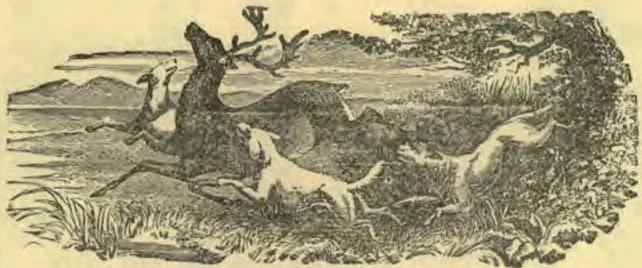
This graceful animal is the most useful of the wild game of North America; its flesh forms a palatable article of food; its skin is made into various articles of clothing both for civilized man and the savage; its horns are useful for handles of different kinds of cutlery; its very sinews form the bow-strings and snow-shoe netting of the North American Indian.
Although very timid, yet when persecuted by the hunter, it still lingers around its old haunts. During the day, it retires to thickets and swamps, coming out to feed and drink by night. In hot weather it is fond of immersing itself deeply in ponds and streams.
The food of the deer in winter consists of buds of the wild rose, hawthorn, brambles, and various leaves; and in spring and summer, of the tender grasses.
In walking, the deer carries the head low, the largest animal usually leading the herd, which advances in single file. When alarmed, it gives two or three graceful springs, and, if it sees any danger, rushes off with the speed of a race-horse.
The deer has been hunted by the Indians with the bow and arrow, and by the white man with rifle and hounds, until they are growing scarce, except in the unsettled parts.

You have reached the end of this edition.

The Youth’s Instructor · May 26, 1880