The Youth’s Instructor, Vol. 48, No. 51.

HINDU CUSTOMS

The Youth’s Instructor

Dec 27, 1900

Review and Herald Publishing Company · Battle Creek, Mich. · Dec 27, 1900

HINDU CUSTOMS

THE religion of the Hindu enters into everything he does. Visiting Karmatar the other day, I saw a cow purchased for the orphanage. The price (about thirteen dollars) being paid, the seller took a wisp of straw from the pile where the cow was eating, and said some formula over it, wishing the cow long life. He handed the wisp to the gardener, who took it with salaams, and put it in his turban. The seller then bowed low, salaaming the cow, and went his way.
The rice is being harvested at Karmatar. After the grain is beaten or trodden out on the threshing-floor by oxen, the men winnow it, pouring it from above the head in long piles, while two men with fans blow out the dust and chaff. When the pile in hand is completed, the men do a little poojah (worship) to it or for it.
Thus superstition keeps its hold on men at every turn. But does it not suggest how often we who know the true God fail to think of him as present with us in every transaction? Our acknowledgments are not to be paid with outward show and vain repetitions; but too commonly we leave the thought of God out of our daily tasks.
Calcutta. W. A. SPICER.

SCENES IN GREECE

FOR nearly two hours we had been winding our way upward, in and out among fig and olive trees, until their grateful shade had been passed, and we neared the summit of the hill from which we would take a last look at Sparta. Dropping down in the shadow of a great rock, we soon forgot our fatigue in admiring the surrounding scenery. Behind us rose the mountains, higher and higher, one after another, until they seemed to pierce the very heavens; while before us lay the beautiful valley from which we had just come. In the center, apparently set in orange, lemon, fig, and mulberry trees, lay the town of Sparta. It is now a new town of about four thousand inhabitants, having been built only about sixty years; but it stands on the same spot where its ancient namesake once rivaled Athens as the first city of civilization. The same snow-capped Taygetus keeps eternal watch over the valley; the same River Eurotas waters its fertile soil; and opposite us is the pass out of which the brave Spartan soldiers used to march to defend their valley against ambitious countrymen, or their country against the Persians. It may be that these stern mountains lent to the Greeks their hardy and cruel nature, though the beautiful valley was an esthetic education in itself; for Christ had not yet come to teach the doctrine of peace, which even to-day so few are ready to receive.
Here it was that Leonidas learned to throw the spear and afterward to direct the battle, a pile of large stones being still pointed out as marking his resting-place; and here Lycurgus established his famous social laws. But the traveler to-day finds more of interest in the old, deserted city of Mistra, built on a hillside about an hour's walk from Sparta. The road leading to it passes through beautiful gardens and orchards; and here, morning and evening, may be seen pretty Spartan girls, their faces nearly hidden in large white handkerchiefs, going to and from their work in the silk factories.
As we approached the city, we passed through a little inhabited village of the same name; many of its houses are centuries old, and bear the scars of many wars. Down some of its narrow streets run small streams of the pure, sparkling spring water abundant in this neighborhood. Ascending the hill, we found ourselves winding about between ruined walls and houses. At times we passed through great gates; in fact, the entire labyrinth was a series of fortifications, one above the other, with houses in the walls. Every little while the guide led us into a church; these churches are of the Byzantine order, and in many of them the liturgies are still performed. Many of these churches are in ruins; and the guide, when asked how many there were, looked bewildered, and answered, “Very, very many.” In each of them the bones of many saints are kept.
Some years ago a Frenchman removed a large stone image of Christ, with several paintings, from a church to a museum near by. Such sacrilege incensed the people; and our guide, with a few others, caught the man, and would have killed him but for the timely interference of the soldiers. The men were severely punished; but our guide's only regret seemed to be that he did not succeed in killing the Frenchman.
The hill is crowned with a very strong fortress. Our guide solemnly asserted that this city was over six thousand years old; of course he was mistaken. It was probably founded shortly after Christ; was greatly strengthened by the Franks during the crusades; held for some centuries by the Turks; and then retaken by its rightful owners, the Greeks, in their war for independence in 1821.
Recalling our minds to present surroundings, we find ourselves entering the famous pass of Langatha. This is one of the most beautiful valleys of Greece. Travelers who do not mind the difficulties of a ten-hours' ride on mule-back,—for the way is merely a bridle-path,—take this route from Sparta to Kalamata. We made the trip on foot, however; and though it was a slower journey, the privilege of visiting with the people was certainly worth the effort.
We ascended a narrow path, on one side of which a cliff, many hundred feet high, rose almost perpendicularly, and on the other, as far below and almost straight down, lay a beautiful valley. The narrow path called vividly to mind what is said in “Early Writings” about the experience that awaits the saints just before Christ's second coming. The burning sun became almost unbearable, our lips were parched, and the constant climbing had taken all our strength; but the guide urged us on with the words, “Only a little farther.” At length we came to a large rock, and with difficulty toiled around it, wondering why such an obstacle had to be in the way, when, O joy! in its shadow we found a bright little spring bursting forth, and a pleasant place to rest. Did you ever find life's journey so hard that it seemed you could go no farther, or a task that made you say, “I can not do it”? Listen to your Guide when he says, “A little farther,” and you will certainly come to the pleasant places.
Did this mean that our labor was over?—By no means; it meant that we were refreshed, and could ascend to greater heights. After a little we reached the summit, and before us was spread out another valley, more beautiful than the first. A half-hour's descent brought us again among the trees, and under their pleasant shade we pursued our way, finding much amusement in throwing stones, and listening to hear them strike in the stream far below. Now and then we found a little settlement of mountaineers, or passed a shepherd with his sheep and goats guarded by fierce dogs. These people are very simple in their habits, and pleasant to talk with. I have been warned against them many times; yet I saw nothing to alarm me except the dogs, to guard against which each traveler must carry a heavy stick.
About the middle of the afternoon great clouds suddenly rolled up over the mountains, and we were soon driven under a large cliff for shelter; darkness seemed to have fallen upon us, and the rain came down in torrents. I began to wonder if we should have to spend the night in our cave, when the guide said, “Never mind; it will soon pass.” So it did; and when we came out of our retreat, those black clouds were rolling down the valley, the sun was shining, and all nature was smiling and beautiful.
When night overtook us, we found lodgings in a beautifully situated little village, deep down in the valley. Although my bed was not very comfortable, I never slept more soundly; and it was with difficulty that the guide got me started at seven o'clock the next morning. For two hours we ascended the mountain on the other side of the valley, and at its summit were rewarded by seeing our destination, Kalamata, lying apparently at our feet, in a beautiful plain covered with tropical fruits, while the Mediterranean shone blue in the distance. H. A. HENDERSON.

WINTER'S SILVER SHUTTLES

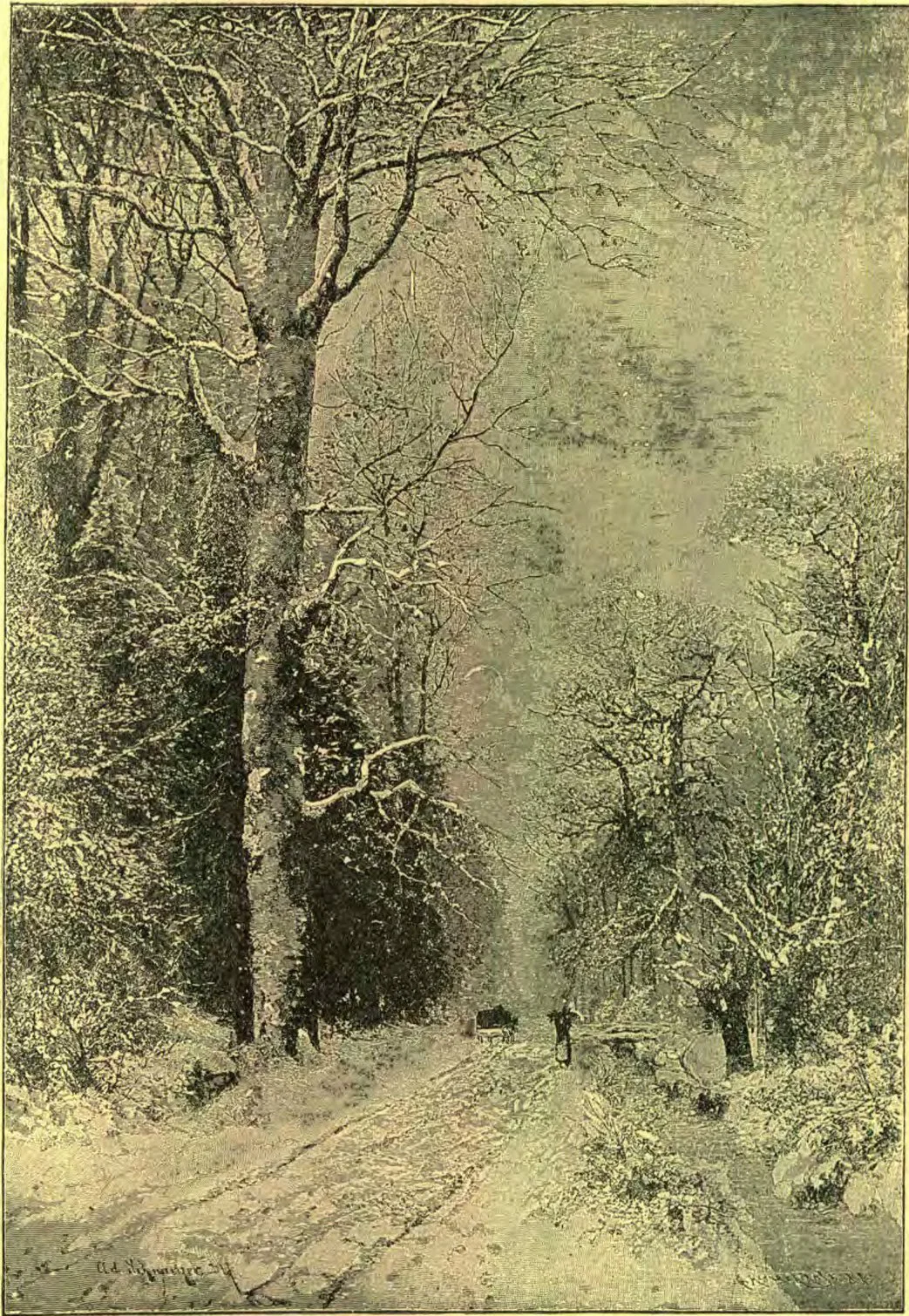
To and fro, To and fro, Athwart the tingling, icy air, The linden branches blow, and so, With warp of wind and woof of snow, The weaver Winter's shuttles go. Such garments rare The earth shall wear, No softest ermine, neither vair, Nor royal robing anywhere, Nor any cunning looms may show A fabric half so fair.
A world of shining hints of hues, Wherein all tints so gently fuse In loveliness of light and shade, No eye may tell whereof is made Such pearly radiance; nor invade The violet depth thereof for clews To clasp its color-keys, and know The subtle secrets of the snow; The gleaming heavens, overlaid With loosened spangles, softly fade Into the gleaming earth below; And all horizons seem to be Lost in white purity.
Aye, richly, Winter, to and fro Thus let your silver shuttles go, Till every sparkling web is spun; Still, with rare skill, unceasing ply Your artful trickeries, and try All chill enchantments, every one Of all devices to beguile This dreary, overweary while Wherein we wait the sun; And since the north must yet prevail, And bitter, cheerless winds assail, Come, white-winged snows, and over all Like shreds of floating feathers fall, And lightly lie! So, by and by,— Ah, by and by,— Like blue flakes from an azure sky, The April birds will fly.
— Evaleen Stein.
A WORLD OF SHINING HINTS OF HUES

HOW SHALL WE REGARD UNCONGENIAL ASSOCIATES?

We are often thrown in direct company and close association with persons who are whimsical, notional, and so difficult to please that we are strongly tempted to avoid them altogether. Instead of doing that, we ought rather to be glad of such an opportunity; for it will be a constant school for us, serving to bring to the surface tact, judgment, and other latent qualities in our characters. The very crankiness that is manifested by our immediate associates may be used by God as a rare opportunity to bring out a strong reflection of the divine from our lives. If one does not recognize this principle, such experiences will tend to develop evil traits of character instead of molding him to become more like the divine model. If a person occupying some position of responsibility abuses and misuses us, it is probably God's object, in permitting it, to teach us how not to treat some one else when we are called to occupy a similar position.
When others talk about us, and say all manner of evil against us falsely, this is a God-given call for us to rejoice and be exceeding glad. If we do this, the thing that seemed so hard to bear will only serve to bring out more prominently the really good points in our character. Every person who is permitted to wrong us may serve as a heavenly chariot to bring away luscious fruits of divine love from us, just as the same car that carries rubbish and trash in one direction, may return filled with useful and beautiful things.
DAVID PAULSON, M. D.

REJOICE IN THE LORD

CHRIST says to his followers, “Ye are the light of the world.” Then let your light shine forth in clear, steady rays. Do not wrap about you a cloud of darkness. Cease to suspect others. By good works represent the character of Christ. When you are tempted to yield to despondency, look to Jesus, and talk with him. Your Elder Brother will never make a mistake. He will judge righteously. He will guide you aright.
God is not pleased to see his children wrapped in gloom and sadness. His arm is mighty to save all who will lay hold on him. He desires us to be cheerful, but not trifling. He says to each one of us, “But as he which hath called you is holy, so be ye holy in all manner of conversation.” God wants us to be happy. He desires to put a new song on our lips, even praise to our God. He wants us to believe that he forgives our sins, and takes away our unrighteousness. He wants us to make melody in our hearts to him.
The “hope set before us”—what is it?—The hope of eternal life. Nothing short of this will satisfy the Redeemer; and it is our part to lay hold of this hope by living faith in him. If we are partakers with him in his sufferings, we shall be partakers with him in the glory which will be his; for his merits have purchased forgiveness and immortality for every sinful, perishing soul. “This hope we have as an anchor of the soul, both sure and steadfast.” Our trust in this hope, purchased for us by the atonement and intercession of Christ, is to keep us steadfast and unmovable in every hour of conflict. With such a hope as this before us, shall we allow Satan to cast his shadow across our pathway, to eclipse our view of the future?
Christ values human beings with a value that is beyond any human computation. Then let us encourage faith. Take your eyes off yourself. Faith and hope are not to be centered in self: they are to enter into that within the veil, whither our Forerunner is for us entered. Talk of the blessed hope and glorious appearing of our Lord and Saviour Jesus Christ. We are exposed to great moral danger; and if we trust in self, looking no higher, we shall make shipwreck of faith. Do not fail nor be discouraged. Hope is an anchor to the soul, both sure and steadfast when it enters into that within the veil. Thus the tempest-tossed soul becomes anchored in Christ. Amid the raging of temptation, he will neither be driven upon the rocks nor drawn into the whirlpool. His ship will outride the storm.
Close the door of the heart to distrust, and throw it open to the heavenly Guest. Put away all fretting and complaining; for these things are a snare of the devil. Let us make a pledge before God and the heavenly angels that we will not dishonor our Maker by cherishing darkness and unbelief, by speaking words of discouragement and mistrust. Let every word we utter, every line we write, be fraught with encouragement and unwavering faith. If we live faith, we shall talk faith. Think not that Jesus is the Saviour of your brother only. He is your personal Saviour. If you entertain this precious thought, you will beat back the clouds of despondency and gloom, and make melody to God in your soul. It is our privilege to triumph in God. It is our privilege to lead others to see that their only hope is in God, and to flee to him for refuge.
Every act of consecration to God brings joy; for as we appreciate the light he has given us, more and greater light will come. We must banish the spirit of complaining, and open the heart to the bright beams of the Sun of Righteousness. There is peace in perfect submission. Peace follows grace. They work in perfect harmony, and are multiplied in progression. When the hand of faith takes hold of the hand of Christ, the expression of the heart is: “Blessed be the God and Father of our Lord Jesus Christ, which according to his abundant mercy hath begotten us again unto a lively hope by the resurrection of Jesus Christ from the dead, to an inheritance incorruptible, and undefiled, and that fadeth not away.”
Open the windows of the soul heavenward, and let the rays of the Sun of Righteousness in. Look on the bright side. Let the peace of God reign in your soul. Then you will have strength to bear all suffering, and you will rejoice that you have grace to endure. Praise the Lord; talk of his goodness; tell of his power. Sweeten the atmosphere that surrounds your soul. Do not dishonor God by words of fretfulness and repining. Praise, with heart and soul and voice, him who is the health of your countenance, your Saviour, and your God.
MRS. E. G. WHITE.

The New Year

What do you keep for us, O stranger Year? Days overfull of grief, or loving cheer? Of ease, or toil? We question vainly thus; For no reply the New Year has for us.
But face of Christ we see with love alight, And this it tells us: “Depth, nor breadth, nor height, Nor present things, nor those that are to be, In any wise can sunder you from me.”
Thrice welcome, then; we need not shrink in fear From aught that you can bring us, untried Year! Christ’s arm is ’round us. Speed you on your way; And we will try to make each passing day
The setting for some loving-hearted deed Or tender word to those who are in need Of gentle ministries. So shall we be, Dear Christ, at the year’s end more near to thee.
—Young People’s Weekly.

LESSON 7—DRAWING FROM NATURE

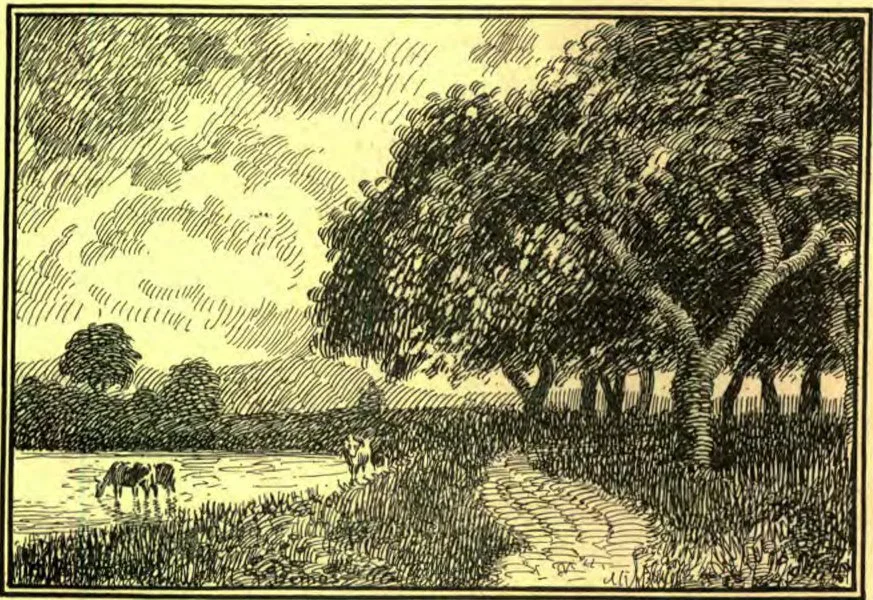
When drawing from nature, one of the chief qualities to be avoided in pen-and-ink work is “fussiness,”—putting in little lines that detract from the picture.
One difficulty the student will have will be in discovering which are the most important lines; but by making a careful preliminary drawing and studying what must be retained, and what can be left out without detracting from the general effect, he can determine which lines must be retained. The important things should be clearly noted with the pen; the rest should be erased, leaving nothing but black lines and white paper, which will reproduce perfectly.
In the drawing of trees, mannerisms should be avoided; and the only system to follow must be that which each student invents for himself by studying nature. Analyze everything in nature, and ascertain what lines will best give the character of form, texture, and quality of each object. Remember to mass your shades, especially in trees, no matter what technique is used. Hardly two artists use the same technique in drawing trees or other objects, yet one will observe that the shades in all drawing are massed in nearly the same manner.
After the pencil outline has been drawn, the color-tones and shadows can be indicated very lightly with a softer pencil in the parts to which they belong; then the student can see what shades can possibly be left out. In general this will be whatever does not give character to the object.
In using the term “color-tones,” I mean the varying degrees of light and dark, and am not speaking of the colors as colors,—red, blue, green, etc. In pen-work the artist is unable to indicate the colors of an object; but of the strength of value of one color, as compared with the colors around it, he should be able to give a fair understanding.
Never work at a picture when tired, or when not in the mood to draw; for if you do, your work will show it. Never work laboriously upon a drawing in the hope of remedying an error already made. It is better, when completely dissatisfied with one’s work, to begin it afresh. “Not failure, but low aim, is crime.”
The border, if the drawing requires one, should be as heavy as any other line in the picture, if not heavier. This will set the picture off, while a lighter line will not. A picture with heavy lines or dark shades will look best with a dark border.
A picture is finished when you are doubtful if any additional work will improve it. Sometimes beginners, in studying the work of artists, see very little in their pictures to admire, especially in pen-work, which contains broad strokes, seems to have been carelessly drawn, and appears to them only partly finished. But the student will do well to follow this style of drawing; for he should remember that these artists have made a study of their work, perhaps devoting a lifetime of constant study to attaining the perfection they have reached. The student will, when sooner or later, if he continues to study art, come to this conclusion, and will regret that he wasted his time in following the taste and advice of those who were not masters of the art.
If the student has a turn of mind toward decorative art, he will find much help in studying nature. The same rules in drawing for reproduction apply to decorative art for publication; that is, the lines should be open and clear. Book plates, initials, chapter-headings, tail-pieces, posters, decorative panels, etc., all come under the head of “decorative art.” More detail is sometimes put into this class of work than the other. Nature must be the foundation of this work; for plant and flower forms, mostly conventionalized, are used in nearly all decorative work.
For poster work, and drawings like the accompanying panel, the student will find the shadow drawing, explained in a previous article, of great help to him.
A few words as to the signature on a drawing. Some artists sign their full names, others simply a monogram, and others their initials. Any of these ways is good; but don’t scatter your name clear across the drawing, nor sign it in a way which is no more legible than a puzzle. Make a neat, clear signature. A signature is put to a picture so that any one who wishes to know who the artist is, can find out by reading the artist’s name. It should not be so plain that it is the first thing that attracts the eye, and in a way detracts from the picture; neither should it be so constructed that no one but the artist himself can decipher it.
In making pen-drawings for reproduction, the greatest difficulties will be avoided if the student will carefully attend to the following suggestions:—
  1. First of all, study nature.
  2. Study good examples of pen-work.
  3. Draw from memory.
  4. Make careful outlines.
  5. Draw only what impresses you.
  6. Mass and simplify your shades and shadows.
  7. Be individual in your choice of subjects.
  8. Represent objects with as few lines as possible.
  9. Do not fill your work with little scribbled lines.
PEDRO LEMOS.

HOUR BY HOUR

“If you have a disagreeable duty to perform, do it as bravely and as faithfully as you can, but don't do it a dozen times over,” said the gray-haired lady. Then, as the girls looked up at her, wonderingly, she added: “If some distasteful task awaits you at four o'clock, don't spoil ten, eleven, and all the hours between by forecasting it: leave it to the hour where it belongs. Then, when you have met it and have done your best, don't let its echoes make discord of all the rest of the day; leave it still in the hour where it belonged.
“Do you say that is impossible? It is largely a matter of habit, and it is a habit well worth cultivating, for the sake of peace and strength of mind. Have you an appointment with the dentist or surgeon? You gain nothing but added pain and loss of self-control by giving up the preceding hours to nervous dread. Have you an interview with friend or acquaintance, in which unpalatable truth must be told? Nothing will so unfit you to tell it calmly and with ‘sweet reasonableness’ as constant brooding and worrying over it beforehand. The best preparation for any duty is the faithful doing of the one just before it; but too many of our days have only one hour in them, and that the darkest one.”

THE LABORS OF A GRASSHOPPER

RAMBLING one summer day over a hilly pasture in Vermont, driving the grasshoppers before me, my eyes accidentally fell on a grasshopper which did not budge, although I nearly walked over it as it sat perched on a stick of wood. On looking closer, I was somewhat astonished at seeing that it apparently grew out of the stick.
Of the hinder portion of the body only a small part could be seen, the rest being imbedded in the wood. It was plain that the poor creature did not move because it could not; it was stuck fast. What was the fellow about?
It proved to be one of our common grasshoppers, the “sprinkled locust,” found in all our northern tier of States east of the Rocky Mountains, and also in Canada, being particularly fond of the edge of the woods. It has the remarkable habit of laying its eggs in half-decayed “punky” wood.
To do this the female has to bore deep holes in old logs, the underside of boards, or in any soft wood lying on the ground: upright timber it avoids, no matter how much decayed. The wood must be firm enough to keep the pod of eggs in place, and soft enough to absorb plenty of moisture until the eggs hatch.
Somewhere from six to fourteen eggs are laid in one hole, and are placed aslant, one upon another. To accommodate them, the creature has to bore a hole about an inch long by about an eighth of an inch in diameter.
She really does more than that. She selects wood that is hard on the outside, and bores almost perpendicularly into this until she finds it soft enough beneath for her purpose. Then she turns the direction of the hole so as to make it run with the grain of the wood; the necessary cavity in this softer part must be of the proper size, for it is only in this that the eggs are placed.
Usually the perpendicular portion of the hole is only about a quarter of an inch deep; but this means an inch and a quarter for the whole extent of the burrow.
Now the grasshopper herself—for all the work devolves upon the mother—is only about an inch long, and the abdomen, which is the only part of the body that can be crowded into the hole, only half an inch. But the abdomen can be greatly extended; and it is by means of this that the female manages to construct so long a burrow, with a somewhat abrupt turn in it.
The apparatus for making the hole seems quite incapable of such a performance. It consists of a pair of sinuous, horny hooks, or claws, at the very end of the body. They diverge at the tip, one scraping upward, the other downward. They appear about as suitable as a bent pin for the excavation of wood; yet the holes are perfectly cylindrical, and look as if bored with a minute auger.
Imagine the patience of the creature! Patience? Why, for one hole bored to the end and put to use, anywhere from twenty to fifty are bored part way, and abandoned because unsuited to the fastidious tastes of the parent!
In a single stick of wood about eighteen inches long and two or three wide, I once counted seventy-five borings, only three of which had been used as nests; and I have often found abandoned nests from one half to three quarters of an inch deep.
All the sawdust must be dragged laboriously out by the hooks, now serving as hoes, and the body again forced into the hole, which it tightly fits. Poor old thing! When her work is over, her body trails behind her like a wet rag.
But she has some compensations. The black-sided males come to sing to her and cheer her in her work. I once found three of them around one half-buried female, busy at her task, two of them so near together that they could cross antennae.
Their song is not an elaborate one. They merely raise their hind legs, and with them scratch their upper wings a few times with solemn regularity. The first or first two strokes of the fiddle-bow usually do not strike anything, and so no sound follows; but the number of notes which are finally made varies from seven to sixteen.
The rapidity of their sequence varies with the temperature. If the sun is shining, the songsters are merrier, and scrape their violin the more rapidly, finishing their song of say ten notes in about three seconds. But if the day is cloudy, they make only about nine notes in the same time. No great difference, but perceptible.
While performing her task, the female is most of the time motionless, remaining rigidly in one position, the action of the tail-scrapers being of course concealed. She heads the opposite way to the completed hole, and when it is finished, fills it with her eggs from the same position.
The eggs are packed in sawdust, as it were, with great regularity. Then the vertical part of the hole is filled with a frothy material which exudes from the hinder end of the body. Finally, the top is covered with a thick pad of “molasses” from the mouth of the grasshopper.
This hardens into a tough cake, and effectually protects the eggs until the early spring, when the increased moisture softens the pad sufficiently to allow the escaping young to push it out or eat through it.—Youth’s Companion.
Continue reading: THE LION’S NAMESAKE