The Youth’s Instructor, Vol. 47, No. 21.

A GIANT INDUSTRY

The Youth’s Instructor

May 25, 1899

Review and Herald Publishing Company · Battle Creek, Mich. · May 25, 1899

A GIANT INDUSTRY.
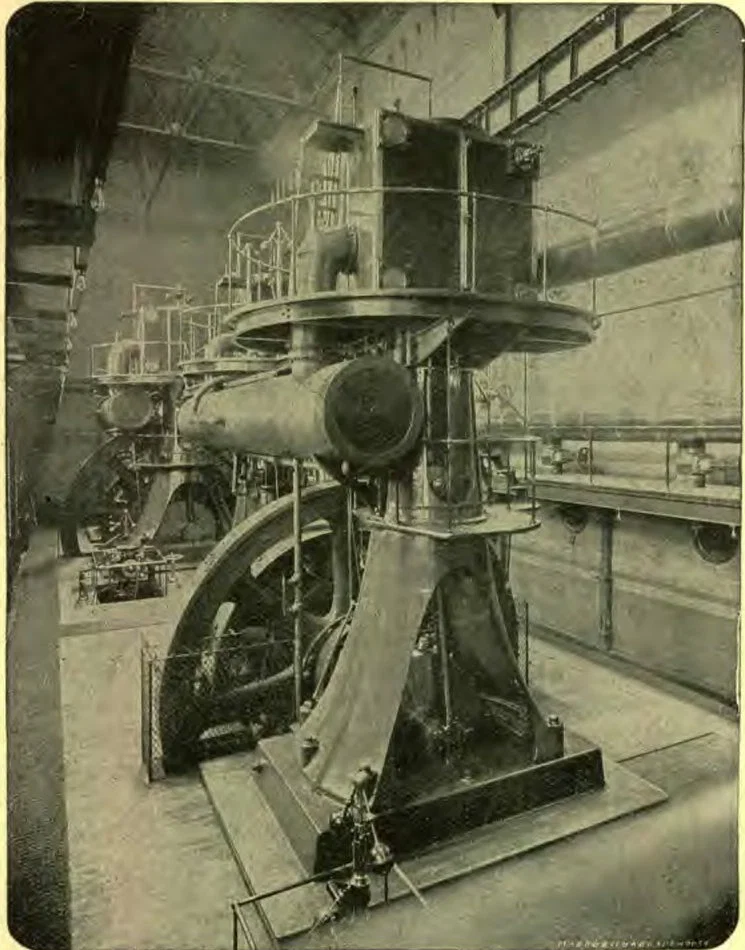
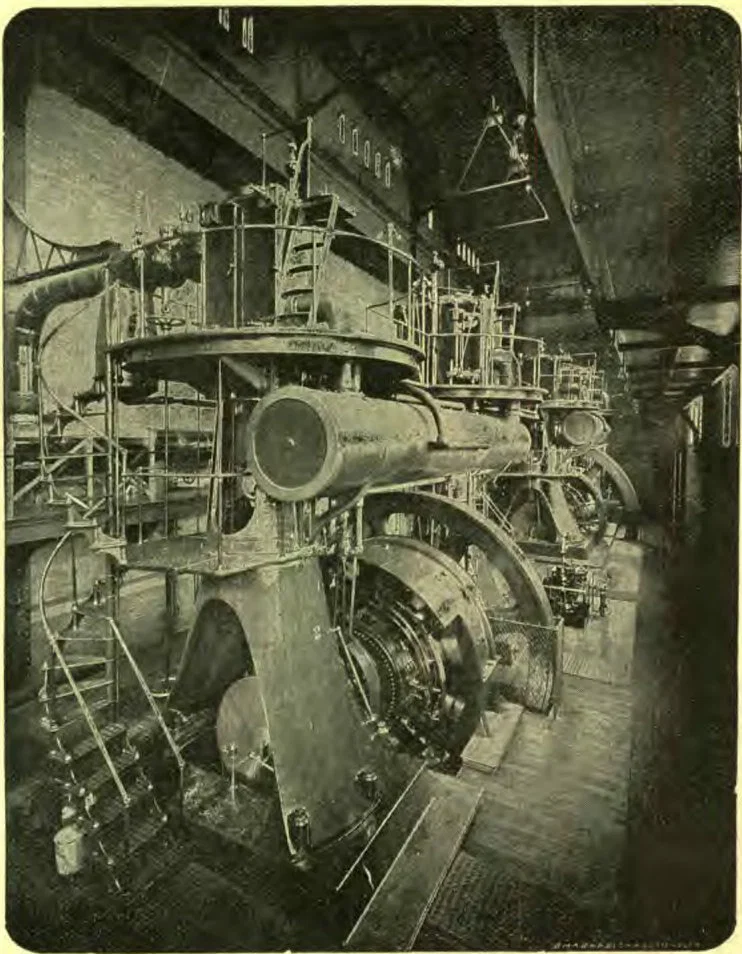
The century just closing has been described not inaptly as the “iron age,” on account of the marvelous advances made in the use of the dark metal. In this wonderful development, few manufacturing concerns have had a more important part than the Reliance Iron Works of the Edward P. Allis Company, of Milwaukee, Wis. This company is to-day without a rival in its line, being the most extensive builders of steam-engines in the world. Its shops have a floor space of twenty-eight acres, the daily pay-roll is four thousand dollars, and fully two thousand men are employed all the time. In every part of the world where civilization and modern methods have found their way, the products of this firm are used.
ALLIS VERTICAL CROSS COMPOUND CONDENSING ENGINE, IN THE POWER-HOUSE OF THE CHICAGO METROPOLITAN RAILROAD.
ANOTHER VIEW OF THE COMPOUND CONDENSING ENGINE.
Fifty expert draftsmen are constantly employed in this great institution, working out plans and specifications for steam-engines. No two engines in this shop are made exactly alike, plans being designed for each one, so that in each case the machine will be specially adapted for its work in the place where it will be operated.
As one enters the various departments, where different processes of manufacture are carried on, the attention is attracted by the immense electric cranes used in lifting and carrying to different parts of the works the enormous castings finally brought together in the completed engine. The delicacy shown in the adjustment of these machines, and their fitness to do what is expected of them, in just the way desired, are certainly wonderful. There are, all told, thirteen of these cranes in the institution, some of them having a lifting capacity of forty tons.
One of the most interesting features of the establishment is the molding department. Both sand-work and loam-work are produced; but the latter method is used most, especially for large castings. In making molds for the loam-work, large brick-kilns are constructed according to specially prepared plans, and so built as to conform to the shape of the casting to be molded. After the metal has had time to cool in the molds, the entire structure, brick work and all, is torn away; and the well-shaped part of some monster engine comes to light. Castings weighing as much as sixty tons are often made in this way.
The Allis Works is now filling the largest single order for stationary steam-engines ever received by any company, being that of an Eastern street railway company. The order calls for eleven power-engines, with a total running capacity of sixty thousand horse-power. When these engines are completed and in place, the company owning them will have the largest power-plant under one roof in the world. These engines are so made that each one can be run with perfect safety to the limit of seven thousand horse-power, though they will probably be run at a rate not exceeding six thousand horse-power . The significance of these figures will be appreciated when it is remembered that expert mechanical engineers thought that the top notch of high-power engines had been reached when a three-thousand-horse-power engine was made by the Allis Company, and set up to run the vast machinery connected with the Columbian Exposition, held at Chicago in 1893. The gain made since that time seems almost incredible. The Allis Company not only manufactures engines, both large and small, but other kinds of machinery as well, including flour-mill, saw-mill, and mining machinery. The firm maintains agencies in the leading American cities, also in the City of Mexico, Paris, Sydney, London, Johannesburg, and other foreign points.
Orders have recently been filled for immense street-railway power-plants at Madrid and Barcelona, Spain; Dublin, Ireland; and for the underground railway system of London, England.
J. C. BARTHOLF.

Cheap Method of Filling Ice-Houses With Clear Ice

At Claremont, N. H., an original method of cheaply filling ice-houses with fine ice was in successful operation last winter. The ice-house has within it a water-tight tank, just enough smaller than the house to allow for the expansion occasioned when water turns into ice. The water, taken from the water-works, first goes to a tank sixty feet above ground; from this it emerges through small tubes, and is allowed to fall to the floor of the ice-house below, just as shot are made in a shot-tower. The water freezes on its way down. The ice builds upon itself, becoming all the time denser and clearer, and the result in the end is a house filled with one solid three-hundred-ton cake of ice of such pure color as no one ever saw who has been limited to pond or river ice. The outside temperature must, of course, be freezing or colder. The ice is estimated to cost only five cents a ton.—The Pathfinder.

BETWEEN THE DAYS.

Between the days—the weary days— He drops the darkness and the dews; Over tired eyes his hand he lays, And strength, and hope, and life renews— Thank God for rest between the days!
Else who could bear the battle's stress, Or who withstand the tempter's shocks? Who thread the dreary wilderness, Among the pitfalls and the rocks, Came not the night, with folded flocks?
The white light scorches; and the plain Stretches before us, parched with heat; But by and by the fierce beams wane; And lo, the nightfall, cool and sweet, With dews to bathe the aching feet!
For he remembereth our frame! Even for this I render praise. O tender Master! slow to blame The falterer on life's stony ways, Abide with us between the days! — Emma Herrick Weed.

THE RESURRECTION OF LAZARUS.

IX.

At this council Christ’s enemies had been deeply convicted. The Holy Spirit had impressed their minds. But Satan strove to gain control over them. He urged upon their notice the grievances they had suffered on account of Christ. How little he had honored their righteousness! He had presented a righteousness far greater, which all must possess who would be children of God. Taking no notice of their forms and ceremonies, he had made the service of God so simple that sinners were encouraged to go directly to God, as to a merciful Father, and make their wants known to him. Thus, in their opinion, Christ had set aside the priesthood. He had refused to acknowledge the theology of the rabbinical schools. He had exposed the evil practices of the priests, and had irreparably hurt their influence. He had injured the effect of their maxims and traditions, declaring that though they strictly enforced the ritual law, they made the law of God void by their traditions. He had accused them of being ignorant of the Scriptures and of the power of God, denouncing them as hypocrites. This Satan now brought to their minds, persuading them that they had a quarrel against Jesus, which nothing but his death could end.
Satan told them that in order to save their authority, they must put Jesus to death. This counsel they followed. The fact that they might lose the power they then exercised was, they thought, sufficient reason for coming to some decision. With the exception of a few who dared not speak their minds, the Sanhedrin received the words of the high priest as the words of God. Relief came to the council; the discord ceased. They resolved to put Christ to death at the first favorable opportunity. In coming to this shameful decision they eased their minds with the fact that many guiltless lives had been sacrificed to save others.
The rulers were well pleased with themselves. They regarded themselves as patriots, who were seeking the nation’s salvation. Thus they persuaded themselves that they would be doing God a service in apprehending Christ. They thought that by putting him to death they could avert danger and preserve their power. Every device possible was to be tried to find something whereby Christ could be represented as working against the Roman power. By putting spies on his track, who would profess to be honest inquirers after truth, they hoped to entrap him. Thus by their own course of action they demonstrated as true all that Jesus had said of their malignity.
This spirit had been worked out in the history of Daniel. His enemies, who hated the faithful statesman for his integrity, and who wished to remove him from their path, that they might rise to eminence, planned and intrigued long in order to find some way by which he might be condemned and put to death.
By deciding to murder the Son of God, the Jewish rulers forged the fetters that were to hold them in irrevocable bondage. They loaded the cloud of vengeance that was soon to break over them, leaving them divorced from God and a prey to their enemies. From the time of this decision, the protection of God was withdrawn from the Jewish nation. The restraint of his Holy Spirit was removed.
Christ’s act in raising Lazarus was the crowning act of his life. What an influence for good it should have had upon all! But the hearts of the priests were hardened by it. Heaven’s light was shining upon them; the evidence was strong enough to lead them out of the dark shadow in which the enemy had enveloped them. But the words were verified: “Though he had done so many miracles before them, yet they believed not on him. . . . Because that Esaias said again, He hath blinded their eyes, and hardened their heart; that they should not see with their eyes, nor understand with their heart, and be converted, and I should heal them.”
God never hardens the heart in any other way than by giving great light. Heaven’s favors slighted, turned from, rejected, because of a perverse will, harden the heart. So Pharaoh’s heart was hardened. In order to accomplish his purpose, the Lord continued to give him greater and still greater manifestations of his power. But the king’s first resistance made obedience to God more difficult. To refuse first, and then obey, is humiliating.
God did not actually make Pharaoh stubborn and unyielding. He continued to give him light, and the king’s increasing stubbornness brought its sure result. By resisting the will of God, seeds of disobedience are sown, and a harvest of evil is reaped. One seed of unbelief generates another and a stronger seed. By submission to the will of God, seeds are sown that will produce a rich harvest of good. The seed that is sown is the seed reaped; for seed reproduces itself. “Whatsoever a man soweth, that shall he also reap.” As responsible agents, all are deciding for themselves what their harvest shall be.
God never urges any one on in wickedness. He never leads man to become desperate in his rebellion. He will not that any should perish, but that all should be saved. But he forces no one to accept the light. If, after bearing long with man, God sees that he will not submit, he leaves him to work out his natural hatred. He gives him up to the worst of all tyrants,—self.
From those who will not see the light, who are determined to go on in the hardness of their hearts, God gradually withdraws the restraining power of his grace.
To-day, as in the days when Christ worked his wonderful miracles, the truth of God is made known. Men have within themselves the evidence of its divinity. The Holy Spirit impresses their minds by the manifestation of divine power. If received, the light sent from God leads to freedom, life, and salvation. But if by resistance, preconceived opinions are strengthened, if the God-given blessing is not received, the light becomes darkness.
MRS. E. G. WHITE.

“I WILL DELIVER THEE.”

INSTANCES of remarkable answers to prayer are not lacking in the history of the brave men and women who have gone out into the dark places of earth with the gospel lamp in their hands, nor, indeed, with believers everywhere. Many a Christian cherishes the memory of some special deliverance in answer to prayer, and remembers, with a thrill of joy, how the closed way opened before him, and the evidence of God’s hand in it all was so plain it could not be mistaken. The experience related below is one more fulfilment of the promise that the Lord will deliver those who call upon him in the day of trouble:—
In September, 1863, Dr. Chamberlain, missionary in India, with some native preachers, a large party of coolies, and an armed guard, started on a twelve-hundred-mile journey into the interior, where no missionary had yet gone. The journey required five months’ time, on horseback, and was beset with grave danger from fevers, wild beasts, and fierce northern tribes, who for hundreds of years had offered human sacrifices.
“They expected to find a government steamer, when they struck the Pranheta River, an affluent of the great Godavery. But the heavy torrents of the monsoon had made the Godavery a stream of tumultuous waters, three miles wide. The steamer, in attempting to stem that fierce current, had broken its machinery, and could not come to their aid. There was now no way out of their trouble but to march through the seventy-five miles of that deadly jungle, dare its fever and the tigers, and at the foot of the second cataract reach the next steamer.”
Deserted by the coolies and the guard, in a lonely country, Dr. Chamberlain and his companions pressed on, and succeeded in crossing the swollen Godavery. Then he got together a new caravan, and “struck once more into the jungle, amid perils and exposures so great that only by intimidation could even those hardy men be compelled to go forward. At last a new and seemingly insurmountable obstacle lay in their way. Two huntsmen crossed their track, from whom they learned that the backwater of the Godavery flood, thirty feet higher than usual, had made unfordable the affluents beyond which lay their only safe resting-place for the night. And to their inquiries the answer was returned that there was neither boat nor raft nor any floating material to make a raft, whereby to cross to the knoll where they had purposed to encamp. The party were even then standing in the wet and mud, as they surveyed their hopeless plight. The royal guides and native preachers, who were in the party, were disheartened and at their wit’s end; and the fierce, hungry roar of the tigers could be heard about them as the night began to fall.”
At this point the brave missionary, who was doing one of the Master’s errands, rode away from the party to pray. As he committed his cause to the Lord, he heard an answer, “not audible,” he says, “but distinct, as if spoken in my ear by human voice, ‘Turn to the left, to the Godavery, and you will find rescue.’”
When he proposed to follow this direction, he was met with opposition by the guides. What! turn to that swollen river, a mile away, where there was no rising ground on which to camp, and no village for many miles! It would be folly.
Again the missionary rode apart for prayer; again came the answer, “Turn to the left, to the Godavery, and you will find rescue,” and again the guides objected. In despair he once more retired for prayer, and still again the answer was repeated. Then with the courage of God in his heart he commanded his men to turn to the river.
Knowing no more of how deliverance would come than did his bewildered companions and the unwilling coolies, but his heart filled with the calm assurance of one who has come near to God, he rode ahead as they reached the river, “all his senses keenly observant. And as he emerged from the dense undergrowth of bushes, there, right at his feet, lay a large flat-boat, tied to a tree at the shore—a large flat-boat, with strong railings along both sides, with square ends to run upon the shore. It had been built by the British military authorities in troublous times, to ferry over artillery and elephants, but it belonged at a station high up on the north bank of the Godavery. Two men were trying to keep the boat afloat in the tossing current. ‘How came this boat here?’ said the doctor.”
“They, taking him to be a government official who was calling them to account, begged him not to be angry with them, and protested that they had done their best to keep the boat where it belonged, but declared that it seemed to them possessed. A huge rolling wave swept down the river, snapped the cables, and drove the boat before it. Despite their best endeavors, it was carried farther and farther from its moorings into the current and down stream; they said they had fought all day to get it back to the other shore, but it seemed as if some supernatural power were shoving the boat over. An hour before, they had given up, let it float to its present position, and then tied it to a tree.”
Dr. Chamberlain had full authority to use any government property on his journey; so he immediately took possession of the boat.
“Who,” he gratefully says, “had ordered that tidal wave in the morning of that day, that had torn that boat from its moorings, and driven it so many miles down the river, and across from the north to the south bank, and that had thwarted every endeavor of the frightened boatmen to force it back to the north shore, and had brought it to the little cove-like recess, just at that point where we would strike the river? Who but He on whose orders we had come; he who had said, ‘I will be with you;’ he who knew beforehand the dire straits in which we would be in that very place, on that very day, that very hour; he who had thrice told me distinctly, ‘Turn to the left, to the Godavery, and you will find rescue?’ I bowed my head, and in amazed reverence thanked God for this signal answer to my pleading prayer.”

MAKING HOME PEACEFUL.

XXV.

Reginald had been an unobserved listener to this conversation; and now, snatching his cap, he hurried out of the house, more determined than ever that he would overcome his father's scruples, and before the winter was over, be his own master, and enjoy perfect freedom at Uncle Earl's. Still the boy had moments of real sorrow over his own waywardness, and at last he determined to promise his father that he would certainly do better, and would quit the company of bad boys altogether, or else try to induce them to visit him at his own home. For a week after his promise was made, which he really intended to keep faithfully, the lad was so good and obedient that his father at last gave a reluctant consent to his going away to school; and the next Thursday afternoon was appointed for his departure.
But a whole week of orderly conduct, of respectful attention to his parents' wishes, of staying at home or helping his father at the store evenings, and going to bed when the other members of the family did; in short, a whole week of unreproachable conduct, seemed an age to the self-willed lad, and was almost more than he could endure; so the reformation which his anxious father and too sanguine mother had hoped was to be permanent, proved, before the week was gone, to be of very short duration.
The evening before he was to leave home was a beautiful one; a thousand diamonds glittered and sparkled on the crisp snow, as the bright light from the street-lamps fell upon it, and the temptation to spend an hour or two with his reckless companions before he left them, was too strong to be put aside. So, carelessly remarking that he guessed he'd go over to the store for a while, he went out to spend his last evening with the wild young men whose acquaintance he had cultivated, and whose habits and manners he had long imitated. Reginald knew very well where he would be likely to find them; in fact, Will Green had suggested that day that he meet a few of the boys for a “good-by treat” at Reddy's hotel in the evening.
The lad was not altogether hardened; and his conscience whispered to him not to heed the invitation, but to spend his last evening at home, especially as little Flossie begged him, just as he was going out, to hold her in his lap, and tell her about the big tigers in his natural history. But the evil angels prevailed. Down the streets he hurried, as if driven on by the spirits of darkness. The gay saloon, with its brilliant lights, is reached and entered. As he opens the door, snatches of vile songs and coarse laughter fall upon his ear. He does not intend to stay long; but it takes only a glass or two to bewilder and confuse his mind, and the hours pass rapidly by, as in a dream. At last, as the midnight hour approaches, he is carried out by two of his companions, more accustomed to the effects of the vile cup, and steadied home, conscious only of a terribly aching head, an outraged stomach, making an effort at frequent intervals to relieve itself of its vile contents, and haunted by a vague fear of the results of his act of indiscretion. By the time he has dragged his unwilling feet up the steps, he is completely overcome, and is quite unable to enter the house. His sneaking companions, whom he calls “friends,” ring the bell loudly, leave the poor lad in a heap upon the cold steps, and beat a hasty retreat.
Mrs. Beardsley had supposed that Reginald was at the store until his father came home at half-past nine; then she did not mention his absence, hoping her husband would not ask about him; and he, supposing Reginald had spent his last evening at home, with his mother, said nothing. Mrs. Beardsley had two objects in expressing no surprise to her husband that Reginald was not with him when he came home: she hoped to be able thus to keep the truth from him; for she knew well that he would be grieved and disappointed that the boy had not kept his word, and perhaps he might refuse entirely to let him go to his uncle's. Even if he did not do this, she feared he would reprove him; and the unwise and foolish woman dreaded nothing so much as that her son, the darling of her heart, should receive censure for anything. She had gone to bed hoping that he had taken a night-key with him, and that his father would not be awakened when he returned. She didn't believe in being so strict with him, anyway, and was greatly annoyed because she could not induce her husband to give up his “straight-laced notions,” as she termed them.
Let us not be too hard upon this woman, foolish and unwise as she appears. She believed in her son,—believed in him implicitly,—and that is well. No mother can have any influence over her son, who does not believe in him. But Ellen Beardsley believed in her son blindly, unwisely, and against her better judgment; yet, even against the evidence of her own senses. She was getting to fear not so much the sin as the exposure; not so much the baneful effect of evil companions as that something should occur which would serve to thwart her cherished plans. She had not believed it possible that her boy could be led very far away from the path of rectitude; other boys might be led away, but surely not hers. Had she thought this possible, she would have been as greatly distressed and grieved as any less unwise mother. She hoped for great things from him—her first-born. He will graduate! How proud she will be of him! and how surprised Professor Hill will be! From this fond dream she was awakened by the loud ringing of the bell. Thoughts of Reginald were the first that filled her mind, and rushed in upon her waking consciousness, even as they had been the last that occupied her sleeping fancies.
“What is it, Ellen?”
“Nothing—just somebody at the door, that's all.” A dread of something terrible about to happen almost paralyzed her tongue. What if—but no! it could not be Reginald. Still, she felt an unaccountable and almost overmastering desire to hurry down-stairs.
MRS. L. D. AVERY-STUTTLE.
(To be continued.)

A PRECIOUS PILLOW.

The experiences of Dr. Adoniram Judson, who went to India in 1810, and spent thirty-seven years in missionary service, are among the most thrilling in the annals of mission life. From 1824–1826 England was at war with Burma; and Dr. Judson, suspected of being a spy, was seized, and cast into a loathsome prison, where he was confined seventeen months, being bound with three, and for two months with five, pairs of fetters. His sufferings during this time are beyond description.
Before seized by the officers, he had finished the translation of the New Testament into Burmese, though it had not yet been printed. This manuscript was the most precious thing the faithful missionaries possessed. Fearing for its safety, Mrs. Judson buried it in the ground; but she knew that if left there, it would soon be ruined. Finally she decided to put it in a cotton pillow, and take it to her husband. For a wonder the keeper did not object: the pillow was so hard and small he did not covet it. After seven months it was taken from Mr. Judson; but his wife cleverly redeemed it with a better one. Sometime later he was taken to another prison, and the pillow was thrown into the prison yard with other rubbish. Now it would surely seem as if the precious roll must perish, and all the work of the missionary be in vain. But God was guarding the labor of his servant; in a few hours a native Christian found the pillow, and took it home to keep as a relic. Long afterward the manuscript, complete and in good condition, was found in the cotton. It was printed; and thus, after many vicissitudes, the New Testament was given to the Burmese.

Energy and Patience in the House of Life

“In the house of Life, Energy seems to do all the work, but Patience does the real drudgery.”

A PLAIN LITTLE GIRL.

Once I knew a little girl, Very plain; You might try her hair to curl, All in vain; On her cheek no tint of rose Paled and blushed, or sought repose: She was plain.
But the thoughts that through her brain Came and went, As a recompense for pain, Angels sent; So full many a beauteous thing, In the young soul blossoming, Gave content.
Every thought was full of grace, Pure and true; And in time the ugly face Lovelier grew, With a heavenly radiance bright From the soul's reflected light Shining through.
So I tell you, little child, Plain or poor, If your thoughts are undefiled, You are sure Of the loveliness of worth; And this beauty, not of earth, Will endure.
— St. Nicholas.

HERBERT'S SCIENCE LETTERS.

Ethel Terry Reeder.
My dear Ralph: Uncle John went away last week, to be gone some time. We boys didn't like the idea of giving up our talks for so long; so he said he would write out what he had to tell us, and then we might send the letters to you. We received the first one yesterday, and I will send it on to you, with the two little pictures. Your loving cousin, Herbert.

Uncle John's Letter.

My dear boys: After arriving here, I found that the business which I came to attend to will keep me away from home much longer than I expected; but I think I shall find time for our science letters each week.
This time I will write about the use of water in running machinery. Perhaps you have never seen a water-wheel; but only a few years ago nearly all the flour and meal were ground in mills run by water-wheels. You may have heard grandpa tell how, when he was a young man, he used to ride horseback to mill, and take two bags of grain to be ground, and then carry the flour or meal home in the same way. I never think of the old water-wheels without thinking of a proverb that I learned when I was a boy: “The mill will never grind with the water that has passed.” It taught me a good lesson: see if you can find one in it.
Overshot water-wheel
Nowadays, a few large mills, with powerful engines, make flour and meal for all the world; and the small mill, with its clanking wheel, is seldom seen. The large mill is run by water, though, in another form.
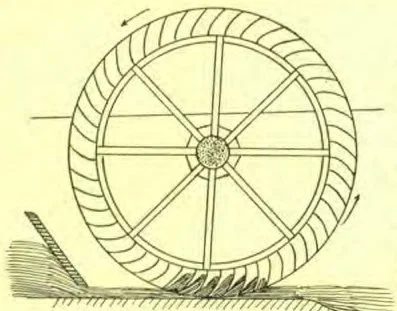
I have made two illustrations, which will help you understand how the water-wheel works. Fig. 1 is what is known as an overshot wheel. It is so arranged that the water from a running stream is caught in the little cups marked a, a. The weight and force of the water keep the wheel turning in the direction indicated by the arrows. Where there is no natural fall, the stream is dammed, and an artificial fall made. The water is carried out on the wheel by a trough, like d. The machinery inside the mill is attached to the wheel by a strong rod, or bar, passed through c, and is thus kept in motion.
Where a fall can not be arranged, the undershot wheel (Fig. 2) can be used. This wheel is placed in a running stream in such a way that the water rushes under instead of over it, filling the little cups, or buckets, a, a, and turning the wheel in the direction of the arrows.
Undershot water-wheel.
At b is an arrangement to measure and regulate the quantity of water passing under the wheel, and thus regulate the working power of the wheel. This can be done with the overshot wheel by a simple device in the trough, d.
Last summer when we went across the lake on the little steamer, you were sure you could not have taken the ride if it had not been for the water; but did you ever think, when you were riding on the train, that it was water that was pulling you along so fast? Yet it is true that our great locomotives would run little better than Bob's toy engine if it were not for water; neither would it be possible to move any of the machinery in our large mills without water; for water does much of the world's work.
You know that when water is heated, it floats away in steam, or vapor. It does this without any apparent effort when it is free to do just as nature intended; but when men want the water to work for them, they shut it up, and heat it. As it is heated, it expands; and in trying to get away, it puts forth a great deal of energy.
I hope you will sometime have an opportunity to study more about the ways in which water is made to work. Meanwhile, keep your eyes open.
Yours lovingly, Uncle John.

QUEER LITTLE HISTORIANS.

Just a raindrop loitering earthward, All alone, Leaves a tiny, tell-tale story In the stone.
Gravel, tossed by teasing water Down the hill, Shows where once in merry laughter Flowed a rill.
In the cool bed, dark and hidden, Ferns (how queer!) Left a message, plainly saying, “We've been here!”
You may see where tiny ripples On the sands Leave a history written by their Unseen hands.
Why, the oak-trees, by their bending, Clearly show The direction playful winds blew, Years ago!
So our habits tell us, little Maids and men, What the history of our whole past Life has been!
— Selected.
Continue reading: WOOD-TURNING