THE wonderful power of God is manifested, not in extraordinary exercise on His part, but in the greatness of that which is accomplished. If the greatest of His works, or even all of them combined, required any conceivable exertion of physical effort, that would imply a limitation of power at some point, however remote. In the creation of the world only the speaking of the word was necessary. "He spake, and it was done." Ps. 33:9. His power is so great that only a word is necessary to accomplish any desired effect. "By the word of God the heavens were of old," that is, before the Flood; "but the heavens and the earth, which are now, by the same word are kept in store." 2 Peter 3:5-7. The centurion understood that it was not necessary for the Christ to even walk to his house in order to heal his dying servant. He said, "Speak the word only, and my servant shall be healed." Matt. 8:8.
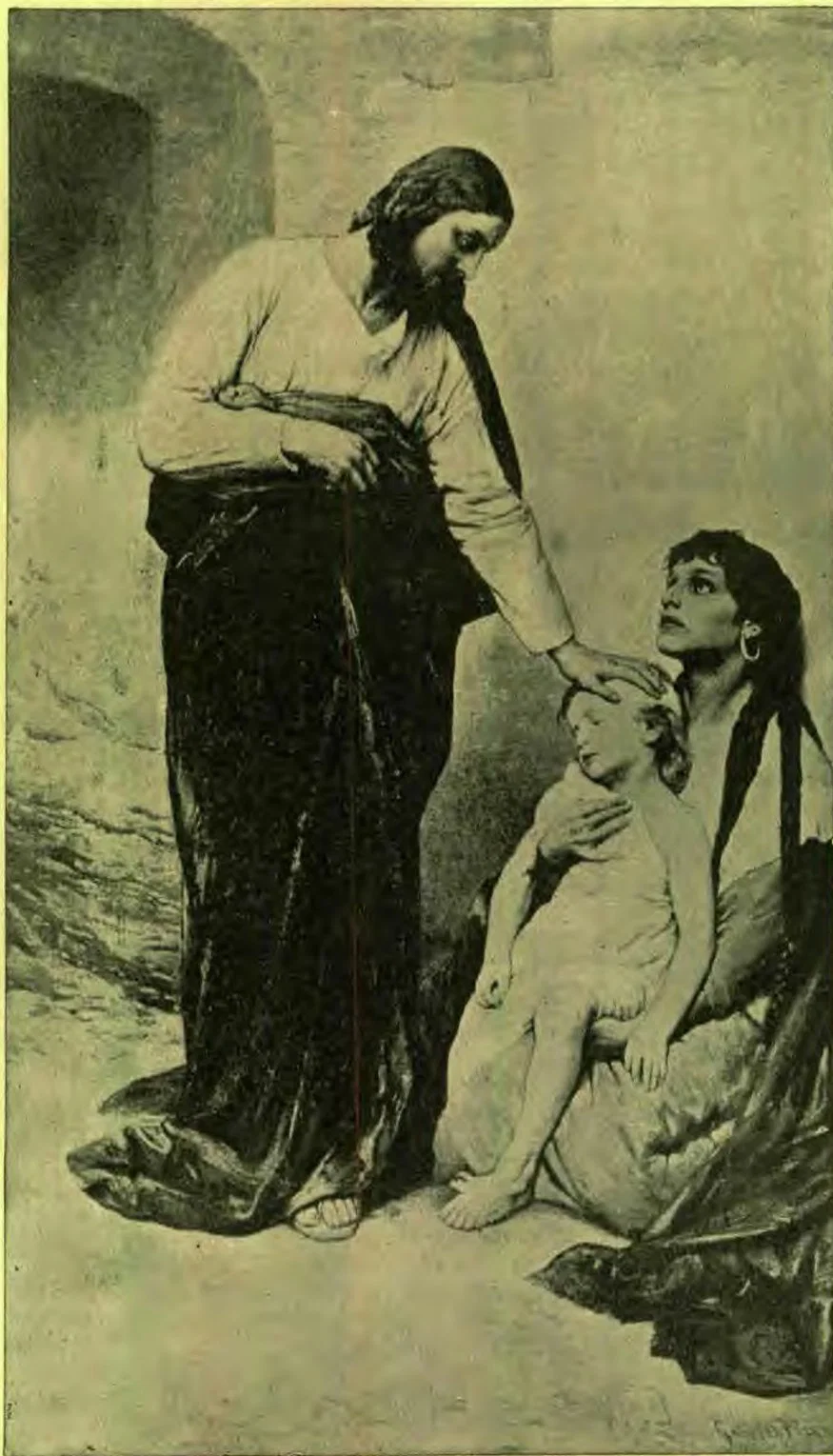
"And they brought young children to Him, that He should touch them." Mark 10:13.
THE same is true of the Saviour's touch. It is sufficient to heal; for the virtue is not in the ostentation of herculean effort or "bodily exercise," but in Him and in the power of His word.
ONE Sabbath day after a service in the synagog in Capernaum, Jesus went to the home of Simon Peter. Peter's mother-in-law was very sick of a fever; and Jesus "touched her hand, and the fever left her." So complete was the cure that she immediately "arose, and ministered unto them." Matt. 8:14, 15. The same touch that would heal a fever patient could also heal one afflicted with leprosy.
"And there came a leper to Him, beseeching Him, and kneeling down to Him, and saying unto Him, If Thou wilt, Thou canst make me clean. And Jesus, moved with compassion, put forth His hand, and touched him, and saith unto him, I will; be thou clean. And as soon as He had spoken, immediately the leprosy departed from him, and he was cleansed." Mark 1:40-42.
Now, IT was unlawful for a leper to come near enough to another person to be touched by him, lest the disease be transmitted. The leper was required, not only to dwell away from the habitations of other people, but he must proclaim his uncleanness to all who should approach him. "The leper in whom the plague is, his clothes shall be rent, and his head bare, and he shall put a covering upon his upper lip, and shall cry, Unclean, unclean. All the days wherein the plague shall be in him he shall be defiled; he is unclean; he shall dwell alone; without the camp shall his habitation be." Lev. 13:45, 46.
LEPROSY was the most dreadful disease known to man, and there were many lepers in Palestine at this time. Even to touch one was supposed to mean contamination and defilement. Why, then, should Jesus touch this man at all, when a word would produce the healing?—It was the touch of divinity. Christ had no occasion to fear, for God was with Him (Acts 10:38), and God was in Him (John 10:37, 38). His power was greater than that of any disease. Inoculation could not flow toward Him; the strong current of influence ran the other way. Power to heal would naturally ward off and overcome all danger of infection. In His touch Jesus, as a man, manifested His faith that God was in Him to heal, and that the power of the word He spoke was effectual to make it safe to touch the leper as proof of the healing.
IT was because of this overpowering outflow of virtue that Christ could live a perfect life in this sin-sick world. As the power of the Word dwelling in Him could repel and banish disease, so the Holy Spirit with which He was filled was a barrier to every form of sin. Leprosy is a type of sin, and the same word which was effectual in the expression, "I will; be thou clean," is just as potent when it says, "Thy sins be forgiven thee." See Mark 2:3-12. Because they were endued with this power from on high, Christ could send forth His disciples to carry on the work begun in the earth by Himself. And He sent them with the assurance that "these signs shall follow them that believe; in My name shall they cast out devils; they shall speak with new tongues; they shall take up serpents; and if they drink any deadly thing, it shall not hurt them; they shall lay hands on the sick, and they shall re-2cover." Chapter 16:17, 18. Let it not be forgotten that the gifts of the Spirit are for the church till the end of time. John 14:16, 17.
THAT the divine touch is potent in the instant forgiveness of sin, and as a qualifier of laborers, is shown also by Old Testament testimony. The prophet Isaiah, in recording a wonderful vision of God and His attendant train, says: "Then said I, Wo is me! for I am undone; because I am a man of unclean lips, and I dwell in the midst of a people of unclean lips; for mine eyes have seen the King, the Lord of hosts. Then flew one of the seraphims unto me, having a live coal in his hand, which he had taken with the tongs from off the altar; and he laid it upon my mouth, and said, Lo, this hath touched thy lips; and thine iniquity is taken away, and thy sin purged. Also I heard the voice of the Lord, saying, Whom shall I send, and who will go for us? Then said I, Here am I; send me." Isa. 6:5-8.
WHEN the word of the Lord came to Jeremiah, informing him that he had been ordained before he was born to be "a prophet unto the nations," he replied, "Ah, Lord God! behold, I can not speak; for I am a child." Then he says, "But the Lord said unto me, Say not, I am a child; for thou shalt go to all that I shall send thee, and whatsoever I command thee thou shalt speak. Be not afraid of their faces; for I am with thee to deliver thee, saith the Lord. Then the Lord put forth His hand, and touched my mouth. And the Lord said unto me, Behold, I have put My words in thy mouth. See, I have this day set thee over the nations and over the kingdoms, to root out, and to pull down, and to destroy, and to throw down, to build, and to plant." Jer. 1:4-10.
SMALL as a touch may seem, the divine touch, through the mediation of Christ, is the reconciliation of the sinner to God. That which seems to the sinner to be almost, if not altogether, an impossibility, is, through persistent faith, brought to a point where only a touch removes the vast distance between the Author of the broken law and the sin-stained offender. Great as is the work to be accomplished, the simple plan of salvation, as brought about through the sacrifice of the Son of God, is reduced to this: "If Thou wilt, Thou canst make me clean." "I will; be thou clean." The faith and the touch bring the Father and the prodigal together in loving embrace. There is no defilement so loathsome as to hinder the cleansing touch of the sympathetic, all-healing Saviour. The hard-hearted, selfish men and women may flee from the possibility of contact with the dread contagion. He who came to call sinners to repentance will not turn away from the most dreadful case. Do not think that you are beyond the reach of His outstretched arm, altho it may seem to be so. "Fear not; only believe;" and "tho your sins be as scarlet, they shall be as white as snow." The divine touch can reach and heal every one who calls for it in simple faith.
A HELPFUL LIFE.
“I REMEMBER once being called to see a sick girl,” said Henry Ward Beecher, “who was, perhaps, seventeen or eighteen years of age. A gentleman informed me that she had been sick for twelve months, and that she had become quite disconsolate. He said: ‘She has the sweetest disposition, and she is the most patient creature imaginable. And you ought to hear her talk; one can hardly tell whether she talks or prays. It is heaven to go into her room.’ I wanted a little more of the spirit of heaven, so I went to see her. I was engaged in the special labors of a revival of religion at the time.
“She said: ‘I hear of what you are doing, and of what my companions are doing, and I long to go out and labor for Christ; and it seems very strange to me that God keeps me here on this sick bed.’ ‘My dear child,’ said I, ‘do you not know that you are preaching Christ to this whole household, and to every one who knows you? Your gentleness and patience and Christian example are known and read by all. You are laboring for Christ more effectually than you could anywhere else.’ Her face brightened; she looked up without a word; and doubtless she gave thanks to God, and angels sang more sweetly than before.”
AN ALL-SUFFICIENT SAVIOUR.
By Mrs. E. G. White
BY MRS. E. G. WHITE.
CHRIST came to this world to live a life of perfect obedience to the laws of God's kingdom. He came to uplift and ennoble human beings, to work out an enduring righteousness for them. He came as a medium through which truth was to be imparted. In Him are found all the excellencies necessary to absolute perfection of character. To those who receive Him, He gives power to become the sons of God. "The Word was made flesh, and dwelt among us, . . . full of grace and truth. . . . And of His fulness have all we received, and grace for grace. For the law was given by Moses, but grace and truth came by Jesus Christ."
In Christ "we have redemption through His blood, even the forgiveness of sins." He is "the image of the invisible God, the first-born of every creature." "By Him were all things created, that are in heaven, and that are in earth, visible and invisible, whether they be thrones, or dominions, or principalities, or powers; all things were created by Him, and for Him; and He is before all things, and by Him all things consist. And He is the head of the body, the church; who is the beginning, the first-born from the dead; that in all things He might have the pre-eminence. For it pleased the Father that in Him should all fulness dwell; and, having made peace through the blood of His cross, by Him to reconcile all things unto Himself; by Him, I say, whether they be things in earth or things in heaven.
"And you, that were sometime alienated and enemies in your mind by wicked works, yet now hath He reconciled in the body of His flesh through death, to present you holy and unblamable and unreprovable in His sight; if ye continue in the faith grounded and settled, and be not moved away from the hope of the Gospel, which ye have heard, and which was preached to every creature which is under heaven."
Christ gave up His high command in the heavenly courts, and, laying aside His royal robe and kingly crown, He clothed His divinity with humanity. For our sake He became poor in earthly riches and advantages, that human beings might be rich in the eternal weight of glory. He took His place at the head of the human family, and consented to endure in our behalf the trials and temptations that sin has brought. He might have come in power and great glory, escorted by a multitude of heavenly angels. But no; He came in humility, of lowly parentage. He was brought up in an obscure and despised village. He lived a life of poverty, and suffered often with privation and hunger. This He did to show that earthly riches and high rank do not increase the value of souls in the sight of God. He has given us no encouragement to think that riches make men worthy of eternal life. Those church members who when a brother becomes poor treat him as if he were unworthy of their notice, certainly did not learn this from Christ. To one who during His ministry offered to follow Him as His disciple, He said, "Foxes have holes, and the birds of the air have nests; but the Son of Man hath not where to lay His head." Those who follow Him must share His poverty. "If any man will come after Me," He declares, "let him deny himself, and take up his cross, and follow Me." "So shall he be My disciple."
It is submission to sin that brings the great unhappiness of the soul. It is not poverty, but disobedience, that lessens man's hope of gaining the eternal life which the Saviour came to bring him. True riches, true peace, true content, enduring happiness,—these are found only in entire surrender to God, in perfect reconciliation to His will.
Christ came to our world to live a life of stainless purity; thus to show sinners that in His strength they, too, can obey God's holy precepts, the laws of His kingdom. He came to magnify the law and make it honorable by His perfect conformity to its principles. He united humanity and Divinity, that fallen human beings might become partakers of the divine nature, and thus escape the corruption that is in the world through lust.
It was from the Father that Christ constantly drew the power that enabled Him to keep His life free from spot or stain of sin. It was this power that enabled Him to resist temptation.
“HEREIN IS LOVE.”
A GENTLEMAN who was a professed Christian was taken seriously ill. He became much troubled about the little love he felt in his heart for God, and spoke of his experience to a friend. This is how the friend answered him: “When I go home from here, I expect to take my baby on my knee, look into her sweet eyes, listen to her charming prattle, and, tired as I am, her presence will rest me;3for I love that child with unutterable tenderness. But she loves me little. If my heart were breaking, it would not disturb her sleep. If my body were racked with pain, it would not interrupt her play. If I were dead, she would forget me in a few days. Besides this, she has never brought me a penny, but was a constant expense to me. I am not rich, but there is not money enough in the world to buy my baby. How is it? Does she love me? or do I love her? Do I withhold my love until I know she loves me? Am I waiting for her to do something worthy of my love before extending it?” This practical illustration of the love of God for His children caused the tears to roll down the sick man’s face. “O, I see,” he exclaimed, “it is not my love to God, but God’s love for me, that I should be thinking of. And I do love Him now as I never loved him before.” “Herein is love, not that we loved God, but that He loved us.” 1 John 4:10.—Anon.
THOU SHALT NOT BE AFRAID.
By C. M. Snow
BY C. M. SNOW.
CEASE doubting, O soul, tho the sea be a-roar
With the billows of strife, and tho legions of war
Are treading to dust the green of the lea
And red'ning the rivers that run to the sea.
There's a bow in the sky, and its diamond-wrought rim
Is the pledge of our hope, and that hope is in Him
Who holdeth the world in the cup of His hand
And bindeth the sea with a shackle of sand.
What need that I cherish the tremor of dread
While the bow of His word bends bright overhead?
Tho the sea may be red with the blood of the slain,
And the dead be piled high on the slippery plain;
Tho the arrows of death fly on every hand,
And the specter of pestilence stalk through the land;
I will trust in Him still, for my anchor will hold,
And my soul be at peace in His heavenly fold.
I'll fear not the gloom of that terrible day
When the hopes of the heedless are smitten away;
When the face of the sinner is blackened with dread,
And the angels of wrath on their mission have sped;
For swift o'er the shuddering, tremulous sod
Come the chariot wheels of my Saviour and God,
And deep in the heart that is trusting in Him
Glows the lamp of His Word which no terror can dim.
SEARCH THE SCRIPTURES
By F. D. Starr
ISAIAH.
BY F. D. STARR.
HO, every one that thirsteth, come ye to the waters, and he that hath no money; come ye, buy, and eat; yea, come, buy wine and milk without money and without price." Isa. 55: Thus sounds forth the Gospel proclamation from this unique book, written by one who is by some styled the Fifth Evangelist, because his writings so vividly describe the life and sufferings of our blessed Lord, and thus make this book a companion piece to the first four books of the New Testament.
As we come now to the prophetic portion of God's Holy Book, a new interest is aroused in our minds to become better acquainted with the "more sure word of prophecy, whereunto ye do well that ye take heed, as unto a light that shineth in a dark place." 2 Peter 1: 19.
As we attempt to say something concerning the wonderful things that we find in the several books in the Bible, words seem entirely inadequate to express the rapture and delight that the soul experiences in beholding its exhaustless treasures. It seems like the merchantman seeking goodly pearls, who found, not only one pearl of great price, but scores of precious pearls of priceless value. Who would not work a mine like this?
Isaiah's prophetic office continued during the reign of four kings of Judah, covering a period of more than threescore years, and commencing back in the eighth century before Christ. His book is divided into sixty-six chapters, or exactly as many chapters as there are books in the Bible; and while each one of the sacred books may be regarded as a pearl of itself, it seems as if, like the gates of the New Jerusalem, each chapter is composed of one several pearl. Any one who will take the time to do so, the youth especially, will find it a most satisfying accomplishment to become so familiar with the various chapters of this book that he can give from memory some account of the contents of each chapter.
With the exception of the book of Psalms, no book of the Old Testament seems to have been so extensively quoted in the New as Isaiah.
If time and space permitted, it would be interesting to notice some points in each chapter. The first chapter calls our attention to the lost condition of fallen man—the whole head sick, the whole heart faint. From this forlorn condition, release is found in verse 18: "Come now, and let us reason together, saith the Lord; tho your sins be as scarlet, they shall be as white as snow; tho they be red like crimson, they shall be as wool." The conditions on which this is to be done are stated in the preceding verses: "Wash you, make you clean." "Cease to do evil; learn to do well." We should not fail to see the connection between these statements and the gracious promise of verse 18. As the German version reads, "Then come and let us reason together." The "now" that defines the time when the blood-red stains are to be made white as snow, is when these changes in conduct have been instituted. This is simply the doctrine proclaimed by Daniel to King Nebuchadnezzar: "Break off thy sins by righteousness, and thine iniquities by shewing mercy to the poor; if it may be a strengthening of thy tranquillity." Dan. 4: 27. It is the same message as that proclaimed by John the Baptist, when he declined to baptize the unrepentant Pharisees: "Bring forth therefore fruits meet for repentance." It is the same teaching as that of James, when he tells us that "faith without works is dead." The Lord says to us, Make these necessary changes, then come and your sins shall be thoroughly cleansed.
It is He who gives us the power to make these changes. "He that confesseth and forsaketh his sins shall find mercy." He that forgives shall be forgiven.
The second chapter of Isaiah contains the prediction concerning the popular cry of a temporal millennium and the world's conversion. But none should fail to notice that it is not the Lord that has spoken this word concerning this expected time of universal peace, but the people that give utterance to this sentiment. This being but human speculation, the Lord says to us concerning it: "Cease ye from man, whose breath is in his nostrils; for wherein is he to be accounted of?" It is the world's destruction, and not its conversion, that is now near at hand.
The fifty-third chapter brings us to the scenes of Gethsemane and Calvary. What vivid descriptions of the sufferings of our Lord!
In this chapter we have an instance that shows us how the Septuagint or Greek translation was used by New Testament writers generally, instead of their making each time a new translation from the original Hebrew. Verse 7 says: "He is brought as a lamb to the slaughter, and as a sheep before her shearers is dumb, so He openeth not His mouth." When the eunuch, as recorded in Acts 8: 27-33, was reading the book of Isaiah, it was this very scripture that took his attention. It is quoted thus: "He was led as a sheep to the slaughter; and like a lamb dumb before His shearer, so opened He not His mouth." It will be noticed that the terms sheep and lamb are here transposed. The explanation is that the New Testament gives it just as it was found in the Septuagint. The Greek translators got the terms interchanged. There are quite a number of other texts that exhibit this same feature, showing how extensively the Greek version was used in the time the New Testament was written.
The last chapter of the book brings us to the new earth state, and informs us that there the holy Sabbath shall be observed. Indeed, this wonderful book gives us some very important information upon the Sabbath question. From chapter 56 we learn concerning the Sabbath reformation in the last days just before the Lord comes. From chapter 58 we also find the exalted nature of the work those are doing who observe the Sabbath and teach others to observe it. They shall be called repairers of the breach. As the French version says, "they shall raise up the foundations that have lain waste for many generations." The fact that this work is now being done is one of the many infallible proofs of the inspiration of this book. "Seek ye out of the book of the Lord, and read; no one of these shall fail." Who can possibly reject the opportunity of enjoying the feast of fat things provided in this book? "Let your soul delight itself in fatness."
Forest, Idaho.
ASSURANCE OF SUCCESS.
By C. L. Taylor
BY C. L. TAYLOR.
THERE are few people in the world who do not have desires to be and to do right. They have had these desires from earliest childhood; for it is the gift of God, His plan, that all people born into the world shall have in their lives a longing for the pure and good.
Now this fact should encourage young men and women everywhere to yield themselves to God. Our heavenly Father has placed within the reach of each one that which will fully satisfy all the longings which He has created in the human heart. God is love, and He could not awaken His children to their need of righteousness and then leave them without any hope of ever obtaining it. The very fact that a young man is conscious of an ambition to be upright is an everlasting assurance that God will satisfy his ambition.
It is recorded of one of the Roman emperors that he enacted certain laws which the people were to obey under penalty of death; but when the laws were posted they were printed so small and placed so high above the people that it was impossible to read them. Of course, the people wanted to obey, for the mere fact that laws were proclaimed caused the citizens to desire to conform to them. But the purpose to obey brought only trouble and disappointment, because there was no possible way to come into touch with what was required. In fact, the purpose of the emperor was to harass, and annoy, and destroy those over whom he ruled. He delighted in the misery of his subjects.
Not so, however, with God. He is the Father as well as the king. "He doth not afflict willingly nor grieve the children of men. To crush under His feet all the prisoners of the earth, to turn aside the right of a man from the face of the Most High, to subvert a man in his cause, the Lord approveth not." He delighteth in mercy. He desires that all men shall be saved. He was so anxious that no one should be lost that He gave His only-begotten Son to die for a sinful world.
This being the case, it is very easy to see that whenever or wherever any one can be found who will bring his own desire to be right to the altar of Christ, where it shall have a living connection with God's desire that he be right, there is absolutely nothing which can hinder him from being right. When man's desire and God's desire are brought together in this way, the desire becomes crystallized into fact.
Look at this in another way. God's desire to have men right is expressed in the giving of His own dear Son, in giving all that He had. He gave Himself in Christ. Now, when an individual gives expression to his desire in giving, in the bringing of himself to God, he then and there enters into a new experience,—he becomes right.4Christ Jesus takes his sin, and he takes the Saviour's righteousness.
Dear young friend, God is not tantalizing you in this matter of wanting you to be upright and pure. He is ready to provide you with all that you need to save you from both sin and sinning. He is able to save to the uttermost. He can keep you from falling. "His divine power hath given unto us all things that pertain unto life and godliness."
While it is true that only those who obey all the commandments in all their holiness will be able to enter the kingdom of God, yet it is also true that those commandments have been brought so close to mankind that all may truly and fully obey them. "For this commandment which I command thee this day, it is not hidden from thee, neither is it far off. It is not in heaven, that thou shouldst say, Who shall go up for us to heaven, and bring it unto us, that we may hear it, and do it? Neither is it beyond the sea, that thou shouldst say, Who shall go over the sea for us, and bring it unto us, that we may hear it, and do it?" Deut. 30:11-13. The Lord Jesus, who has been given to the world in the plan of salvation, brings to us the pure and holy law of God, and in Him the least and weakest may do all that is required. It is only a falsehood of the enemy that it is impossible for men and women to do right. And to believe that falsehood would be to make God a tyrant who has held out a hope that we can never realize.
No, young friends, God is too good and too wise to mislead. The desire to be right, planted in every human heart, shows that the kingdom of God is not far away. Heaven is close to the human family. The Lord Jesus has demonstrated that it is possible for man to do right under the greatest difficulties, and with the whole world in opposition. He came and took sinful flesh with all its weaknesses and liabilities, "that the righteousness of the law might be fulfilled in us."
The call of God to each soul to enter the kingdom of heaven is a promise in itself to do all that is needful to cause him to reach that place. When Jesus bade Peter, "Come," there was power in that simple word to enable the disciple to walk upon the water to Jesus' side. Matt. 14:29. Over and over again, it is shown in the Scriptures that simple belief in God's word has strengthened man to do that which is naturally impossible. In fact, the whole Bible is a story of miracle power, that men and women, youth and children, may be encouraged to trust God to do the impossible for them.
Why, then, should not every one allow God to do for him what must be done? Why should not each one who reads these words let the desire to become righteous move him to devote himself to God and to do so now? If God be true, and His word sure, why not accept His promise at this hour? Is it treating God's invitation justly to delay this matter longer?
O, dear friend, remember that this is not a question of your ability "to hold out," but rather of God's ability. He is almighty, and so does "exceeding abundantly above all that we ask or think." Take the first step in the direction of the Lord Jesus as He is revealed in His Word, and at once you will begin to understand the blessedness of His promise. You will at once find yourself bound to Him.
To-day He calls upon you to yield to Him. Why not do it?
STRIKING PARALLELS OF HISTORY.
By A. T. Robinson
BY A. T. ROBINSON.
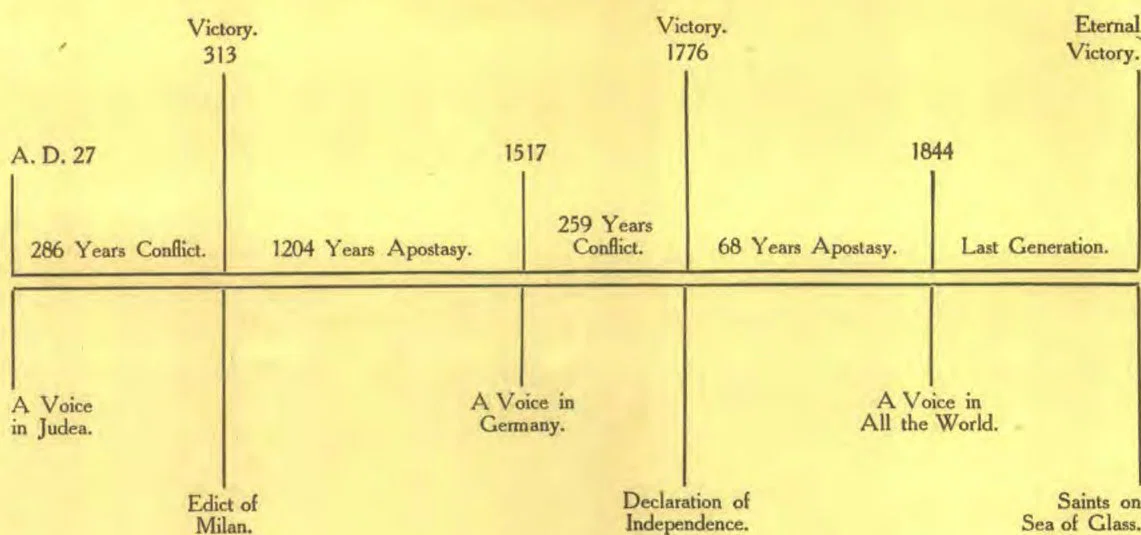
THE above diagram represents some of the striking parallels of history, in the battle that has been waged between truth and error, between light and darkness, between liberty and bondage, since "liberty to the captives" was proclaimed by the greatest of all the reformers that the world has ever known.
When Christ began His ministry in this world, the shackles of an earthly despotism were bound so firmly upon mankind that no man dared to assert his God-given liberty of conscience. The world at that time was "one vast Roman prison," from which death was the only means of escape. The condition of the world at that time is forcibly expressed by Mr. Bancroft, who says:
"No one thought of vindicating religion for the conscience of the individual, till a voice in Judea, breaking day for the greatest epoch in the life of humanity, by establishing a pure, spiritual, and universal religion of mankind, enjoined to render to Cæsar only that which is Cæsar's."
There was begun at that time a mighty contest between the forces of light and darkness. On the one side there was all the wealth, education, influence, and power of the mightiest empire ever built by human hands, and backed up by the unseen hosts of the Prince of darkness. Against all this confederacy of the powers of darkness there was uplifted one human voice.
It has been said of truth, that "you may put handcuffs upon it, shackle it, bind it down to the cold prison floor, behind iron bars, and surrounded by massive stone walls; it is truth all the same, and is on the road to victory. But put error upon a throne, with a crown upon its head, a scepter in its hand, and worshipping millions at its feet, and it is error still, and on the road to defeat."
From the time when that voice was first heard in Judea, proclaiming liberty to the captives, there followed a contest between liberty and bondage, which lasted for two hundred and eighty-six years, when victory was proclaimed to all men, in the Edict of Milan. That was a declaration of human rights, giving to every man in the world the right to think and act for himself in the realm of conscience.
But that noble victory won by truth, was, by scheming religio-political priests and bishops, turned into a worse despotism than ever existed under Pagan Rome, and there followed a thousand years of the "midnight of the world's history."
Twelve hundred and four years after the Edict of Milan, the midnight of the Dark Ages was broken by a voice in Germany, heralding day for another grand epoch in the life of humanity. The sound of Luther's hammer, as he nailed up his ninety-five propositions against Rome, on the church doors at Wittenberg, was a signal for another battle which raged for two hundred and fifty-nine years, when liberty was again proclaimed to all the world, in the grandest charter of human rights the world had ever heard—the Declaration of the Independence of the United States. That declaration of principles was the crowning event in that grand reformation begun by Martin Luther and his associates. John W. Draper, in his "History of European Morals," recognizes this fact in the following statement:
The history of the Reformation does not close, as many European authors have supposed, in a balanced and final distribution between the Protestants and Catholics. . . . Macaulay and others who have treated of the Reformation, have taken too limited a view of it, supposing this to have been its point of arrest. It made another and enormous stride, when, at the American Revolution, the state and church were solemnly and openly dissevered from one another.
How gladly would we speak of the glorious fruits of such a victory; but alas, it was no sooner won than scheming religio-political priests began to use, for their own aggrandizement, the liberty for which millions had bled and died, thus turning back the sun-dial of religious freedom.
The hasty retreat toward the Dark Ages that is now taking place, calls for another voice to be lifted against the principles of religious intolerance and spiritual bondage. The message due the world at this time has been foretold in the prophetic Word, as a proclamation to go to "every nation, and kindred, and tongue, and people." Such a message, bearing on its front, the "commandments of God, and the faith of Jesus," is now being sounded in the ears of humanity. This message has now encircled the globe, and in every country in the world there are living witnesses of its saving, sanctifying power—a people who are designated as those who "keep the commandments of God and the faith of Jesus." This message is found in the fourteenth chapter of the Revelation, and is there designated the "Third Angel's Message."
D'Aubigne, in the preface to his "History of the Reformation," says: "Christianity and the Reformation are the two greatest revolutions on record." He then restates the matter thus: "Christianity and the Reformation are the same revolution, effected at different times, and under different circumstances. The one is a repetition of the other; the middle ages lie between."
5The whole history of the contest between truth and error, since the time of Christ, might thus be summed up as one great three-fold reformation. Christianity, the Reformation of the 16th century, and the Third Angel's Message, are the three mightiest revolutions on record. We may restate the case thus: Christianity, the Reformation, and the Third Angel's Message are the same great revolution effected at different times, and under different circumstances.
The last great decisive battle between bondage and liberty is now being waged. This conflict is destined to end in eternal and everlasting victory, with the victors—the saints of God—standing upon a sea of glass, having harps of victory, and singing the song of Moses and the song of the Lamb. Rev. 15:2, 3.
"Nay, now, these things that you yearn to teach,
Bear wisdom in your judgment, rich and strong.*
Give voice to them, tho no man hear your speech,*
Since right is right, tho all the world go wrong.*
The proof that you believe what you declare,*
Is that you still stand firm, tho throngs pass by;*
Better cry truth a lifetime to void air,*
Than flatter listening millions with one lie."*
College View, Neb.
Seizing Opportunity
"The lucky man is the man who sees and grasps his opportunity."