One of the most significant signs of the times is the demand that is now being made for religious, or moral, legislation. The beginning of this nation was marked by a complete departure from the belief that kings or majorities should rule in the province of religion. Under a régime of civil and religious liberty the United States has grown to be one of the greatest nations known to history.
Yet it is thought by many that our country is going to ruin unless certain religious observances are espoused by the government. This belief has increased in religious circles at such an accelerated pace during the past decade as to assume a very threatening aspect.
When our Constitution was framed, it was purposed that religious matters should be entirely eliminated from civil affairs. This principle was embodied in the First Amendment to the Constitution, which declares that “Congress shall make no law respecting an establishment of religion or prohibiting the free exercise thereof.”
The effort to involve our government in religious matters is centered largely in the question of Sunday laws. The plea is often made that such laws are not unconstitutional. The following statement made on the floor of the House of Representatives by Hon. Richard Bartholdt, of Missouri, is a valuable one in this connection:—
“I believe in a complete separation of church and state, and in this belief go so far as to assert that the daily prayers in this House, as well as all Sunday laws, are unconstitutional, because they signify a mixing of church and state. These views, although Lutheran doctrine, I hold not as a Lutheran, but as an American who reveres the Constitution. As such, too, I believe in religious freedom and religious tolerance.”—Congressional Record, Dec. 16, 1912.
When the program to secure a national Sunday law is opposed by a small minority on the ground that a law of this character would deprive them of their religious and civil rights, the reply is often given that the majority should rule, even in religious matters. A very pointed comment on such an argument was made by Senator John Sharp Williams, of Mississippi, on the floor of the Senate:—
“I am not one of those who believe that tyranny is a particle sweeter because it is the tyranny of a majority. I believe, with old Roger Williams, that there are two classes of things in this world—the things of the first table and the things of the second table. The things of the first table are those things which are between God and the individual man, and government has no right to touch them. If 99,999,999 of the people out of 100,000,000 wanted to do anything in connection with them and one man stood up in his right and said ‘No,’ then that one man’s voice should restrain all the rest. Amongst these things are freedom of religion and various other things that will occur to your own minds. Ninety-nine per cent of the American people, I suppose, are nominally Christians. One per cent of the American people are Jews. The people have voluntarily put upon themselves restrictions with reference to that matter. They have never established the Christian religion as the religion of their country. They had the power to do it. They had the power to refuse to restrict themselves from doing it. But they decreed that for all time there should never be among us an establishment of religion. They were wise enough to know that men always, everywhere, have weaknesses.”—Congressional Record, Jan. 30, 1913.
The February number of the Knights of Labor paper, the Journal, contains a lengthy article protesting against the enactment of a Sunday law for the District of Columbia. The editor has a clear grasp of our fundamental law in regard to religious liberty. We pass along the following paragraphs taken from his article:—
“The making of any federal law which shall in the slightest degree impair the policy of the absolute separation of church and state, or tend in any way to build up ecclesiastical authority or domination, would be a distinct step backward in the evolution of human progress and liberty, and bring far-reaching disaster to our government and to the people of this country.
“The founders of the republic fully realized the evils springing from legislation pertaining to religious beliefs of any kind, and in the strongest way possible provided against the possibility of the enactment of such legislation at any time. Not content with limiting the jurisdiction of federal authority to the specific grants of power therein set forth, they further provided (so as to shut out all possibility of such legislation) the First Amendment. . .
“Any proposition to pass Sunday legislation in the District of Columbia is a direct violation of the positive prohibitions of the Constitution, against the spirit of our institutions, and against the policy heretofore maintained by the federal government. It is true that certain impairments of the doctrine of the entire separation of church and state have from time to time been made, such as the appointment of chaplains to conduct religious exercises in Congress and in our army and navy, and in the putting forth of proclamations by the chief executive of the nation providing for days of thanksgiving or of fasting, etc. It is well known that these things were strongly objected to by Jefferson and some of the other executives and statesmen in the early days of the republic. They are innovations which have crept in by sufferance rather than by the expressed wish or positive act of the great masses of the people, and their tolerance provides stepping-stones on which can stand those who clamor for still greater and more pronounced recognition by the federal government of religious doctrines and ordinances, such as the demand that the word God be put into the federal Constitution, and that Sunday laws be enacted by Congress, so zealously contended for from time to time during the last half-century.”
Speaking of the “Christian nation decision,” the editor further says:—
“The doctrine of the absolute separation of church and state, and the entire lack of federal jurisdiction to legislate or to meddle with matters of religious faith and practise, so clear-cut in the earlier days of our history, is now sought to be assailed by some persons and religious bodies upon the ground that the Supreme Court of the United States has declared this to be a Christian nation; and therefore that Congress would be justified in passing laws for the enforcement of what are deemed to be the practises and obligations of Christianity. In point of fact the Supreme Court of the United States has never laid down any such doctrine, and has never had occasion to declare it. The claim comes from certain expressions put forth by the late Justice Brewer, which did not involve the consideration of any such theory or point of law whatsoever. In giving an opinion upon the question before that court, which was regarding the construction to be held as to the immigration laws forbidding the entrance into this country of certain aliens, Justice Brewer took occasion, after declaring the opinion of the court upon the main point of controversy, to travel outside of the issue thus decided and by what is known in law as obiter dictum express the opinion that this is a Christian country, inferentially holding that Christianity and its ordinances were a part of and within the jurisdiction of federal governmental authority and operation.
“What he thus said has no force whatever in the realm of legal decision, is binding upon no court of this land, affords no precedent whatsoever to any legal authority, State or national, and when carefully read and digested is inconsistent with the recognized judicial authorities of the land and with the history of this country. The integrity and high character of this eminent justice really cloaks this declaration with undue value and authority; and what he said was largely inspired by his zeal for the Christian religion.”
These quotations are worthy of preservation. They show that there are many who are not afraid to speak out against the rising tide of intolerance in religious matters which is rapidly sweeping in upon our country.
Takoma Park, D. C.
Ripening Slowly
“SOME fruits are not sweet until the late fall. Some persons ripen slowly, and it takes a long time before they become sweet, beautiful, helpful. We should not reject any life because it is not yet beautiful, because it does not yet seem lovely. Wait and let God train and discipline it in his own way, and some day it may be ready to fill an important place.”
Struggles for Great Principles
By C. M. S.
Far back in the days of Moses, when a people had been delivered from involuntary servitude, we find the first recorded use of the word “liberty.” It occurs in this expression: “Proclaim liberty throughout the land unto all the inhabitants thereof.”
It is not merely a coincidence that these identical words should have been cast on the bell that was to ring out to the American people their proclamation of liberty from the rule of a country beyond the sea. While that bell had been tolling from its tower, circumstances had been educating a people in the love of liberty. With eyes opened by a divine hand, they had been enabled to see the violation of principles of truth and justice in the liberties which were denied them. Because they had been taxed without representation, because they had been looked upon as subjects rather than as equals, they made this declaration to the world: “We hold these truths to be self-evident, that all men are created equal,” etc. It was a principle new to the nations, but in itself as old as creation. It simply meant that the circumstances of birth could not justly give to any man a preeminence in rights over another. It was a bold statement to make; but it was true, and they made it. It was a broad foundation on which to build; but it was a solid one, and they built upon it. They built wiser than their day, and they built wiser, it seems, than the majority of their posterity in this day are able to appreciate. Without that foundation, the structure they reared could not have stood a hundred years; and a departure from that foundation will see that structure ruined in much less than a hundred years from the date of the departure.
Because they had been deprived of many natural rights, they declared that all men “are endowed by their Creator with certain unalienable rights; that among these are life, liberty, and the pursuit of happiness.” Because they had been ruled by one who claimed the inherited right to rule without any regard to the authority of those he ruled, and had suffered under that rule, they pledged their lives, their fortunes, and their sacred honor to the outspoken principle that “governments derive their just powers from the consent of the governed;” and because those principles were not recognized nor those rights allowed, they declared that “these united colonies are and of right ought to be free and independent states.” From these plain declarations of principle, and the firm stand which they took upon them, there grew up what was then an anomaly among the nations, an anomaly which persisted by virtue of the principles upon which it was founded.
Now, in these later days the remembrance of those principles is fading away, even as fades the ink in which they were written. The outlines of those words which meant so much to the descendants of the American colonists are dimming to obscurity to-day, and he must look with keen eye who would see those principles in the deeds and words of many of those who are formulating public sentiment to-day.
When the nation was still young, there were incorporated into its fundamental law specific declarations of principles to safeguard the liberty of the soul as well as of the body. These were as hard a blow at the established church as the declaration of civil independence was against the former established government in the country. But they had been whipped and burned and banished when religion had been established by state law, and they would protect themselves and their posterity by disestablishing that power which had made such things possible.
Naturally the established church was strongly opposed to the cutting off of its financial state aid, its exceptional prerogatives, and its advantages over other sects. So the battle for religious freedom followed hard after the battles for civil freedom, and the victories gained were as much more important than the military victories as the freedom of the soul is more important than the name of the country to which the person owes allegiance. Efforts were made to recommit the country to the principles of a union of church and state, but they failed as they deserved to do, and there went into the constitutions of every one of the original thirteen States the principles, if not the exact words, of the following declaration: “No man shall be compelled to frequent or support any religious worship, place, or ministry whatsoever, nor shall suffer on account of his religious opinions or belief; opinion in matters of religion shall in no wise diminish, enlarge, or affect civil capacities. The rights hereby asserted are of the natural rights of man.”
Most of the other States since added to the Union, have also incorporated these principles into their constitutions. The nation itself was not permitted to remain silent on so great and vital a principle. It prohibited in emphatic terms the making of religion a test of qualification for public office, and forbade even Congress itself to invade the citadel of the soul by enacting religious legislation.
Therefore, with the Declaration of Independence speaking as it does, with the Constitution of the nation speaking as it does, with the constitutions of forty or more of the States speaking as they do, and with the history before us of the memorable struggle that was waged by the founders of the nation for religious liberty, it would certainly seem that the people of these United States had spoken plainly enough, and that the lesson had been learned well enough, so that never again in this land could religious persecution raise its head to hurt or punish any for worshiping God according to the dictates of their consciences.
But in spite of it all, the principles of church and state union, whose logical sequence is and always has been religious persecution, has been retained, upheld, and promoted in nearly all the States—so far have their legislators lost sight of the principle upon which their own religious freedom rests, the principle upon which the nation was established, the principle “on which the gospel was first propagated, and the Reformation from popery carried on.”
As the battle for civil freedom and the battle for religious freedom were carried on at practically the same time and by the same people, so the forgetting of those political principles and those principles of soul freedom are going on at the same time and on the part of the same people. As the fathers of the nation declared it “impossible for the magistrate to adjudge the right of preference among the various sects that profess the Christian faith without erecting a claim to infallibility, which would lead us back to the Church of Rome,” and as the magistrate is now permitted to do that very thing in every prosecution of a Christian for the violation of a Sunday law, it is evident that that claim has been to all intents and purposes erected, and that the nation is now being led just where they said it would be.
If it was “proper” in those distant days “to take alarm at the first experiment upon our liberties,” it must be eminently “proper to take alarm” at the249multitudinous experiments that are made to-day along that line. It certainly is very proper so to do when men in these days have been repeatedly condemned to prison and to the payments of burdensome fines for worshiping God according to the dictates of their consciences.
Out of the persecutions suffered by the Baptists and Quakers and others because of their mode of worship grew the guaranties of liberty in religious things that were incorporated into our national and State constitutions. But now we have the persecutions as they had them, and that, too, in spite of the supposed guaranties of religious freedom. America, which should have stood as a light and pattern to the world, which fought the battles of mankind and won; America, the asylum for the oppressed, is forgetting the most vital principle for which she stood,—the freedom of the consciences of men. The great hand of an oppressive church is now grasping the seats of government in State and nation, even as the founders of this nation warned us that it would do when the people departed from the principles of religious liberty.
The plans laid by the National Reform Association, by the Lord’s Day Alliance, by the Federal Council of the Churches of Christ in America, by the American Federation of Catholic Societies, and, in a word, by the great Catholic Church as a body, contemplate the accomplishment of a work that is the very antithesis of what the founders of the country did. Let those plans become a fact, and the nation has started back toward the bitter experiences of colonial days and of the middle ages. It is unthinkable and unexplainable; but thus has the prophet outlined it, and thus do we see it fulfilling before our eyes to-day. C. M. S.
Delivered as the Believers Prayed
By W. A. S.
WHEN Peter was in prison under sentence of death, “prayer was made without ceasing of the church unto God for him.” And while the believers prayed, the deliverance came; an angel led Peter out to safety and service, the apostle not being able to realize for a time that it was not a dream.
Some time ago, in a non-Christian land, the believers were praying as one of their number, an evangelist, went up for military examination and appointment in time of war. In time of peace, trials and tests for stoutest faith lie in wait for the Sabbath-keeping Christian called to military service. But such a call in war time meant a crisis in the life of the evangelist.
He first visited the general offices to explain his conscientious convictions in the matter, but was told that there was no help for him, and was sent on to report to the barracks. The superintendent of our work in that field wrote, at the time, an account of the evangelist’s experience, which we reproduce without names:—
On account of his visit to the general office, he arrived at the barracks about three hours late. He was obliged to call on one of the officers at his hotel. To this officer he explained his case, and received considerable sympathy. Now, the penalty for being even several hours late in reporting is two months’ solitary confinement. But this officer excused him for his tardiness—a special favor. But he said that he, too, had no authority to deal with his case, or to excuse him from service. Then, as a further favor, he permitted Brother — to return home for the night.
Early next morning Brother — repaired again to the barracks, and again stated his case to other officers, but with the same result; they could do nothing in his case.
Reluctantly he joined the other men in order to pass the required physical examination. The first examiner tested his eyes, and passed him. The next questioned him about as follows: “Are you quite well?” “Fairly well, but not so strong as formerly.” “Do you sleep well?” “Sometimes not very well.” “All right, that will do.”
Supposing that he had been passed as fit for service, he went on to the dressing-room. Very soon two of the examining physicians came to him, and asked, “When did your health begin to fail?” Brother — replied that he could give no exact time, meanwhile wondering at their question. “You had better go home and care for your health,” the physician said, and left him.
He could hardly believe that he was free; so he went to the officer, and was again assured that he was free to go home. He says that the only way he can understand the matter is that the Lord intervened; for while not so strong and rugged as he was ten years ago [when serving in war time, before he was a Christian], he has been in very fair health.
Another remarkable thing is that of about three hundred examined that day, he was the only one excused, so far as he could learn. His brother went with him, and stood where he could have seen any who might have come out. But Brother — was the only one.
Small wonder that this believer attributes his deliverance to the direct intervention of the Lord. And the worker reporting the matter to us adds: “I shall not take time to tell particulars about our earnest seasons of prayer for him. Next day was Sabbath, and Brother — occupied the time with an account of his experience. Then we united in heartfelt praise to God. But other trials await us, so we must be constant in prayer.”
In the trying times that lie between us all and the heavenly city we shall of a truth need strong and unshakable faith in the living God who does things for his children on earth. W. A. S.
The General Conference Session
By F. M. W.
THE next General Conference of Seventh-day Adventists will open at Takoma Park, Washington, D. C., May 15, 1913. It will be the most important meeting ever held by this denomination. This will be true in the very nature of the case. Our work has grown to greater proportions, and greater questions are involved in its promotion and administration; at this meeting the representation will be larger than at any preceding meeting; from every part of the world will come delegates and workers bringing for consideration perplexing questions relating to the work in their particular fields; important questions of finance and organization must be considered; men and women will be chosen as standard-bearers for another quadrennial term; the denomination will be brought face to face as never before with the great work of the world's evangelization which has been committed to it, and larger plans for the development and carrying forward of the gospel message will be considered. These internal conditions and questions affecting the church, together with the state of affairs in the world, the fulfilling of the prophetic word, the marshaling of the forces that are to combine eventually against truth and right, emphasize the great importance of the coming General Conference meeting.
In dealing with these important subjects, how great the need of the spirit and wisdom of heaven! How great the need of a divine unction, the outpouring of the Holy Spirit, to prepare the church to take part in the final conflict before us! Most appropriate indeed is it that the coming meeting be made an object of earnest prayer on the part of all our people. Pray that every delegate that attends the meeting may be a man of God, and may take with him to the gathering the spirit and wisdom of heaven. Pray that the committees which shall be appointed may have special grace and wisdom in considering the questions submitted to them for study. Pray that every one chosen to positions of responsibility may be God's man, and the one whom he would have lead his people. Pray that the plans laid for the promotion of the work may be broad and generous. Pray that peace and prosperity and a great outpouring of the Spirit of God may attend the meeting from beginning to end.
This meeting should bring a great spiritual uplift to the people of God. It should mark the beginning of a new era in this movement. By God's grace we believe this result may be achieved. Let us work for it, pray for it, and believe for it. F. M. W.
The Twenty-Eighth Inauguration
The inauguration of Pres. Woodrow Wilson was probably the greatest inaugural celebration ever held in Washington. The day was a very different one from that on which President Taft went into office. On that day the country east of the Rockies was in the grip of a veritable blizzard; on this day the country seemed to be standing on the Mason and Dixon line, between winter and summer. From early morning until late at night the city was full of the celebration and its preparation and aftermath. Shortly after noon took place the vital part of the ceremonies, the swearing in of the President and Vice-President. Following the inaugural addresses, began the great parade of 35,000 public officials, soldiers, sailors, members of civic organizations, and college students, which required more than four hours to pass a given point. In the evening the city was brilliantly illuminated, and the inaugural ceremonies closed with a magnificent display of fireworks. The new President and the old rode together over the route of the parade; and while President Wilson was reviewing the parade, ex-President Taft was being whirled away in a special car toward Atlanta. Many remarked upon the fact that here was the culmination of a political revolution in a great nation, in which the government was completely overturned, and all without bloodshed and with the utmost good feeling. The new President, a Democrat, has a Democratic House and a Democratic Senate to help him in shaping the affairs of the country in harmony with the purposes of the people who elected him. There are questions to be settled which will test all the powers of statesmanship and diplomacy which the new administration can bring to its aid. It is no small task that faces the new President and the new Congress. The true Christian, whatever his personal preference, will wish them the guidance of God in the conduct of the nation's affairs, that the rights of men may not be trampled upon and the work of God may not be hindered.
No Religious Test
ONE of the provisions of the national Constitution is to the effect that “no religious test shall ever be required as a qualification to any office or public trust” in the government of the United States. Some of the States long had provisions in their constitutions which excluded Catholics from public office. The new national administration, however, can not be accused of making any discrimination against that class of citizens. A Roman Catholic administered the oath of office to the President of the United States. A Roman Catholic is private secretary to the new President, and this private secretary’s first assistant is also a Catholic. The private secretary of the President’s wife is a Roman Catholic. Thus all the correspondence of the President’s household comes under the eye of a member of the Roman Church. No communication can get to the President that does not pass under the eye of a Catholic. Catholic editors are jubilant over this arrangement. Says the Catholic Citizen (of Milwaukee) of February 15: “A Southern Democrat is quoted as saying that there will be ‘no Catholic in the Cabinet,’ but ‘Catholics will be appeased with minor jobs.’” The editor of the Catholic Citizen then adds: “We shall see.” So while the government is debarred from making religion a test, the Catholic Church makes it a test, and urges adherence to its faith as a qualification to holding public office.
Loma Linda Day
By William T. Knox
LOMA LINDA MEDICAL COLLEGE, its work and needs, have in recent numbers of the REVIEW AND HERALD, and in the special readings for the second Sabbath service, been very fully set before the denomination. Our need of such an institution for the training of our young people desiring a medical education has also been made evident. The General Conference Committee hope that most careful consideration has been given to these articles, and that the Spirit of God has deeply impressed upon all hearts the importance of this enterprise, and begotten within all a sympathetic interest for our brethren who are immediately responsible for the operating of the college.
All who have visited Loma Linda express themselves as greatly pleased with what has been done in securing the necessary facilities. The buildings are neat and substantial, and of the character best suited for the work to be done. Other facilities must be added, however, some of them at once, in order to meet the requirements of the different State boards of medical examiners. Otherwise the graduating students will not have a standing with any of these boards, and will not be admitted to examination.
All feel to heartily commend the college board for the stand it has taken, that, urgent as is the need for these facilities, it will supply them only as it has money and can do so without creating further debt. The hospital building, which must be supplied immediately, will require about $20,000. It is for this that the General Conference now appeals to the churches for a liberal offering, Sabbath, March 15. Recognizing the need, let us honor the position taken by our brethren in Loma Linda against further debt making, by coming to their assistance in a most substantial offering. Let us not be satisfied with an offering totaling less than an average of fifty cents a member from every church, and let church and conference treasurers hurry the offerings forward, that the work may be done at once.
W. T. KNOX.
In the Balkans
Press reports from the Balkans indicate that there may soon be a reopening of negotiations looking to a settlement of the trouble between the allies and Turkey. The Turks seem willing now to surrender Adrianople and yield much on the boundary question, but do not propose to pay any indemnity. The allies, on the other hand, are demanding Adrianople, Scutari, Janina, and the peninsula of Gallipoli, together with all the islands of the Ægean Sea that are now occupied by the Greeks. This would give to the allies practical control of the Dardanelles. Just how the greater powers will look upon these demands is not known, but it is understood that Turkey has signified her willingness to place her interests entirely in the hands of the greater powers of Europe, feeling that in this way she would save to herself at least the control of the Dardanelles.
The Mexican Situation
By C. M. S.
REPORTS from Mexico indicate that the new government is succeeding in bringing to its standard a number of the rebel organizations, and has prospects of bringing still others to its side. The government seems to be taking energetic measures to put down such rebel organizations as have refused to yield allegiance to the government. Along the northern border, however, the Mexican troops have manifested a determination to get into trouble with the United States soldiers who are at the border line on patrol duty. On two successive days they have attacked the American soldiers and have been driven off, with some loss to themselves. None of the nations have yet formally recognized the new government of Mexico, and probably will not do so until after a regular election. General Diaz, the nephew of the former President Diaz, has announced himself as a candidate for the presidency.
C. M. S.
A Wonderful Meteorite
A WONDERFUL meteorite passed over Peshawur, India, recently. Its altitude appeared to be only one thousand feet, while its tail stretched over one hundred yards.
Missionaries at the Language School in China
The efficiency of a missionary depends largely upon his ability to acquire the language on reaching his field. In China, at Nanking, is a language school conducted by other mission boards, and our brethren there have recommended our missionaries to attend it on reaching that field. After spending some time there, Brother S. G. White, who recently went out to China from California, has this to say of it:—
“1. Being away from home, the student has no interruption nor cares while studying. This means much, especially to those who have families.”
“2. Competition. Students who have just finished college courses, and some who hold university degrees, are attending the language school; therefore, one has to do his best in order to keep up with those who come fresh from study.”
“3. Lectures. Persons who have been in China for many years give the students occasional lectures, which seem to be practical, and which lighten the load and light the path.”
“4. Foreign instruction. Three foreign teachers systematically devote considerable of their time to teaching. The ones who give instruction have had experience here, some of them for twenty-five years. This enables the student to work intelligently from the start.”
“5. Rotation of teachers, or better, of students. The individual study-rooms are about ten by twelve feet in size. These are numbered, and open into a large room on two sides. While the teacher remains in the same room week after week, the students move each Monday to the room next higher. If one has an inferior teacher this week, it is consoling to know that a good one is in the room above his. Another advantage of this system is that the teacher does not become acquainted to any extent with the student's failings; and if he has faults or peculiarities, the student does not absorb them.”
“6. Inspection of teachers. At the head of the corps of Chinese teachers is an experienced Chinese, who has traveled over China considerably, and is therefore acquainted with the different dialects and qualified to correct errors and give special instruction. This man visits the study-rooms frequently during the day, and if the teacher is not checking up and correcting the students’ mistakes, tones, or pronunciation, he is instructed forthwith. Besides this Chinese head teacher, we have daily visits from the three foreign instructors. Only one who is learning the language can appreciate what a help this is, especially at the start.”
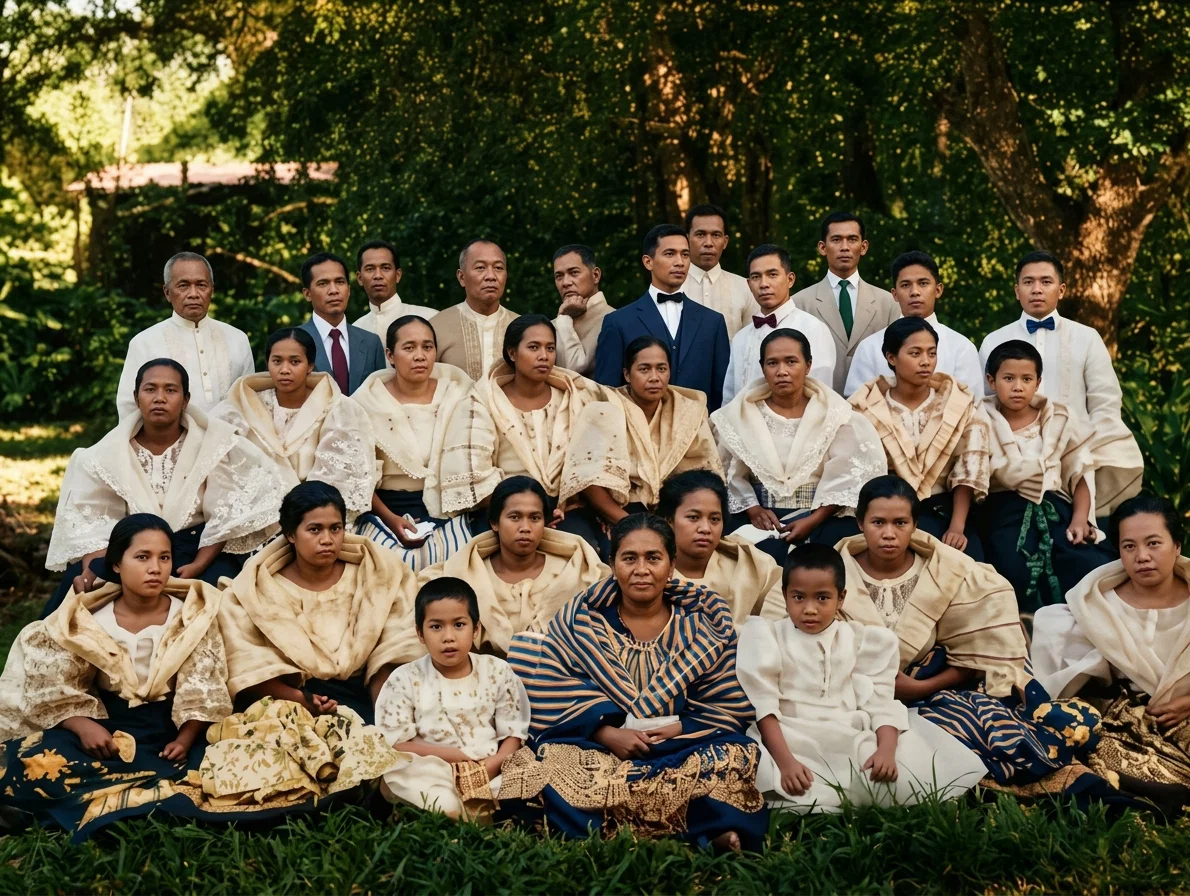
GROUP OF SABBATH-KEEPERS AT CERVANTES, PHILIPPINE ISLANDS
“7. Poor teachers dismissed. After teachers have been given a fair trial and prove to be lazy or incompetent, they are dismissed at the end of the month, and others are employed. Thus the Chinese teaching force is kept up to a high standard.”
“8. Some attention is given to physical exercise in the middle of both the forenoon and afternoon sessions.”